Search results for tag #nature
![[?]](https://files.defcon.social/dcsocial-s3/accounts/avatars/113/208/344/507/078/943/original/014820ad22daee1c.jpg)
Four Years Of Nasa Neowise Data
NASA's Near-Earth Object Wide-field Infrared Survey Explorer (NEOWISE) mission has released its fourth year of survey data. Since the mission was restarted in December 2013, after a period of hibernation, the asteroid- and comet-hunter has completely scanned the skies nearly eight times and has observed and characterized 29,375 objects in four years of operations. This total includes 788 near-Earth objects and 136 comets since the mission restart.
Near-Earth objects (NEOs) are comets and asteroids that have been nudged by the gravitational attraction of the planets in our solar system into orbits that allow them to enter Earth's neighborhood. Ten of the objects discovered by NEOWISE in the past year have been classified as potentially hazardous asteroids (PHAs). Near-Earth objects are classified as PHAs, based on their size and how closely they can approach Earth's orbit.
"NEOWISE continues to expand our catalog and knowledge of these elusive and important objects," said Amy Mainzer, NEOWISE principal investigator from NASA's Jet Propulsion Laboratory in Pasadena, California. "In total, NEOWISE has now characterized sizes and reflectivities of over 1,300 near-Earth objects since the spacecraft was launched, offering an invaluable resource for understanding the physical properties of this population, and studying what they are made of and where they have come from."
[...]
More than 2.5 million infrared images of the sky were collected in the fourth year of operations by NEOWISE. These data are combined with the year one through three NEOWISE data into a single publicly available archive. That archive contains approximately 10.3 million sets of images and a database of more than 76 billion source detections extracted from those images.
https://www.jpl.nasa.gov/news/four-years-of-nasa-neowise-data/
CREDIT
Jet Propulsion Laboratory
#space #comets #astrophotography #photography #science #astronomy #nature #NASA #ESA
From Contributors to Wikimedia projects
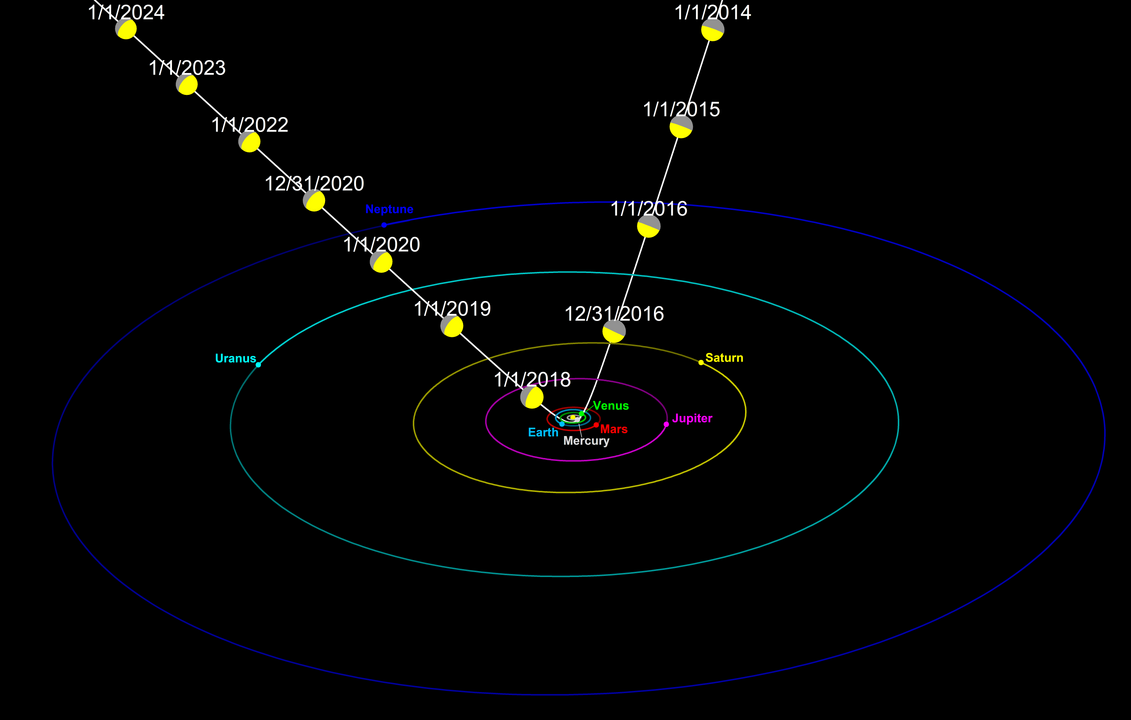
1I/ʻOumuamua
is the first confirmed interstellar object detected passing through the Solar System. Formally designated 1I/2017 U1, it was discovered by Robert Weryk using the Pan-STARRS telescope at Haleakalā Observatory, Hawaii, on 19 October 2017, approximately 40 days after it passed its closest point to the Sun on 9 September. When it was first observed, it was about 33 million km (21 million mi; 0.22 AU) from Earth (about 85 times as far away as the Moon) and already heading away from the Sun.
ʻOumuamua is a small object estimated to be between 100 and 1,000 metres (328 and 3,280 ft) long, with its width and thickness both estimated between 35 and 167 metres (115 and 548 ft). It has a red color, like objects in the outer Solar System. Despite its close approach to the Sun, it showed no signs of having a coma, the usual nebula around comets formed when they pass near the Sun. Further, it exhibited non‑gravitational acceleration, potentially due to outgassing or a push from solar radiation pressure.
It has a rotation rate similar to the Solar System's asteroids, but many valid models permit it to be unusually more elongated than all but a few other natural bodies observed in the solar system. This feature raised speculation about its origin. Its light curve, assuming little systematic error, presents its motion as "tumbling" rather than "spinning", and moving sufficiently fast relative to the Sun that it is likely of extrasolar origin. Extrapolated and without further deceleration, its path cannot be captured into a solar orbit, so it will eventually leave the Solar System and continue into interstellar space. Its planetary system of origin and age are unknown. [...]
https://en.wikipedia.org/wiki/1I/%CA%BBOumuamua
Image Credit:
By Tomruen https://commons.wikimedia.org/w/index.php?curid=64846159
#space #comets #astrophotography #photography #science #astronomy #nature #NASA #ESA
Alt...
Path of the hyperbolic, extrasolar object ʻOumuamua, the first confirmed interstellar object, discovered in 2017
By Tomruen - Own work made with , labels added with MSPaint, trajectory data from JPL Horizons, CC BY-SA 4.0
From Wikipedia, the free encyclopedia
2I/Borisov
2I/Borisov, originally designated C/2019 Q4 (Borisov), is the first observed rogue comet and the second observed interstellar interloper after ʻOumuamua. It was discovered by the Crimean amateur astronomer and telescope maker Gennadiy Borisov on 29 August 2019 UTC (30 August local time).
2I/Borisov has a heliocentric orbital eccentricity of 3.36 and is not bound to the Sun. The comet passed through the ecliptic of the Solar System at the end of October 2019, and made its closest approach to the Sun at just over 2 AU on 8 December 2019. The comet passed closest to Earth on 28 December 2019.
In November 2019, astronomers from Yale University said that the comet's tail was 14 times the size of Earth, and stated, "It's humbling to realize how small Earth is next to this visitor from another solar system."
The comet is formally called "2I/Borisov" by the International Astronomical Union (IAU), with "2I" or "2I/2019 Q4" being its designation and "Borisov" being its name, but is sometimes referred to as "Comet Borisov", especially in the popular press. As the second observed interstellar interloper after 1I/ʻOumuamua, it was given the "2I" designation, where "I" stands for interstellar. The name Borisov follows the tradition of naming comets after their discoverers. Before final designation as 2I/Borisov, the object was referred to by other names:
gb00234
C/2019 Q4
https://en.wikipedia.org/wiki/2I/Borisov#Nomenclature
#space #comets #astrophotography #photography #science #astronomy #nature #NASA #ESA
Alt...
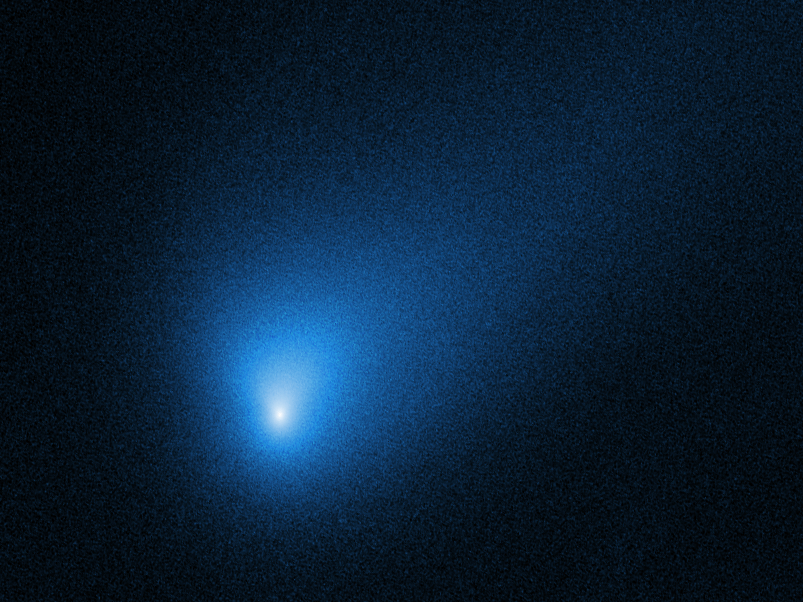
English: About This Image
HUBBLE'S VIEW OF INTERSTELLAR COMET 2I/BORISOV
https://hubblesite.org/contents/media/images/2019/53/4578-Image
NASA's Hubble Space Telescope has given astronomers their best look yet at an interstellar visitor – comet 2I/Borisov – whose speed and trajectory indicate it has come from beyond our solar system. Hubble photographed the comet at a distance of 260 million miles from Earth. This Hubble image, taken on October 12, 2019, is the sharpest view to date of the comet. Hubble reveals a central concentration of dust around the nucleus (which is too small to be seen by Hubble). The comet is falling toward the Sun and will make its closest approach on December 7, 2019, when it will be twice as far from the Sun as Earth. The comet is following a hyperbolic path around the Sun and will exit back into interstellar space. Comet 2I/Borisov is only the second such interstellar object known to have passed through the solar system. In 2017, the first identified interstellar visitor, an object formally named 'Oumuamua, swung within 24 million miles of the Sun before racing out of the solar system.
Color Info
These images are a composite of separate exposures acquired by the WFC3 instrument on the Hubble Space Telescope. The color results
Credit
NASA, ESA, and D. Jewitt (UCLA)
Alt...
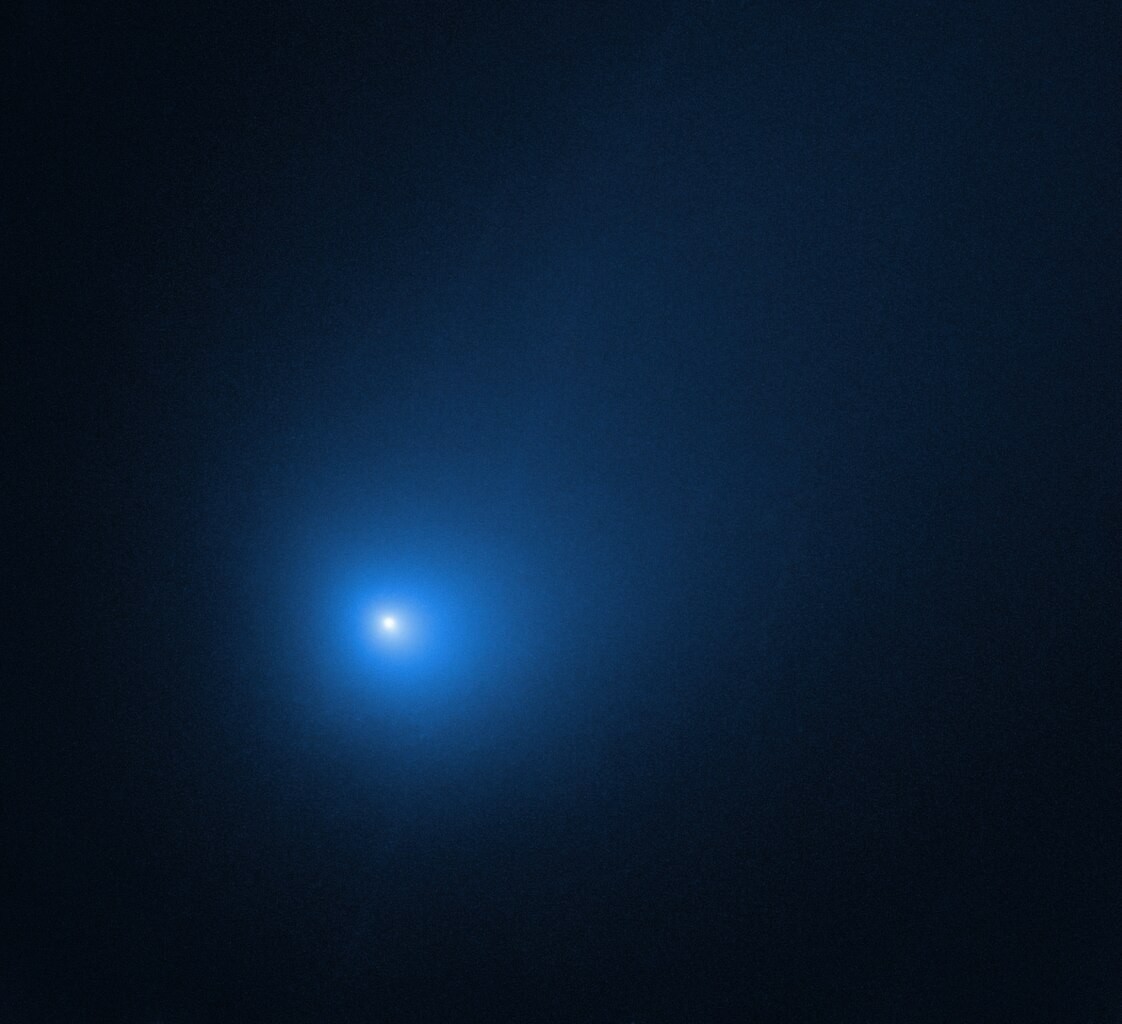
2I/Borisov
The object was discovered on 30 August 2019 at MARGO, Nauchnyy, Crimea by Gennadiy Borisov using his custom-built 0.65-meter telescope. On 13 September 2019, the Gran Telescopio Canarias obtained a low-resolution visible spectrum of 2I/Borisov that revealed that this object has a surface composition not too different from that found in typical Oort Cloud comets. The IAU Working Group for Small Body Nomenclature kept the name Borisov, giving the comet the interstellar designation of 2I/Borisov. On 12 March 2020, astronomers reported observational evidence of "ongoing nucleus fragmentation" from Borisov.
In this observation, the NASA/ESA Hubble Space Telescope revisited the comet shortly after its closest approach to the Sun. There it was subjected to a greater degree of heating than it had ever experienced, after spending most of its life in the extreme cold of interstellar space. The comet is 298 million kilometres from Earth in this photo, near the inner edge of the asteroid belt. The nucleus, an agglomeration of ices and dust, is still too small to be resolved. The bright central portion is a coma made up of dust leaving the surface. The comet will make its closest approach to Earth in late December, when it will be at a distance of 290 million kilometres. Comet 2I/Borisov is only the second interstellar object known to have passed through our Solar System.
As seen from Earth, the comet was in the northern sky from September until mid-November. It crossed the ecliptic plane on 26 October near the star Regulus, and the celestial equator on 13 November 2019, entering the southern sky. On 8 December 2019, the comet reached perihelion (closest approach to the Sun) and was near the inner edge of the asteroid belt. In late December, it made its closest approach to Earth, 1.9 au, and had a solar elongation of about 80°. Due to its 44° orbital inclination, 2I/Borisov did not make any notable close approaches to the planets. 2I/Borisov entered the Solar System from the direction of Cassiopeia near the border with Perseus. This direction indicates that it originates from the galactic plane, rather than from the galactic halo. It will leave the Solar System in the direction of Telescopium. In interstellar #space, 2I/Borisov takes roughly 9000 years to travel a light-year relative to the Sun
2I/Borisov's trajectory is extremely hyperbolic, having an orbital eccentricity of 3.36. This is much higher than the 300+ known weakly hyperbolic comets, with heliocentric eccentricities just over 1, and even ʻOumuamua with an eccentricity of 1.2.
2I/Borisov also has a hyperbolic excess velocity ( v ∞ {\displaystyle v_{\infty }}) of 32 km/s, much higher than what could be explained by perturbations, which could produce velocities when approaching an infinite distance from the Sun of less than a few km/s. These two parameters are important indicators of 2I/Borisov's interstellar origin. For comparison, the Voyager 1 spacecraft, which is leaving the Solar System, is traveling at 16.9 km/s (3.57 AU/a). 2I/Borisov has a much larger eccentricity than ʻOumuamua due to its higher excess velocity and its significantly higher perihelion distance. At this larger distance, the Sun's gravity is less able to alter its path as it passes through the Solar System.
From Wikipedia
#comets #astrophotography #photography #science #astronomy #nature #NASA #ESA
TOPIC> Interstellar Visitors !>NEWS
2025 July 17
3I/ATLAS
* Image Credit: Gemini Observatory/NOIRLab/NSF/AURA/K. Meech (IfA/U. Hawaii)
* Processing: Jen Miller, Mahdi Zamani (NSF/NOIRLab)
https://noirlab.edu/public/
Explanation:
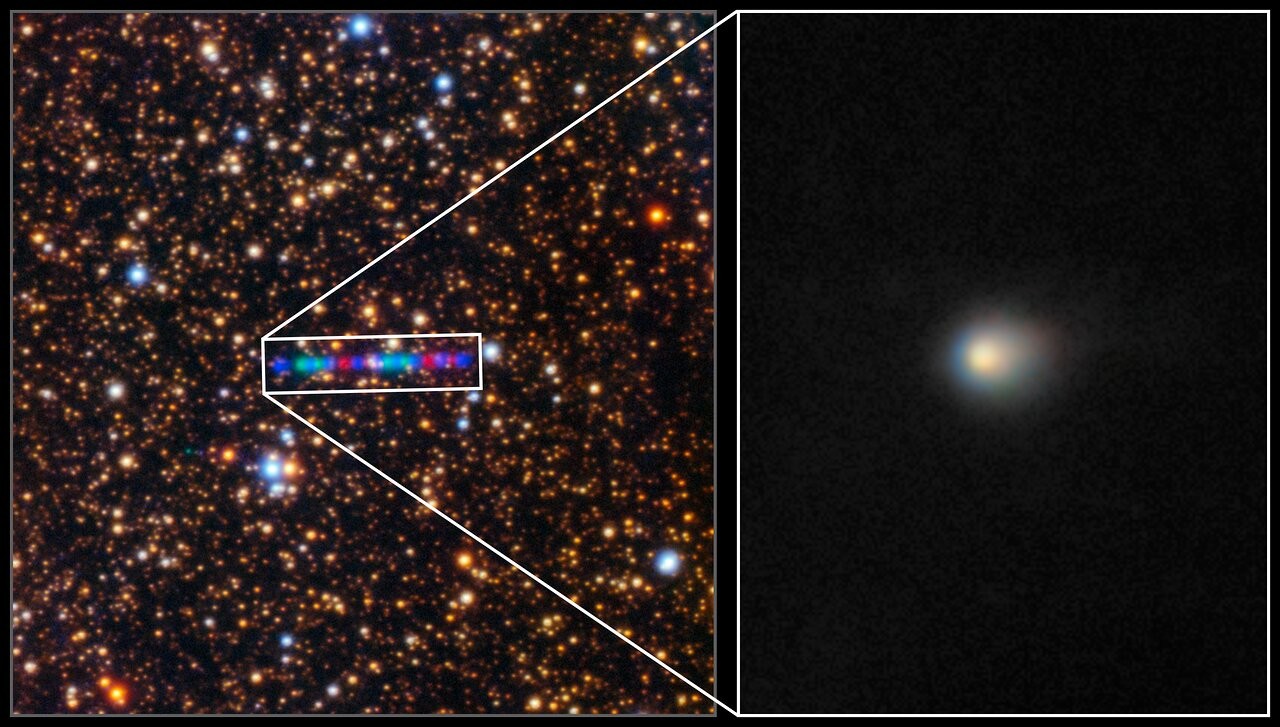
Discovered on July 1 with the NASA-funded ATLAS (Asteroid Terrestrial-impact Last Alert, System) survey telescope in Rio Hurtado, Chile, 3I/ATLAS is so designated as the third known interstellar object to pass through our Solar System It follows 1I/ʻOumuamua in 2017 and the comet 2I/Borisov in 2019. Also known as C/2025 N1, 3I/ATLAS is clearly a comet, its diffuse cometary coma, a cloud of gas and dust surrounding an icy nucleus, is easily seen in these images from the large Gemini North telescope on Maunakea, Hawai‘i. The left panel tracks the comet as it moves across the sky against fixed background stars in successive exposures. Three different filters were used, shown in red, green, and blue. In the right panel the multiple exposures are registered and combined to form a single image of the comet. The comet's interstellar origin is also clear from its orbit, determined to be an eccentric, highly hyperbolic orbit that does not loop back around the Sun and will return 3I/ATLAS to interstellar space. Not a threat to planet Earth, the inbound interstellar interloper is now within the Jupiter's orbital distance of the Sun, while its closest approach to the Sun will bring it just within the orbital distance of Mars.
https://noirlab.edu/public/news/noirlab2522/
https://minorplanetcenter.net/mpec/K25/K25N12.html
https://science.nasa.gov/blogs/planetary-defense/2025/07/02/nasa-discovers-interstellar-comet-moving-through-solar-system/
https://apod.nasa.gov/apod/ap250707.html
https://en.wikipedia.org/wiki/3I/ATLAS
https://apod.nasa.gov/apod/ap250717.html
#comets #astrophotography #photography #science #astronomy #nature #NASA #ESA #news
Alt...
2025 July 17
3I/ATLAS
* Image Credit: Gemini Observatory/NOIRLab/NSF/AURA/K. Meech (IfA/U. Hawaii)
* Processing: Jen Miller, Mahdi Zamani (NSF/NOIRLab)
Explanation:
Discovered on July 1 with the NASA-funded ATLAS (Asteroid Terrestrial-impact Last Alert, System) survey telescope in Rio Hurtado, Chile, 3I/ATLAS is so designated as the third known interstellar object to pass through our Solar System It follows 1I/ʻOumuamua in 2017 and the comet 2I/Borisov in 2019. Also known as C/2025 N1, 3I/ATLAS is clearly a comet, its diffuse cometary coma, a cloud of gas and dust surrounding an icy nucleus, is easily seen in these images from the large Gemini North telescope on Maunakea, Hawai‘i. The left panel tracks the comet as it moves across the sky against fixed background stars in successive exposures. Three different filters were used, shown in red, green, and blue. In the right panel the multiple exposures are registered and combined to form a single image of the comet. The comet's interstellar origin is also clear from its orbit, determined to be an eccentric, highly hyperbolic orbit that does not loop back around the Sun and will return 3I/ATLAS to interstellar space. Not a threat to planet Earth, the inbound interstellar interloper is now within the Jupiter's orbital distance of the Sun, while its closest approach to the Sun will bring it just within the orbital distance of Mars.
Authors & editors: Robert Nemiroff (MTU) & Jerry Bonnell (UMCP)
NASA Official: Amber Straughn
2025 August 9
Interstellar Interloper 3I/ATLAS from Hubble
* Image Credit: NASA, ESA, David Jewitt (UCLA) et al. -
https://www.nasa.gov/
https://www.spacetelescope.org/
http://www2.ess.ucla.edu/~jewitt/David_Jewitt.html
https://epss.ucla.edu/
* Processing; Joseph DePasquale (STScI)
https://www.stsci.edu/who-we-are
Explanation:
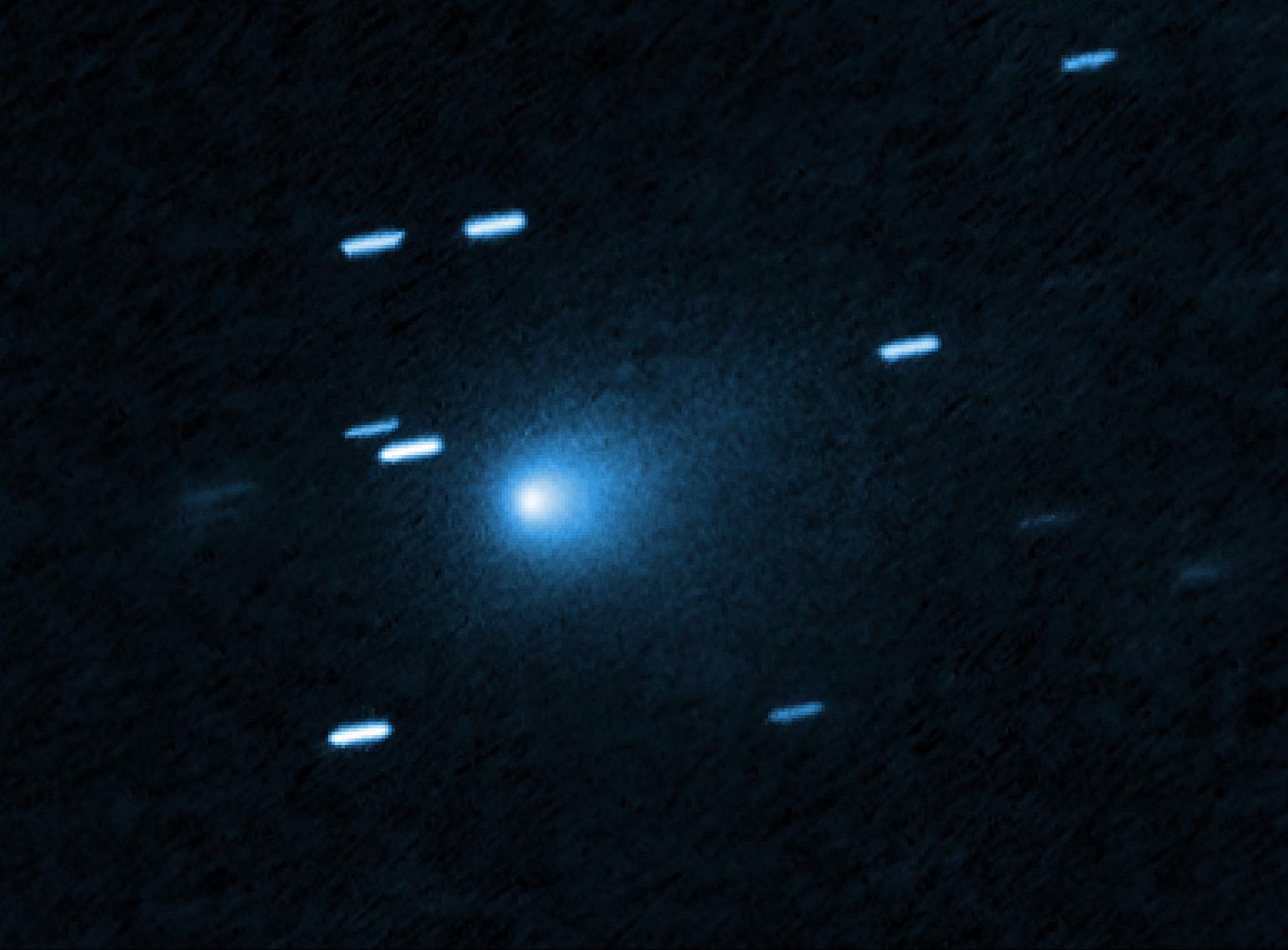
Discovered on July 1 with the NASA-funded ATLAS (Asteroid Terrestrial-impact Last Alert System) survey telescope in Rio Hurtado, Chile, 3I/ATLAS is so designated as the third known interstellar object to pass through our Solar System. It follows 1I/ʻOumuamua in 2017 and the comet 2I/Borisov in 2019. Also known as C/2025 N1, 3I/ATLAS is a comet. A teardrop-shaped cloud of dust, ejected from its icy nucleus warmed by increasing sunlight, is seen in this sharp image from the Hubble Space Telescope captured on July 21. Background stars are streaked in the exposure as Hubble tracked the fastest comet ever recorded on its journey toward the inner solar system. An analysis of the Hubble image indicates the solid nucleus, hidden from direct view, is likely less that 5.6 kilometers in diameter. This comet's interstellar origin is clear from its orbit, determined to be an eccentric, highly hyperbolic orbit that does not loop back around the Sun and will return 3I/ATLAS to interstellar space. Not a threat to planet Earth, the inbound interstellar interloper is now within the Jupiter's orbital distance of the Sun, while its closest approach to the Sun will bring it just inside the orbital distance of Mars.
https://science.nasa.gov/asset/hubble/comet-3i-atlas/
https://en.wikipedia.org/wiki/3I/ATLAS
https://arxiv.org/abs/2508.02934
https://science.nasa.gov/missions/hubble/as-nasa-missions-study-interstellar-comet-hubble-makes-size-estimate/
https://minorplanetcenter.net/mpec/K25/K25N12.html
https://apod.nasa.gov/apod/ap250809.html
#comets #astrophotography #photography #science #astronomy #nature #NASA #ESA
Alt...
2025 August 9
Interstellar Interloper 3I/ATLAS from Hubble
* Image Credit: NASA, ESA, David Jewitt (UCLA) et al. -
* Processing; Joseph DePasquale (STScI)
Explanation:
Discovered on July 1 with the NASA-funded ATLAS (Asteroid Terrestrial-impact Last Alert System) survey telescope in Rio Hurtado, Chile, 3I/ATLAS is so designated as the third known interstellar object to pass through our Solar System. It follows 1I/ʻOumuamua in 2017 and the comet 2I/Borisov in 2019. Also known as C/2025 N1, 3I/ATLAS is a comet. A teardrop-shaped cloud of dust, ejected from its icy nucleus warmed by increasing sunlight, is seen in this sharp image from the Hubble Space Telescope captured on July 21. Background stars are streaked in the exposure as Hubble tracked the fastest comet ever recorded on its journey toward the inner solar system. An analysis of the Hubble image indicates the solid nucleus, hidden from direct view, is likely less that 5.6 kilometers in diameter. This comet's interstellar origin is clear from its orbit, determined to be an eccentric, highly hyperbolic orbit that does not loop back around the Sun and will return 3I/ATLAS to interstellar space. Not a threat to planet Earth, the inbound interstellar interloper is now within the Jupiter's orbital distance of the Sun, while its closest approach to the Sun will bring it just inside the orbital distance of Mars.
Authors & editors: Robert Nemiroff (MTU) & Jerry Bonnell (UMCP)
As NASA Missions Study Interstellar Comet, Hubble Makes Size Estimate - NASA Science
--By Andrea Gianopoulos
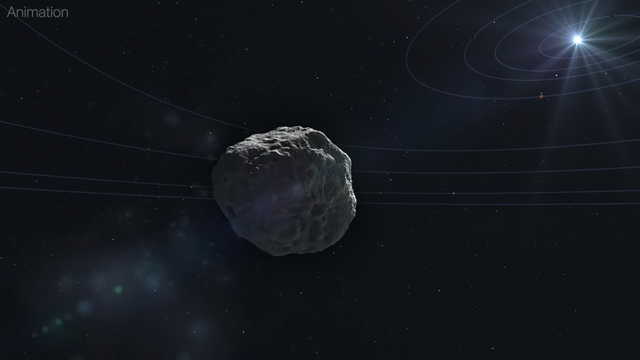
A team of astronomers has taken the sharpest-ever picture of the unexpected interstellar comet 3I/ATLAS using the crisp vision of NASA’s Hubble Space Telescope. Hubble is one of many missions across NASA’s fleet of space telescopes slated to observe this comet, together providing more information about its size and physical properties. While the comet poses no threat to Earth, NASA’s space telescopes help support the agency's ongoing mission to find, track, and better understand near-Earth objects.
[...]
Video Credits:
+ Halley’s Comet Animation via Pond5
+ Milky Way Timelapse via Pond5
+ Comet Grazing the Sun (Tsuchinshan-ATLAS)
+ Exocomets in Solar System
ESO/L. Calçada/N. Risinger
+ Comets orbiting White Dwarf Star
ESA/Hubble, NASA, ESO, M. Kornmesser
+ Oumuamua Image
ESA/Hubble, NASA, ESO, M. Kornmesser
#comets #astrophotography #photography #science #astronomy #nature #NASA #ESA
Alt...
The Hubble Space Telescope has been operating for more than three decades and continues to make ground-breaking discoveries that shape our fundamental understanding of the universe. Hubble is a project of international cooperation between NASA and ESA (European Space Agency). NASA’s Goddard Space Flight Center in Greenbelt, Maryland, manages the telescope and mission operations. Lockheed Martin Space, based in Denver, also supports mission operations at Goddard. The Space Telescope Science Institute in Baltimore, which is operated by the Association of Universities for Research in Astronomy, conducts Hubble science operations for NASA.
Video Credits:
+ Halley’s Comet Animation via Pond5
+ Milky Way Timelapse via Pond5
+ Comet Grazing the Sun (Tsuchinshan-ATLAS)
+ Exocomets in Solar System
ESO/L. Calçada/N. Risinger
+ Comets orbiting White Dwarf Star
ESA/Hubble, NASA, ESO, M. Kornmesser
+ Oumuamua Image
ESA/Hubble, NASA, ESO, M. Kornmesser
2025 October 5
A Long Storm System on Saturn
* Image Credit: NASA, JPL, ESA, Cassini Imaging Team, SSI
https://www.nasa.gov/
https://www.jpl.nasa.gov/
https://www.esa.int/
http://ciclops.org/
https://www.spacescience.org/
Explanation:
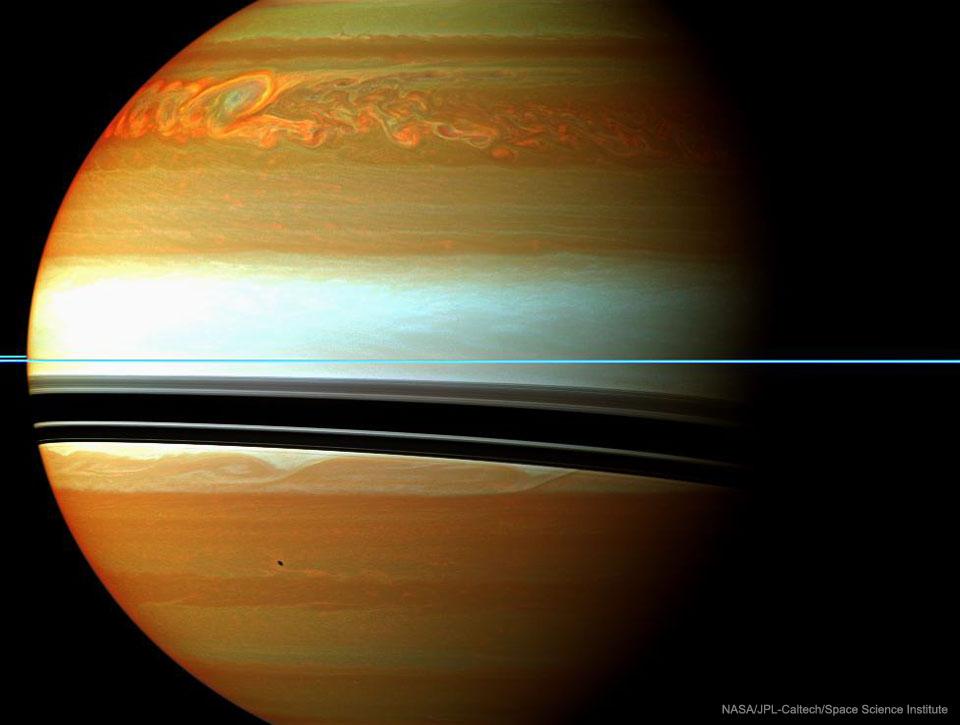
It was one of the largest and longest lived storms ever recorded in our Solar System. First seen in late 2010, the featured cloud formation in the northern hemisphere of Saturn started larger than the Earth and soon spread completely around the planet. The storm was tracked not only from Earth but from up close by the robotic Cassini spacecraft then orbiting Saturn. Pictured here in false colored infrared in February, orange colors indicate clouds deep in the atmosphere, while light colors highlight clouds higher up. The rings of Saturn are seen nearly edge-on as the thin blue horizontal line. The warped dark bands are the shadows of the rings cast onto the cloud tops by the Sun to the upper left. A source of radio noise from lightning, the intense storm was thought to relate to seasonal changes when spring emerges in the north of Saturn. After raging for over six months, the iconic storm circled the entire planet and then tried to absorb its own tail -- which surprisingly caused it to fade away.
https://www.jpl.nasa.gov/news/cassini-chronicles-life-of-saturns-giant-storm/
https://science.nasa.gov/photojournal/storm-tail-in-false-color/
https://en.wikipedia.org/wiki/Rings_of_Saturn
https://en.wikipedia.org/wiki/Rings_of_Saturn
https://apod.nasa.gov/apod/ap251005.html
#space #saturn #astrophotography #photography #science #astronomy #physics #nature #NASA
Alt...
2025 October 5
The planet Saturn is shown in infrared with great detail visible on its cloud tops. The rings appear as a thin blue horizontal line. She shadow of the rings appear as curving dark lines on the clouds. Near the top one of the tan cloud bands shows appears quite jumbled. Please see the explanation for more detailed information.
A Long Storm System on Saturn
* Image Credit: NASA, JPL, ESA, Cassini Imaging Team, SSI
Explanation:
It was one of the largest and longest lived storms ever recorded in our Solar System. First seen in late 2010, the featured cloud formation in the northern hemisphere of Saturn started larger than the Earth and soon spread completely around the planet. The storm was tracked not only from Earth but from up close by the robotic Cassini spacecraft then orbiting Saturn. Pictured here in false colored infrared in February, orange colors indicate clouds deep in the atmosphere, while light colors highlight clouds higher up. The rings of Saturn are seen nearly edge-on as the thin blue horizontal line. The warped dark bands are the shadows of the rings cast onto the cloud tops by the Sun to the upper left. A source of radio noise from lightning, the intense storm was thought to relate to seasonal changes when spring emerges in the north of Saturn. After raging for over six months, the iconic storm circled the entire planet and then tried to absorb its own tail -- which surprisingly caused it to fade away.
What Was The Grand Finale?
In April 2017, NASA's Cassini spacecraft began writing the final, thrilling chapter of its remarkable 20-year-long story of exploration: its Grand Finale.
Every week, Cassini dived through the approximately 1,200-mile-wide (2,000-kilometer-wide) gap between Saturn and its rings. No other spacecraft had ever explored this unique region.
A final close flyby of the moon Titan on April 22 used the moon's gravity to reshape Cassini's trajectory so that the spacecraft leapt over the planet's icy rings to pass between the rings and Saturn. During 22 such passes over about five months, the spacecraft's altitude above Saturn's clouds varied from about 1,000 to 2,500 miles (1,600 to 4,000 kilometers), thanks to occasional distant passes by Titan that shifted the closest approach distance. At times, Cassini skirted the very inner edge of the rings; at other times, it skimmed the outer edges of the atmosphere. During its final five orbits, its orbit passed through Saturn's uppermost atmosphere, before finally plunging directly into the planet on Sept. 15.
A Daring Dive
Cassini's Grand Finale was about so much more than the spacecraft's final dive into Saturn. That dramatic event was the capstone of six months of daring exploration and scientific discovery. And those six months were the thrilling final chapter in a historic 20-year journey.
At times, the spacecraft skirted the very inner edge of the rings; at other times, it skimmed the outer edges of the atmosphere. While the mission team was confident the risks were well understood, there could still have surprises. It was the kind of bold adventure that could only be undertaken at the end of the mission.
https://science.nasa.gov/mission/cassini/grand-finale/overview/
#space #saturn #astrophotography #photography #science #astronomy #physics #nature #NASA
Alt...
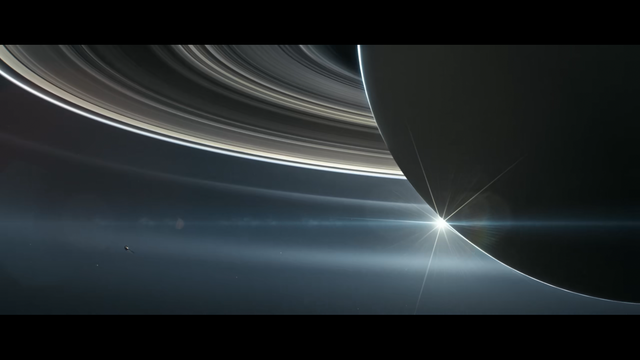
A short, animated video describing the Cassini's Grand Finale.
In April 2017, NASA's Cassini spacecraft began writing the final, thrilling chapter of its remarkable 20-year-long story of exploration: its Grand Finale.
Every week, Cassini dived through the approximately 1,200-mile-wide (2,000-kilometer-wide) gap between Saturn and its rings. No other spacecraft had ever explored this unique region.
A final close flyby of the moon Titan on April 22 used the moon's gravity to reshape Cassini's trajectory so that the spacecraft leapt over the planet's icy rings to pass between the rings and Saturn. During 22 such passes over about five months, the spacecraft's altitude above Saturn's clouds varied from about 1,000 to 2,500 miles (1,600 to 4,000 kilometers), thanks to occasional distant passes by Titan that shifted the closest approach distance. At times, Cassini skirted the very inner edge of the rings; at other times, it skimmed the outer edges of the atmosphere. During its final five orbits, its orbit passed through Saturn's uppermost atmosphere, before finally plunging directly into the planet on Sept. 15.
CREDIT
NASA JPL
Starting a moon exploration tour from the couch? Why not? With a good internet connection, you can hit the ground running right away and enjoy your moonwalk:
https://trek.nasa.gov/moon/#v=0.1&x=0&y=0&z=1&p=urn%3Aogc%3Adef%3Acrs%3AEPSG%3A%3A104903&d=&locale=&b=moon&e=-281.2499947536844%2C-131.83593504078956%2C281.2499947536844%2C131.83593504078956&sfz=&w=
And don't forget: The Trump administration has cut off NASA's financial support from government funds! It stands to reason that this institution is to be weakened by financial erosion in order to then privatise it and sell it cheaply to loyal greedy super-rich. So no one can know how long all this information and data will be publicly available, which is now the property of the American people and the calling card for a United America. Do we really want to put up with THAT? This country is still called "United States of America" and may this name preserve its values for a long time to come! Stop freezing like the rabbit before the poison snake, stay strong and unite USA and finally defend yourself against your malicious destruction by greedy narcissists!
#space #moon #astrophotography #photography #science #astronomy #nature #NASA #education #us #uspol #trump #usa #europe #italy #france #unitedkingdom #resist
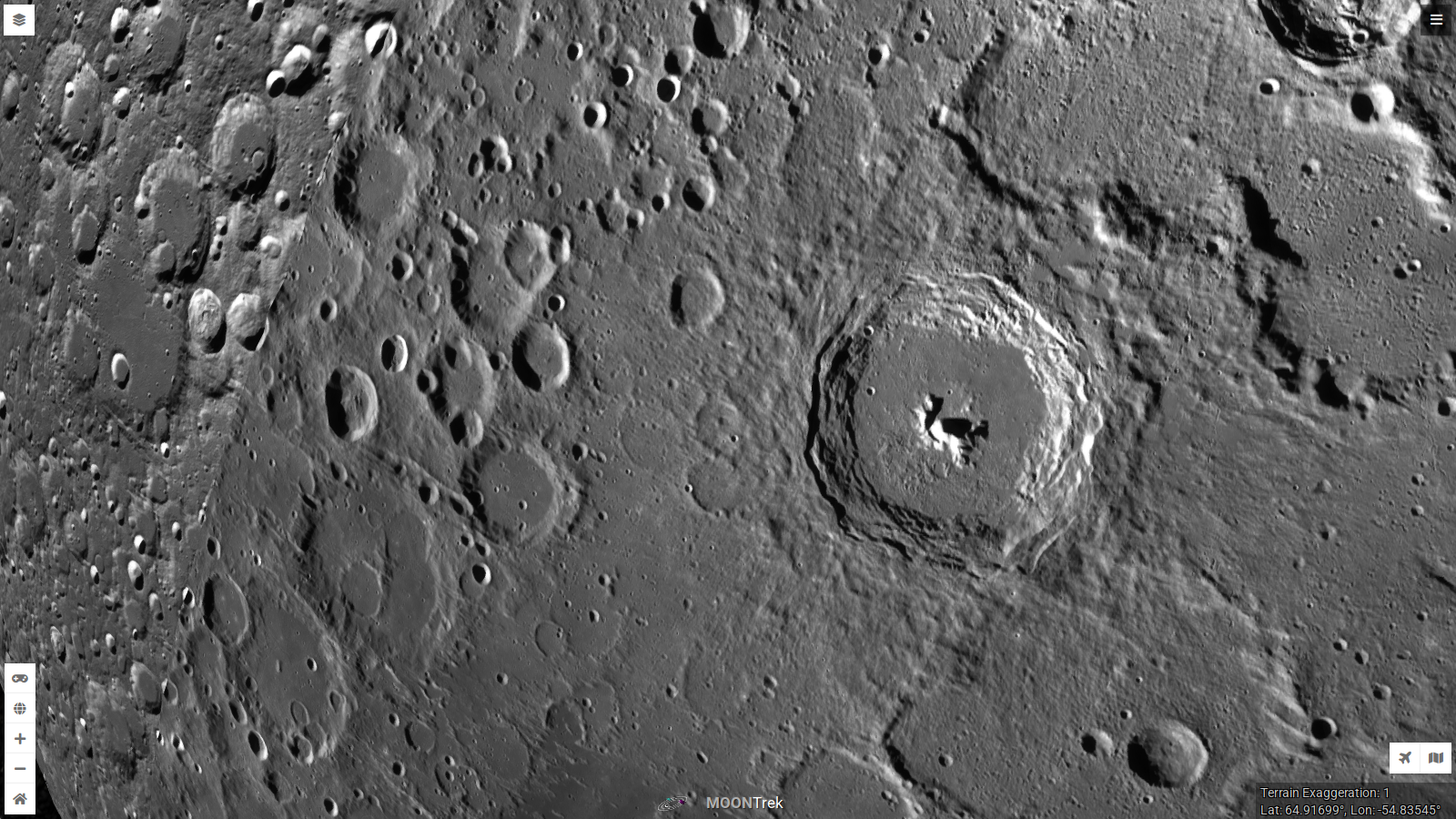
Alt...
Moon Trek allows you to explore the Moon via your own computer. Credit: NASA/SSERVI
Data and Music: What 50 Years of Exploring Our Moon Sounds Like
Sonification is the process of translating data into sound and music. In this musical data sonification of lunar knowledge and exploration, we can hear the progress made throughout the Apollo program to now as our understanding of the Moon expands. Listen to the percussion, which signals launches and the passage of time; the pitch of the string and brass instruments conveys the amount of scientific activity associated with the Moon over time.
Here’s a breakdown of the individual instruments:
Pitch of the string and brass = scientific activity
Percussion instruments = passage of time
Clock ticking = months
Snare drum = years
Bass drum = decades
Cymbals = launches
In the video, the blue line indicates the amount of scientific activity (the number of scientific publications, citations and patents) in each year that is related to NASA’s Apollo program. The red and yellow lines indicate the amount of scientific activity associated with Apollo samples and Apollo images, respectively. The other colors indicate the amount of scientific activity associated with each of NASA’s lunar robotic missions.
Each year's data represents the number of articles, citations and patents dated in that year and returned by Google Scholar when applying a certain set of keywords.
CREDIT
NASA's Goddard Space Flight Center
SYSTEM Sounds
Data sonification and visualization by Matt Russo and Andrew Santaguida of SYSTEM Sounds. Data compiled by NASA.
Music credits: "Giant Leaps" by SYSTEM Sounds
https://svs.gsfc.nasa.gov/13204
#space #moon #astrophotography #photography #science #astronomy #nature #NASA #education
You're Invited!
The next International Observe the Moon Night is tonight !
International Observe the Moon Night is a time to come together with fellow Moon enthusiasts and curious people worldwide. Everyone on Earth is invited to learn about lunar science and exploration, take part in celestial observations, and honor cultural and personal connections to the Moon. We encourage everyone to interpret “observe” broadly!
International Observe the Moon Night occurs annually in September or October, when the Moon is around first quarter ― a great phase for evening observing. A first-quarter Moon offers excellent viewing opportunities along the terminator (the line between night and day), where shadows enhance the Moon’s cratered landscape.
You can join International Observe the Moon Night from wherever you are. Attend or host a virtual or in-person event, or observe the Moon from home. Connect with fellow lunar enthusiasts around the world by using #ObserveTheMoon on your preferred social media platform and visiting the International Observe the Moon Night Flickr group.
Outdoors, at home, online, or wherever you may be, we’re glad to have you with us. However you choose to observe, please follow local guidelines on health and safety.
* Unite people across the globe in a celebration of lunar observation, science, and exploration.
* Provide information, a platform, and resources in order to:
* Raise awareness of NASA’s lunar science and exploration programs.
* Empower people to learn more about the Moon and space science and exploration, using Earth’s Moon as an accessible entry point.
* Facilitate sharing of Moon-inspired stories, images, artwork, and more.
* Inspire continued observation of the Moon, the sky, and the world around us.
* Support all people who are interested in learning more about, and connecting to, the Moon.
https://moon.nasa.gov/observe-the-moon-night/about/overview/
https://moon.nasa.gov/observe-the-moon-night/participate/10-ways-to-observe-the-moon/
#space #moon #astrophotography #photography #science #astronomy #nature #NASA #education
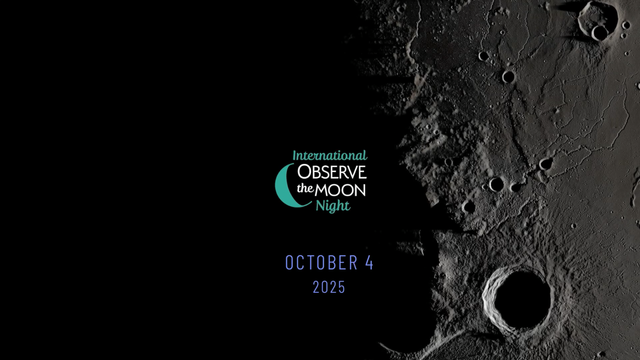
Alt...
Video trailer for International Observe the Moon Night 2025.
https://moon.nasa.gov/observe-the-moon-night/
Join In!
The countdown is on.. for the International Observe the Moon Night 2025 on October 4!
https://moon.nasa.gov/observe-the-moon-night/
https://moon.nasa.gov/observe-the-moon-night/register/individual-participation/
#space #moon #astrophotography #photography #science #astronomy #nature #NASA #education
![[?]](https://cdn.masto.host/socelnet/accounts/avatars/109/355/496/809/872/483/original/4bb481e7a50769d3.jpg)
A thunderstorm is approaching - the dark sky makes the yellow sunflowers glow.
Sunflower field abstract - hand-painted watercolor and ink painting -
https://karen-kaspar.pixels.com/featured/sunflower-field-abstract-karen-kaspar.html
#sunflowers #sunflower #MastoArt #art #painting #FediArt #FediGiftShop #artist #arte #InteriorDesign #MastodonArt #ArtistsOnMastodon #TraditionalArt #kunst #contemporaryArt #watercolor #watercolour #BuyIntoArt #flowers #garden #floral #nature #NatureLover #ink #ArtForSale #wallArt #abstractart #aquarell #handmade #storm

Alt...
Sunflower Field Abstract is a painting in portrait format painted with watercolors and ink by the artist Karen Kaspar. It shows a field with many yellow blossoming sunflowers under a dark indigo blue cloudy sky.
A summer thunderstorm is approaching and rain is on the horizon. The dark sky makes the yellow sunflowers glow.
Abell 2744: Pandora's Cluster Revealed
X-ray, Optical & Lensing Map Images of Abell 2744
One of the most complicated and dramatic collisions between galaxy clusters ever seen is captured in this new composite image. This collision site, known officially as Abell 2744, has been dubbed "Pandora's Cluster" because of the wide variety of different structures seen. Data from NASA's Chandra X-ray Observatory are colored red, showing gas with temperatures of millions of degrees. In blue is a map showing the total mass concentration (mostly dark matter) based on data from the Hubble Space Telescope (HST), the European Southern Observatory's Very Large Telescope (VLT), and the Japanese Subaru telescope. Optical data from HST and VLT also show the constituent galaxies of the clusters.
The "core" region shows a bullet-shaped structure in the X-ray emitting hot gas and a separation between the hot gas and the dark matter. (As a guide, local peaks in the distribution of hot gas and overall matter in the different regions are shown with red and blue circles respectively). This separation occurs because electric forces between colliding particles in the clouds of hot gas create a friction that slows them down, while dark matter is unaffected by such forces.
In the Northwest ("NW") region, a much larger separation is seen between the hot gas and the dark matter. Surprisingly, the hot gas leads the "dark" clump (mostly dark matter) by about 500,000 light years. [...]
https://chandra.harvard.edu/photo/2011/a2744/
CREDIT
X-ray: NASA/CXC/ITA/INAF/J.Merten et al
Lensing: NASA/STScI; NAOJ/Subaru; ESO/VLT
Optical: NASA/STScI/R.Dupke)
#space #cluster #astrophotography #photography #science #astronomy #physics #nature #NASA #education
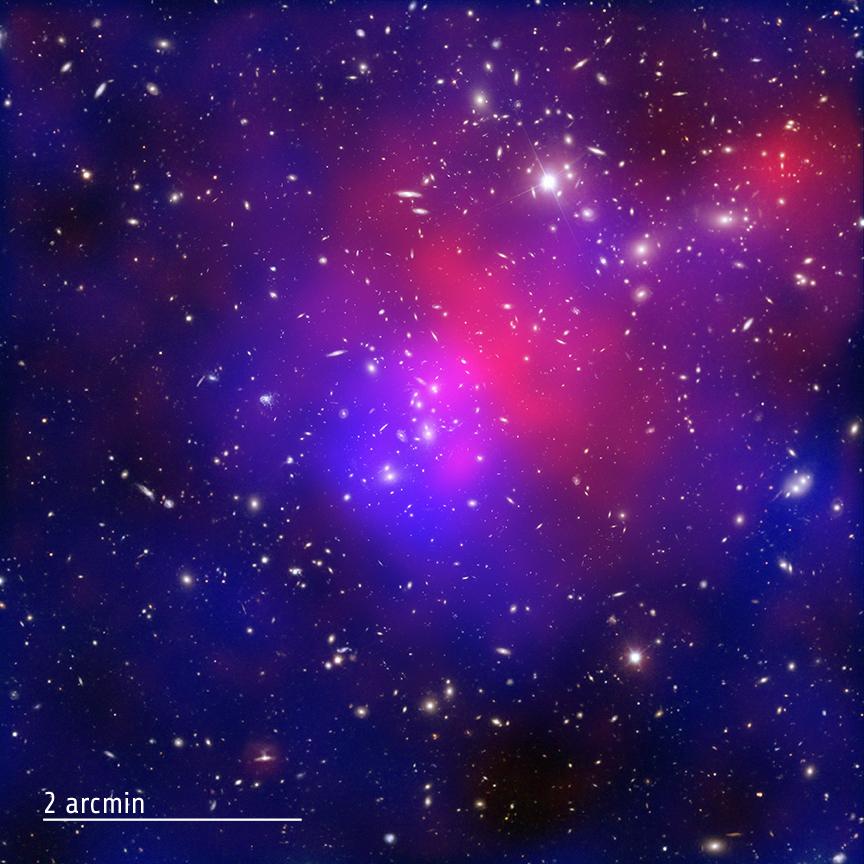
Alt...
The composite image of galaxy cluster Abell 2744 showcases an array of distant galaxies, hot gas and other celestial objects. The image features a vibrant pink and blue-purple hue, which is prevalent throughout the galaxy cluster, creating a captivating contrast against the dark blue background. At the center of the image, there is a large hot pink gaseous shape, almost like a mottled bird, diving into the more blue-purple nebulous area. The gaseous, nebulous shapes are littered with bright white-yellow pops of light, like too many holiday lights on a tree. This object was created by one of the most complicated and dramatic collisions between galaxy clusters ever seen. It has been dubbed "Pandora's Cluster" because of the wide variety of different structures seen. Data from NASA's Chandra X-ray Observatory are colored pink-red, showing gas with temperatures of millions of degrees. In blue is a map showing the total mass concentration (mostly dark matter) based on data from the Hubble Space Telescope, the Very Large Telescope, and the Japanese Subaru telescope. Optical data also show the constituent galaxies of the clusters. The "core" region shows a slightly bullet shaped structure in the X-ray emitting hot gas (the diving bird) and a separation between the hot gas and the dark matter. This separation occurs because electromagnetic forces between colliding particles in the clouds of hot gas create a friction that slows them down, while dark matter is unaffected by such forces
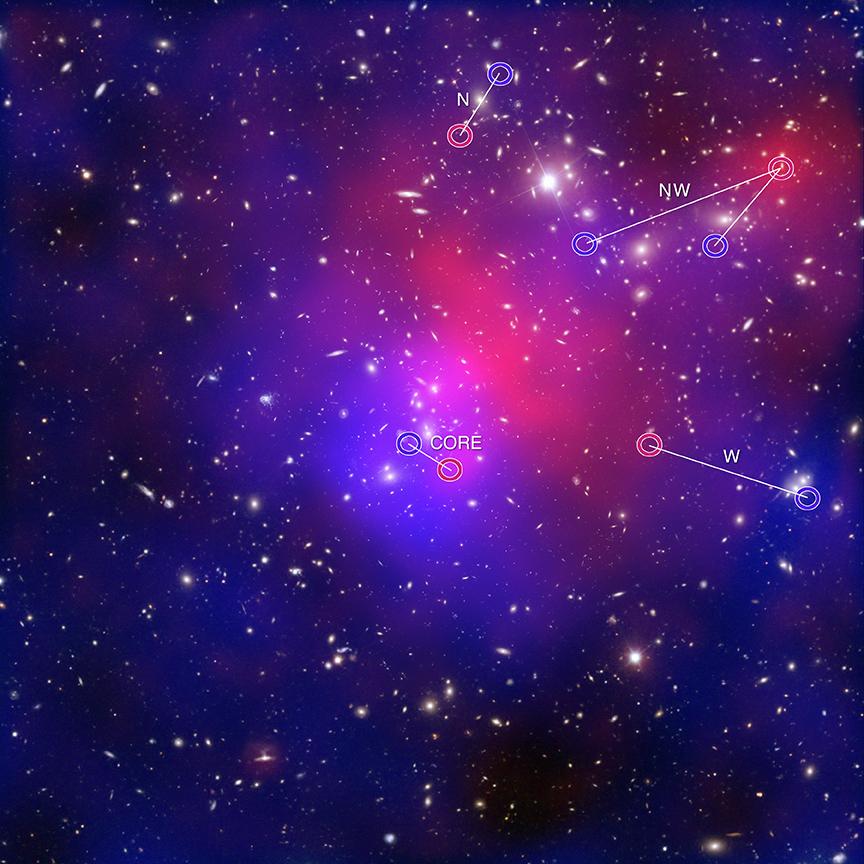
Alt...
Labeled image of Abell 2744
These images feature one of the most complicated and dramatic collisions between galaxy clusters ever seen. Known officially as Abell 2744, this system has been dubbed "Pandora's Cluster" because of the wide variety of different structures found. Data from Chandra show gas with temperatures of millions of degrees. Next is a map showing the total mass concentration (mostly dark matter) based on data from the Hubble Space Telescope, the Very Large Telescope (VLT), and the Subaru telescope. Optical data from HST and VLT also show the constituent galaxies of the clusters. Astronomers think at least four galaxy clusters coming from a variety of directions are involved with this collision.
CREDIT
X-ray: NASA/CXC/ITA/INAF/J.Merten et al,
Lensing: NASA/STScI; NAOJ/Subaru; ESO/VLT,
Optical: NASA/STScI/R.Dupke
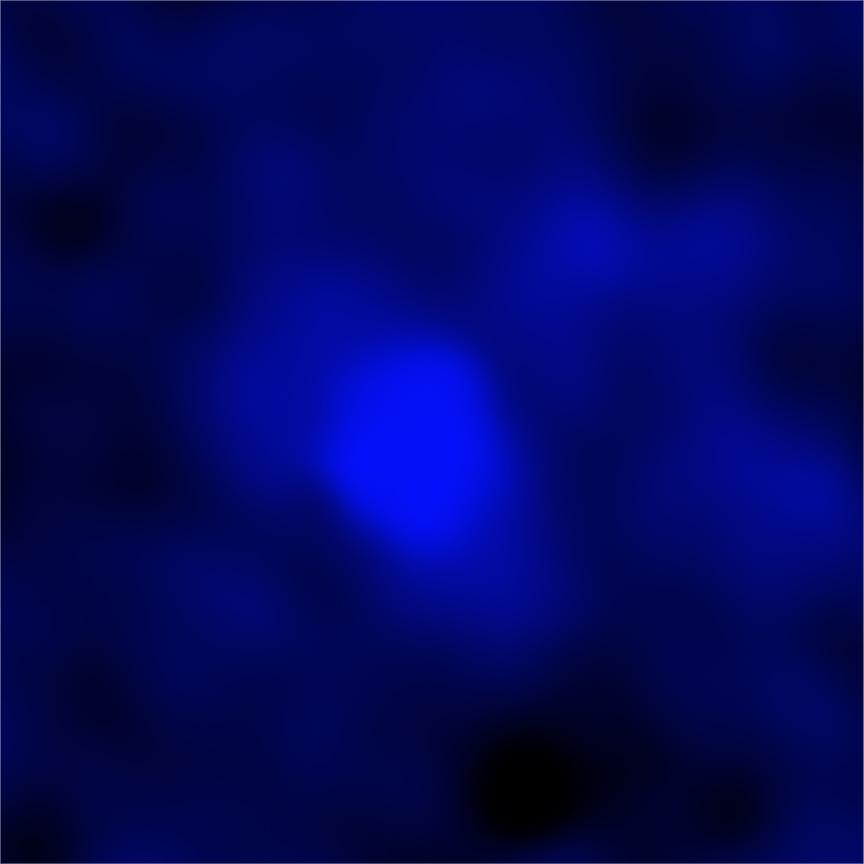
Alt...
LMap image of Abell 2744
CREDIT
X-ray: NASA/CXC/ITA/INAF/J.Merten et al,
Lensing: NASA/STScI; NAOJ/Subaru; ESO/VLT,
Optical: NASA/STScI/R.Dupke
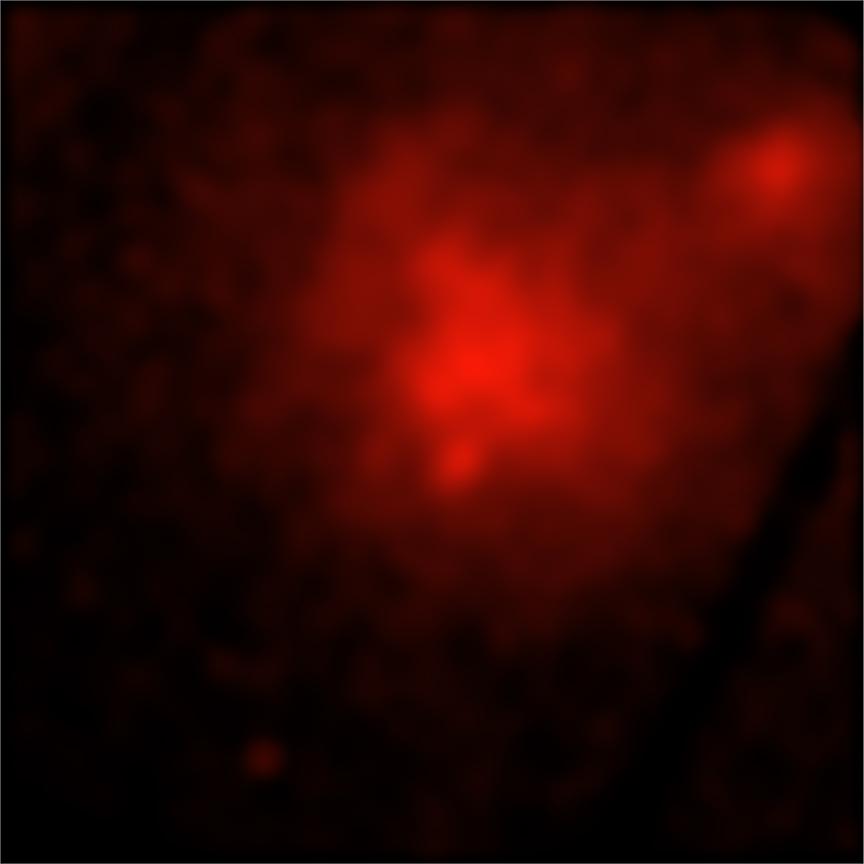
Alt...
X-ray image of Abell 2744
CREDIT
X-ray: NASA/CXC/ITA/INAF/J.Merten et al,
Lensing: NASA/STScI; NAOJ/Subaru; ESO/VLT,
Optical: NASA/STScI/R.Dupke
Gravity – Nature’s Magnifying Glass
This video explains how very distant galaxies are magnified through the phenomenon of gravitational lensing. Gravitational lenses can magnify the light from distant galaxies that are at or near the peak of star formation. This effect allows researchers to study the details of early galaxies too far away to be seen with even the most powerful space telescopes.
Credit
NASA, ESA, CSA, STScI, Leah Hustak (STScI)
https://science.nasa.gov/asset/webb/gravity-natures-magnifying-glass/ <- Due to the lapse in federal government funding, NASA is not updating this website.
#space #galaxy #astrophotography #photography #science #physics #nature #NASA #ESA #education
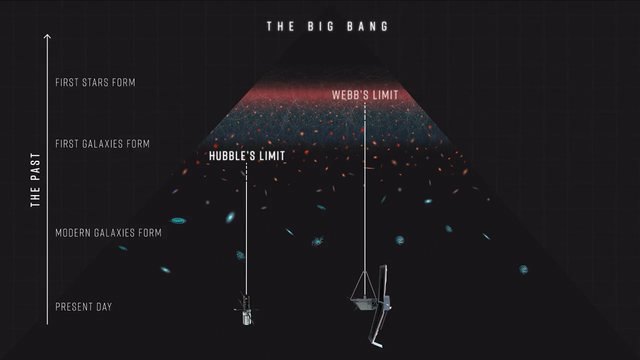
Alt...
This video explains how very distant galaxies are magnified through the phenomenon of gravitational lensing. Gravitational lenses can magnify the light from distant galaxies that are at or near the peak of star formation. This effect allows researchers to study the details of early galaxies too far away to be seen with even the most powerful space telescopes.
Credit
NASA, ESA, CSA, STScI, Leah Hustak (STScI)
Take a Tour of Pandora’s Cluster
This video tours Pandora’s Cluster (Abell 2744), a region where multiple clusters of galaxies are in the process of merging to form a megacluster. Astronomers estimate 50,000 sources of near-infrared light are represented in this image from NASA’s James Webb Space Telescope.
The concentration of mass in Pandora’s Cluster is so great that the fabric of spacetime is warped by gravity, creating an effect that makes the region of special interest to astronomers: a natural, super-magnifying glass called a “gravitational lens” that they can use to see very distant sources of light beyond the cluster that would otherwise be undetectable, even to Webb. These lensed sources, which are particularly prominent in the lower right area, appear red in the image, and often as elongated arcs distorted by the gravitational lens.
The video also highlights a mysterious object that appears to be no more than a red dot. One theory is that this source of infrared light is a glowing disk of gas surrounding a supermassive black hole in the early universe.
Credit
Video: STScI, Danielle Kirshenblat; Music: PremiumBeat Music, Klaus Hergersheimer; Science: Ivo Labbe (Swinburne), Rachel Bezanson (University of Pittsburgh); Image Processing: STScI, Alyssa Pagan
https://science.nasa.gov/asset/webb/take-a-tour-of-pandoras-cluster/ <- Due to the lapse in federal government funding, NASA is not updating this website.
#space #cluster #astrophotography #photography #science #astronomy #physics #nature #NASA
2025 October 3
Pandora's Cluster of Galaxies
* Image Credit: NASA, ESA, CSA, Ivo Labbe (Swinburne), Rachel Bezanson (University of Pittsburgh)
https://www.nasa.gov/
https://www.esa.int/
https://www.asc-csa.gc.ca/eng/
* Processing: Alyssa Pagan (STScI)
https://www.stsci.edu/
Explanation:
This deep field mosaicked image presents a stunning view of galaxy cluster Abell 2744 recorded by the James Webb Space Telescope's NIRCam. Also dubbed Pandora's Cluster, Abell 2744 itself appears to be a ponderous merger of three different massive galaxy clusters. It lies some 3.5 billion light-years away, toward the constellation Sculptor. Dominated by dark matter, the mega-cluster warps and distorts the fabric of spacetime, gravitationally lensing even more distant objects. Redder than the Pandora cluster galaxies, many of the lensed sources are very distant galaxies in the early Universe, their lensed images stretched and distorted into arcs. Of course, distinctive diffraction spikes mark foreground Milky Way stars. At the Pandora Cluster's estimated distance, this cosmic box spans about 6 million light-years. But don't panic. You can explore the tantalizing region in a 2 minute video tour.
https://science.nasa.gov/missions/webb/nasas-webb-uncovers-new-details-in-pandoras-cluster/
FYI in Gravitational Lensing you might want to see:
https://defcon.social/@grobi/114374350096488478
https://apod.nasa.gov/apod/fap/ap220319.html
https://apod.nasa.gov/apod/ap251003.html <- Due to the lapse in federal government funding, NASA is not updating this website.
#NASA #inofficial #space #cluster #astrophotography #photography #science #astronomy #physics #nature
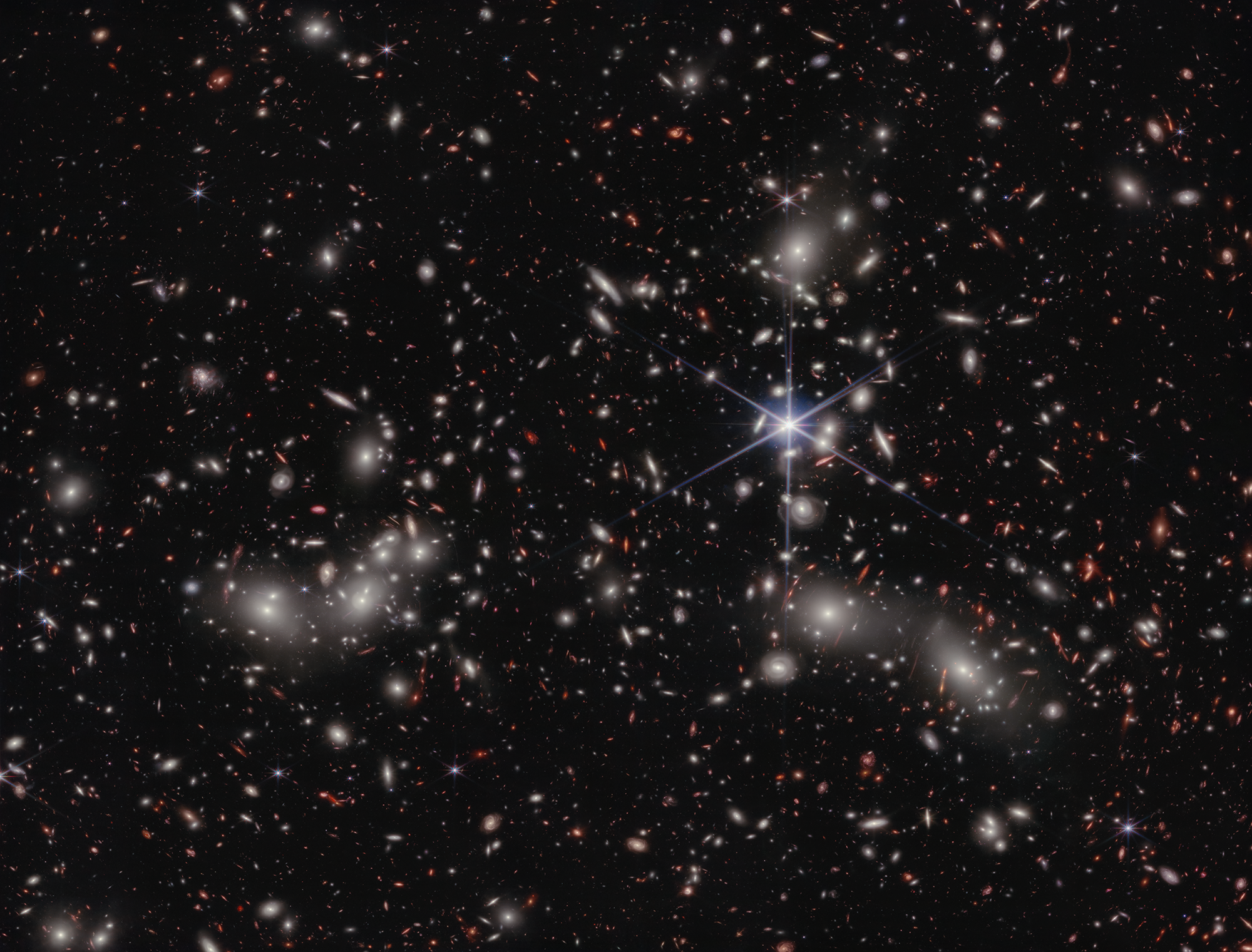
Alt...
2025 October 3
Pandora's Cluster of Galaxies
* Image Credit: NASA, ESA, CSA, Ivo Labbe (Swinburne), Rachel Bezanson (University of Pittsburgh)
* Processing: Alyssa Pagan (STScI)
Explanation:
This deep field mosaicked image presents a stunning view of galaxy cluster Abell 2744 recorded by the James Webb Space Telescope's NIRCam. Also dubbed Pandora's Cluster, Abell 2744 itself appears to be a ponderous merger of three different massive galaxy clusters. It lies some 3.5 billion light-years away, toward the constellation Sculptor. Dominated by dark matter, the mega-cluster warps and distorts the fabric of spacetime, gravitationally lensing even more distant objects. Redder than the Pandora cluster galaxies, many of the lensed sources are very distant galaxies in the early Universe, their lensed images stretched and distorted into arcs. Of course, distinctive diffraction spikes mark foreground Milky Way stars. At the Pandora Cluster's estimated distance, this cosmic box spans about 6 million light-years. But don't panic. You can explore the tantalizing region in a 2 minute video tour.
Authors & editors: Robert Nemiroff (MTU) & Jerry Bonnell (UMCP)
NASA Official: Amber Straughn Specific rights apply.
NASA Web Privacy, Accessibility, Notices;
A service of: ASD at NASA / GSFC,
NASA Science Activation
& Michigan Tech. U.
TOPIC> Star Clusters
2025 July 19
Messier 6
* Image Credit & Copyright: Xinran Li
https://app.astrobin.com/u/Flying_Dutchman#gallery
Explanation:
The sixth object in Charles Messier's famous catalog of things which are not comets, Messier 6 is a galactic or open star cluster. A gathering of 100 stars or so, all around 100 million years young, M6 lies some 1,600 light-years away toward the central Milky Way in the constellation Scorpius. Also cataloged as NGC 6405, the pretty star cluster's outline suggests its popular moniker, the Butterfly Cluster. Surrounded by diffuse reddish emission from the region's hydrogen gas the cluster's mostly hot and therefore blue stars are near the center of this colorful cosmic snapshot. But the brightest cluster member is a cool K-type giant star. Designated BM Scorpii it shines with a yellow-orange hue, seen near the end of one of the butterfly's antennae. This telescopic field of view spans nearly 2 Full Moons on the sky. That's 25 light-years at the estimated distance of Messier 6.
https://app.astrobin.com/i/7472xp
https://en.wikipedia.org/wiki/BM_Scorpii
https://en.wikipedia.org/wiki/Butterfly_Cluster
https://science.nasa.gov/image-detail/skychart-scorpiusm6m7-july-2024/
https://earthsky.org/clusters-nebulae-galaxies/m6-and-m7-deep-sky-gems-by-scorpius-tail/
https://science.nasa.gov/people/explore-the-night-sky-hubbleatms-messier-catalog-bio/
https://apod.nasa.gov/apod/ap250719.html
#space #cluster #astrophotography #photography #science #nature #NASA

Alt...
2025 July 19
Messier 6
* Image Credit & Copyright: Xinran Li
Explanation:
The sixth object in Charles Messier's famous catalog of things which are not comets, Messier 6 is a galactic or open star cluster. A gathering of 100 stars or so, all around 100 million years young, M6 lies some 1,600 light-years away toward the central Milky Way in the constellation Scorpius. Also cataloged as NGC 6405, the pretty star cluster's outline suggests its popular moniker, the Butterfly Cluster. Surrounded by diffuse reddish emission from the region's hydrogen gas the cluster's mostly hot and therefore blue stars are near the center of this colorful cosmic snapshot. But the brightest cluster member is a cool K-type giant star. Designated BM Scorpii it shines with a yellow-orange hue, seen near the end of one of the butterfly's antennae. This telescopic field of view spans nearly 2 Full Moons on the sky. That's 25 light-years at the estimated distance of Messier 6.
Authors & editors: Robert Nemiroff (MTU) & Jerry Bonnell (UMCP)
NASA Official: Amber Straughn Specific rights apply.
NASA Web Privacy, Accessibility, Notices;
A service of: ASD at NASA / GSFC,
NASA Science Activation
& Michigan Tech. U.
Globular Star Clusters
Ancient and giant, globular star clusters are stellar "dinosaurs" scattered throughout the universe. They can survive for billions of years, holding some of the oldest stars in the universe.
Globular star clusters contain anywhere from tens of thousands to millions of stars, packed tightly together in dense clumps ranging from 50 to 450 light-years across, and they can be found throughout the halo, or outer regions, of our own Milky Way galaxy. These stars formed within massive clouds of gas anywhere from about 8 to 13 billion years ago. Once formed, these roughly spherical star clusters were left without gas and dust to feed new star formation. There is, however, some evidence that some globular clusters can produce multiple generations of stars early in the cluster’s life.
Globular star clusters are associated with all types of galaxies. The Milky Way holds about 150 known globular clusters, many of which are in retrograde orbits, meaning they are orbiting the center of the galaxy in the opposite direction of most of the objects in the Milky Way. This indicates that our galaxy could have captured these clusters during an interaction with another galaxy. These clusters are born so dense and massive that they can remain a cluster even after being pulled apart by gravity over time.
Because they contain so many stars, globular clusters are often the most visibly obvious clusters. Sky watchers can see many of them with the unaided eye. The largest and brightest globular cluster in the Milky Way galaxy, Omega Centauri (NGC 5139), is one of the clusters visible without a telescope.
"Due to their strong compression of mass, they can also be used for gravitational lensing. https://defcon.social/@grobi/114653568101686376"
* Text excerpt from https://science.nasa.gov/universe/star-clusters-inside-the-universes-stellar-collections/
CREDIT
* Chelsea Gohd
NASA Universe Web Team
Please see ALT-Text for more information about Messier 2 (image below)
#space #cluster #astrophotography #photography #science #physics #nature #NASA

Alt...
This image shows a good example of globular star clusters:
Messier 2
* Image Credit: ESA/Hubble & NASA, G. Piotto et al.
Explanation:
After the Crab Nebula, this giant star cluster is the second entry in 18th century astronomer Charles Messier's famous list of things that are not comets. M2 is one of the largest globular star clusters now known to roam the halo of our Milky Way galaxy. Though Messier originally described it as a nebula without stars, this stunning Hubble image resolves stars across the cluster's central 40 light-years. Its population of stars numbers close to 150,000, concentrated within a total diameter of around 175 light-years. About 55,000 light-years distant toward the constellation Aquarius, this ancient denizen of the Milky Way, also known as NGC 7089, is 13 billion years old. An extended stellar debris stream, a signature of past gravitational tidal disruption, was recently found to be associated with Messier 2.
Authors & editors: Robert Nemiroff (MTU) & Jerry Bonnell (UMCP)
NASA Official: Amber Straughn Specific rights apply.
NASA Web Privacy Policy and Important Notices
A service of: ASD at NASA / GSFC,
NASA Science Activation
& Michigan Tech. U.
Open Clusters
Smaller than globular clusters, open clusters are more loosely bound groups that typically contain anywhere from tens to thousands of stars. Open star clusters have a core that typically measures a few light-years across that is surrounded by a corona, or the outermost part of a star’s atmosphere, that can stretch about tens of light-years out from the center.
Found in irregular galaxies and spiral galaxies like the Milky Way, open clusters contain both old and young stars and are generally much younger than globular clusters – typically they are less than a billion years old. Stars in open clusters are also more spread out, so these clusters are not very stable and the stars have a tendency to disperse after a few million years.
More plentiful in our galaxy than globular clusters, there are thousands of open clusters in the Milky Way, though it's thought that there could be many, many more. In the Milky Way, these clusters can be spotted in our galaxy's disk, both in and between its spiral arms.
* Text excerpt from https://science.nasa.gov/universe/star-clusters-inside-the-universes-stellar-collections/
CREDIT
* Chelsea Gohd
NASA Universe Web Team
Please see ALT-Text for more information about Messier 2 (image below)
#space #cluster #astrophotography #photography #science #physics #nature #NASA

Alt...
2025 February 27
Open Star Clusters M35 and NGC 2158
* Image Credit & Copyright: Evan Tsai, LATTE: Lulin-ASIAA Telescope
Explanation:
Framed in this single, starry, telescopic field of view are two open star clusters, M35 and NGC 2158. Located within the boundaries of the constellation Gemini, they do appear to be side by side. Its stars concentrated toward the upper right, M35 is relatively nearby, though. M35 (also cataloged as NGC 2168) is a mere 2800 light-years distant, with 400 or so stars spread out over a volume about 30 light-years across. Bright blue stars frequently distinguish younger open clusters like M35, whose age is estimated at 150 million years. At lower left, NGC 2158 is about four times more distant than M35 and much more compact, shining with the more yellowish light of a population of stars over 10 times older. In general, open star clusters are found along the plane of our Milky Way Galaxy. Loosely gravitationally bound, their member stars tend to be dispersed over billions of years as the open star clusters orbit the galactic center.
Authors & editors: Robert Nemiroff (MTU) & Jerry Bonnell (UMCP)
NASA Official: Amber Straughn Specific rights apply.
NASA Web Privacy Policy and Important Notices
A service of: ASD at NASA / GSFC,
NASA Science Activation
& Michigan Tech. U.
Stellar Associations
While globular and open clusters are generally referred to as the two main types of star clusters, there is a third variety of stellar groupings, called stellar associations, which are the most dispersed of the bunch. In fact, the vast majority of stars are born as members of a stellar association before they move apart.
In the Milky Way, the highest concentration of stellar associations is in the galaxy's spiral arms. Stellar associations are very loose clusters of 10 to upwards of 10,000 stars. While they might hold fewer stars than other types of clusters, because the stars are so spread out, stellar associations can be very large, averaging 700 light-years across.
Stellar associations are categorized based on the types of stars they contain. OB associations are made up of O and B-type stars that are young and massive (B-type stars are typically 2 to 15 times more massive than the Sun and O-type stars are usually 15 to 90 times as massive); R associations have young, bright stars with a medium mass between 3 to 10 times the mass of the Sun; and T associations contain mostly T Tauri stars that are fairly cool, young stars with low mass similar to the mass of our Sun.
[...]
Please see the reply for more Information about Stellar Associations
* Text excerpt from https://science.nasa.gov/universe/star-clusters-inside-the-universes-stellar-collections/
CREDIT
* Chelsea Gohd
NASA Universe Web Team
Please see ALT-Text for more information about NGC 206
(image below)
#space #cluster #astrophotography #photography #science #physics #nature #NASA

Alt...
2023 April 12
NGC 206 and the Star Clouds of Andromeda
* Image Credit & Copyright: Howard Trottier
Explanation:
The large stellar association cataloged as NGC 206 is nestled within the dusty arms of the neighboring Andromeda galaxy along with the galaxy's pinkish star-forming regions. Also known as M31, the spiral galaxy is a mere 2.5 million light-years away. NGC 206 is found right of center in this sharp and detailed close-up of the southwestern extent of Andromeda's disk. The bright, blue stars of NGC 206 indicate its youth. In fact, its youngest massive stars are less than 10 million years old. Much larger than the open or galactic clusters of young stars in the disk of our Milky Way galaxy, NGC 206 spans about 4,000 light-years. That's comparable in size to the giant stellar nurseries NGC 604 in nearby spiral M33 and the Tarantula Nebula in the Large Magellanic Cloud.
Authors & editors: Robert Nemiroff (MTU) & Jerry Bonnell (UMCP)
NASA Official: Phillip Newman Specific rights apply.
NASA Web Privacy Policy and Important Notices
A service of: ASD at NASA / GSFC,
NASA Science Activation
& Michigan Tech. U.
[...]
The stars in stellar associations are so spread out that they defy the image of a "cluster." Visually, the stars in these clusters might not look bound together at all. This is because, while the stars in stellar associations formed together and continue to move together through space, they have become gravitationally unbound. As a result, stellar associations are the least stable variety of star cluster. However, many of the brightest stars in constellations like Scorpius, Lupus, Centaurus, and Crux as well as the bright star Antares are all a part of a stellar association located about 400 light-years away.
Because they are not as obvious as their counterparts, stellar associations can be hard to spot. But scientists can still determine if stars are part of the same cluster or have common origins based on key factors like the stars’ age, movement, and sometimes even their chemical composition.
* Text excerpt from https://science.nasa.gov/universe/star-clusters-inside-the-universes-stellar-collections/
CREDIT
* Chelsea Gohd
NASA Universe Web Team
Please see ALT-Text for more information
(image below)
#space #cluster #astrophotography #photography #science #physics #nature #NASA
![Stellar Association
The Little Fox and the Giant Stars
New stars are the lifeblood of our Galaxy, and there is enough material revealed by this Herschel infrared image to build stars for millions of years to come.
Situated 8000 light-years away in the constellation Vulpecula – latin for little fox – the region in the image is known as Vulpecula OB1. It is a ‘stellar association’ in which a batch of truly giant ‘OB’ stars is being born.
The vast quantities of ultraviolet and other radiation emitted by these stars is compressing the surrounding cloud, causing nearby regions of dust and gas to begin the collapse into more new stars. In time, this process will ‘eat’ its way through the cloud, transforming some of the raw material into shining new stars.
The image was obtained as part of Herschel’s Hi-GAL key-project. This used the infrared space observatory’s instruments to image the entire galactic plane in five different infrared wavelengths.
These wavelengths reveal cold material, most of it between -220ºC and -260ºC. None of it can be seen at ordinary optical wavelengths, but this infrared view shows astronomers a surprising amount of structure in the cloud’s interior.
The surprise is that the Hi-GAL survey has revealed a spider’s web of filaments that stretches across the star-forming regions of our Galaxy. Part of this vast network can be seen in this image as a filigree of red and orange threads.
[...]
CREDIT
ESA/Herschel/PACS, SPIRE/Hi-GAL Project](https://files.defcon.social/dcsocial-s3/media_attachments/files/114/880/338/660/099/903/original/eb32e8ae41ed8ac6.jpg "Stellar Association
The Little Fox and the Giant Stars
New stars are the lifeblood of our Galaxy, and there is enough material revealed by this Herschel infrared image to build stars for millions of years to come.
Situated 8000 light-years away in the constellation Vulpecula – latin for little fox – the region in the image is known as Vulpecula OB1. It is a ‘stellar association’ in which a batch of truly giant ‘OB’ stars is being born.
The vast quantities of ultraviolet and other radiation emitted by these stars is compressing the surrounding cloud, causing nearby regions of dust and gas to begin the collapse into more new stars. In time, this process will ‘eat’ its way through the cloud, transforming some of the raw material into shining new stars.
The image was obtained as part of Herschel’s Hi-GAL key-project. This used the infrared space observatory’s instruments to image the entire galactic plane in five different infrared wavelengths.
These wavelengths reveal cold material, most of it between -220ºC and -260ºC. None of it can be seen at ordinary optical wavelengths, but this infrared view shows astronomers a surprising amount of structure in the cloud’s interior.
The surprise is that the Hi-GAL survey has revealed a spider’s web of filaments that stretches across the star-forming regions of our Galaxy. Part of this vast network can be seen in this image as a filigree of red and orange threads.
[...]
CREDIT
ESA/Herschel/PACS, SPIRE/Hi-GAL Project")
Alt...
Stellar Association
The Little Fox and the Giant Stars
New stars are the lifeblood of our Galaxy, and there is enough material revealed by this Herschel infrared image to build stars for millions of years to come.
Situated 8000 light-years away in the constellation Vulpecula – latin for little fox – the region in the image is known as Vulpecula OB1. It is a ‘stellar association’ in which a batch of truly giant ‘OB’ stars is being born.
The vast quantities of ultraviolet and other radiation emitted by these stars is compressing the surrounding cloud, causing nearby regions of dust and gas to begin the collapse into more new stars. In time, this process will ‘eat’ its way through the cloud, transforming some of the raw material into shining new stars.
The image was obtained as part of Herschel’s Hi-GAL key-project. This used the infrared space observatory’s instruments to image the entire galactic plane in five different infrared wavelengths.
These wavelengths reveal cold material, most of it between -220ºC and -260ºC. None of it can be seen at ordinary optical wavelengths, but this infrared view shows astronomers a surprising amount of structure in the cloud’s interior.
The surprise is that the Hi-GAL survey has revealed a spider’s web of filaments that stretches across the star-forming regions of our Galaxy. Part of this vast network can be seen in this image as a filigree of red and orange threads.
[...]
CREDIT
ESA/Herschel/PACS, SPIRE/Hi-GAL Project
2025 July 26
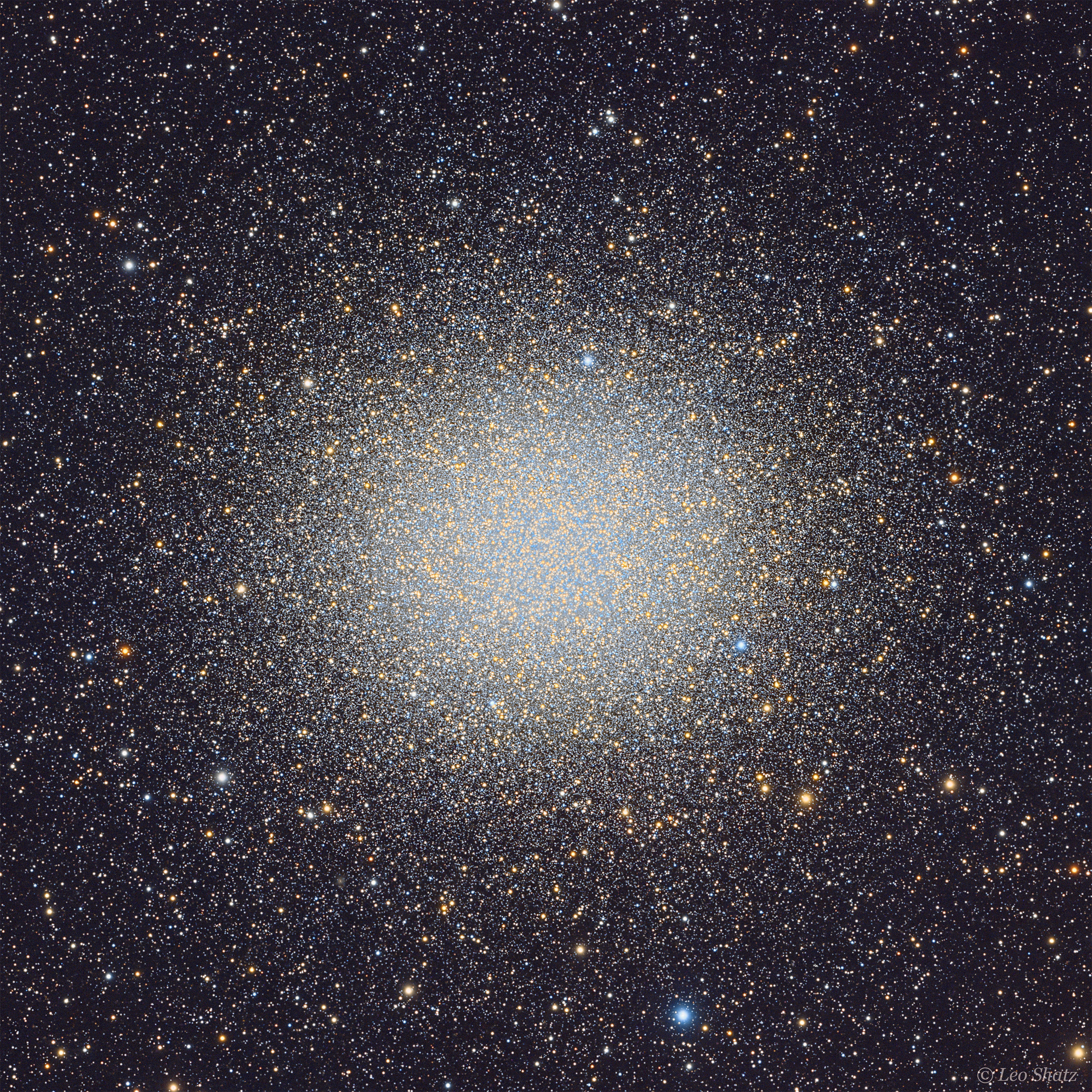
Globular Cluster Omega Centauri
* Image Credit & Copyright: Data acquisition - SkyFlux Team, Processing - Leo Shatz
https://app.astrobin.com/u/spinlock#gallery
Explanation:
Globular star cluster Omega Centauri packs about 10 million stars much older than the Sun into a volume some 150 light-years in diameter. Also known as NGC 5139, at a distance of 15,000 light-years it's the largest and brightest of 200 or so known globular clusters that roam the halo of our Milky Way galaxy. Though most star clusters consist of stars with the same age and composition, the enigmatic Omega Cen exhibits the presence of different stellar populations with a spread of ages and chemical abundances. In fact, Omega Cen may be the remnant core of a small galaxy merging with the Milky Way. With a yellowish hue, Omega Centauri's red giant stars are easy to pick out in this sharp telescopic view. A two-decade-long exploration of the dense star cluster with the Hubble Space Telescope has revealed evidence for a massive black hole near the center of Omega Centauri.
https://app.astrobin.com/i/7na4mz
https://ui.adsabs.harvard.edu/abs/2021A%26A...653L...8L/abstract
https://en.wikipedia.org/wiki/Globular_cluster
https://earthsky.org/clusters-nebulae-galaxies/omega-centauri-milky-ways-prize-star-cluster/
https://esahubble.org/news/heic0809/
https://apod.nasa.gov/apod/ap250726.html
About Intermediate-Mass Black Hole in Omega Centauri:
https://defcon.social/@grobi/114918173169808417
#space #cluster #astrophotography #photography #science #astronomy #physics #nature #NASA
Alt...
2025 July 26
Globular Cluster Omega Centauri
* Image Credit & Copyright: Data acquisition - SkyFlux Team, Processing - Leo Shatz
Explanation:
Globular star cluster Omega Centauri packs about 10 million stars much older than the Sun into a volume some 150 light-years in diameter. Also known as NGC 5139, at a distance of 15,000 light-years it's the largest and brightest of 200 or so known globular clusters that roam the halo of our Milky Way galaxy. Though most star clusters consist of stars with the same age and composition, the enigmatic Omega Cen exhibits the presence of different stellar populations with a spread of ages and chemical abundances. In fact, Omega Cen may be the remnant core of a small galaxy merging with the Milky Way. With a yellowish hue, Omega Centauri's red giant stars are easy to pick out in this sharp telescopic view. A two-decade-long exploration of the dense star cluster with the Hubble Space Telescope has revealed evidence for a massive black hole near the center of Omega Centauri.
Authors & editors: Robert Nemiroff (MTU) & Jerry Bonnell (UMCP)
NASA Official: Amber Straughn Specific rights apply.
NASA Web Privacy, Accessibility, Notices;
A service of: ASD at NASA / GSFC,
NASA Science Activation
& Michigan Tech. U.
2025 August 7
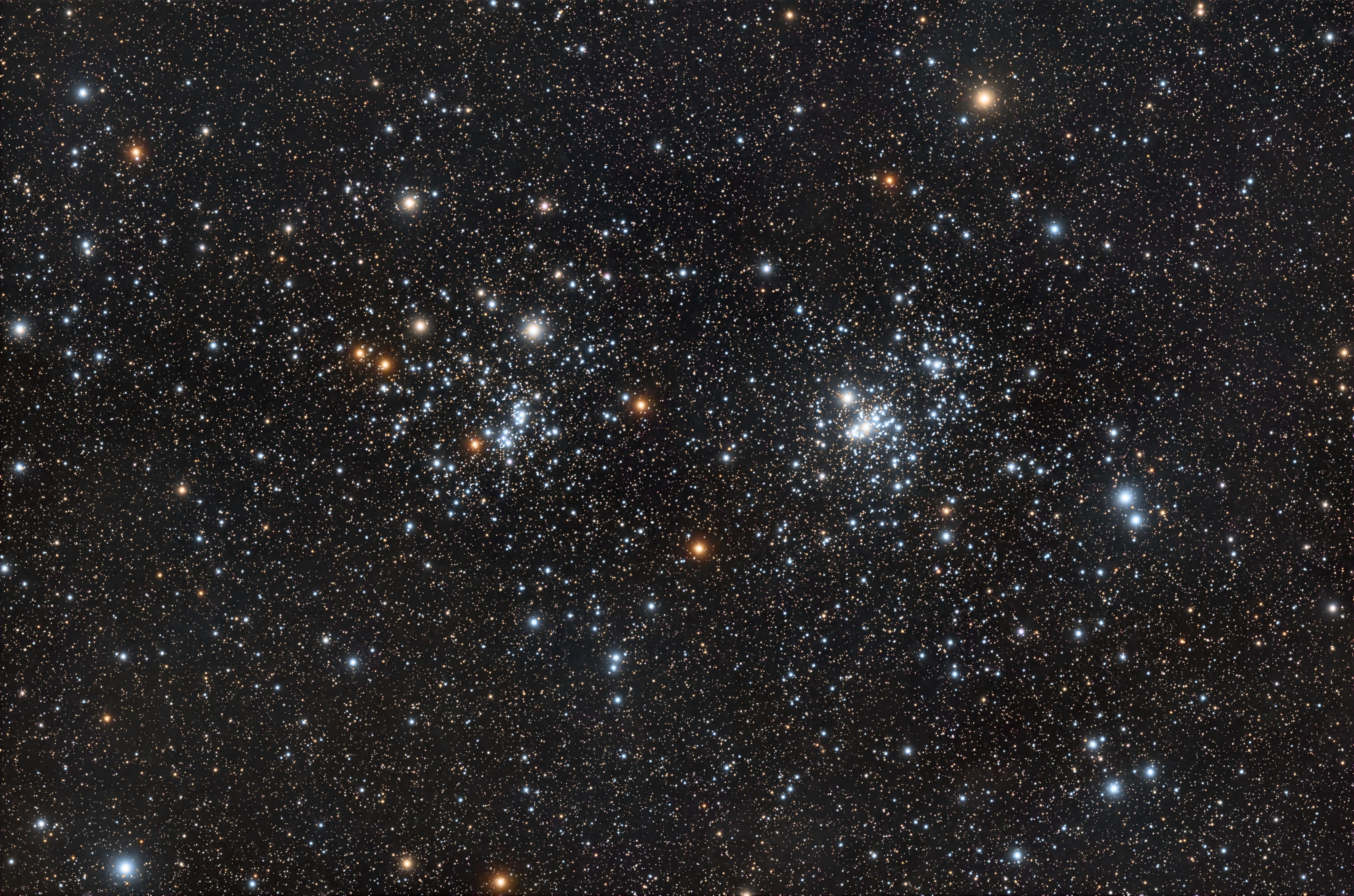
The Double Cluster in Perseus
* Image Credit & Copyright: Ron Brecher
https://astrodoc.ca/about-me/
Explanation:
This stunning starfield spans about three full moons (1.5 degrees) across the heroic northern constellation of Perseus. It holds the famous pair of open star clusters, h and Chi Persei. Also cataloged as NGC 869 (right) and NGC 884, both clusters are about 7,000 light-years away and contain stars much younger and hotter than the Sun. Separated by only a few hundred light-years, the clusters are both 13 million years young based on the ages of their individual stars, evidence that both clusters were likely a product of the same star-forming region. Always a rewarding sight in binoculars or small telescopes, the Double Cluster is even visible to the unaided eye from dark locations.
https://astrodoc.ca/double-cluster-2025/
https://science.nasa.gov/mission/hubble/science/explore-the-night-sky/hubble-caldwell-catalog/caldwell-14/
http://www.messier.seds.org/xtra/ngc/n0869.html
https://arxiv.org/abs/astro-ph/0205130
https://astrobackyard.com/double-cluster-in-perseus/
https://en.wikipedia.org/wiki/Perseus_(constellation)
http://www.messier.seds.org/open.html
https://apod.nasa.gov/apod/ap250807.html
#space #cluster #astrophotography #photography #science #astronomy #physics #nature #NASA
Alt...
2025 August 7
The Double Cluster in Perseus
* Image Credit & Copyright: Ron Brecher
Explanation:
This stunning starfield spans about three full moons (1.5 degrees) across the heroic northern constellation of Perseus. It holds the famous pair of open star clusters, h and Chi Persei. Also cataloged as NGC 869 (right) and NGC 884, both clusters are about 7,000 light-years away and contain stars much younger and hotter than the Sun. Separated by only a few hundred light-years, the clusters are both 13 million years young based on the ages of their individual stars, evidence that both clusters were likely a product of the same star-forming region. Always a rewarding sight in binoculars or small telescopes, the Double Cluster is even visible to the unaided eye from dark locations.
Authors & editors: Robert Nemiroff (MTU) & Jerry Bonnell (UMCP)
NASA Official: Amber Straughn Specific rights apply.
NASA Web Privacy, Accessibility, Notices;
A service of: ASD at NASA / GSFC,
NASA Science Activation
& Michigan Tech. U.
2025 August 14
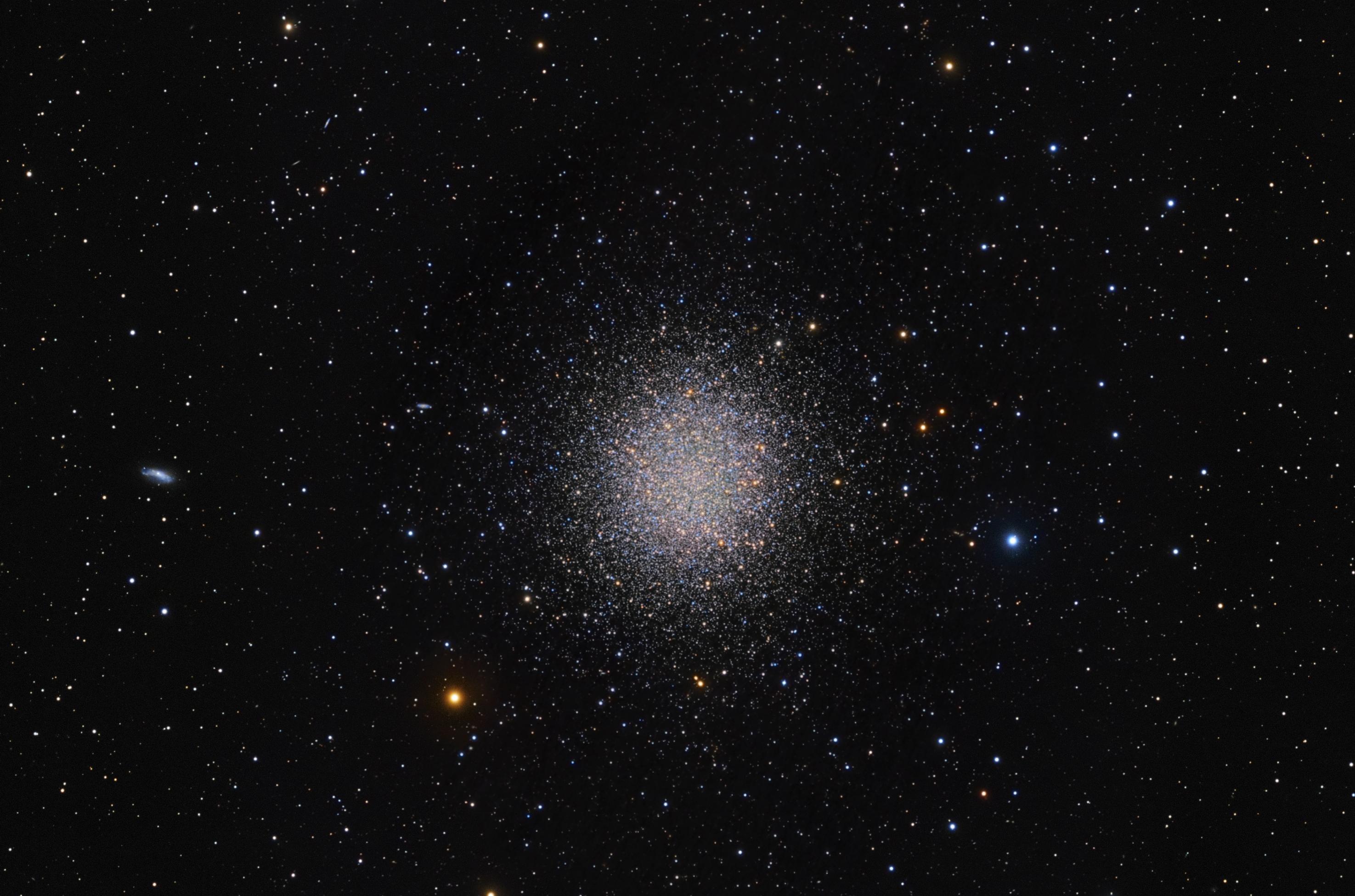
M13: The Great Globular Cluster in Hercules
* Image Credit & Copyright: R. Jay Gabany
https://www.cosmotography.com/index.html
Explanation:
In 1716, English astronomer Edmond Halley noted, "This is but a little Patch, but it shews itself to the naked Eye, when the Sky is serene and the Moon absent." Of course, M13 is now less modestly recognized as the Great Globular Cluster in Hercules, one of the brightest globular star clusters in the northern sky. Sharp telescopic views like this one reveal the spectacular cluster's hundreds of thousands of stars. At a distance of 25,000 light-years, the cluster stars crowd into a region 150 light-years in diameter. Approaching the cluster core, upwards of 100 stars could be contained in a cube just 3 light-years on a side. For comparison with our neighborhood of the Milky Way, the closest star to the Sun is over 4 light-years away. Early telescopic observers of the great globular cluster also noted a curious convergence of three dark lanes with a spacing of about 120 degrees, seen here just below the cluster center. Known as the propeller in M13, the shape is likely a chance optical effect of the distribution of stars viewed from our perspective against the dense cluster core.
http://www.messier.seds.org/m/m013.html
https://science.nasa.gov/missions/hubble/a-celestial-snow-globe-of-stars/
https://www.cosmotography.com/images/small_ngc6205.html
https://en.wikipedia.org/wiki/Globular_cluster
http://www.messier.seds.org/xtra/similar/halley_pt.html
https://www.bbc.co.uk/history/historic_figures/halley_edmond.shtml
https://skyandtelescope.org/observing/gobs-of-globs-guide-to-16-spring-globular-clusters/
https://apod.nasa.gov/apod/ap250814.html
#space #cluster #astrophotography #photography #science #astronomy #physics #nature #NASA
Alt...
2025 August 14
M13: The Great Globular Cluster in Hercules
* Image Credit & Copyright: R. Jay Gabany
Explanation:
In 1716, English astronomer Edmond Halley noted, "This is but a little Patch, but it shews itself to the naked Eye, when the Sky is serene and the Moon absent." Of course, M13 is now less modestly recognized as the Great Globular Cluster in Hercules, one of the brightest globular star clusters in the northern sky. Sharp telescopic views like this one reveal the spectacular cluster's hundreds of thousands of stars. At a distance of 25,000 light-years, the cluster stars crowd into a region 150 light-years in diameter. Approaching the cluster core, upwards of 100 stars could be contained in a cube just 3 light-years on a side. For comparison with our neighborhood of the Milky Way, the closest star to the Sun is over 4 light-years away. Early telescopic observers of the great globular cluster also noted a curious convergence of three dark lanes with a spacing of about 120 degrees, seen here just below the cluster center. Known as the propeller in M13, the shape is likely a chance optical effect of the distribution of stars viewed from our perspective against the dense cluster core.
Authors & editors: Robert Nemiroff (MTU) & Jerry Bonnell (UMCP)
NASA Official: Amber Straughn Specific rights apply.
NASA Web Privacy, Accessibility, Notices;
A service of: ASD at NASA / GSFC,
NASA Science Activation
& Michigan Tech. U.
![[?]](https://files.mastodon.social/accounts/avatars/110/785/978/856/457/376/original/491bc21b6e651aad.jpg)
#Bicycle in #Spring #Garden by Kaye Menner Wide variety #Prints & lovely #Products at:
https://kaye-menner.pixels.com/featured/bicycle-in-spring-garden-by-kaye-menner-kaye-menner.html
#vintage #flowers #floral #colorfulflowers #spring #springflowers #sunrise #blossoms #pastel #garden #nature #ai #digitalart #homedecor #mastoart #fediverse #fediart #fedigiftshop #giftideas #wallartforsale #Art #artforsale #BuyIntoArt #AYearForArt #Artist #FineArtAmerica #PhotographyFeed #VisualArts #CreativeArts

Alt...
A vintage teal bicycle rests gracefully in a dreamlike garden, its basket overflowing with fresh blossoms. Surrounded by vibrant flowers and soft golden light, the scene radiates peace, romance, and timeless charm.
The soft glow of a misty sunrise bathes the entire scene in warm, serene hues. Delicate petals and leaves create a tranquil yet lively atmosphere, blending seamlessly with the natural surroundings.
By Kaye Menner
https://kaye-menner.pixels.com/featured/bicycle-in-spring-garden-by-kaye-menner-kaye-menner.html
THE FINE ART AMERICA LOGO WILL NOT APPEAR ON PURCHASED PRINTS OR PRODUCTS.
Robin in the blue - a little handmade watercolor painting for the bird lovers.
Have a great day!
Art --> https://karen-kaspar.pixels.com/featured/robin-in-the-blue-karen-kaspar.html
#MastoArt #art #painting #FediArt #FediGiftShop #artist #arte #InteriorDesign #MastodonArt #ArtistsOnMastodon #TraditionalArt #kunst #contemporaryArt #watercolor #watercolour #creativeToots #BuyIntoArt #bird #birds #BirdsOfMastodon #BirdArt #birding #nature #NatureLover #BirdWatching #wildlife #vogel #cute #animals #handmade #robin #blue

Alt...
Robin in the Blue is a watercolor painting in contemporary square format painted by the artist Karen Kaspar. A little robin sits on a branch and looks to the right. The background is abstract in light blue with loose brushstrokes and splashes of colour. The orange-red breast of the little bird stands out as an eye-catcher for the viewer due to the color contrast with the background.
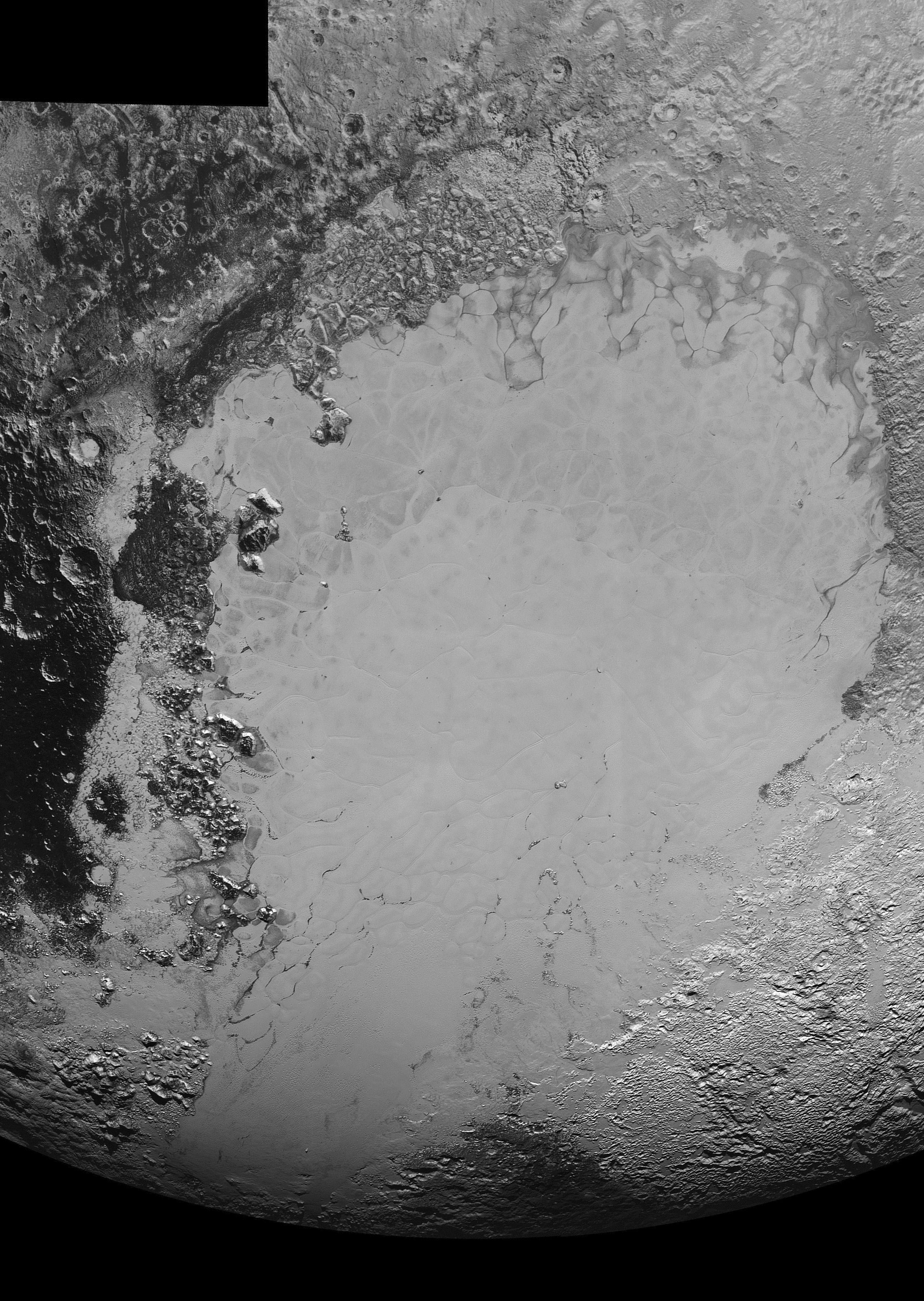
To help understand the diversity of terrain and to piece together how Pluto’s surface has formed and evolved over time, mission scientists construct geological maps like the one shown upper left.
This map covers a portion of Pluto’s surface that measures 1,290 miles (2,070 kilometers) from top to bottom, and includes the vast nitrogen-ice plain informally named Sputnik Planum and surrounding terrain. As the key in the figure below indicates, the map is overlaid with colors that represent different geological terrains. Each terrain, or unit, is defined by its texture and morphology – smooth, pitted, craggy, hummocky or ridged, for example. How well a unit can be defined depends on the resolution of the images that cover it. All of the terrain in this map has been imaged at a resolution of approximately 1,050 feet (320 meters) per pixel or better, meaning scientists can map units with relative confidence The various blue and greenish units that fill the center of the map represent different textures seen across Sputnik Planum, from the cellular terrain in the center and north, to the smooth and pitted plains in the south. The black lines represent troughs that mark the boundaries of cellular regions in the nitrogen ice. The purple unit represents the chaotic, blocky mountain ranges that line Sputnik’s western border, and the pink unit represents the scattered, floating hills at its eastern edge. The possible cryovolcanic feature informally named Wright Mons is mapped in red in the southern corner of the map. The rugged highlands of the informally named Cthulhu Regio are mapped in dark brown along the western edge, pockmarked by many large impact craters, shown in yellow.
[...]
Please read more in the ALT-Text of the map (left image)
#space #pluto #astrophotography #photography #science #astronomy #nature #NASA #education
![[...]
By studying how the boundaries between units crosscut one another, mission scientists can determine which units overlie others, and assemble a relative chronology for the different units. For example, the yellow craters (at left, on the western edge of the map) must have formed after their surrounding terrain. Producing such maps is important for gauging what processes have operated where on Pluto, and when they occurred relative to other processes at work. The base map for this geologic map is a mosaic of 12 images obtained by the Long Range Reconnaissance Imager (LORRI) at a resolution of 1,280 feet (about 390 meters) per pixel. The mosaic was obtained at a range of approximately 48,000 miles (77,300 kilometers) from Pluto, about an hour and 40 minutes before New Horizons' closest approach on July 14, 2015. (Last Updated: Feb. 11, 2016 - Editor: Tricia Talbert) The original NASA image has been cropped by the uploader.
CREDIT
NASA / Johns Hopkins University Applied Physics Laboratory / Southwest Research Institute](https://files.defcon.social/dcsocial-s3/media_attachments/files/115/306/221/513/300/442/original/db3f7f42bc1db26b.jpg "[...]
By studying how the boundaries between units crosscut one another, mission scientists can determine which units overlie others, and assemble a relative chronology for the different units. For example, the yellow craters (at left, on the western edge of the map) must have formed after their surrounding terrain. Producing such maps is important for gauging what processes have operated where on Pluto, and when they occurred relative to other processes at work. The base map for this geologic map is a mosaic of 12 images obtained by the Long Range Reconnaissance Imager (LORRI) at a resolution of 1,280 feet (about 390 meters) per pixel. The mosaic was obtained at a range of approximately 48,000 miles (77,300 kilometers) from Pluto, about an hour and 40 minutes before New Horizons' closest approach on July 14, 2015. (Last Updated: Feb. 11, 2016 - Editor: Tricia Talbert) The original NASA image has been cropped by the uploader.
CREDIT
NASA / Johns Hopkins University Applied Physics Laboratory / Southwest Research Institute")
Alt...
[...]
By studying how the boundaries between units crosscut one another, mission scientists can determine which units overlie others, and assemble a relative chronology for the different units. For example, the yellow craters (at left, on the western edge of the map) must have formed after their surrounding terrain. Producing such maps is important for gauging what processes have operated where on Pluto, and when they occurred relative to other processes at work. The base map for this geologic map is a mosaic of 12 images obtained by the Long Range Reconnaissance Imager (LORRI) at a resolution of 1,280 feet (about 390 meters) per pixel. The mosaic was obtained at a range of approximately 48,000 miles (77,300 kilometers) from Pluto, about an hour and 40 minutes before New Horizons' closest approach on July 14, 2015. (Last Updated: Feb. 11, 2016 - Editor: Tricia Talbert) The original NASA image has been cropped by the uploader.
CREDIT
NASA / Johns Hopkins University Applied Physics Laboratory / Southwest Research Institute

Alt...
Annotated map of Sputnik Planitia on Pluto
- Geological mapping of Sputnik Planitia on Pluto, Icarus (2017), doi: 10.1016/j.icarus.2017.01.011
CREDIT
Oliver L. White, Jeffrey M. Moore, William B. McKinnon, John R. Spencer, Alan D. Howard, Paul M. Schenk, Ross A. Beyer, Francis Nimmo, Kelsi N. Singer, Orkan M. Umurhan, S. Alan Stern, Kimberly Ennico, Cathy B. Olkin, Harold A. Weaver, Leslie A. Young, Andrew F. Cheng, Tanguy Bertrand, Richard P. Binzel, Alissa M. Earle, Will M. Grundy, Tod R. Lauer, Silvia Protopapa, Stuart J. Robbins, Bernard Schmitt, the New Horizons Science Team
Alt...
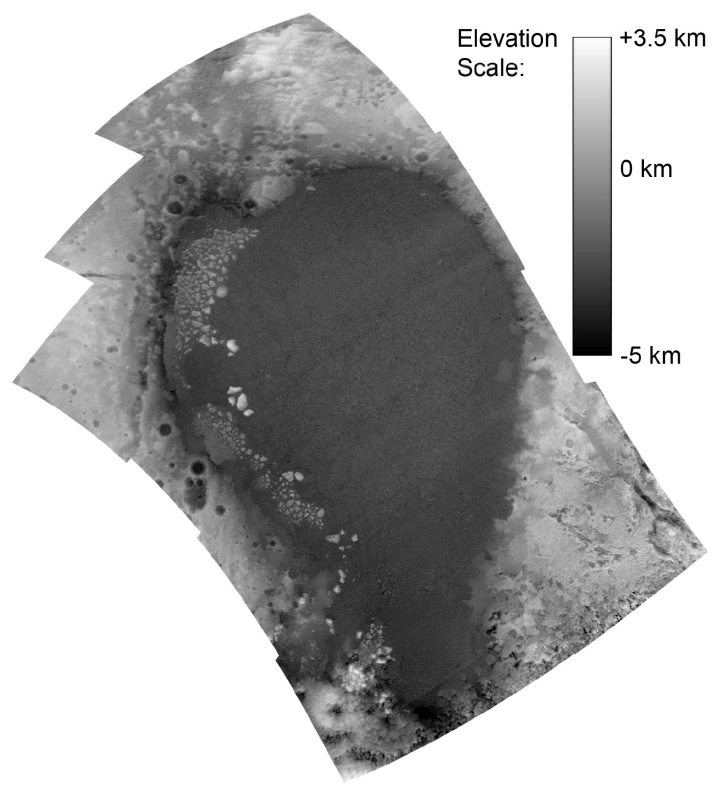
A topographic image of the Sputnik Planitia basin, showing the rising scarps bordering the glacial plains. The banding is an artefact of the camera.
- Geological mapping of Sputnik Planitia on Pluto, Icarus (2017), doi: 10.1016/j.icarus.2017.01.011
CREDIT
Oliver L. White, Jeffrey M. Moore, William B. McKinnon, John R. Spencer, Alan D. Howard, Paul M. Schenk, Ross A. Beyer, Francis Nimmo, Kelsi N. Singer, Orkan M. Umurhan, S. Alan Stern, Kimberly Ennico, Cathy B. Olkin, Harold A. Weaver, Leslie A. Young, Andrew F. Cheng, Tanguy Bertrand, Richard P. Binzel, Alissa M. Earle, Will M. Grundy, Tod R. Lauer, Silvia Protopapa, Stuart J. Robbins, Bernard Schmitt, the New Horizons Science Team
Alt...
Mosaic of high-resolution LORRI images of Pluto, sent back from NASA's New Horizons spacecraft from Sept. 5 to 7, 2015. The image is dominated by the informally-named icy plain Sputnik Planum, the smooth, bright region across the center. This image also features a tremendous variety of other landscapes surrounding Sputnik. The smallest visible features are 0.5 miles (0.8 kilometers) in size, and the mosaic covers a region roughly 1,000 miles (1600 kilometers) wide. The image was taken as New Horizons flew past Pluto on July 14, 2015, from a distance of 50,000 miles (80,000 kilometers). The Johns Hopkins University Applied Physics Laboratory in Laurel, Maryland, designed, built, and operates the New Horizons spacecraft, and manages the mission for NASA's Science Mission Directorate. The Southwest Research Institute, based in San Antonio, leads the science team, payload operations and encounter science planning. New Horizons is part of the New Frontiers Program managed by NASA's Marshall Space Flight Center in Huntsville, Alabama. UPLOADER NOTES: The original NASA image has been modified by the uploader as follows: rotating clockwise 90°, extending the lower border by 154 pixels, and converting from TIFF to JPEG format. North is to the upper right.
Secrets Revealed from Pluto’s ‘Twilight Zone’
NASA's New Horizons spacecraft took this stunning image of Pluto only a few minutes after closest approach on July 14, 2015. The image was obtained at a high phase angle -- that is, with the sun on the other side of Pluto, as viewed by New Horizons. Seen here, sunlight filters through and illuminates Pluto's complex atmospheric haze layers. The southern portions of the nitrogen ice plains informally named Sputnik Planum, as well as mountains of the informally named Norgay Montes, can also be seen across Pluto's crescent at the top of the image.
Looking back at Pluto with images like this gives New Horizons scientists information about Pluto's hazes and surface properties that they can't get from images taken on approach. The image was obtained by New Horizons' Ralph/Multispectral Visual Imaging Camera (MVIC) approximately 13,400 miles (21,550 kilometers) from Pluto, about 19 minutes after New Horizons' closest approach. The image has a resolution of 1,400 feet (430 meters) per pixel. Pluto's diameter is 1,475 miles (2,374 kilometers).
[...]
Please read about the annotations in ALT-Text.
CREDIT
The Johns Hopkins University Applied Physics Laboratory in Laurel, Maryland, designed, built, and operates the New Horizons spacecraft, and manages the mission for NASA's Science Mission Directorate. The Southwest Research Institute, based in San Antonio, leads the science team, payload operations and encounter science planning. New Horizons is part of the New Frontiers Program managed by NASA's Marshall Space Flight Center in Huntsville, Alabama.
https://science.nasa.gov/photojournal/secrets-revealed-from-plutos-twilight-zone/
#space #pluto #astrophotography #photography #science #astronomy #physics #nature #NASA #education
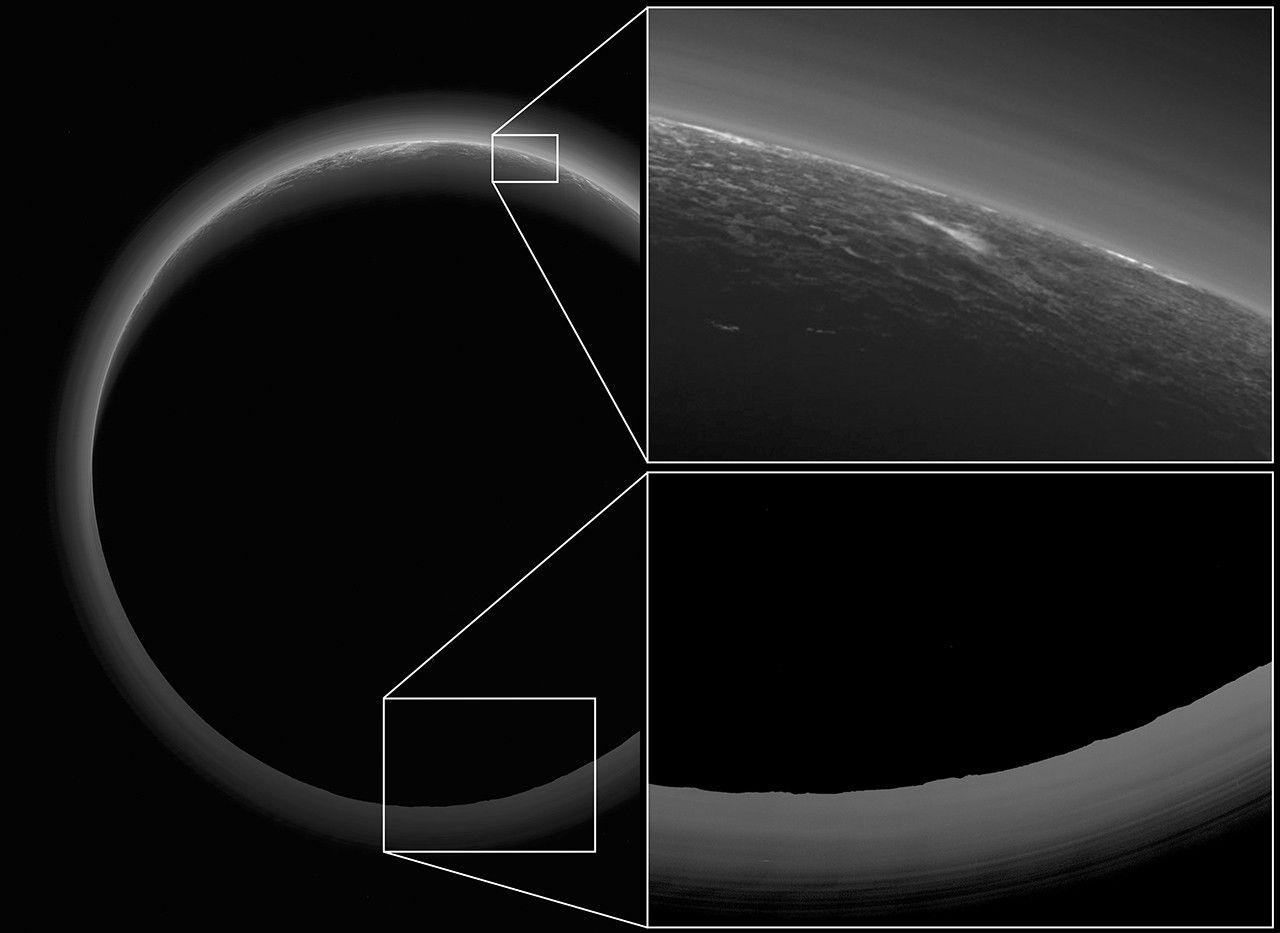
Alt...
Annotated Version of image in previous post
The inset at top right in the annotated version shows a detail of Pluto's crescent, including an intriguing bright wisp (near the center) measuring tens of miles across that may be a discreet, low-lying cloud in Pluto's atmosphere; if so, it would be the only one yet identified in New Horizons imagery. This cloud -- if that's what it is -- is visible for the same reason the haze layers are so bright: illumination from the sunlight grazing Pluto's surface at a low angle. Atmospheric models suggest that methane clouds can occasionally form in Pluto's atmosphere. The scene in this inset is 140 miles (230 kilometers) across.
The inset at bottom right shows more detail on the night side of Pluto. This terrain can be seen because it is illuminated from behind by hazes that silhouette the of the annotated version limb. The topography here appears quite rugged, and broad valleys and sharp peaks with relief totaling 3 miles (5 kilometers) are apparent. This image, made from closer range, is much better than the lower-resolution images of this same terrain taken several days before closest approach. These silhouetted terrains therefore act as a useful "anchor point," giving New Horizons scientists a rare, detailed glimpse at the lay of the land in this mysterious part of Pluto seen at high resolution only in twilight. The scene in this inset is 460 miles (750 kilometers) wide.
TOPIC> Pluto
2025 October 2
Pluto at Night
* Image Credit: NASA, Johns Hopkins Univ./APL, Southwest Research Institute
http://www.nasa.gov/
http://www.jhuapl.edu/
http://www.swri.edu/
Explanation:
The night side of Pluto spans this shadowy scene. In the stunning spacebased perspective, the Sun is 4.9 billion kilometers (almost 4.5 light-hours) behind the dim and distant world. It was captured by far flung New Horizons in July of 2015 when the spacecraft was at a range of some 21,000 kilometers from Pluto. That was about 19 minutes after its closest approach. A denizen of the Kuiper Belt in dramatic silhouette, the image also reveals Pluto's tenuous, surprisingly complex layers of hazy atmosphere. Near the top of the frame the crescent twilight landscape includes southern areas of nitrogen ice plains now formally known as Sputnik Planitia and rugged mountains of water-ice in the Norgay Montes.
https://science.nasa.gov/photojournal/secrets-revealed-from-plutos-twilight-zone/
https://science.nasa.gov/photojournal/new-horizons-best-close-up-of-plutos-surface/
https://en.wikipedia.org/wiki/Sputnik_Planitia
https://science.nasa.gov/solar-system/kuiper-belt/
https://apod.nasa.gov/apod/fap/ap251002.html
#NASA #inofficial #space #pluto #astrophotography #photography #science #astronomy #nature
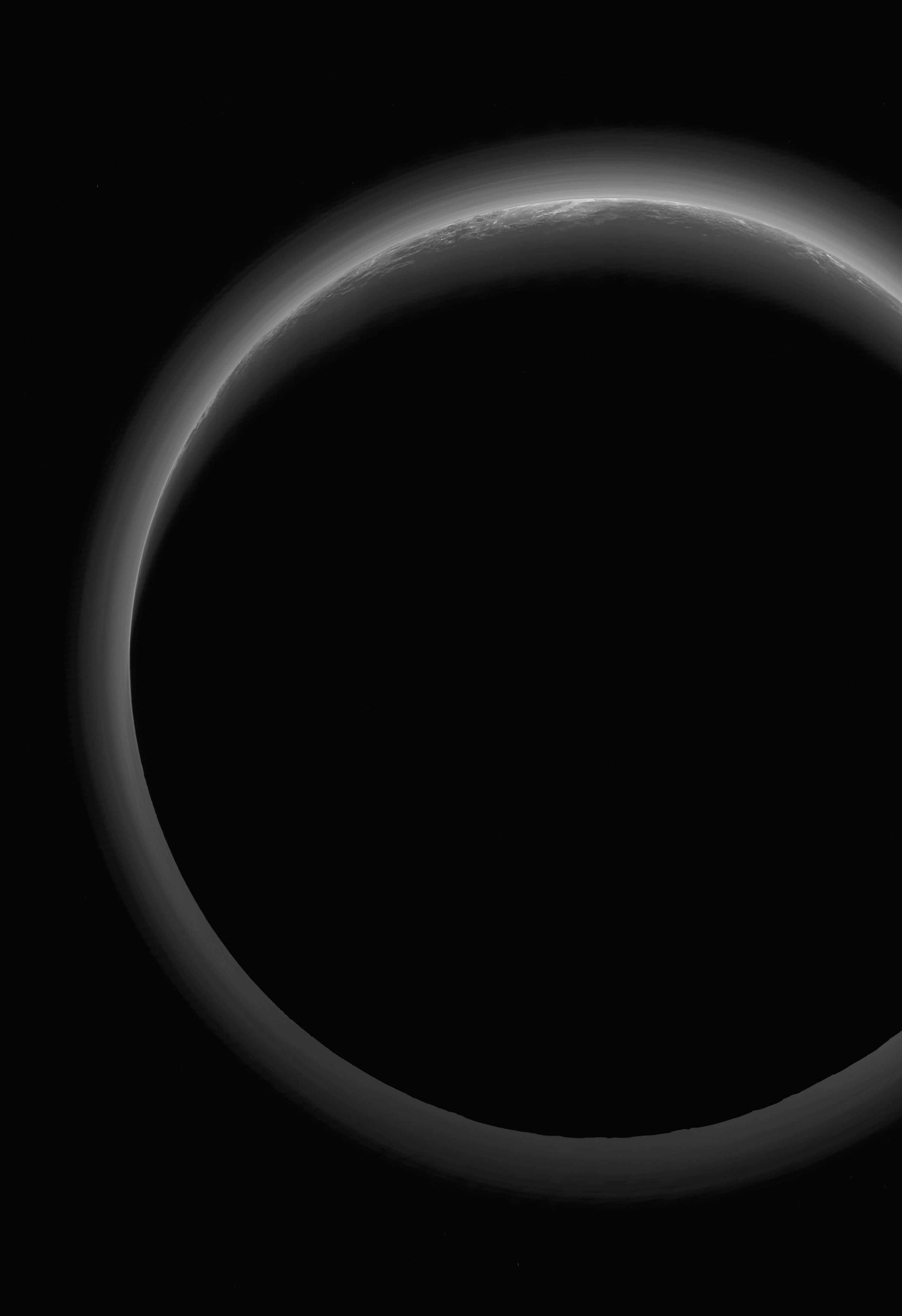
Alt...
2025 October 2
Pluto at Night
* Image Credit: NASA, Johns Hopkins Univ./APL, Southwest Research Institute
Explanation:
The night side of Pluto spans this shadowy scene. In the stunning spacebased perspective, the Sun is 4.9 billion kilometers (almost 4.5 light-hours) behind the dim and distant world. It was captured by far flung New Horizons in July of 2015 when the spacecraft was at a range of some 21,000 kilometers from Pluto. That was about 19 minutes after its closest approach. A denizen of the Kuiper Belt in dramatic silhouette, the image also reveals Pluto's tenuous, surprisingly complex layers of hazy atmosphere. Near the top of the frame the crescent twilight landscape includes southern areas of nitrogen ice plains now formally known as Sputnik Planitia and rugged mountains of water-ice in the Norgay Montes.
Authors & editors: Robert Nemiroff (MTU) & Jerry Bonnell (UMCP)
NASA Official: Amber Straughn Specific rights apply.
NASA Web Privacy, Accessibility, Notices;
A service of: ASD at NASA / GSFC,
NASA Science Activation
& Michigan Tech. U.
2025 August 6
Meteor before Galaxy
* Image Credit & Copyright: Fritz Helmut Hemmerich
https://www.flickr.com/people/fhhemmerich/
Explanation:
What's that green streak in front of the Andromeda galaxy? A meteor. While photographing the Andromeda galaxy in 2016, near the peak of the Perseid Meteor Shower, a small pebble from deep space crossed right in front of our Milky Way Galaxy's far-distant companion. The small meteor took only a fraction of a second to pass through this 10-degree field. The meteor flared several times while braking violently upon entering Earth's atmosphere. The green color was created, at least in part, by the meteor's gas glowing as it vaporized. Although the exposure was timed to catch a Perseid meteor, the orientation of the imaged streak seems a better match to a meteor from the Southern Delta Aquariids, a meteor shower that peaked a few weeks earlier. Not coincidentally, the Perseid Meteor Shower peaks next week, although this year the meteors will have to outshine a sky brightened by a nearly full moon.
https://apod.nasa.gov/apod/ap250806.html
#space #perseids #astrophotography #photography #science #astronomy #nature #NASA
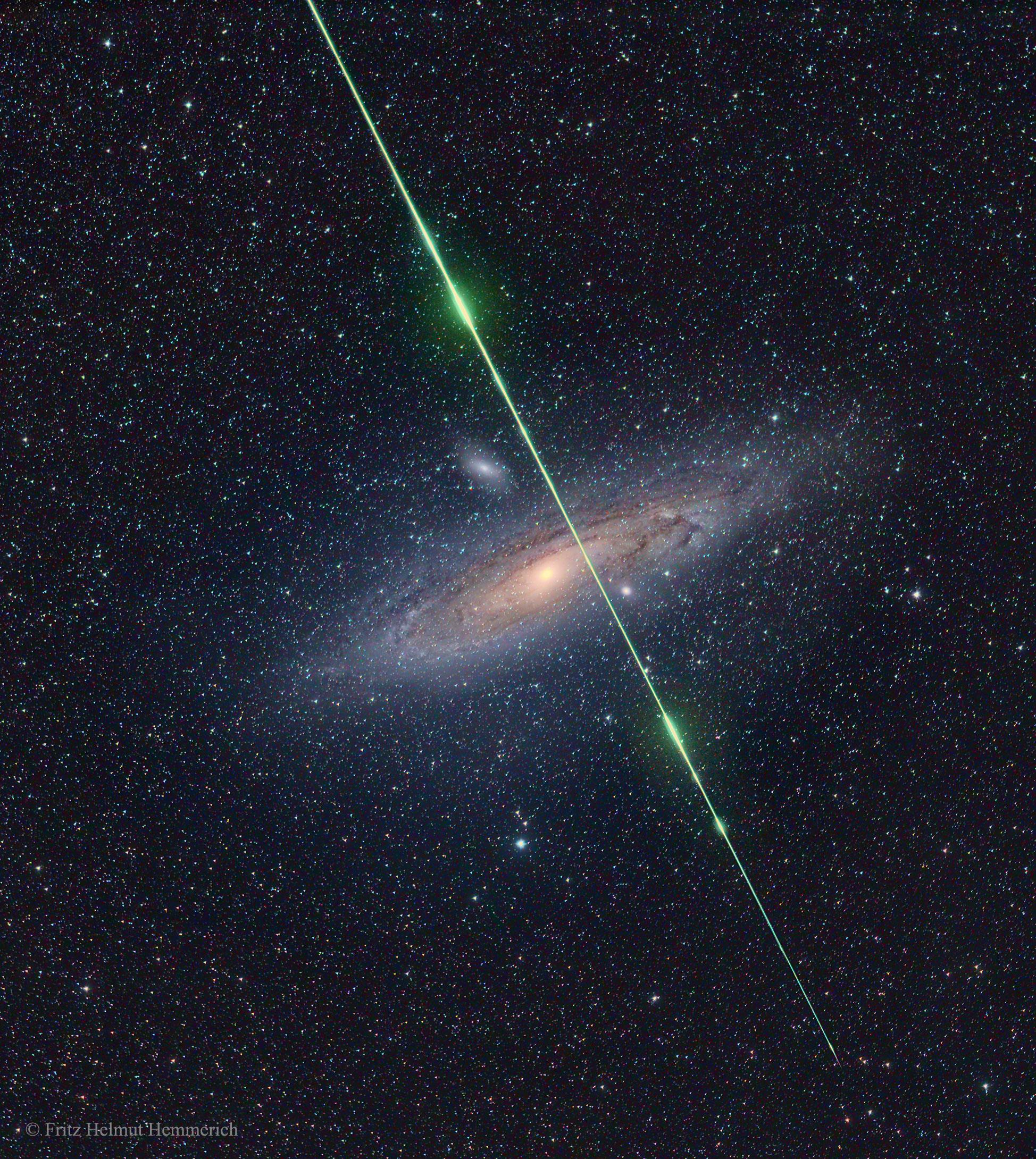
Alt...
2025 August 6
A starfield has the Andromeda galaxy in the center. Streaking down from the top is a green line with several bright segments -- a meteor captured coincidently. Please see the explanation for more detailed information.
Meteor before Galaxy
* Image Credit & Copyright: Fritz Helmut Hemmerich
Explanation:
What's that green streak in front of the Andromeda galaxy? A meteor. While photographing the Andromeda galaxy in 2016, near the peak of the Perseid Meteor Shower, a small pebble from deep space crossed right in front of our Milky Way Galaxy's far-distant companion. The small meteor took only a fraction of a second to pass through this 10-degree field. The meteor flared several times while braking violently upon entering Earth's atmosphere. The green color was created, at least in part, by the meteor's gas glowing as it vaporized. Although the exposure was timed to catch a Perseid meteor, the orientation of the imaged streak seems a better match to a meteor from the Southern Delta Aquariids, a meteor shower that peaked a few weeks earlier. Not coincidentally, the Perseid Meteor Shower peaks next week, although this year the meteors will have to outshine a sky brightened by a nearly full moon.
Authors & editors: Robert Nemiroff (MTU) & Jerry Bonnell (UMCP)
NASA Official: Amber Straughn Specific rights apply.
NASA Web Privacy, Accessibility, Notices;
A service of: ASD at NASA / GSFC,
NASA Science Activation
& Michigan Tech. U.
TOPIC> Perseids & Co. Meteor Showers
2023 August 24
Meteors along the Milky Way
* Image Credit & Copyright: Ali Hosseini Nezhad
Explanation:
Under dark and mostly moonless night skies, many denizens of planet Earth were able to watch this year's Perseid meteor shower. Seen from a grassy hillside from Shiraz, Iran these Perseid meteors streak along the northern summer Milky Way before dawn on Sunday, August 13. Frames used to construct the composited image were captured near the active annual meteor shower's peak between 02:00 AM and 04:30 AM local time. Not in this night skyscape, the shower's radiant in the heroic constellation Perseus is far above the camera's field of view. But fans of northern summer nights can still spot a familiar asterism. Formed by bright stars Deneb, Vega, and Altair, the Summer Triangle spans the luminous band of the Milky Way.
https://apod.nasa.gov/apod/ap230824.html
#space #galaxy #perseids #astrophotography #photography #science #astronomy #nature #NASA
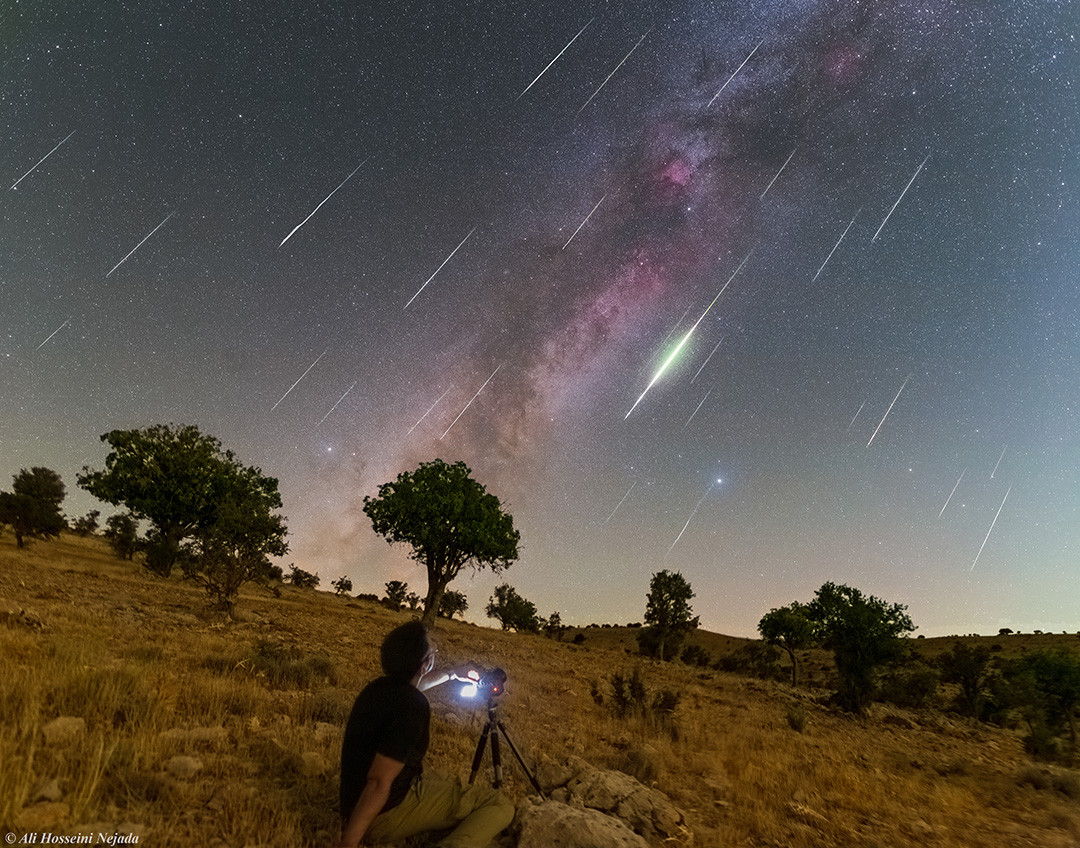
Alt...
2023 August 24
Meteors along the Milky Way
* Image Credit & Copyright: Ali Hosseini Nezhad
Explanation:
Under dark and mostly moonless night skies, many denizens of planet Earth were able to watch this year's Perseid meteor shower. Seen from a grassy hillside from Shiraz, Iran these Perseid meteors streak along the northern summer Milky Way before dawn on Sunday, August 13. Frames used to construct the composited image were captured near the active annual meteor shower's peak between 02:00 AM and 04:30 AM local time. Not in this night skyscape, the shower's radiant in the heroic constellation Perseus is far above the camera's field of view. But fans of northern summer nights can still spot a familiar asterism. Formed by bright stars Deneb, Vega, and Altair, the Summer Triangle spans the luminous band of the Milky Way.
Authors & editors: Robert Nemiroff (MTU) & Jerry Bonnell (UMCP)
NASA Official: Phillip Newman Specific rights apply.
NASA Web Privacy Policy and Important Notices
A service of: ASD at NASA / GSFC,
NASA Science Activation
& Michigan Tech. U.
Annotations for previous post.
#space #galaxy #perseids #astrophotography #photography #science #astronomy #nature #NASA
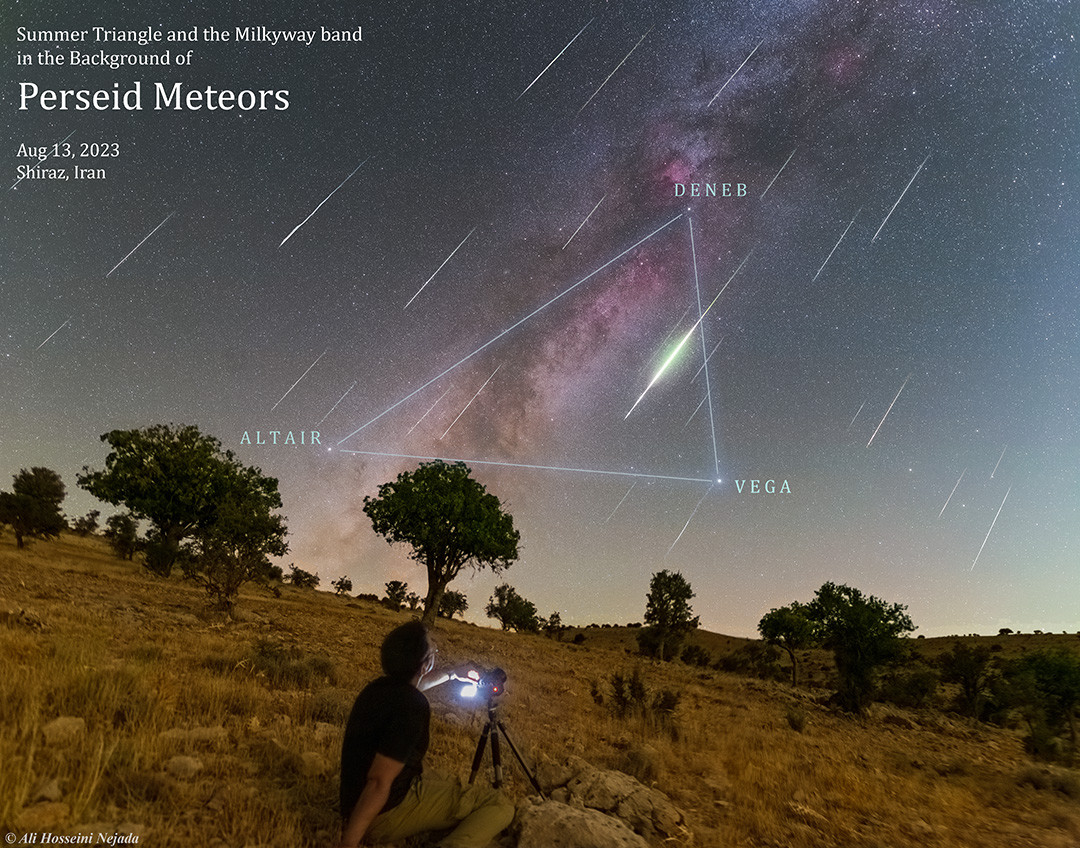
Alt...
Annotations for previous post.
2023 August 24
Meteors along the Milky Way
* Image Credit & Copyright: Ali Hosseini Nezhad
Explanation:
Under dark and mostly moonless night skies, many denizens of planet Earth were able to watch this year's Perseid meteor shower. Seen from a grassy hillside from Shiraz, Iran these Perseid meteors streak along the northern summer Milky Way before dawn on Sunday, August 13. Frames used to construct the composited image were captured near the active annual meteor shower's peak between 02:00 AM and 04:30 AM local time. Not in this night skyscape, the shower's radiant in the heroic constellation Perseus is far above the camera's field of view. But fans of northern summer nights can still spot a familiar asterism. Formed by bright stars Deneb, Vega, and Altair, the Summer Triangle spans the luminous band of the Milky Way.
Authors & editors: Robert Nemiroff (MTU) & Jerry Bonnell (UMCP)
NASA Official: Phillip Newman Specific rights apply.
NASA Web Privacy Policy and Important Notices
A service of: ASD at NASA / GSFC,
NASA Science Activation
& Michigan Tech. U.
Perseids
NASA Science Editorial Team
Perseids Meteor Shower
The Perseids meteor shower peaks in mid-August, and is the most popular meteor shower of the year.
About the Meteor Shower
The Perseids, which peaks in mid-August, is considered the best meteor shower of the year. With swift and bright meteors, Perseids frequently leave long "wakes" of light and color behind them as they streak through Earth's atmosphere. The Perseids are one of the most plentiful showers with about 50 to 100 meteors seen per hour. They occur with warm summer nighttime weather allowing sky watchers to comfortably view them.
Perseids are also known for their fireballs. Fireballs are larger explosions of light and color that can persist longer than an average meteor streak. This is due to the fact that fireballs originate from larger particles of cometary material. Fireballs are also brighter, with apparent magnitudes greater than -3.
Viewing Tips
The Perseids are best viewed in the Northern Hemisphere during the pre-dawn hours, though at times it is possible to view meteors from this shower as early as 10 p.m.
Where Do Meteors Come From?
Meteors come from leftover comet particles and bits from broken asteroids. When comets come around the Sun, they leave a dusty trail behind them. Every year Earth passes through these debris trails, which allows the bits to collide with our atmosphere and disintegrate to create fiery and colorful streaks in the sky.
The Comet
The pieces of space debris that interact with our atmosphere to create the Perseids originate from comet 109P/Swift-Tuttle. Swift-Tuttle takes 133 years to orbit the Sun once. It was Giovanni Schiaparelli who realized in 1865 that this comet was the source of the Perseids. Comet Swift-Tuttle last visited the inner solar system in 1992.
https://science.nasa.gov/solar-system/meteors-meteorites/perseids/
#space #galaxy #perseids #astrophotography #photography #science #astronomy #nature #NASA
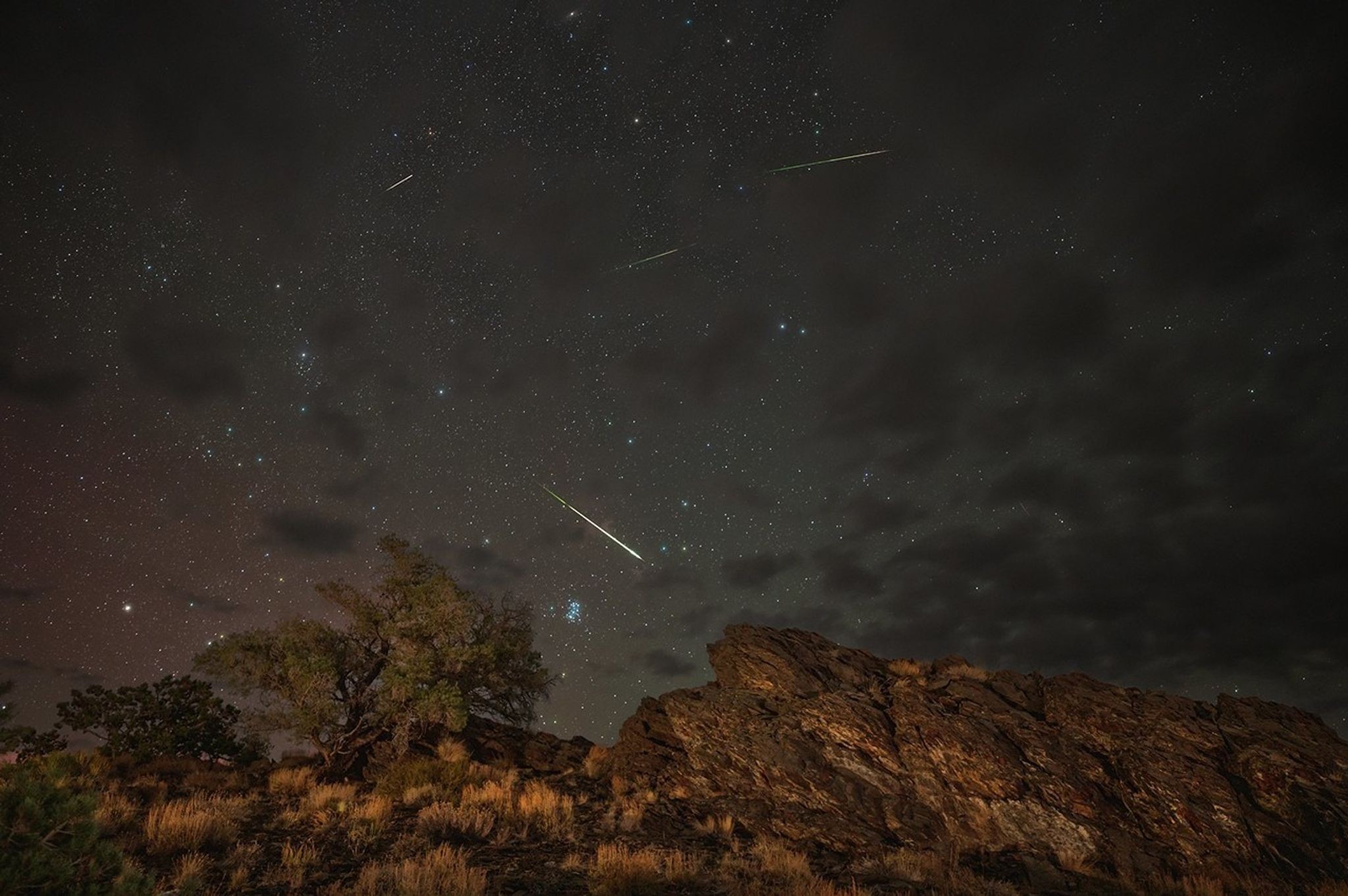
Alt...
Meteors from the Perseids Meteor Shower streak across a partly cloudy sky above Inyo National Forest in Bishop, California, in 2024.
CREDIT
NASA/Preston Dyches
_____
Fast Facts
Comet of Origin 109P/Swift-Tuttle
Radiant Constellation Perseus
Active July 17 to Aug. 23, 2025 (Peak night: Aug. 12-13)
Observed Under Dark Skies About 25 meteors per hour
Meteor Velocity 37 miles (59 km) per second
____
The Comet
The pieces of space debris that interact with our atmosphere to create the Perseids originate from comet 109P/Swift-Tuttle. Swift-Tuttle takes 133 years to orbit the Sun once. It was Giovanni Schiaparelli who realized in 1865 that this comet was the source of the Perseids. Comet Swift-Tuttle last visited the inner solar system in 1992.
Comet Swift-Tuttle was discovered in 1862 by Lewis Swift and Horace Tuttle. Swift-Tuttle is a large comet: its nucleus is 16 miles (26 kilometers) across. (This is almost twice the size of the object hypothesized to have led to the demise of the dinosaurs.)
Their radiant – the point in the sky from which the Perseids appear to come – is the constellation Perseus. This is also where we get the name for the shower: Perseids. However, the constellation for which a meteor shower is named only serves to aid viewers in determining which shower they are viewing on a given night. The constellation is not the source of the meteors.
2024 August 9
A Perseid Below
* Image Credit: Ron Garan, ISS Expedition 28 Crew, NASA
https://www.nasa.gov/mission/expedition-28/
https://www.nasa.gov/
Explanation:
Denizens of planet Earth typically watch meteor showers by looking up. But this remarkable view, captured on August 13, 2011 by astronaut Ron Garan, caught a Perseid meteor by looking down. From Garan's perspective on board the International Space Station orbiting at an altitude of about 380 kilometers, the Perseid meteors streak below, swept up dust from comet Swift-Tuttle. The vaporizing comet dust grains are traveling at about 60 kilometers per second through the denser atmosphere around 100 kilometers above Earth's surface. In this case, the foreshortened meteor flash is near frame center, below the curving limb of the Earth and a layer of greenish airglow, just below bright star Arcturus. Want to look up at a meteor shower? You're in luck, as the 2024 Perseid meteor shower is active now and predicted to peak near August 12. With interfering bright moonlight absent, this year you'll likely see many Perseid meteors under clear, dark skies after midnight.
https://apod.nasa.gov/apod/ap240809.html
#space #galaxy #perseids #astrophotography #photography #science #astronomy #nature #NASA
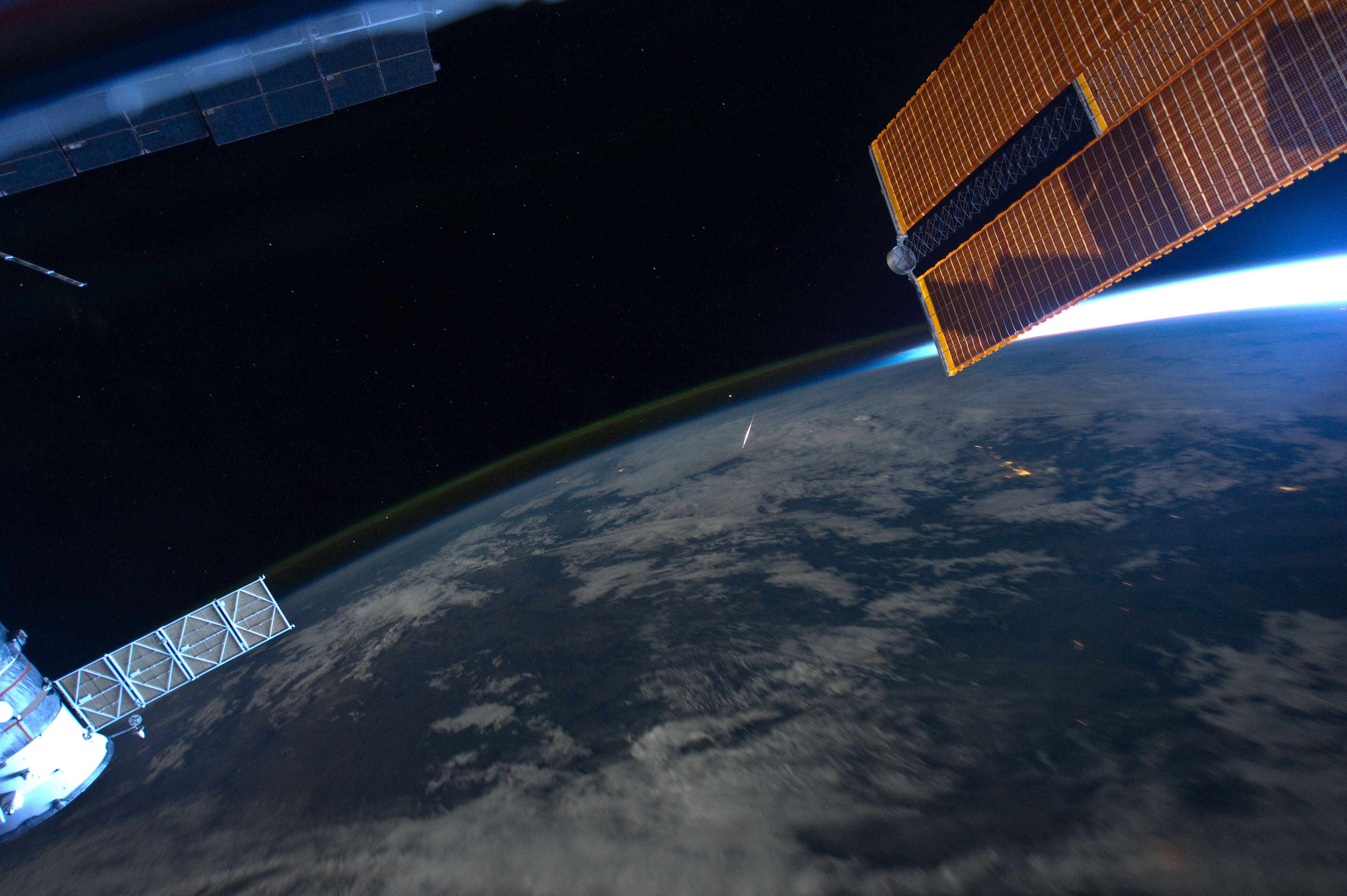
Alt...
2024 August 9
A Perseid Below
* Image Credit: Ron Garan, ISS Expedition 28 Crew, NASA
Explanation:
Denizens of planet Earth typically watch meteor showers by looking up. But this remarkable view, captured on August 13, 2011 by astronaut Ron Garan, caught a Perseid meteor by looking down. From Garan's perspective on board the International Space Station orbiting at an altitude of about 380 kilometers, the Perseid meteors streak below, swept up dust from comet Swift-Tuttle. The vaporizing comet dust grains are traveling at about 60 kilometers per second through the denser atmosphere around 100 kilometers above Earth's surface. In this case, the foreshortened meteor flash is near frame center, below the curving limb of the Earth and a layer of greenish airglow, just below bright star Arcturus. Want to look up at a meteor shower? You're in luck, as the 2024 Perseid meteor shower is active now and predicted to peak near August 12. With interfering bright moonlight absent, this year you'll likely see many Perseid meteors under clear, dark skies after midnight.
Authors & editors: Robert Nemiroff (MTU) & Jerry Bonnell (UMCP)
NASA Official: Amber Straughn Specific rights apply.
NASA Web Privacy, Accessibility Notices
A service of: ASD at NASA / GSFC,
NASA Science Activation
& Michigan Tech. U.
"Our pets and farm animals also enjoy the annual variety full of short surprises in the night sky. It will start again soon! Do you already know when and where to look? Look here, there is everything:https://earthsky.org/astronomy-essentials/everything-you-need-to-know-perseid-meteor-shower/"
2019 August 15
The Perseids and the Plough
* Image Credit & Copyright: Jeff Dai (TWAN)
https://twanight.org/profile/jeff-dai/
Explanation:
Despite interfering moonlight, many denizens of planet Earth were able to watch this year's Perseid meteor shower. This pastoral scene includes local skygazers admiring the shower's brief, heavenly flashes in predawn hours near peak activity on August 13 from Nalati Grassland in Xinjiang, China. A composite, the image registers seven frames taken during a two hour span recording Perseid meteor streaks against a starry sky. Centered along the horizon is the Plough, the north's most famous asterism, though some might see the familiar celestial kitchen utensil known as the Big Dipper. Perhaps the year's most easily enjoyed meteor shower, Perseid meteors are produced as Earth itself sweeps through dust from periodic comet Swift-Tuttle. The dust particles are vaporized at altitudes of 100 kilometers or so as they plow through the atmosphere at 60 kilometers per second.
https://apod.nasa.gov/apod/ap190815.html
#space #galaxy #perseids #astrophotography #photography #science #astronomy #nature #NASA
Alt...
2019 August 15
The Perseids and the Plough
* Image Credit & Copyright: Jeff Dai (TWAN)
Explanation:
Despite interfering moonlight, many denizens of planet Earth were able to watch this year's Perseid meteor shower. This pastoral scene includes local skygazers admiring the shower's brief, heavenly flashes in predawn hours near peak activity on August 13 from Nalati Grassland in Xinjiang, China. A composite, the image registers seven frames taken during a two hour span recording Perseid meteor streaks against a starry sky. Centered along the horizon is the Plough, the north's most famous asterism, though some might see the familiar celestial kitchen utensil known as the Big Dipper. Perhaps the year's most easily enjoyed meteor shower, Perseid meteors are produced as Earth itself sweeps through dust from periodic comet Swift-Tuttle. The dust particles are vaporized at altitudes of 100 kilometers or so as they plow through the atmosphere at 60 kilometers per second.
Authors & editors: Robert Nemiroff (MTU) & Jerry Bonnell (UMCP)
NASA Official: Phillip Newman Specific rights apply.
NASA Web Privacy Policy and Important Notices
A service of: ASD at NASA / GSFC
& Michigan Tech. U.
2018 September 8
Real Time Perseid
* Video Credit & Copyright: Till Credner, AlltheSky.com
http://www.allthesky.com/
Explanation:
Bright meteors and dark night skies made this year's Perseid meteor shower a great time for a weekend campout. And while packing away their equipment, skygazers at a campsite in the mountains of southern Germany found at least one more reason to linger under the stars, witnessing this brief but colorful flash with their own eyes. Presented as a 50 frame gif, the two second long video was captured during the morning twilight of August 12. In real time it shows the development of the typical green train of a bright Perseid meteor. A much fainter Perseid is just visible farther to the right. Plowing through Earth's atmosphere at 60 kilometers per second, Perseids are fast enough to excite the characteristic green emission of atomic oxygen at altitudes of 100 kilometers or so.
https://apod.nasa.gov/apod/ap180908.html
#space #galaxy #perseids #astrophotography #photography #science #astronomy #nature #NASA
2022 August 16
A Meteor Wind over Tunisia
* Image Credit & Copyright: Makrem Larnaout
https://www.facebook.com/TheRoyalAstronomicalSociety
Explanation:
Does the Earth ever pass through a wind of meteors? Yes, and they are frequently visible as meteor showers. Almost all meteors are sand-sized debris that escaped from a Sun-orbiting comet or asteroid, debris that continues in an elongated orbit around the Sun. Circling the same Sun, our Earth can move through an orbiting debris stream, where it can appear, over time, as a meteor wind. The meteors that light up in Earth's atmosphere, however, are usually destroyed. Their streaks, though, can all be traced back to a single point on the sky called the radiant. The featured image composite was taken over two days in late July near the ancient Berber village Zriba El Alia in Tunisia, during the peak of the Southern Delta Aquariids meteor shower. The radiant is to the right of the image. A few days ago our Earth experienced the peak of a more famous meteor wind -- the Perseids.
https://apod.nasa.gov/apod/ap220816.html
#space #galaxy #perseids #astrophotography #photography #science #astronomy #nature #NASA
Alt...
2022 August 16
The featured image shows a composite image capturing many meteor streaks above the ruins of an ancient village.
A Meteor Wind over Tunisia
* Image Credit & Copyright: Makrem Larnaout
Explanation:
Does the Earth ever pass through a wind of meteors? Yes, and they are frequently visible as meteor showers. Almost all meteors are sand-sized debris that escaped from a Sun-orbiting comet or asteroid, debris that continues in an elongated orbit around the Sun. Circling the same Sun, our Earth can move through an orbiting debris stream, where it can appear, over time, as a meteor wind. The meteors that light up in Earth's atmosphere, however, are usually destroyed. Their streaks, though, can all be traced back to a single point on the sky called the radiant. The featured image composite was taken over two days in late July near the ancient Berber village Zriba El Alia in Tunisia, during the peak of the Southern Delta Aquariids meteor shower. The radiant is to the right of the image. A few days ago our Earth experienced the peak of a more famous meteor wind -- the Perseids.
Authors & editors: Robert Nemiroff (MTU) & Jerry Bonnell (UMCP)
NASA Official: Phillip Newman Specific rights apply.
NASA Web Privacy Policy and Important Notices
A service of: ASD at NASA / GSFC,
NASA Science Activation
& Michigan Tech. U.
Annotations for previous post.
#space #galaxy #perseids #astrophotography #photography #science #astronomy #nature #NASA
Alt...
Annotations for previous post.
2022 August 16
The featured image shows a composite image capturing many meteor streaks above the ruins of an ancient village.
A Meteor Wind over Tunisia
* Image Credit & Copyright: Makrem Larnaout
Explanation:
Does the Earth ever pass through a wind of meteors? Yes, and they are frequently visible as meteor showers. Almost all meteors are sand-sized debris that escaped from a Sun-orbiting comet or asteroid, debris that continues in an elongated orbit around the Sun. Circling the same Sun, our Earth can move through an orbiting debris stream, where it can appear, over time, as a meteor wind. The meteors that light up in Earth's atmosphere, however, are usually destroyed. Their streaks, though, can all be traced back to a single point on the sky called the radiant. The featured image composite was taken over two days in late July near the ancient Berber village Zriba El Alia in Tunisia, during the peak of the Southern Delta Aquariids meteor shower. The radiant is to the right of the image. A few days ago our Earth experienced the peak of a more famous meteor wind -- the Perseids.
2022 August 11
Perseids and MAGIC
* Image Credit & Copyright: Urs Leutenegger
https://www.instagram.com/urs.leutenegger/?hl=en
Explanation:
On August 11, 2021 a multi-mirror, 17 meter-diameter MAGIC telescope reflected this starry night sky from the Roque de los Muchachos European Northern Observatory on the Canary Island of La Palma. MAGIC stands for Major Atmospheric Gamma Imaging Cherenkov. The telescopes can see the brief flashes of optical light produced in particle air showers as high-energy gamma rays impact the Earth's upper atmosphere. To the dark-adapted eye the mirror segments offer a tantalizing reflection of stars and nebulae along the plane of our Milky Way galaxy. But directly behind the segmented mirror telescope, low on the horizon, lies the constellation Perseus. And on that date the dramatic composite nightscape also captured meteors streaming from the radiant of the annual Perseid meteor shower. This year the Perseid shower activity will again peak around August 13 but perseid meteors will have to compete with the bright light of a Full Moon.
https://apod.nasa.gov/apod/ap220811.html
#space #galaxy #perseids #astrophotography #photography #science #astronomy #nature #NASA
Alt...
2022 August 11
Perseids and MAGIC
* Image Credit & Copyright: Urs Leutenegger
Explanation:
On August 11, 2021 a multi-mirror, 17 meter-diameter MAGIC telescope reflected this starry night sky from the Roque de los Muchachos European Northern Observatory on the Canary Island of La Palma. MAGIC stands for Major Atmospheric Gamma Imaging Cherenkov. The telescopes can see the brief flashes of optical light produced in particle air showers as high-energy gamma rays impact the Earth's upper atmosphere. To the dark-adapted eye the mirror segments offer a tantalizing reflection of stars and nebulae along the plane of our Milky Way galaxy. But directly behind the segmented mirror telescope, low on the horizon, lies the constellation Perseus. And on that date the dramatic composite nightscape also captured meteors streaming from the radiant of the annual Perseid meteor shower. This year the Perseid shower activity will again peak around August 13 but perseid meteors will have to compete with the bright light of a Full Moon.
Authors & editors: Robert Nemiroff (MTU) & Jerry Bonnell (UMCP)
NASA Official: Phillip Newman Specific rights apply.
NASA Web Privacy Policy and Important Notices
A service of: ASD at NASA / GSFC,
NASA Science Activation
& Michigan Tech. U.
2016 August 20
Gamma-rays and Comet Dust
* Image Credit & Copyright: Daniel López (El Cielo de Canarias)
https://www.elcielodecanarias.com/
Explanation:
Gamma-rays and dust from periodic Comet Swift-Tuttle plowed through planet Earth's atmosphere on the night of August 11/12. Impacting at about 60 kilometers per second the grains of comet dust produced this year's remarkably active Perseid meteor shower. This composite wide-angle image of aligned shower meteors covers a 4.5 hour period on that Perseid night. In it the flashing meteor streaks can be traced back to the shower's origin on the sky. Alongside the Milky Way in the constellation Perseus, the radiant marks the direction along the perodic comet's orbit. Traveling at the speed of light, cosmic gamma-rays impacting Earth's atmosphere generated showers too, showers of high energy particles. Just as the meteor streaks point back to their origin, the even briefer flashes of light from the particles can be used to reconstruct the direction of the particle shower, to point back to the origin on the sky of the incoming gamma-ray. Unlike the meteors, the incredibly fast particle shower flashes can't be followed by eye. But both can be followed by the high speed cameras on the multi-mirrored dishes in the foreground. Of course, the dishes are MAGIC (Major Atmospheric Gamma Imaging Cherenkov) telescopes, an Earth-based gamma-ray observatory on the Canary Island of La Palma.
https://apod.nasa.gov/apod/ap160820.html
#space #galaxy #perseids #astrophotography #photography #science #astronomy #nature #NASA
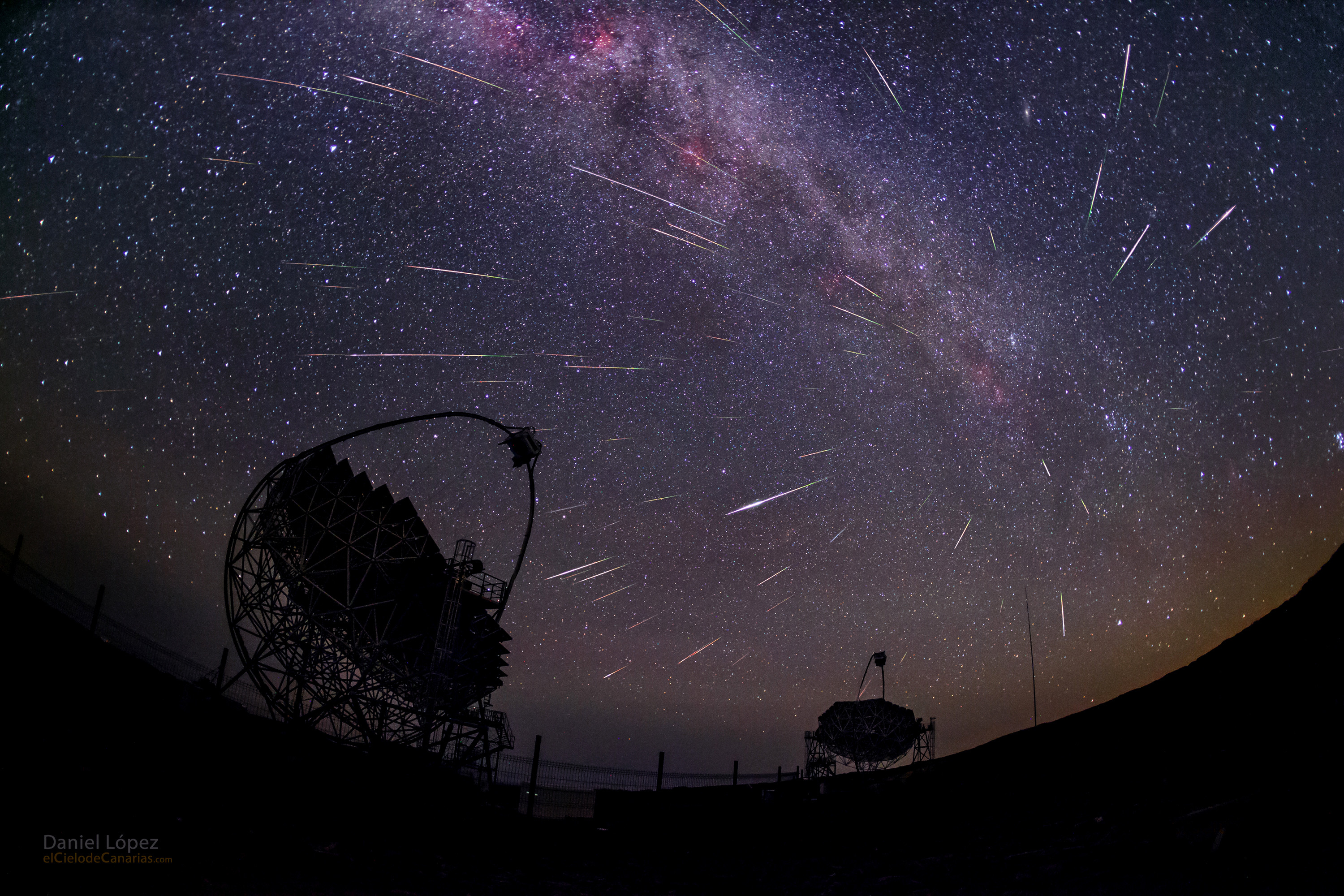
Alt...
2016 August 20
Gamma-rays and Comet Dust
* Image Credit & Copyright: Daniel López (El Cielo de Canarias)
Explanation:
Gamma-rays and dust from periodic Comet Swift-Tuttle plowed through planet Earth's atmosphere on the night of August 11/12. Impacting at about 60 kilometers per second the grains of comet dust produced this year's remarkably active Perseid meteor shower. This composite wide-angle image of aligned shower meteors covers a 4.5 hour period on that Perseid night. In it the flashing meteor streaks can be traced back to the shower's origin on the sky. Alongside the Milky Way in the constellation Perseus, the radiant marks the direction along the perodic comet's orbit. Traveling at the speed of light, cosmic gamma-rays impacting Earth's atmosphere generated showers too, showers of high energy particles. Just as the meteor streaks point back to their origin, the even briefer flashes of light from the particles can be used to reconstruct the direction of the particle shower, to point back to the origin on the sky of the incoming gamma-ray. Unlike the meteors, the incredibly fast particle shower flashes can't be followed by eye. But both can be followed by the high speed cameras on the multi-mirrored dishes in the foreground. Of course, the dishes are MAGIC (Major Atmospheric Gamma Imaging Cherenkov) telescopes, an Earth-based gamma-ray observatory on the Canary Island of La Palma.
Authors & editors: Robert Nemiroff (MTU) & Jerry Bonnell (UMCP)
"To upload this video, I converted it and compressed it to a smaller file-size under #linux with the free software ffmpeg and the corresponding command:
'ffmpeg -i video_in.mkv -vcodec libx265 -crf 30 video_out.mp4'
Maybe you would like to post a corresponding video on a scientifically related topic, but it is perhaps too big? Then try ffmpeg.
Just for now let's enjoy this Perseids Night Timelaps together"
2021 September 28
Night of the Perseids
* Video Credit & Copyright: Vikas Chander & Dorje Angchuk
https://www.youtube.com/channel/UCa_53XIkP1fYEbHCWoMgIrg
* Music: Tea Time via PremiumBeat
https://www.premiumbeat.com/artist/yellow-tea
Explanation:
Have you ever experienced a meteor shower? To help capture the wonder, a video was taken during the peak of the recent Perseid meteor shower above the Indian Astronomical Observatory in Hanle, India, high up in the Himalayan mountains. Night descends as the video begins, with the central plane of our Milky Way Galaxy approaching from the left and Earth-orbiting satellites zipping by overhead. During the night, the flash of meteors that usually takes less than a second is artificially extended. The green glow of most meteors is typically caused by vaporizing nickel. As the video continues, Orion rises and meteors flare above the 2-meter Himalayan Chandra Telescope and the seven barrels of the High Energy Gamma Ray Telescope (Hagar). The 2 minute 30 second movie ends with the Sun rising, preceded by a false dawn of zodiacal light.
https://apod.nasa.gov/apod/ap210928.html
#space #galaxy #perseids #astrophotography #photography #science #astronomy #nature #NASA
Alt...
2021 September 28
Night of the Perseids
* Video Credit & Copyright: Vikas Chander & Dorje Angchuk
* Music: Tea Time via PremiumBeat
Explanation:
Have you ever experienced a meteor shower? To help capture the wonder, a video was taken during the peak of the recent Perseid meteor shower above the Indian Astronomical Observatory in Hanle, India, high up in the Himalayan mountains. Night descends as the video begins, with the central plane of our Milky Way Galaxy approaching from the left and Earth-orbiting satellites zipping by overhead. During the night, the flash of meteors that usually takes less than a second is artificially extended. The green glow of most meteors is typically caused by vaporizing nickel. As the video continues, Orion rises and meteors flare above the 2-meter Himalayan Chandra Telescope and the seven barrels of the High Energy Gamma Ray Telescope (Hagar). The 2 minute 30 second movie ends with the Sun rising, preceded by a false dawn of zodiacal light.
Authors & editors: Robert Nemiroff (MTU) & Jerry Bonnell (UMCP)
NASA Official: Phillip Newman Specific rights apply.
NASA Web Privacy Policy and Important Notices
A service of: ASD at NASA / GSFC
& Michigan Tech. U.
2023 August 23 (*)
The Meteor and the Galaxy
* Credit & Copyright: Jose Pedrero
https://www.instagram.com/josepedrero.jpart/
Explanation:
It came from outer space. It -- in this case a sand-sized bit of a comet nucleus -- was likely ejected many years ago from Sun-orbiting Comet Swift-Tuttle, but then continued to orbit the Sun alone. When the Earth crossed through this orbit, the piece of comet debris impacted the atmosphere of our fair planet and was seen as a meteor. This meteor deteriorated, causing gases to be emitted that glowed in colors emitted by its component elements. The featured image was taken last week(*) from Castilla La Mancha, Spain, during the peak night of the Perseids meteor shower. The picturesque meteor streak happened to appear in the only one of 50 frames that also included the Andromeda galaxy. Stars dot the frame, each much further away than the meteor. Compared to the stars, the Andromeda galaxy (M31) is, again, much further away.
https://apod.nasa.gov/apod/ap230823.html
#space #galaxy #perseids #astrophotography #photography #astroart #science #astronomy #nature #NASA
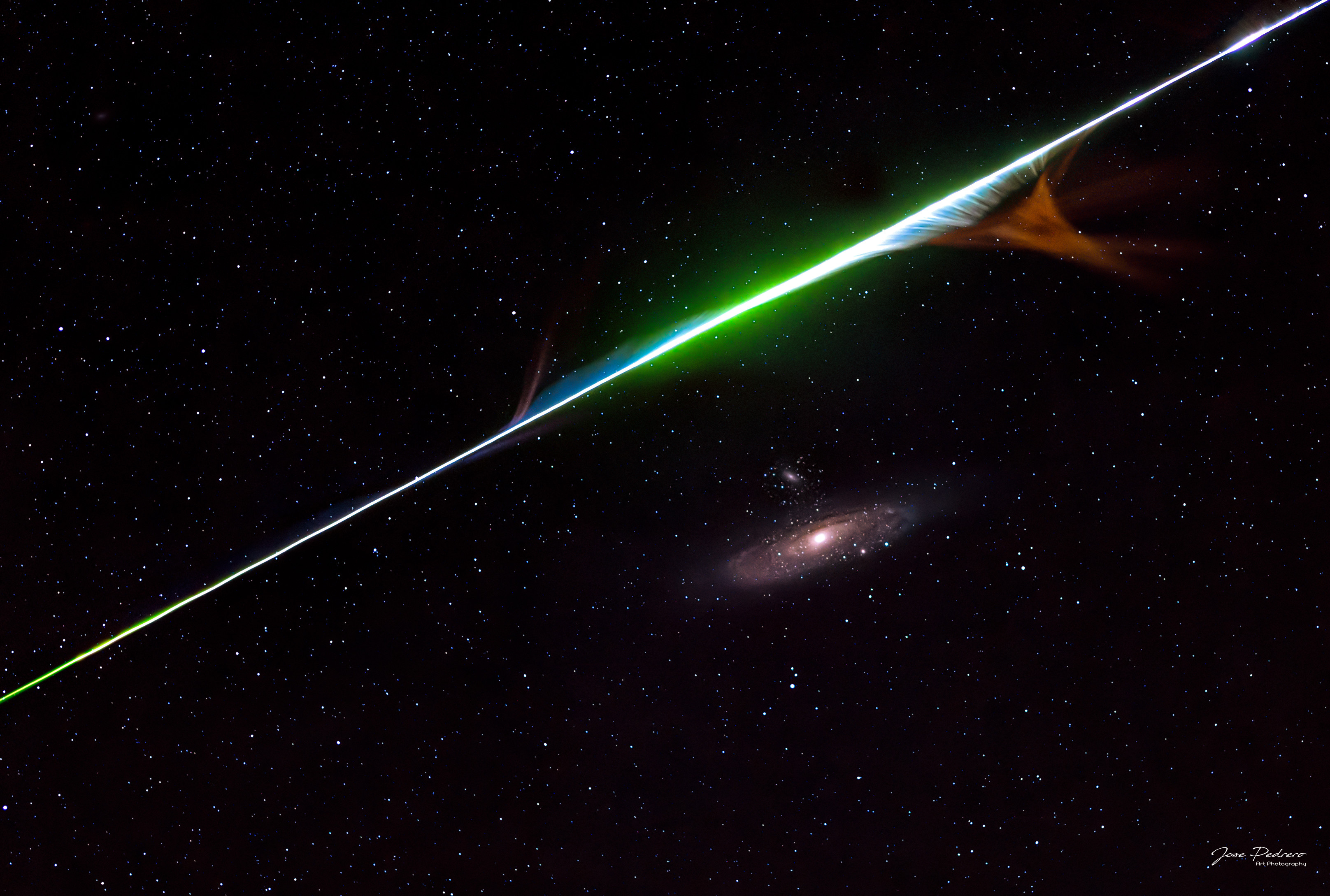
Alt...
2023 August 23
A color meteor streak is seen above the Andromeda spiral galaxy. Please see the explanation for more detailed information.
The Meteor and the Galaxy
* Credit & Copyright: Jose Pedrero
Explanation:
It came from outer space. It -- in this case a sand-sized bit of a comet nucleus -- was likely ejected many years ago from Sun-orbiting Comet Swift-Tuttle, but then continued to orbit the Sun alone. When the Earth crossed through this orbit, the piece of comet debris impacted the atmosphere of our fair planet and was seen as a meteor. This meteor deteriorated, causing gases to be emitted that glowed in colors emitted by its component elements. The featured image was taken last week from Castilla La Mancha, Spain, during the peak night of the Perseids meteor shower. The picturesque meteor streak happened to appear in the only one of 50 frames that also included the Andromeda galaxy. Stars dot the frame, each much further away than the meteor. Compared to the stars, the Andromeda galaxy (M31) is, again, much further away.
Authors & editors: Robert Nemiroff (MTU) & Jerry Bonnell (UMCP)
NASA Official: Phillip Newman Specific rights apply.
NASA Web Privacy Policy and Important Notices
A service of: ASD at NASA / GSFC,
NASA Science Activation
& Michigan Tech. U.