Search results for tag #moon
![[?]](https://files.defcon.social/dcsocial-s3/accounts/avatars/113/208/344/507/078/943/original/014820ad22daee1c.jpg)
[...]
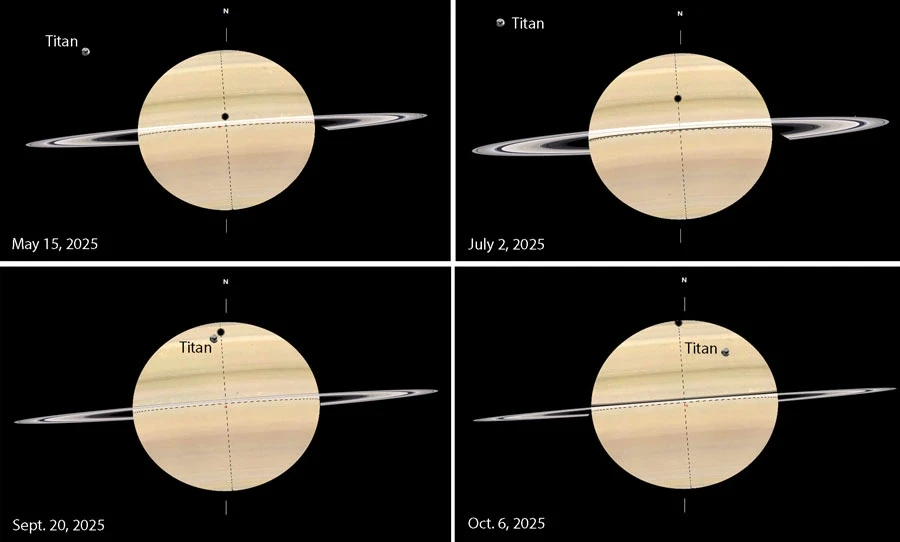
Saturn's moons likewise cast shadows, with Titan's the easiest to see because it's the largest, with an apparent diameter of 0.8″at opposition on September 21st. This means you'll want to use at least a 3-inch telescope and magnification of 200× or more to discern the inky speck. At times, both moon and shadow will occupy the disk simultaneously. Titan itself appears somewhat smaller than its shadow and paler in tone. Even after the shadow portion of the transit series ends on October 6th, you can continue to observe the moon pass in front of Saturn every 16 days, through January 25, 2026.
When the current transit series began last November, timing favored Eastern Hemisphere observers. Now through early October, skywatchers in the Americas will get a crack at the shadow. Most of the transits occur after midnight, especially for the eastern half of the U.S. The table above lists the Universal Times (UT) of the start, midpoint, and end of each event. To convert to local times, use this UTC time zone converter https://dateful.com/convert/utc.
Notice that the transits occur every 16 days, which is Titan's orbital period.
Titan and its shadow gradually migrate northward across Saturn's oblate disk this spring and summer. The May 15th transit occurs across the planet's Equatorial Zone (EZ) and lasts nearly 6 hours. But on October 6th, when Titan's shadow nibbles the northern limb, the event lasts only about 2 hours.
[...]
Exerpt from:
"Titan Shadow Transit Season Underway"
By Bob King
https://skyandtelescope.org/astronomy-news/observing-news/titan-shadow-transit-season-underway/
#space #moon #titan #astrophotography #photography #science #astronomy #nature #NASA
Alt...
These simulated views show Titan's shadow at mid-transit on the dates indicated. The shadow migrates north during the time, finally departing the disk after October 6th.
Diagrams created with WinJUPOS
Upcoming titan shadow transits (UT)
Date Start Mid-transit End
May 15 9:49 12:59 15:44
May 31 9:05 12:12 14:53
June 16 8:21 11:24 14:00
July 2 7:40 10:35 13:03
July 18 7:00 9:44 12:05
Aug. 3 6:25 8:52 11:04
Aug. 19 5:52 8:01 10:00
Sept. 4 5:25 7:09 8:50
Sept. 20 5:09 6:20 7:34
Oct. 6 5:32*
Start and end times are when Titan's full shadow is first and last visible entering and exiting Saturn's disk, respectively. * Full shadow on disk only at mid-transit
2009 March 19
Saturn: Moons in Transit
* Credit: NASA, ESA, Hubble Heritage Team (STScI/AURA)
http://www.nasa.gov/
http://www.spacetelescope.org/
http://heritage.stsci.edu/
* Acknowledgment: M.H. Wong (STScI/UC Berkeley), C. Go (Philippines)
https://www.stsci.edu/contents/news-releases/2024/news-2024-401?user=birkmann
Explanation:
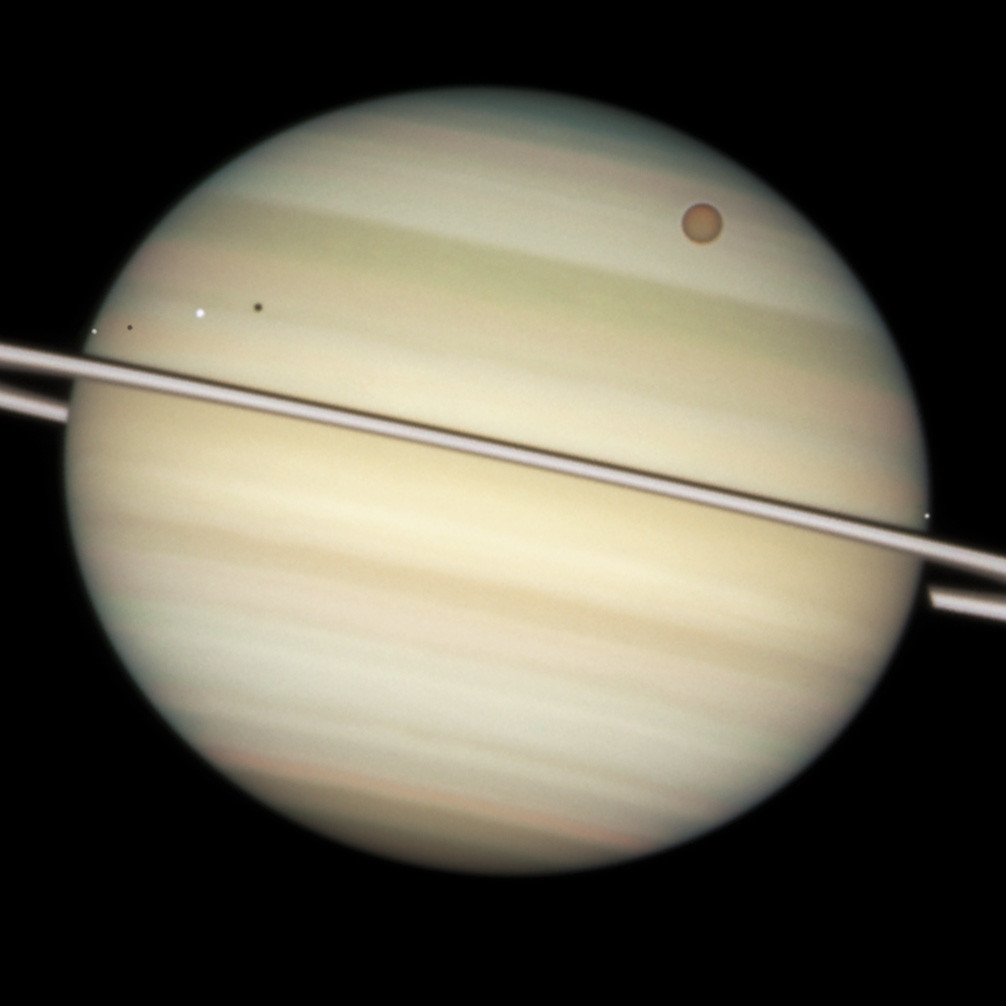
Every 14 to 15 years, Saturn's rings are tilted edge-on to our line of sight. As the bright, beautiful rings seem to grow narrower it becomes increasingly difficult to see them, even with large telescopes. But it does provide the opportunity to watch multiple transits of Saturn's moons. During a transit, a sunlit moon and its shadow glide across the cloudy face of the gas giant. Recorded on February 24, this Hubble image is part of a sequence showing the transit of four of Saturn's moons. From left to right are Enceladus and shadow, Dione and shadow, and Saturn's largest moon Titan. Small moon Mimas is just touching Saturn's disk near the ring plane at the far right. The shadows of Titan and Mimas have both moved off the right side of the disk. Saturn itself has an equatorial diameter of about 120,000 kilometers.
https://apod.nasa.gov/apod/ap090319.html
#space #moon #titan #astrophotography #photography #science #astronomy #nature #NASA
Alt...
2009 March 19
Saturn: Moons in Transit
* Credit: NASA, ESA, Hubble Heritage Team (STScI/AURA)
* Acknowledgment: M.H. Wong (STScI/UC Berkeley), C. Go (Philippines)
Explanation:
Every 14 to 15 years, Saturn's rings are tilted edge-on to our line of sight. As the bright, beautiful rings seem to grow narrower it becomes increasingly difficult to see them, even with large telescopes. But it does provide the opportunity to watch multiple transits of Saturn's moons. During a transit, a sunlit moon and its shadow glide across the cloudy face of the gas giant. Recorded on February 24, this Hubble image is part of a sequence showing the transit of four of Saturn's moons. From left to right are Enceladus and shadow, Dione and shadow, and Saturn's largest moon Titan. Small moon Mimas is just touching Saturn's disk near the ring plane at the far right. The shadows of Titan and Mimas have both moved off the right side of the disk. Saturn itself has an equatorial diameter of about 120,000 kilometers.
Authors & editors: Robert Nemiroff (MTU) & Jerry Bonnell (UMCP)
NASA Official: Phillip Newman Specific rights apply.
NASA Web Privacy Policy and Important Notices
A service of: ASD at NASA / GSFC
& Michigan Tech. U.
2005 October 21
Ringside
* Credit : Cassini Imaging Team, SSI, JPL, ESA, NASA
http://ciclops.org/
http://www.spacescience.org/
http://www.jpl.nasa.gov/
http://www.esa.int/
http://www.nasa.gov/home/index.html
Explanation:
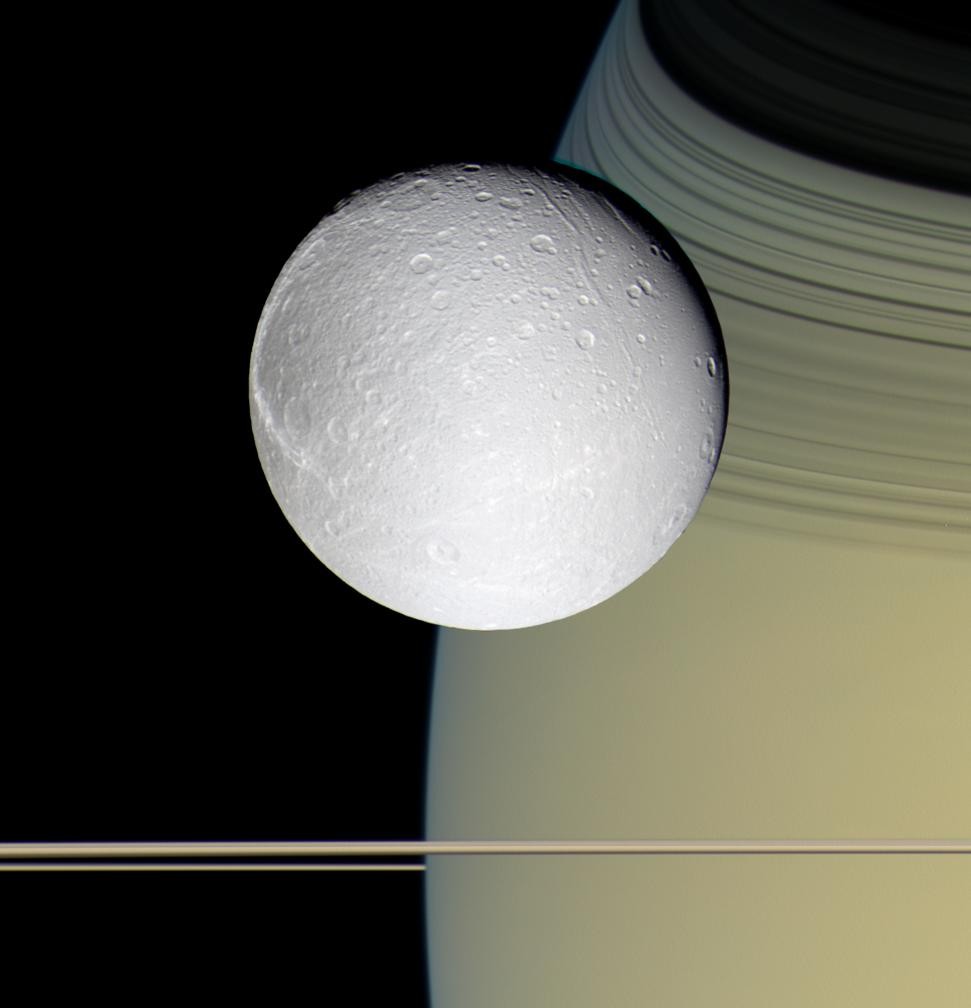
Orbiting in the plane of Saturn's rings, Dione and the other icy saturnian moons have a perpetual ringside view of the gorgeous gas giant planet. Of course, while passing through the ring plane the Cassini spacecraft also shares their stunning perspective. The rings themselves can be seen slicing across the bottom of this Cassini snapshot. Remarkably thin, the bright rings still cast arcing shadows across the planet's cloud tops. Pale Dione, in the foreground, is about 1,100 kilometers across and orbits over 300,000 kilometers from the visible outer edge of the A ring.
https://apod.nasa.gov/apod/ap051021.html
#space #moon #Dione #saturn #astrophotography #photography #science #astronomy #nature #NASA
Alt...
2005 October 21
Ringside
* Credit : Cassini Imaging Team, SSI, JPL, ESA, NASA
Explanation:
Orbiting in the plane of Saturn's rings, Dione and the other icy saturnian moons have a perpetual ringside view of the gorgeous gas giant planet. Of course, while passing through the ring plane the Cassini spacecraft also shares their stunning perspective. The rings themselves can be seen slicing across the bottom of this Cassini snapshot. Remarkably thin, the bright rings still cast arcing shadows across the planet's cloud tops. Pale Dione, in the foreground, is about 1,100 kilometers across and orbits over 300,000 kilometers from the visible outer edge of the A ring.
Authors & editors: Robert Nemiroff (MTU) & Jerry Bonnell (USRA)
NASA Web Site Statements, Warnings, and Disclaimers
NASA Official: Jay Norris. Specific rights apply.
A service of: EUD at NASA / GSFC
& Michigan Tech. U.
2015 August 24
Dione, Rings, Shadows, Saturn
* Credit : Cassini Imaging Team, SSI, JPL, ESA, NASA
http://ciclops.org/
http://www.spacescience.org/
http://www.jpl.nasa.gov/
http://www.esa.int/
http://www.nasa.gov/home/index.html
Explanation:
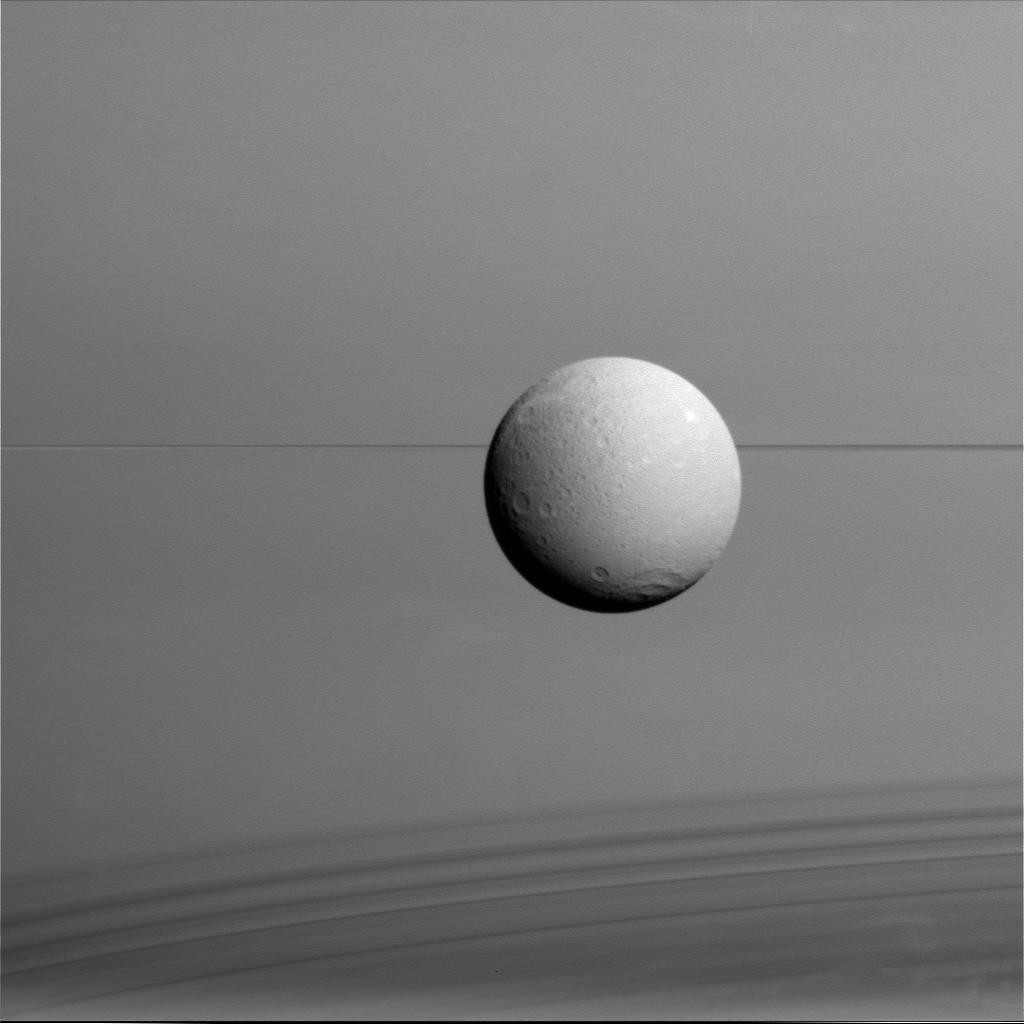
What's happening in this strange juxtaposition of moon and planet? First and foremost, Saturn's moon Dione was captured here in a dramatic panorama by the robotic Cassini spacecraft currently orbiting the giant planet. The bright and cratered moon itself spans about 1100-km, with the large multi-ringed crater Evander visible on the lower right. Since the rings of Saturn are seen here nearly edge-on, they are directly visible only as a thin horizontal line that passes behind Dione. Arcing across the bottom of the image, however, are shadows of Saturn's rings, showing some of the rich texture that could not be seen directly. In the background, few cloud features are visible on Saturn. The featured image was taken during the last planned flyby of Dione by Cassini, as the spacecraft is scheduled to dive into Saturn's atmosphere during 2017.
https://apod.nasa.gov/apod/ap150824.html
#space #moon #Dione #Saturn #astrophotography #photography #science #astronomy #nature #NASA
Alt...
2015 August 24
Dione, Rings, Shadows, Saturn
* Image Credit: Cassini Imaging Team, SSI, JPL, ESA, NASA
Explanation:
What's happening in this strange juxtaposition of moon and planet? First and foremost, Saturn's moon Dione was captured here in a dramatic panorama by the robotic Cassini spacecraft currently orbiting the giant planet. The bright and cratered moon itself spans about 1100-km, with the large multi-ringed crater Evander visible on the lower right. Since the rings of Saturn are seen here nearly edge-on, they are directly visible only as a thin horizontal line that passes behind Dione. Arcing across the bottom of the image, however, are shadows of Saturn's rings, showing some of the rich texture that could not be seen directly. In the background, few cloud features are visible on Saturn. The featured image was taken during the last planned flyby of Dione by Cassini, as the spacecraft is scheduled to dive into Saturn's atmosphere during 2017.
Authors & editors: Robert Nemiroff (MTU) & Jerry Bonnell (UMCP)
NASA Official: Phillip Newman Specific rights apply.
NASA Web Privacy Policy and Important Notices
A service of: ASD at NASA / GSFC
& Michigan Tech. U.
2015 July 8
In the Company of Dione
* Image Credit: NASA/JPL-Caltech/Space Science Institute
http://www.nasa.gov/
http://www.spacescience.org/index.php
Explanation:
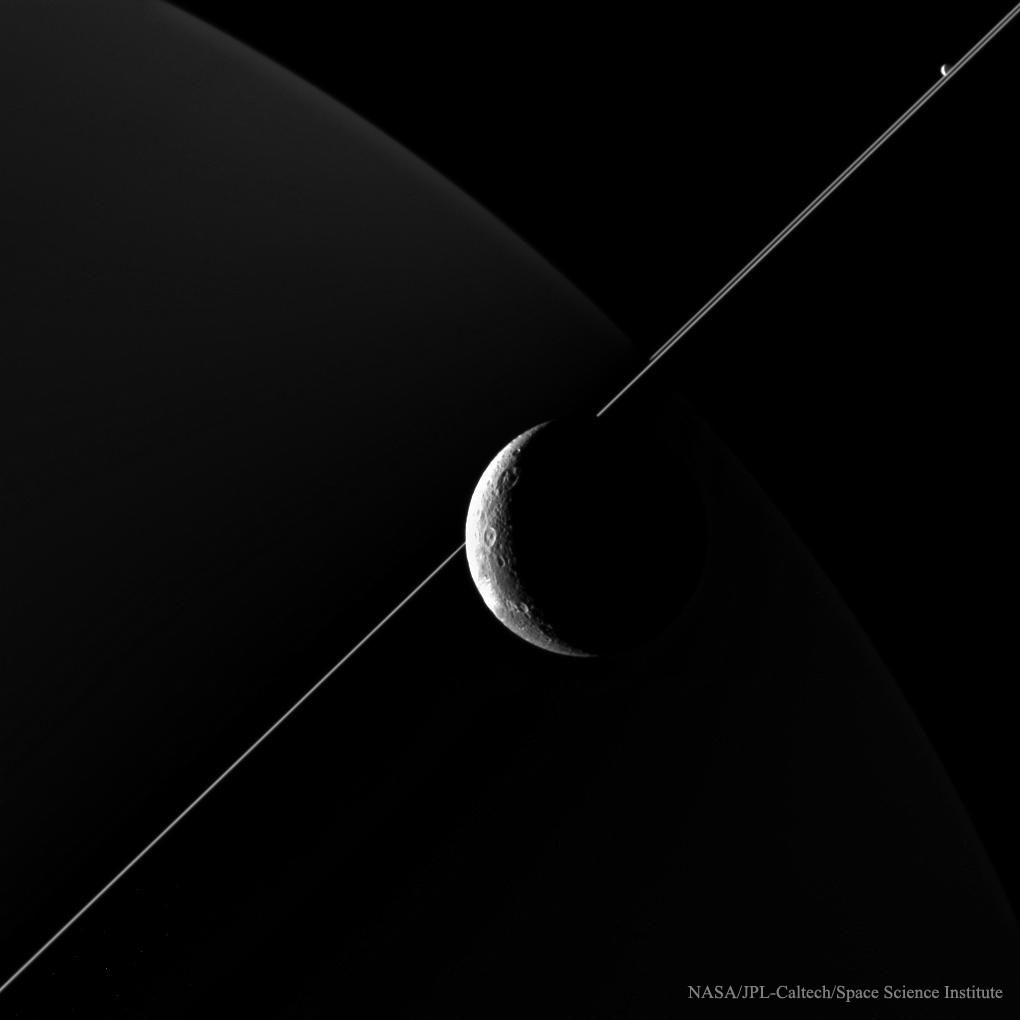
That is not our Moon. It's Dione, and it's a moon of Saturn. The robotic Cassini spacecraft took the featured image during a flyby of Saturn's cratered Moon last month. Perhaps what makes this image so interesting, though, is the background. First, the large orb looming behind Dione is Saturn itself, faintly lit by sunlight first reflected from the rings. Next, the thin lines running diagonally across the image are the rings of Saturn themselves. The millions of icy rocks that compose Saturn's spectacular rings all orbit Saturn in the same plane, and so appear surprisingly thin when seen nearly edge-on. Front and center, Dione appears in crescent phase, partially lit by the Sun that is off to the lower left. A careful inspection of the ring plane should also locate the moon Enceladus on the upper right.
https://apod.nasa.gov/apod/ap150708.html
#space #moon #Dione #saturn #astrophotography #photography #science #astronomy #nature #NASA
Alt...
2015 July 8
In the Company of Dione
* Image Credit: NASA/JPL-Caltech/Space Science Institute
Explanation:
That is not our Moon. It's Dione, and it's a moon of Saturn. The robotic Cassini spacecraft took the featured image during a flyby of Saturn's cratered Moon last month. Perhaps what makes this image so interesting, though, is the background. First, the large orb looming behind Dione is Saturn itself, faintly lit by sunlight first reflected from the rings. Next, the thin lines running diagonally across the image are the rings of Saturn themselves. The millions of icy rocks that compose Saturn's spectacular rings all orbit Saturn in the same plane, and so appear surprisingly thin when seen nearly edge-on. Front and center, Dione appears in crescent phase, partially lit by the Sun that is off to the lower left. A careful inspection of the ring plane should also locate the moon Enceladus on the upper right.
Authors & editors: Robert Nemiroff (MTU) & Jerry Bonnell (UMCP)
NASA Official: Phillip Newman Specific rights apply.
NASA Web Privacy Policy and Important Notices
A service of: ASD at NASA / GSFC
& Michigan Tech. U.
2025 June 10
Enceladus in True Color
* Image Credit: NASA, ESA, JPL, SSI, Cassini Imaging Team
http://ciclops.org/
http://www.spacescience.org/
http://www.jpl.nasa.gov/
http://www.esa.int/
http://www.nasa.gov/home/index.html
Explanation:
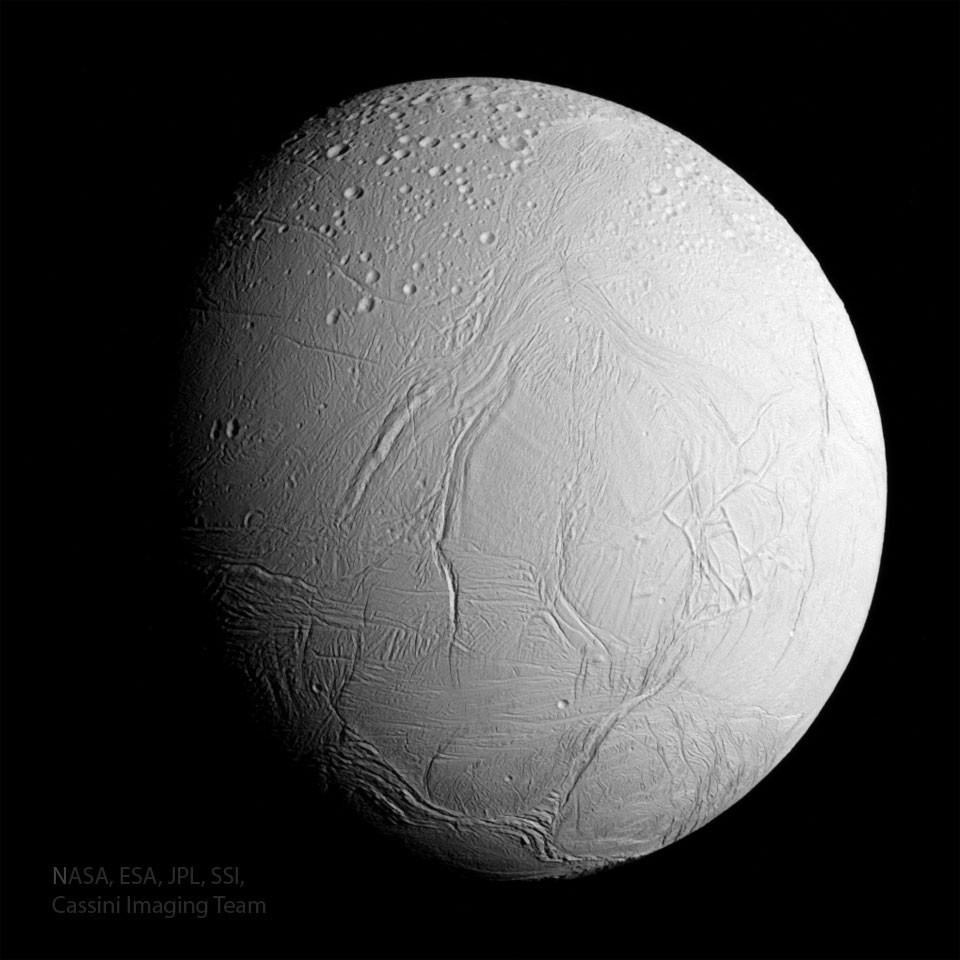
Do oceans under the ice of Saturn's moon Enceladus contain life? A reason to think so involves long features -- some dubbed tiger stripes -- that are known to be spewing ice from the moon's icy interior into space. These surface cracks create clouds of fine ice particles over the moon's South Pole and create Saturn's mysterious E-ring. Evidence for this has come from the robot Cassini spacecraft that orbited Saturn from 2004 to 2017. Pictured here, a high resolution image of Enceladus is shown in true color from a close flyby. The deep crevasses are partly shadowed. Why Enceladus is active remains a mystery, as the neighboring moon Mimas, approximately the same size, appears quite dead. An analysis of ejected ice grains has yielded evidence that complex organic molecules exist inside Enceladus. These large carbon-rich molecules bolster -- but do not prove -- that oceans under Enceladus' surface could contain life.
https://science.nasa.gov/saturn/moons/enceladus/
https://apod.nasa.gov/apod/ap250610.html
#space #moon #Enceladus #saturn #astrophotography #photography #science #astronomy #nature #NASA
Alt...
2025 June 10
Enceladus in True Color
* Image Credit: NASA, ESA, JPL, SSI, Cassini Imaging Team
Explanation:
Do oceans under the ice of Saturn's moon Enceladus contain life? A reason to think so involves long features -- some dubbed tiger stripes -- that are known to be spewing ice from the moon's icy interior into space. These surface cracks create clouds of fine ice particles over the moon's South Pole and create Saturn's mysterious E-ring. Evidence for this has come from the robot Cassini spacecraft that orbited Saturn from 2004 to 2017. Pictured here, a high resolution image of Enceladus is shown in true color from a close flyby. The deep crevasses are partly shadowed. Why Enceladus is active remains a mystery, as the neighboring moon Mimas, approximately the same size, appears quite dead. An analysis of ejected ice grains has yielded evidence that complex organic molecules exist inside Enceladus. These large carbon-rich molecules bolster -- but do not prove -- that oceans under Enceladus' surface could contain life.
Authors & editors: Robert Nemiroff (MTU) & Jerry Bonnell (UMCP)
NASA Official: Amber Straughn Specific rights apply.
NASA Web Privacy, Accessibility, Notices;
A service of: ASD at NASA / GSFC,
NASA Science Activation
& Michigan Tech. U.
2007 October 13
Enceladus Ice Geysers
* Credit : Cassini Imaging Team, SSI, JPL, ESA, NASA
http://ciclops.org/
http://www.spacescience.org/
http://www.jpl.nasa.gov/
http://www.esa.int/
http://www.nasa.gov/home/index.html
Explanation:
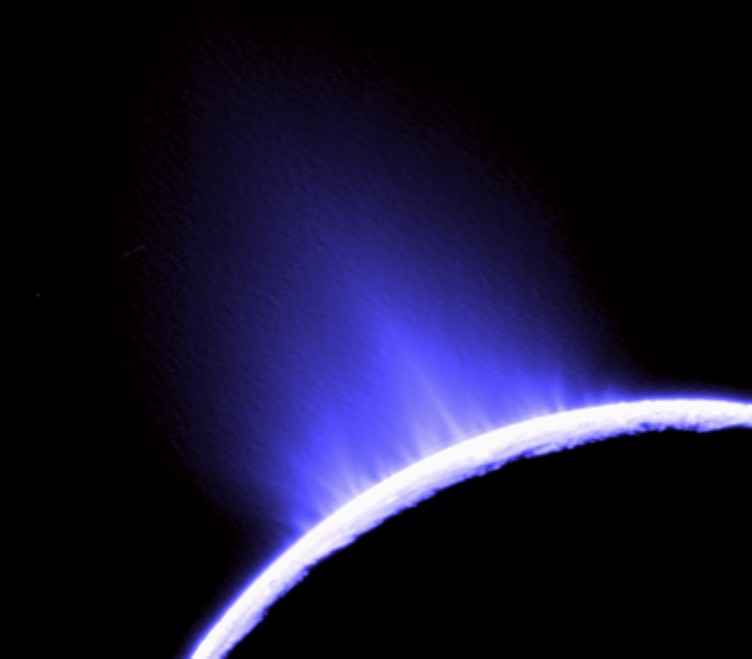
Ice geysers erupt on Enceladus, bright and shiny inner moon of Saturn. Shown in this false-color image, a backlit view of the moon's southern limb, the majestic, icy plumes were discovered by instruments on the Cassini Spacecraft during close encounters with Enceladus in November of 2005. Eight source locations for these geysers have now been identified along substantial surface fractures in the moon's south polar region. Researchers suspect the geysers arise from near-surface pockets of liquid water with temperatures near 273 kelvins (0 degrees C). That's hot when compared to the distant moon's surface temperature of 73 kelvins (-200 degrees C). The cryovolcanism is a dramatic sign that tiny, 500km-diameter Enceladus is surprisingly active. Enceladus ice geysers also likely produce Saturn's faint but extended E ring.
https://en.wikipedia.org/wiki/Enceladus
https://apod.nasa.gov/apod/ap071013.html
#space #moon #Enceladus #saturn #astrophotography #photography #science #astronomy #nature #NASA
Alt...
2007 October 13
Enceladus Ice Geysers
* Credit: Cassini Imaging Team, SSI, JPL, ESA, NASA
Explanation:
Ice geysers erupt on Enceladus, bright and shiny inner moon of Saturn. Shown in this false-color image, a backlit view of the moon's southern limb, the majestic, icy plumes were discovered by instruments on the Cassini Spacecraft during close encounters with Enceladus in November of 2005. Eight source locations for these geysers have now been identified along substantial surface fractures in the moon's south polar region. Researchers suspect the geysers arise from near-surface pockets of liquid water with temperatures near 273 kelvins (0 degrees C). That's hot when compared to the distant moon's surface temperature of 73 kelvins (-200 degrees C). The cryovolcanism is a dramatic sign that tiny, 500km-diameter Enceladus is surprisingly active. Enceladus ice geysers also likely produce Saturn's faint but extended E ring.
Authors & editors: Robert Nemiroff (MTU) & Jerry Bonnell (UMCP)
NASA Official: Phillip Newman Specific rights apply.
NASA Web Privacy Policy and Important Notices
A service of: ASD at NASA / GSFC
& Michigan Tech. U.
2025 November 29
Moon Games
* Image Credit & Copyright: Giorgia Hofer
https://www.giorgiahoferphotography.com/
Explanation:
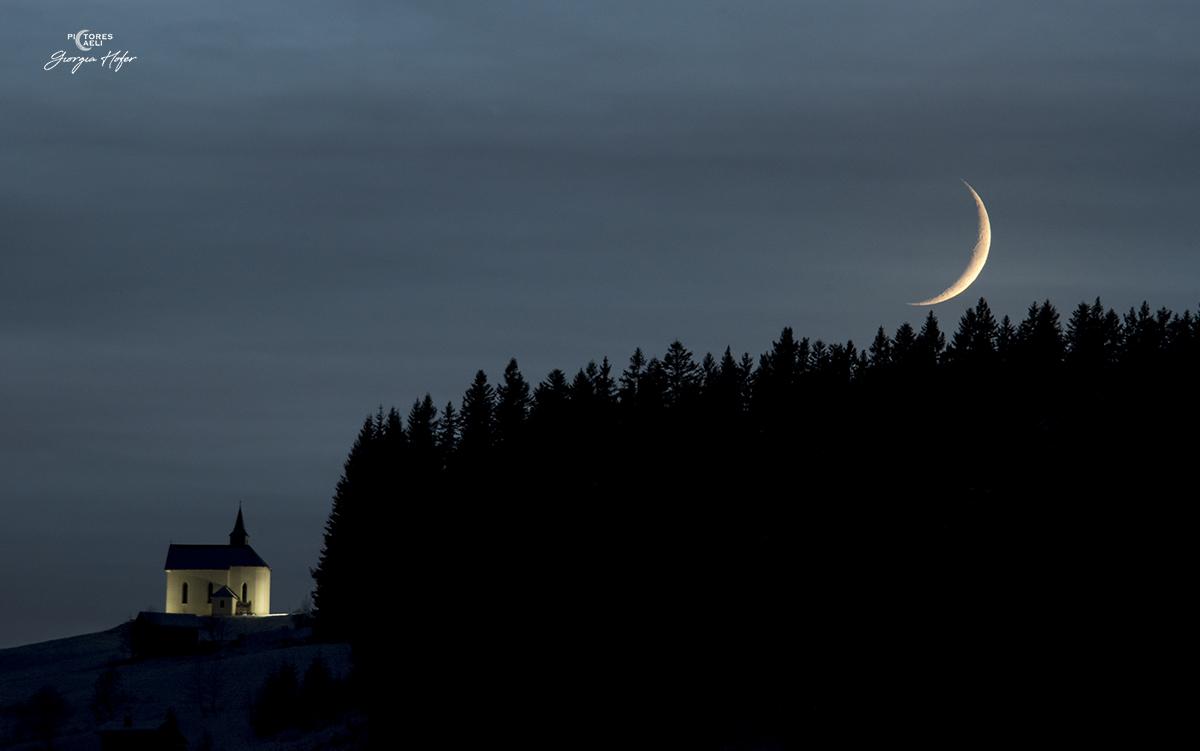
This is not a screen from a video game. Nestled below the tree-line, the small mountain church does look like it might be hiding from Moon though. In the well-composed telephoto snapshot, taken on November 23, the church walls are partly reflecting light from terrestrial flood lights. Of course, the Moon is reflecting light from the Sun. At any given time the Sun illuminates fully half of the Moon's surface, also known as the lunar dayside, but on that night only a sliver of its sunlit surface was visible. About three days after New Moon, the Moon was in a waxing crescent phase. The single exposure was captured shortly after sunset in skies near Danta di Cadore, northern Italy, planet Earth.
https://www.giorgiahoferphotography.com/moon
https://moon.nasa.gov/moon-observation/daily-moon-guide/?intent=021
https://science.nasa.gov/moon/moon-phases/
https://apod.nasa.gov/apod/fap/ap251129.html
#space #moon #apod #NASA #astrophotography #photography #science #astronomy #nature #space_related #Space_Culture_Club
Alt...
2025 November 29
Moon Games
* Image Credit & Copyright: Giorgia Hofer
Explanation:
This is not a screen from a video game. Nestled below the tree-line, the small mountain church does look like it might be hiding from Moon though. In the well-composed telephoto snapshot, taken on November 23, the church walls are partly reflecting light from terrestrial flood lights. Of course, the Moon is reflecting light from the Sun. At any given time the Sun illuminates fully half of the Moon's surface, also known as the lunar dayside, but on that night only a sliver of its sunlit surface was visible. About three days after New Moon, the Moon was in a waxing crescent phase. The single exposure was captured shortly after sunset in skies near Danta di Cadore, northern Italy, planet Earth.
Authors & editors: Robert Nemiroff (MTU) & Jerry Bonnell (UMCP)
NASA Official: Amber Straughn Specific rights apply.
NASA Web Privacy, Accessibility, Notices;
A service of: ASD at NASA / GSFC,
NASA Science Activation
& Michigan Tech. U.
![[?]](https://files.mastodon.social/accounts/avatars/111/389/433/739/003/113/original/a88eb493c68ded9f.jpeg)
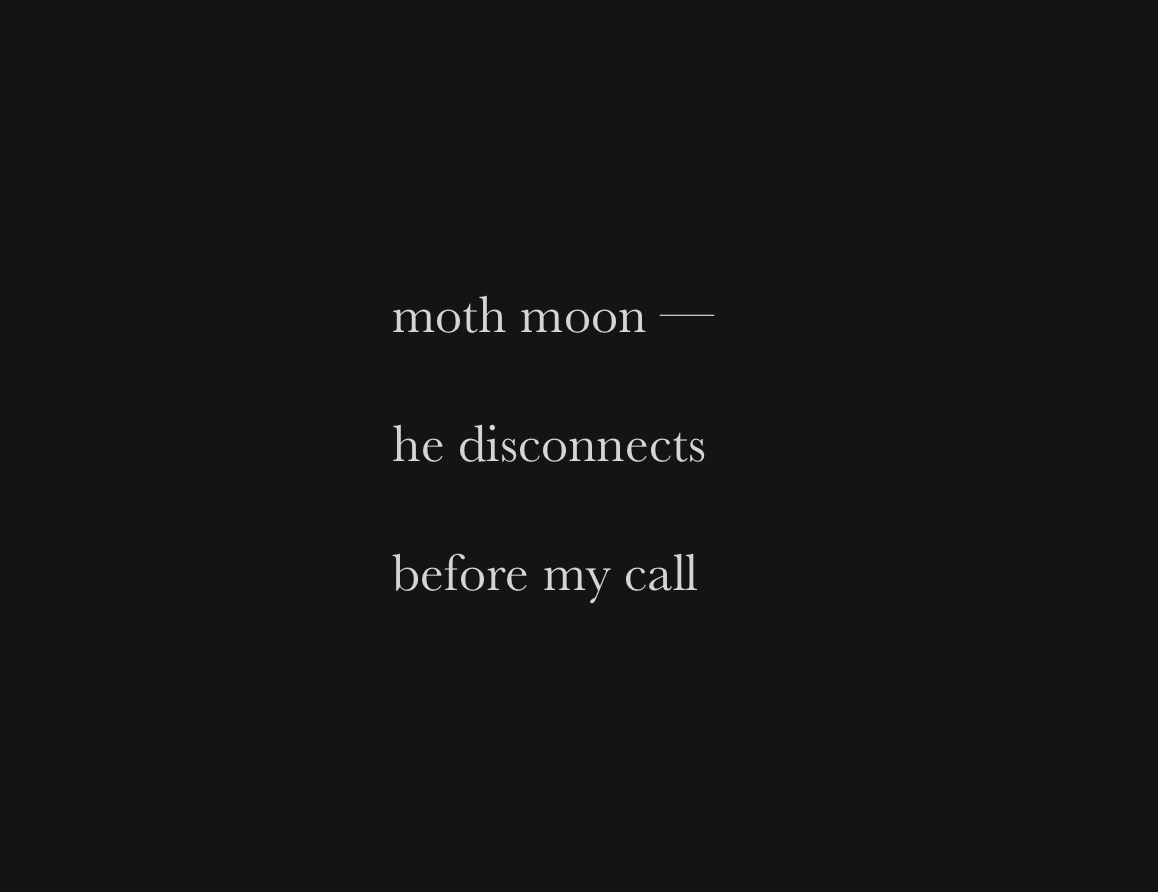
#haiku by new contributor, Doug Belleville @_flippoetry Doug writes both short (haiku) & long-form #poetry, with work published in a variety of journals. Based in #Ohio, he is a mental health professional, married with three adult children, & enjoys traveling, reading, hiking, & playing chess. #saxophone #poetrylovers #moon #harvestmoon #micropoetry #poetrycommunity
2025 November 12
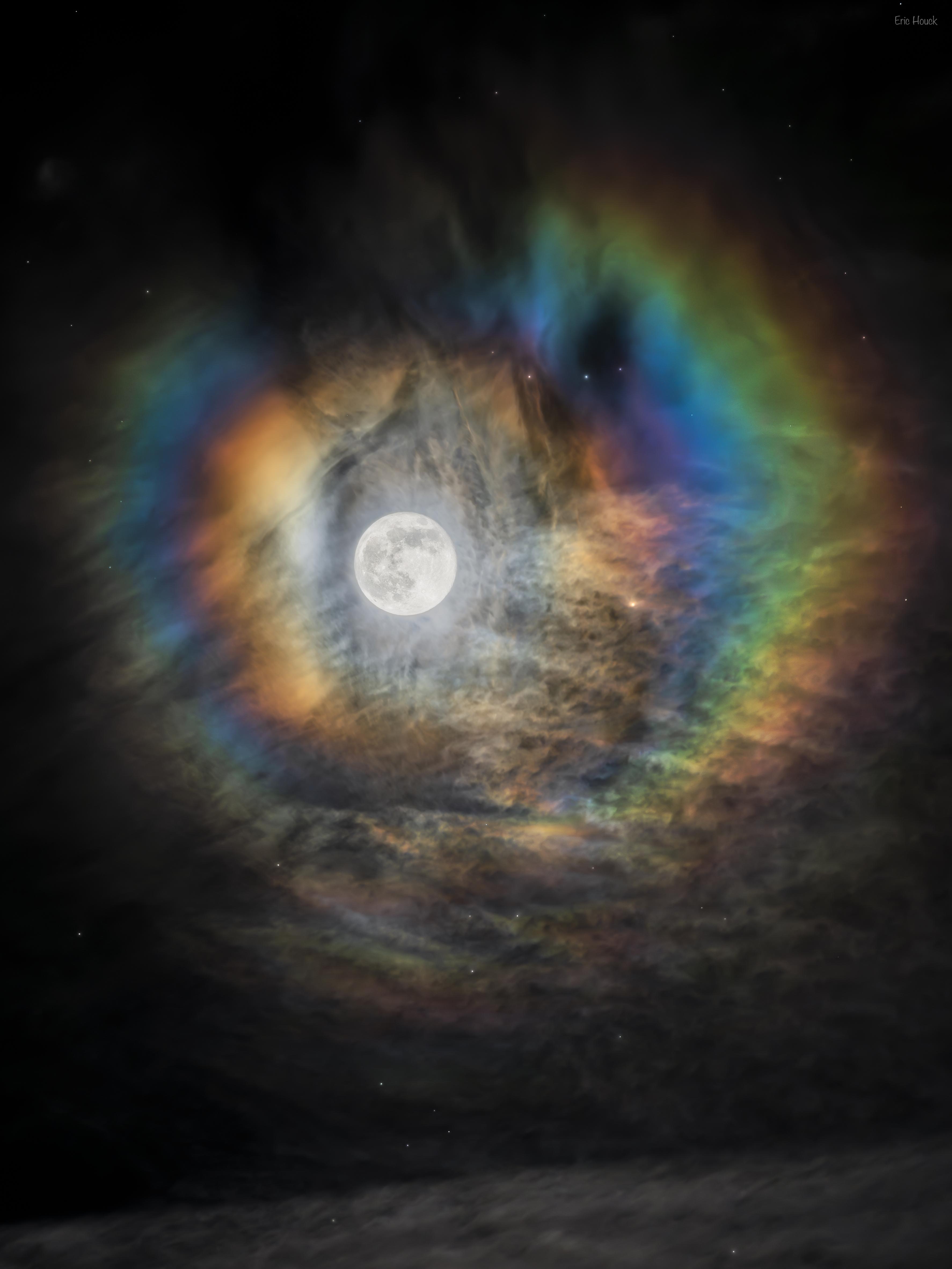
A Super Lunar Corona
* Image Credit & Copyright: Eric Houck
https://www.instagram.com/a_guy_named_eric/
Explanation:
What are those colorful rings around the Moon? A corona. Rings like this will sometimes appear when the Moon is seen through thin clouds. The effect is created by the diffraction of light around individual, similarly-sized water droplets in an intervening but mostly transparent cloud. Since light of different colors has different wavelengths, each color diffracts differently. Lunar coronae are one of the few color diffraction effects that can be easily seen with the unaided eye. The featured image of a lunar corona was captured around last week's full Super Moon from near Knight's Ferry, California, USA. To the right of the full Moon is the giant orange star Botein. Similar coronae that form around the Sun are typically harder to see because of the Sun's great brightness.
https://en.wikipedia.org/wiki/Corona_(optical_phenomenon)
https://www.atoptics.co.uk/blog/corona-formation/
https://en.wikipedia.org/wiki/Diffraction
https://www.youtube.com/shorts/-zSIty9q73E
https://science.nasa.gov/moon/
https://science.nasa.gov/ems/01_intro/
https://defcon.social/@grobi/114964072917217796
https://en.wikipedia.org/wiki/Delta_Arietis
https://apod.nasa.gov/apod/ap251112.html
#space #earth #moon #astrophotography #photography #science #astronomy #physics #nature #NASA #apod
Alt...
2025 November 12
The Moon is pictured in the center. ARound the Moon are colorful rings. The rings are nearly circular but have gaps. This but structured clouds are seen around the scene and at the bottom of the frame.
A Super Lunar Corona
* Image Credit & Copyright: Eric Houck
Explanation:
What are those colorful rings around the Moon? A corona. Rings like this will sometimes appear when the Moon is seen through thin clouds. The effect is created by the diffraction of light around individual, similarly-sized water droplets in an intervening but mostly transparent cloud. Since light of different colors has different wavelengths, each color diffracts differently. Lunar coronae are one of the few color diffraction effects that can be easily seen with the unaided eye. The featured image of a lunar corona was captured around last week's full Super Moon from near Knight's Ferry, California, USA. To the right of the full Moon is the giant orange star Botein. Similar coronae that form around the Sun are typically harder to see because of the Sun's great brightness.
Authors & editors: Robert Nemiroff (MTU) & Jerry Bonnell (UMCP)
NASA Official: Amber Straughn Specific rights apply.
NASA Web Privacy, Accessibility, Notices;
A service of: ASD at NASA / GSFC,
NASA Science Activation
& Michigan Tech. U.
2025 November 10
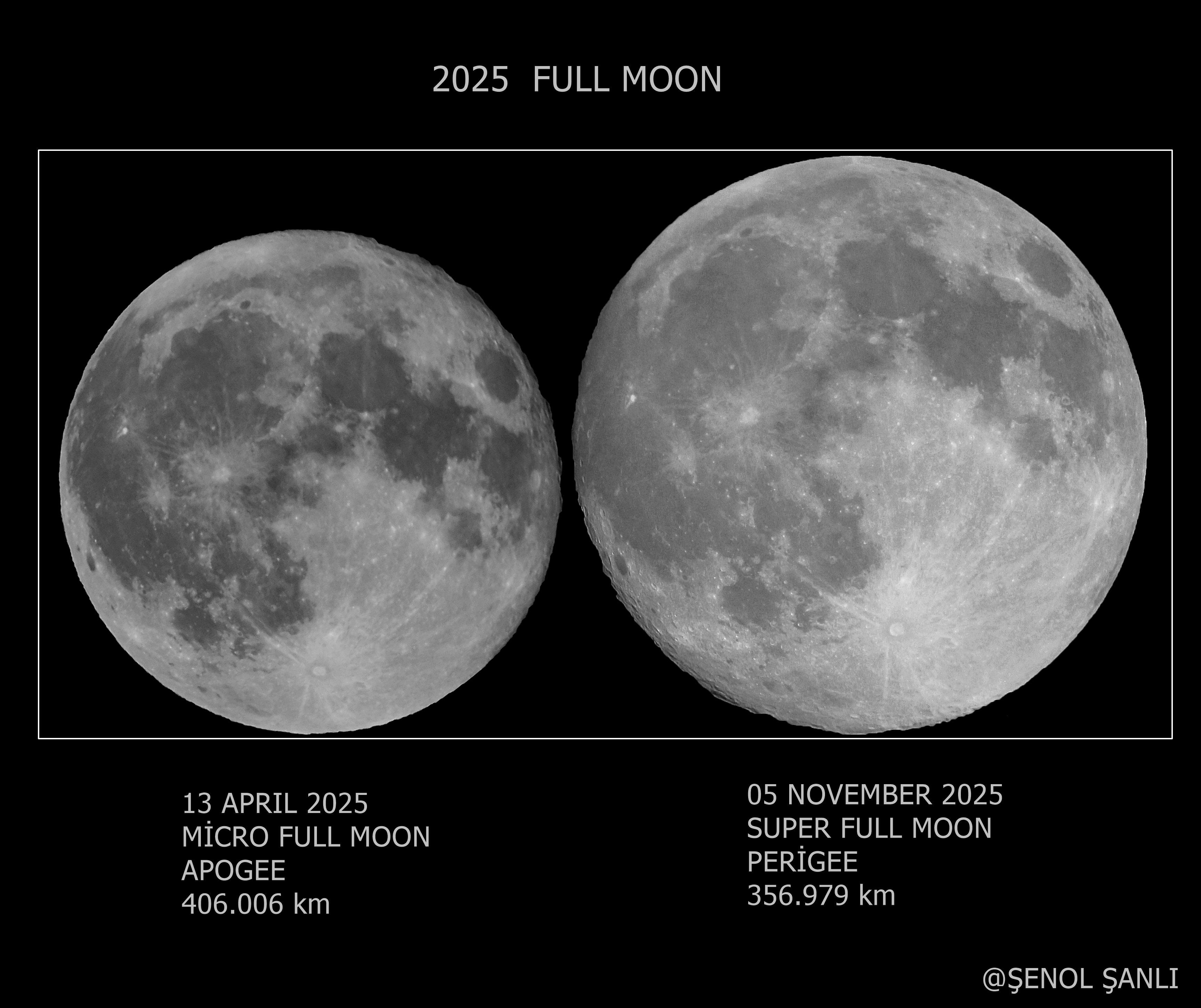
Micro Moon vs. Super Moon
* Image Credit & Copyright: Şenol Şanlı"
https://www.instagram.com/snlsanli/
Explanation:
What was so super about Wednesday's supermoon? Last week, a full moon occurred that appeared slightly larger and brighter than usual. The reason is that the Moon's fully illuminated phase occurred within a short time from perigee - when the Moon was its closest to the Earth in its elliptical orbit. Although the precise conditions that define a supermoon vary, last Wednesday's supermoon was surely the closest, largest, and brightest full moon this year. One reason supermoons are popular is because they are so easy to see -- just go outside at sunset and watch an impressive full moon rise! Pictured here, Wednesday's supermoon is compared to April's micro moon -- when a full Moon occurs near the furthest part of the Moon's orbit -- so that it appears slightly smaller and dimmer than usual. Given many definitions, at least one supermoon occurs each year, with another one coming next month (moon-th).
https://science.nasa.gov/moon/
https://www.universetoday.com/articles/what-is-a-super-moon
https://svs.gsfc.nasa.gov/5415/
https://science.nasa.gov/moon/moon-phases/
https://en.wikipedia.org/wiki/Supermoon
https://ophysics.com/f6.html
https://en.wiktionary.org/wiki/perigee
https://apod.nasa.gov/apod/ap251110.html
#space #earth #moon #astrophotography #photography #science #astronomy #physics #nature #NASA #apod
Alt...
2025 November 10
Two full Moons are shown. They are different sizes because the Micro Moon image on the left was captured when the Moon was near its furthest from the Earth, while the Super Moon on the right was captured when the Moon was near its closest to the Earth.
Micro Moon vs. Super Moon
* Image Credit & Copyright: Şenol Şanlı"
Explanation:
What was so super about Wednesday's supermoon? Last week, a full moon occurred that appeared slightly larger and brighter than usual. The reason is that the Moon's fully illuminated phase occurred within a short time from perigee - when the Moon was its closest to the Earth in its elliptical orbit. Although the precise conditions that define a supermoon vary, last Wednesday's supermoon was surely the closest, largest, and brightest full moon this year. One reason supermoons are popular is because they are so easy to see -- just go outside at sunset and watch an impressive full moon rise! Pictured here, Wednesday's supermoon is compared to April's micro moon -- when a full Moon occurs near the furthest part of the Moon's orbit -- so that it appears slightly smaller and dimmer than usual. Given many definitions, at least one supermoon occurs each year, with another one coming next month (moon-th).
Authors & editors: Robert Nemiroff (MTU) & Jerry Bonnell (UMCP)
NASA Official: Amber Straughn Specific rights apply.
NASA Web Privacy, Accessibility, Notices;
A service of: ASD at NASA / GSFC,
NASA Science Activation
& Michigan Tech
2025 November 8
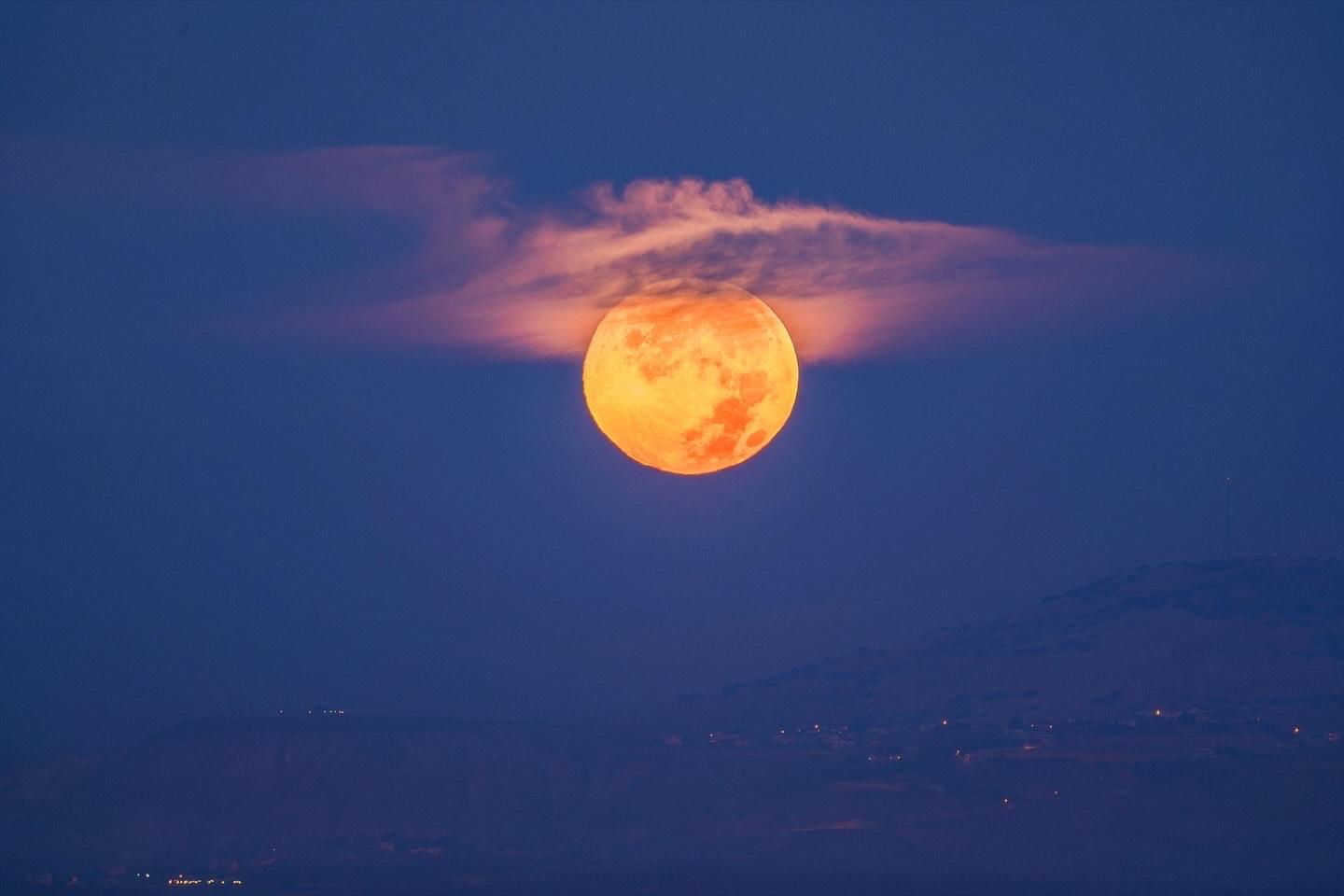
A Full Moon at Perigee
* Image Credit & Copyright: Betul Turksoy
https://www.instagram.com/betul_turksoy/p/DQqj4P-Dcgu/
Explanation:
What is big, bright, and beautiful, can wear a cape made of clouds, and is at the closest point in its elliptical orbit around planet Earth? A full moon at perigee of course, captured here near moonset in predawn skies on November 5 from Kayseri, Turkiye. Full moons that happen at (or very near) perigee, and so are slightly larger and brighter than full moons on average, have become popularly known as supermoons. In fact, this full moon at perigee is the closest and brightest of the three supermoons of 2025. Rising as the Sun sets, this full moon follows this October's Harvest Moon and is traditionally known to some as the Hunter's Moon.
https://science.nasa.gov/moon/supermoons/
https://astropixels.com/ephemeris/moon/fullperigee2001.html
https://earthsky.org/astronomy-essentials/everything-you-need-to-know-hunters-moon/
https://apod.nasa.gov/apod/fap/ap251108.html
#space #earth #moon #astrophotography #photography #science #astronomy #nature #NASA #apod
Alt...
2025 November 8
A Full Moon at Perigee
* Image Credit & Copyright: Betul Turksoy
Explanation:
What is big, bright, and beautiful, can wear a cape made of clouds, and is at the closest point in its elliptical orbit around planet Earth? A full moon at perigee of course, captured here near moonset in predawn skies on November 5 from Kayseri, Turkiye. Full moons that happen at (or very near) perigee, and so are slightly larger and brighter than full moons on average, have become popularly known as supermoons. In fact, this full moon at perigee is the closest and brightest of the three supermoons of 2025. Rising as the Sun sets, this full moon follows this October's Harvest Moon and is traditionally known to some as the Hunter's Moon.
Authors & editors: Robert Nemiroff (MTU) & Jerry Bonnell (UMCP)
NASA Official: Amber Straughn Specific rights apply.
NASA Web Privacy, Accessibility, Notices;
A service of: ASD at NASA / GSFC,
NASA Science Activation
& Michigan Tech. U.
![[?]](https://sbonline.nyc3.digitaloceanspaces.com/accounts/avatars/109/694/346/929/844/617/original/f4847180e4e3ef0e.jpg)
"The Vera Historia is not only the first detailed narrative about traveling through space to the moon in the Western tradition, it is also, arguably, the strangest."
https://publicdomainreview.org/essay/lucians-trips-to-the-moon/
#senryu by returning contributor, Laila Brahmbhatt @laila_brahmbhatt #haiku #moon #poetrycommunity #poem #poetrylovers #micropoetry #newyork #autumn
2021 November 20
An Almost Total Lunar Eclipse
* Image Credit & Copyright: Robert Fedez
https://app.astrobin.com/u/RobertFedez#gallery
Explanation:
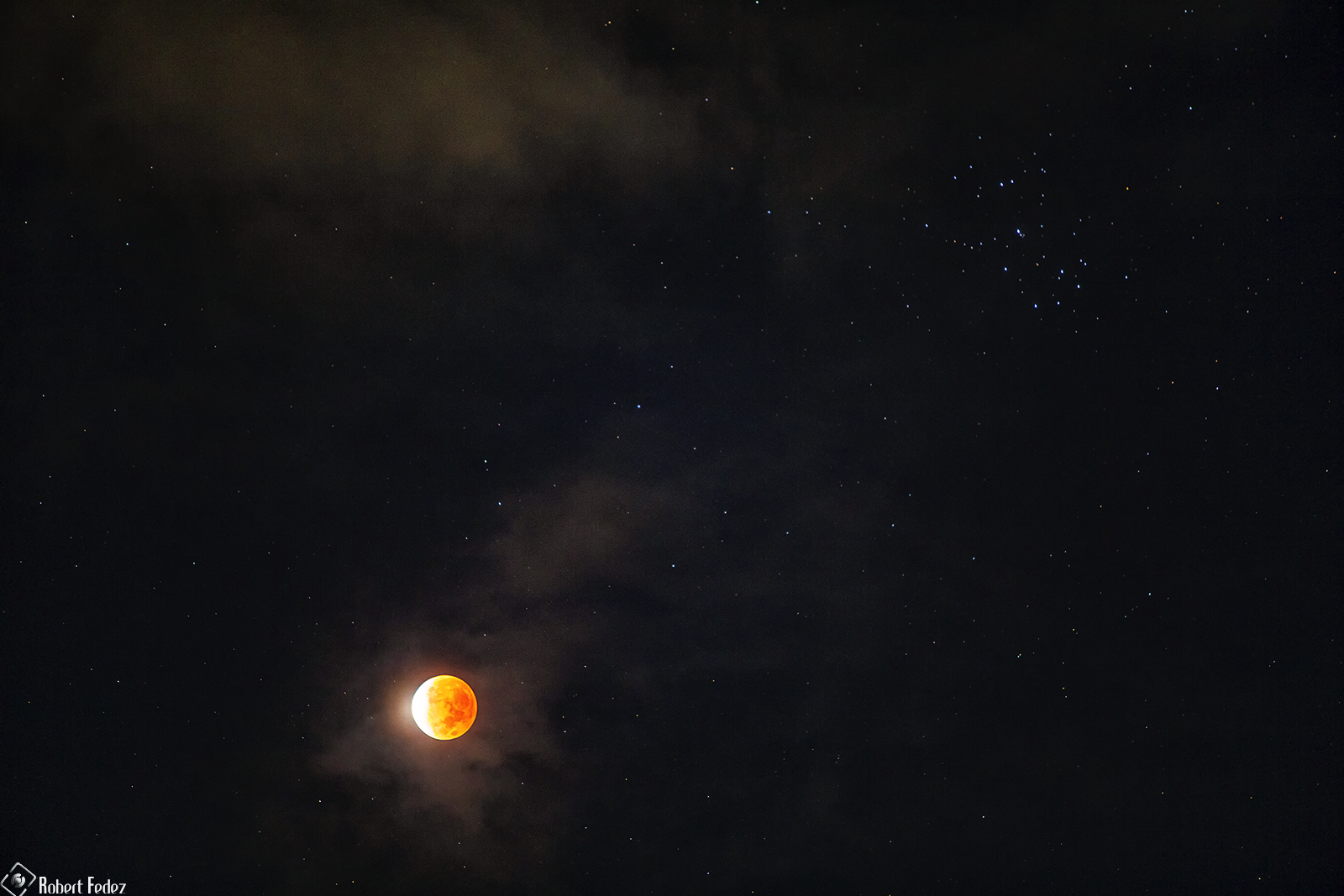
Predawn hours of 2021 November 19 found the Moon in partly cloudy skies over Cancun, Mexico. Captured in this telephoto snapshot, the lunar disk is not quite entirely immersed in Earth's dark umbral shadow during a long partial lunar eclipse. The partial eclipse was deep though, deep enough to show the dimmed but reddened light in Earth's shadow. That's a sight often anticipated by fans of total lunar eclipses. Wandering through the constellation Taurus, the eclipsed Moon's dimmer light also made it easier to spot the Pleiades star cluster. The stars of the Seven Sisters share this frame at the upper right, with the almost totally eclipsed Moon.
https://apod.nasa.gov/apod/ap211120.html
#space #pleiades #moon #astrophotography #photography #science #astronomy #nature #NASA
Alt...
2021 November 20
An Almost Total Lunar Eclipse
* Image Credit & Copyright: Robert Fedez
Explanation:
Predawn hours of 2021 November 19 found the Moon in partly cloudy skies over Cancun, Mexico. Captured in this telephoto snapshot, the lunar disk is not quite entirely immersed in Earth's dark umbral shadow during a long partial lunar eclipse. The partial eclipse was deep though, deep enough to show the dimmed but reddened light in Earth's shadow. That's a sight often anticipated by fans of total lunar eclipses. Wandering through the constellation Taurus, the eclipsed Moon's dimmer light also made it easier to spot the Pleiades star cluster. The stars of the Seven Sisters share this frame at the upper right, with the almost totally eclipsed Moon.
Authors & editors: Robert Nemiroff (MTU) & Jerry Bonnell (UMCP)
NASA Official: Phillip Newman Specific rights apply.
NASA Web Privacy Policy and Important Notices
A service of: ASD at NASA / GSFC
& Michigan Tech. U.
![[?]](https://files.mastodon.social/accounts/avatars/110/785/978/856/457/376/original/491bc21b6e651aad.jpg)
#Halloween in the #Woods by Kaye Menner Wide variety #Prints & lovely #Products at:
https://kaye-menner.pixels.com/featured/halloween-in-the-woods-by-kaye-menner-kaye-menner.html
#happyhalloween #witch #witchonbroom #moon #bats #spiderwebs #pumpkins #halloweenpumpkins #jackolanterns #handdigital #notai #homedecor #mastoart #fediverse #fediart #fedigiftshop #giftideas #wallartforsale #Art #artforsale #BuyIntoArt #AYearForArt #Artist #FineArtAmerica #PhotographyFeed #VisualArts #CreativeArts

Alt...
A Happy Halloween digital art image in the woods with lots to scare you... with witch on broom, bats, spiders, graves, lots of halloween pumpkins and a spider web overlay to add to the scare.
The background scene I give credit to Belle Fleur Textures. This was blended with one of my own background images.
By Kaye Menner
https://kaye-menner.pixels.com/featured/halloween-in-the-woods-by-kaye-menner-kaye-menner.html
THE FINE ART AMERICA LOGO WILL NOT APPEAR ON PURCHASED PRINTS OR PRODUCTS.
![[?]](https://mastodon-sdoh.nyc3.digitaloceanspaces.com/accounts/avatars/112/260/167/001/540/754/original/76fe129575c8a7cb.png)
2025 October 9
The Jenga Moon
* Image Credit & Copyright: Mike Carroll
https://www.instagram.com/jerseyportraits/?hl=en
Explanation:
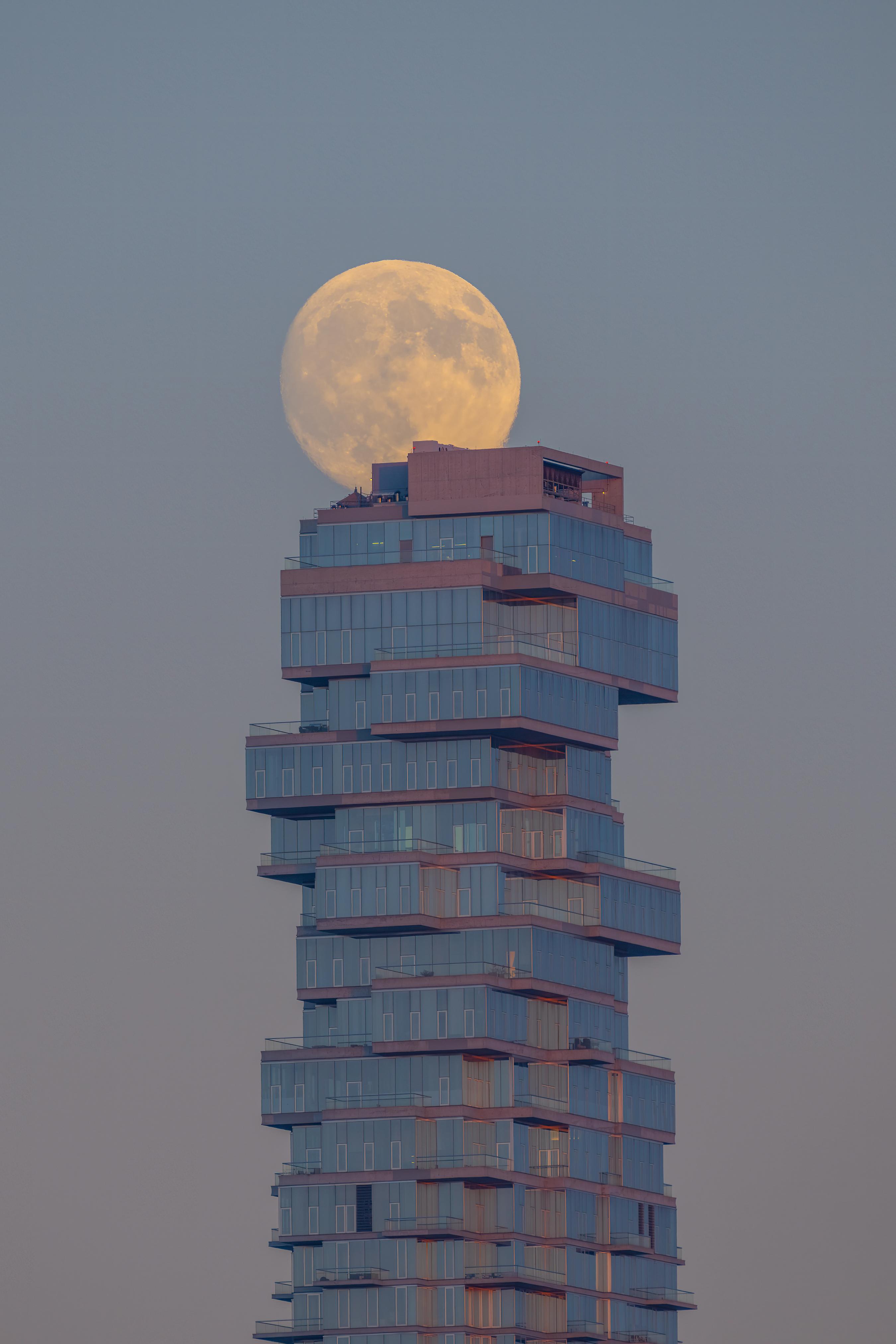
That big, bright, beautiful Full Moon you watched rise on the night of October 6 was the Harvest Moon. Famed in festival, story, and song, Harvest Moon is just the traditional name of the full moon nearest the time of the northern hemisphere's autumnal equinox. According to lore the name is a fitting one. Despite the diminishing daylight hours, as the growing season drew to a close in the north, farmers could harvest crops by the light of a full moon shining on from dusk to dawn. Later this year than usual, in 2025 October's Harvest Moon was also known to some as a supermoon, a term becoming a traditional name for a full moon near the time of lunar perigee. And this telephoto snapshot of the (almost) full moon rising above a conspicuous skyscraper in New York city, taken on October 5, is suggestive of yet another full moon moniker.
https://science.nasa.gov/moon/supermoons/
https://en.wikipedia.org/wiki/56_Leonard_Street
https://en.wikipedia.org/wiki/56_Leonard_Street
#space #earth #moon #astrophotography #photography #science #astronomy #nature #NASA #apod
Alt...
2025 October 9
The Jenga Moon
* Image Credit & Copyright: Mike Carroll
Explanation:
That big, bright, beautiful Full Moon you watched rise on the night of October 6 was the Harvest Moon. Famed in festival, story, and song, Harvest Moon is just the traditional name of the full moon nearest the time of the northern hemisphere's autumnal equinox. According to lore the name is a fitting one. Despite the diminishing daylight hours, as the growing season drew to a close in the north, farmers could harvest crops by the light of a full moon shining on from dusk to dawn. Later this year than usual, in 2025 October's Harvest Moon was also known to some as a supermoon, a term becoming a traditional name for a full moon near the time of lunar perigee. And this telephoto snapshot of the (almost) full moon rising above a conspicuous skyscraper in New York city, taken on October 5, is suggestive of yet another full moon moniker.
Authors & editors: Robert Nemiroff (MTU) & Jerry Bonnell (UMCP)
NASA Official: Amber Straughn Specific rights apply.
NASA Web Privacy, Accessibility, Notices;
A service of: ASD at NASA / GSFC,
NASA Science Activation
& Michigan Tech. U.
TOPIC> "Full Moon"
~*~
Above the Dock
Above the quiet dock in mid night,
Tangled in the tall mast’s corded height,
Hangs the moon. What seemed so far away
Is but a child’s balloon, forgotten after play.
T. E. Hulme
1883 –
1917
~*~
2025 July 12
Clouds and the Golden Moon
* Image Credit & Copyright:
https://www.instagram.com/alexsandromota805/p/DL8VjPIy8Ed/
Explanation:
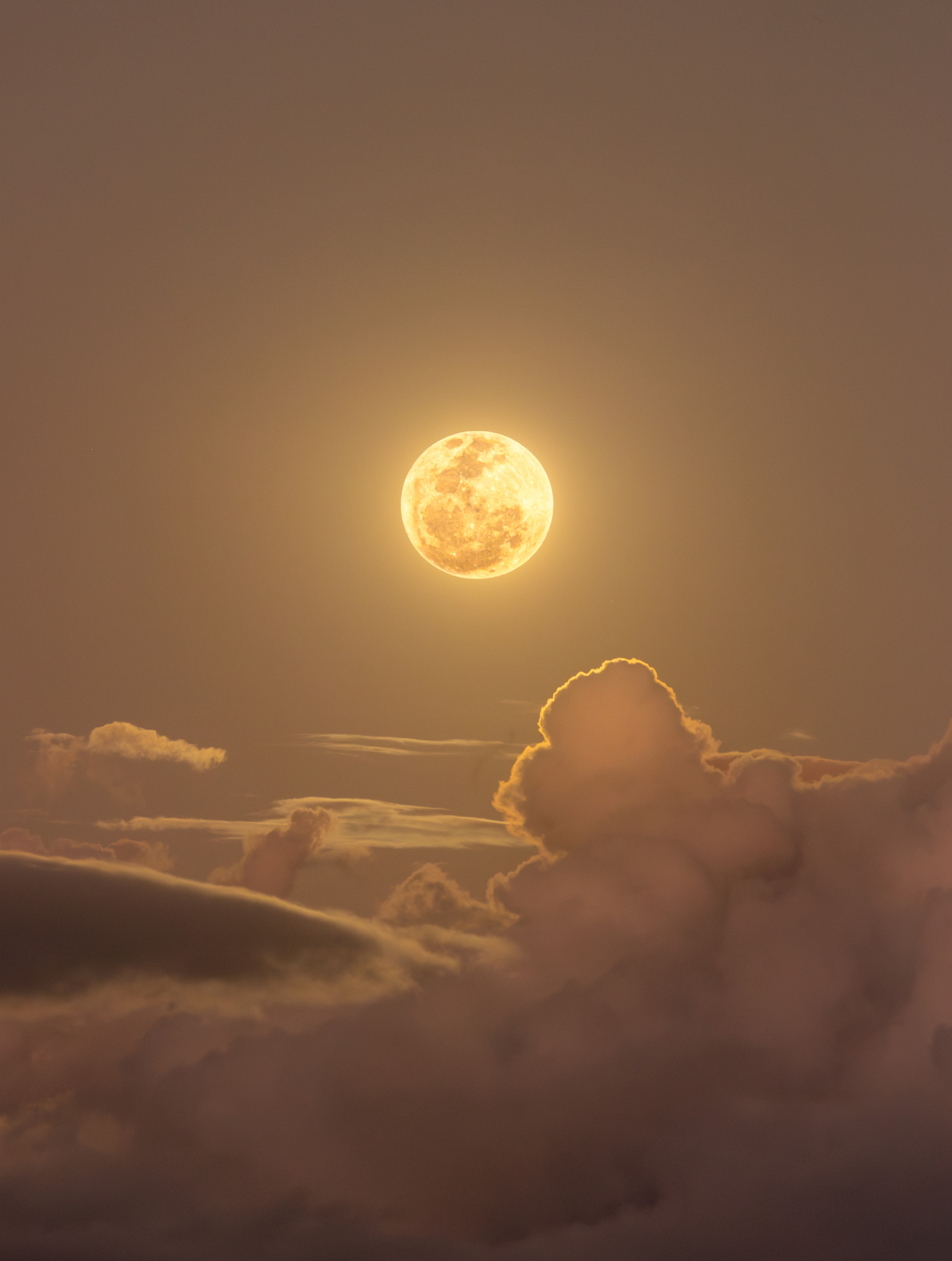
As the Sun set, a bright Full Moon rose on July 10. Its golden light illuminates clouds drifting through southern hemisphere skies in this well-composed telephoto image from Conceição do Coité, Bahia, Brazil. The brightest lunar phase is captured here with both a short and long exposure. The two exposures were combined to reveal details of the lunar surface in bright moonlight and a subtle iridescence along the dramatically backlit cloudscape. Of course, July's Full Moon is a winter moon in the southern hemisphere. But in the north it's known to some as the Thunder Moon, likely a nod to the sounds of this northern summer month's typically stormy weather.
https://www.instagram.com/alexsandromota805/p/DL8VjPIy8Ed/
https://moon.nasa.gov/moon-observation/daily-moon-guide/?intent=021
https://apod.nasa.gov/apod/archivepix.html
#space #moon #astrophotography #photography #science #nature #NASA
Alt...
2025 July 12
Clouds and the Golden Moon
* Image Credit & Copyright: Alexsandro Mota
Explanation:
As the Sun set, a bright Full Moon rose on July 10. Its golden light illuminates clouds drifting through southern hemisphere skies in this well-composed telephoto image from Conceição do Coité, Bahia, Brazil. The brightest lunar phase is captured here with both a short and long exposure. The two exposures were combined to reveal details of the lunar surface in bright moonlight and a subtle iridescence along the dramatically backlit cloudscape. Of course, July's Full Moon is a winter moon in the southern hemisphere. But in the north it's known to some as the Thunder Moon, likely a nod to the sounds of this northern summer month's typically stormy weather.
Authors & editors: Robert Nemiroff (MTU) & Jerry Bonnell (UMCP)
NASA Official: Amber Straughn Specific rights apply.
NASA Web Privacy, Accessibility, Notices;
A service of: ASD at NASA / GSFC,
NASA Science Activation
& Michigan Tech. U.
2024 August 24
South Pacific Shadowset
* Image Credit & Copyright: Jin Wang
Explanation:
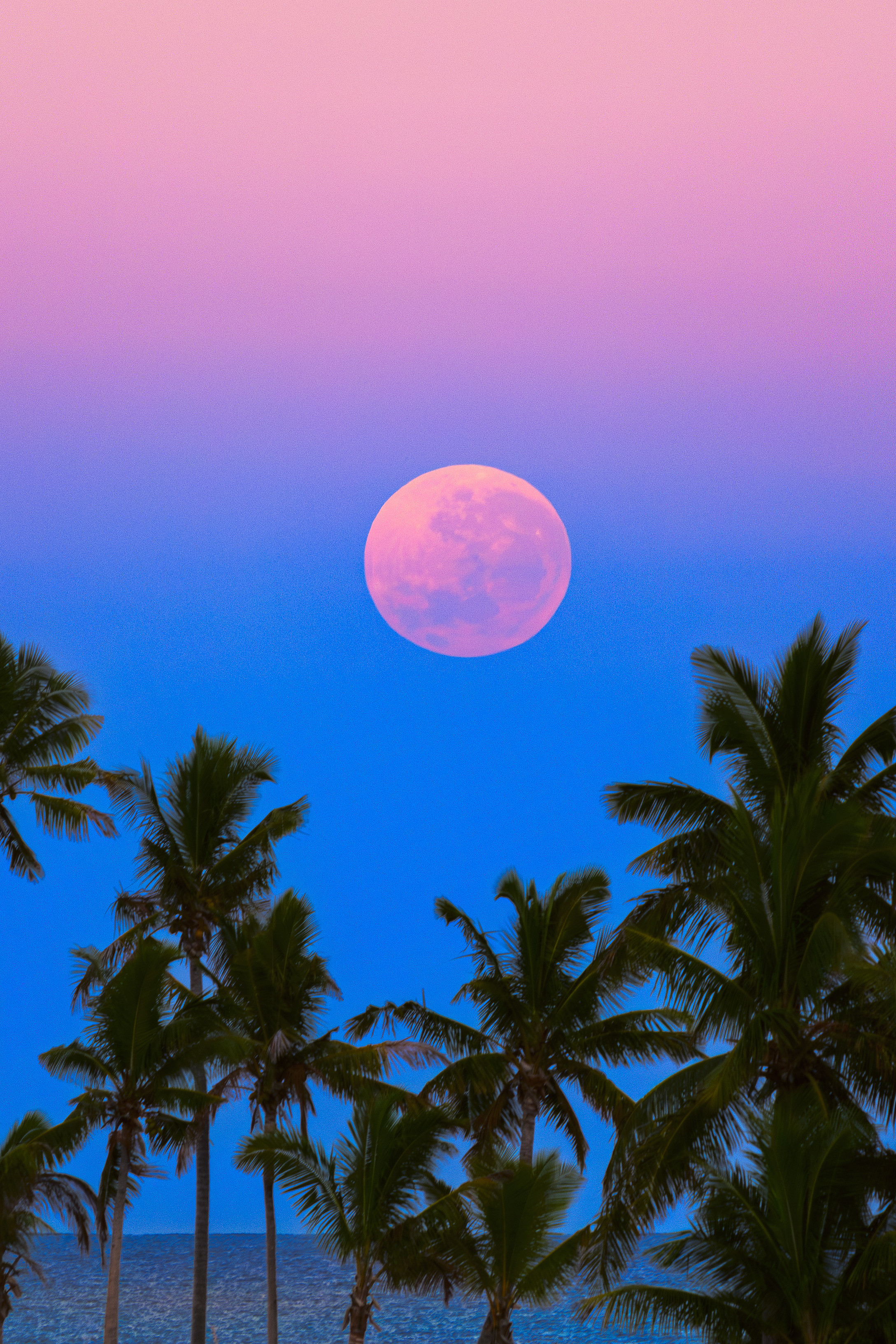
The full Moon and Earth's shadow set together in this island skyscape. The alluring scene was captured Tuesday morning, August 20, from Fiji, South Pacific Ocean, planet Earth. For early morning risers shadowset in the western sky is a daily apparition. Still, the grey-blue shadow is often overlooked in favor of a brighter eastern horizon. Extending through the dense atmosphere, Earth's setting shadow is bounded above by a pinkish glow or anti-twilight arch. Known as the Belt of Venus, the arch's lovely color is due to backscattering of reddened light from the opposite horizon's rising Sun. Of course, the setting Moon's light is reddened by the long sight-line through the atmosphere. But on that date the full Moon could be called a seasonal Blue Moon, the third full Moon in a season with four full Moons. And even though the full Moon is always impressive near the horizon, August's full Moon is considered by some the first of four consecutive full Supermoons in 2024.
https://apod.nasa.gov/apod/ap240824.html
#space #earth #moon #atmosphere #astrophotography #photography #science #astronomy #nature #NASA
Alt...
2024 August 24
South Pacific Shadowset
* Image Credit & Copyright: Jin Wang
Explanation:
The full Moon and Earth's shadow set together in this island skyscape. The alluring scene was captured Tuesday morning, August 20, from Fiji, South Pacific Ocean, planet Earth. For early morning risers shadowset in the western sky is a daily apparition. Still, the grey-blue shadow is often overlooked in favor of a brighter eastern horizon. Extending through the dense atmosphere, Earth's setting shadow is bounded above by a pinkish glow or anti-twilight arch. Known as the Belt of Venus, the arch's lovely color is due to backscattering of reddened light from the opposite horizon's rising Sun. Of course, the setting Moon's light is reddened by the long sight-line through the atmosphere. But on that date the full Moon could be called a seasonal Blue Moon, the third full Moon in a season with four full Moons. And even though the full Moon is always impressive near the horizon, August's full Moon is considered by some the first of four consecutive full Supermoons in 2024.
Authors & editors: Robert Nemiroff (MTU) & Jerry Bonnell (UMCP)
NASA Official: Amber Straughn Specific rights apply.
NASA Web Privacy, Accessibility Notices
A service of: ASD at NASA / GSFC,
NASA Science Activation
& Michigan Tech. U.
2024 August 20
Supermoon Beyond the Temple of Poseidon
* Image Credit: Alexandros Maragos
https://www.instagram.com/p/C-3NZVEOdaV/
Explanation:
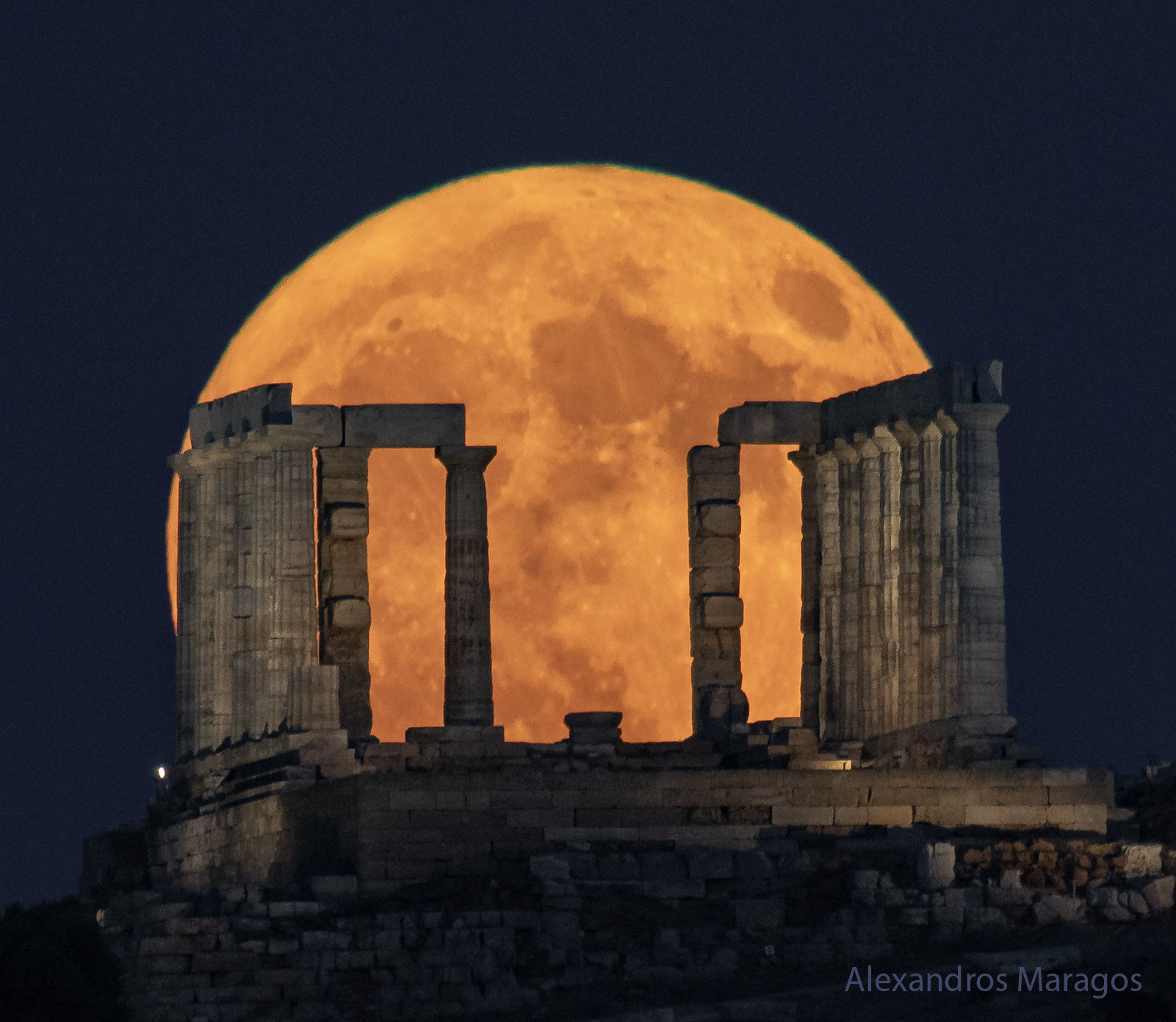
A supermoon occurred yesterday. And tonight's moon should also look impressive. Supermoons appear slightly larger and brighter than most full moons because they reach their full phase when slightly nearer to the Earth -- closer than 90 percent of all full moons. This supermoon was also a blue moon given the definition that it is the third of four full moons occurring during a single season. Blue moons are not usually blue, and a different definition holds that a blue moon is the second full moon that occurs during a single month. The featured image captured the blue supermoon right near its peak size yesterday as it was rising beyond the Temple of Poseidon in Greece. This supermoon is particularly unusual in that it is the first of four successive supermoons, the next three occurring in September, October, and November.
https://apod.nasa.gov/apod/ap240820.html
#space #earth #moon #atmosphere #astrophotography #photography #science #astronomy #nature #NASA
Alt...
2024 August 20
A large and orange-tinted moon is pictured rising beyond the pillars of an ancient structure. The foreground is dark and the night sky behind the Moon appear blue.
Supermoon Beyond the Temple of Poseidon
* Image Credit: Alexandros Maragos
Explanation:
A supermoon occurred yesterday. And tonight's moon should also look impressive. Supermoons appear slightly larger and brighter than most full moons because they reach their full phase when slightly nearer to the Earth -- closer than 90 percent of all full moons. This supermoon was also a blue moon given the definition that it is the third of four full moons occurring during a single season. Blue moons are not usually blue, and a different definition holds that a blue moon is the second full moon that occurs during a single month. The featured image captured the blue supermoon right near its peak size yesterday as it was rising beyond the Temple of Poseidon in Greece. This supermoon is particularly unusual in that it is the first of four successive supermoons, the next three occurring in September, October, and November.
Authors & editors: Robert Nemiroff (MTU) & Jerry Bonnell (UMCP)
NASA Official: Amber Straughn Specific rights apply.
NASA Web Privacy, Accessibility, Notices;
A service of: ASD at NASA / GSFC,
NASA Science Activation
& Michigan Tech. U.
2024 June 20
Sandy and the Moon Halo
* Image Credit & Copyright: Marcella Giulia Pace
https://greenflash.photo/about-me/
Explanation:
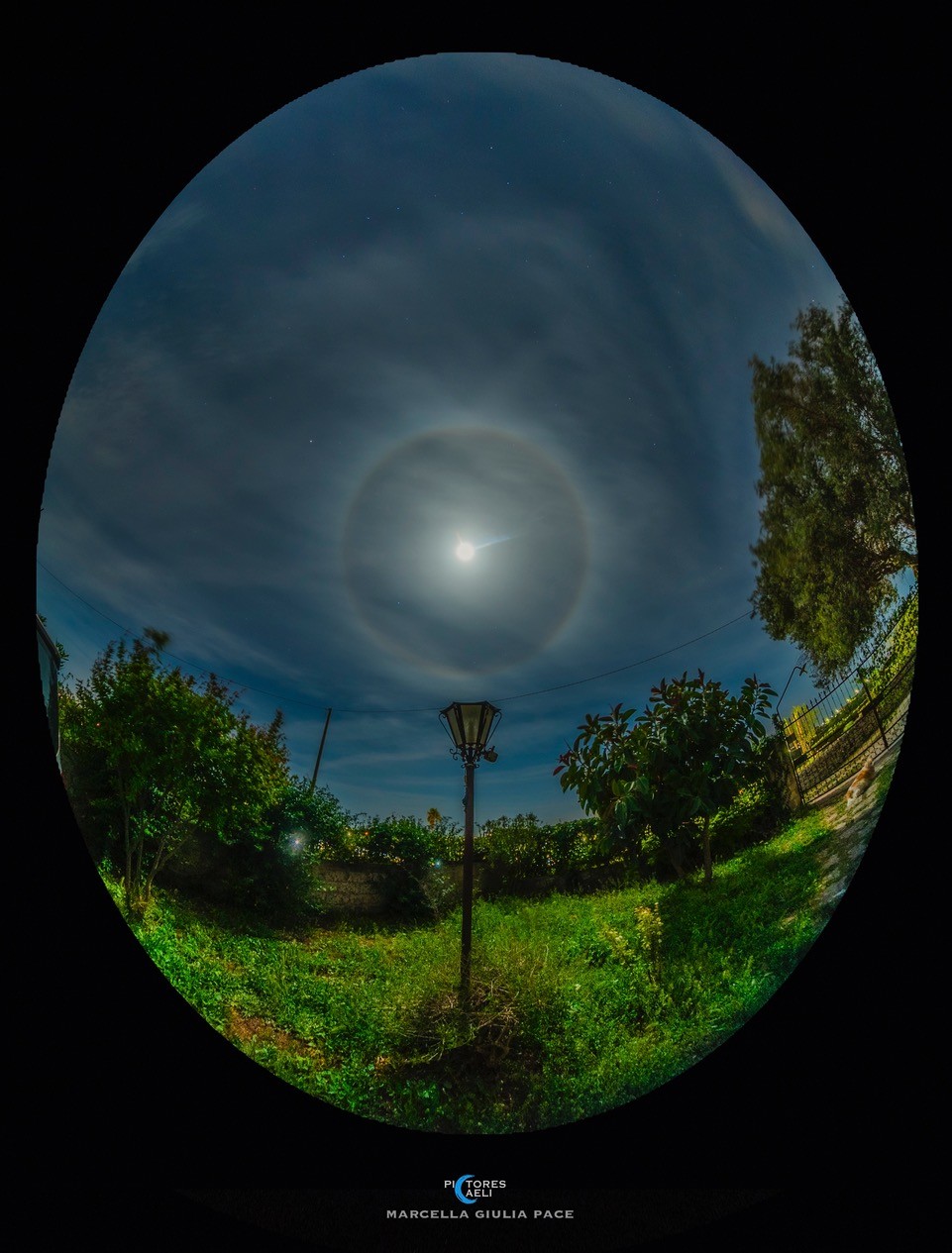
Last Year April's Full Moon shines through high clouds near the horizon, casting shadows in this garden-at-night skyscape. Along with canine sentinel Sandy watching the garden gate, the wide-angle snapshot also captured the bright Moon's 22 degree ice halo.
https://apod.nasa.gov/apod/ap240620.html
#space #earth #moon #atmosphere #astrophotography #photography #science #astronomy #nature #NASA
Alt...
2024 June 20
Sandy and the Moon Halo
* Image Credit & Copyright: Marcella Giulia Pace
Explanation:
Last Year April's Full Moon shines through high clouds near the horizon, casting shadows in this garden-at-night skyscape. Along with canine sentinel Sandy watching the garden gate, the wide-angle snapshot also captured the bright Moon's 22 degree ice halo.
Authors & editors: Robert Nemiroff (MTU) & Jerry Bonnell (UMCP)
NASA Official: Amber Straughn Specific rights apply.
NASA Web Privacy, Accessibility Notices
A service of: ASD at NASA / GSFC,
NASA Science Activation
& Michigan Tech. U.
2024 January 27
Full Observatory Moon
* Image Credit & Copyright: Yuri Beletsky (Carnegie Las Campanas Observatory, TWAN)
https://www.instagram.com/yuribeletsky/
https://carnegiescience.edu/
https://www.lco.cl/
Explanation:
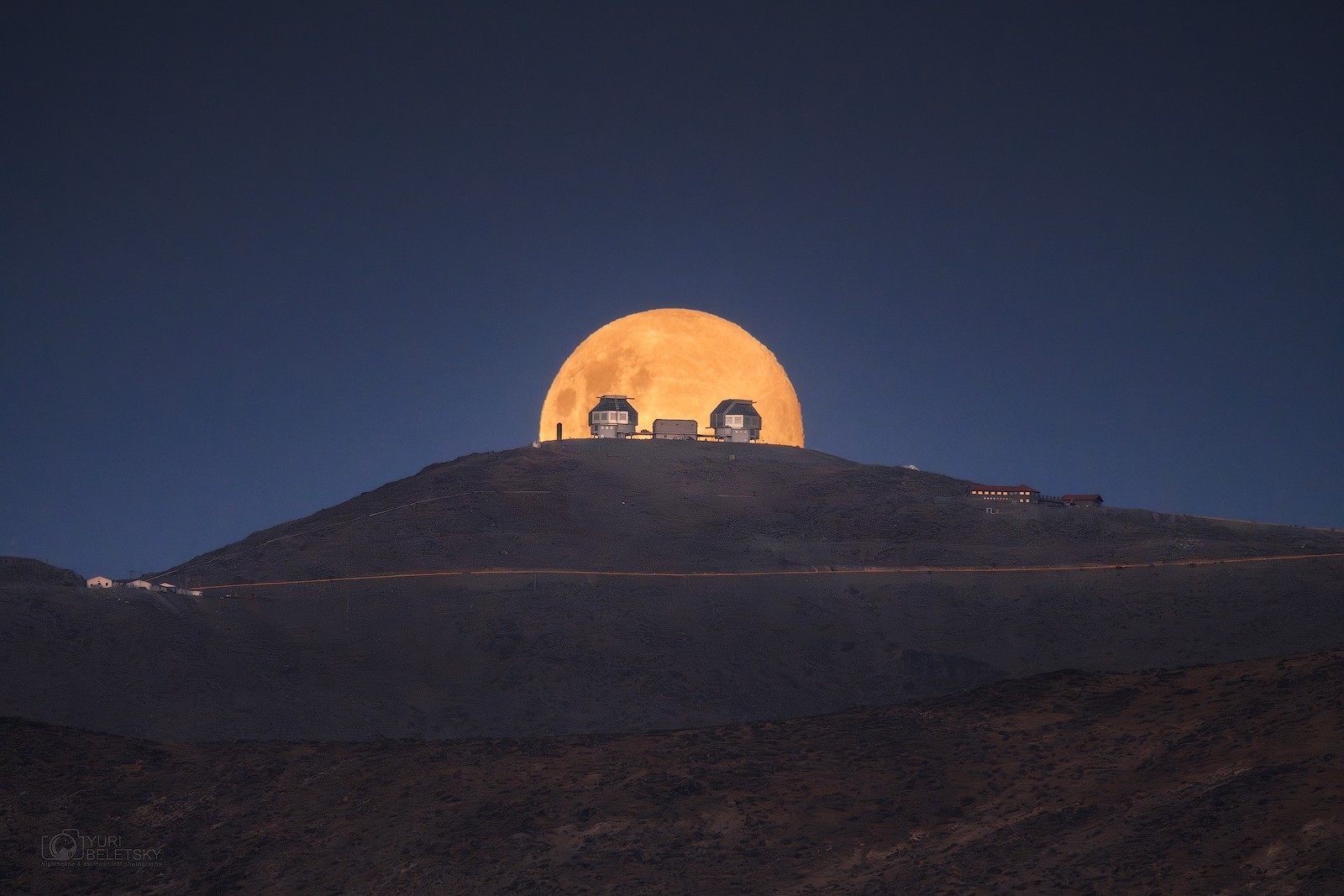
A popular name for (2024) January's full moon in the northern hemisphere is the Full Wolf Moon. As the new year's first full moon, it rises over Las Campanas Observatory in this dramatic Earth-and-moonscape. Peering from the foreground like astronomical eyes are the observatory's twin 6.5 meter diameter Magellan telescopes. The snapshot was captured with telephoto lens across rugged terrain in the Chilean Atacama Desert, taken at a distance of about 9 miles from the observatory and about 240,000 miles from the lunar surface. Of course the first full moon of the lunar new year, known to some as the Full Snow Moon, will rise on February 24.
https://apod.nasa.gov/apod/ap240127.html
#space #earth #moon #atmosphere #astrophotography #photography #science #astronomy #nature #NASA
Alt...
2024 January 27
Full Observatory Moon
* Image Credit & Copyright: Yuri Beletsky (Carnegie Las Campanas Observatory, TWAN)
Explanation:
A popular name for (2024) January's full moon in the northern hemisphere is the Full Wolf Moon. As the new year's first full moon, it rises over Las Campanas Observatory in this dramatic Earth-and-moonscape. Peering from the foreground like astronomical eyes are the observatory's twin 6.5 meter diameter Magellan telescopes. The snapshot was captured with telephoto lens across rugged terrain in the Chilean Atacama Desert, taken at a distance of about 9 miles from the observatory and about 240,000 miles from the lunar surface. Of course the first full moon of the lunar new year, known to some as the Full Snow Moon, will rise on February 24.
Authors & editors: Robert Nemiroff (MTU) & Jerry Bonnell (UMCP)
NASA Official: Amber Straughn Specific rights apply.
NASA Web Privacy Policy and Important Notices
A service of: ASD at NASA / GSFC,
NASA Science Activation
& Michigan Tech. U.
2024 January 2
Rocket Transits Rippling Moon
* Image Credit & Copyright: Steven Madow
https://www.instagram.com/stevenmadow/
Explanation:
Can a rocket make the Moon ripple? No, but it can make a background moon appear wavy. The rocket, in this case, was a SpaceX Falcon Heavy that blasted off from NASA's Kennedy Space Center last week. In the featured launch picture, the rocket's exhaust plume glows beyond its projection onto the distant, rising, and nearly full moon. Oddly, the Moon's lower edge shows unusual drip-like ripples. The Moon itself, far in the distance, was really unchanged. The physical cause of these apparent ripples was pockets of relatively hot or rarefied air deflecting moonlight less strongly than pockets of relatively cool or compressed air: refraction. Although the shot was planned, the timing of the launch had to be just right for the rocket to be transiting the Moon during this single exposure.
https://apod.nasa.gov/apod/ap240102.html
#space #earth #moon #atmosphere #astrophotography #photography #science #astronomy #nature #NASA
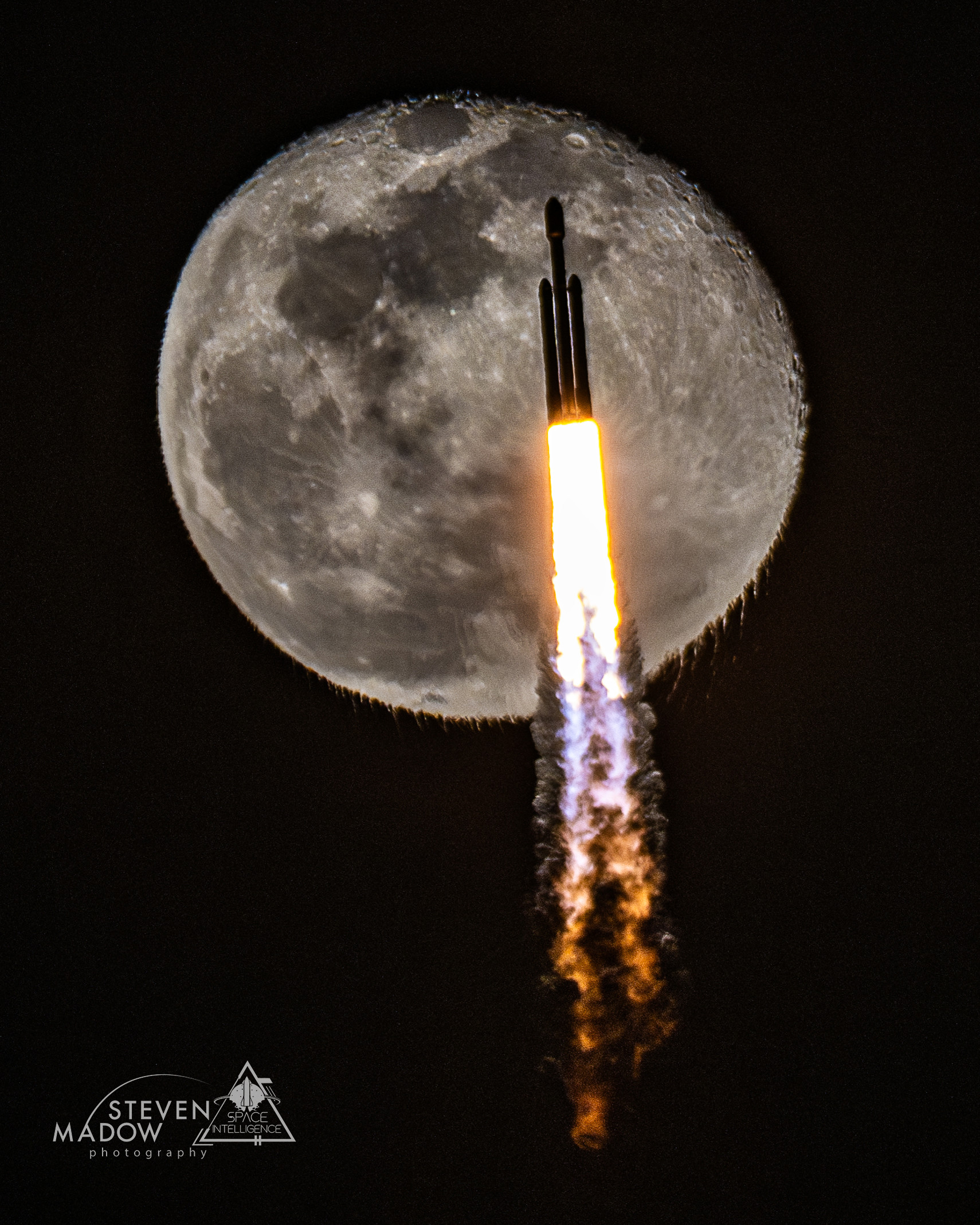
Alt...
2024 January 2
A rocket is pictured ascending during launch. A nearly full moon is behind it. The rocket exhaust, itself visible, causes the bottom of the Moon to appear unusually rippled.
Rocket Transits Rippling Moon
* Image Credit & Copyright: Steven Madow
Explanation:
Can a rocket make the Moon ripple? No, but it can make a background moon appear wavy. The rocket, in this case, was a SpaceX Falcon Heavy that blasted off from NASA's Kennedy Space Center last week. In the featured launch picture, the rocket's exhaust plume glows beyond its projection onto the distant, rising, and nearly full moon. Oddly, the Moon's lower edge shows unusual drip-like ripples. The Moon itself, far in the distance, was really unchanged. The physical cause of these apparent ripples was pockets of relatively hot or rarefied air deflecting moonlight less strongly than pockets of relatively cool or compressed air: refraction. Although the shot was planned, the timing of the launch had to be just right for the rocket to be transiting the Moon during this single exposure.
Authors & editors: Robert Nemiroff (MTU) & Jerry Bonnell (UMCP)
NASA Official: Ryan Smallcomb Specific rights apply.
NASA Web Privacy Policy and Important Notices
A service of: ASD at NASA / GSFC,
NASA Science Activation
& Michigan Tech. U.
2023 December 30
The Persistence of Moonlight
* Image Credit & Copyright: Giacomo Venturin
Explanation:
Known to some in the northern hemisphere as December's Cold Moon or the Long Night Moon, the last full moon of 2023 is rising in this surreal mountain and skyscape. The Daliesque scene was captured in a single exposure with a camera and long telephoto lens near Monte Grappa, Italy. The full moon is not melting, though. Its stretched and distorted appearance near the horizon is caused as refraction along the line of sight changes and creates shifting images or mirages of the bright lunar disk. The changes in atmospheric refraction correspond to atmospheric layers with sharply different temperatures and densities. Other effects of atmospheric refraction produced by the long sight-line to this full moon rising include the thin red rim seen faintly on the distorted lower edge of the Moon and a thin green rim along the top.
https://apod.nasa.gov/apod/ap231230.html
#space #earth #moon #atmosphere #astrophotography #photography #science #astronomy #nature #NASA
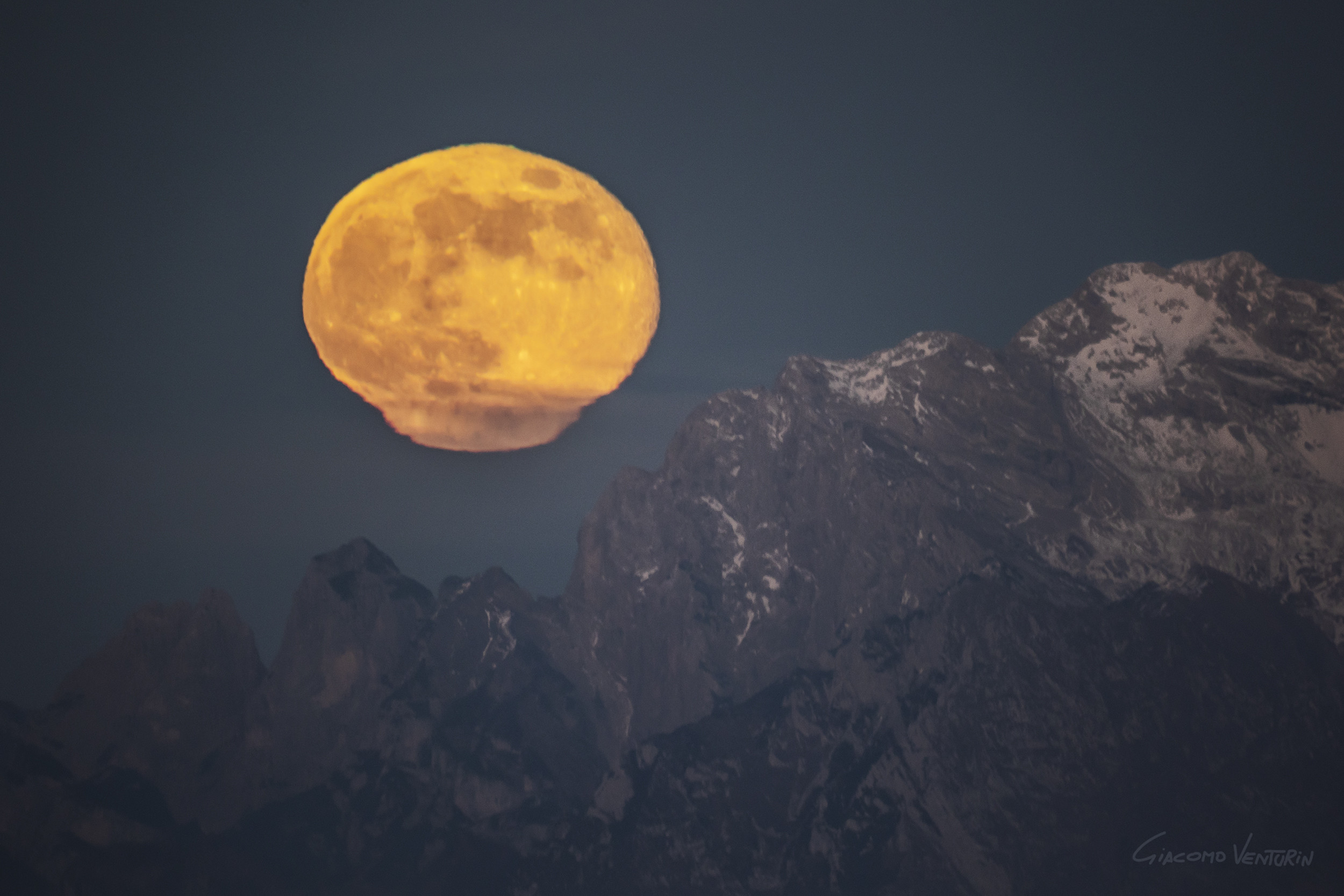
Alt...
2023 December 30
The Persistence of Moonlight
* Image Credit & Copyright: Giacomo Venturin
Explanation:
Known to some in the northern hemisphere as December's Cold Moon or the Long Night Moon, the last full moon of 2023 is rising in this surreal mountain and skyscape. The Daliesque scene was captured in a single exposure with a camera and long telephoto lens near Monte Grappa, Italy. The full moon is not melting, though. Its stretched and distorted appearance near the horizon is caused as refraction along the line of sight changes and creates shifting images or mirages of the bright lunar disk. The changes in atmospheric refraction correspond to atmospheric layers with sharply different temperatures and densities. Other effects of atmospheric refraction produced by the long sight-line to this full moon rising include the thin red rim seen faintly on the distorted lower edge of the Moon and a thin green rim along the top.
Authors & editors: Robert Nemiroff (MTU) & Jerry Bonnell (UMCP)
NASA Official: Phillip Newman Specific rights apply.
NASA Web Privacy Policy and Important Notices
A service of: ASD at NASA / GSFC,
NASA Science Activation
& Michigan Tech. U.
2023 September 30
A Harvest Moon over Tuscany
* Image Credit & Copyright: Antonio Tartarini
Explanation:
For northern hemisphere dwellers, September's Full Moon was the Harvest Moon. Reflecting warm hues at sunset, it rises behind cypress trees huddled on a hill top in Tuscany, Italy in this telephoto view from September 28. Famed in festival, story, and song, Harvest Moon is just the traditional name of the full moon nearest the autumnal equinox. According to lore the name is a fitting one. Despite the diminishing daylight hours as the growing season drew to a close, farmers could harvest crops by the light of a full moon shining on from dusk to dawn. This Harvest Moon was also known to some as a supermoon, a term becoming a traditional name for a full moon near perigee. It was the fourth and final supermoon for 2023.
https://earthsky.org/astronomy-essentials/harvest-moon-2/
https://apod.nasa.gov/apod/ap230930.html
#space #earth #moon #atmosphere #astrophotography #photography #science #astronomy #nature #NASA
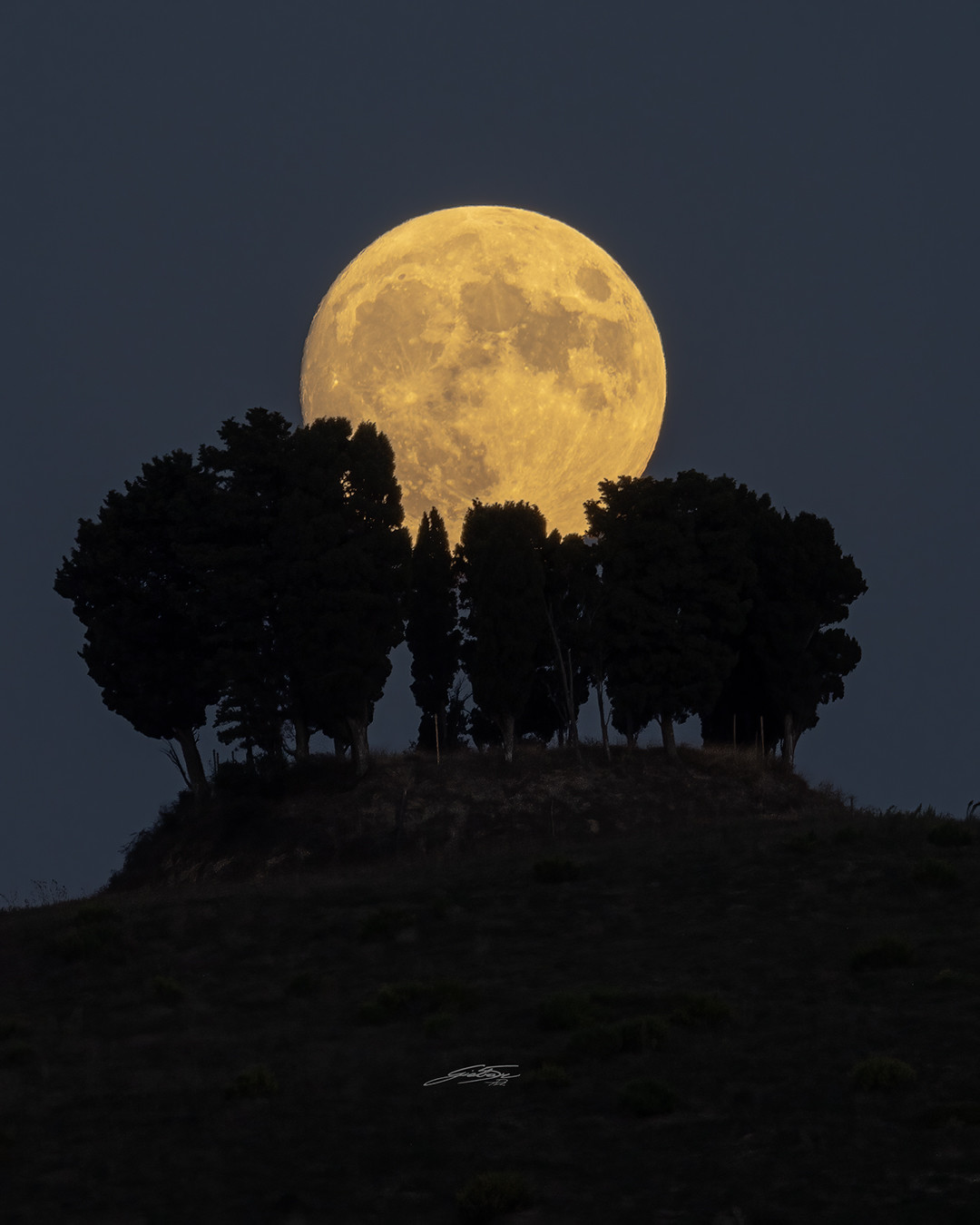
Alt...
2023 September 30
A Harvest Moon over Tuscany
* Image Credit & Copyright: Antonio Tartarini
Explanation:
For northern hemisphere dwellers, September's Full Moon was the Harvest Moon. Reflecting warm hues at sunset, it rises behind cypress trees huddled on a hill top in Tuscany, Italy in this telephoto view from September 28. Famed in festival, story, and song, Harvest Moon is just the traditional name of the full moon nearest the autumnal equinox. According to lore the name is a fitting one. Despite the diminishing daylight hours as the growing season drew to a close, farmers could harvest crops by the light of a full moon shining on from dusk to dawn. This Harvest Moon was also known to some as a supermoon, a term becoming a traditional name for a full moon near perigee. It was the fourth and final supermoon for 2023.
Authors & editors: Robert Nemiroff (MTU) & Jerry Bonnell (UMCP)
NASA Official: Phillip Newman Specific rights apply.
NASA Web Privacy Policy and Important Notices
A service of: ASD at NASA / GSFC,
NASA Science Activation
& Michigan Tech. U.
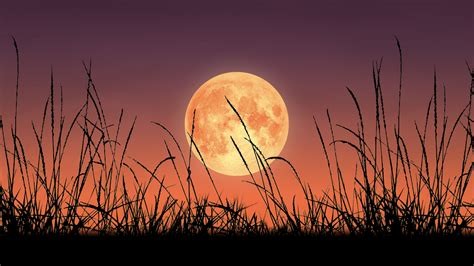
What can I say? The title of the last post almost cries out for this song and I just can't resist, sorry.. I hope you like this version 🤠 😅
Music & Video Credit:
The Brothers Comatose & AJ Lee - "Harvest Moon" (by Neil Young)
** Note by grobi:
"To upload this video, I converted it and compressed it to a smaller file-size under linux with the free software ffmpeg and the corresponding command:
'ffmpeg -i video_in.webm -vcodec libx265 -crf 30 video_out.mp4'
Maybe you would like to post a corresponding video on a scientifically related 😅 topic, but it is perhaps too big? Then try ffmpeg."
#space #earth #moon #atmosphere #astrophotography #photography #music #grobi_muzak
Alt...
The Brothers Comatose & AJ Lee - "Harvest Moon" (by Neil Young)
"So really... on the way back to the peak of normal I say "Good Night" for today with this composition of Mars and the Moon, I dream of a mandolin, like AJ Lee's but everything in its time.. I am happy that several friends of mine were convinced to meet 1 time a week for house music after the summer holidays. Making music together is something great and gives so much strength for everyday life, doesn't it? The Brothers Comatose & AJ Lee (previous post) are an inspiring example!"
2022 December 15
Full Moon, Full Mars
* Image Credit & Copyright: Tomas Slovinsky
https://www.tomasslovinsky.com/#about
Explanation:
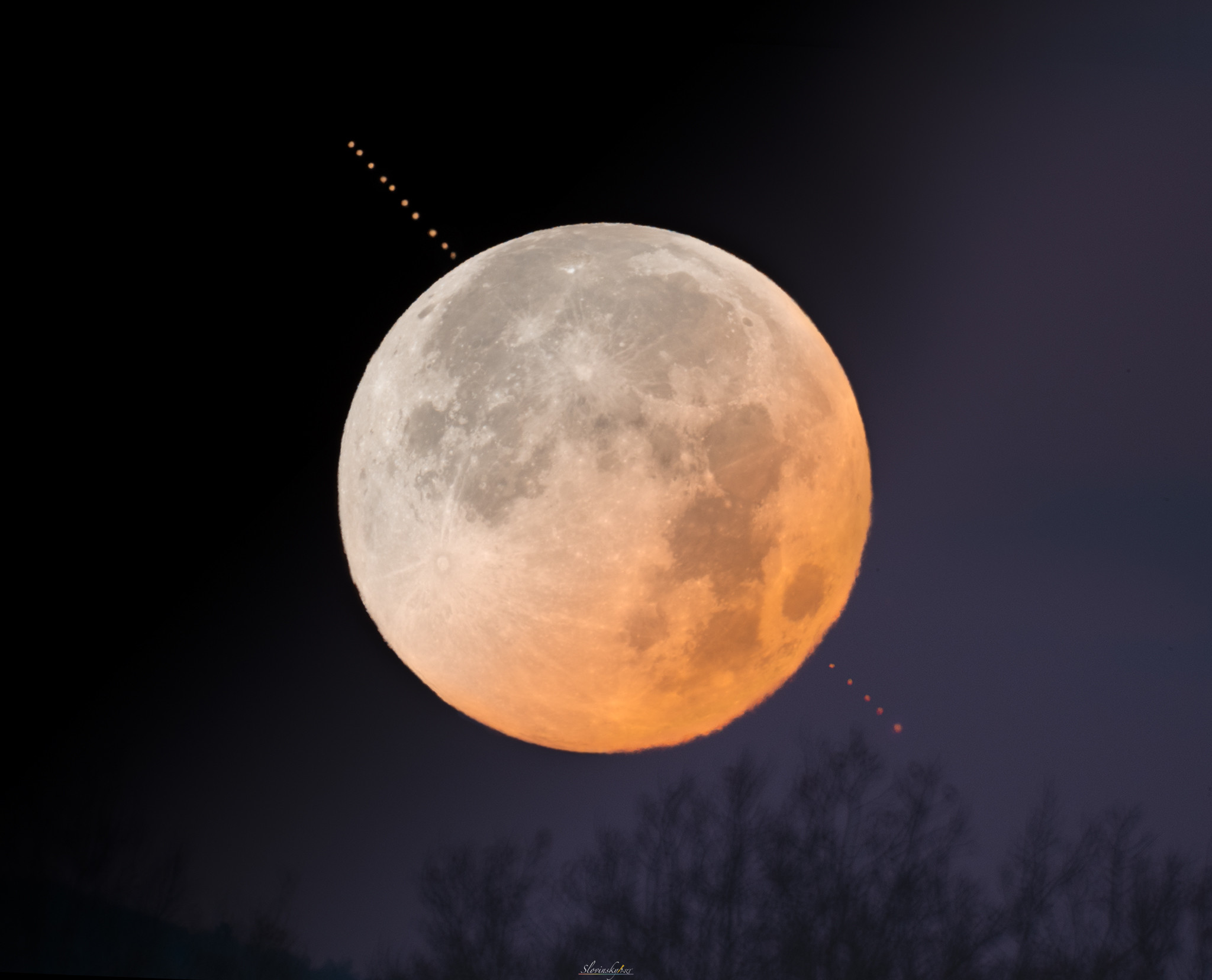
On (2022) December 8 a full Moon and a full Mars were close, both bright and opposite the Sun in planet Earth's sky. In fact Mars was occulted, passing behind the Moon when viewed from some locations across Europe and North America. Seen from the city of Kosice in eastern Slovakia, the lunar occultation of Mars happened just before sunrise. The tantalizing spectacle was recorded in this telescopic timelapse sequence of exposures. It took about an hour for the Red Planet to disappear behind the lunar disk and then reappear as a warm-hued full Moon, the last full Moon of 2022, sank toward the western horizon. The next lunar occultation of bright planet Mars will be in the new year on January 3, when the Moon is in a waxing gibbous phase. Lunar occultations are only ever visible from a fraction of the Earth's surface, though. The January 3 occultation of Mars will be visible from parts of the South Atlantic, southern Africa, and the Indian Ocean.
https://apod.nasa.gov/apod/ap221215.html
#space #earth #moon #atmosphere #astrophotography #photography #science #astronomy #nature #NASA #SilentSunsday
Alt...
2022 December 15
Full Moon, Full Mars
* Image Credit & Copyright: Tomas Slovinsky
Explanation:
On (2022) December 8 a full Moon and a full Mars were close, both bright and opposite the Sun in planet Earth's sky. In fact Mars was occulted, passing behind the Moon when viewed from some locations across Europe and North America. Seen from the city of Kosice in eastern Slovakia, the lunar occultation of Mars happened just before sunrise. The tantalizing spectacle was recorded in this telescopic timelapse sequence of exposures. It took about an hour for the Red Planet to disappear behind the lunar disk and then reappear as a warm-hued full Moon, the last full Moon of 2022, sank toward the western horizon. The next lunar occultation of bright planet Mars will be in the new year on January 3, when the Moon is in a waxing gibbous phase. Lunar occultations are only ever visible from a fraction of the Earth's surface, though. The January 3 occultation of Mars will be visible from parts of the South Atlantic, southern Africa, and the Indian Ocean.
Authors & editors: Robert Nemiroff (MTU) & Jerry Bonnell (UMCP)
NASA Official: Phillip Newman Specific rights apply.
NASA Web Privacy Policy and Important Notices
A service of: ASD at NASA / GSFC,
NASA Science Activation
& Michigan Tech. U.
Der Mond ist aufgegangen
Die goldnen Sternlein prangen
Am Himmel hell und klar:
Der Wald steht schwarz und schweiget,
Und aus den Wiesen steiget
Der weiße Nebel wunderbar.
The moon is risen, beaming,
The golden stars are gleaming
So brightly in the skies;
The hushed, black woods are dreaming,
The mists, like phantoms seeming,
From meadows magically rise.
* 1st verse of the song "Der Mond ist aufgegangen" by Matthias Claudius translated by Margarete Münsterberg
https://en.wikipedia.org/wiki/Der_Mond_ist_aufgegangen.
Welcome back to the weekend full moon topic and have a nice and relaxed evening! 🌕 🔭
2022 June 16
Strawberry Supermoon from China
* Image Credit & Copyright: Jeff Dai (TWAN)
https://twanight.org/profile/jeff-dai/
Explanation:
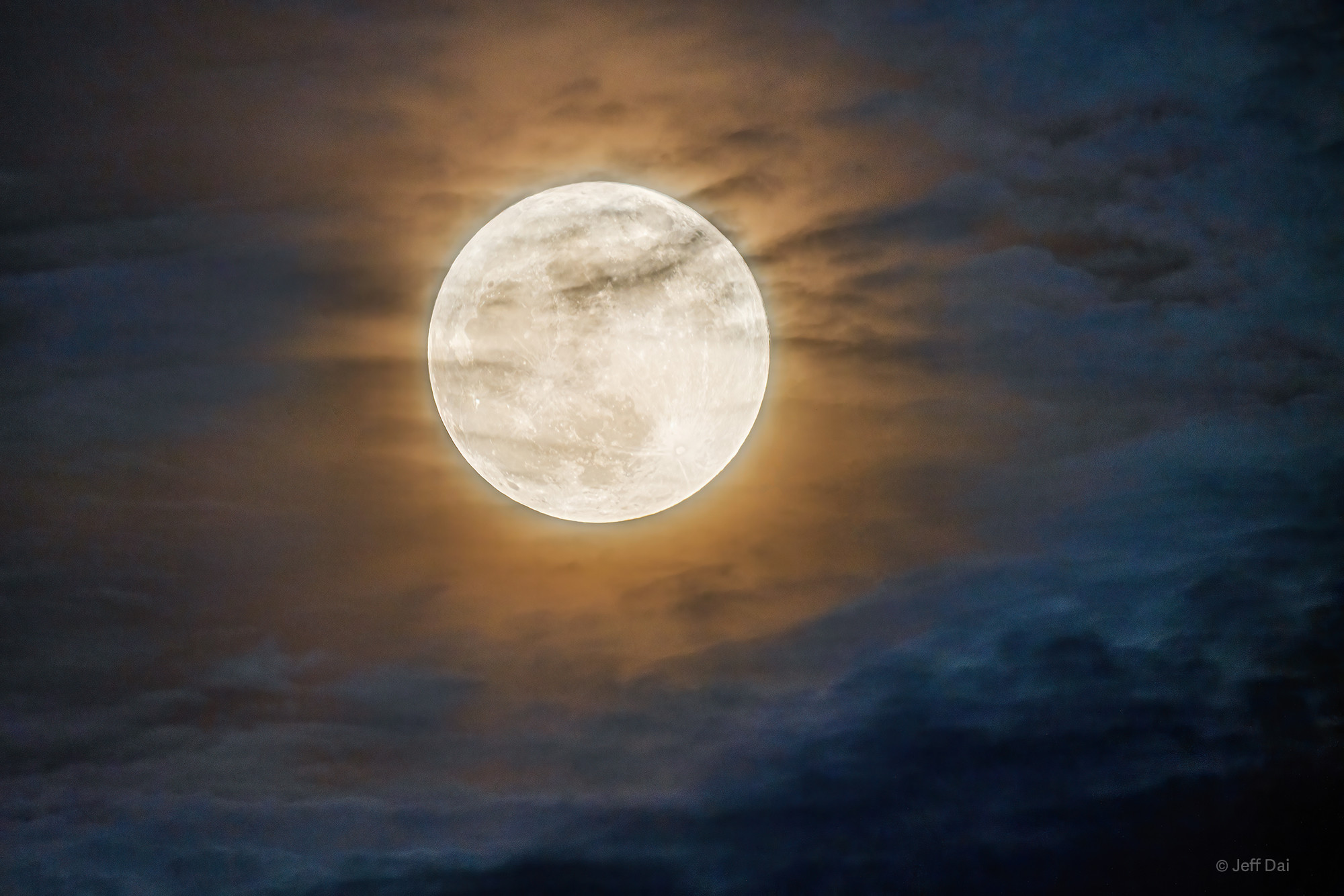
There were four Full Supermoons in 2022. Using the definition of a supermoon as a Full Moon near perigee, that is within at least 90% of its closest approach to Earth in a given orbit, the year's Full Supermoon dates were May 16, June 14, July 13, and August 12. Full Moons near perigee really are the brightest and largest in planet Earth's sky. But size and brightness differences between Full Moons are relatively small and an actual comparison with other Full Moons is difficult to make by eye alone. Two exposures are blended in this supermoon and sky view from June 14. That Full Moon was also known to northern hemisphere skygazers as the Strawberry moon. The consecutive short and long exposures allow familiar features on the fully sunlit lunar nearside to be seen in the same image as a faint lunar corona and an atmospheric cloudscape. They were captured in skies over Chongqing, China.
https://apod.nasa.gov/apod/ap220616.html
#space #earth #moon #atmosphere #astrophotography #photography #science #astronomy #nature #NASA
Alt...
2022 June 16
Strawberry Supermoon from China
* Image Credit & Copyright: Jeff Dai (TWAN)
Explanation:
There were four Full Supermoons in 2022. Using the definition of a supermoon as a Full Moon near perigee, that is within at least 90% of its closest approach to Earth in a given orbit, the year's Full Supermoon dates were May 16, June 14, July 13, and August 12. Full Moons near perigee really are the brightest and largest in planet Earth's sky. But size and brightness differences between Full Moons are relatively small and an actual comparison with other Full Moons is difficult to make by eye alone. Two exposures are blended in this supermoon and sky view from June 14. That Full Moon was also known to northern hemisphere skygazers as the Strawberry moon. The consecutive short and long exposures allow familiar features on the fully sunlit lunar nearside to be seen in the same image as a faint lunar corona and an atmospheric cloudscape. They were captured in skies over Chongqing, China.
Authors & editors: Robert Nemiroff (MTU) & Jerry Bonnell (UMCP)
NASA Official: Phillip Newman Specific rights apply.
NASA Web Privacy Policy and Important Notices
A service of: ASD at NASA / GSFC
& Michigan Tech. U.
2023 September 5
A large Moon is seen behind a historic stone structure.
Blue Supermoon Beyond Syracuse
* Credit & Copyright: Kevin Saragozza
https://www.facebook.com/kevinsaragozza/
Explanation:
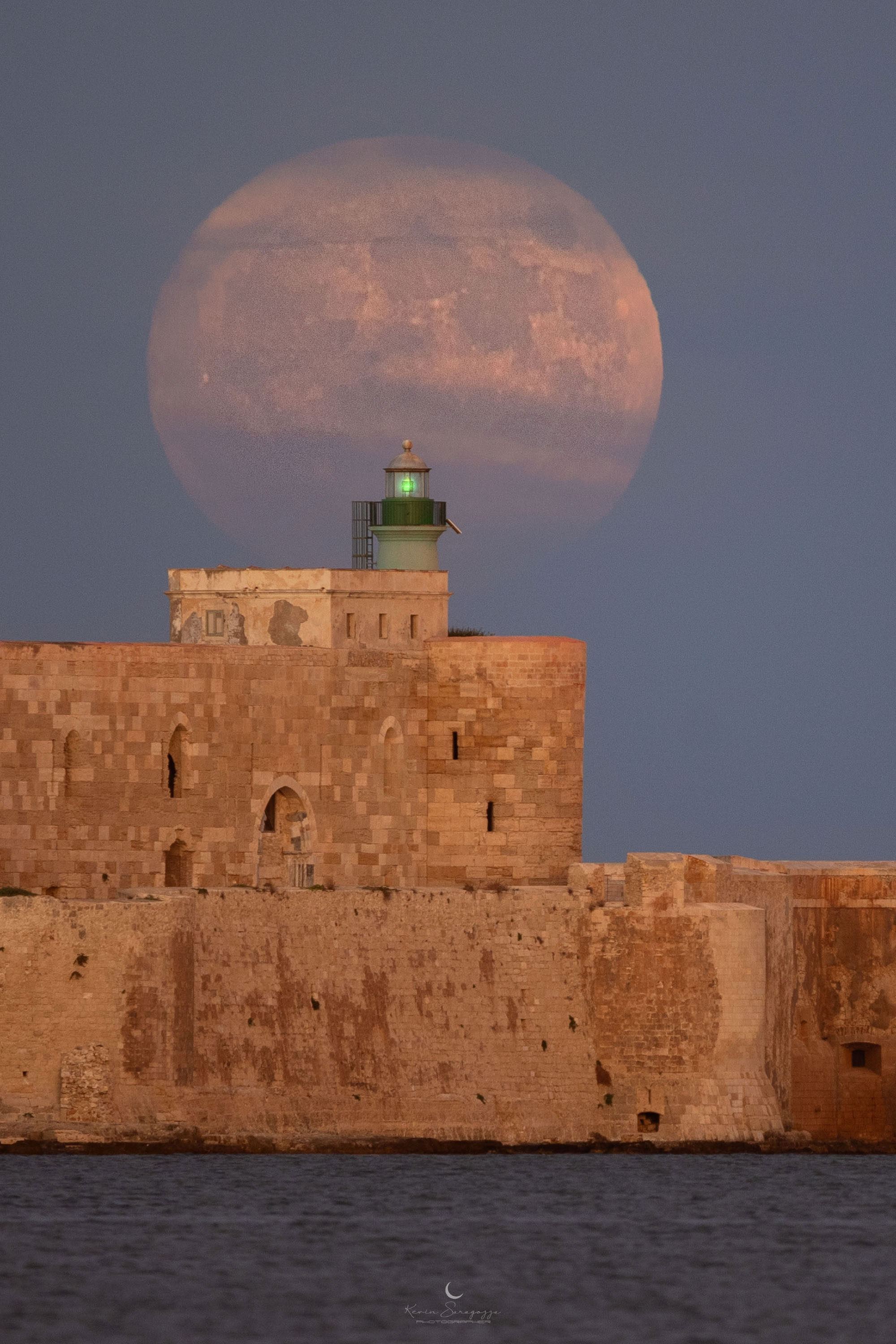
This full moon was doubly unusual. First of all, it was a blue moon. A modern definition of a blue moon is a second full moon to occur during one calendar month. Since there were 13 full moons in 2023, one month has to have two -- and that month was August. The first full moon was on August 1 and named a Sturgeon Moon. The second reason that the last full moon was unusual was because it was a supermoon. A modern definition of supermoon is a moon that reaches its full phase when it is relatively close to Earth -- and so appears a bit larger and brighter than average. Pictured, the blue supermoon of 2023 was imaged hovering far behind a historic castle and lighthouse in Syracuse, Sicily, Italy.
https://apod.nasa.gov/apod/ap230905.html
#space #earth #moon #atmosphere #astrophotography #photography #science #astronomy #nature
Alt...
2023 September 5
A large Moon is seen behind a historic stone structure.
Blue Supermoon Beyond Syracuse
* Credit & Copyright: Kevin Saragozza
Explanation:
This full moon was doubly unusual. First of all, it was a blue moon. A modern definition of a blue moon is a second full moon to occur during one calendar month. Since there were 13 full moons in 2023, one month has to have two -- and that month was August. The first full moon was on August 1 and named a Sturgeon Moon. The second reason that the last full moon was unusual was because it was a supermoon. A modern definition of supermoon is a moon that reaches its full phase when it is relatively close to Earth -- and so appears a bit larger and brighter than average. Pictured, the blue supermoon of 2023 was imaged hovering far behind a historic castle and lighthouse in Syracuse, Sicily, Italy.
Authors & editors: Robert Nemiroff (MTU) & Jerry Bonnell (UMCP)
NASA Official: Phillip Newman Specific rights apply.
NASA Web Privacy Policy and Important Notices
A service of: ASD at NASA / GSFC,
NASA Science Activation
& Michigan Tech. U.
"Ah Bella Italia! Let's linger a little longer in the beautiful Mediterranean south of this country, whose people are so particularly warm and lovable, and treat ourselves to the sight of this fantastic "Harvest Moon". Inevitably, I remember the famous song by Neil Young and that yesterday I uploaded a folk version of it, which, despite its great charm, received little attention from you. Maybe yesterday it was already too late for that and we have better luck today .."
https://defcon.social/@grobi/114842524039878298
2022 September 15
Harvest Moon over Sicily
* Image Credit & Copyright: Dario Giannobile
https://www.dariogiannobile.com/
Explanation:
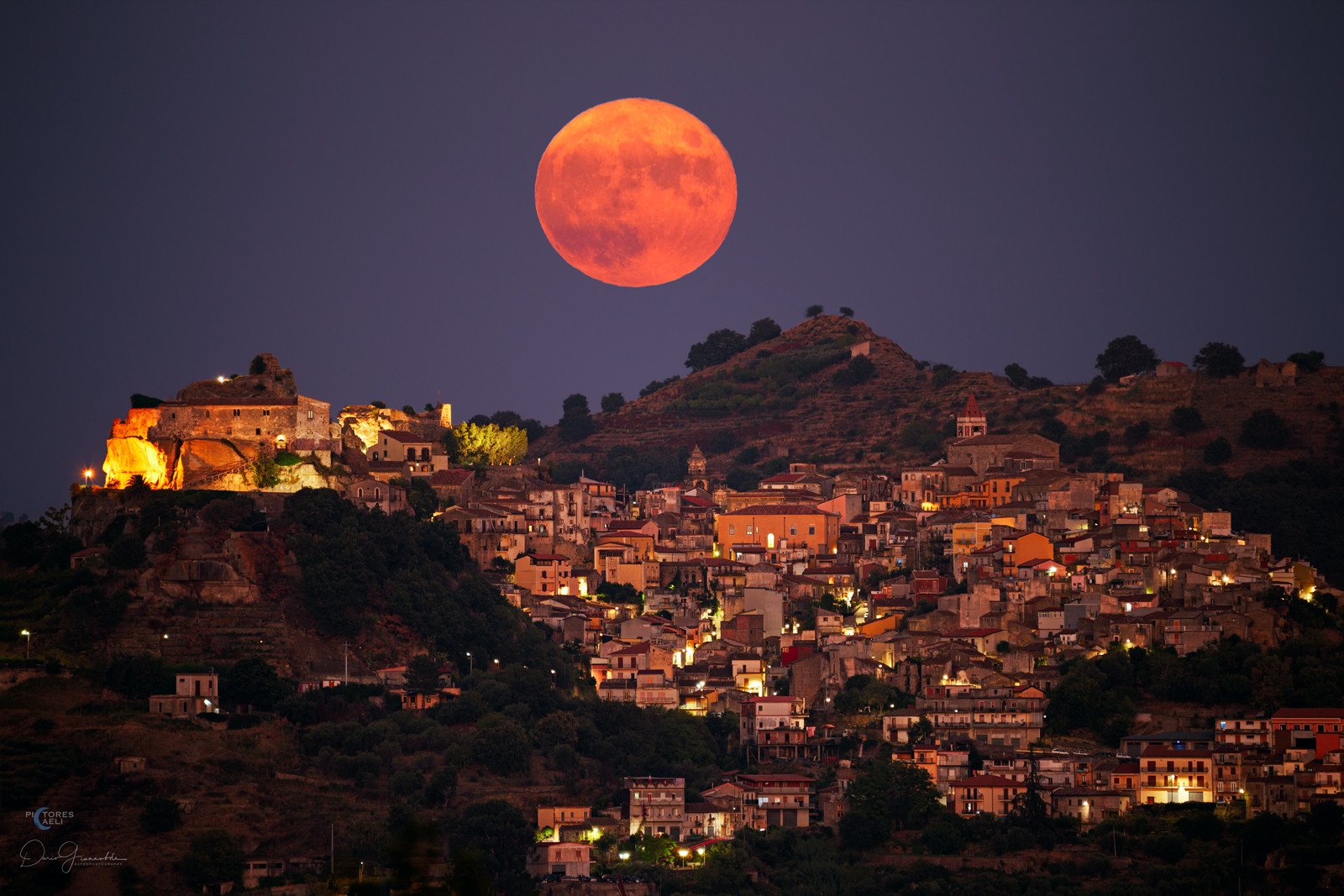
For northern hemisphere dwellers, September's Full Moon was the Harvest Moon. Reflecting warm hues at sunset it rises over the historic town of Castiglione di Sicilia in this telephoto view from September 9. Famed in festival, story, and song Harvest Moon is just the traditional name of the full moon nearest the autumnal equinox. According to lore the name is a fitting one. Despite the diminishing daylight hours as the growing season drew to a close, farmers could harvest crops by the light of a full moon shining on from dusk to dawn.
https://apod.nasa.gov/apod/ap220915.html
#space #earth #moon #atmosphere #astrophotography #photography #science #astronomy #nature #NASA #italy
Alt...
2022 September 15
Harvest Moon over Sicily
* Image Credit & Copyright: Dario Giannobile
Explanation:
For northern hemisphere dwellers, September's Full Moon was the Harvest Moon. Reflecting warm hues at sunset it rises over the historic town of Castiglione di Sicilia in this telephoto view from September 9. Famed in festival, story, and song Harvest Moon is just the traditional name of the full moon nearest the autumnal equinox. According to lore the name is a fitting one. Despite the diminishing daylight hours as the growing season drew to a close, farmers could harvest crops by the light of a full moon shining on from dusk to dawn.
Authors & editors: Robert Nemiroff (MTU) & Jerry Bonnell (UMCP)
NASA Official: Phillip Newman Specific rights apply.
NASA Web Privacy Policy and Important Notices
A service of: ASD at NASA / GSFC,
NASA Science Activation
& Michigan Tech. U.
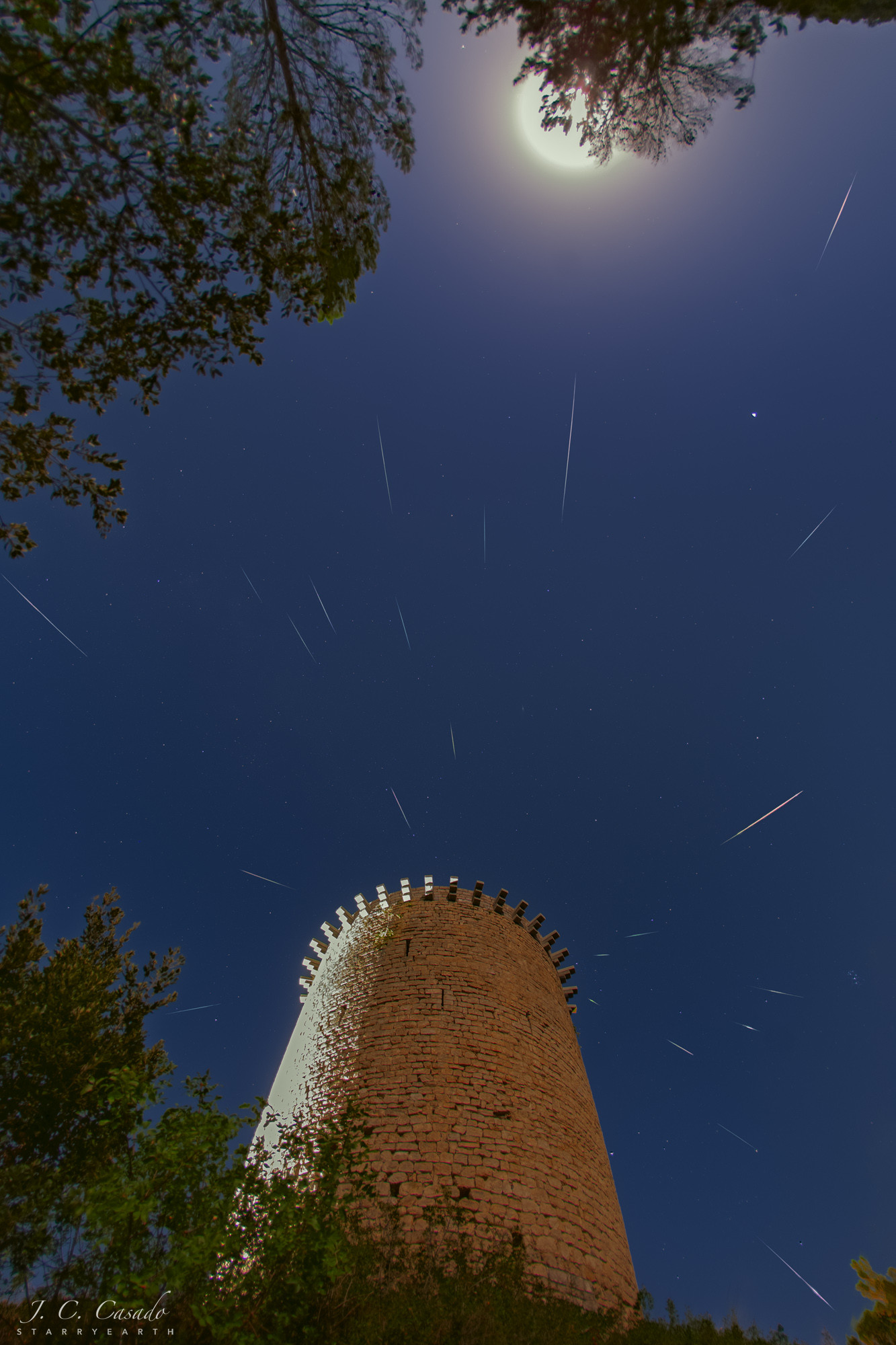
2022 August 18
Full Moon Perseids
* Image Credit & Copyright: Juan Carlhttps://twanight.org/profile/juan-carlos-casado/os Casado (Starry Earth, TWAN)
https://twanight.org/profile/juan-carlos-casado/
Explanation:
The annual Perseid meteor shower was near its peak on 2022 August 13. As planet Earth crossed through streams of debris left by periodic Comet Swift-Tuttle meteors rained in northern summer night skies. But even that night's nearly Full Moon shining near the top of this composited view couldn't hide all of the popular shower's meteor streaks. The image captures some of the brightest perseid meteors in many short exposures recorded over more than two hours before the dawn. It places the shower's radiant in the heroic constellation of Perseus just behind a well-lit medieval tower in the village of Sant Llorenc de la Muga, Girona, Spain. Observed in medieval times, the Perseid meteor shower is also known in Catholic tradition as the Tears of St. Lawrence, and festivities are celebrated close to the annual peak of the meteor shower. Joining the Full Moon opposite the Sun, bright planet Saturn also shines in the frame at the upper right.
https://apod.nasa.gov/apod/ap220818.html
#space #earth #moon #atmosphere #astrophotography #photography #science #astronomy #nature #NASA
Alt...
2022 August 18
Full Moon Perseids
* Image Credit & Copyright: Juan Carlos Casado (Starry Earth, TWAN)
Explanation:
The annual Perseid meteor shower was near its peak on August 13. As planet Earth crossed through streams of debris left by periodic Comet Swift-Tuttle meteors rained in northern summer night skies. But even that night's nearly Full Moon shining near the top of this composited view couldn't hide all of the popular shower's meteor streaks. The image captures some of the brightest perseid meteors in many short exposures recorded over more than two hours before the dawn. It places the shower's radiant in the heroic constellation of Perseus just behind a well-lit medieval tower in the village of Sant Llorenc de la Muga, Girona, Spain. Observed in medieval times, the Perseid meteor shower is also known in Catholic tradition as the Tears of St. Lawrence, and festivities are celebrated close to the annual peak of the meteor shower. Joining the Full Moon opposite the Sun, bright planet Saturn also shines in the frame at the upper right.
Authors & editors: Robert Nemiroff (MTU) & Jerry Bonnell (UMCP)
NASA Official: Phillip Newman Specific rights apply.
NASA Web Privacy Policy and Important Notices
A service of: ASD at NASA / GSFC,
NASA Science Activation
& Michigan Tech. U.
Let's get a little inspiration as we walk on this beach at night ..
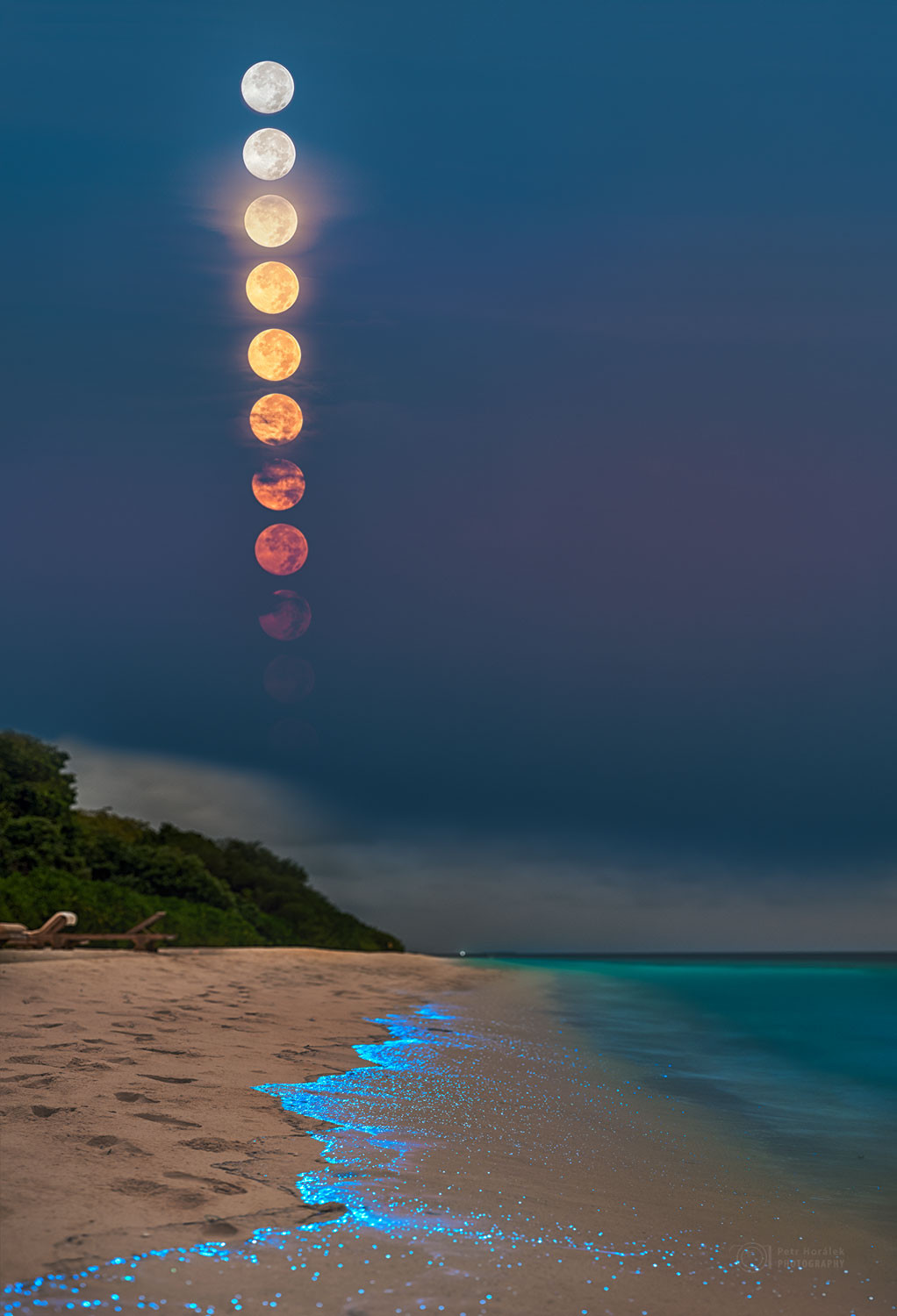
2024 March 11
A Full Plankton Moon
* Credit & Copyright: Petr Horálek / Institute of Physics in Opava
https://www.petrhoralek.com/#about-1
https://www.slu.cz/phys/en/
Explanation:
What glows in the night? This night featured a combination of usual and unusual glows. Perhaps the most usual glow was from the Moon, a potentially familiar object. The full Moon's nearly vertical descent results from the observer being near Earth's equator. As the Moon sets, air and aerosols in Earth's atmosphere preferentially scatter out blue light, making the Sun-reflecting satellite appear reddish when near the horizon. Perhaps the most unusual glow was from the bioluminescent plankton, likely less familiar objects. These microscopic creatures glow blue, it is thought, primarily to surprise and deter predators. In this case, the glow was caused primarily by plankton-containing waves crashing onto the beach. The image was taken on Soneva Fushi Island, Maldives just over one year ago.
https://apod.nasa.gov/apod/ap240311.html
#space #earth #moon #atmosphere #astrophotography #photography #science #astronomy #physics #nature #NASA
Alt...
2024 March 11
Several images of a full moon setting are superposed. The moon images are nearly white near the top, but turn orange and then are covered by low clouds near the horizon. Unusually, the setting moon images line up almost vertically. In the foreground is a beach with waves illuminated by blue-glowing plankton.
A Full Plankton Moon
* Credit & Copyright: Petr Horálek / Institute of Physics in Opava
Explanation:
What glows in the night? This night featured a combination of usual and unusual glows. Perhaps the most usual glow was from the Moon, a potentially familiar object. The full Moon's nearly vertical descent results from the observer being near Earth's equator. As the Moon sets, air and aerosols in Earth's atmosphere preferentially scatter out blue light, making the Sun-reflecting satellite appear reddish when near the horizon. Perhaps the most unusual glow was from the bioluminescent plankton, likely less familiar objects. These microscopic creatures glow blue, it is thought, primarily to surprise and deter predators. In this case, the glow was caused primarily by plankton-containing waves crashing onto the beach. The image was taken on Soneva Fushi Island, Maldives just over one year ago.
Authors & editors: Robert Nemiroff (MTU) & Jerry Bonnell (UMCP)
NASA Official: Amber Straughn; Specific rights apply.
NASA Web Privacy Policy and Important Notices
A service of: ASD at NASA / GSFC,
NASA Science Activation
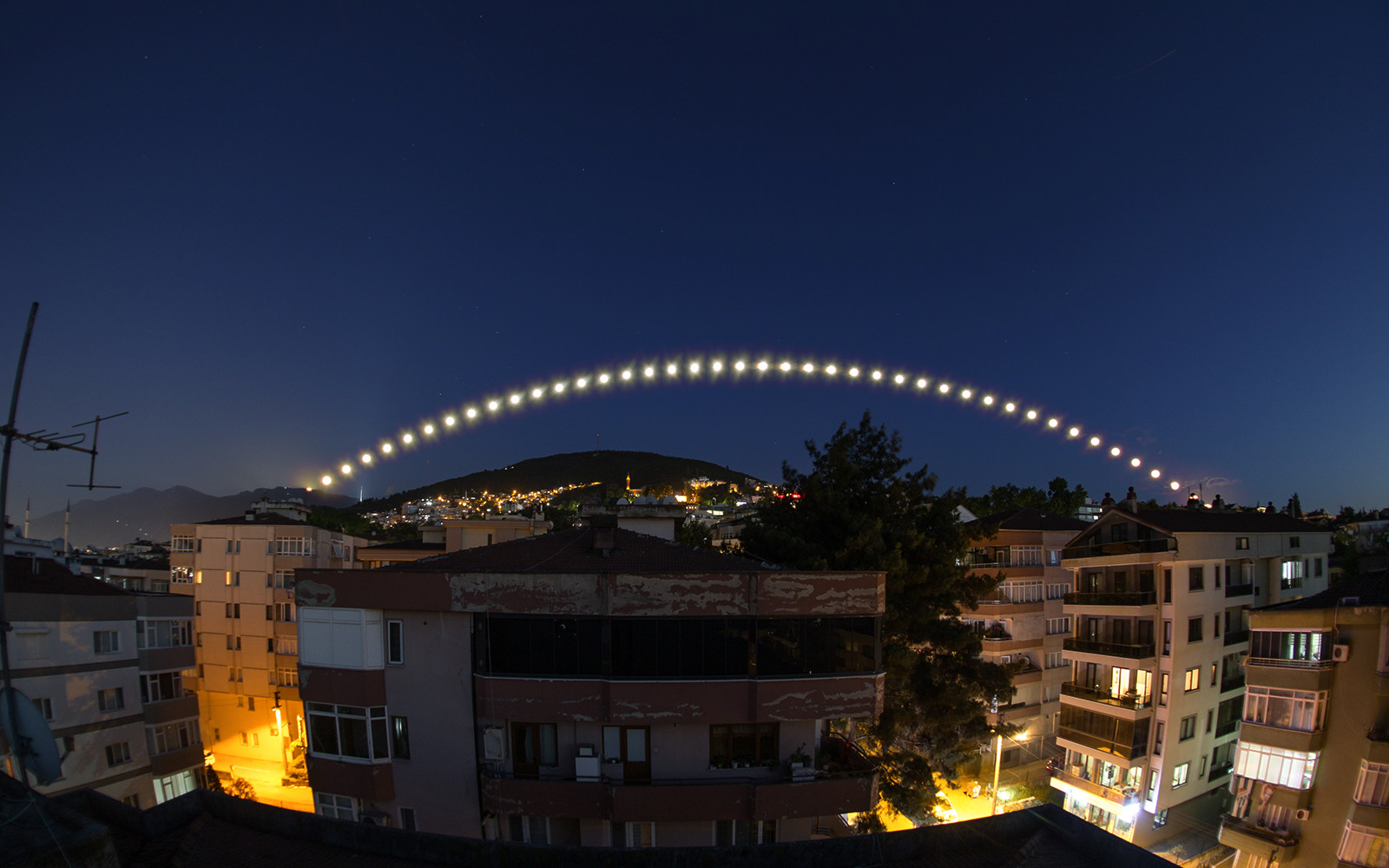
2024 June 29
A Solstice Moon
* Image Credit & Copyright: Tunc Tezel (TWAN)
https://twanight.org/profile/tunc-tezel/
Explanation:
Rising opposite the setting Sun, June's Full Moon occurred within about 28 hours of the solstice. The Moon stays close to the Sun's path along the ecliptic plane and so while the solstice Sun climbed high in daytime skies, June's Full Moon remained low that night as seen from northern latitudes. In fact, the Full Moon hugs the horizon in this June 21 rooftop night sky view from Bursa, Turkey, constructed from exposures made every 10 minutes between moonrise and moonset. In 2024 the Moon also reached a major lunar standstill, an extreme in the monthly north-south range of moonrise and moonset caused by the precession of the Moon's orbit over an 18.6 year cycle. As a result, this June solstice Full Moon was at its southernmost moonrise and moonset along the horizon.
https://apod.nasa.gov/apod/ap240629.html
#space #earth #moon #atmosphere #astrophotography #photography #science #astronomy #nature #NASA
Alt...
2024 June 29
A Solstice Moon
* Image Credit & Copyright: Tunc Tezel (TWAN)
Explanation:
Rising opposite the setting Sun, June's Full Moon occurred within about 28 hours of the solstice. The Moon stays close to the Sun's path along the ecliptic plane and so while the solstice Sun climbed high in daytime skies, June's Full Moon remained low that night as seen from northern latitudes. In fact, the Full Moon hugs the horizon in this June 21 rooftop night sky view from Bursa, Turkey, constructed from exposures made every 10 minutes between moonrise and moonset. In 2024 the Moon also reached a major lunar standstill, an extreme in the monthly north-south range of moonrise and moonset caused by the precession of the Moon's orbit over an 18.6 year cycle. As a result, this June solstice Full Moon was at its southernmost moonrise and moonset along the horizon.
Authors & editors: Robert Nemiroff (MTU) & Jerry Bonnell (UMCP)
NASA Official: Amber Straughn Specific rights apply.
NASA Web Privacy, Accessibility Notices
A service of: ASD at NASA / GSFC,
NASA Science Activation
& Michigan Tech. U.
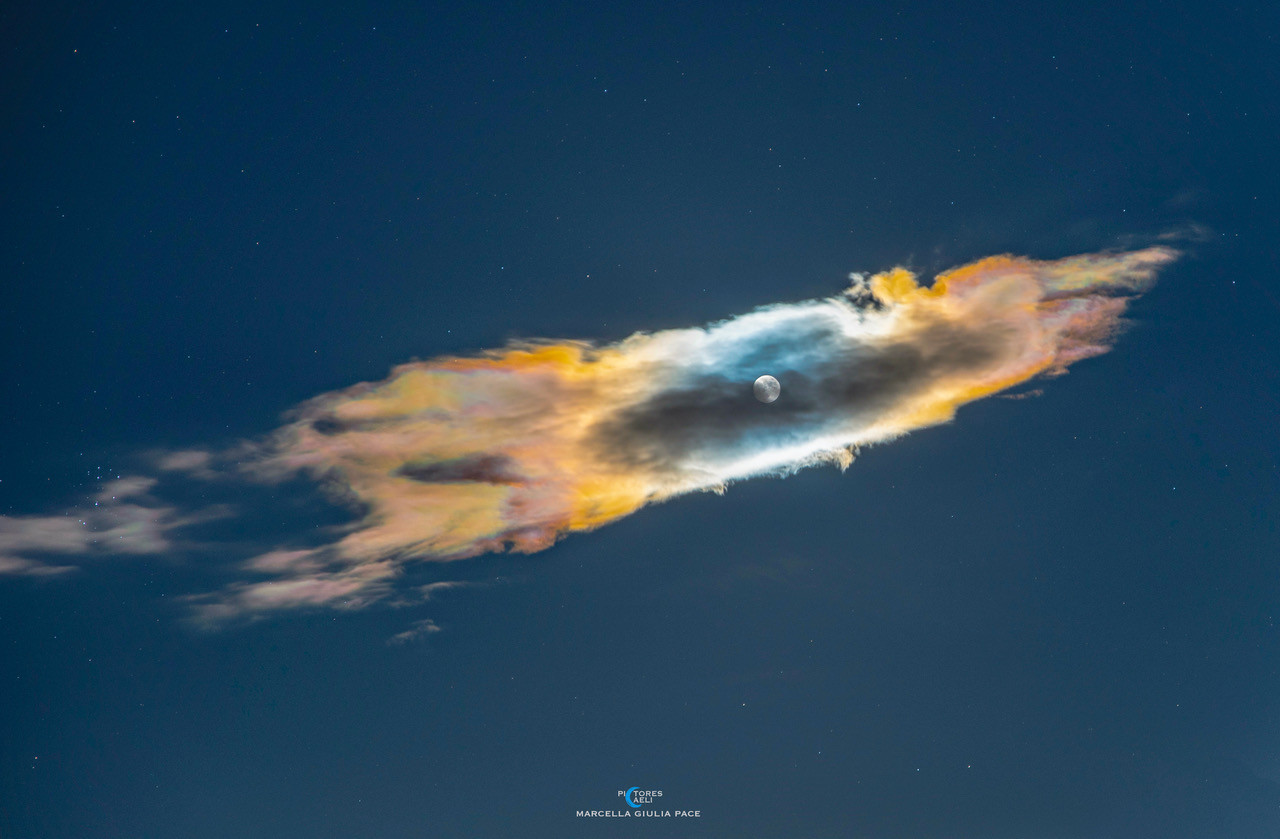
2021 December 4
Iridescent by Moonlight
* Image Credit & Copyright: Marcella Giulia Pace
https://greenflash.photo/about-me/
Explanation:
In this snapshot from November 18, the Full Moon was not far from Earth's shadow. In skies over Sicily the brightest lunar phase was eclipsed by passing clouds though. The full moonlight was dimmed and momentarily diffracted by small but similar sized water droplets near the edges of the high thin clouds. The resulting iridescence shines with colors like a lunar corona. On that night, the Full Moon was also seen close to the Pleiades star cluster appearing at the lower left of the iridescent cloud bank. The stars of the Seven Sisters were soon to share the sky with a darker, reddened lunar disk.
https://apod.nasa.gov/apod/ap211204.html
#space #earth #moon #atmosphere #astrophotography #photography #science #astronomy #nature #NASA
Alt...
2021 December 4
Iridescent by Moonlight
* Image Credit & Copyright: Marcella Giulia Pace
Explanation:
In this snapshot from November 18, the Full Moon was not far from Earth's shadow. In skies over Sicily the brightest lunar phase was eclipsed by passing clouds though. The full moonlight was dimmed and momentarily diffracted by small but similar sized water droplets near the edges of the high thin clouds. The resulting iridescence shines with colors like a lunar corona. On that night, the Full Moon was also seen close to the Pleiades star cluster appearing at the lower left of the iridescent cloud bank. The stars of the Seven Sisters were soon to share the sky with a darker, reddened lunar disk.
Authors & editors: Robert Nemiroff (MTU) & Jerry Bonnell (UMCP)
NASA Official: Phillip Newman Specific rights apply.
NASA Web Privacy Policy and Important Notices
A service of: ASD at NASA / GSFC
& Michigan Tech. U.
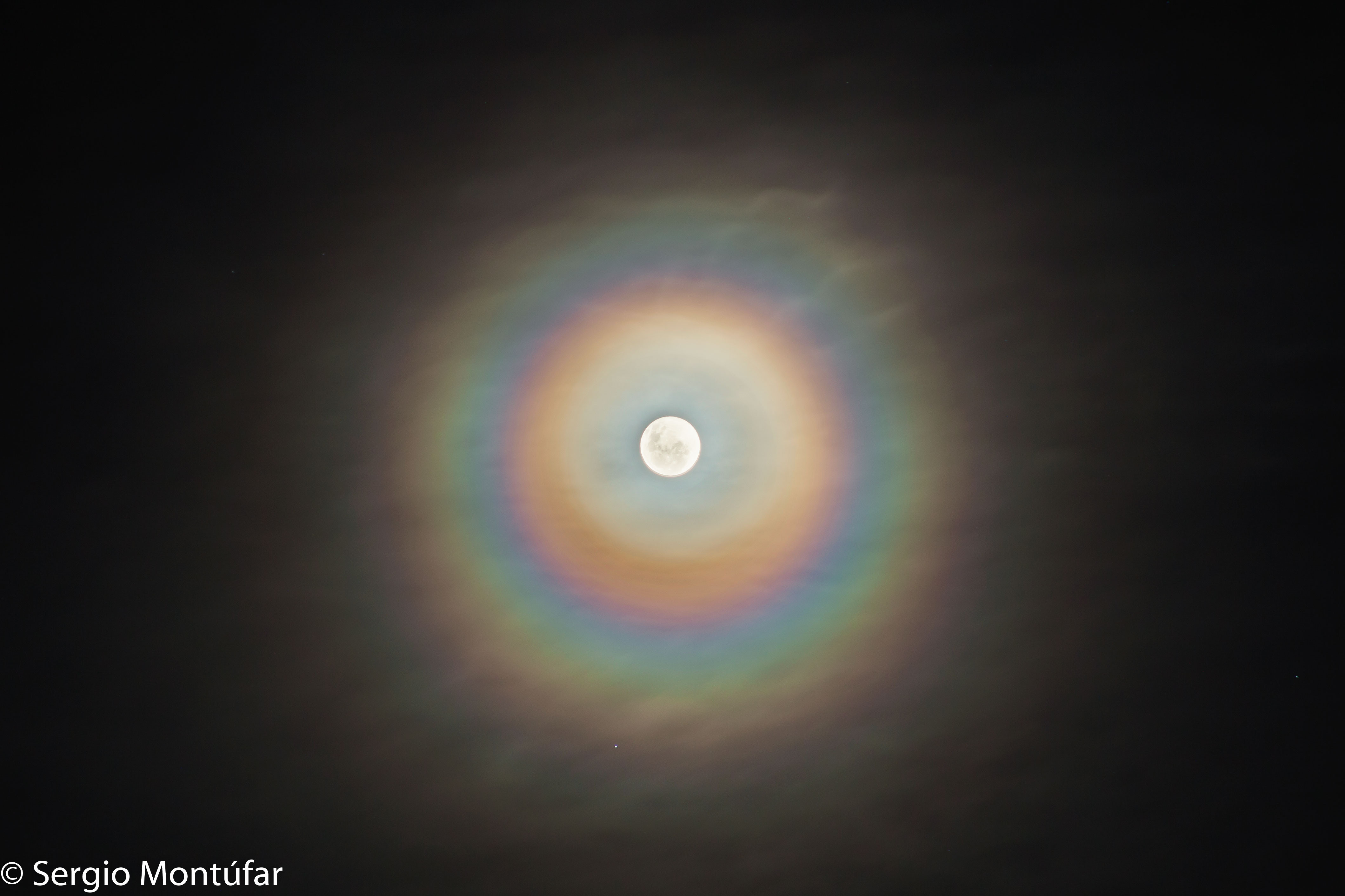
2015 June 15
A Colorful Lunar Corona
* Image Credit & Copyright: Sergio Montúfar , Planetario Ciudad de La Plata
https://www.ferventastronomy.com/Gallery/BrandAmbassadors/SergioMontufar/
https://planetario.unlp.edu.ar/
Explanation:
What are those colorful rings around the Moon? A corona. Rings like this will sometimes appear when the Moon is seen through thin clouds. The effect is created by the quantum mechanical diffraction of light around individual, similarly-sized water droplets in an intervening but mostly-transparent cloud. Since light of different colors has different wavelengths, each color diffracts differently. Lunar Coronae are one of the few quantum mechanical color effects that can be easily seen with the unaided eye. The featured lunar corona was captured around a Strawberry Moon on June 2 from La Plata, Argentina. Similar coronae that form around the Sun are typically harder to see because of the Sun's great brightness.
https://en.wikipedia.org/wiki/Corona_(optical_phenomenon)
https://youtu.be/r_nPQcfxhOM
https://www.atoptics.co.uk/blog/corona-formation/
https://en.wikipedia.org/wiki/Diffraction
https://www.youtube.com/watch?v=fgiOjqTiwn8
https://physics.stackexchange.com/questions/65397/quantum-mechanics-and-everyday-nature
https://epod.usra.edu/blog/2014/02/coronas-around-the-moon.html
https://apod.nasa.gov/apod/ap150615.html
#space #earth #moon #atmosphere #astrophotography #photography #science #astronomy #physics #quantummechanic #nature #NASA
Alt...
2015 June 15
A Colorful Lunar Corona
* Image Credit & Copyright: Sergio Montúfar , Planetario Ciudad de La Plata
Explanation:
What are those colorful rings around the Moon? A corona. Rings like this will sometimes appear when the Moon is seen through thin clouds. The effect is created by the quantum mechanical diffraction of light around individual, similarly-sized water droplets in an intervening but mostly-transparent cloud. Since light of different colors has different wavelengths, each color diffracts differently. Lunar Coronae are one of the few quantum mechanical color effects that can be easily seen with the unaided eye. The featured lunar corona was captured around a Strawberry Moon on June 2 from La Plata, Argentina. Similar coronae that form around the Sun are typically harder to see because of the Sun's great brightness.
Authors & editors: Robert Nemiroff (MTU) & Jerry Bonnell (UMCP)
NASA Official: Phillip Newman Specific rights apply.
NASA Web Privacy Policy and Important Notices
A service of: ASD at NASA / GSFC
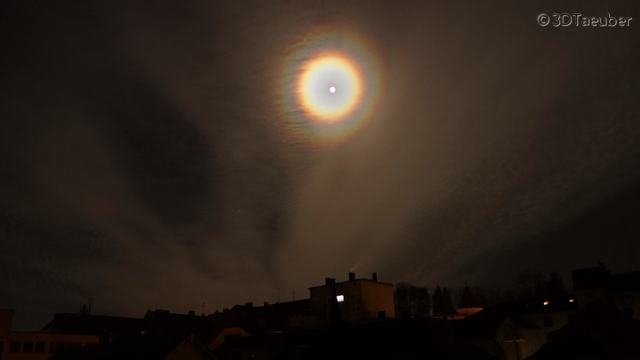
Video of the lunar corona around the blood moon of 2015 April 4.
If you look closely, you can see not only the lunar corona but also that the structure of the higher clouds is influenced by the gravitational wave effect.
.. and last but not least the ISS crossing the sky ..
VIDEO CREDIT
Nature 3D Taeuber
https://www.youtube.com/watch?v=fgiOjqTiwn8
#space #earth #moon #atmosphere #astrophotography #photography #science #astronomy #physics #quantummechanic #nature #NASA
Alt...
Video of the lunar corona around the blood moon of 2015 April 4.
VIDEO CREDIT
Nature 3D Taeuber
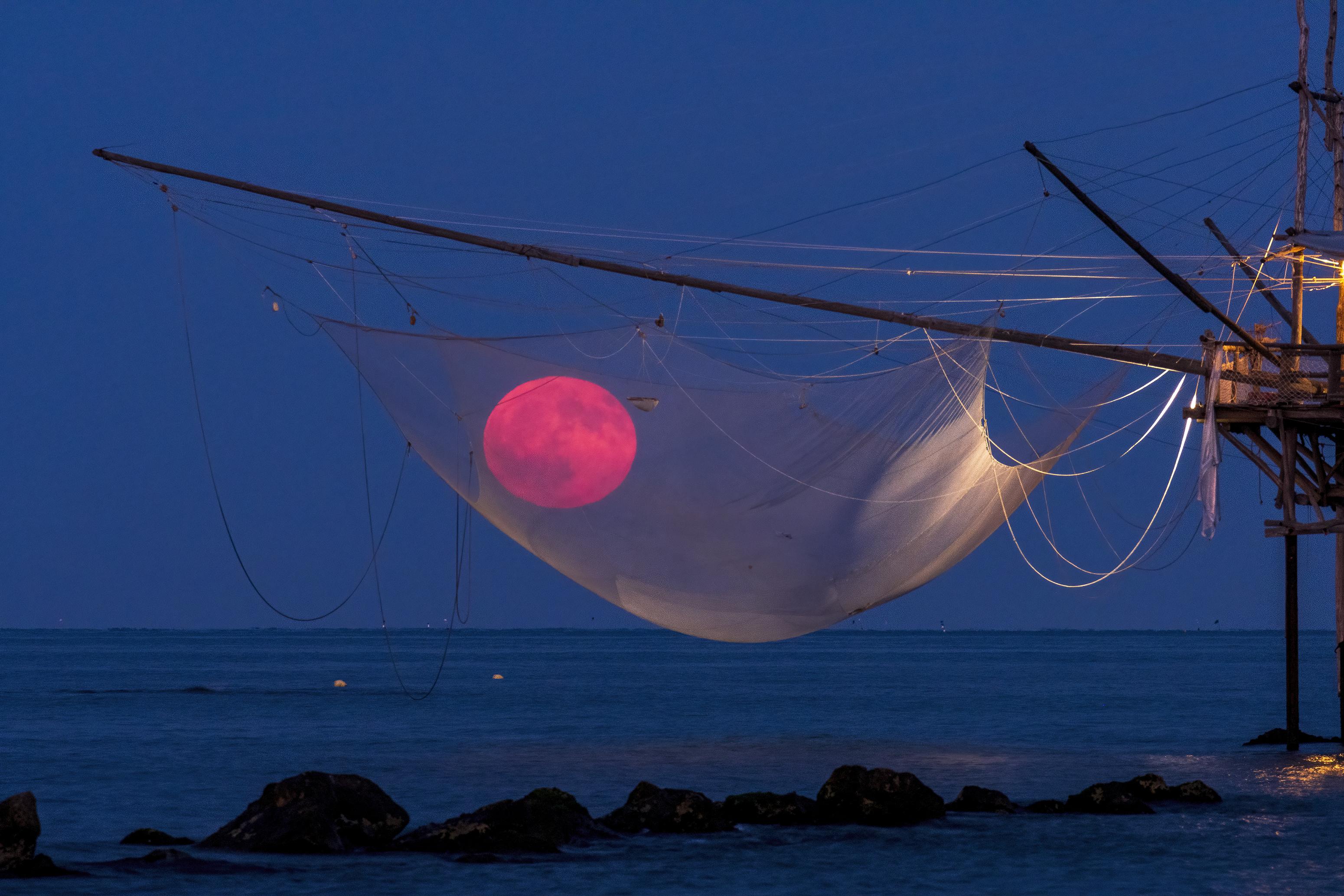
2025 August 23
Fishing for the Moon
* Image Credit & Copyright: Marco Bellelli
Explanation:
How big is planet Earth's Moon? Compared to other moons of the Solar System, it's number 5 on the largest to smallest ranked list, following Jupiter's moon Ganymede, Saturn's moon Titan, and Jovian moons Callisto and Io. Continuing the list, the Moon comes before Jupiter's Europa and Neptune's Triton. It's also larger than dwarf planets Pluto and Eris. With a diameter of 3,475 kilometers the Moon is about 1/4 the size of Earth though, and that does make it the largest moon when compared to the size of its parent Solar System planet. Of course in this serene, twilight sea and skyscape, August's rising Full Moon still appears small enough to be caught in the nets of an ancient fishing rig. The telephoto snapshot was taken along the Italian Costa dei Trabocchi, on the Adriatic Sea.
https://science.nasa.gov/moon/facts/
https://en.wikipedia.org/wiki/List_of_Solar_System_objects_by_size
https://apod.nasa.gov/apod/ap231128.html
https://apod.nasa.gov/apod/ap250503.html
https://apod.nasa.gov/apod/ap020120.html
https://apod.nasa.gov/apod/ap240329.html
https://apod.nasa.gov/apod/ap231023.html
https://apod.nasa.gov/apod/ap140826.html
https://apod.nasa.gov/apod/ap250823.html
#space #earth #moon #astrophotography #photography #science #astronomy #nature #NASA
Alt...
2025 August 23
Fishing for the Moon
* Image Credit & Copyright: Marco Bellelli
Explanation:
How big is planet Earth's Moon? Compared to other moons of the Solar System, it's number 5 on the largest to smallest ranked list, following Jupiter's moon Ganymede, Saturn's moon Titan, and Jovian moons Callisto and Io. Continuing the list, the Moon comes before Jupiter's Europa and Neptune's Triton. It's also larger than dwarf planets Pluto and Eris. With a diameter of 3,475 kilometers the Moon is about 1/4 the size of Earth though, and that does make it the largest moon when compared to the size of its parent Solar System planet. Of course in this serene, twilight sea and skyscape, August's rising Full Moon still appears small enough to be caught in the nets of an ancient fishing rig. The telephoto snapshot was taken along the Italian Costa dei Trabocchi, on the Adriatic Sea.
Authors & editors: Robert Nemiroff (MTU) & Jerry Bonnell (UMCP)
NASA Official: Amber Straughn Specific rights apply.
NASA Web Privacy, Accessibility, Notices;
A service of: ASD at NASA / GSFC,
NASA Science Activation
& Michigan Tech. U.
![[?]](https://files.mastodon.social/accounts/avatars/109/116/890/365/586/836/original/b83172252ee5b6f4.png)
Starting a moon exploration tour from the couch? Why not? With a good internet connection, you can hit the ground running right away and enjoy your moonwalk:
https://trek.nasa.gov/moon/#v=0.1&x=0&y=0&z=1&p=urn%3Aogc%3Adef%3Acrs%3AEPSG%3A%3A104903&d=&locale=&b=moon&e=-281.2499947536844%2C-131.83593504078956%2C281.2499947536844%2C131.83593504078956&sfz=&w=
And don't forget: The Trump administration has cut off NASA's financial support from government funds! It stands to reason that this institution is to be weakened by financial erosion in order to then privatise it and sell it cheaply to loyal greedy super-rich. So no one can know how long all this information and data will be publicly available, which is now the property of the American people and the calling card for a United America. Do we really want to put up with THAT? This country is still called "United States of America" and may this name preserve its values for a long time to come! Stop freezing like the rabbit before the poison snake, stay strong and unite USA and finally defend yourself against your malicious destruction by greedy narcissists!
#space #moon #astrophotography #photography #science #astronomy #nature #NASA #education #us #uspol #trump #usa #europe #italy #france #unitedkingdom #resist
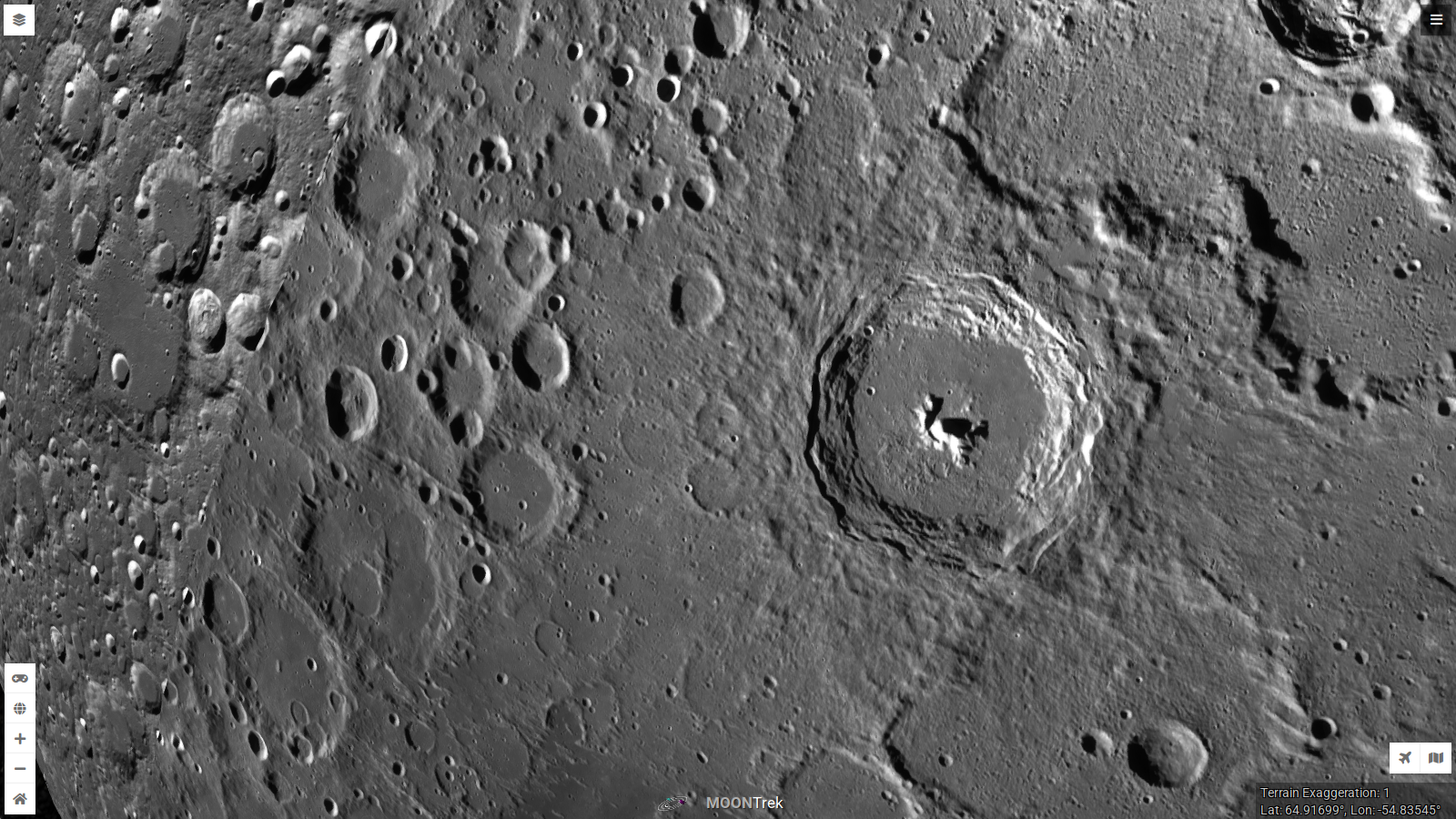
Alt...
Moon Trek allows you to explore the Moon via your own computer. Credit: NASA/SSERVI
Data and Music: What 50 Years of Exploring Our Moon Sounds Like
Sonification is the process of translating data into sound and music. In this musical data sonification of lunar knowledge and exploration, we can hear the progress made throughout the Apollo program to now as our understanding of the Moon expands. Listen to the percussion, which signals launches and the passage of time; the pitch of the string and brass instruments conveys the amount of scientific activity associated with the Moon over time.
Here’s a breakdown of the individual instruments:
Pitch of the string and brass = scientific activity
Percussion instruments = passage of time
Clock ticking = months
Snare drum = years
Bass drum = decades
Cymbals = launches
In the video, the blue line indicates the amount of scientific activity (the number of scientific publications, citations and patents) in each year that is related to NASA’s Apollo program. The red and yellow lines indicate the amount of scientific activity associated with Apollo samples and Apollo images, respectively. The other colors indicate the amount of scientific activity associated with each of NASA’s lunar robotic missions.
Each year's data represents the number of articles, citations and patents dated in that year and returned by Google Scholar when applying a certain set of keywords.
CREDIT
NASA's Goddard Space Flight Center
SYSTEM Sounds
Data sonification and visualization by Matt Russo and Andrew Santaguida of SYSTEM Sounds. Data compiled by NASA.
Music credits: "Giant Leaps" by SYSTEM Sounds
https://svs.gsfc.nasa.gov/13204
#space #moon #astrophotography #photography #science #astronomy #nature #NASA #education
You're Invited!
The next International Observe the Moon Night is tonight !
International Observe the Moon Night is a time to come together with fellow Moon enthusiasts and curious people worldwide. Everyone on Earth is invited to learn about lunar science and exploration, take part in celestial observations, and honor cultural and personal connections to the Moon. We encourage everyone to interpret “observe” broadly!
International Observe the Moon Night occurs annually in September or October, when the Moon is around first quarter ― a great phase for evening observing. A first-quarter Moon offers excellent viewing opportunities along the terminator (the line between night and day), where shadows enhance the Moon’s cratered landscape.
You can join International Observe the Moon Night from wherever you are. Attend or host a virtual or in-person event, or observe the Moon from home. Connect with fellow lunar enthusiasts around the world by using #ObserveTheMoon on your preferred social media platform and visiting the International Observe the Moon Night Flickr group.
Outdoors, at home, online, or wherever you may be, we’re glad to have you with us. However you choose to observe, please follow local guidelines on health and safety.
* Unite people across the globe in a celebration of lunar observation, science, and exploration.
* Provide information, a platform, and resources in order to:
* Raise awareness of NASA’s lunar science and exploration programs.
* Empower people to learn more about the Moon and space science and exploration, using Earth’s Moon as an accessible entry point.
* Facilitate sharing of Moon-inspired stories, images, artwork, and more.
* Inspire continued observation of the Moon, the sky, and the world around us.
* Support all people who are interested in learning more about, and connecting to, the Moon.
https://moon.nasa.gov/observe-the-moon-night/about/overview/
https://moon.nasa.gov/observe-the-moon-night/participate/10-ways-to-observe-the-moon/
#space #moon #astrophotography #photography #science #astronomy #nature #NASA #education
Alt...
Video trailer for International Observe the Moon Night 2025.
https://moon.nasa.gov/observe-the-moon-night/
Join In!
The countdown is on.. for the International Observe the Moon Night 2025 on October 4!
https://moon.nasa.gov/observe-the-moon-night/
https://moon.nasa.gov/observe-the-moon-night/register/individual-participation/
#space #moon #astrophotography #photography #science #astronomy #nature #NASA #education
This clip of Orientale Basin was made with data from the Lunar Reconnaissance Orbiter by NASA's Scientific Visualization Studio.
Image credit: NASA’s Scientific Visualization Studio/Ernie Wright
https://moon.nasa.gov/observe-the-moon-night/participate/10-ways-to-observe-the-moon/
https://moon.nasa.gov/observe-the-moon-night/resources/moon-map/
#space #moon #astrophotography #photography #science #astronomy #nature #NASA #education
Join In!
The countdown is on.. for the International Observe the Moon Night 2025 on October 4!
https://moon.nasa.gov/observe-the-moon-night/
https://moon.nasa.gov/observe-the-moon-night/register/individual-participation/
#space #moon #astrophotography #photography #science #astronomy #nature #NASA #education