Search results for tag #astronomy
![[?]](https://files.mastodon.social/accounts/avatars/110/441/535/131/897/219/original/0ddf9d4dd12a5dee.png)
A Scholar Recognized the Inscriptions in the Margins of This Manuscript. The Scribbles Turned Out to Be Galileo’s Handwritten Notes
Found in a 16th-century copy of an ancient astronomy treatise, the annotations suggest that the trailblazing scientist studied Earth-centric models before lending his support to heliocentrism
by Christian Thorsberg
Galileo at PG:
https://www.gutenberg.org/ebooks/subject/6741
Alt...
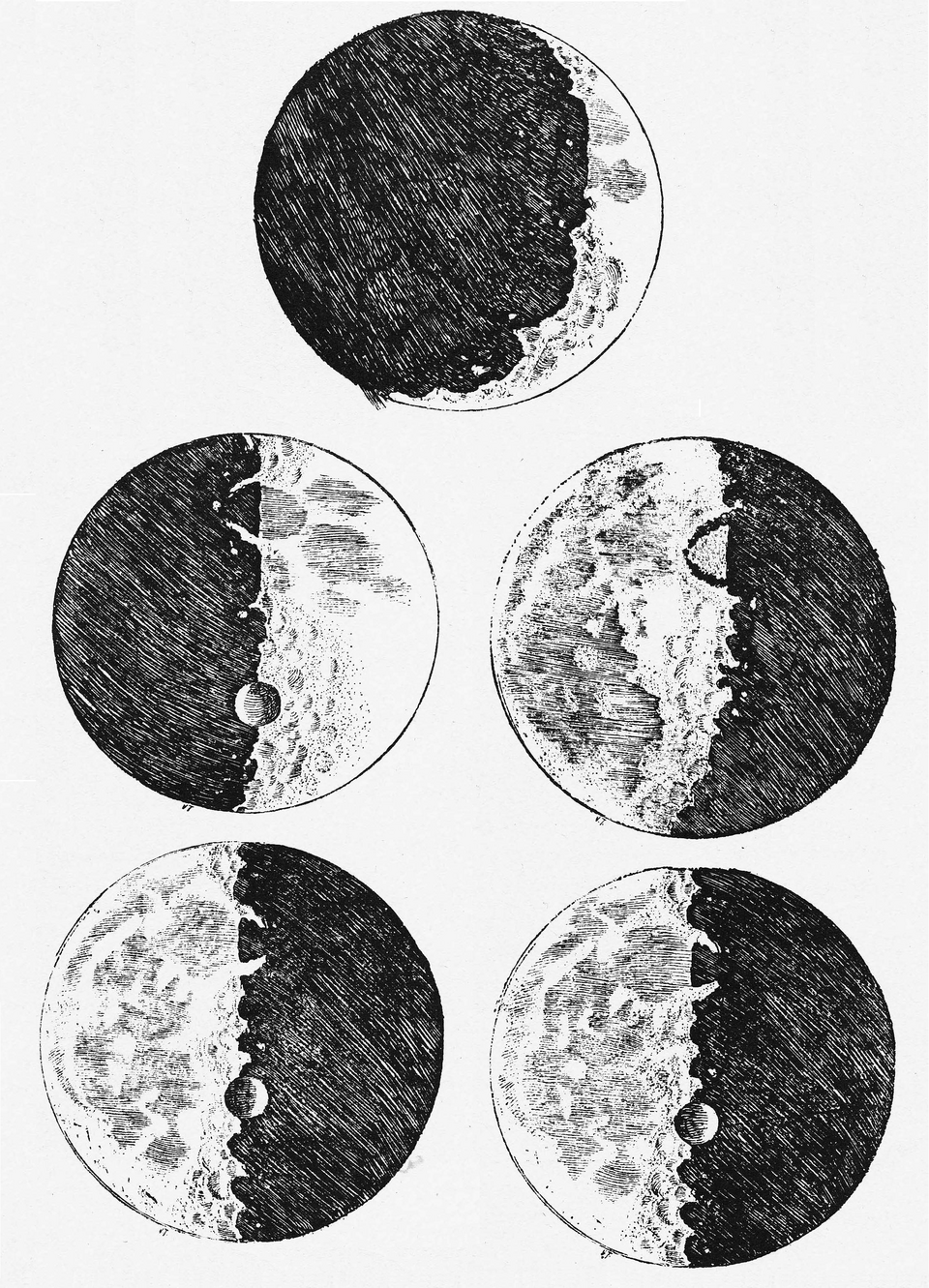
Galileo's sketches of the moon from en:Sidereus Nuncius, published in March 1610.
Five circular engraved illustrations arranged on a white page — one at the top centre, two in the middle row, and two in the bottom row — each depicting the Moon at a different phase.
The images are rendered in fine crosshatching and stippling, with dense black ink filling the shadowed portions and detailed textural work in the illuminated zones.
Along the terminator — the boundary between light and dark — rugged, jagged edges suggest mountains, craters, and uneven terrain, with small circular formations visible that read clearly as craters.
The uppermost image shows the Moon mostly in shadow with only a crescent of illuminated surface visible at right.
The middle and lower pairs show progressively more of the lit surface, with the terminator cutting diagonally across each disk.
The overall effect is observational and scientific rather than decorative, conveying a three-dimensional, geologically complex surface.
https://en.wikipedia.org/wiki/Sidereus_Nuncius#/media/File:Galileo's_sketches_of_the_moon.png
Rare 'planetary parade' will return to the evening sky this week — but you'll have to look at exactly the right time
By Jamie Carter
Six planets will shine together in the evening sky on Feb. 28. Here's how to get the best view before they disappear.
Alt...
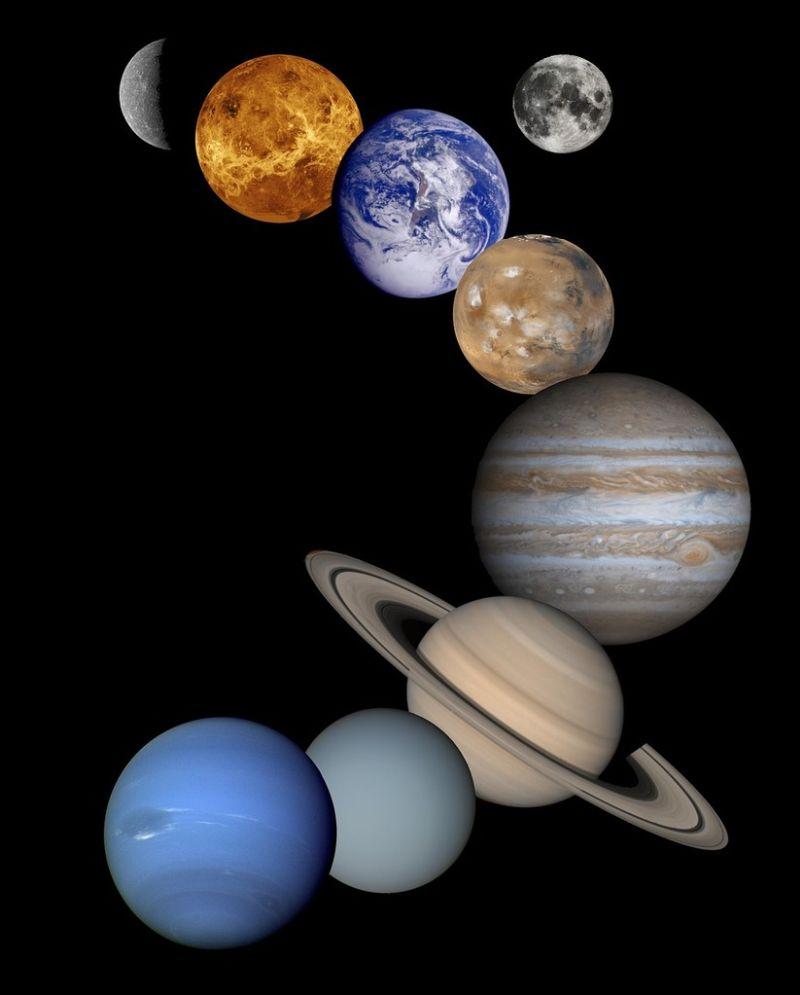
The planets in our solar system.
Trans-Neptunian planet (Planet X) computations by Elizabeth Williams
https://azmemory.azlibrary.gov/nodes/view/76023?lsk=2c55a12ad11e2434a14e1abfdebbdae0
![[?]](https://files.mastodon.social/accounts/avatars/000/034/380/original/c4398fad142099bc.jpg)
That's a pretty cool looking conjunction tonight and it's in the right direction for Jupiter here (NW) but Stellarium doesn't show any stars nearly that bright nearby. Can anyone identify them? Sorry for crappy phonecam snap. #Astronomy

Alt...
A very bright dot just to the right and slightly below a fainter dot. Another dot about the same magnitude as the fainter dot is further to the left, all three are in a straight line.
![[?]](https://polymaths.social/fileserver/01HCMX6M1CZNEVJ4F5H58TT5XJ/attachment/original/01JHC5KM5K0V0J0436SPD3F86H.jpeg)


 🍵
🍵  [
[Today's #APOD's a looker ;)
Date: 2026 February 02
URL: https://apod.nasa.gov/apod/ap260202.html
Title: Orion: The Running Man Nebula
![[?]](https://cdn.masto.host/num8bitorbustinfo/accounts/avatars/113/917/028/478/692/467/original/0f03c315daa46fa6.png)
What does #spaceKaren have against #astronomy?
Did he look through a telescope and have a Lovecraft moment, realising the universe is vast and uncaring?
Instead of taking H.P.’s line of racism and purple prose, he decided on racism and preventing anyone else seeing the sky.
X-rays from SLAC's synchrotron reveal star maps in a centuries-old manuscript
Pages from the Codex Climaci Rescriptus palimpsest from the Museum of the Bible in Washington, DC, were brought to the Stanford Synchrotron Radiation Lightsource to recover erased astronomical text, especially fragments from Hipparchus' star catalog.
Hipparchus at PG:
https://www.gutenberg.org/ebooks/search/?query=Hipparchus
#books #old_manuscripts #astronomy

Alt...
A leaf from the Codex Climaci Rescriptus in the Green Collection.
This image shows:
Upper layer (darker text): Written in Syriac (a dialect of Aramaic), visible as the black script
Under layer (faint, underlying text): The ghostly traces of an earlier text in Christian Palestinian Aramaic (also called Palestinian Syriac), visible as the fainter, brownish text running underneath
Two layers: You can see both texts overlapping, with the undertext running in a different direction or angle from the overtext
About the Codex Climaci Rescriptus:
Undertext (Christian Palestinian Aramaic): Written in the 6th-8th centuries CE
Overtext (Syriac): Written later, around the 8th-9th centuries CE or later
https://commons.wikimedia.org/wiki/File:Codex_Climaci_Rescriptus.jpg
![[?]](https://files.mastodon.social/accounts/avatars/108/194/517/328/875/592/original/23e08b8ecac44c68.gif)
Enter the Dragon 🐉🥋
Here it is – my new JWST image of the young protostellar outflow system in Cassiopeia called HH288, aka The Dragon Jet.
We discovered it in the 1990s & the NASA/ESA/CSA JWST reveals stunning new detail, including several new jets crossing the main dragon 🙂👍
This is a 4K version – you can view & download the full 12K image here: https://www.flickr.com/gp/markmccaughrean/944q5814f8
For more coverage, see this by @DrCarpineti at: https://www.iflscience.com/dragon-jet-erupts-from-baby-stars-in-stunning-new-jwst-image-82374
#Space #SpaceScience #Astronomy #Photography

Alt...
An image of a young protostellar outflow called HH288 in space, as seen with JWST. Much of the background is dark black and blue, with many stars sprinkled across with different colours and brightnesses, many showing the classic eight-pointed shape that comes from the JWST optics. The Dragon Jet itself is a swath of red, orange, and yellow emission spread horizontally across the image, with at least two crossing flows. The main flow resembles a Chinese dragon, hence the name.
"You've come, have you? – You've come, you source of tears to many mothers. It is long since I saw you; but as I see you now you are much more terrible, for I see you brandishing the downfall of my country."
William of Malmesbury, Gesta regum Anglorum
Halley’s comet may need a new, medieval name
Astronomers suggest the honor should go to an 11th century monk known for a disastrous flying attempt.
by Andrew Paul
https://www.popsci.com/science/halleys-comet-new-name/
At PG:
https://www.gutenberg.org/ebooks/search/?query=halley+comet
![The 1066 CE appearance of Halley's comet is famously depicted in the Bayeux tapestry.
The image shows:
Left panel: Figures pointing upward at the sky, gesturing in what appears to be alarm or wonder
Center: A stylized representation of the comet with streaming tail, labeled "ISTI MIRANT[UR] STELLA[M]" (These men marvel at the star)
Right panel: Shows King Harold II of England seated on his throne, with the label "HAROLD" visible. Attendants are informing him about the omen
The comet: Depicted with a bright head and flowing tail in the characteristic medieval artistic style](https://files.mastodon.social/media_attachments/files/115/966/450/937/631/057/original/d1ac18e596446e13.webp "The 1066 CE appearance of Halley's comet is famously depicted in the Bayeux tapestry.
The image shows:
Left panel: Figures pointing upward at the sky, gesturing in what appears to be alarm or wonder
Center: A stylized representation of the comet with streaming tail, labeled \"ISTI MIRANT[UR] STELLA[M]\" (These men marvel at the star)
Right panel: Shows King Harold II of England seated on his throne, with the label \"HAROLD\" visible. Attendants are informing him about the omen
The comet: Depicted with a bright head and flowing tail in the characteristic medieval artistic style")
Alt...
The 1066 CE appearance of Halley's comet is famously depicted in the Bayeux tapestry.
The image shows:
Left panel: Figures pointing upward at the sky, gesturing in what appears to be alarm or wonder
Center: A stylized representation of the comet with streaming tail, labeled "ISTI MIRANT[UR] STELLA[M]" (These men marvel at the star)
Right panel: Shows King Harold II of England seated on his throne, with the label "HAROLD" visible. Attendants are informing him about the omen
The comet: Depicted with a bright head and flowing tail in the characteristic medieval artistic style

![[?]](https://cdn.masto.host/retrogaidencom/accounts/avatars/112/281/202/751/309/557/original/4e2344e9c012a474.gif)
Vega, the brightest star in the Lyra constellation, is 25 light years away from Earth.
That means Vega will soon be receiving radio signals carrying “How You Remind Me” by Nickelback.
During the height of this song’s popularity in 2001, not a second went by where it wasn’t playing somewhere. This song also kicked off the viral hatred for the band (who are actually good).
Useful #shell (#ksh/#bash) #function du-jour:
function apod {
    #Today's NASA Astronomy Picture of the Day info-fetcher
    curl -sL 'https://apod.nasa.gov/apod/archivepix.html' \
        |grep -m1 "[0-9][0-9]:" \
        |sed 's/^/Date: /;
            s|: *<a href="|\nURL: https://apod.nasa.gov/apod/|;
            s/">/\nTitle: /; s/<.*$//'
}

~ $ apod
Date: 2026 January 05
URL: https://apod.nasa.gov/apod/ap260105.html
Title: The Red Rectangle Nebula from Hubble
~ $
The Hidden Aesthetics of Early Astrophotography
Behind the transformative star photographs of the 1880s lay a complex collaboration between astronomers and engravers.
By: Danny Robb
https://daily.jstor.org/the-hidden-aesthetics-of-early-astrophotography/
Astronomy at PG:
https://www.gutenberg.org/ebooks/bookshelf/101
#books #astronomy #photography

Alt...
Spiral nebula M 51 by the Lick observatory 1900.
The center of the image shows a spectacular spiral galaxy with clearly defined spiral arm structure. The galaxy appears as a bright, roughly circular object with luminous spiral arms curving outward from a bright central core.
https://commons.wikimedia.org/wiki/File:PSM_V58_D028_Spiral_nebula_m_51_by_the_lick_observatory_1900.png
"Geometry does not teach us to draw these lines, but requires them to be drawn; for it requires that the learner should first be taught to describe these accurately, before he enters upon geometry; then it shows how by these operations problems may be solved."
Preface. Philosophiæ Naturalis Principia Mathematica (1687)
~Isaac Newton born #OTD in 1643.
Newton at PG:
https://www.gutenberg.org/ebooks/author/6288
#books #physics #mathematics #astronomy
Alt...
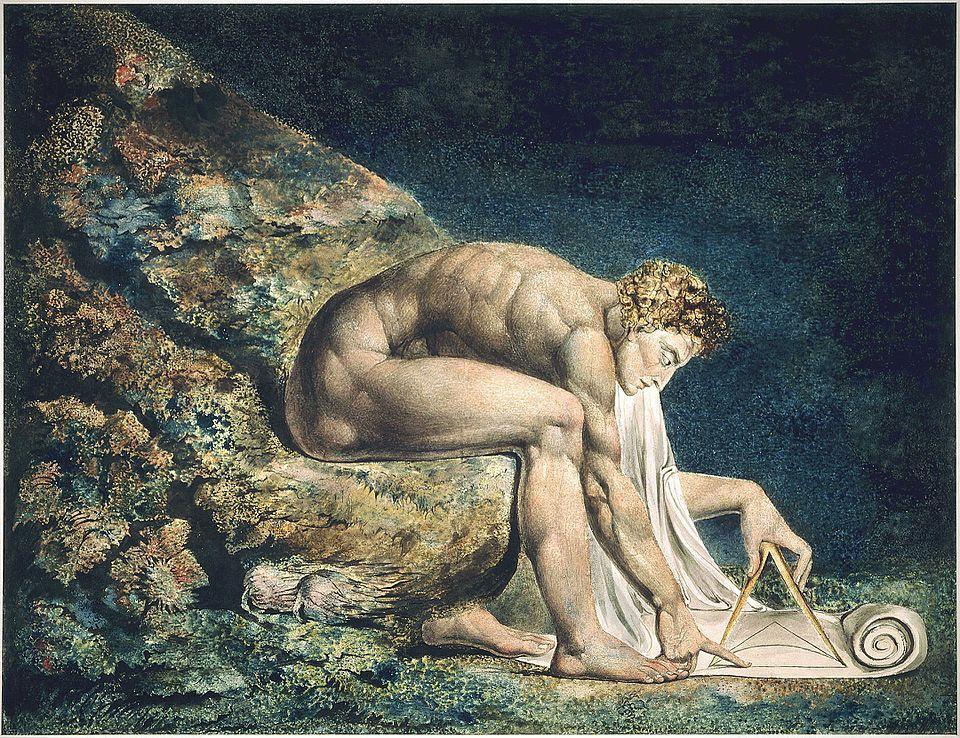
William Blake's Newton (1795), colour print with pen & ink and watercolour.
Blake's picture of Newton as a divine geometer was one of a series he created while living in Lambeth in the late 1790s.
Blake's printing appears to have been a form of self-developed monoprint which he then finished with additions in pen and ink coupled with watercolour washes.
The image depicts Sir Isaac Newton as a muscular, heroic nude figure crouched on what appears to be a rocky outcrop or ledge at the bottom of an underwater or subterranean world. Newton is shown in profile, bent over in intense concentration as he uses a compass to draw geometric diagrams on a scroll or parchment that unfurls before him.
https://commons.wikimedia.org/wiki/File:Newton-WilliamBlake.jpg
Opere di Galileo Galilei, edited by Carlo Manolessi, published by Bologna, per gli hh del Dozza, 1655-5, is available online:
https://tile.loc.gov/storage-services/service/rbc/rbctos/2017gen30462v2/2017gen30462v2.pdf
Going to the Moon: Early Cartography of the Lunar Surface
The lunar maps shown in this post were created long before satellite images became available. The topography is highly detailed and the historical backgrounds of the astronomers who created them are compelling.
by: Cynthia Smith (from the archives)
https://blogs.loc.gov/maps/2020/03/going-to-the-moon-early-cartography-of-the-lunar-surface/
Galileo at PG:
https://www.gutenberg.org/ebooks/author/39014
Alt...
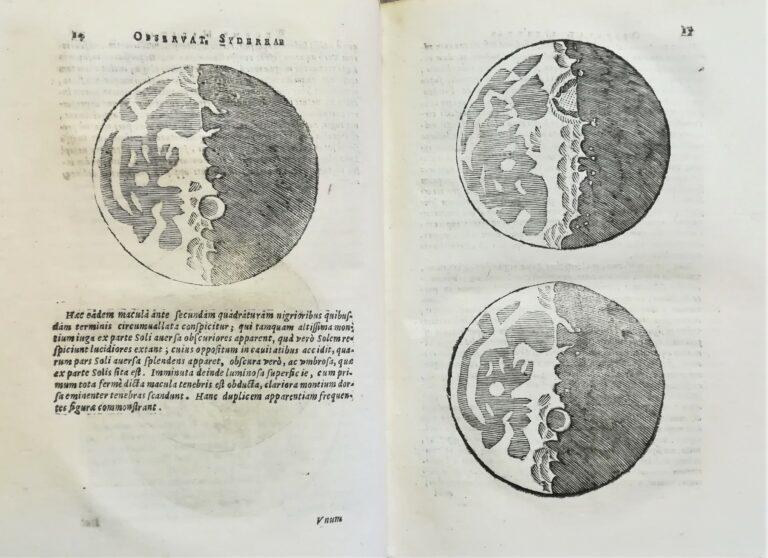
This is a historic page showing three of Galileo Galilei's pioneering telescopic observations of the Moon, from his Opere di Galileo Galilei (1655), held in the Rare Books and Special Collections Division at the Library of Congress.
The page displays three circular illustrations of the Moon in different phases, arranged with two at the top (left and right) and one at the bottom right. The page header reads "OBSERVAT SIDERUM" (Observations of the Stars/Heavens), with page numbers visible (34 and 35, suggesting this is a two-page spread).
https://brescia-raccoltestoriche.unicatt.it/storie/la-sezione-galileo-galilei/
![[?]](https://files.defcon.social/dcsocial-s3/accounts/avatars/113/208/344/507/078/943/original/014820ad22daee1c.jpg)
2026 January 3
Full Moonlight
* Image Credit & Copyright: Zhengjie Wu and Jeff Dai
https://twanight.org/profile/jeff-dai/
Explanation:
The Full Moon is the brightest lunar phase, and tonight you can stand in the light of the first Full Moon of 2026. In fact, the Moon's full phase occurs on January 3 at 10:03 UTC, while only about 7 hours later planet Earth reaches its 2026 perihelion, the closest point in its elliptical orbit around the Sun, at 17:16 UTC. January's Full Moon was also not far from its own perigee, or closest approach to planet Earth. For this lunation the Moon's perigee was on January 1 at 21:44 UTC. You can also spot planet Jupiter, near its brightest for 2026 and close on the sky to the Full Moon tonight. But while you're out skygazing don't forget to look for rare, bright fireballs from the Quadrantid meteor shower.
https://apod.nasa.gov/apod/ap211118.html
https://earthsky.org/earth/rare-alignment-of-earth-moon-and-sun-january-1-2-3-2026/
https://earthsky.org/tonight/january-full-moon-is-the-wolf-moon/
https://moon.nasa.gov/moon-observation/daily-moon-guide/?intent=011
https://www.amsmeteors.org/2025/12/viewing-the-2026-quadrantid-meteor-shower/
https://apod.nasa.gov/apod/fap/ap260103.html
#space #earth #moon #astrophotography #photography #science #astronomy #physics #nature #NASA #apod
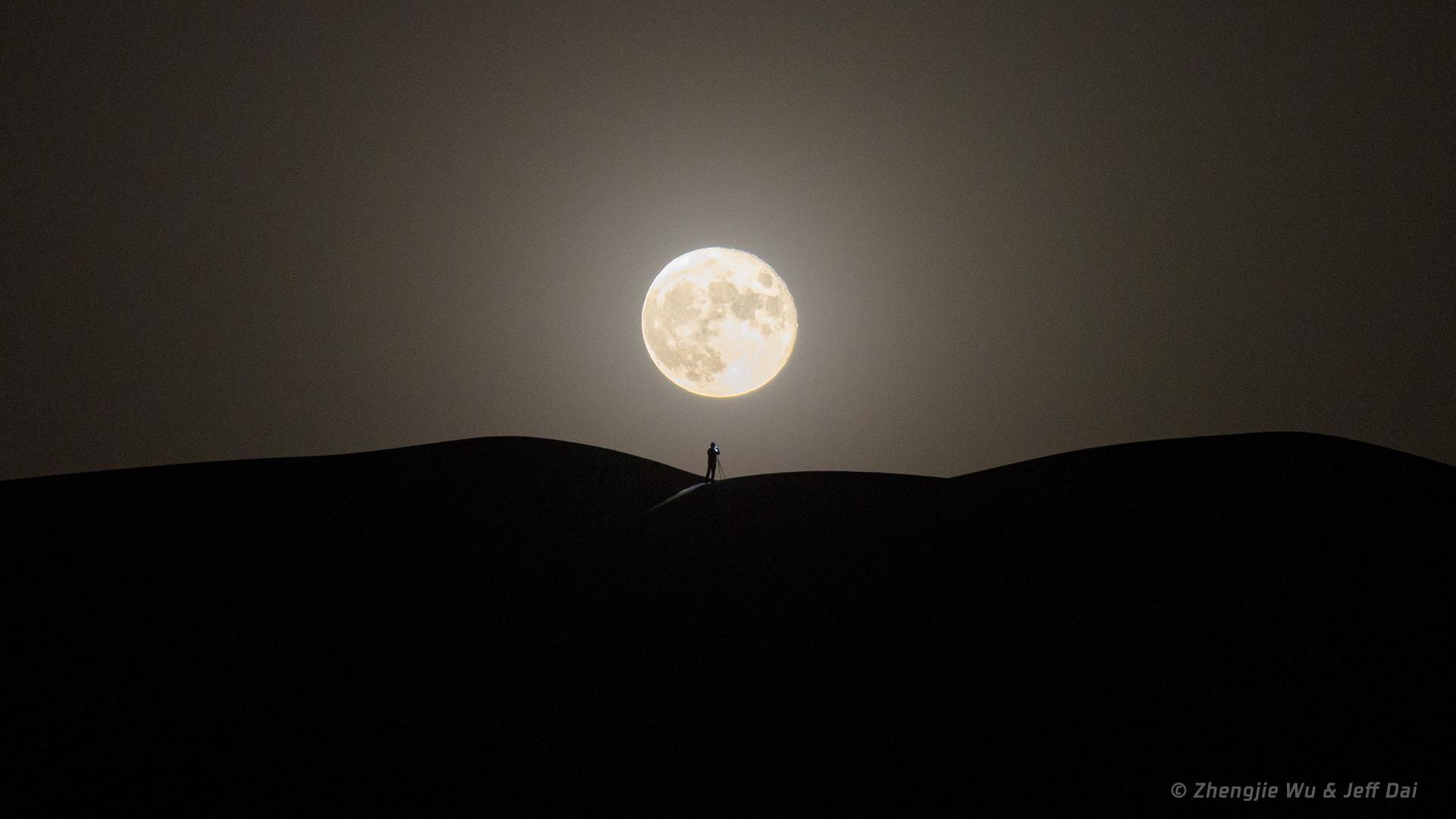
Alt...
2026 January 3
Full Moonlight
* Image Credit & Copyright: Zhengjie Wu and Jeff Dai (TWAN)
Explanation:
The Full Moon is the brightest lunar phase, and tonight you can stand in the light of the first Full Moon of 2026. In fact, the Moon's full phase occurs on January 3 at 10:03 UTC, while only about 7 hours later planet Earth reaches its 2026 perihelion, the closest point in its elliptical orbit around the Sun, at 17:16 UTC. January's Full Moon was also not far from its own perigee, or closest approach to planet Earth. For this lunation the Moon's perigee was on January 1 at 21:44 UTC. You can also spot planet Jupiter, near its brightest for 2026 and close on the sky to the Full Moon tonight. But while you're out skygazing don't forget to look for rare, bright fireballs from the Quadrantid meteor shower.
Authors & editors: Robert Nemiroff (MTU) & Jerry Bonnell (UMCP)
NASA Official: Amber Straughn Specific rights apply.
NASA Web Privacy, Accessibility, Notices;
A service of: ASD at NASA / GSFC,
NASA Science Activation
& Michigan Tech. U.
![[?]](https://files.mastodon.social/accounts/avatars/108/199/369/635/905/314/original/c1e859b9fa6a0178.jpg)
So cool. If you zoom in on the upper right, you see a little crescent. That's the Martian moon Phobos.
Zoom in again and you'll see a star next to Phobos. That's Earth! That's home.
Seen from Mars by NASA's Curiosity rover.
https://science.nasa.gov/photojournal/curiosity-views-earth-setting-phobos-rising/ #science #space #astronomy

Alt...
NASA's Curiosity Mars rover used its Mast Camera, or Mastcam, to capture this view of Earth setting while Phobos, one of Mars' two moons, is rising. It's the first time an image of the two celestial bodies have been captured together from the surface of Mars.
![[?]](https://cdn.fosstodon.org/accounts/avatars/109/366/856/446/242/299/original/1cc13c1ce46c76d0.jpg)
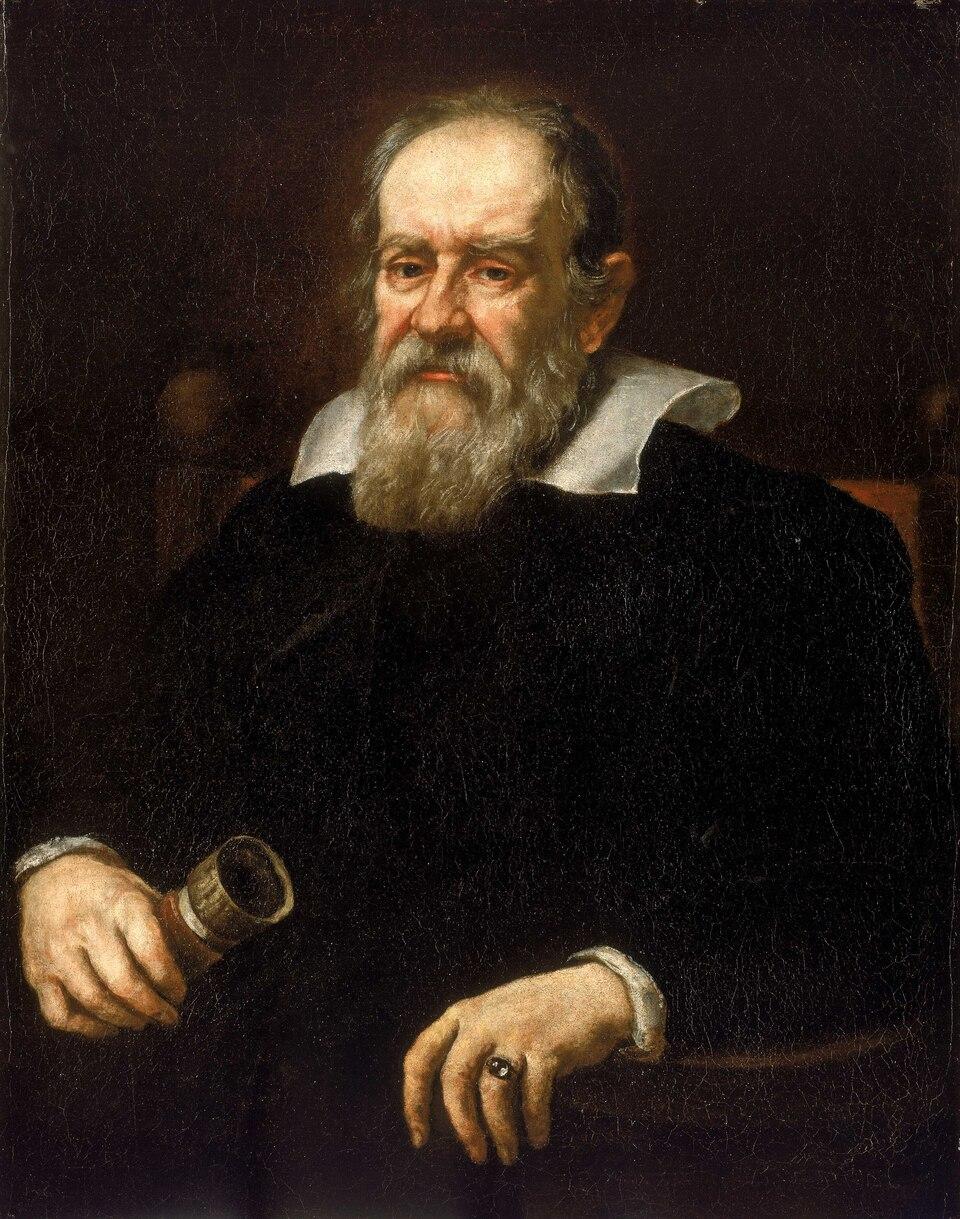
#OTD in 1612 (and 27 January 1613). Galileo Galilei became the first person to observe the planet Neptune, although he mistakenly catalogued it as a fixed star.
Because Neptune was only beginning its yearly retrograde cycle in Dec. 1612, the motion of the planet was far too slight to be detected with Galileo's small telescope.
https://en.wikipedia.org/wiki/Neptune
Neptune at PG:
https://www.gutenberg.org/ebooks/subject/34991
Alt...
Portrait of Galileo Galilei.
A half-length portrait, in old age, of the Italian mathematician, philosopher and astronomer, who was appointed court mathematician to the Medici dukes of Tuscany at Florence in 1610. He is dressed in black, wears a white beard and is seated in a chair holding a telescope in his right hand. His left hand rests on the arm of the chair and he wears a ring with a clear stone on his fourth finger. He faces forward towards the viewer.
https://en.wikipedia.org/w/index.php?title=File:Galileo_Galilei_(1564-1642)_RMG_BHC2700.tiff&page=1
![[?]](https://cdn.masto.host/swisssocial/accounts/avatars/109/610/582/883/537/207/original/0e6a86a6c0df06cc.jpg)

#astronomy #astronomie #science #wissenschaft #wissen #knowledge #scinexx #archaologie
Dieser Exoplanet ist einzigartig – und unerklärlich
Astronomen rätseln über Pulsar-nahen Gasriesen aus fast reinem Kohlenstoff 🤓
https://www.scinexx.de/news/kosmos/dieser-exoplanet-ist-einzigartig-und-unerklaerlich/
Today's #APOD: I think God's trying to give us his email address
https://apod.nasa.gov/apod/ap251212.html
"Northern Fox Fires"
2025 December 7
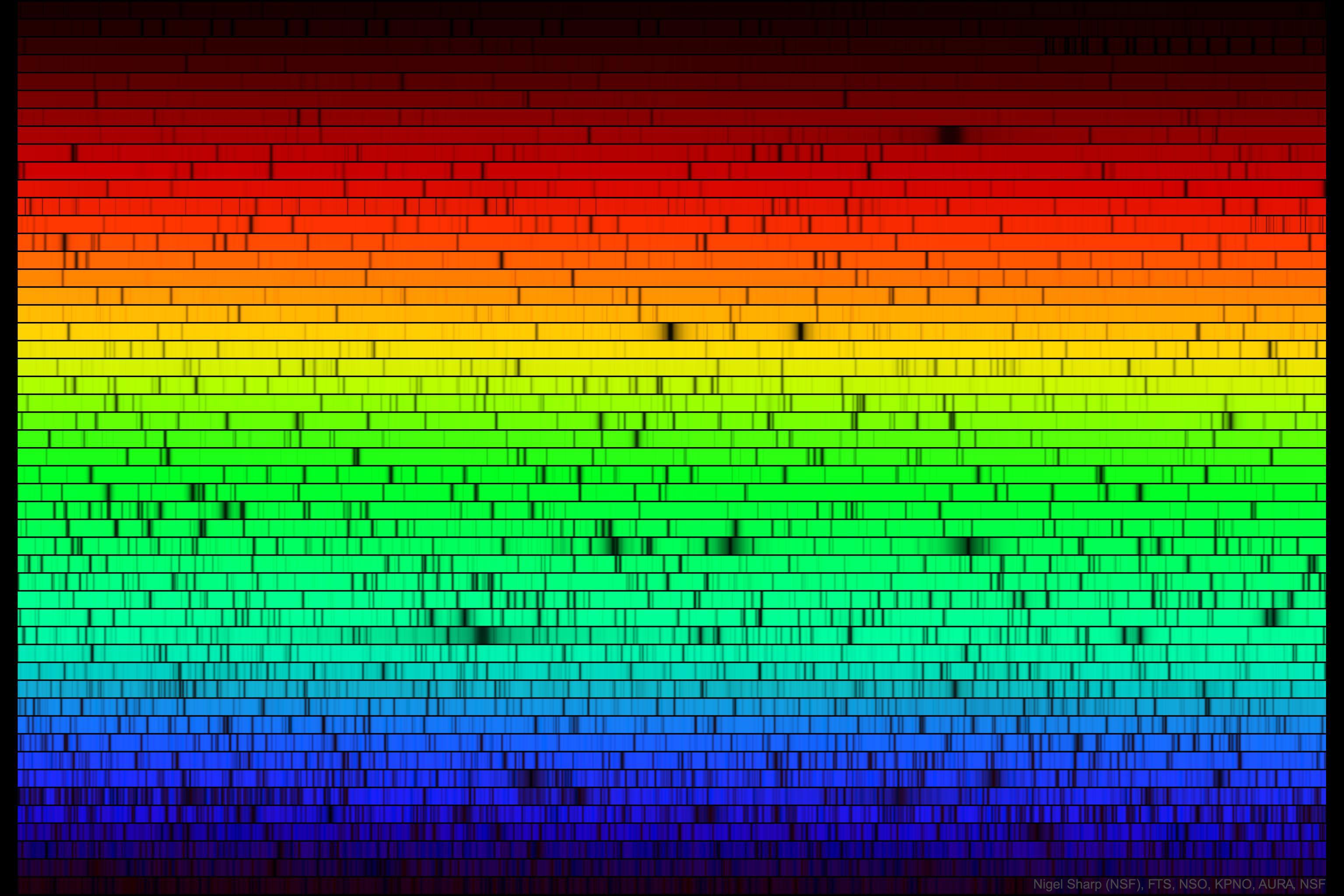
The Sun and Its Missing Colors
* Image Credit: Nigel Sharp (NSF), FTS, NSO, KPNO, AURA, NSF
https://noirlab.edu/public/images/noao-02592/
https://www.nsf.gov/
https://nso.edu/
https://noirlab.edu/public/programs/kitt-peak-national-observatory/
https://www.aura-astronomy.org/
Explanation:
It is still not known why the Sun's light is missing some colors. Here are all the visible colors of the Sun, produced by passing the Sun's light through a prism-like device. The spectrum was created at the McMath-Pierce Solar Observatory and shows, first off, that although our white-appearing Sun emits light of nearly every color, it appears brightest in yellow-green light. The dark patches in the featured spectrum arise from gas at or above the Sun's surface absorbing sunlight emitted below. Since different types of gas absorb different colors of light, it is possible to determine what gasses compose the Sun. Helium, for example, was first discovered in 1868 on a solar spectrum and only later found here on Earth. Today, the majority of spectral absorption lines have been identified - but not all.
https://science.nasa.gov/sun/
https://science.nasa.gov/ems/09_visiblelight/
https://en.wikipedia.org/wiki/Prism_%28optics%29
https://www.color-meanings.com/list-of-colors-names-hex-codes/
https://solar-center.stanford.edu/SID/activities/GreenSun.html
https://astronomy.swin.edu.au/cosmos/a/absorption+line
https://ui.adsabs.harvard.edu/abs/2005ASPC..336...25A/abstract
https://en.wikipedia.org/wiki/Helium
https://www.smithsonianmag.com/history/how-scientists-discovered-helium-first-alien-element-1868-180970057/
https://pwg.gsfc.nasa.gov/stargaze/Sun4spec.htm
https://noirlab.edu/public/programs/kitt-peak-national-observatory/mcmath-pierce-solar-telescope/
https://apod.nasa.gov/apod/ap120316.html
https://apod.nasa.gov/apod/image/0208/earthlights02_dmsp_big.jpg
https://apod.nasa.gov/apod/image/0208/earthlights02_dmsp_big.jpg
https://apod.nasa.gov/apod/fap/ap251207.html
#space #sun #astrophotography #photography #science #astronomy #physics #nature #NASA #ESA #apod
Alt...
2025 December 7
Colors from red at the top to blue at the bottom occupy this spectral image. In the midst of the colors are some dark spots indicating missing colors.
The Sun and Its Missing Colors
* Image Credit: Nigel Sharp (NSF), FTS, NSO, KPNO, AURA, NSF
Explanation:
It is still not known why the Sun's light is missing some colors. Here are all the visible colors of the Sun, produced by passing the Sun's light through a prism-like device. The spectrum was created at the McMath-Pierce Solar Observatory and shows, first off, that although our white-appearing Sun emits light of nearly every color, it appears brightest in yellow-green light. The dark patches in the featured spectrum arise from gas at or above the Sun's surface absorbing sunlight emitted below. Since different types of gas absorb different colors of light, it is possible to determine what gasses compose the Sun. Helium, for example, was first discovered in 1868 on a solar spectrum and only later found here on Earth. Today, the majority of spectral absorption lines have been identified - but not all.
Authors & editors: Robert Nemiroff (MTU) & Jerry Bonnell (UMCP)
NASA Official: Amber Straughn Specific rights apply.
NASA Web Privacy, Accessibility, Notices;
A service of: ASD at NASA / GSFC,
NASA Science Activation
& Michigan Tech. U.