Search results for tag #cybersecurity
 boosted
![[?]](https://social.gamefan.net/system/accounts/avatars/116/450/677/342/166/464/original/4de7a562f86cf564.png)
New York enacts one-year data center ban on projects larger than 50 megawatts — first US state to impleme…
New York is the first to pass a statewide data center moratorium, which pauses all projects greater than 50 MW for one year. The governor's office said that it will create a GEIS to hold developments to "consistent stan…
#Tech #Technology #TechNews #AI #Gadgets #Software #Cybersecurity #Apple #Google #Microsoft #Startup #OpenSource #TomsHardware [Tom's Hardware]
boosted![[?]](https://files.mastodon.social/accounts/avatars/114/048/194/944/023/530/original/3a6b93b37c67427d.png)
TS-2026-009: Insecure argument handling in Tailscale SSH permitted root access
https://tailscale.com/security-bulletins
Comments: https://news.ycombinator.com/item?id=48915004
#HackerNews #Tailscale #SSH #security #rootaccess #vulnerability #cybersecurity #technews
boosted![[?]](https://files.mastodon.social/accounts/avatars/114/053/503/262/903/476/original/dce7681e0a12d41e.png)
🚨 Oh, look! Another #security bulletin! 🎉 Apparently, #Tailscale is handing out #root #access like candy with their *super secure* #SSH feature. But don't worry, they'll make it all better at #TailscaleUp, where you'll learn to put out fires 🔥 you didn't start. 🙄
https://tailscale.com/security-bulletins #Vulnerability #Cybersecurity #Issues #HackerNews #ngated
![[?]](https://nbg1.your-objectstorage.com/tno-mastodon/accounts/avatars/111/434/264/745/920/273/original/52ff85db085a2a1d.jpg)
![[?]](https://files.defcon.social/dcsocial-s3/accounts/avatars/116/489/591/321/348/118/original/4712cfc9353d5e1e.png)
NIST SP 800-53
NIST Special Publication 800-53 is a foundational catalog of security and privacy controls designed to protect information systems and organizations. Originally mandatory for U.S. federal agencies and government contractors, it has evolved into a global standard widely used across both public and private sectors.
#cybersecurity #governance #risk #technology #gaming #programming #ai #business #engineering
Link: https://blackcatwhitehatsecurity.com

Alt...
NIST SP 800-53
NIST Special Publication 800-53 is a foundational catalog of security and privacy controls designed to protect information systems and organizations. Originally mandatory for U.S. federal agencies and government contractors, it has evolved into a global standard widely used across both public and private sectors.
Now, defenders are embracing the #PromptInjection, too
https://arstechnica.com/security/2026/07/now-defenders-are-embracing-the-prompt-injection-too/
![[?]](https://files.mastodon.social/accounts/avatars/112/066/993/516/962/338/original/65c95328ea8e0e54.jpg)
Behind YouTube: Hurley, Chen, and Karim #negativepid #digitalInvestigations #OSINT #cybersecurity #AI #tech #onlineInvestigations #robotics #cyberpsychology #cybercrime https://negativepid.blog/behind-youtube-hurley-chen-and-karim/?utm_source=mastodon&utm_medium=social&utm_campaign=fedica-Negative-PID-Blog
Children's #SocialMedia curbs planned across #EU, von der Leyen says
#AgeVerification #privacy #cybersecurity #Europe #politics #SocialMediaBan
Lessons Learned from #CISA’s Recent #GitHub Leak
https://krebsonsecurity.com/2026/07/lessons-learned-from-cisas-recent-github-leak/
![[?]](https://media.mstdn.social/accounts/avatars/109/271/456/836/657/845/original/eeff846d4300463c.png)
This is a great distillation of some important points about risk, cybersecurity, and the NIST CSF. If your work touches on any of those, this is worth a read.
https://cyberriskbook.com/ai-wont-save-you-from-weak-cybersecurity-fundamentals/
![[?]](https://media.infosec.exchange/infosec.exchange/accounts/avatars/109/243/688/522/761/749/original/958dc2958799c9b8.png)
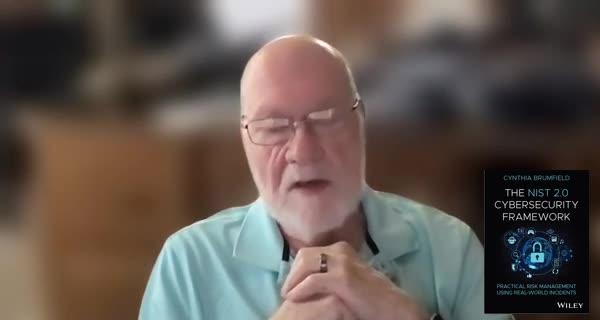
I sat down with cybersecurity pioneer and distinguished professor of computer science at Purdue University, Gene Spafford -- who wrote the foreword to my book on the NIST Cybersecurity Framework -- to discuss why we need stalwart frameworks such as the NIST CSF more than ever in the AI era.
One fascinating point he made: AI isn't uncovering new vulnerabilities; it's exposing old ones, which Gene calls a form of willful tech debt.
Willful debt is the security investment an organization, mostly vendors, chose to skip, the same way you'd choose a new TV over paying the electric bill. AI just makes the consequences show up faster.
Watch his explanation below and read more about our full conversation at https://cyberriskbook.com/ai-wont-save-you-from-weak-cybersecurity-fundamentals/
#CyberSecurity #NIST #NISTCSF #RiskManagement
Alt...
Gene Spafford talking about willful tech debt.
![[?]](https://cdn.fosstodon.org/accounts/avatars/107/297/362/770/635/523/original/3ce6a735f191afe9.jpeg)
NicFab Newsletter #29 is out — Privacy, Data Protection, AI, Cybersecurity & Tech Law.
This week: Garante fines Character.AI €158k; EDPB guidelines on anonymisation and web scraping for GenAI; the EP shields end-to-end encryption; the CJEU on the journalistic exemption; Apple stays a gatekeeper — plus my new book "Agentic AI".
EN: https://www.nicfab.eu/en/newsletter-issues/2026-07-14-issue-29/
IT: https://www.nicfab.eu/it/newsletter-issues/2026-07-14-issue-29/
Scam victimology: why did they pick me? #negativepid #digitalInvestigations #OSINT #cybersecurity #AI #tech #onlineInvestigations #robotics #cyberpsychology #cybercrime https://negativepid.blog/scam-victimology-why-did-they-pick-me/?utm_source=mastodon&utm_medium=social&utm_campaign=fedica-Negative-PID-Blog
How the #FSF sysadmins block botnets with #reaction
https://www.fsf.org/blogs/community/blocking-botnets-with-reaction
![[?]](https://files.social.openrightsgroup.org/system/accounts/avatars/109/382/359/215/932/523/original/ea34e4d5bb2b649c.png)
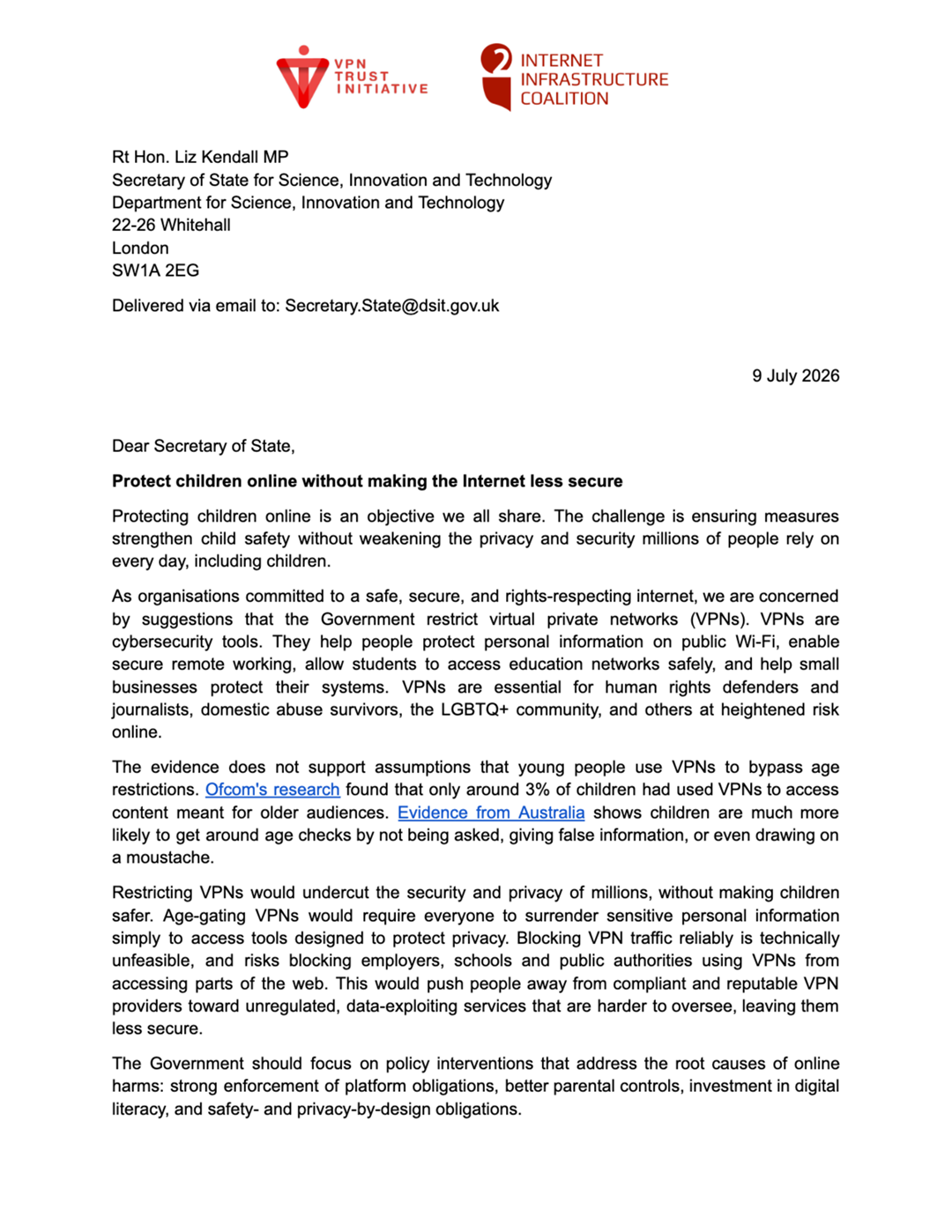
Today we’ve joined over 20 organisations to urge the UK Government to protect children online without making the internet less secure by restricting VPNs.
Child safety and security aren’t competing objectives – we need both.
Read our letter ➡️ https://www.openrightsgroup.org/publications/joint-letter-protect-vpns/
#SafeAndSecure #ProtectVPNs #vpn #cybersecurity #onlinesafety #privacy #ukpolitics #ukpol
Alt...
Protecting children online is an objective we all share. The challenge is ensuring measures strengthen child safety without weakening the privacy and security millions of people rely on every day, including children.
As organisations committed to a safe, secure, and rights-respecting internet, we are concerned by suggestions that the Government restrict virtual private networks (VPNs). VPNs are cybersecurity tools. They help people protect personal information on public Wi-Fi, enable secure remote working, allow students to access education networks safely, and help small businesses protect their systems. VPNs are essential for human rights defenders and journalists, domestic abuse survivors, the LGBTQ+ community, and others at heightened risk online.
The evidence does not support assumptions that young people use VPNs to bypass age restrictions. Ofcom’s research found that only around 3% of children had used VPNs to access content meant for older audiences. Evidence from Australia shows children are much more likely to get around age checks by not being asked, giving false information, or even drawing on a moustache.
Restricting VPNs would undercut the security and privacy of millions, without making children safer. Age-gating VPNs would require everyone to surrender sensitive personal information simply to access tools designed to protect privacy. Blocking VPN traffic reliably is technically unfeasible, and risks blocking employers, schools and public authorities using
Alt...
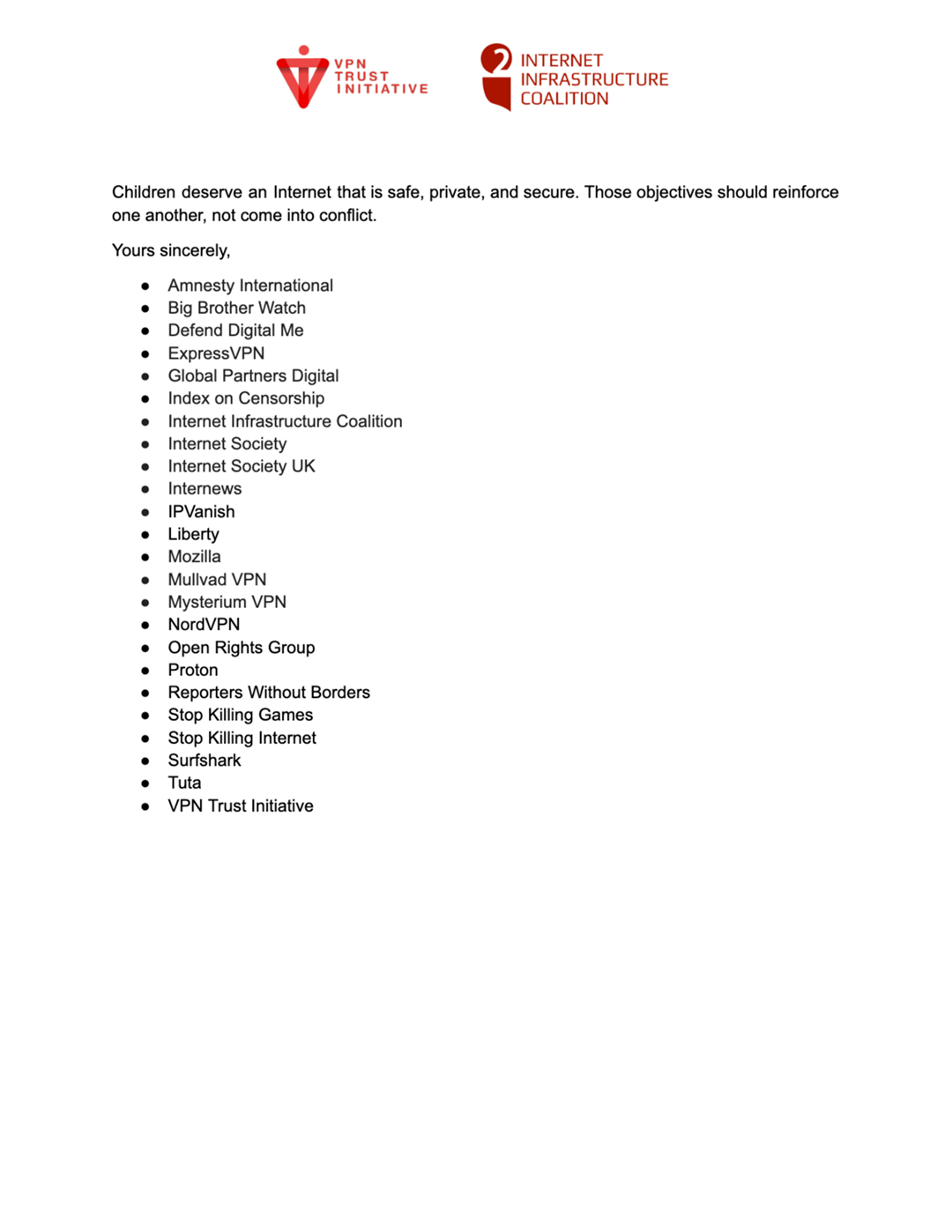
Children deserve an Internet that is safe, private, and secure. Those objectives should reinforce one another, not come into conflict.
Yours sincerely,
• Amnesty International
• Big Brother Watch
• Defend Digital Me
• ExpressVPN
• Global Partners Digital
• Index on Censorship
• Internet Infrastructure Coalition
• Internet Society
• Internet Society UK
• lnternews
• IPVanish
• Liberty
• Mozilla
• Mullvad VPN
• Mysterium VPN
• NordVPN
• Open Rights Group
• Proton
• Reporters Without Borders
• Stop Killing Games
• Stop Killing Internet
• Surfshark
• Tuta
• VPN Trust Initiative
![[?]](https://media.infosec.exchange/infosec.exchange/accounts/avatars/114/372/473/711/554/045/original/336266689a6c5f66.jpg)


"DHS Cybersecurity Reportedly Has an ‘I’m Sure It’s Nothing’ Problem"
"DHS probably shouldn't be dismissing actual breaches as false positives...twice."
https://gizmodo.com/dhs-cybersecurity-reportedly-has-an-im-sure-its-nothing-problem-2000785126
Daily Digest | 14 July 2026
Your daily dose of Privacy, Data Protection, AI & Cybersecurity news.
5 stories you should not miss.
Read more: https://www.nicfab.eu/daily-digest/
Dave Winer, RSS and the rise of blogging #negativepid #digitalInvestigations #OSINT #cybersecurity #AI #tech #onlineInvestigations #robotics #cyberpsychology #cybercrime https://negativepid.blog/dave-winer-rss-and-the-rise-of-blogging/?utm_source=mastodon&utm_medium=social&utm_campaign=fedica-Negative-PID-Blog
Women who shaped vulnerability disclosure #negativepid #digitalInvestigations #OSINT #cybersecurity #AI #tech #onlineInvestigations #robotics #cyberpsychology #cybercrime https://negativepid.blog/women-who-shaped-vulnerability-disclosure/?utm_source=mastodon&utm_medium=social&utm_campaign=fedica-Negative-PID-Blog
![[?]](data:image/png;base64, iVBORw0KGgoAAAANSUhEUgAAAEAAAABAAQAAAACCEkxzAAAAUUlEQVQoz43R0QkAMQwCUDdw/y3dwEvsvzlL4X1IoQkAisKmwfAFT3RgJHbQezpSRoXEqeqCL9BJBf7h3QbOCCxV5EVWMEMwG7K1/WODtlvxAYTtEsDU9F34AAAAAElFTkSuQmCC)
t.me isn't "down" because Telegram's infrastructure failed. It's failing because the domain is in serverHold, a registry-level EPP status that removes DNS delegation from the parent zone. No nameservers, no DNS resolution, regardless of how healthy Telegram's servers are.
A good reminder that registries, not just registrars, are part of your infrastructure risk model.
Full breakdown: https://thecybersecguru.com/news/tme-domain-serverhold-status-explained/
#CyberSecurity #InfoSec #DNS #EPP #serverHold #Telegram #DomainSecurity #DFIR
![[?]](https://static.toot.community/accounts/avatars/116/714/846/648/079/827/original/a425c282d9dc85a8.png)
Age verification laws are spreading fast, and it’s a massive privacy trainwreck. Forcing users to hand over IDs or biometric scans kills anonymity & builds giant honeypots for hackers.
Track the creep with @proton.me’s map: https://proton.me/age-verification
![[?]](https://files.mastodon.social/accounts/avatars/109/863/301/407/027/033/original/6bc7b34c6f69c7a7.png)
🚨PSA: If you think you're a targeted individual, don't install macOS apps from the web. macOS code signing and TCC are broken. We accidentally found a bug that lets any command modify the binaries of other apps, including Signal, Brave, Chrome, and even Xcode. Watch the demo👇
![[?]](https://media.infosec.exchange/infosec.exchange/accounts/avatars/114/614/907/486/620/795/original/f2706694126a7cd8.png)
New by me: Waze Terms Update: What It Means for Location Privacy
https://www.kylereddoch.me/blog/waze-terms-update-what-it-means-for-location-privacy/
Dutch intelligence agencies are facing fresh scrutiny after a watchdog found unauthorized access to bulk citizen datasets, excessive data retention, and weak audit logging.
Privacy advocates now fear some of that data could also be used in AI systems, raising questions about oversight, transparency, and whether agencies have learned from past failures.
Full breakdown:
https://thecybersecguru.com/news/aivd-mivd-ai-training-citizen-data/
#CyberSecurity #Privacy #AI #Infosec #DataProtection #Surveillance #Netherlands #GDPR
The digital mind: how technology shapes mental health #negativepid #digitalInvestigations #OSINT #cybersecurity #AI #tech #onlineInvestigations #robotics #cyberpsychology #cybercrime https://negativepid.blog/the-digital-mind-how-technology-shapes-mental-health/?utm_source=mastodon&utm_medium=social&utm_campaign=fedica-Negative-PID-Blog
We shipped a Privacy Gateway for Darkmoon: an open source autonomous AI pentest agent can use a frontier model without the model ever seeing your real IPs, hosts or creds. Deterministic placeholders, local rehydration, anti exfiltration. Proven on OWASP Juice Shop: 56 vulns found, model never saw a real IP. GPLv3.
![[?]](https://media.wired.com/photos/615e2b8ce78a8cd913bbaa76/16:9/w_1280,c_limit/wired_bug.jpg) WIRED - The Latest in Technology, Science, Culture and Business [Unofficial] » 🌐
WIRED - The Latest in Technology, Science, Culture and Business [Unofficial] » 🌐
@wired.com@web.brid.gy
A Leak of San Francisco Police Drone Footage Exposes the New Reality of Urban Surveillance
The SFPD’s exposure of hours of videos from drone platform Skydio reveals how broadly it’s watching the city from above—and how the results can spill online.

Alt...
A Leak of San Francisco Police Drone Footage Exposes the New Reality of Urban Surveillance
Organized cybercrime: the rise of cybercrime syndicates #negativepid #digitalInvestigations #OSINT #cybersecurity #AI #tech #onlineInvestigations #robotics #cyberpsychology #cybercrime https://negativepid.blog/organized-cybercrime-the-rise-of-cybercrime-syndicates/?utm_source=mastodon&utm_medium=social&utm_campaign=fedica-Negative-PID-Blog
Daily Digest | 13 July 2026
Your daily dose of Privacy, Data Protection, AI & Cybersecurity news.
5 stories you should not miss.
Read more: https://www.nicfab.eu/daily-digest/
![[?]](https://files.ioc.exchange/iocexchange/accounts/avatars/109/263/596/645/841/066/original/266fb87f321afc00.jpg)
"I Am Tracking You" exposes the dark reality of spyware & digital surveillance. Bronze Medal Winner at Global Music Awards! Featuring powerful vocals by AENDZI, this EDM track warns about privacy threats lurking in our devices.
Watch here: https://www.youtube.com/watch?v=qLkgKzqZY2s
#cybersecurity #EDM #privacy #infosec #spyware #GlobalMusicAwards

Alt...
Youtube thumbnail image for the video: I Am Tracking You (feat. AENDZI)
boosted![[?]](https://cdn.masto.host/indiewebsocial/accounts/avatars/112/536/017/792/352/435/original/a87e9128d6303e02.png)
⚠️ sys/kern/sysv_sem.c in OpenBSD through 7.9 has a use-after-free allowing local privilege escalation to root. This is a context switch use-after-free after tsleep in sys_semget().