Search results for tag #christianity
![[?]](https://i0.wp.com/dailyintheword.blog/wp-content/uploads/2026/05/cropped-blogtitleimage.jpg?fit=512%2C512&ssl=1)
The Throne Beyond the Veil
A Poem Inspired by Hebrews 4:14–16 Beyond the veil where mortal eyesHave never pierced the courts above,There stands a throne in radiant light,Established by eternal love.No shadow stains its holy height,No darkness dims its perfect grace;The hosts of heaven bow in aweBefore the splendor of that place. The stars that wheel through endless night,The seas that thunder at command,The mountains crowned with ancient snow,Are fashioned by a sovereign hand.Yet greater still the wondrous […] [SENSITIVE CONTENT]

A Poem Inspired by Hebrews 4:14–16
Beyond the veil where mortal eyes
Have never pierced the courts above,
There stands a throne in radiant light,
Established by eternal love.
No shadow stains its holy height,
No darkness dims its perfect grace;
The hosts of heaven bow in awe
Before the splendor of that place.
The stars that wheel through endless night,
The seas that thunder at command,
The mountains crowned with ancient snow,
Are fashioned by a sovereign hand.
Yet greater still the wondrous truth
That echoes through creation’s frame:
A Priest has entered heaven’s gate,
And Jesus Christ is His name.
Not clothed in robes of earthly thread,
Nor bearing incense made by men,
He passed beyond the highest skies
And entered God’s own courts again.
The Son of God, enthroned on high,
The Lamb once slain for guilty souls,
Now stands before the Father’s face
While endless praise around Him rolls.
The prophets saw His distant day
And longed to understand the sight;
The kings desired to glimpse His reign
That shines with everlasting light.
The saints who wandered deserts bare,
Who trusted through the fiercest flame,
Looked forward to the promised One,
And rested in His mighty name.
He is the Priest forevermore,
The Mediator strong and true;
No other hand can bridge the gulf,
No other heart can see us through.
The ancient altars fade away,
Their sacrifices now fulfilled;
For by His blood the debt was paid,
And heaven’s justice stands appeased.
Yet marvel not alone that Christ
Has entered through the gates above;
Marvel that the Lord of all
Is filled with sympathy and love.
Though crowned with glory infinite,
Though seated on the throne of might,
He bears remembrance of the path
He walked through sorrow’s deepest night.
He knew the wilderness of thirst,
The lonely burden of rejection;
He heard the mocker’s bitter laugh,
The sinner’s cold and hard objection.
He felt the weight of human grief,
The sting of tears that freely fell;
He walked among the brokenhearted
And entered suffering’s darkest cell.
The storm-tossed sea obeyed His voice,
Yet still He slept in weariness.
The angels waited at His word,
Yet He endured humanity’s distress.
The Prince of Life knew hunger’s ache,
The Holy One knew sorrow’s pain;
The Lord of Glory wore our flesh
And walked beneath the curse’s stain.
Temptation pressed from every side,
Its subtle whisper and its cry;
Yet never once did darkness gain
The smallest victory thereby.
His heart remained unstained by sin,
His hands untouched by evil’s art;
The perfect Lamb stood firm and pure,
With flawless love and steadfast heart.
Therefore the weary need not fear
That heaven cannot understand.
The Savior knows the pilgrim’s road,
The burdens carried by our hand.
He knows the battle hidden deep,
The doubts concealed from human sight;
He knows the tears that fall unseen
Beneath the cover of the night.
When conscience trembles under guilt,
When faith appears a dying flame,
When weakness seems a chain of iron,
And shame repeats its cruel claim,
The child of God may lift his eyes
Beyond the failures of the day,
And see a Priest whose nail-scarred hands
Still intercede along the way.
O blessed mystery of grace!
The Judge Himself became our Friend;
The One before whom angels bow
Secures our welcome without end.
No flaming sword now guards the path,
No cherub bars the sinner’s plea;
The veil is torn, the door stands wide,
And mercy flows abundantly.
Come then, believer, draw thou near,
Not shrinking back in guilty dread.
The throne before thee is not crowned
With wrath to strike the trembling dead.
Though holy beyond mortal thought,
Though bright with uncreated flame,
It bears a sweeter, dearer title:
The Throne of Grace, forever named.
There mercy waits with open hands,
And kindness greets the contrite soul;
There wounds are healed and fears are calmed,
And broken hearts are rendered whole.
There strength is given to the weak,
And courage to the faint of breath;
There hope arises from the dust
And triumph sings in face of death.
The world may offer fleeting aid,
A comfort passing as the dew;
Its promises dissolve like mist,
Its words prove frail and often few.
But grace descends from heaven’s height,
Abundant as the boundless sea,
And every wave proclaims anew
The riches of God’s charity.
In every hour of urgent need,
When trials gather like a storm,
The Savior’s presence shall remain,
A refuge constant, sure, and warm.
His mercy does not ebb away
As seasons fade and kingdoms fall;
His faithfulness endures unchanged,
The same Lord over all.
Therefore let hearts hold fast their hope,
Though winds may rage and mountains shake;
The Priest who entered heaven’s courts
Will never leave His own forsake.
His promises are firm as truth,
His covenant shall ever stand;
The sheep He purchased with His blood
Are safely held within His hand.
And when at last life’s journey ends,
And earthly shadows flee from sight,
The faithful shall behold their King
In everlasting realms of light.
The throne once sought through prayer and faith
Shall stand unveiled before their gaze;
And they shall join the countless choir
In endless songs of grateful praise.
Then every doubt shall disappear,
And every tear be wiped away;
The mercy sought in earthly need
Shall blossom into perfect day.
The Great High Priest shall welcome home
The saints redeemed by grace alone,
And they shall dwell forevermore
Before the everlasting throne.
Until that dawn, let every soul
Take courage from this sacred word:
The heavens hold a faithful Priest,
Our Savior, Master, King, and Lord.
Therefore with confidence draw near,
And seek the grace God freely gives;
For mercy flows from heaven’s throne,
And Christ, our Great High Priest, lives.

Alt...
The Throne Beyond the Veil
![[?]](https://babka-mastodon.nyc3.cdn.digitaloceanspaces.com/accounts/avatars/109/554/492/947/534/560/original/cccb05f65e8f3af8.png)
I have spent years watching what happens to people when Hebrew finally clicks for them and it is never just about the language.
Something opens. A connection to family they could not fully reach before. A scripture they always heard but never truly understood. A trip to Israel that finally felt like coming home. A heritage that was always theirs but always felt just out of reach.
That is what Hebrew does. And that is why I will never stop teaching it.
hebrewbyinbal.com/speak 🇮🇱
#LearnHebrew #Hebrew #HebrewForBeginners #Christianity #LanguageLearning

The Open Door
A Short Story Inspired by Hebrews 4:14-16 The emergency room waiting area was quieter than usual. Ethan sat alone beneath the glow of fluorescent lights, staring at a paper cup of coffee that had long since gone cold. Across from him, a television mounted high on the wall played a morning news program with the volume turned down. People moved through the halls beyond the glass doors, but everything felt distant, as though he were watching life happen from underwater. His phone buzzed […] [SENSITIVE CONTENT]

A Short Story Inspired by Hebrews 4:14-16
The emergency room waiting area was quieter than usual.
Ethan sat alone beneath the glow of fluorescent lights, staring at a paper cup of coffee that had long since gone cold. Across from him, a television mounted high on the wall played a morning news program with the volume turned down. People moved through the halls beyond the glass doors, but everything felt distant, as though he were watching life happen from underwater.
His phone buzzed again.
No new updates.
His mother was in surgery.
Three hours earlier she had collapsed while tending flowers in her backyard. The doctors had spoken carefully, using words that sounded hopeful but uncertain. Now all Ethan could do was wait.
Waiting had never been his strength.
He stood and paced the room. Then he sat again. Then he stood.
A familiar voice interrupted his restless thoughts.
“You’re wearing a path in the floor.”
Ethan turned and saw Pastor James carrying two cups of coffee.
“I figured you might need this,” the pastor said.
“You didn’t have to come.”
“Of course I did.”
The older man sat beside him and handed him a fresh cup.
For several minutes neither of them spoke.
Sometimes silence was kinder than advice.
Finally Ethan sighed.
“I don’t know what to pray anymore.”
Pastor James nodded.
“That happens.”
“I mean it,” Ethan said. “I’ve prayed all morning. I’ve begged God to help her. I’ve quoted verses. I’ve tried to believe. Now I’m just exhausted.”
The pastor listened.
Ethan continued.
“And honestly, I feel guilty.”
“Why?”
“Because I keep wondering whether God is tired of hearing from me.”
Pastor James looked surprised.
“Tired of hearing from you?”
“Yeah.”
Ethan stared at the floor.
“I’ve made a mess of things over the years. You know that. There were years I barely stepped inside a church. Years when I ignored God completely. Then something goes wrong and suddenly I’m knocking on heaven’s door again.”
His voice cracked.
“What if I’ve worn out my welcome?”
The pastor leaned back in his chair.
“That’s a heavy burden to carry.”
“It feels true.”
The older man was quiet for a moment.
“Do you remember the first time you came back to church?”
Ethan laughed softly.
“Unfortunately.”
“You sat in the back row.”
“I sat by the exit.”
“You looked like you were preparing an escape plan.”
“I was.”
Pastor James smiled.
“And what happened?”
“You preached.”
“No, after that.”
Ethan thought.
“You came and talked to me.”
“What did I say?”
The younger man shrugged.
“You asked if I wanted coffee.”
“And?”
“You said I didn’t have to earn my way through the door.”
Pastor James nodded.
“Exactly.”
Ethan looked away.
“That was church.”
“Yes.”
“This is God.”
The pastor’s expression softened.
“That’s precisely why it matters.”
The waiting room grew quiet again.
A nurse walked past.
Someone laughed down the hallway.
Life continued.
Pastor James folded his hands.
“Years ago, when I was young, I thought prayer worked like a performance review.”
Ethan raised an eyebrow.
“A performance review?”
“I imagined God sitting behind a giant desk. Every prayer request had to pass inspection. Good Christians got quick access. Weak Christians waited in line. Failures stayed outside.”
“That sounds familiar.”
“It does, doesn’t it?”
The pastor smiled sadly.
“But Scripture paints a different picture.”
Ethan listened.
“It tells us we have a great High Priest who understands our weakness.”
He paused.
“Not one who merely tolerates us. One who understands us.”
Ethan stared into his coffee.
Pastor James continued.
“Think about that. Jesus knows exhaustion. He knows grief. He knows fear. He knows betrayal. He knows what it feels like to stand in the shadow of suffering.”
“But He never sinned.”
“No.”
“Then how can He understand?”
The pastor nodded.
“That’s what makes it remarkable. He faced every kind of temptation and pressure without surrendering to it. He knows the full weight of human struggle better than we do.”
Ethan considered that.
For years he had imagined God as distant.
Powerful, certainly.
Holy, definitely.
But not approachable.
Not accessible.
Not near.
“Sometimes,” Ethan said quietly, “I feel like I’m standing outside a locked door.”
Pastor James pointed toward the hospital entrance.
“You see those security doors?”
Ethan nodded.
“They only open for authorized people.”
“Right.”
“If you walk up to them without permission, they stay shut.”
“Exactly.”
The pastor smiled.
“A lot of people think God’s presence works that way.”
“It doesn’t?”
“No.”
He leaned forward.
“Because of Christ, the door is already open.”
Ethan looked at him.
“You don’t approach God based on your record.”
“Then how?”
“Through Jesus.”
The words settled into the silence between them.
Not through success.
Not through religious achievements.
Not through flawless behavior.
Through Jesus.
For the first time that morning, Ethan felt something loosen inside his chest.
A knot he had carried for years began to unwind.
The surgery was still happening.
Nothing had changed.
Yet somehow everything felt different.
Hours later, the surgeon finally appeared.
Ethan stood so quickly he nearly spilled his coffee.
The doctor removed his mask.
The expression on his face was impossible to read.
For a terrifying second Ethan imagined the worst.
Then the doctor smiled.
“The procedure went well.”
The room tilted with relief.
Ethan felt his knees weaken.
“She’s stable?”
“Yes.”
“She’s okay?”
“She has a long recovery ahead of her, but yes. She’s okay.”
Ethan closed his eyes.
A breath escaped him.
Not a sigh.
Not quite a laugh.
Something in between.
The surgeon continued explaining details, but Ethan barely heard them.
His mother was alive.
That was enough.
Afterward, he sat back down.
Pastor James returned from making a phone call.
“Well?”
Ethan’s eyes filled with tears.
“She’s going to be okay.”
The pastor smiled.
“Praise God.”
For a few moments neither man spoke.
Then Ethan laughed unexpectedly.
“What?”
“I just realized something.”
“What’s that?”
“I spent all morning trying to convince myself that God would listen.”
Pastor James nodded.
“And?”
“And maybe the whole time He already was.”
The older man smiled.
“Yes.”
Ethan looked toward the ceiling.
Not because he thought heaven was physically above the hospital.
Not because he suddenly understood every mystery of faith.
But because for the first time in a long while, he felt welcomed.
Known.
Seen.
The fear that had haunted him for years was beginning to fade.
The fear that he was too broken.
Too inconsistent.
Too late.
Too far gone.
The truth was far better.
The throne of God was not merely a throne of power.
It was a throne of grace.
And grace meant the door remained open.
Weeks later, Ethan pushed his mother’s wheelchair through a sunny city park.
Summer had arrived.
Children played near a fountain.
Dogs chased tennis balls across bright green grass.
His mother was still recovering, but her strength was returning.
“Slow down,” she laughed.
“I am slowing down.”
“You’re pushing like you’re in a race.”
Ethan grinned.
“Old habits.”
They stopped near a bench overlooking a pond.
For a while they watched ducks glide across the water.
Then his mother asked a question.
“Can I tell you something?”
“Sure.”
“You seem different.”
Ethan smiled.
“How so?”
“Lighter.”
He looked toward the pond.
“I think I am.”
She waited.
“You know, when I was sitting in that hospital waiting room, I realized something.”
“What?”
“I’ve spent most of my life thinking God was reluctantly putting up with me.”
His mother said nothing.
“I thought every failure moved me farther away.”
“And now?”
Ethan watched sunlight dance across the water.
“Now I think He was calling me closer all along.”
A breeze stirred the trees overhead.
For a moment the world seemed unusually still.
Peaceful.
The kind of peace that cannot be manufactured.
The kind that arrives when fear finally releases its grip.
Ethan thought about all the doors people encounter in life.
Doors that remain closed.
Doors guarded by expectations.
Doors requiring credentials.
Doors that open only for the worthy.
But the door Christ opened was different.
It welcomed the weary.
The ashamed.
The struggling.
The uncertain.
The fearful.
The broken.
Not because their need was small.
But because His grace was greater.
And as Ethan sat beside his mother beneath the warmth of the afternoon sun, he understood something he had never truly grasped before.
The invitation had never been to stand outside and wonder whether he belonged.
The invitation had always been to come near.
With confidence.
With honesty.
With need.
And there, at the throne of grace, he would find exactly what he needed most:
Mercy for yesterday.
Grace for today.
And hope for tomorrow.

Alt...
The Open Door
Leading with Confidence at the Throne of Grace
A Message to Church Leaders from Hebrews 4:14-16 Hebrews 4:14–16 stands among the most encouraging and pastorally significant passages in the New Testament. In just a few verses, the writer of Hebrews brings together the glory of Christ, the weakness of humanity, the confidence of faith, and the sustaining grace of God. For church leaders, these words offer both a theological foundation and a practical lifeline. They remind pastors, elders, ministry leaders, teachers, missionaries, and […] [SENSITIVE CONTENT]

A Message to Church Leaders from Hebrews 4:14-16
Hebrews 4:14–16 stands among the most encouraging and pastorally significant passages in the New Testament. In just a few verses, the writer of Hebrews brings together the glory of Christ, the weakness of humanity, the confidence of faith, and the sustaining grace of God. For church leaders, these words offer both a theological foundation and a practical lifeline. They remind pastors, elders, ministry leaders, teachers, missionaries, and servants of the church that their ministry does not rest upon their own strength but upon the perfect ministry of Jesus Christ, our Great High Priest.
The passage declares:
“Therefore, since we have a great high priest who has ascended into heaven, Jesus the Son of God, let us hold firmly to the faith we profess. For we do not have a high priest who is unable to sympathize with our weaknesses, but we have one who has been tempted in every way, just as we are—yet he did not sin. Let us then approach God’s throne of grace with confidence, so that we may receive mercy and find grace to help us in our time of need.”
These words were written to believers who were weary, discouraged, and tempted to abandon their steadfast confession of Christ. They were facing opposition and hardship. Their faith was being tested. The writer does not begin by directing their attention to themselves. Instead, he directs their attention upward to Jesus.
This remains the first responsibility of every church leader. Leadership in the church is not primarily about strategy, administration, innovation, or influence. It begins with seeing Christ clearly. Ministry becomes unhealthy when leaders become consumed with their own abilities, failures, challenges, or ambitions. Healthy leadership begins when the eyes of the heart are fixed upon the risen and exalted Son of God.
The writer describes Jesus as our “great high priest.” This title carries profound significance. Under the old covenant, the high priest represented the people before God. He entered the Holy of Holies on behalf of the nation. He served as a mediator between a holy God and sinful people. Yet every earthly priest was limited. Every priest was imperfect. Every priest eventually died.
Jesus is different.
He is not merely a high priest; He is the great high priest. His priesthood is superior in every way. He is both the sacrifice and the priest who offers the sacrifice. He is both fully God and fully man. He does not minister in an earthly sanctuary but in the very presence of God. His ministry never ends because He lives forever.
Church leaders must continually remember that the church belongs to Christ. It is not sustained by human wisdom but by the ongoing ministry of Jesus. The burden of carrying the church was never intended to rest upon human shoulders alone. Christ Himself is the ultimate Shepherd of His people.
Many leaders carry unnecessary burdens because they unconsciously assume responsibilities that belong only to Christ. They attempt to change hearts, sustain every struggling believer, solve every conflict, and guarantee every outcome. Yet Scripture repeatedly points leaders back to the reality that Christ remains the Head of His church.
The health of ministry depends upon recognizing this truth. Leaders are called to serve faithfully, but they are not called to replace Christ. They are called to shepherd, but they are not the Chief Shepherd. They are called to teach, but they are not the source of truth. They are called to lead, but they are not the Savior.
The confidence of ministry grows when leaders understand that Jesus is actively reigning and interceding for His people.
The writer continues by declaring that Jesus has “ascended into heaven.” This statement reminds believers that Christ’s work on earth was completed successfully. His death accomplished redemption. His resurrection demonstrated victory over sin and death. His ascension revealed His exaltation and authority.
Church leaders often labor in situations where visible results seem small. Sermons are preached without obvious response. Counseling conversations appear unfruitful. Evangelistic efforts seem ineffective. Programs fail. Attendance fluctuates. Discouragement can quietly settle into the soul.
Yet Hebrews reminds leaders that their confidence is not rooted in visible success but in the finished work of Christ. Jesus reigns regardless of present circumstances. He remains victorious even when ministry seasons are difficult.
This perspective guards leaders from both despair and pride.
It guards against despair because Christ remains sovereign even when leaders feel ineffective.
It guards against pride because any fruit that appears ultimately comes through His power rather than human effort.
The command that follows is simple but profound: “Let us hold firmly to the faith we profess.”
Church leaders are often focused on helping others remain faithful. They preach perseverance. They encourage commitment. They call believers to endure trials. Yet leaders themselves must heed this same command.
One of the greatest dangers in ministry is the gradual erosion of personal devotion. A leader may remain active in ministry while quietly neglecting communion with Christ. Sermons can be prepared while prayer becomes shallow. Ministry activities can multiply while intimacy with God diminishes.
The writer calls leaders to hold firmly to their confession of faith. Ministry effectiveness cannot substitute for spiritual faithfulness.
Church history is filled with examples of gifted leaders whose ministries appeared impressive while their private walk with God deteriorated. The lesson is clear. No amount of public success can compensate for a declining relationship with Christ.
The strength to persevere comes from remembering who Jesus is and what He has done.
The next truth in this passage is among the most comforting in all of Scripture. The writer tells us that Jesus is able to sympathize with our weaknesses.
This is especially important for church leaders.
Leadership often carries unique pressures. Leaders are expected to remain strong during crises. They are called upon to comfort grieving families, navigate difficult decisions, address conflicts, and carry significant responsibilities. At times, these pressures can create feelings of isolation.
Many leaders quietly struggle with discouragement, exhaustion, fear, disappointment, loneliness, and temptation. They may believe that no one fully understands their burdens.
Hebrews offers remarkable comfort.
Jesus understands.
The Son of God entered human experience completely. He knew hunger, fatigue, rejection, misunderstanding, betrayal, sorrow, and suffering. He experienced opposition from religious leaders, abandonment by friends, and the weight of overwhelming responsibility.
He understands what it means to be weary.
He understands what it means to be misunderstood.
He understands what it means to be rejected.
He understands what it means to carry a difficult calling.
This does not mean Christ merely observes human weakness from a distance. The word “sympathize” conveys deep identification and compassionate understanding. Jesus does not respond to struggling leaders with cold detachment. He responds with mercy and compassion.
This truth transforms the way leaders approach God.
Many leaders carry hidden guilt because they feel they should be stronger than they are. They believe they should never become discouraged, weary, or overwhelmed. Yet Hebrews does not deny human weakness. Instead, it acknowledges weakness and points believers toward a sympathetic Savior.
The goal of spiritual maturity is not pretending weakness does not exist.
The goal is bringing weakness honestly before Christ.
The writer further explains that Jesus was “tempted in every way, just as we are—yet he did not sin.”
This statement highlights both Christ’s identification with humanity and His perfect holiness.
Jesus experienced the reality of temptation. He faced the enticements of power, comfort, self-preservation, and compromise. He encountered every category of temptation common to humanity.
Yet He never sinned.
This truth makes Him uniquely qualified to help His people.
A leader who has fallen into sin cannot ultimately rescue another from sin. A struggling sinner cannot serve as the perfect deliverer of sinners. Only the sinless Christ can provide complete salvation and ongoing help.
Church leaders should take great comfort in this reality. The foundation of ministry is not the leader’s perfection but Christ’s perfection.
Every leader remains dependent upon grace.
Every leader remains dependent upon forgiveness.
Every leader remains dependent upon Christ.
This dependence is not a weakness; it is the very heart of Christian ministry.
The passage then reaches its glorious climax: “Let us then approach God’s throne of grace with confidence.”
What a remarkable invitation.
Under the old covenant, access to God’s presence was limited. The Holy of Holies was separated by a veil. Only the high priest could enter, and only under specific conditions.
But through Christ, access has been opened.
Church leaders are invited to come boldly before God.
Notice that the destination is a throne.
A throne speaks of authority, sovereignty, majesty, and power.
God remains the King of the universe.
He rules over nations.
He governs history.
He reigns over every circumstance.
Nothing occurs outside His sovereign authority.
Yet this throne is also described as a throne of grace.
For believers in Christ, the throne of the King has become a place of welcome rather than terror.
This truth should shape every aspect of ministry leadership.
Leaders face countless situations that exceed their wisdom. There are counseling situations without easy answers. There are financial challenges. There are relational conflicts. There are ministry decisions filled with uncertainty.
The temptation is to rely primarily upon experience, intelligence, or strategy.
Yet Hebrews points leaders toward prayer.
The throne of grace is not merely a theological concept. It is a practical reality.
The most effective leaders are not necessarily those with the greatest talents. They are often those who have learned to live before the throne of grace.
Prayerlessness is ultimately a declaration of self-sufficiency.
Prayer is a declaration of dependence.
Healthy leaders recognize that every ministry challenge should drive them toward God rather than away from Him.
The writer tells believers to approach this throne with confidence.
This confidence is not arrogance.
It is not self-confidence.
It is Christ-confidence.
Believers approach boldly because Jesus has already secured their acceptance.
Church leaders must remember this distinction.
Many leaders live under constant pressure to prove themselves. They measure their worth by attendance numbers, ministry growth, public approval, or personal performance.
The gospel liberates leaders from this exhausting burden.
Acceptance before God does not depend upon ministry success.
It depends upon Christ.
Leaders do not earn access to God through effectiveness.
They receive access through grace.
This truth creates freedom.
It enables leaders to serve faithfully without being enslaved to outcomes.
It enables them to lead courageously without being controlled by fear.
It enables them to endure criticism without losing heart.
It enables them to remain humble during seasons of blessing.
The passage concludes with a promise: “that we may receive mercy and find grace to help us in our time of need.”
Every church leader lives in continual need.
There is never a season when leaders outgrow their dependence upon mercy and grace.
Mercy addresses our failures.
Grace provides strength for our responsibilities.
Mercy forgives what is behind us.
Grace empowers what lies before us.
Mercy meets us in our weakness.
Grace equips us for faithful service.
This promise assures leaders that God’s resources are always sufficient for His calling.
There will be days when ministry feels overwhelming. There will be seasons of discouragement. There will be moments when leaders question their strength, wisdom, and ability to continue.
In those moments, Hebrews does not point leaders toward self-reliance.
It points them toward the throne of grace.
There they receive mercy.
There they find grace.
There they discover fresh strength.
There they remember that Christ remains their Great High Priest.
The church of Jesus Christ desperately needs leaders who understand this passage. It needs leaders who are captivated by the greatness of Christ, anchored in the gospel, honest about their weaknesses, committed to prayer, and dependent upon grace.
The future of faithful ministry does not depend upon stronger personalities, better programs, or greater resources. It depends upon leaders who continually come before the throne of grace and draw strength from their living Savior.
Therefore, church leaders must not lose heart. The One who called them remains faithful. The One who saved them continues to intercede for them. The One who understands their weaknesses provides mercy and grace in every season.
Jesus Christ, the Son of God, has passed through the heavens. He reigns in glory. He sympathizes with His servants. He welcomes them into His presence. He supplies everything necessary for faithful ministry.
Because of Him, leaders can hold firmly to their confession.
Because of Him, leaders can approach God with confidence.
Because of Him, leaders can continue serving with courage, humility, and hope until the day they stand before the Chief Shepherd and hear His words of eternal commendation.

Alt...
Leading with Confidence at the Throne of Grace
Holding Fast to Our Great High Priest
A Sermon Reflecting on Hebrews 4:14-16 The book of Hebrews was written to believers who were facing pressure, uncertainty, and the temptation to drift away from their confidence in Christ. Into that setting comes one of the most comforting and powerful passages in all of Scripture: “Therefore, since we have a great high priest who has ascended into heaven, Jesus the Son of God, let us hold firmly to the faith we profess. For we do not have a high priest who is unable to sympathize with […] [SENSITIVE CONTENT]

A Sermon Reflecting on Hebrews 4:14-16
The book of Hebrews was written to believers who were facing pressure, uncertainty, and the temptation to drift away from their confidence in Christ. Into that setting comes one of the most comforting and powerful passages in all of Scripture:
“Therefore, since we have a great high priest who has ascended into heaven, Jesus the Son of God, let us hold firmly to the faith we profess. For we do not have a high priest who is unable to sympathize with our weaknesses, but we have one who has been tempted in every way, just as we are—yet he did not sin. Let us then approach God’s throne of grace with confidence, so that we may receive mercy and find grace to help us in our time of need.”
These verses invite believers into a deeper understanding of who Jesus is and what He continues to do for His people. They reveal Christ as our Great High Priest, our sympathetic Savior, and our gracious Advocate. They call us to perseverance, confidence, and hope. In a world filled with anxiety, temptation, suffering, and uncertainty, Hebrews 4:14–16 reminds us that we are not alone and that our access to God is secure because of Jesus Christ.
The passage begins with the declaration, “Since we have a great high priest.” The language immediately draws upon the rich imagery of the Old Testament. Under the old covenant, the high priest occupied a unique position among God’s people. He represented the nation before God. Once each year, on the Day of Atonement, he entered the Most Holy Place to offer sacrifices for sin and to intercede for the people.
The ministry of the high priest revealed two important truths. First, humanity is separated from God by sin and cannot approach Him casually. Second, God graciously provides a mediator who stands between Himself and His people.
The Old Testament priesthood was designed to point beyond itself. Every sacrifice, every priestly garment, every act of mediation anticipated the coming of Jesus Christ. The priests of Israel were temporary, imperfect, and mortal. They themselves needed sacrifices for their own sins. Their ministry could never permanently remove guilt or transform the human heart.
But Jesus is different.
The writer of Hebrews calls Him “a great high priest.” He is not merely another priest in a long succession of priests. He is the ultimate Priest. He fulfills everything the old covenant anticipated. He is greater than Aaron. He is greater than every earthly mediator. His priesthood is perfect, eternal, and complete.
The greatness of Christ’s priesthood is demonstrated in the next phrase: “who has ascended into heaven.” The earthly high priest entered an earthly sanctuary. Jesus entered heaven itself. Earthly priests passed through a curtain. Jesus passed through the heavens. Earthly priests stood before symbolic representations of God’s presence. Jesus entered the very presence of the Father.
This truth changes everything for believers.
Our Savior is not merely a figure from history. He is the risen and exalted Lord. He is seated at the right hand of God. His work of atonement has been accomplished. His sacrifice has been accepted. His victory over sin, death, and Satan has been secured.
The ascension of Christ reminds us that His ministry did not end at the cross or even at the resurrection. Today He lives and reigns. Today He intercedes for His people. Today He represents believers before the Father.
The Christian faith rests not merely on what Christ did in the past but also on what Christ is doing in the present. Even now He serves as our advocate and mediator.
Because of this reality, the writer exhorts believers: “Let us hold firmly to the faith we profess.”
This command is deeply practical. Faith must be held firmly because life often brings pressures that challenge belief. Trials come. Disappointments arise. Prayers seem unanswered. Temptations increase. Doubts whisper. Opposition emerges.
The temptation for many believers is not always outright rejection of Christ but gradual drift away from wholehearted trust in Him. Spiritual complacency can quietly replace spiritual passion. Confidence can be weakened by fear. Hope can be diminished by suffering.
Hebrews reminds us that perseverance is rooted not in our strength but in Christ’s priestly ministry. We hold fast because He holds us. We persevere because He intercedes for us. We remain faithful because He remains faithful.
The security of the believer ultimately rests not upon human determination but upon the ongoing ministry of Jesus Christ.
Many people imagine that spiritual maturity means reaching a place where weakness no longer exists. Yet the Christian life continually reveals our dependence upon God’s grace. The more we grow in Christ, the more aware we become of our need for Him.
This is why the next verse provides such extraordinary comfort.
“For we do not have a high priest who is unable to sympathize with our weaknesses.”
These words reveal the tenderness of Christ’s heart.
Jesus is not distant from human suffering. He is not detached from human struggles. He is not indifferent to human weakness.
The Son of God entered human history. He experienced hunger, fatigue, sorrow, rejection, grief, loneliness, and pain. He knew what it was to be misunderstood. He knew what it was to be betrayed by friends. He knew what it was to face intense opposition. He knew what it was to weep.
When believers suffer, Christ understands.
When believers feel overwhelmed, Christ understands.
When believers struggle with temptation, Christ understands.
When believers experience sorrow, disappointment, or fear, Christ understands.
His sympathy is not theoretical. It is experiential.
The word “sympathize” carries the idea of sharing in another’s experience. Jesus does not merely observe our struggles from a distance. He enters into them with compassionate understanding.
This truth transforms prayer.
Many people hesitate to come before God because they assume He cannot understand their struggles. They imagine Him as stern, distant, or inaccessible. Yet Hebrews presents a Savior whose heart is full of compassion.
Christ understands every burden carried by His people.
There is no sorrow too deep, no temptation too strong, no wound too painful, and no weakness too embarrassing to bring before Him.
The text continues: “but we have one who has been tempted in every way, just as we are—yet he did not sin.”
This statement reveals both Christ’s identification with humanity and His absolute uniqueness.
Jesus experienced real temptation. The temptations He faced were not imaginary. They were genuine and intense. Satan assaulted Him directly in the wilderness. Throughout His ministry He encountered opportunities to avoid suffering, compromise obedience, or pursue power apart from the Father’s will.
Yet unlike every other human being, Jesus remained completely sinless.
He experienced temptation fully because He never surrendered to it. Every pressure that temptation could exert was felt by Him, yet He remained perfectly obedient.
His sinlessness is essential to His role as Savior.
If Christ had sinned, He would have needed a Savior Himself. But because He remained without sin, He became the perfect sacrifice for sinners.
His purity qualified Him to bear our guilt.
His righteousness becomes the basis of our acceptance before God.
His victory becomes the foundation of our hope.
The believer approaches God not because of personal merit but because of Christ’s perfect righteousness.
This leads directly to one of the most remarkable invitations in Scripture.
“Let us then approach God’s throne of grace with confidence.”
The language is astonishing.
Throughout biblical history, God’s throne represented His absolute holiness, authority, and majesty. Sinful humanity could not casually approach His presence. The holiness of God inspired reverence and awe.
Yet through Christ, believers are invited to draw near.
Notice that the throne remains God’s throne. His holiness has not diminished. His majesty has not changed. His sovereignty remains absolute.
But for those who belong to Christ, the throne is now described as a “throne of grace.”
Because Jesus has satisfied divine justice, believers encounter grace rather than condemnation.
The throne where judgment might have fallen becomes the throne where mercy is received.
The throne where guilt might have been exposed becomes the throne where forgiveness is granted.
The throne where sinners might have been rejected becomes the throne where children are welcomed.
This invitation is extended with the command to come “with confidence.”
Confidence does not mean arrogance. It does not mean demanding things from God. It does not mean presumption.
Rather, it means approaching God with assurance because of Christ’s finished work.
The believer does not approach God based upon personal achievements. We do not gain access because we have performed well enough, prayed long enough, or served faithfully enough.
We come because Jesus has opened the way.
His blood secures our entrance.
His righteousness secures our acceptance.
His intercession secures our welcome.
This confidence should transform the prayer life of every believer.
Too often Christians pray timidly, as though uncertain of God’s willingness to receive them. Yet Hebrews teaches that Christ has already secured access to the Father.
We are invited to come boldly, frequently, and expectantly.
We come not as strangers seeking an audience but as children welcomed into the Father’s presence.
The purpose of this approach is beautifully expressed in the final phrase: “so that we may receive mercy and find grace to help us in our time of need.”
The Christian life is sustained by two divine gifts: mercy and grace.
Mercy addresses our failures.
Grace addresses our needs.
Mercy meets us in our guilt.
Grace strengthens us in our weakness.
Mercy forgives what we have done wrong.
Grace empowers what we must do next.
Every believer needs both.
There are moments when we come before God burdened by sin and failure. We need mercy. We need forgiveness. We need cleansing.
There are other moments when we face challenges beyond our strength. We need grace. We need divine help. We need supernatural strength.
God provides both.
Notice also that this help comes “in our time of need.”
God’s grace is not merely theoretical. It is timely.
The Lord knows exactly when His people need encouragement.
He knows when temptation is strongest.
He knows when sorrow feels unbearable.
He knows when faith feels fragile.
He knows when strength is exhausted.
And at precisely the right moment, He provides what His people need.
His grace is sufficient.
His mercy is abundant.
His resources are inexhaustible.
This passage ultimately directs our eyes away from ourselves and toward Christ.
When we focus only on our weaknesses, we become discouraged.
When we focus only on our failures, we become overwhelmed.
When we focus only on our circumstances, we become fearful.
But when we focus on our Great High Priest, hope is renewed.
Jesus has entered heaven on our behalf.
Jesus sympathizes with our weaknesses.
Jesus understands our struggles.
Jesus remains without sin.
Jesus intercedes for His people.
Jesus grants access to the throne of grace.
Jesus provides mercy and grace in every season of need.
The Christian life is not a journey of self-sufficiency. It is a life of continual dependence upon a living Savior. Every day believers are called to hold firmly to their confession, not because life is easy, but because Christ is faithful.
The church does not stand upon human strength, wisdom, or ability. It stands upon the ministry of the risen Christ. He is our Priest, our Advocate, our Intercessor, and our King.
Therefore let weary hearts take courage. Let struggling believers find comfort. Let those facing temptation find hope. Let those burdened by guilt seek mercy. Let those facing impossible circumstances seek grace.
The throne of God is not closed to those who belong to Christ. It is open. The invitation stands. The Savior intercedes.
And because we have such a Great High Priest, we may hold fast to our faith, draw near with confidence, and discover again and again that God’s mercy and grace are always sufficient for every need.

Alt...
Holding Fast to Our Great High Priest
The Great High Priest and the Throne of Grace
A Theological Commentary on Hebrews 4:14–16 Hebrews 4:14–16 stands as one of the most profound Christological and pastoral passages in the New Testament. In these verses, the author of Hebrews brings together several major theological themes that dominate the epistle: the superiority of Christ, His high priestly ministry, His incarnation, His sympathy with human weakness, His sinlessness, and the believer’s confident access to God. The passage serves as both a doctrinal summit and a […] [SENSITIVE CONTENT]

A Theological Commentary on Hebrews 4:14–16
Hebrews 4:14–16 stands as one of the most profound Christological and pastoral passages in the New Testament. In these verses, the author of Hebrews brings together several major theological themes that dominate the epistle: the superiority of Christ, His high priestly ministry, His incarnation, His sympathy with human weakness, His sinlessness, and the believer’s confident access to God. The passage serves as both a doctrinal summit and a practical exhortation. It moves from theology to application, from Christ’s heavenly ministry to the believer’s earthly perseverance.
The text reads:
“Seeing then that we have a great high priest, that is passed into the heavens, Jesus the Son of God, let us hold fast our profession. For we have not an high priest which cannot be touched with the feeling of our infirmities; but was in all points tempted like as we are, yet without sin. Let us therefore come boldly unto the throne of grace, that we may obtain mercy, and find grace to help in time of need.”
These verses form a transition within the larger argument of Hebrews. Earlier sections have emphasized the supremacy of the Son over angels, Moses, and Joshua. The author has also warned readers against unbelief and spiritual hardness. Having spoken of God’s penetrating Word in Hebrews 4:12–13, the writer now turns attention to the One before whom all things are exposed: Jesus Christ, the great High Priest.
The opening statement, “Seeing then that we have a great high priest,” introduces one of the central themes of Hebrews. No New Testament book develops the doctrine of Christ’s priesthood more fully than Hebrews. The Old Testament priesthood provided the conceptual framework through which God’s people understood mediation, sacrifice, atonement, and worship. Priests stood between God and humanity. They represented the people before God and offered sacrifices for sin.
The author deliberately describes Jesus not merely as a high priest but as a “great high priest.” The adjective emphasizes Christ’s superiority over every priest who preceded Him. The Aaronic priests served in an earthly sanctuary. Christ ministers in the heavenly sanctuary. The Levitical priests offered repeated sacrifices. Christ offered Himself once for all. Earthly priests died and were replaced. Christ lives forever.
The greatness of Christ’s priesthood rests not only upon His function but also upon His identity. The text immediately identifies Him as “Jesus the Son of God.” This dual designation is significant. The name “Jesus” emphasizes His humanity. It recalls His incarnation, earthly ministry, suffering, and identification with humanity. The title “Son of God” emphasizes His deity, eternal relationship with the Father, and divine authority.
Throughout Hebrews, the author carefully maintains both realities. Jesus is fully human and fully divine. Any deficiency in either nature would undermine His priestly ministry. If He were merely divine, He could not truly represent humanity. If He were merely human, He could not provide an eternal and sufficient atonement. The mystery of the incarnation provides the foundation for His mediatorial work.
The phrase “that is passed into the heavens” points to Christ’s ascension and exaltation. Unlike the Old Testament high priest who entered the earthly Holy of Holies once each year on the Day of Atonement, Christ has entered the true heavenly sanctuary. The earthly tabernacle and temple were shadows pointing toward a greater reality. Christ’s entrance into heaven fulfills and surpasses everything anticipated in Old Testament worship.
The imagery would have been particularly powerful for Jewish believers familiar with the Day of Atonement described in Leviticus 16. On that sacred day, the high priest passed through the veil into the Most Holy Place carrying sacrificial blood. Christ, however, passed through the heavens themselves. His ascension was not merely a return to heaven but the triumphant entrance of the victorious Redeemer into the presence of the Father.
This heavenly dimension highlights an essential aspect of Christ’s present ministry. Christianity is not merely concerned with what Christ accomplished in the past. It also proclaims what Christ is doing now. The risen Lord actively intercedes for His people. His priesthood is ongoing. His work of mediation continues. Believers are not left to navigate life alone. Their representative stands continually before God on their behalf.
The practical implication follows immediately: “let us hold fast our profession.” Theology leads to perseverance. The writer does not present doctrine merely to satisfy intellectual curiosity. He presents truth to strengthen faithfulness.
The term translated “profession” refers to confession or public acknowledgment of faith. These believers faced pressure, persecution, and temptation to abandon Christianity. The author exhorts them to maintain their allegiance to Christ.
This exhortation is particularly significant within the context of Hebrews. Throughout the letter, warnings against apostasy appear alongside encouragements to perseverance. The existence of a great High Priest provides the basis for endurance. Believers are called to hold fast not because they possess extraordinary strength but because Christ faithfully fulfills His priestly ministry.
The command underscores the covenantal relationship between Christ and His people. Perseverance is not merely human determination. It is sustained by divine grace. The believer’s endurance rests ultimately upon the faithfulness of Christ.
Verse 15 introduces one of the most comforting truths in Scripture: “For we have not an high priest which cannot be touched with the feeling of our infirmities.”
The double negative emphasizes the positive reality. Christ is not distant, detached, or indifferent. He is deeply acquainted with human weakness. The language speaks of sympathy, compassion, and shared experience.
The Greek concept behind “touched with the feeling” conveys profound identification. Christ does not merely know about human suffering intellectually. He knows it experientially. His sympathy arises from participation in human life.
This statement addresses a perennial theological concern. How can the exalted Lord truly understand human struggles? Does heavenly glory create distance from earthly suffering? Hebrews answers decisively: no.
The incarnation permanently establishes Christ’s identification with humanity. His exaltation does not erase His experience of human weakness. Rather, His earthly life equips Him to serve as a compassionate High Priest.
The term “infirmities” encompasses the full range of human weakness. It includes physical limitations, emotional suffering, temptation, grief, weariness, and vulnerability. Christ entered fully into the realities of fallen human existence, though without participating in sin.
This sympathy does not imply mere emotional sentimentality. It reflects covenantal compassion that leads to effective help. Christ’s understanding is not passive observation but active engagement.
The text continues by declaring that He “was in all points tempted like as we are, yet without sin.”
This statement has generated extensive theological reflection throughout church history. The phrase “in all points” does not mean that Jesus experienced every specific temptation encountered by every individual. Rather, it means that He experienced the full range and reality of temptation common to humanity.
His temptations were genuine. They were not theatrical demonstrations or artificial exercises. The Gospel accounts portray authentic encounters with testing and opposition. In the wilderness, Satan tempted Him directly. Throughout His ministry, He faced misunderstanding, rejection, hostility, and suffering.
The reality of Christ’s temptation safeguards His true humanity. He experienced the pressures and challenges inherent in human existence. He knew hunger, fatigue, sorrow, loneliness, and anguish.
At the same time, the text insists upon His sinlessness. “Yet without sin” is essential to understanding His priestly role.
The sinlessness of Christ is not a secondary doctrine but a foundational necessity. Every Old Testament sacrifice required an unblemished offering. Likewise, the ultimate sacrifice for sin had to be morally perfect.
Christ’s sinlessness distinguishes Him from every earthly priest. Aaron and his descendants needed sacrifices for their own sins before ministering on behalf of others. Jesus required no such sacrifice. He was entirely holy.
Theologically, Christ’s sinlessness reflects both His divine nature and His perfect obedience as the incarnate Son. Throughout His earthly life, He fulfilled the will of the Father completely. He succeeded where Adam failed. He accomplished what Israel could not accomplish. He rendered the obedience humanity owed to God.
Importantly, Christ’s sinlessness does not diminish the reality of His temptations. In some respects, His experience of temptation exceeded ours. Human beings often yield to temptation before its full force is felt. Christ never yielded. He endured temptation to its fullest extent without compromise.
Consequently, He understands temptation more profoundly than any sinner can. His victory does not create distance from human weakness; it qualifies Him uniquely to assist those who struggle.
Verse 16 draws the practical conclusion: “Let us therefore come boldly unto the throne of grace.”
The word “therefore” connects this invitation directly to Christ’s priestly ministry. Because Christ is both sympathetic and victorious, believers may approach God with confidence.
This invitation would have been astonishing within the framework of Old Testament worship. Access to God’s presence was highly restricted. The Most Holy Place was separated by a veil. Only the high priest could enter, and only once each year.
Through Christ, that barrier has been removed. The believer is invited into the very presence of God.
The term “boldly” does not imply arrogance or irreverence. Rather, it denotes confidence, freedom of speech, and openness. Believers need not approach God with uncertainty regarding acceptance. Their confidence rests not in personal merit but in Christ’s mediation.
The imagery of the “throne” is significant. A throne represents authority, sovereignty, and kingship. God reigns as the sovereign Lord of the universe.
Yet the throne is described as a “throne of grace.” This remarkable phrase combines majesty with mercy. The sovereign ruler is also the gracious giver. The place that might inspire terror becomes the place of welcome because of Christ.
The concept reflects one of the central themes of biblical theology: grace reigns through redemption. God remains holy and just, yet He provides mercy through the work of His Son.
The purpose of approaching the throne is expressed in two parallel phrases: “that we may obtain mercy” and “find grace to help in time of need.”
Mercy and grace are closely related but distinct concepts. Mercy addresses human misery and need. Grace addresses human unworthiness.
Mercy withholds deserved judgment. Grace bestows undeserved blessing.
Believers require both. They need forgiveness for past failures and strength for present challenges. The throne of grace provides both abundantly.
The phrase “in time of need” literally suggests help that arrives at the appropriate moment. God’s grace is timely. It is not merely theoretical provision but practical assistance.
This assurance speaks directly to the realities of Christian discipleship. The Christian life involves ongoing dependence upon divine grace. Believers face trials, temptations, sufferings, and weaknesses. The promise of Hebrews 4:16 is not exemption from difficulty but access to divine help.
Theologically, this passage contributes significantly to the doctrine of assurance. The believer’s confidence rests not in subjective feelings or personal achievements but in the objective reality of Christ’s priestly ministry.
It also contributes to ecclesiology and worship. Christian worship is fundamentally Christ-centered. Access to God comes through the mediation of the Son. Prayer, praise, and communion with God depend entirely upon His priestly work.
Furthermore, the passage enriches Christology by presenting the unique union of divine transcendence and human sympathy in Christ. He is exalted above the heavens and yet intimately acquainted with human weakness. He reigns as Son of God and sympathizes as Jesus of Nazareth.
In the broader context of Hebrews, these verses introduce themes developed extensively in subsequent chapters. The author will elaborate on Christ’s priesthood according to the order of Melchizedek, His superior covenant, His once-for-all sacrifice, and His eternal intercession. Hebrews 4:14–16 serves as the doorway into that larger theological exposition.
Ultimately, this passage reveals the heart of the gospel itself. Through Jesus Christ, the eternal Son of God who became truly human, believers possess a perfect mediator. He has entered heaven on their behalf. He sympathizes with their weaknesses. He remains sinless and victorious. He grants access to God’s gracious presence.
Therefore, the Christian life is characterized neither by fear nor by self-reliance. It is marked by confident dependence upon the great High Priest. The church perseveres because Christ intercedes. Believers endure because Christ understands. Sinners approach God because Christ has opened the way.
Hebrews 4:14–16 thus stands as one of Scripture’s most comprehensive summaries of Christ’s priestly ministry and one of its most powerful invitations to faith. The exalted Savior who reigns in heaven is also the compassionate mediator who welcomes His people to the throne of grace. There, mercy is received, grace is supplied, and weary believers discover that the One who represents them before God is perfectly able to sustain them until the day they stand in His presence forever.

Alt...
The Great High Priest and the Throne of Grace
![[?]](https://gemsofknowledge.com/wp-content/uploads/2025/09/cropped-gemsofknowledge.png)
Staying Connected to God
Have you ever had a friendship slowly drift apart? No argument. No betrayal. Just less communication. Less connection. Less time together. Our relationship with God can drift the same way if we're not careful. He reminds us that connection must happen on both ends - no matter how mush He calls, if we don't answer we will never connect. Click here to read the full devotional. ✨ [SENSITIVE CONTENT]
Today’s One Year Bible Verses: 1 Kings 12:20–13:34, Acts 9:26–43, Psalm 132:1–18, Proverbs 17:6
God Never Hangs Up
Have you ever been on a phone call when the other person suddenly hangs up?
It doesn’t matter how long you continue talking. It doesn’t matter how firmly you hold the phone or how much you want the conversation to continue. Once the connection is broken on one end, communication stops.
As I prayed this mornings, the Lord gave me this Gem of Knowledge:
“Staying connected requires connection on both ends. If one lets go, the connection is lost. I can hold on, but it does nothing for you if you don’t hold on too.”
What a powerful picture of our relationship with God.
The good news is that God never hangs up. He never walks away. He never stops listening. He never stops loving, pursuing, guiding, or reaching for us.
The question is not whether God is holding on to us – The question is whether we are holding on to Him.
Today’s one year bible reading reveal both sides of that truth.
1 Kings provides a sobering example. After the kingdom divided, Jeroboam feared losing the loyalty of the people. Instead of trusting God, he created his own system of worship and led Israel away from the Lord.
God had extended promises to Jeroboam. God had given him opportunities. God had reached out to him repeatedly. But Jeroboam stopped holding on.
The result was not that God abandoned him. Rather, Jeroboam drifted further and further from the very One who wanted to bless him.
We see a completely different picture in Acts.
After Saul’s dramatic encounter with Jesus, everything changed. His relationship with Christ was not a one-time experience on the road to Damascus. Saul continued pursuing God. He continued learning, growing, obeying, and holding tightly to the One who had transformed his life.
Likewise, we see Peter faithfully following God’s leading as he ministered to believers, healed the sick, and raised Tabitha from the dead through God’s power.
The common thread is connection.
God was present in each situation, but those who experiencing His power were the ones who remained close to Him.
Psalm 132 celebrates David’s desire for God’s presence. More than a kingdom, more than success, more than personal comfort, David longed for God to dwell among His people…He desired connection.
That longing is what keeps a relationship alive. Relationships do not grow through occasional contact. They grow through consistent connection.
Prayer.
Worship.
Time in God’s Word.
Listening.
Obedience.
Trust.
These are the ways we hold on.
The beautiful truth is that God is never the one pulling away or letting go. He is always reaching, always calling, always inviting.
But love does not force itself upon anyone. Just as a hand extended in friendship must be grasped by another hand, God invites us to respond to Him and stay connected.
Today’s Gem reminds us that while God faithfully holds on, we must choose to hold on as well. 💎
Action (5 Minutes with God)
Take at least 5 minutes to connect with the Lord today. Ask Him:
- “Lord, what do You want me to know about this personally?”
- Journal what He gives you through His Holy Spirit.
- Then ask, “What do You want me to do?”
- Journal what He reveals – then do it!
Let today be a day of strengthening your connection with God.
Prayer
Dear Father, thank You for never letting go of me. Thank You for Your faithfulness, even when I am distracted or distant. Help me remain connected to You through prayer, worship, Your Word, and obedience. Draw my heart closer to Yours and teach me to pursue Your presence daily. I want more than Your blessings—I want You. Strengthen my relationship with You and help me hold tightly to the One who never lets go. In Jesus’ name I pray, Amen.
To read more 5 Minutes with God devotionals click here.
If Gems of Knowledge has blessed your walk with Christ, please subscribe or consider partnering with us today. Your gift helps keep these devotionals free for everyone and carries God’s Word to more hearts. Every seed matters—thank you for sowing into this work! 💛
Test everything by the Word and the Spirit (John 16:13)

Alt...
Jesus holds a telephone receiver while the disconnected phone hangs beside a person walking away, symbolizing a broken spiritual connection.
The Throne of Grace: Holding Fast to Christ Our Great High Priest
A Bible Study Reflecting on Hebrews 4:14-16 Hebrews 4:14–16 stands as one of the most comforting and profound passages in all of Scripture. These verses gather together several of the great themes of the Christian faith: the person of Christ, His priestly ministry, His sympathy toward His people, His sinlessness, the privilege of prayer, and the confidence believers may have in approaching God. The writer of Hebrews presents Jesus not merely as a teacher, prophet, or king, but as the Great […] [SENSITIVE CONTENT]

A Bible Study Reflecting on Hebrews 4:14-16
Hebrews 4:14–16 stands as one of the most comforting and profound passages in all of Scripture. These verses gather together several of the great themes of the Christian faith: the person of Christ, His priestly ministry, His sympathy toward His people, His sinlessness, the privilege of prayer, and the confidence believers may have in approaching God. The writer of Hebrews presents Jesus not merely as a teacher, prophet, or king, but as the Great High Priest who has accomplished what no earthly priest could ever accomplish. Through Him, sinners are welcomed into the very presence of God and are invited to receive mercy and grace in every season of need.
The passage reads:
“Seeing then that we have a great high priest, that is passed into the heavens, Jesus the Son of God, let us hold fast our profession.
For we have not an high priest which cannot be touched with the feeling of our infirmities; but was in all points tempted like as we are, yet without sin.
Let us therefore come boldly unto the throne of grace, that we may obtain mercy, and find grace to help in time of need.”
These verses are deeply connected to everything that has come before in Hebrews. The author has been demonstrating the superiority of Christ over angels, Moses, Joshua, and every aspect of the old covenant system. Now he focuses on the priesthood of Christ. For Jewish believers familiar with the temple and its sacrifices, the idea of a high priest carried tremendous significance. The high priest was the representative who entered God’s presence on behalf of the people. Once each year, on the Day of Atonement, he entered the Most Holy Place to make atonement for the sins of Israel.
Yet every earthly high priest was limited. He was sinful. He was mortal. He could only enter the earthly sanctuary. His sacrifices had to be repeated continually because they could never permanently remove sin.
Jesus is presented as infinitely greater.
The passage begins with a declaration: “Seeing then that we have a great high priest.” The emphasis falls upon the greatness of Christ. The Old Testament knew many priests, but Hebrews speaks of one Great High Priest. Jesus surpasses all who came before Him.
The greatness of Christ’s priesthood is revealed in His identity. He is not merely a descendant of Aaron. He is “Jesus the Son of God.” The humanity and deity of Christ are joined together in this title. “Jesus” points to His true humanity. He entered history as a man. He walked among people. He experienced hunger, weariness, sorrow, and suffering. “The Son of God” points to His eternal divine nature. He is not merely another servant in God’s house; He is the eternal Son who shares the Father’s nature and glory.
This combination is essential for understanding salvation. Only a true man could represent humanity. Only the divine Son could provide a sacrifice of infinite worth. In Christ, God and humanity meet perfectly.
The writer also declares that Christ “is passed into the heavens.” This statement points beyond the resurrection to the ascension. Unlike earthly priests who entered an earthly sanctuary made with human hands, Christ entered the heavenly sanctuary itself.
The earthly tabernacle and temple were only shadows of heavenly realities. The true dwelling place of God is heaven itself. After accomplishing redemption through His death and resurrection, Christ entered the heavenly presence of the Father.
This truth carries enormous significance. The work of Christ was accepted. His sacrifice was sufficient. He entered heaven not as a defeated victim but as a victorious Savior. He sits at the right hand of God because His atoning work is complete.
Because Christ has entered heaven as our representative, believers possess a secure relationship with God. The writer therefore urges, “let us hold fast our profession.”
The Christian confession is not merely a set of doctrines. It is faith in the crucified, risen, and exalted Christ. The readers of Hebrews faced pressure, opposition, and persecution. Some were tempted to turn back to old religious systems. Others were weary in their faith.
The solution was not to look inward but upward. The certainty of Christ’s priesthood becomes the foundation for perseverance.
The same principle remains true today. Faith is sustained not by human strength but by confidence in the One who represents us before God. Believers hold fast because Christ holds them fast. The security of the Christian life rests ultimately upon the faithfulness of the Savior.
The passage then moves into one of the most beautiful descriptions of Christ found anywhere in Scripture.
“For we have not an high priest which cannot be touched with the feeling of our infirmities.”
The language is striking. Christ is not distant from human suffering. He is not detached from human weakness. He is not indifferent to the struggles of His people.
The phrase means that Christ deeply sympathizes with those who come to Him.
Sympathy here is not mere awareness. It is a compassionate participation. It is the ability to enter into another person’s experience with understanding and concern.
This truth addresses one of humanity’s deepest fears. People often wonder whether anyone truly understands their struggles. Even among family and friends, there are experiences that can feel isolating.
Yet the believer is assured that Jesus understands completely.
He understands sorrow because He was “a man of sorrows.”
He understands rejection because He was despised and rejected by men.
He understands loneliness because His disciples abandoned Him.
He understands poverty because He had nowhere to lay His head.
He understands grief because He stood at Lazarus’s tomb and wept.
He understands betrayal because Judas betrayed Him with a kiss.
He understands physical suffering because He endured scourging and crucifixion.
He understands temptation because He faced the full force of Satan’s assaults.
Nothing that believers experience is foreign to Him.
The writer continues: “but was in all points tempted like as we are, yet without sin.”
This statement reveals both the solidarity and uniqueness of Christ.
He was tempted like humanity in every essential way. He experienced real temptation, not imaginary temptation. Satan tempted Him in the wilderness. Religious leaders tempted Him through opposition and hostility. Circumstances tempted Him toward discouragement and suffering.
Yet there is a crucial distinction.
He was “without sin.”
This means more than the fact that Jesus did not commit sinful acts. It means that His entire nature was free from sin. He possessed no sinful inclination, no corrupt desire, no inward rebellion against God.
This distinction actually deepens rather than diminishes His experience of temptation.
Fallen humanity often yields to temptation before experiencing its full force. Christ never yielded. He endured temptation to its fullest extent and emerged perfectly obedient.
His victory where Adam failed and where humanity continually fails qualifies Him uniquely to be the Savior.
Had Christ sinned even once, He could not have been the spotless sacrifice required for redemption.
Because He remained sinless, He could offer Himself as the perfect sacrifice for sin.
Because He remained sinless, He could conquer death.
Because He remained sinless, He could stand as the righteous representative of His people.
The sinlessness of Christ is not a minor theological detail. It is central to the gospel itself.
The writer then reaches the practical conclusion of everything he has said.
“Let us therefore come boldly unto the throne of grace.”
The word “therefore” is crucial. Because Christ is our Great High Priest, because He sympathizes with our weaknesses, because He has entered heaven on our behalf, believers may approach God with confidence.
The contrast with the old covenant is remarkable.
Under the old covenant, access to God’s presence was limited. The Most Holy Place was separated by a veil. Only the high priest could enter, and only once each year.
The holiness of God was emphasized through distance and restriction.
But through Christ, access has been opened.
The veil has been torn.
The way into God’s presence has been made available.
Believers are invited to come.
The invitation is astonishing because of where believers are invited to come.
The destination is a throne.
A throne represents authority, majesty, power, and sovereignty. The throne of God is the center of universal rule. It is the place from which God governs creation.
For sinners, a throne could be a place of terror. It could be the place of judgment and condemnation.
Yet through Christ, the throne is described as a throne of grace.
This does not mean God’s holiness has diminished. It means that mercy is available because Christ has satisfied divine justice.
At the cross, justice and grace met perfectly.
God did not ignore sin. He judged it fully in His Son.
Because justice has been satisfied, grace now flows freely to those who trust in Christ.
The command to come boldly does not mean coming arrogantly or presumptuously. It means coming with confidence and freedom.
Believers need not approach God with uncertainty about whether they will be accepted.
They need not wonder whether Christ’s work was sufficient.
They need not fear rejection.
The confidence rests not in human worthiness but in Christ’s finished work.
Prayer, therefore, becomes one of the greatest privileges of the Christian life.
Prayer is not merely a religious exercise.
Prayer is entering the throne room of heaven through Christ.
Prayer is communion with the living God.
Prayer is the expression of dependence upon divine grace.
The passage specifically identifies two blessings available at the throne of grace.
First, believers “obtain mercy.”
Mercy addresses human misery and guilt.
Mercy means that God does not treat sinners according to what they deserve.
Every believer continues to need mercy. Though justified through faith, Christians still struggle with weakness, failure, and imperfection.
The throne of grace is the place where mercy is continually received.
When believers fall, mercy welcomes them.
When believers grieve over sin, mercy restores them.
When believers feel overwhelmed by weakness, mercy sustains them.
Second, believers “find grace to help in time of need.”
Grace goes beyond mercy.
Mercy withholds deserved judgment.
Grace provides undeserved blessing.
The grace offered at God’s throne is not merely forgiveness for past failures. It is present help for current struggles.
The phrase “in time of need” carries the idea of timely assistance. God’s grace arrives exactly when it is needed.
Sometimes grace comes as strength to endure suffering.
Sometimes grace comes as wisdom for difficult decisions.
Sometimes grace comes as peace during anxiety.
Sometimes grace comes as courage in moments of fear.
Sometimes grace comes as comfort in grief.
The promise is not that believers will avoid every trial. Rather, it is that divine help will always be available.
This truth is profoundly practical.
Many Christians live as though spiritual resources are scarce. They face challenges relying primarily upon their own strength.
Yet Hebrews reminds believers that infinite grace is available through Christ.
The Christian life was never intended to be lived through self-sufficiency.
Every aspect of discipleship depends upon grace.
Grace sustains worship.
Grace empowers obedience.
Grace strengthens endurance.
Grace produces holiness.
Grace enables faithful service.
The throne of grace remains open because Christ remains our Great High Priest.
This reality also transforms the believer’s understanding of suffering.
Trials often create feelings of isolation. Pain can make people feel abandoned or forgotten.
Hebrews points believers back to Christ.
The Savior who intercedes in heaven is the Savior who suffered on earth.
The One seated upon the throne is the One who wore the crown of thorns.
The One who reigns in glory is the One whose hands were pierced.
Therefore, suffering believers are not approaching a distant ruler but a compassionate Redeemer.
The heart of this passage is not ultimately about human effort but about Christ Himself.
He is the Great High Priest.
He is the Son of God.
He has passed through the heavens.
He sympathizes with weakness.
He was tempted yet remained without sin.
He opens the way to God’s throne.
He secures mercy.
He provides grace.
Everything centers upon Him.
Hebrews 4:14–16 calls believers away from self-reliance and toward confident dependence upon Christ. It reminds the church that its hope is not found in personal strength, religious performance, or human achievement. Hope rests entirely in the Savior who lives and intercedes for His people.
Because He reigns, believers may hold fast their confession.
Because He understands their weakness, believers may come honestly before Him.
Because He is sinless, believers may trust completely in His atoning work.
Because He reigns at the throne of grace, believers may approach God with confidence.
And because His grace is sufficient, believers may find help for every need until the day faith becomes sight and they stand forever in the presence of the One who is both the Lamb who was slain and the Great High Priest who reigns eternally.

Alt...
The Throne of Grace: Holding Fast to Christ Our Great High Priest
The Throne of Grace
A Devotional Meditation on Hebrews 4:14–16 Hebrews 4:14–16 stands as one of the most comforting and profound passages in all of Scripture. It opens a window into the ongoing ministry of Jesus Christ and invites believers to approach God with confidence. These verses unite the majesty of Christ's heavenly exaltation with the tenderness of His compassionate heart. They reveal a Savior who is both transcendent and near, both sovereign and sympathetic, both enthroned in glory and acquainted […] [SENSITIVE CONTENT]

A Devotional Meditation on Hebrews 4:14–16
Hebrews 4:14–16 stands as one of the most comforting and profound passages in all of Scripture. It opens a window into the ongoing ministry of Jesus Christ and invites believers to approach God with confidence. These verses unite the majesty of Christ’s heavenly exaltation with the tenderness of His compassionate heart. They reveal a Savior who is both transcendent and near, both sovereign and sympathetic, both enthroned in glory and acquainted with human weakness.
The writer of Hebrews declares, “Seeing then that we have a great high priest, that is passed into the heavens, Jesus the Son of God, let us hold fast our profession.” The language immediately draws attention to the Old Testament priesthood. Under the old covenant, the high priest served as a mediator between God and His people. Once each year he entered the Most Holy Place with sacrificial blood, representing the nation before the Lord. Yet every earthly priest was limited. He was mortal. He was sinful. He could never permanently remove guilt. His ministry pointed forward to a greater reality yet to come.
Jesus is that greater reality.
He is not merely a high priest among many. He is the great High Priest. The superiority of Christ is one of the central themes of Hebrews. He is greater than angels, greater than Moses, greater than Joshua, and greater than every priest who ever served in the temple. Unlike earthly priests, He has passed through the heavens. He has entered the very presence of God. His work of atonement is complete, and His position at the Father’s right hand is secure.
The significance of this truth cannot be overstated. The Christian faith rests not merely upon what Christ did in the past but also upon what Christ is doing in the present. The crucified Savior is now the exalted Savior. The One who died for sin now intercedes for sinners. The One who shed His blood now represents His people before the Father.
Because Jesus lives and reigns, believers are called to hold fast their confession. Faith is not sustained by human determination alone. It is sustained by the living Christ who faithfully preserves His people. The foundation of Christian perseverance is not found in the strength of believers but in the strength of the Savior who continually ministers on their behalf.
The passage then moves from Christ’s greatness to His compassion. “For we have not an high priest which cannot be touched with the feeling of our infirmities; but was in all points tempted like as we are, yet without sin.”
This statement reveals the astonishing depth of Christ’s identification with humanity.
Jesus does not observe human suffering from a distance. He entered it. He experienced hunger, weariness, rejection, sorrow, loneliness, betrayal, and pain. He lived in a fallen world and faced the relentless pressures of temptation. He knows what it means to be misunderstood. He knows what it means to be opposed. He knows what it means to suffer.
The Son of God did not merely assume a human body; He entered fully into the human condition, apart from sin. He experienced the realities of life in a broken world. Therefore, when believers come to Him in weakness, they do not approach someone who lacks understanding. They come to One who knows.
This truth is especially precious in seasons of struggle. Human sympathy has limits. Even the most compassionate friend cannot fully enter another person’s experience. Yet Christ understands perfectly. He sees every burden, every fear, every disappointment, every grief, and every hidden battle. Nothing is concealed from His gaze, and nothing is beyond His understanding.
His sympathy, however, is not passive. He does not merely feel for His people; He actively ministers to them. The compassion of Christ is joined to His power. He is able not only to understand weakness but also to provide strength. He is able not only to sympathize with suffering but also to sustain those who suffer.
The phrase “yet without sin” is equally important. Christ’s sinlessness is what makes His priesthood effective. Had He sinned, He would have needed a sacrifice for Himself. But because He remained perfectly holy, He became the spotless sacrifice for others. His sympathy never compromises His holiness, and His holiness never diminishes His sympathy.
This creates a perfect mediator.
On the one hand, He fully understands humanity. On the other hand, He perfectly represents God. He stands uniquely qualified to bring sinful people into fellowship with a holy God.
The climax of the passage arrives in verse sixteen: “Let us therefore come boldly unto the throne of grace, that we may obtain mercy, and find grace to help in time of need.”
The word “therefore” connects this invitation to everything that has been said about Christ. Because Jesus is the great High Priest and because He sympathizes with human weakness, believers may approach God with confidence.
The invitation is remarkable.
The throne of God is the seat of divine authority and absolute sovereignty. Throughout Scripture, God’s throne inspires awe and reverence. It is the throne from which He rules the universe. It is the throne before which angels worship and nations tremble.
Yet Hebrews describes it as a throne of grace.
For those who belong to Christ, the throne is no longer primarily a place of judgment. It is a place of welcome. The Judge of all the earth has become the gracious Father of redeemed sinners. Because of Christ’s finished work, believers may draw near without fear of condemnation.
The boldness spoken of here is not arrogance or presumption. It is confidence grounded in the sufficiency of Christ. Christians do not come because they are worthy. They come because Christ is worthy. They do not come trusting their own righteousness. They come trusting His righteousness.
This invitation transforms prayer.
Prayer is not merely a religious exercise. It is access to the throne room of God. Every prayer offered in faith enters the presence of the King. Every cry of weakness is heard. Every expression of need is welcomed. Every burden may be laid before Him.
The promise attached to this invitation is equally beautiful. Believers may obtain mercy and find grace.
Mercy addresses past failures. Grace addresses present needs.
Mercy meets the sinner in guilt and provides forgiveness. Grace meets the believer in weakness and provides strength. Mercy removes what is deserved. Grace supplies what is needed.
Both are available at God’s throne.
The phrase “in time of need” literally suggests help that arrives at the right moment. God’s assistance is never late. He knows precisely when His children need sustaining grace. Sometimes He provides strength before the trial arrives. Sometimes He supplies endurance during the trial. Sometimes He grants comfort after the trial. But He always provides exactly what is needed according to His wisdom and love.
This passage reminds believers that Christianity is not a journey undertaken alone. The risen Christ accompanies His people every step of the way. He intercedes for them. He sympathizes with them. He strengthens them. He welcomes them into God’s presence.
In moments of temptation, there is grace.
In seasons of suffering, there is grace.
In times of doubt, there is grace.
In experiences of failure, there is mercy.
The throne remains open because Christ remains faithful.
The believer’s confidence rests not in fluctuating emotions, personal achievements, or spiritual performance, but in the unchanging ministry of Jesus Christ. The same Savior who shed His blood on Calvary now reigns in heaven and continually intercedes for His people. His compassion has not diminished. His power has not weakened. His promises have not failed.
Therefore, let every weary heart draw near. Let every struggling believer come. Let every burdened soul approach the throne of grace. There, in the presence of the great High Priest, mercy is abundantly given, grace is freely supplied, and help is always found for every need.
Prayer
Gracious Father, we thank You for the gift of Your Son, our great High Priest. Thank You that He has entered heaven on our behalf and continually intercedes for Your people. Thank You that He understands our weaknesses, sympathizes with our struggles, and remains faithful in every season of life. Teach us to come boldly to Your throne of grace, trusting not in ourselves but in the finished work of Christ. Grant us mercy for our failures, grace for our needs, and strength to persevere in faith. May our hearts rest in the assurance that our Savior reigns and that His help is always sufficient. Through Jesus Christ our Lord, Amen.

Alt...
The Throne of Grace
![[?]](https://files.mastodon.social/accounts/avatars/110/540/252/708/905/804/original/2589fba324f877a2.jpeg)
The temptation to sin is an ever-present reality we face every day, but God is our fortress, and His word is our defense. Click or tap the link to read more.
#afaithfulsower #christianity #Bible #Jesus #dailydevotional
https://afaithfulsower.org/2026/06/14/how-to-respond-when-temptation-strikes-part-2/
![[?]](https://s3.us-west-1.wasabisys.com/thereslife/accounts/avatars/113/483/449/915/421/635/original/bc3a4db9a538bd99.jpg)
Click below to find out why watching Citichurch at a casino hotel is no gamble 👇
📍Waterfront Hotel, Cebu City
🕛 16:28 PH time (09:28 BST)
🖥 https://www.citichurch.ph
#churchonline #christianity #churchservice #filipinochristians #churchserviceonline

The Throne of Grace
A Prayer Inspired by Hebrews 4:14-16 Gracious and Almighty God, We come before You with humble hearts, giving thanks for the immeasurable gift You have given us in Jesus Christ, our great High Priest. We praise You because You have not left us to wander through this fallen world alone. You have provided a Savior who has passed through the heavens, who reigns in glory at Your right hand, and who continually intercedes for His people. We rejoice that our faith rests not upon human effort, […] [SENSITIVE CONTENT]

A Prayer Inspired by Hebrews 4:14-16
Gracious and Almighty God,
We come before You with humble hearts, giving thanks for the immeasurable gift You have given us in Jesus Christ, our great High Priest. We praise You because You have not left us to wander through this fallen world alone. You have provided a Savior who has passed through the heavens, who reigns in glory at Your right hand, and who continually intercedes for His people. We rejoice that our faith rests not upon human effort, religious achievement, or personal righteousness, but upon the finished work of the Lord Jesus Christ.
Father, we marvel at the wonder of the gospel. The One who sits enthroned in majesty is the same One who walked among sinners, endured temptation, experienced sorrow, and carried the weight of suffering. He knows the weakness of our flesh. He understands the burdens that often weigh heavily upon our hearts. He is acquainted with grief and familiar with every struggle that confronts us in this broken world. Yet He remained without sin, perfectly obedient, perfectly holy, perfectly faithful in all things.
Lord, we confess that we often forget this glorious truth. We sometimes imagine that You are distant when trials arise. We assume that our failures have placed us beyond Your compassion. We allow shame, fear, and discouragement to silence our prayers. We hide our wounds behind outward appearances and attempt to carry burdens that were never meant to be borne alone. Forgive us for these moments of unbelief. Forgive us for doubting the tenderness of Christ’s heart toward His people.
Thank You that our great High Priest is not indifferent to our struggles. Thank You that He welcomes the weary, strengthens the weak, comforts the afflicted, and restores the brokenhearted. Thank You that He understands temptation not as a distant observer but as One who endured its assaults and overcame them completely. Thank You that there is no sorrow we experience that He does not understand, no pain He cannot sympathize with, and no need He is unable to meet according to Your perfect wisdom.
Today we bring before You those who are carrying heavy burdens. Some are weary from prolonged suffering. Some are walking through seasons of uncertainty. Some face financial pressures, family difficulties, broken relationships, physical illness, emotional exhaustion, or spiritual struggles. Some feel overwhelmed by responsibilities they cannot manage in their own strength. Others silently battle fears known only to You.
Lord Jesus, draw near to each one. Let them know the comfort of Your presence. Remind them that they are not abandoned. Assure them that the One who sits upon the throne is also the Shepherd who walks beside His flock. In moments when faith feels weak, strengthen their hearts. In moments when hope seems distant, remind them of Your promises. In moments when the future appears uncertain, help them rest in Your sovereign care.
Father, we thank You for the invitation found in Your Word to approach the throne of grace with confidence. What a remarkable privilege this is. We who were once separated by sin have been welcomed into Your presence through the blood of Christ. We who deserved judgment have received mercy. We who stood condemned have been declared righteous through faith in Your Son.
Teach us to live in the freedom of this invitation. Remove the fear that keeps us from prayer. Remove the pride that causes us to depend upon ourselves. Remove the unbelief that whispers that You are unwilling to hear us. Help us instead to come boldly, not because of our worthiness, but because of Christ’s worthiness. Help us to draw near with confidence, knowing that the throne we approach is not merely a throne of power, but a throne of grace.
Lord, we praise You that grace is greater than our failures. Your mercy is deeper than our sin. Your compassion is stronger than our weakness. When we stumble, You lift us up. When we wander, You call us back. When we are discouraged, You remind us of Your faithfulness. When we are afraid, You surround us with Your peace.
We pray for Your church throughout the world. Strengthen pastors, elders, missionaries, teachers, and faithful servants who labor in Your name. Many carry unseen burdens. Many face opposition, criticism, loneliness, and fatigue. Renew them through the ministry of Christ, our great High Priest. Remind them that their labor is not in vain. Grant them wisdom, courage, humility, and perseverance as they serve Your people.
We pray for believers who face persecution because of their faith. Uphold them with Your mighty hand. Let them experience the sustaining grace promised in Your Word. May they know that Christ stands with them in every trial and that nothing can separate them from His love.
We pray also for those who have not yet come to know Christ. Open their eyes to the beauty of the gospel. Draw them to the Savior who welcomes sinners and offers forgiveness, mercy, and eternal life. May they discover that there is no greater hope than the One who intercedes for His people before the Father.
Lord, as we journey through the challenges of daily life, help us to hold firmly to our confession. Guard us from drifting into doubt. Protect us from the distractions of the world. Keep our eyes fixed upon Jesus, the author and finisher of our faith. May His glory captivate our hearts. May His truth shape our minds. May His love transform our lives.
Teach us to depend upon grace every day. Not merely in moments of crisis, but in every circumstance. Let us seek Your wisdom when decisions must be made. Let us seek Your strength when tasks seem overwhelming. Let us seek Your comfort when sorrow comes. Let us seek Your mercy when we fail. Let us seek Your presence above all else.
Father, we thank You that Your grace is always sufficient. We thank You that Your mercies are new every morning. We thank You that Christ continually intercedes for His people. We thank You that the throne of heaven remains open to all who come through Him. We thank You that we never approach You alone, but always through the perfect righteousness and faithful advocacy of our Savior.
As we leave this time of prayer, help us to walk in confidence, not in ourselves, but in Christ. May we rest in His finished work. May we trust in His ongoing intercession. May we draw near to You daily with faith, knowing that we will find mercy and grace to help in every time of need.
We offer this prayer with gratitude, hope, and confidence in the name of Jesus Christ, our great High Priest, our Savior, and our Lord.
Amen.

Alt...
The Throne of Grace
A Messenger from the Ashes
A Poem Inspired by Job 1:13-15 A day of laughter crowned the fields with gold,The oxen traced their furrows straight and deep,The patient earth, as in the days of old,Received the labor faithful hands would keep.The asses grazed beside the open plain,Beneath the calm and untroubled sky above;No whisper yet foretold the coming pain,Nor shadow crossed the pathways marked by love. The morning wore a garment bright and fair,Its gentle breezes carried scents of grain;The songs of workers drifted […] [SENSITIVE CONTENT]

A Poem Inspired by Job 1:13-15
A day of laughter crowned the fields with gold,
The oxen traced their furrows straight and deep,
The patient earth, as in the days of old,
Received the labor faithful hands would keep.
The asses grazed beside the open plain,
Beneath the calm and untroubled sky above;
No whisper yet foretold the coming pain,
Nor shadow crossed the pathways marked by love.
The morning wore a garment bright and fair,
Its gentle breezes carried scents of grain;
The songs of workers drifted through the air,
And all creation seemed at rest again.
The household prospered under heaven’s care,
The barns were full, the herds increased each year;
No eye perceived the hidden waiting snare,
No heart anticipated grief so near.
Yet while the sons and daughters shared their bread,
And gladness filled the chambers of the feast,
An unseen storm advanced with silent tread,
Like some dark hunter seeking not the least.
The hour appeared as countless hours before,
The world unchanged, the heavens clear and wide;
But ruin waited just beyond the door,
And judgment’s mystery walked at mankind’s side.
How swiftly earthly confidence may fade,
How frail the walls that seem secure and strong;
The brightest noon can cast the darkest shade,
The sweetest joy may yield to bitter song.
For mortal eyes behold but part of truth,
A fragment of the story God has penned;
The vigor of the field, the fire of youth,
Must one day bow before their sovereign end.
Then suddenly across the troubled land
A rider came with terror in his face;
The dust of haste lay thick upon his hand,
Despair had stolen all his former grace.
His garments bore the witness of alarm,
His breath was broken by the speed of fear;
He carried news of violence and harm,
The kind of word no listener longs to hear.
The oxen plowed beneath the midday sun,
The asses fed beside them in the field;
The ordinary tasks had just begun,
The earth its quiet harvest seemed to yield.
Then fell a blow no laborer could stay,
No watchman saw the danger drawing near;
A ruthless force swept suddenly that way,
And left behind confusion, death, and fear.
The Sabeans descended like a flood,
Their hearts unmoved by mercy’s gentle plea;
They stained the peaceful ground with servants’ blood,
And seized the wealth that grazed in quiet lea.
The sword flashed bright where plowshares once had shone,
The cry of anguish pierced the startled air;
The field that moments earlier seemed known
Became a scene of ruin and despair.
One man alone escaped the dreadful tide,
One witness fled from devastation’s reign;
Through dust and terror he was forced to ride,
Bearing the burden of another’s pain.
He came not bringing comfort or relief,
No word of rescue rested on his tongue;
He carried only tidings born of grief,
A mournful dirge before it had been sung.
O messenger whose trembling lips must tell
The sorrow that another cannot bear,
How often history has known thee well,
The herald clothed in garments of despair.
Thou standest at the threshold of the room,
While joy still lingers unaware within;
Yet in thy hand thou carriest the gloom
Of suffering’s arrival among men.
The story of our race is marked the same,
For every age has heard the messenger’s cry;
No throne escapes the touch of grief or shame,
No strength prevents the hour when hopes may die.
The wealthy hear him knocking at the gate,
The poor receive him by the cottage wall;
He enters both the palace and estate,
For sorrow keeps an appointment with us all.
And yet the deeper mystery remains,
For heaven watched the tragedy unfold;
The Lord who measures oceans, stars, and rains
Knew every moment long before it told.
The field was not abandoned to mere chance,
Nor history surrendered to the night;
Beyond the reach of circumstance and dance
There stood the throne of everlasting might.
Though evil men performed their violent deed,
Though wicked hands accomplished cruel intent,
The Lord still governed every thought and seed,
Permitting what His wisdom had consented.
The ways of providence are deep and vast,
A sea whose depths no mortal line can trace;
The present pain, the future and the past,
Lie open to the gaze of sovereign grace.
Job did not yet perceive what heaven knew,
Nor hear the conversation held above;
He only saw the loss that pierced him through,
The wounds that seemed impossible to prove.
The curtain hid the greater things from sight,
The battle raging in the unseen sphere;
He stood amid the gathering of night,
Confronted by the substance of his fear.
How often saints have walked the selfsame road,
Receiving news they never wished to hear;
A burden suddenly imposed and owed,
A valley entered through the gate of tears.
The doctor’s word, the unexpected call,
The letter waiting silent in the box;
The world that seemed so steady starts to fall,
And certainty dissolves beneath the shocks.
Yet faith is not the child of sunny skies,
Nor merely born where blessings overflow;
Its finest fruit before affliction lies,
Its deepest roots through suffering often grow.
The oak that stands against the winter storm
Has learned its strength through tempests of the past;
The soul transformed by God’s preserving arm
Discovers grace sufficient to the last.
The messenger still rides across the years,
His horse yet crosses every human land;
He bears reports of losses, graves, and tears,
Of plans undone by an unseen command.
No generation silences his voice,
No century dismisses him away;
His summons leaves no mortal soul a choice,
For all must hear him on some future day.
Yet there is One who stands beyond the grave,
Whose kingdom cannot perish nor decline;
The Lord who wounds possesses power to save,
And works through threads no mortal can define.
The fields may vanish and the herds be gone,
The servants fall beneath oppression’s sword;
But still eternal purposes move on,
Directed by the wisdom of the Lord.
Therefore when messengers of sorrow come,
And knock upon the doorway of the heart,
Let faith remember heaven’s greater home,
Where loss and pain shall finally depart.
For though the earth may tremble underneath,
And all familiar landmarks disappear,
The God who reigns through every storm and grief
Remains unchanged, eternal, and near.
The oxen cease, the harvest fades away,
The servants sleep beneath the silent sod;
Yet beyond the shadows of a fleeting day
There shines the steadfast faithfulness of God.
And when at last the final news is told,
When every earthly treasure has been weighed,
The saints shall find a kingdom more than gold,
A city that can never, ever fade.
Then let the messenger complete his task,
Let sorrow speak the words it must declare;
For faith beholds beyond the darkened mask
The hands of God still governing with care.
And though the ashes gather at our feet,
And though the night seems endless in its span,
The Lord remains forever on His seat,
The sovereign God, the hope of mortal man.

Alt...
A Messenger from the Ashes
The Last Delivery
A Short Story Inspired by Job 1:13-15 The rain had started just after lunch. By three o’clock it was falling in sheets across the city, turning streets into rivers of reflected headlights and blurred storefront signs. Daniel Mercer sat behind the wheel of his delivery van, tapping the steering wheel as he waited at a red light. His phone buzzed. A text from his wife. Don’t forget. Emma’s recital starts at seven. Daniel smiled. Wouldn’t miss it. He sent the reply and slipped […] [SENSITIVE CONTENT]

A Short Story Inspired by Job 1:13-15
The rain had started just after lunch.
By three o’clock it was falling in sheets across the city, turning streets into rivers of reflected headlights and blurred storefront signs. Daniel Mercer sat behind the wheel of his delivery van, tapping the steering wheel as he waited at a red light.
His phone buzzed.
A text from his wife.
Don’t forget. Emma’s recital starts at seven.
Daniel smiled.
Wouldn’t miss it.
He sent the reply and slipped the phone back into the holder. Their daughter had been practicing piano for months. Every evening the same songs drifted through their small house while Daniel cooked dinner or folded laundry.
Tonight was important.
The light changed.
Daniel pressed the accelerator and continued toward the warehouse district.
The afternoon seemed ordinary. That was the strange thing about disasters. They rarely announced themselves.
The warehouse belonged to Riverside Feed and Supply, a company Daniel had delivered to dozens of times. He backed the van into the loading area and stepped out into the rain.
Workers moved pallets beneath metal awnings.
Forklifts beeped.
Someone laughed.
Life carried on exactly as it had the day before.
Daniel signed a receipt and was about to leave when he heard shouting.
At first he couldn’t understand the words.
Then a man came running around the corner of the building.
“Fire!”
Everything changed in an instant.
Workers abandoned equipment and rushed toward the rear loading docks. Daniel followed.
A thick plume of black smoke climbed into the gray sky.
Flames licked through the upper windows of a storage section attached to the main warehouse.
Sirens wailed in the distance.
Someone yelled for an employee named Carlos.
Someone else screamed that people were still inside.
The scene dissolved into confusion.
Daniel stood helplessly among dozens of workers as firefighters arrived.
Rain fell harder.
Smoke rose higher.
Nobody knew exactly what had happened.
Only minutes earlier people had been unloading feed and inventory.
Now they watched part of the building collapse inward.
The sound was like thunder.
A terrible silence followed.
Hours later Daniel finally reached home.
His clothes smelled of smoke.
His daughter’s recital had ended without him.
The fire had shut down several roads, trapping traffic across the city.
When he walked through the front door, Emma was sitting at the kitchen table.
“You missed it,” she said softly.
“I know.”
She looked disappointed, but she wrapped her arms around him anyway.
His wife, Rachel, handed him a cup of coffee.
“You look exhausted.”
Daniel nodded.
“There was a fire.”
The words sounded unreal even as he spoke them.
He described what he had seen.
The smoke.
The panic.
The collapse.
The uncertainty.
Rachel listened quietly.
“What caused it?” she asked.
“No one knows.”
That answer seemed to hang in the air.
No one knows.
The next morning the city was full of rumors.
Faulty wiring.
Chemical storage.
An equipment malfunction.
Social media offered a hundred explanations.
None were confirmed.
Meanwhile, families waited for news about loved ones.
Several workers remained unaccounted for.
Daniel found himself unable to concentrate.
The images replayed in his mind.
The running man.
The shouting.
The smoke.
The collapse.
Each memory felt sharp and immediate.
By evening he sat alone on the back porch while rainwater dripped from the gutters.
His elderly neighbor, Mr. Thompson, walked over carrying a newspaper.
“You hear about Riverside?” the old man asked.
Daniel nodded.
“Hard to think about anything else.”
Mr. Thompson sat beside him.
For a while neither spoke.
Finally the older man said, “Funny how quickly things change.”
Daniel looked at him.
“Yeah.”
“One moment people are eating lunch. The next moment their whole world is different.”
Daniel knew he was right.
The workers who had arrived that morning expected an ordinary day.
None of them imagined catastrophe waiting around the corner.
None of them planned to become part of a tragedy.
Life simply changed.
Without warning.
Without permission.
Without explanation.
The following week memorial services began.
The missing workers had been found.
The city mourned.
Photographs appeared on screens and bulletin boards.
Faces.
Families.
Stories.
People who had expected to go home that evening.
Daniel attended one of the services.
He sat in the back row and listened as friends and relatives shared memories.
One speaker said something that stayed with him.
“We always think tomorrow belongs to us.”
The sanctuary remained silent.
“But tomorrow is a gift, not a guarantee.”
Daniel felt the truth of those words settle heavily upon him.
For years he had rushed through ordinary moments.
Breakfast conversations.
Evening walks.
Family dinners.
He assumed there would always be another opportunity.
Another day.
Another chance.
Yet the fire reminded him how fragile life could be.
How quickly certainty could disappear.
The following Friday he left work early.
Not because he had to.
Because he wanted to.
He picked up Emma from school.
Her eyes widened when she saw him waiting outside.
“What are you doing here?”
“Taking you for ice cream.”
She grinned.
“Really?”
“Really.”
They spent the afternoon talking about school, music, friends, and dreams.
Nothing extraordinary happened.
And yet the day felt precious.
As the sun began to set, they sat beside a small lake near town.
The water reflected gold and orange light.
Emma skipped a stone across the surface.
“Dad?”
“Yeah?”
“You’ve been different lately.”
Daniel smiled.
“Different how?”
“You pay attention more.”
The words surprised him.
Children often noticed things adults missed.
“I guess maybe I do.”
She nodded thoughtfully.
“I like it.”
For a long moment neither spoke.
The lake remained calm.
Birds drifted across the evening sky.
Daniel thought again about the workers at Riverside.
About families whose lives had changed in a single afternoon.
About the uncertainty that shadows every human life.
None of them had seen disaster coming.
Neither had Job long ago when a messenger arrived with terrible news.
One ordinary day had become a day of loss.
One familiar moment had become a moment of grief.
The story remained painfully recognizable because every generation eventually encounters its own messenger.
A phone call.
A diagnosis.
A knock at the door.
An unexpected accident.
Bad news often arrives without warning.
Yet Daniel had also learned something else.
Disaster does not only reveal what can be lost.
It reveals what matters most.
Love.
Faith.
Family.
Kindness.
The ordinary gifts that are too often overlooked.
As darkness settled across the lake, Daniel placed an arm around his daughter’s shoulders.
The future remained unknown.
It always would.
But this moment was here.
This conversation was here.
This blessing was here.
And for the first time in a long while, he was fully present to receive it.
The wind stirred gently across the water.
Emma leaned against him.
Neither hurried to leave.
Some moments deserved to be treasured.
Especially because no one knew what tomorrow might bring.

Alt...
The Last Delivery
When the Messenger Brings Bad News
A Message to Church Leaders Reflecting on Job 1:13–15 “There was a day when his sons and daughters were eating and drinking wine in their eldest brother's house: and there came a messenger unto Job, and said, The oxen were plowing, and the asses feeding beside them: and the Sabeans fell upon them, and took them away; yea, they have slain the servants with the edge of the sword; and I only am escaped alone to tell thee.” (Job 1:13–15) Every church leader eventually discovers that […] [SENSITIVE CONTENT]

A Message to Church Leaders Reflecting on Job 1:13–15
“There was a day when his sons and daughters were eating and drinking wine in their eldest brother’s house: and there came a messenger unto Job, and said, The oxen were plowing, and the asses feeding beside them: and the Sabeans fell upon them, and took them away; yea, they have slain the servants with the edge of the sword; and I only am escaped alone to tell thee.” (Job 1:13–15)
Every church leader eventually discovers that ministry is not merely the work of preaching, teaching, planning, and shepherding. It is also the work of standing in the midst of human suffering. Leaders often envision ministry through the lens of growth, discipleship, worship, and service. Yet sooner or later, the messenger arrives. A phone call comes in the middle of the night. A family receives a devastating diagnosis. A faithful servant dies unexpectedly. A marriage collapses. A church faces conflict. A community suffers tragedy. The leader who faithfully proclaims the goodness of God must also stand before wounded people when life suddenly falls apart.
Job 1:13–15 introduces us to one of the most dramatic moments in all of Scripture. Job, a righteous man who feared God and turned away from evil, suddenly receives news that shatters his world. The passage begins with ordinary life. His children are gathered together. The oxen are plowing. The donkeys are feeding nearby. Daily responsibilities continue as usual. Everything appears normal.
Then a messenger arrives.
The scene reminds us how quickly circumstances can change. One moment life appears stable. The next moment everything seems uncertain. Leadership often requires standing at the intersection between ordinary days and unexpected disasters. Church leaders know what it is like to prepare sermons, attend meetings, encourage believers, and make plans for the future, only to find those plans interrupted by sudden crises.
The text begins with the simple phrase, “There was a day.” The wording is striking because it reflects how suffering often enters human experience. There is rarely a warning. There is seldom an announcement. Disaster frequently arrives on what seemed like a completely ordinary day.
Church leaders should remember this reality when shepherding God’s people. Many believers silently carry burdens that others cannot see. A person may enter worship smiling while carrying fears about their health. A family may appear strong while quietly facing financial collapse. A faithful church member may be wrestling with grief, anxiety, or heartbreak hidden beneath a calm exterior.
The leader’s calling is not merely to address visible needs but to shepherd people with the awareness that every congregation contains stories known fully only by God.
Job’s tragedy reminds us that earthly stability is never ultimate security. The oxen represented productivity. The donkeys represented resources. The servants represented labor and support. In a single event, all of these were disrupted. What appeared dependable proved vulnerable.
Church leaders often face the temptation to place confidence in visible measures of ministry success. Attendance numbers, budgets, buildings, programs, and organizational structures all have their place. They are valuable tools for ministry. Yet Job’s experience reminds us that earthly foundations can be shaken.
The church must never place its confidence primarily in resources, strategies, or structures. Our confidence must remain in God Himself.
History repeatedly demonstrates this truth. Churches have lost buildings yet remained spiritually vibrant. Congregations have faced persecution yet continued to flourish. Ministries have endured financial hardship while seeing remarkable displays of God’s faithfulness. What sustains God’s people is not ultimately the strength of their resources but the faithfulness of their Lord.
One of the most difficult responsibilities of church leadership is helping people understand the reality of suffering without diminishing the goodness of God. Job’s story forces us to wrestle with profound questions. Why do terrible things happen to faithful people? Why does God allow suffering? Why do righteous individuals experience devastating loss?
While Job’s opening chapters provide readers with heavenly insight, Job himself does not possess that perspective. He receives the pain without receiving the explanation.
Church leaders frequently encounter this same challenge. People come seeking answers. They want explanations for tragedies that seem impossible to understand. Yet there are moments when leaders must humbly acknowledge that not every question receives an immediate answer.
The temptation during such moments is either to offer simplistic explanations or to retreat into silence. Neither response serves suffering people well.
Instead, faithful leaders point people toward the character of God. Even when God’s purposes remain hidden, His nature remains trustworthy. Even when circumstances appear chaotic, His sovereignty remains intact. Even when answers are unavailable, His presence remains certain.
Job’s story teaches leaders that faith is not sustained by complete understanding. Faith is sustained by confidence in the One who understands completely.
Notice also the role of the messenger in this passage. The messenger did not create the tragedy. He delivered the news. Yet his task was painful nonetheless.
Church leaders often serve as messengers in difficult seasons. They sit beside hospital beds. They make difficult phone calls. They announce losses to congregations. They counsel grieving families. They communicate hard realities that others may not wish to hear.
Such responsibilities can weigh heavily upon the heart of a shepherd.
The messenger’s words reveal the devastating scope of the disaster. Property is lost. Servants are killed. Violence has erupted. Stability has vanished.
Leadership during crisis requires both truthfulness and compassion. The messenger did not minimize the loss. Neither did he exaggerate it. He simply spoke the truth.
Church leaders must learn this balance. In difficult moments, people need honesty. False optimism eventually collapses under the weight of reality. Yet people also need compassion. Truth delivered without grace can wound rather than heal.
The ministry of leadership often involves speaking difficult truths through tears, offering hope without denying pain, and pointing people toward God’s faithfulness while acknowledging their grief.
Another lesson emerges from the fact that Job’s suffering began before he fully understood its extent. This first messenger would soon be followed by others. More devastating news was still coming.
Many church leaders understand this experience. There are seasons when difficulties arrive in waves. One challenge is followed by another. One crisis barely concludes before the next begins.
Such seasons test the endurance of leaders.
The danger during prolonged hardship is spiritual exhaustion. Leaders who consistently carry the burdens of others can become weary themselves. The demands of ministry can drain emotional, physical, and spiritual strength.
This reality highlights the necessity of remaining deeply rooted in communion with God.
Leaders cannot effectively guide others to spiritual refreshment if they have abandoned the source of their own refreshment. Prayer is not optional. Scripture is not merely material for sermon preparation. Worship is not simply something leaders facilitate for others. These are essential means through which God sustains His servants.
The same God who called leaders into ministry also provides the strength necessary to fulfill that calling.
Job’s experience also reminds church leaders of the spiritual realities that exist beyond human sight. The opening chapter reveals a cosmic conflict invisible to earthly observers. Human beings see circumstances. God sees the entire picture.
This truth encourages humility.
Leaders often feel pressure to understand every situation fully. Yet our perspective remains limited. We see fragments while God sees the whole story. We observe moments while God governs eternity.
Such humility should shape both leadership and pastoral care.
When confronting suffering, leaders should avoid speaking with unwarranted certainty about matters God has not revealed. Instead, they should cultivate trust in God’s wisdom, even when His purposes remain hidden.
The church desperately needs leaders who are confident in God’s character without pretending to possess exhaustive knowledge of His plans.
Perhaps one of the most powerful lessons for church leaders from this passage is the reminder that suffering can touch even the most faithful servants of God.
Job was not experiencing judgment for secret sin. He was not being disciplined for rebellion. Scripture presents him as a man of remarkable integrity and devotion.
This truth challenges a prosperity-centered understanding of faith. Faithfulness does not guarantee immunity from suffering. Obedience does not eliminate hardship. Spiritual maturity does not exempt believers from pain.
Church leaders must teach this truth with clarity and compassion.
When believers are taught that faithfulness ensures comfort, suffering often becomes spiritually devastating. But when believers understand that trials can occur even in the lives of God’s most faithful servants, they are better equipped to endure hardship without losing confidence in God.
The gospel does not promise freedom from every storm. It promises God’s presence within the storm.
Leaders should also remember that their response to suffering often teaches more powerfully than their words. Congregations observe how leaders navigate adversity. They watch how pastors respond to disappointment. They notice whether faith remains steady when circumstances become difficult.
This does not mean leaders must project an image of invulnerability. Scripture never presents godly leaders as emotionless individuals untouched by grief. Instead, it presents leaders who bring their sorrows honestly before God.
Authentic faith is not the absence of pain. Authentic faith is steadfast trust amid pain.
Job’s story ultimately points beyond himself to a greater suffering servant. The trials of Job foreshadow the suffering of Christ. Jesus Himself experienced rejection, sorrow, betrayal, and death. He entered fully into human suffering and emerged victorious through resurrection.
This reality transforms the way church leaders view suffering.
Because Christ has suffered, He understands the suffering of His people. Because Christ has overcome death, suffering does not have the final word. Because Christ reigns as Lord, even the darkest chapters of human experience exist under His sovereign authority.
The leader who ministers from this conviction possesses a hope that transcends circumstances.
Job 1:13–15 reminds us that ministry often takes place in a broken world. Messengers still bring difficult news. Tragedies still occur. Hearts still break. Congregations still grieve. Leaders still face moments when answers seem elusive.
Yet the God who sustained Job remains the same God who sustains His church today.
Church leaders are called to stand faithfully when disaster strikes unexpectedly. They are called to comfort the hurting, strengthen the weary, encourage the fearful, and point people toward the unchanging faithfulness of God.
When the messenger arrives with bad news, the church needs leaders who are anchored in truth, filled with compassion, grounded in prayer, and confident in the sovereignty of God.
The same Lord who governed the events of Job’s life governs every circumstance facing His people today. Nothing escapes His notice. Nothing exceeds His authority. Nothing frustrates His ultimate purposes.
Therefore, church leaders must continue serving with courage, shepherding with tenderness, preaching with conviction, and trusting with confidence.
For while disasters may arrive suddenly, God’s faithfulness never departs. While earthly security may fail, His promises remain sure. While suffering may endure for a season, the Lord remains enthroned forever.
And in every season of ministry, whether marked by celebration or sorrow, abundance or loss, clarity or mystery, the calling remains the same: to lead God’s people toward steadfast trust in the God who is sovereign over every messenger, every trial, and every moment of their lives.

Alt...
When the Messenger Brings Bad News
When Disaster Strikes Without Warning
A Sermon Reflecting on Job 1:13-15 The book of Job opens with a portrait of remarkable blessing. Job is introduced as a man of integrity, devotion, and reverence before God. He is prosperous, respected, and deeply concerned about the spiritual welfare of his family. Yet beneath the surface of this peaceful and prosperous life, a spiritual conflict is unfolding that Job cannot see. The reader is given access to the heavenly conversation that explains what is about to happen, but Job himself […] [SENSITIVE CONTENT]

A Sermon Reflecting on Job 1:13-15
The book of Job opens with a portrait of remarkable blessing. Job is introduced as a man of integrity, devotion, and reverence before God. He is prosperous, respected, and deeply concerned about the spiritual welfare of his family. Yet beneath the surface of this peaceful and prosperous life, a spiritual conflict is unfolding that Job cannot see. The reader is given access to the heavenly conversation that explains what is about to happen, but Job himself remains completely unaware.
Job 1:13-15 records the beginning of a series of devastating calamities:
“And there was a day when his sons and his daughters were eating and drinking wine in their eldest brother’s house: And there came a messenger unto Job, and said, The oxen were plowing, and the asses feeding beside them: And the Sabeans fell upon them, and took them away; yea, they have slain the servants with the edge of the sword; and I only am escaped alone to tell thee.”
These verses mark the first wave of suffering that crashes into Job’s life. In only a few moments, the stability of years is shattered. Wealth is lost. Servants are killed. Security vanishes. What follows in the remainder of the chapter will become even more devastating, but here the first blow falls.
This passage speaks powerfully to every generation because it confronts one of the most difficult realities of human existence: suffering often arrives without warning.
The text begins with a simple phrase: “And there was a day.”
The ordinary nature of these words is striking. There is no indication that anything unusual is about to happen. No storm clouds gather. No alarm sounds. No visible warning appears. It is simply another day.
The sons and daughters of Job are gathered together in fellowship and celebration. The oxen are plowing. The donkeys are feeding nearby. Servants are carrying out their responsibilities. Life appears normal.
Yet within a matter of moments everything changes.
The Bible repeatedly reminds us that human life is fragile. We often live as though tomorrow is guaranteed, but Scripture teaches otherwise. The plans of men can be interrupted in an instant. A phone call, a diagnosis, an accident, a loss, or a tragedy can suddenly alter the course of life.
This reality is not presented to create fear but humility. It reminds believers that security is not found in circumstances. Security is found in God.
The illusion of control is one of humanity’s greatest deceptions. We carefully arrange our schedules, establish our plans, and build our futures. There is wisdom in planning, but there is danger in believing that our plans ultimately govern our lives.
Job’s story teaches that even the most righteous individuals are not exempt from unexpected suffering.
One of the most important truths revealed in this passage is that suffering is not always connected to personal wrongdoing.
Throughout history many have assumed that hardship is always a direct result of sin. The friends of Job will eventually make this mistake. They will insist that such suffering must prove hidden guilt.
Yet the opening chapter of Job destroys that assumption.
The reader already knows that Job’s suffering is not punishment for sin. God Himself has declared Job to be a man of integrity. His suffering comes not because he has rebelled against God but because he is caught within a spiritual battle beyond his understanding.
This truth is profoundly important for pastoral ministry.
When tragedy enters a person’s life, there is often a temptation to ask, “What did I do wrong?”
Certainly there are times when suffering results from sinful choices. Scripture acknowledges this reality. Yet there are many other times when suffering comes for reasons that are hidden from human understanding.
Not every illness is divine punishment.
Not every loss is evidence of God’s displeasure.
Not every tragedy is connected to personal failure.
The story of Job reminds believers that God’s purposes are often deeper than human perception.
Another striking feature of this passage is the suddenness of evil.
The messenger reports that the Sabeans attacked without warning. They seized the animals and killed the servants.
Evil enters the story abruptly and violently.
This reflects the reality of life in a fallen world.
Since humanity’s rebellion in Eden, creation has been marked by brokenness. Violence, injustice, greed, hatred, and suffering continue to leave scars upon human history.
The Bible never minimizes the reality of evil.
Sometimes believers are tempted to offer simplistic answers to profound suffering. Yet Scripture speaks honestly about the pain caused by evil.
The attack by the Sabeans was not an illusion. It was not merely a matter of perspective. People died. Property was stolen. Loss was real.
The Christian faith does not require pretending that suffering is insignificant.
Instead, Christianity uniquely provides hope in the midst of suffering because it acknowledges both the reality of evil and the sovereignty of God.
This passage also reminds believers that earthly blessings are temporary.
Job’s wealth was substantial. His possessions were extensive. His influence was significant.
Yet in a moment, a portion of those blessings disappeared.
Scripture repeatedly teaches that material possessions are gifts from God, but they are never intended to become the foundation of identity or security.
Many people spend their lives pursuing financial stability as though it were the ultimate answer to human need. Wealth can provide comfort, but it cannot provide permanence.
Everything in this world is temporary.
Businesses rise and fall.
Markets fluctuate.
Homes deteriorate.
Possessions disappear.
Even the most stable earthly treasures eventually pass away.
Jesus taught His followers not to store up treasures solely on earth, where moth and rust destroy and thieves break in and steal. Instead, believers are called to invest in eternal realities.
Job’s experience demonstrates how quickly earthly security can vanish.
Yet as the story unfolds, something remarkable becomes evident. Though Job loses possessions, he does not lose God.
This distinction changes everything.
The greatest treasure of the believer is not what can be held in the hand but the God who holds the believer in His hand.
The passage further reveals the mystery of divine providence.
Providence refers to God’s sovereign rule and guidance over all creation.
At first glance, Job 1:13-15 appears to describe a random tragedy. A raiding party attacks. Servants die. Property is stolen.
Yet the reader knows that more is occurring than human eyes can see.
Behind visible events stands an invisible reality.
Satan intends destruction.
The Sabeans act according to their own sinful desires.
Yet above all of these actions stands the sovereign God.
This truth does not eliminate mystery.
The book of Job never provides easy explanations for suffering.
Instead, it provides a greater vision of God.
Throughout Scripture, divine providence means that God remains sovereign even when circumstances seem chaotic.
Joseph was sold into slavery by his brothers, yet God was working through the event.
Israel faced the Red Sea, yet God was preparing deliverance.
The cross appeared to be the triumph of evil, yet it became the means of salvation.
Again and again, Scripture reveals that God is at work even when His purposes remain hidden.
Job cannot see what the reader sees.
He does not know about the heavenly conversation.
He does not understand why these events are occurring.
He only knows that suffering has arrived.
Many believers find themselves in a similar position.
Questions arise.
Why now?
Why this loss?
Why this pain?
Why this suffering?
Often there are no immediate answers.
Faith does not mean possessing complete understanding.
Faith means trusting God when understanding is absent.
One of the greatest challenges of suffering is that it tests what lies at the center of the heart.
When life is comfortable, faith may seem strong. Yet adversity reveals whether trust rests in God or merely in God’s gifts.
This is the very issue raised in the heavenly conversation at the beginning of Job.
Satan claims that Job serves God only because of the blessings he has received.
The events of chapter one become a test of that accusation.
Will Job continue to trust God when blessings disappear?
Will worship remain when comfort is removed?
Will faith endure when suffering arrives?
These questions remain relevant today.
Every believer faces moments when faith is tested.
The loss of health.
The death of a loved one.
Financial hardship.
Broken relationships.
Unfulfilled dreams.
Unexpected disappointments.
Such experiences expose the foundations upon which life has been built.
A faith rooted merely in circumstances cannot endure severe trials.
A faith rooted in the character of God can survive even the darkest seasons.
The practical applications of this passage are numerous.
First, believers should cultivate trust in God before crises arrive.
Job’s spiritual strength did not appear suddenly when tragedy struck. It was the result of a life already devoted to God.
Spiritual preparation occurs during ordinary days.
Prayer.
Scripture reading.
Worship.
Obedience.
Fellowship with God.
These practices deepen roots that will sustain believers when storms come.
Second, believers should hold earthly blessings with gratitude but not with ultimate dependence.
Everything we possess is ultimately a gift from God.
Families, careers, possessions, opportunities, and achievements are blessings worthy of thanksgiving.
Yet none of these gifts should replace the Giver.
When blessings become idols, suffering becomes even more devastating.
When God remains supreme, loss cannot destroy ultimate hope.
Third, believers should resist simplistic judgments regarding suffering.
The book of Job warns against assuming that every hardship is evidence of divine punishment.
Compassion must replace condemnation.
When people suffer, they often need presence more than explanations.
They need comfort more than criticism.
They need reminders of God’s faithfulness more than speculation about hidden causes.
Fourth, believers should remember that unseen realities are often at work.
Job’s circumstances appeared chaotic, but heaven was not in chaos.
God remained on His throne.
The same remains true today.
Many circumstances make little sense from a human perspective.
Yet God’s sovereignty has not diminished.
His wisdom has not failed.
His purposes have not been defeated.
Finally, believers should anchor their hope in God’s ultimate redemption.
The story of Job points beyond itself to a greater story.
Job suffered though he was righteous.
Yet there is One who suffered perfectly and completely.
The Lord Jesus Christ entered a world filled with suffering and sorrow.
He experienced rejection, betrayal, injustice, pain, and death.
Unlike Job, Christ was completely without sin.
Unlike Job, Christ willingly embraced suffering for the salvation of others.
At the cross, it appeared that evil had won.
Darkness covered the land.
The Son of God was crucified.
Hope seemed extinguished.
Yet God was accomplishing redemption.
The resurrection revealed that suffering does not have the final word.
Death does not have the final word.
Evil does not have the final word.
God does.
This truth provides hope for every believer facing hardship.
Job 1:13-15 reminds us that suffering may arrive suddenly, unexpectedly, and painfully. Yet it also reminds us that God remains sovereign when life is shaken. The believer may not understand every circumstance, but can trust the God who governs every circumstance.
The day came when Job’s world began to collapse. Yet the God who watched over Job had not abandoned him. The God who permitted the trial would ultimately sustain him through it.
The same God reigns today.
When disaster strikes without warning, when questions remain unanswered, when sorrow enters uninvited, believers can cling to the unchanging character of God. His wisdom is perfect. His purposes are good. His presence is faithful. His grace is sufficient.
And because He reigns, even the darkest chapter is never the end of the story.

Alt...
When Disaster Strikes Without Warning
The First Blow Against Job: Providence, Evil, and Human Suffering
A Theological Commentary on Job 1:13-15 Job 1:13–15 records the first devastating calamity that falls upon Job after the heavenly dialogue between God and Satan. The passage reads: “And there was a day when his sons and his daughters were eating and drinking wine in their eldest brother's house: And there came a messenger unto Job, and said, The oxen were plowing, and the asses feeding beside them: And the Sabeans fell upon them, and took them away; yea, they have slain the servants […] [SENSITIVE CONTENT]

A Theological Commentary on Job 1:13-15
Job 1:13–15 records the first devastating calamity that falls upon Job after the heavenly dialogue between God and Satan. The passage reads:
“And there was a day when his sons and his daughters were eating and drinking wine in their eldest brother’s house: And there came a messenger unto Job, and said, The oxen were plowing, and the asses feeding beside them: And the Sabeans fell upon them, and took them away; yea, they have slain the servants with the edge of the sword; and I only am escaped alone to tell thee.”
These verses mark the beginning of one of Scripture’s most profound explorations of suffering, divine sovereignty, human righteousness, and the mystery of evil. Though brief, the passage introduces theological themes that reverberate throughout the entire book and ultimately contribute to a biblical theology of suffering that extends into the New Testament. For the seminary student, Job 1:13–15 serves as an entry point into understanding not merely why suffering exists, but how suffering functions within God’s providential governance of the world.
The narrative begins with the simple phrase, “And there was a day.” The language appears ordinary, almost mundane. Yet theologically it is loaded with significance. The author intentionally presents catastrophe as arriving in the midst of normal life. Job’s children are gathered together in celebration. The oxen are plowing. The donkeys are feeding peacefully. Servants are engaged in their daily responsibilities. Nothing appears unusual. No warning signs precede the disaster.
This detail reflects a recurring biblical truth concerning the unpredictability of earthly existence. Human beings often assume continuity and stability. We construct plans, pursue goals, and imagine tomorrow based upon the apparent security of today. Yet Scripture repeatedly reminds us that life remains fragile. Jesus echoes this principle in His parables, particularly when He speaks of sudden judgment or unexpected events. James likewise warns against presumptuous confidence regarding the future.
Theologically, the ordinary setting of Job’s suffering underscores humanity’s creaturely limitations. Human beings possess neither exhaustive knowledge nor ultimate control. The future remains hidden within the wisdom of God. Job’s experience becomes a dramatic illustration of the gap between divine omniscience and human ignorance.
An important literary feature emerges immediately. The reader already knows something Job does not know. In chapters one and two, the audience is granted access to the heavenly court. We have witnessed Satan’s challenge and God’s permission. We know that a cosmic dimension lies behind the coming disasters. Job, however, remains completely unaware.
This literary strategy creates what scholars often call dramatic irony. The reader possesses information unavailable to the main character. Consequently, the reader observes Job’s suffering through two perspectives simultaneously. From the earthly perspective, random disasters appear to strike without explanation. From the heavenly perspective, events unfold within the framework of divine permission and spiritual conflict.
This distinction is crucial for understanding the theology of the book. Job never receives access to chapters one and two. Throughout his suffering, he never learns about the heavenly dialogue. The book therefore teaches that faithfulness cannot depend upon possessing complete explanations.
One of the most significant lessons of Job is that divine sovereignty operates even when human understanding is absent. The believer is often called to trust God’s wisdom without receiving comprehensive answers.
The mention of Job’s sons and daughters gathered in their eldest brother’s house also carries theological significance. Earlier in chapter one, the author emphasized Job’s concern for the spiritual well-being of his children. He regularly offered sacrifices on their behalf, fearing they might sin against God in their hearts.
The gathering itself appears innocent. Nothing suggests rebellion, wickedness, or divine judgment upon the children. Their celebration is portrayed as a normal family event. This observation becomes important because it challenges simplistic theories of retribution.
Throughout much of ancient thought, suffering was often viewed as direct punishment for specific sins. The book of Job systematically dismantles this assumption. The children are not presented as objects of divine wrath. Job himself is explicitly declared blameless and upright. Yet suffering still arrives.
This challenges a mechanistic view of God’s governance. Scripture certainly teaches that sin carries consequences. However, Job demonstrates that not all suffering can be explained through direct personal wrongdoing. The relationship between righteousness and prosperity is more complex than Job’s friends later assume.
The arrival of the messenger introduces the first wave of disaster. The report begins with the statement that “the oxen were plowing, and the asses feeding beside them.” The description emphasizes productivity and peace.
In the ancient Near Eastern world, oxen represented agricultural strength and economic stability. Donkeys served important functions in transportation and commerce. Together they symbolized prosperity and provision. Their activity reflects normal operations within Job’s flourishing estate.
Theologically, these details remind readers that material blessings originate from God. Earlier in chapter one, Job’s wealth had been described extensively. His prosperity was not accidental but part of God’s blessing upon his life.
Yet the narrative now demonstrates that earthly blessings remain vulnerable. Wealth, possessions, and economic security can disappear rapidly. The passage exposes the instability of material foundations.
This theme resonates throughout biblical theology. The wisdom literature consistently warns against placing ultimate confidence in riches. Jesus later teaches that treasures on earth are subject to corruption and loss. Job’s experience becomes a dramatic illustration of this truth.
The attack by the Sabeans introduces the role of human evil in the narrative. The Sabeans were likely a nomadic people involved in trade and raiding activities. Their assault represents a deliberate act of violence motivated by greed and aggression.
This raises important theological questions regarding secondary causes. Although readers know that Satan stands behind the disasters, the immediate cause is human action. The Sabeans freely choose to attack. They bear genuine moral responsibility for their actions.
The Bible consistently affirms both divine sovereignty and human responsibility. These truths operate simultaneously without contradiction. The Sabeans act wickedly according to their own desires, yet their actions occur within the larger framework of God’s providential governance.
This principle appears throughout Scripture. The crucifixion of Christ provides the supreme example. Human authorities freely and wickedly condemned Jesus, yet their actions fulfilled God’s predetermined redemptive plan. Likewise, the Sabeans remain culpable for their violence even though their attack forms part of the larger drama unfolding under divine permission.
The passage therefore contributes to a robust doctrine of providence. Providence does not eliminate secondary causes. Rather, God governs through and above them. Human choices remain real. Moral responsibility remains intact. Yet divine sovereignty encompasses all events.
The statement that the Sabeans “fell upon them, and took them away” reveals another dimension of evil. Sin is inherently destructive. Evil does not merely oppose God abstractly; it damages human flourishing and distorts creation.
The theft of the animals represents economic devastation. What took years to build vanishes in a moment. The passage reminds readers that fallen humanity often becomes an instrument through which suffering enters the lives of others.
This reality remains relevant today. Much suffering arises not from natural disasters but from human sin. Violence, oppression, exploitation, and injustice continue to inflict pain throughout the world. Job’s experience reminds believers that evil possesses both spiritual and social dimensions.
The report intensifies with the announcement that the servants have been slain “with the edge of the sword.” The narrative moves beyond financial loss to the loss of human life.
This detail is significant because it prevents readers from viewing Job’s suffering merely in economic terms. Human beings are not interchangeable assets. The death of the servants represents genuine tragedy.
Theologically, their deaths remind readers that suffering often extends beyond the central figure in a narrative. The book focuses on Job, yet many others are affected by the events surrounding him. The consequences of evil frequently ripple outward, touching numerous lives.
This observation challenges overly individualistic readings of suffering. Human existence is communal. Families, communities, and societies experience the effects of both righteousness and wickedness. The deaths of the servants underscore the broader reach of suffering within a fallen world.
The messenger concludes with the recurring phrase, “I only am escaped alone to tell thee.” This expression appears repeatedly throughout the disaster reports.
The phrase serves a literary function by heightening the dramatic tension. Each messenger arrives before the previous report can be processed. The effect is overwhelming. One catastrophe follows another with relentless force.
Theologically, the lone survivor motif emphasizes the completeness of the disaster. Only enough remains to communicate the loss. The survivor becomes a witness to catastrophe.
There is also an irony embedded within the phrase. The messenger survives to report death and destruction. His preservation serves not primarily his own comfort but the communication of painful truth.
Throughout Scripture, witnesses often bear difficult responsibilities. Prophets announce judgment. Apostles proclaim a crucified Messiah. Here the messenger bears testimony to devastating loss. Truth-telling itself becomes a painful vocation.
The larger theological significance of Job 1:13–15 emerges when viewed within the framework of the entire book. The passage initiates a sustained examination of the relationship between divine sovereignty and human suffering.
Importantly, the text does not present God as absent. Nor does it portray evil as an independent force operating beyond divine control. The heavenly prologue has already established that Satan acts only within divinely imposed limits.
At the same time, the passage refuses simplistic explanations. God’s sovereignty does not automatically translate into immediate human understanding. The reader knows that God remains in control, but the reasons for His permission remain mysterious.
This tension lies at the heart of biblical theology. Scripture affirms God’s absolute sovereignty while simultaneously acknowledging the profound mystery surrounding many instances of suffering. The book of Job refuses to sacrifice either truth.
The passage also contributes to the doctrine of spiritual warfare. Behind visible events lies an invisible conflict. Human observers see raiders and disasters. The reader sees a deeper spiritual reality.
Yet Job avoids dualism. Satan is not God’s equal. He appears before God as a creature subject to divine authority. The conflict occurs within a monotheistic framework in which God alone possesses ultimate sovereignty.
This distinction is essential. Biblical theology never presents the universe as a battleground between equal opposing powers. Evil is real, but it remains subordinate. Satan operates only within limits established by God.
For Christian theology, this principle provides profound comfort. Believers may encounter suffering, opposition, and spiritual attack, but none of these realities exist outside God’s sovereign oversight.
Job 1:13–15 also anticipates themes fulfilled in Christ. Like Job, Jesus was righteous yet suffered. Like Job, He endured affliction not because of personal sin. Like Job, He became the target of satanic opposition.
Yet Christ surpasses Job in every respect. Job’s suffering ultimately points forward to the greater suffering of the innocent Son of God. At the cross, the deepest mystery of suffering and sovereignty converges. Human evil, satanic hostility, and divine purpose intersect in the accomplishment of redemption.
The cross demonstrates that God can bring ultimate good from the darkest acts of evil. This truth does not eliminate the pain of suffering, but it provides theological hope. The God who governed Job’s trials is the same God who transformed Calvary into the means of salvation.
In conclusion, Job 1:13–15 serves as far more than the opening report of a tragic story. It introduces fundamental theological questions concerning providence, evil, suffering, human responsibility, and divine sovereignty. The passage reveals the fragility of earthly security, the reality of human wickedness, the mystery of God’s governance, and the limitations of human understanding.
Most importantly, it establishes the framework within which the rest of the book must be read. Suffering cannot always be explained through personal sin. Divine purposes often remain hidden. Faithfulness may be required in the absence of answers. Yet behind the visible events of history stands a sovereign God whose wisdom exceeds human comprehension.
The first blow against Job therefore becomes the first lesson for the reader: life may change in a moment, but God’s rule does not. The circumstances of earth may appear chaotic, yet heaven’s throne remains occupied. The mystery may be profound, but divine sovereignty remains unshaken. Within that tension, the theology of Job begins, and within that tension, believers continue to live by faith.

Alt...
The First Blow Against Job: Providence, Evil, and Human Suffering
Rest in His Care
Are you worried about the future? God isn't. He is already watching over you, planning your future, and protecting your life.❤️ Chick here to read the full devotional ✨ [SENSITIVE CONTENT]
Today’s One Year Bible Verses: 1 Kings 11:1–12:19, Acts 9:1–25, Psalm 131:1–3, Proverbs 17:4–5
God Is Watching Over You
“Have you ever wondered what tomorrow holds?
Maybe you’re facing a difficult decision. Maybe you’re worried about someone you love. Maybe you’re carrying concerns about your health, finances, ministry, or future.
It is easy to become anxious when we cannot see what lies ahead.
As I prayed about today’s Scriptures, the Lord gave me this Gem of Knowledge:
“Be at peace and know that I am right here watching over you, planning your future and protecting your life. Amen.”
One of the most remarkable examples is found in the story of Saul.
When Saul set out for Damascus, he had no idea that his life was about to change forever…
When Saul set out for Damascus, he had no idea that his life was about to change forever. He was traveling with a plan of his own, determined to persecute followers of Jesus. But God was already watching over him, already pursuing him, already preparing a future Saul could not yet imagine.
As Saul journeyed down that road, Jesus met him.
In a single moment, everything changed.
The man who had come to destroy the Church would become one of its greatest champions. The persecutor would become a preacher. The enemy of the Gospel would become a vessel chosen by God.
What is amazing is that God’s plan for Saul existed long before Saul understood it.
God was watching over him even when Saul was walking in the wrong direction.
How comforting is that?
If God could see the future He had planned for Saul while Saul was still blind to it, then surely He sees the future He has planned for us as well.
We see the opposite picture in today’s reading from Kings. Solomon began his reign with wisdom, humility, and devotion to God. Yet over time, he allowed other influences to pull his heart away from the Lord.
Even then, God remained sovereign.
Though kingdoms divided and consequences followed, God’s greater plan continued to unfold. Human mistakes could not overturn God’s purposes.
That truth should bring us peace.
Our future does not rest solely on our ability to get everything right. It rests in the hands of a God who is watching over us, guiding us, correcting us when necessary, and working all things toward His purposes.
Psalm 131 paints a beautiful picture of this trust:
“Instead, I have calmed and quieted myself, like a weaned child who no longer cries for its mother’s milk. Yes, like a weaned child is my soul within me.” (Psalm 131:2, NLT)
A small child rests peacefully because they trust someone else is caring for them.
That is the posture God invites us to have.
Not striving, panicking or trying to control every outcome…Simply trusting.
God is not surprised by tomorrow. He is already there. He is watching over you today. He is protecting your life. He is preparing your future. And He is faithful to complete the work He has begun.
When uncertainty comes knocking, let your heart rest in this truth:
God sees what you cannot see.
And He is taking care of you. 💎
Action (5 Minutes with God)
Take 5 simple minutes to be with the Creator today. Ask Him:
- “Lord, what do You want me to know about this personally?”
- Journal what He gives you through His Holy Spirit.
- Then ask, “What do You want me to do?”
- Journal what He reveals – then do it!
Let today be a day of intention surrender and rest, knowing God has a plan for you and He is over it all.
Prayer
Father, thank You that I do not have to carry the weight of tomorrow. Thank You for watching over me, protecting me, and preparing the path ahead. Forgive me for the times I allow fear and uncertainty to steal my peace. Help me trust You more deeply and rest in Your care. Remind me that You see what I cannot see and that Your plans are always good. Teach me to quiet my soul and place my hope fully in You. In Jesus’ name I pray, Amen.
To read more 5 Minutes with God devotionals click here.
If Gems of Knowledge has blessed your walk with Christ, please subscribe or consider partnering with us today. Your gift helps keep these devotionals free for everyone and carries God’s Word to more hearts. Every seed matters—thank you for sowing into this work! 💛
Test everything by the Word and the Spirit (John 16:13)

Alt...
Saul falls to the ground on the road to Damascus as Jesus appears in radiant heavenly light before him.
When Disaster Strikes Without Warning
A Bible Study Reflecting on Job 1:13-15 Job 1:13–15 says: “There was a day when his sons and his daughters were eating and drinking wine in their eldest brother's house: and there came a messenger unto Job, and said, The oxen were plowing, and the asses feeding beside them: and the Sabeans fell upon them, and took them away; yea, they have slain the servants with the edge of the sword; and I only am escaped alone to tell thee.” (KJV) These verses mark the beginning of one of the most […] [SENSITIVE CONTENT]

A Bible Study Reflecting on Job 1:13-15
Job 1:13–15 says:
“There was a day when his sons and his daughters were eating and drinking wine in their eldest brother’s house: and there came a messenger unto Job, and said, The oxen were plowing, and the asses feeding beside them: and the Sabeans fell upon them, and took them away; yea, they have slain the servants with the edge of the sword; and I only am escaped alone to tell thee.” (KJV)
These verses mark the beginning of one of the most profound and painful narratives in all of Scripture. Up to this point, Job has been introduced as a man of exceptional godliness. He is described as blameless and upright, one who feared God and turned away from evil. He was blessed with a large family, immense wealth, social influence, and spiritual integrity. Yet within a few moments, the foundation of his earthly security begins to crumble.
The words “there was a day” carry a weight that may not be immediately apparent. They introduce a moment that changed everything. It was a day like any other day. There was no warning. No announcement. No visible sign that catastrophe was approaching. Job woke that morning as a wealthy man, a respected leader, and the father of a thriving family. Before the day ended, his world would begin to collapse.
This is one of the difficult realities of life in a fallen world. Calamity often arrives unexpectedly. Scripture never presents life as predictable or controllable. Human beings frequently imagine that careful planning, wisdom, diligence, and righteousness can shield them from suffering. While these things often bring blessing, they do not provide immunity from tragedy.
The opening phrase reminds believers that life can change suddenly. A phone call can alter the future. A medical diagnosis can redirect every plan. An accident can transform a family forever. A financial collapse can undo years of labor. A conflict can fracture relationships that seemed secure.
The Bible never hides this reality. Instead, it prepares God’s people to understand that while earthly circumstances may change without warning, God Himself remains unchanged.
The timing of this disaster is also significant. Job’s children were gathered together in celebration. They were eating and drinking in their eldest brother’s house. This was not a moment of rebellion or obvious sin. It was a moment of joy, fellowship, and family unity.
This detail challenges a common assumption that suffering is always directly connected to personal wrongdoing. The narrative repeatedly emphasizes that Job’s losses did not come because he had abandoned God. In fact, the opposite was true. He was living faithfully before the Lord.
Throughout history, many have struggled with the question of why suffering comes to righteous people. The book of Job confronts this issue head-on. It dismantles simplistic explanations that claim every hardship is a direct punishment for sin.
Certainly, sin has brought suffering into the world. Human rebellion introduced death, disease, violence, and sorrow into creation. Yet individual experiences of suffering cannot always be traced to specific acts of personal disobedience.
The suffering of Job reveals that God’s purposes are often deeper than human understanding. The heavenly conversation described earlier in the chapter demonstrates that events occurring on earth are connected to realities beyond human sight. Job knows nothing of Satan’s accusations. He has no awareness of the spiritual conflict taking place in the heavenly realm. He simply experiences the devastating consequences.
This truth remains relevant today. Believers often see only a tiny fraction of reality. Human vision is limited. God’s perspective is infinite. Circumstances that appear chaotic from an earthly viewpoint are never outside His sovereign knowledge.
The messenger’s report begins with ordinary work. The oxen were plowing. The donkeys were feeding nearby. Everything seemed normal. Daily life was proceeding according to expectation.
The mention of agricultural activity highlights how abruptly tragedy interrupted ordinary routines. Work was being accomplished. Responsibilities were being fulfilled. Nothing seemed unusual.
This reflects the nature of many crises. Disaster often strikes in the middle of ordinary life. People are commuting to work, attending school, sharing meals, caring for children, or completing routine tasks when sudden tragedy appears.
Jesus later described a similar reality when speaking about future judgment. People would be eating, drinking, marrying, buying, selling, planting, and building. Life would seem normal until unexpected events unfolded.
Human beings naturally seek stability in routines. There is comfort in predictable patterns. Yet Scripture repeatedly reminds us that our ultimate security cannot rest in circumstances. Every earthly structure is temporary. Wealth can disappear. Health can deteriorate. Relationships can be interrupted by death. Careers can end. Nations can change.
Only God remains constant.
The attack by the Sabeans introduces another important truth. Much suffering comes through the actions of sinful people. The Sabeans were not acting as instruments of justice. They were driven by greed, violence, and evil intentions. They stole livestock and murdered innocent servants.
The Bible acknowledges the reality of human wickedness. Evil is not merely an abstract concept. It manifests itself through actual choices made by fallen people.
From the opening chapters of Genesis onward, Scripture reveals the destructive consequences of sin. Cain murders Abel. Violence fills the earth before the flood. Nations wage war. Oppression spreads. Injustice flourishes.
The attack on Job’s servants reminds readers that suffering often results from the sinful decisions of others. Many forms of pain arise because someone acts selfishly, violently, dishonestly, or cruelly.
Yet even here, the book of Job teaches a profound lesson. While the Sabeans are responsible for their actions, they are not the ultimate explanation for what is occurring. Behind the visible events lies a deeper spiritual reality.
The Bible consistently presents multiple layers of causation. Human beings make real choices and bear genuine responsibility. Satan actively seeks to destroy and deceive. Yet above all stands the sovereign God who ultimately governs history.
This truth does not remove the mystery of suffering, but it provides assurance that evil never operates independently of God’s authority. Nothing occurs outside His knowledge. Nothing catches Him by surprise. Nothing exceeds His power.
The report also emphasizes the severity of the loss. The livestock were taken. The servants were killed. Only one messenger survived.
The phrase “I only am escaped alone to tell thee” will be repeated throughout the chapter. Each messenger arrives carrying news worse than the previous one. The repetition creates a sense of mounting devastation.
Job does not suffer a single setback. He experiences a cascade of losses. One tragedy follows another before he has time to process the first.
Many believers can relate to this experience. Sometimes suffering arrives not as an isolated event but as a series of overwhelming blows. Difficulties seem to accumulate. One burden is added to another. Strength feels exhausted.
In such moments, people often ask why God allows trials to intensify. While Scripture does not provide simplistic answers, it consistently points believers toward trust in God’s character.
The God who governs suffering is the same God who revealed Himself throughout Scripture as righteous, merciful, faithful, and wise. His purposes may remain hidden, but His character remains trustworthy.
Job’s experience teaches that faith must ultimately rest not in explanations but in God Himself.
One of the striking features of this passage is what Job does not know. He does not know about the heavenly dialogue. He does not know about Satan’s challenge. He does not know that future restoration awaits him. He does not know that his story will become a testimony read by generations of believers.
He only knows that disaster has arrived.
This mirrors much of the Christian experience. Believers often live without complete explanations. They do not possess all the information behind their circumstances. They cannot see the future. They do not know how God intends to use their suffering.
Faith therefore involves trusting God when understanding is incomplete.
The book of Job repeatedly teaches that finite minds cannot fully comprehend infinite wisdom. Human beings naturally desire answers, but God often calls His people to trust before they understand.
This is not blind faith. It is confidence rooted in God’s revealed character. The believer trusts because God has demonstrated His faithfulness throughout redemptive history.
The greatest demonstration of this truth appears in the cross of Christ.
From a human perspective, the crucifixion seemed like catastrophic defeat. The Messiah was rejected, betrayed, condemned, and executed. The disciples were confused and devastated. The situation appeared hopeless.
Yet God was accomplishing His greatest work through that apparent tragedy. Through Christ’s suffering came salvation. Through His death came life. Through His humiliation came exaltation.
The cross reveals that God often works through circumstances that appear incomprehensible from a human perspective.
This does not mean every tragedy will be fully understood in this life. Job himself never receives a detailed explanation of the heavenly events. Instead, he receives a deeper revelation of God.
That pattern remains significant. God’s ultimate answer to suffering is not merely information but His presence.
Practical application emerges naturally from this passage.
First, believers must avoid placing ultimate confidence in earthly blessings. Wealth, family, possessions, and achievements are gifts from God, but they are not permanent foundations. Job possessed extraordinary blessings, yet they could be removed in a single day.
This reality does not diminish the value of God’s gifts. Rather, it reminds believers to hold them with gratitude and humility. Every blessing is a stewardship entrusted by God.
Second, believers should prepare spiritually for unexpected trials. Scripture never promises a life free from suffering. Instead, it calls Christians to cultivate deep roots of faith before storms arrive.
Prayer, worship, Scripture meditation, and fellowship with God’s people strengthen believers for future challenges. Spiritual maturity developed during peaceful seasons becomes invaluable during times of crisis.
Third, believers should resist the temptation to assume suffering always indicates divine displeasure. Job’s experience demonstrates that faithful people may endure profound hardship. While suffering sometimes exposes sin that requires repentance, it is not always a punishment.
Christians should therefore approach those who suffer with compassion rather than judgment.
Fourth, believers should remember that visible circumstances do not tell the entire story. God’s purposes often extend beyond immediate understanding. What appears meaningless may ultimately serve eternal purposes.
Fifth, believers should anchor their hope in God’s sovereignty. The book of Job does not minimize suffering. The pain is real. The losses are devastating. Yet throughout the narrative, God remains on the throne.
The same truth sustains believers today. Economic uncertainty, personal tragedy, violence, illness, and loss do not dethrone God. His rule remains absolute. His wisdom remains perfect. His promises remain secure.
Job 1:13–15 invites readers into one of Scripture’s deepest explorations of suffering. The passage confronts the reality of sudden loss, human vulnerability, and the unpredictability of life in a fallen world. Yet beneath the tragedy stands an unshakable truth: God remains sovereign even when calamity strikes without warning.
The oxen may be stolen. The servants may fall. The day may bring unexpected sorrow. Yet the Lord who governs heaven and earth remains unchanged. His purposes continue. His wisdom endures. His faithfulness never fails.
When disaster strikes, the believer’s ultimate refuge is not found in possessions, circumstances, or explanations. It is found in the eternal God whose sovereignty extends over every event, whose wisdom surpasses human understanding, and whose grace is sufficient even in the darkest hour. The opening wave of Job’s suffering reminds every generation that earthly security is fragile, but the God who holds His people is forever steadfast.

Alt...
When Disaster Strikes Without Warning
When Calamity Knocks at the Door
A Devotional Meditation on Job 1:13-15 Job 1:13-15 records the beginning of one of the most sobering moments in all of Scripture: “Now there was a day when his sons and daughters were eating and drinking wine in their oldest brother's house: and there came a messenger unto Job, and said, The oxen were plowing, and the asses feeding beside them: and the Sabeans fell upon them, and took them away; yea, they have slain the servants with the edge of the sword; and I only am escaped alone to […] [SENSITIVE CONTENT]

A Devotional Meditation on Job 1:13-15
Job 1:13-15 records the beginning of one of the most sobering moments in all of Scripture:
“Now there was a day when his sons and daughters were eating and drinking wine in their oldest brother’s house: and there came a messenger unto Job, and said, The oxen were plowing, and the asses feeding beside them: and the Sabeans fell upon them, and took them away; yea, they have slain the servants with the edge of the sword; and I only am escaped alone to tell thee.”
The passage opens with words that seem ordinary and harmless: “Now there was a day.” The simplicity of that phrase is striking. Nothing appears unusual. No warning is given. No visible sign announces that disaster is approaching. Life is unfolding according to its familiar rhythm. Job’s children are gathered together. The animals are working in the fields. Servants are carrying out their responsibilities. Everything appears normal.
Yet within a matter of moments, the course of Job’s earthly life changes dramatically.
This passage reminds us that human beings live within a world marked by uncertainty. We often imagine that tomorrow will resemble today. We build plans, establish routines, and make assumptions about what lies ahead. Yet Scripture continually teaches that our lives are dependent upon God and not upon circumstances. The illusion of control can vanish in an instant.
Job knew nothing of the heavenly conversation recorded earlier in the chapter. He did not know that Satan had challenged the sincerity of his faith. He did not know that God had permitted a severe test. He saw only the earthly events unfolding before him.
This is one of the great theological themes of the book. God’s people often experience events whose ultimate purposes remain hidden from them. While readers of Job are allowed to see behind the curtain, Job himself is not. His suffering unfolds without explanation.
The reality of God’s hidden providence is both humbling and comforting. It is humbling because it reminds us that we do not possess complete knowledge. We are not given access to all of God’s purposes. There are dimensions of His work that remain beyond human sight.
At the same time, it is comforting because the absence of understanding does not mean the absence of divine purpose. God is always accomplishing more than His people can see.
The tragedy described in these verses begins with the loss of property and the death of servants. The oxen and donkeys represented significant wealth in the ancient world. These were not merely possessions but essential resources for agriculture, transportation, and livelihood. Their loss carried enormous economic consequences.
Yet the report extends beyond financial devastation. Human lives have been taken. Servants have been killed by the sword. Behind the statistics lies profound grief. Families lost loved ones. Relationships were severed. Sorrow entered the lives of many people simultaneously.
Scripture never minimizes the reality of suffering. Sometimes believers can be tempted to speak of hardship in ways that diminish its weight. The Bible does not do this. The losses Job experiences are real losses. The pain is genuine pain. The grief is authentic grief.
Christian faith is not built upon denying sorrow but upon trusting God in the midst of sorrow.
One of the most important observations in this passage is that the Sabeans are identified as the immediate cause of the disaster. They attack. They steal. They kill.
From a human perspective, their actions explain what happened.
Yet readers know there is another dimension to the story. Satan is active behind the scenes. Furthermore, God remains sovereign over all that occurs. The event therefore operates on multiple levels simultaneously.
This teaches a profound truth about biblical theology. Scripture often presents events as having both human causes and divine purposes.
The Sabeans acted freely and wickedly. They are morally responsible for their violence. Satan acted maliciously. He sought to destroy Job’s faith. Yet above these realities stands the sovereign God who permits only what serves His ultimate purposes.
This does not mean evil becomes good. Evil remains evil. Violence remains violence. Sin remains sin.
However, it does mean that evil never escapes God’s control.
Throughout Scripture, this pattern appears repeatedly. The betrayal of Joseph by his brothers was evil, yet God used it for preservation. The crucifixion of Christ was humanity’s greatest crime, yet it became the means of humanity’s redemption. What sinful people intend for destruction, God can employ for His wise and holy purposes.
Job could not see this immediately. The meaning of suffering is rarely clear in the moment of suffering.
Faith often walks through darkness before understanding arrives.
Another striking feature of this passage is the suddenness of the catastrophe. There is no gradual decline. There is no extended warning period. One messenger arrives with devastating news.
Life can change quickly.
Health can change quickly.
Relationships can change quickly.
Financial security can change quickly.
Entire seasons of life can be altered by a single phone call, conversation, diagnosis, accident, or event.
The fragility of earthly things is one of the recurring lessons of Scripture. Human beings naturally place confidence in possessions, achievements, and stability. Yet these things are temporary by nature.
The book of Job exposes the danger of anchoring hope in anything that can be lost.
Job possessed extraordinary wealth, but his security was never meant to rest in wealth.
His security was meant to rest in God.
This distinction becomes critically important. Anything that can be taken away cannot serve as the foundation of ultimate hope.
Only God remains constant when everything else changes.
The passage also reveals the reality of spiritual warfare. Although invisible to Job, a spiritual conflict surrounds the events of his life. This truth extends beyond Job’s experience.
Scripture teaches that believers live within a spiritual battlefield. The enemy opposes God’s people and seeks to undermine their faith. Yet Satan is never portrayed as an equal rival to God. He remains a creature, limited and restrained by divine authority.
Job 1 demonstrates that Satan cannot act independently of God’s permission.
This truth offers deep encouragement. Believers do not face a universe divided between competing powers. They live under the reign of one sovereign Lord whose authority is absolute.
The enemy may attack.
Trials may come.
Suffering may arise.
But none of these realities occur outside the knowledge and authority of God.
This does not eliminate pain, but it transforms its meaning.
The believer suffers within the hands of a faithful Father rather than within a universe governed by chaos.
The messenger’s final statement carries a haunting note: “I only am escaped alone to tell thee.”
The words emphasize the completeness of the disaster. One survivor remains to report the tragedy.
Yet even this detail reflects God’s providence.
The messenger survives so that the event can be known. God preserves a witness.
Throughout Scripture, God often preserves remnants. He preserves Noah during the flood. He preserves Israel through exile. He preserves Elijah when he believes himself to be alone. He preserves a faithful remnant according to His grace.
The survival of this messenger reminds us that God’s preserving hand continues to operate even amid judgment and loss.
There is another lesson hidden within this narrative. Job’s suffering begins while his children are gathered together in apparent celebration and joy. This detail highlights the unpredictability of earthly life.
Moments of happiness do not guarantee immunity from future sorrow.
Yet neither do moments of sorrow eliminate the possibility of future joy.
The rhythms of life move through seasons of blessing and seasons of trial.
Ecclesiastes teaches that there is a time for weeping and a time for laughter. The believer’s hope does not depend upon remaining permanently in one season but upon the presence of God through every season.
Perhaps the greatest theological truth shining through this passage is the sovereignty of God amid unexplained suffering.
Job cannot see the full picture.
The servants cannot see the full picture.
The Sabeans certainly cannot see the full picture.
Only God sees the whole story.
The same remains true today.
Human knowledge is fragmentary. We perceive only portions of reality. God alone sees the beginning, the middle, and the end. He understands every connection, every consequence, and every purpose.
Therefore faith is not merely believing that God exists.
Faith is trusting God’s character when His purposes remain hidden.
It is believing that His wisdom exceeds our understanding.
It is resting in His goodness when circumstances appear confusing.
It is affirming His sovereignty when events seem out of control.
Job 1:13-15 invites believers to remember that sudden calamity does not overthrow God’s throne. Unexpected suffering does not interrupt His plans. Human tragedy does not diminish His authority.
The God who ruled before the messenger arrived remained the same God after the messenger spoke.
The God who blessed Job remained God when Job suffered.
The God who was present in prosperity remained present in loss.
And the same Lord remains faithful today.
When calamity knocks unexpectedly at the door, when explanations are absent, and when grief seems overwhelming, believers may cling to this enduring truth: God is still sovereign, still wise, still good, and still worthy of trust.
The storms of life may arrive without warning, but they never arrive without His knowledge. The trials of His people may be painful beyond words, but they never fall outside His providential care. The path may be dark, but the Shepherd remains present.
The opening waves of Job’s suffering therefore point beyond themselves to the unshakable reality that God’s rule endures even when human understanding fails. And because His rule endures, His people may continue to trust Him, not because they understand every circumstance, but because they know the One who holds every circumstance in His hands.

Alt...
When Calamity Knocks at the Door
![[?]](https://s0.wp.com/wp-content/plugins/activitypub/8.3.0/assets/img/wp-logo.png?m=1779103677i) amgbengaezekieloladosu » 🌐
amgbengaezekieloladosu » 🌐
@megafeastamerica-dmgts.wordpress.com@megafeastamerica-dmgts.wordpress.com
“The Source”
She was excited about the weekend after the work schedule of the week days. Looking forward to host her husband family and friends for a launch this weekend has Doris and Morgan her husband and the kids are busy cleaning the house before the launch time when their visitors will arrived. After the cleaning of the house, Doris looks ahead of going to shopping for the things she needs to prepare the meal for their visitor and friends. In this regards, life is about our preparation toward […] [SENSITIVE CONTENT]
She was excited about the weekend after the work schedule of the week days. Looking forward to host her husband family and friends for a launch this weekend has Doris and Morgan her husband and the kids are busy cleaning the house before the launch time when their visitors will arrived. After the cleaning of the house, Doris looks ahead of going to shopping for the things she needs to prepare the meal for their visitor and friends.
In this regards, life is about our preparation toward certain goal and the way we value to the same goal ahead of us, tells us the other side of the stories either good or bad.
Our job creates the source our income value, likewise countries are depend on a resources that generate the source of income for the growth of the nation. As a leader, leading the economy of the nation, the focus should be how to generate the source of income to growth nation economy that will gives value to every common citizen of the nation. A servant leader should be able to know the added value resource to move the country ahead.
God who created every human being both in different colors and race knows what work best for us.
Our greedy heart makes us neglect the value we have as human created in God’s image and likeness matters.
Gbenga Ezekiel Oladosu
American National Award Winning Author
Mega Feast Bestselling Author
Honored as (WordPress Globetrotter Receive views from 50+ different Countries)
The God Who Remains Sovereign in Sudden Loss
A Prayer Inspired by Job 1:13-15 Gracious and Almighty Father, We come before You with humble hearts, acknowledging that You are the Creator of heaven and earth, the One who rules over all things with wisdom, power, and perfect justice. You are the God who sees the beginning and the end, who knows every hidden detail of our lives, and whose purposes stand forever. Though our understanding is limited and our vision is clouded by the weakness of our humanity, Your knowledge is infinite, Your […] [SENSITIVE CONTENT]

A Prayer Inspired by Job 1:13-15
Gracious and Almighty Father,
We come before You with humble hearts, acknowledging that You are the Creator of heaven and earth, the One who rules over all things with wisdom, power, and perfect justice. You are the God who sees the beginning and the end, who knows every hidden detail of our lives, and whose purposes stand forever. Though our understanding is limited and our vision is clouded by the weakness of our humanity, Your knowledge is infinite, Your judgment is righteous, and Your ways are always good.
Today we reflect upon the painful events that unfolded in the life of Your servant Job, when disaster came suddenly and without warning. In a single day, joy was interrupted by sorrow, security was shaken, and peace gave way to grief. What had seemed stable and secure was suddenly swept away. The ordinary rhythms of life were broken by devastating news. As we consider these events, we are reminded how fragile life can be and how quickly circumstances can change.
Lord, we confess that we often build our confidence upon things that appear permanent. We trust in our plans, our resources, our health, our possessions, and the routines that bring order to our days. Yet Your Word continually reminds us that all earthly things are temporary. Every blessing we enjoy is ultimately a gift from Your hand. Every good thing we possess has been entrusted to us by Your grace. Apart from You, we have nothing. Without Your sustaining power, nothing endures.
When unexpected hardship enters our lives, our hearts are tempted to fear. We wonder why suffering has come. We search for explanations. We wrestle with questions that seem to have no immediate answers. We long to understand what You may be doing in the midst of our pain. Yet the story of Job reminds us that there are realities beyond what human eyes can see. There are purposes at work that are hidden from us. There are dimensions of Your providence that surpass our ability to comprehend.
Teach us, O Lord, to trust You even when we cannot trace Your hand.
Grant us the faith to believe that Your throne remains secure when our world feels unstable. Help us remember that no tragedy catches You by surprise, no sorrow escapes Your notice, and no circumstance falls outside the boundaries of Your sovereign authority. Even when evil appears to triumph, You remain the King of kings and the Lord of all creation.
We pray for those who have recently received painful news. Comfort those whose hearts have been pierced by loss. Strengthen those whose lives have been disrupted by circumstances they never expected. Draw near to those who are grieving, confused, fearful, or overwhelmed. Let them know that they are not abandoned. Remind them that Your presence is not measured by the ease of their circumstances but by the certainty of Your promises.
Lord Jesus, You are the Man of Sorrows who is acquainted with grief. You entered into the suffering of this fallen world and carried our burdens upon Yourself. Because You suffered, You understand our suffering. Because You wept, You understand our tears. Because You endured the cross, we know that You are present with us in our darkest valleys. Help us to fix our eyes upon You when storms rage around us.
We pray for steadfast hearts. In moments of sudden loss, guard us from bitterness. Protect us from despair. Keep us from the temptation to accuse You of wrongdoing or to doubt Your goodness. Instead, plant deep within us a faith that endures. Give us grace to cling to Your character when circumstances seem difficult to reconcile with Your promises. Teach us to rest not in what we see but in who You are.
Father, we acknowledge that this world is broken by sin. Violence, suffering, injustice, disease, and death remind us daily that creation groans under the weight of the Fall. Yet we also rejoice that Your redemptive plan is moving forward. Nothing can hinder Your purposes. Nothing can overturn Your kingdom. Nothing can separate Your people from Your love.
Help us to live with an eternal perspective. When earthly treasures are lost, remind us of the inheritance that can never perish, spoil, or fade. When temporary blessings are taken away, direct our hearts toward the eternal riches found in Christ. When we are tempted to cling tightly to the things of this world, teach us to hold them loosely and to treasure You above all else.
We pray for the church throughout the world. Strengthen believers who are enduring trials, persecution, hardship, and uncertainty. May they stand firm in faith, knowing that You are working even through their suffering. Let their testimony shine brightly in the darkness. May their trust in You point others toward the hope of the gospel.
Lord, give wisdom to pastors, elders, and spiritual leaders as they minister to those who suffer. Grant them compassionate hearts, patient spirits, and words seasoned with grace. Help them to reflect the tenderness of Christ as they walk alongside those who are hurting.
We thank You that our hope is not rooted in earthly circumstances but in Your unchanging nature. You are the same yesterday, today, and forever. Your love never fails. Your mercy never runs dry. Your faithfulness reaches to the heavens. Even when everything around us seems uncertain, You remain our refuge and strength.
As we face the unknown days ahead, teach us to walk by faith. Give us courage for every trial, wisdom for every decision, and peace for every anxious thought. Let us remember that our lives are held securely in Your hands. Though we may encounter hardship along the journey, we are never outside Your care.
We praise You because You are worthy of our trust. We worship You because You are worthy of our devotion. We rest in You because You alone are our sure foundation. May our hearts continually declare that You are good, that You are faithful, and that You are sovereign over all things.
We offer this prayer with confidence in Your perfect wisdom and unfailing love, through Jesus Christ our Lord and Savior.
Amen.

Alt...
The God Who Remains Sovereign in Sudden Loss
The Blueprint in the Rain
A Short Story Inspired by 1 Chronicles 28:20-21 The rain had been falling for three straight days when Caleb Morgan stood alone inside the unfinished community center. The roof was only half complete. Plastic tarps stretched over exposed beams, flapping and snapping in the wind. Water dripped into buckets scattered across the concrete floor. The smell of wet lumber filled the vast, hollow space. Caleb rubbed his tired eyes and looked around. Six months earlier, the project had felt like a […] [SENSITIVE CONTENT]

A Short Story Inspired by 1 Chronicles 28:20-21
The rain had been falling for three straight days when Caleb Morgan stood alone inside the unfinished community center.
The roof was only half complete. Plastic tarps stretched over exposed beams, flapping and snapping in the wind. Water dripped into buckets scattered across the concrete floor. The smell of wet lumber filled the vast, hollow space.
Caleb rubbed his tired eyes and looked around.
Six months earlier, the project had felt like a miracle. A group of churches had partnered together to transform an abandoned warehouse into a place where families could gather, students could study, and homeless neighbors could find support.
Everyone had been excited at first.
Now the money was running low.
Several volunteers had stopped showing up.
Unexpected repairs had doubled the cost.
And this morning, two contractors had called to say they were taking other jobs.
Caleb stared at the half-finished structure and wondered if everyone else had been right.
Maybe they had dreamed too big.
His phone buzzed.
A text message appeared from his friend Marcus.
How’s the palace coming?
Caleb laughed despite himself.
Marcus always called the project “the palace.”
Not because it was impressive.
Because years earlier they had studied the story of King David and Solomon together. Marcus loved reminding him that some of God’s greatest works looked impossible before they were completed.
Caleb typed back.
More like a sinking ship.
A moment later his phone rang.
“You sound defeated,” Marcus said.
“I think we’re finished.”
“No, you’re tired.”
“I’m serious. The budget is a disaster. People are leaving. Everything keeps going wrong.”
Marcus was quiet for a moment.
Then he said, “Do you remember what David told Solomon before the temple was built?”
Caleb sighed.
“You know I do.”
“Then say it.”
Caleb leaned against a stack of plywood.
“‘Be strong and courageous. Do the work.'”
“Exactly.”
“That’s easy to quote when you’re not standing in a building that’s falling apart.”
Marcus chuckled.
“The temple wasn’t exactly easy either.”
Caleb looked upward at the exposed beams.
“I don’t know if I have enough strength left.”
“Maybe that’s the wrong question.”
“What do you mean?”
“David didn’t tell Solomon to trust his own strength. He told him that God would be with him.”
The words lingered in the silence.
Outside, thunder rolled across the gray sky.
Finally Marcus spoke again.
“You’re carrying this project like it depends entirely on you.”
“Doesn’t it?”
“No.”
Caleb knew Marcus was right.
But knowing and believing were two different things.
After they ended the call, he walked through the building.
He passed the future classrooms.
The unfinished kitchen.
The gathering hall.
The counseling offices.
Every room represented a promise.
Every room represented a problem.
Near the back wall, he noticed something he had never seen before.
An old metal cabinet remained tucked into a corner that had escaped demolition.
Curious, he opened it.
Inside sat a dusty cardboard tube.
Caleb pulled it out and removed the cap.
Rolled blueprints slid into his hands.
The original plans for the warehouse.
The paper was yellow with age.
Names and signatures covered the margins.
Engineers.
Architects.
Builders.
People he had never met.
People who had worked decades before.
People who had finished a project that once existed only on paper.
He spread the blueprints across a worktable.
As he studied them, something caught his attention.
Near the bottom was a handwritten note.
The ink had faded, but it was still readable.
No one person builds this alone.
Caleb stared at the sentence.
Simple.
Ordinary.
Yet somehow exactly what he needed to hear.
For months he had been acting as though the entire burden rested on his shoulders.
But the warehouse had not been built by one person.
Neither would the community center.
Neither had the temple.
God had always worked through people together.
The next morning, Caleb arrived before sunrise.
The rain had finally stopped.
Golden light stretched across the city.
He unlocked the building and walked inside.
For the first time in weeks, he felt peace.
Not certainty.
Not confidence in the circumstances.
Peace.
There was a difference.
By eight o’clock, volunteers began arriving.
Then more arrived.
And then more.
An elderly woman named Ruth showed up carrying trays of homemade cinnamon rolls.
A retired electrician named Frank offered to donate two weeks of labor.
A local business owner stopped by with a check.
A church youth group arrived unexpectedly and spent the day hauling supplies.
None of it solved every problem.
But it was enough for that day.
And the next day brought its own provisions.
Weeks passed.
The building slowly changed.
Walls went up.
Windows were installed.
Paint covered bare surfaces.
The sound of hammers gave way to laughter and conversation.
People who had never met before became friends.
Some became family.
One afternoon Marcus visited the site.
He stood beside Caleb in the completed gathering hall.
Sunlight streamed through tall windows.
Children’s artwork already decorated one wall.
A piano waited near a small stage.
The room felt alive.
Marcus smiled.
“Not bad for a sinking ship.”
Caleb laughed.
“You know, there were moments I almost quit.”
“I know.”
“I thought everything depended on me.”
Marcus nodded.
“Most leaders eventually believe that lie.”
Caleb looked around the room.
Parents were talking near the entrance.
Volunteers arranged tables.
A group of students worked on homework in the corner.
The building was doing exactly what they had hoped it would do.
Perhaps even more.
“I finally realized something,” Caleb said.
“What’s that?”
“The work was never mine to carry alone.”
Marcus smiled.
“Now you’re learning.”
A few months later, the center hosted its official dedication.
Hundreds of people filled the building.
Some remembered the abandoned warehouse that had once stood there.
Others had helped build it.
Many would benefit from it for years to come.
Caleb stood near the back as local leaders shared stories and thanked volunteers.
He did not step onto the stage.
He did not need to.
As he watched families gather and children play, his attention drifted toward the exposed ceiling beams overhead.
The same beams that had once dripped rainwater.
The same beams beneath which he had nearly given up.
He remembered standing alone in the storm, convinced the project would fail.
Yet the storm had not been the end of the story.
It had only been part of it.
The final speaker quoted words from Scripture that Caleb knew by heart:
“Be strong and courageous, and do it. Do not be afraid, nor be dismayed: for the LORD God, even my God, is with thee.”
The room grew quiet.
Caleb felt emotion rise in his chest.
Not because the building was finished.
But because the words were true.
The real miracle was not the structure around him.
The real miracle was the faithfulness of God throughout the journey.
God had provided strength when strength was gone.
Courage when fear was loud.
Helpers when the work seemed overwhelming.
Hope when circumstances looked impossible.
As the crowd applauded, Caleb glanced once more at the bustling room.
The work had been completed.
Not because one man was strong enough.
But because God had been present every step of the way.
And that, he realized, had been the blueprint all along.

Alt...
The Blueprint in the Rain
Strong and Courageous in the Work of the Lord
A Message to Church Leaders Reflecting on 1 Chronicles 28:20–21 “David also said to Solomon his son, Be strong and of good courage, and do it: fear not, nor be dismayed: for the LORD God, even my God, will be with thee; he will not fail thee, nor forsake thee, until thou hast finished all the work for the service of the house of the LORD. And, behold, the courses of the priests and the Levites, even they shall be with thee for all the service of the house of God: and there shall be with […] [SENSITIVE CONTENT]

A Message to Church Leaders Reflecting on 1 Chronicles 28:20–21
“David also said to Solomon his son, Be strong and of good courage, and do it: fear not, nor be dismayed: for the LORD God, even my God, will be with thee; he will not fail thee, nor forsake thee, until thou hast finished all the work for the service of the house of the LORD. And, behold, the courses of the priests and the Levites, even they shall be with thee for all the service of the house of God: and there shall be with thee for all manner of workmanship every willing skilful man, for any manner of service: also the princes and all the people will be wholly at thy commandment.” (1 Chronicles 28:20–21)
Church leadership is a sacred calling that carries both great privilege and tremendous responsibility. Those who shepherd God’s people often discover that leadership is filled with moments of joy, encouragement, and spiritual fruitfulness, but it is also accompanied by seasons of difficulty, uncertainty, opposition, and weariness. Every generation of leaders faces the challenge of remaining faithful to God’s calling while navigating the realities of ministry in a fallen world.
The words David spoke to Solomon in 1 Chronicles 28:20–21 provide profound encouragement for those entrusted with leadership in the church. Though David’s immediate concern was the construction of the temple, the principles found in this passage reach far beyond an ancient building project. They reveal enduring truths about God’s presence, God’s faithfulness, God’s provision, and God’s purposes for those who serve Him.
As David approached the end of his life, he gathered Israel’s leaders and publicly entrusted Solomon with the responsibility of building the house of the Lord. This was no small assignment. The temple would become the center of Israel’s worship and a visible testimony to God’s covenant relationship with His people. The task was enormous. Solomon was young. The responsibility was overwhelming. The expectations were significant.
David understood that Solomon would need more than architectural plans, financial resources, or organizational support. He would need spiritual strength. Therefore, David’s first words were not about strategy or administration. They were words of encouragement rooted in the character of God.
“Be strong and of good courage, and do it.”
These words remind church leaders that courage is not optional in the work of God. Every generation requires leaders who are willing to move forward in faith despite challenges. Ministry often presents situations that provoke fear. There are difficult decisions to make, conflicts to address, cultural pressures to navigate, and spiritual battles to fight. Leaders may feel inadequate for the responsibilities placed before them.
Yet Scripture consistently calls God’s servants to courage.
Courage does not mean the absence of fear. Courage means obedience despite fear. It means moving forward because God has spoken. It means trusting His promises more than our emotions. It means believing that His strength is sufficient when our own strength is exhausted.
Many leaders spend too much time looking at their limitations and too little time looking at God’s sufficiency. Moses felt inadequate. Jeremiah felt too young. Gideon felt insignificant. Timothy struggled with timidity. Yet God repeatedly demonstrated that His power is perfected through human weakness.
Church leaders today must remember that the success of ministry ultimately depends not upon human ability but upon divine enablement. The Lord never calls His servants to rely upon themselves. He calls them to rely upon Him.
David not only tells Solomon to be strong and courageous; he also says, “and do it.”
These two simple words carry tremendous significance. Courage must be accompanied by action. Vision without obedience accomplishes nothing. Plans without execution remain dreams. Good intentions without faithful labor produce little fruit.
Many leaders spend years preparing, discussing, evaluating, and strategizing. While careful planning has an important place, there comes a moment when faithful leaders must simply obey God and move forward.
The kingdom of God advances through faithful action. Churches are strengthened when leaders pray and then act. Disciples are made when leaders teach and serve. Communities are impacted when churches move beyond discussion into ministry.
There will never be a perfect time to begin every task God assigns. There will never be complete certainty regarding every outcome. There will always be risks, challenges, and unanswered questions. Yet the call remains the same: “Do it.”
Faith expresses itself through obedience.
David continues by saying, “Fear not, nor be dismayed.”
These words acknowledge a reality familiar to every church leader. There are moments when discouragement threatens to overwhelm the soul. There are seasons when ministry appears fruitless. There are times when criticism wounds deeply. There are circumstances that seem beyond our ability to overcome.
Discouragement is one of the enemy’s most effective weapons against spiritual leaders.
A discouraged leader may lose vision. A discouraged leader may withdraw from ministry opportunities. A discouraged leader may become focused on problems rather than promises.
David addresses this danger directly. He tells Solomon not to be afraid and not to be dismayed.
Why?
Because fear and discouragement distort perspective. They magnify obstacles while minimizing God’s power. They focus attention on circumstances rather than on the Lord who rules over circumstances.
Throughout Scripture, God repeatedly calls His servants to reject fear because fear often arises when people forget who God is.
The church does not belong to its leaders. It belongs to Christ.
The mission does not originate with church leaders. It originates with God.
The future does not rest upon human wisdom. It rests upon divine sovereignty.
Leaders who remember these truths can persevere even during difficult seasons.
David then provides the foundation for courage: “For the LORD God, even my God, will be with thee.”
This statement reveals one of the greatest sources of encouragement available to church leaders.
God’s presence accompanies His servants.
Notice David’s language. He does not merely speak about God in abstract theological terms. He says, “my God.”
David had experienced God’s faithfulness personally. He knew God as shepherd, protector, provider, deliverer, and king. Now he points Solomon to the same covenant God who had sustained him throughout his own life.
Church leaders need more than knowledge about God. They need a living relationship with Him.
Programs cannot replace God’s presence.
Strategies cannot substitute for communion with God.
Leadership skills cannot compensate for spiritual emptiness.
The most effective leaders throughout church history have been men and women who cultivated deep fellowship with God. Their ministries flowed from their relationship with Him.
The promise of God’s presence changes everything.
When challenges arise, God is present.
When opposition comes, God is present.
When burdens increase, God is present.
When resources seem insufficient, God is present.
When leaders feel alone, God is present.
The Lord never abandons His servants.
David reinforces this promise with even greater clarity: “He will not fail thee, nor forsake thee.”
What an extraordinary assurance.
Human leaders sometimes fail.
Friends may disappoint.
Supporters may leave.
Plans may unravel.
Circumstances may change unexpectedly.
But God remains faithful.
The church leader who builds confidence upon human approval will eventually be disappointed. The leader who builds confidence upon God’s faithfulness possesses an unshakable foundation.
God’s faithfulness does not guarantee an easy ministry. It guarantees His sustaining presence throughout ministry.
His faithfulness does not eliminate hardship. It enables endurance through hardship.
His faithfulness does not remove every obstacle. It provides strength to overcome obstacles.
The promise that God will neither fail nor forsake His people echoes throughout Scripture. It appears in various forms from Genesis to Revelation. It reveals a fundamental truth about God’s character.
He is trustworthy.
Church leaders can move forward with confidence because God’s commitment to His people never changes.
David also says that God will remain with Solomon “until thou hast finished all the work for the service of the house of the LORD.”
This reminds leaders that God is committed to completing His purposes.
The work of ministry often unfolds over many years. Significant kingdom impact rarely occurs overnight. Spiritual growth is usually gradual. Discipleship requires patience. Church development takes time.
Leaders sometimes become discouraged because they expect immediate results.
Yet God frequently works through long seasons of faithful labor.
Noah built the ark over many years.
Moses spent decades leading Israel through the wilderness.
Nehemiah faced opposition while rebuilding Jerusalem’s walls.
Paul endured countless hardships throughout his missionary journeys.
The pattern is clear. God calls His servants to faithfulness rather than immediate success.
Leaders are responsible for obedience.
God is responsible for results.
The promise of this passage assures leaders that God remains committed to His work from beginning to end.
The God who initiates His purposes also sustains them.
The God who calls leaders also equips them.
The God who begins a good work is faithful to bring it to completion.
The final verse provides another important lesson. David points Solomon to the people God has provided for the task.
The priests, Levites, skilled workers, princes, and people would all participate in the work.
This highlights an essential principle of church leadership.
God never intended leaders to carry ministry alone.
One of the greatest mistakes leaders make is attempting to do everything themselves.
Healthy ministry is always shared ministry.
The New Testament repeatedly emphasizes the importance of the body of Christ functioning together. Every believer has gifts. Every believer has a role. Every believer can contribute to the work of God’s kingdom.
Wise leaders recognize, develop, and empower others.
They equip the saints for ministry.
They encourage participation.
They cultivate teamwork.
They build environments where people can serve according to their God-given abilities.
Leadership is not about performing all the work. Leadership is about helping God’s people engage in the work.
David reminds Solomon that skilled and willing people are available.
This remains true today.
God continues to raise up gifted servants for His church.
The responsibility of leaders is not to monopolize ministry but to mobilize ministry.
Strong churches are not built upon one gifted leader. They are built upon many faithful servants working together under the lordship of Christ.
As church leaders reflect upon this passage, several truths emerge with remarkable clarity.
First, God’s work requires courage.
Second, God’s calling demands action.
Third, God’s presence sustains His servants.
Fourth, God’s faithfulness guarantees His support.
Fifth, God’s purposes will ultimately prevail.
Sixth, God’s people are called to serve together.
The challenges facing churches today are significant. Cultural pressures continue to increase. Moral confusion grows more widespread. Biblical truth is often questioned or rejected. Many communities experience spiritual apathy.
Yet the answer to these challenges is not fear.
The answer is faithful leadership rooted in confidence in God.
Church leaders must remember that they serve the same God who strengthened Solomon, guided Moses, sustained David, empowered Paul, and built His church through countless generations of faithful servants.
He has not changed.
His promises remain true.
His presence remains real.
His power remains sufficient.
His mission continues.
Therefore, leaders must stand firm. They must lead courageously. They must serve faithfully. They must trust deeply.
The work may be demanding, but God is present.
The task may be large, but God is greater.
The road may be difficult, but God is faithful.
The future may seem uncertain, but God remains sovereign.
Like Solomon, church leaders are called to undertake work that ultimately belongs to God. The church is His. The mission is His. The glory is His.
And because it is His work, leaders can move forward with confidence, hearing anew the timeless words spoken by David:
“Be strong and of good courage, and do it: fear not, nor be dismayed: for the LORD God, even my God, will be with thee; he will not fail thee, nor forsake thee.”
May every church leader embrace that promise, persevere in that confidence, and labor faithfully until the work God has entrusted to them is complete.

Alt...
Strong and Courageous in the Work of the Lord
The Builder’s Charge
A Poem Inspired by 1 Chronicles 28:20-21 When evening gold adorned the fading skyAnd long the shadows stretched through Judah’s land,An aged king, whose years had wandered byBeneath the guidance of Jehovah’s hand,Called forth his son and spoke with solemn grace,Entrusting him the labor yet undone;A holy task no earthly throne could placeAbove the work appointed to his son. The temple still was but a sacred dream,A vision resting in the Father's will;No cedar beam yet caught the morning […] [SENSITIVE CONTENT]

A Poem Inspired by 1 Chronicles 28:20-21
When evening gold adorned the fading sky
And long the shadows stretched through Judah’s land,
An aged king, whose years had wandered by
Beneath the guidance of Jehovah’s hand,
Called forth his son and spoke with solemn grace,
Entrusting him the labor yet undone;
A holy task no earthly throne could place
Above the work appointed to his son.
The temple still was but a sacred dream,
A vision resting in the Father’s will;
No cedar beam yet caught the morning gleam,
No sacred courts adorned Mount Zion’s hill.
Yet God had chosen, and His word stood fast;
The work awaited faithful hearts and hands.
The future rose before them vast,
Like distant mountains crowned with brightened lands.
Then David spoke with wisdom born of years,
Of battles fought and mercies freely shown,
Of countless triumphs mingled with his tears,
And lessons learned before the heavenly throne.
His voice was steady as the evening star
That shines when daylight slowly fades away:
“Be strong, my son, wherever duties are,
And do the work appointed for your day.
“Do not be frightened by the task ahead,
Nor let your heart surrender unto fear.
The God who guides the stars above your head
Will never leave nor cease to draw you near.
The Lord who walked beside me through the night,
Who raised me from the shepherd’s humble field,
Will be your strength, your wisdom, and your light;
To Him alone let every burden yield.
“He shall not fail you in the darkest hour,
Nor turn away before the work is done.
His everlasting love and sovereign power
Shall rest upon you as the years shall run.
Though storms may gather and though trials arise,
Though many doubts may cloud the path you tread,
The Lord who reigns beyond the vaulted skies
Will keep His faithful promises,” he said.
How precious is that ancient royal charge,
Still echoing through every passing age.
For every calling, humble, small, or large,
Finds strength within this sacred, timeless page.
The God who called the builders long ago
Remains the same through centuries untold;
His faithfulness continues yet to flow
More precious than the finest gems or gold.
How often hearts grow weary in the way,
How often burdens seem too great to bear.
The road grows steep beneath the heat of day,
And disappointment whispers dark despair.
Yet heaven’s answer has not changed at all;
The Lord still speaks as once He spoke before.
When trembling servants hear His gentle call,
He bids them trust His strength forevermore.
For none are called to labor by themselves,
Nor left abandoned in the field alone.
The Lord of earth and heaven Himself dwells
Among His people as His chosen own.
His presence walks beside the weakest saint,
His hand upholds the soul inclined to fall.
His mercy answers every cry and plaint,
And His sufficient grace sustains them all.
The temple builders gathered at the king’s command,
Each skilled according to the gift bestowed.
Some shaped the stone; some worked with careful hand
To craft the treasures destined for God’s abode.
No labor stood unnoticed in His sight,
No willing servant vanished from His care.
Each offered strength beneath the sacred light,
Each found a holy purpose waiting there.
So too the kingdom of the Lord today
Is built through countless acts of faithful love.
Some preach the Word and point the wandering way;
Some lift their prayers unto the courts above.
Some teach the young, some comfort those who grieve,
Some serve unseen where only heaven knows.
Yet all who trust and faithfully believe
Help build the kingdom as God’s purpose grows.
No task performed for Christ is ever small,
No sacrifice is wasted in His sight.
The Lord who numbers sparrows one and all
Records each deed accomplished in His light.
The cup of water given in His name,
The word of hope spoken to the distressed,
The quiet service free from earthly fame—
These offerings by heaven are richly blessed.
Yet greater still than labor is the truth
That God Himself completes what He begins.
He strengthens age and energizes youth;
His grace proves stronger than humanity’s sins.
The temple Solomon would one day raise
Was built beneath the oversight of God.
Its splendor stood as testimony and praise
To Him whose people walked the paths He trod.
And every faithful work through every age
Depends not on the wisdom of mankind.
The scholar’s knowledge, prophet’s noble page,
Or ruler’s strength alone cannot suffice.
Unless the Lord sustains the work we do,
Our finest efforts crumble into dust.
But when His Spirit guides and leads us through,
Our labor flourishes because of trust.
Therefore let courage rise within the soul
That faces duties waiting yet today.
The God who holds creation as a whole
Will surely guide His children on their way.
Though challenges may tower high and grim,
Though doubts may seek to darken faith’s bright flame,
The servant’s confidence is found in Him
Who calls His own and knows them each by name.
Let fear not rule where faith has been bestowed.
Let anxious thoughts not steal the heart’s deep peace.
The Lord Himself walks every rugged road
And grants His weary pilgrims sweet release.
His promises are pillars strong and sure,
Unmoved by time or shifting earthly powers.
His covenant forever shall endure,
A refuge through life’s darkest, hardest hours.
One day the work entrusted here below
Will reach completion by the Master’s hand.
The seeds in tears and faithfulness we sow
Will bloom within His everlasting land.
The scaffolds of our labor shall come down,
The tools be laid aside forevermore,
And Christ shall give His servants glory’s crown
Upon the bright and everlasting shore.
Until that day, let every heart take heed
Of David’s charge that still resounds today:
Be strong and brave in every noble deed,
And faithfully pursue God’s chosen way.
For He who calls is faithful, wise, and true;
His presence shall accompany His own.
The work He gives, He shall enable too,
Until His kingdom’s fullness shall be known.
Then let the builders lift their eyes above,
Beyond the dust and burdens of the years.
The God who calls them walks with steadfast love,
And gently wipes away their hidden tears.
His purpose stands; His promises endure;
His power remains unchanged through every age.
And those who trust His faithfulness are sure
To find their strength within His sacred charge.

Alt...
The Builder’s Charge
What they do not tell you about learning Hebrew is that most methods set you up to fail from day one. Words without structure. Grammar without context. And zero understanding of how an English-speaking brain actually makes the transition into Hebrew thinking.
Practically Speaking Hebrew fixes all of that. Built specifically for English speakers, it separates speaking and understanding from reading and writing so you are never overwhelmed, teaches real patterns instead of endless vocabulary lists, and gives you lifetime personal access to me, a native Israeli teacher who stays with you for life.
Thousands of students across 30+ countries found this program after everything else failed them.
hebrewbyinbal.com/speak
#LearnHebrew #Hebrew #HebrewForBeginners #Christianity #LanguageLearning
![[?]](https://files.mastodon.social/accounts/avatars/109/520/189/049/138/124/original/0c9be3813b59c410.jpeg)
Been a few weeks! Today I'll be leading folks through the curriculum that is being used at camp starting next week, all in an effort to share with you all what our kids will be learning and exploring while on the North Shore!
We go live at 2:30 pm Hawai'i time.
#Jesus #Episcopal #Anglican #Christianity #spirituality #theology
Prayer for Strength and Faithful Service
A Prayer Inspired by 1 Chronicles 28:20-21 Gracious and Sovereign Lord, We come before You with humble hearts, acknowledging that You alone are God, the Creator of heaven and earth, the King whose throne is established forever, and the faithful Shepherd of Your people. We praise You because Your wisdom is perfect, Your power is without limit, and Your purposes stand through every generation. Before You all earthly kingdoms rise and fall, yet Your kingdom endures forever. Before You all […] [SENSITIVE CONTENT]

A Prayer Inspired by 1 Chronicles 28:20-21
Gracious and Sovereign Lord,
We come before You with humble hearts, acknowledging that You alone are God, the Creator of heaven and earth, the King whose throne is established forever, and the faithful Shepherd of Your people. We praise You because Your wisdom is perfect, Your power is without limit, and Your purposes stand through every generation. Before You all earthly kingdoms rise and fall, yet Your kingdom endures forever. Before You all human strength fades, yet Your strength never fails. You are the God who calls, equips, sustains, and accomplishes all that You have ordained.
Today we remember the words spoken to Solomon: “Be strong and courageous, and do it. Do not be afraid or discouraged, for the Lord God, my God, is with you.” We thank You that these words reveal not merely a command but a promise. You never call Your servants into a task without also promising Your presence. You never assign a burden without providing grace sufficient to bear it. You never send Your people into the work of Your kingdom alone.
Father, we confess that fear often finds its way into our hearts. We become overwhelmed by the size of the task before us. We see our limitations more clearly than we see Your power. We focus on obstacles instead of Your faithfulness. Forgive us for the times we have allowed anxiety to silence obedience, hesitation to delay faithfulness, or discouragement to weaken our trust. Renew our confidence not in ourselves but in You, for our sufficiency has never been found in human ability but in Your unfailing grace.
Grant us the courage that comes from knowing You are with us. Strengthen pastors who faithfully proclaim Your Word week after week. Encourage elders and church leaders who carry the responsibilities of shepherding Your people. Uphold missionaries who labor in distant places, often unseen and unrecognized. Strengthen teachers, volunteers, servants, and every believer who seeks to build up the body of Christ. Let none grow weary in doing good. Let none lose heart when progress seems slow. Remind them that the work belongs to You and that Your purposes cannot fail.
Lord, when we face challenges that seem larger than our strength, remind us that You are greater still. When we encounter opposition, teach us to stand firm in truth and love. When disappointment comes, help us trust that Your plans are unfolding even when we cannot see the outcome. When we experience seasons of waiting, give us patience to remain faithful. Let us be a people who walk by faith rather than by sight, trusting that You are at work even in hidden ways.
We thank You that the promise given to Solomon reflects a deeper truth fulfilled in Christ. Through Jesus, we know that Your presence is not distant but near. Through the gift of the Holy Spirit, You dwell within Your people. Through the cross, we have been reconciled to You. Through the resurrection, we have been given living hope. Through Your Spirit, we are empowered to serve, endure, and persevere. Thank You that the same God who strengthened Solomon continues to strengthen Your people today.
We pray for Your Church throughout the world. Make us courageous in proclaiming the gospel. Make us steadfast in preserving biblical truth. Make us compassionate toward the hurting, generous toward those in need, and faithful in every good work. Protect us from pride, self-reliance, and the temptation to seek success according to worldly standards. Teach us instead to seek faithfulness, knowing that You see every act of obedience and every sacrifice made for Your name.
Lord, we pray for those who are weary today. Some carry burdens of grief. Some struggle with illness. Some face uncertainty about the future. Some are discouraged by circumstances they cannot change. Some feel inadequate for the responsibilities before them. Speak Your comfort into every troubled heart. Remind them that You do not abandon the work of Your hands. Let them hear Your gentle assurance that You are present, that You are working, and that You will not fail them.
We pray also for the next generation. Raise up men and women who love You wholeheartedly. Call young believers into lives of faithful service. Give them courage to stand for truth in a world that often opposes Your ways. Fill them with wisdom, conviction, humility, and joy. May they know that the God who called Your servants throughout history continues to call and equip His people today.
Father, help us to remember that every task You assign is ultimately part of Your greater redemptive purpose. Whether our work seems large or small, public or hidden, may we perform it for Your glory alone. Keep our eyes fixed on Christ, the Author and Perfecter of our faith. Let every ministry, every act of service, every prayer, every word of encouragement, and every labor of love be offered as worship to You.
We thank You that You are faithful to complete what You begin. You are the God who finishes what You start. You never abandon Your promises. You never leave Your people unfinished. The work of Your kingdom will continue until the day when Christ returns in glory and all things are made new. Until that day, help us to be strong and courageous. Help us to serve with confidence, labor with perseverance, and trust with unwavering faith.
May our lives proclaim that our hope rests not in human strength but in the presence of the living God. May our hearts remain steadfast because You are steadfast. May our service remain faithful because You are faithful. And may all glory, honor, praise, and worship belong to You alone, now and forever.
In the mighty and precious name of Jesus Christ our Lord we pray.
Amen.

Alt...
Prayer for Strength and Faithful Service
Strong and Courageous in God’s Calling
A Devotional Meditation on 1 Chronicles 28:20-21 “David also said to Solomon his son, Be strong and of good courage, and do it: fear not, nor be dismayed: for the Lord God, even my God, will be with thee…” (1 Chronicles 28:20) There are moments in life when God places a task before us that feels larger than our strength. The responsibility may seem overwhelming, the obstacles intimidating, and the path uncertain. Solomon faced such a moment. He had been chosen to build the temple of […] [SENSITIVE CONTENT]

A Devotional Meditation on 1 Chronicles 28:20-21
“David also said to Solomon his son, Be strong and of good courage, and do it: fear not, nor be dismayed: for the Lord God, even my God, will be with thee…” (1 Chronicles 28:20)
There are moments in life when God places a task before us that feels larger than our strength. The responsibility may seem overwhelming, the obstacles intimidating, and the path uncertain. Solomon faced such a moment. He had been chosen to build the temple of the Lord, a work far greater than anything he had attempted before.
David’s counsel to his son was simple yet profound: “Be strong and of good courage, and do it.” Solomon’s confidence was not to be found in his own abilities but in the presence of God. David reminded him that the Lord would be with him, would not fail him, and would not forsake him until the work was complete.
The same truth encourages believers today. God never calls His people to a task and then abandons them to accomplish it alone. Every assignment He gives is accompanied by His presence, wisdom, strength, and provision. When fear whispers that we are inadequate, faith answers that God is sufficient. When challenges arise, we can remember that the Lord who calls us is also the Lord who sustains us.
Whether the task before you is serving your family, ministering to others, facing a difficult trial, or stepping into a new season of obedience, take courage. God is not merely sending you; He is going with you. His faithfulness is greater than your weakness, and His power is more than enough for every challenge.
Prayer:
Heavenly Father, thank You for Your faithful presence in every calling You place before me. When I feel weak or afraid, help me to trust in Your strength and not my own. Give me courage to obey, confidence in Your promises, and perseverance to complete the work You have entrusted to me. Amen.

Alt...
Strong and Courageous in God’s Calling
Strength for the Work of God
A Bible Study Reflecting on 1 Chronicles 28:20-21 1 Chronicles 28:20–21 records some of the final words King David spoke to his son Solomon before the construction of the temple. The passage reads: “And David said to Solomon his son, Be strong and of good courage, and do it: fear not, nor be dismayed: for the LORD God, even my God, will be with thee; he will not fail thee, nor forsake thee, until thou hast finished all the work for the service of the house of the LORD. And, behold, the […] [SENSITIVE CONTENT]

A Bible Study Reflecting on 1 Chronicles 28:20-21
1 Chronicles 28:20–21 records some of the final words King David spoke to his son Solomon before the construction of the temple. The passage reads: “And David said to Solomon his son, Be strong and of good courage, and do it: fear not, nor be dismayed: for the LORD God, even my God, will be with thee; he will not fail thee, nor forsake thee, until thou hast finished all the work for the service of the house of the LORD. And, behold, the courses of the priests and the Levites, even they shall be with thee for all the service of the house of God: and there shall be with thee for all manner of workmanship every willing skilful man, for any manner of service: also the princes and all the people will be wholly at thy commandment.”
These verses stand at a significant moment in redemptive history. David, the warrior king, is nearing the end of his life. Though he desired to build the temple, God had appointed Solomon for that task. David’s role was preparation; Solomon’s role would be completion. In these final instructions, David passes more than architectural plans to his son. He passes spiritual wisdom, covenant confidence, and a vision for faithful service. The passage reveals profound truths about God’s calling, God’s presence, God’s provision, and God’s people.
The first truth that emerges is that God’s work requires strength and courage. David begins with a direct command: “Be strong and of good courage, and do it.” These words echo throughout Scripture. Moses spoke similarly to Joshua before Israel entered the Promised Land. God Himself repeatedly told Joshua to be strong and courageous. The repetition of this command reveals a fundamental reality: obedience to God often requires courage.
The temple project was enormous. Solomon was young and inexperienced. The task before him involved immense responsibility, tremendous expense, and national significance. Any leader facing such a challenge could easily become overwhelmed. David understood that fear would be one of Solomon’s greatest enemies.
Fear often arises whenever God’s people face significant assignments. The call to serve God frequently places believers beyond the boundaries of personal comfort and natural ability. God regularly entrusts His people with responsibilities that expose their weakness so that they might learn dependence upon His strength.
Biblical courage is not the absence of fear. Rather, it is the determination to obey God despite fear. Courage grows from confidence in God’s character rather than confidence in human capability. David does not tell Solomon to trust his intelligence, wealth, or leadership skills. Instead, he directs him toward God.
The command to “do it” is equally important. Many people admire God’s plans without ever participating in them. They appreciate the vision but never engage in the work. They understand what should be done but remain paralyzed by hesitation, uncertainty, or fear. David’s words contain practical urgency. The temple would not build itself. Plans alone could not accomplish the task. Obedience required action.
This principle remains relevant for believers today. Faith is not merely intellectual agreement with God’s truth. Genuine faith produces action. The Christian life involves moving forward in obedience, even when every detail is not yet visible. Spiritual growth requires more than good intentions. It requires faithful action grounded in trust.
The second major truth is that God’s presence empowers God’s servants. David declares, “Fear not, nor be dismayed: for the LORD God, even my God, will be with thee.”
This statement forms the heart of the passage. The reason Solomon can be courageous is not because the task will be easy. The reason he can move forward is because God will accompany him.
Throughout Scripture, God’s presence is presented as the ultimate source of confidence. The Lord assured Moses of His presence. He promised Joshua that He would never leave him. Jesus later gave His disciples a similar promise, declaring that He would be with them always, even unto the end of the age.
The presence of God is more than divine awareness. It is His active involvement, sustaining power, guiding wisdom, and covenant faithfulness. When God promises His presence, He promises Himself.
David’s wording is especially significant. He says, “the LORD God, even my God, will be with thee.” David speaks from personal experience. He knew what it meant to face giants, enemies, betrayal, warfare, and suffering. Through every season, God had remained faithful. David’s confidence regarding Solomon’s future rested upon his own experience of God’s unchanging character.
This illustrates an important theological reality. The faithfulness of God in the past provides confidence for the future. God’s character does not change. The God who sustained David would sustain Solomon. The God who fulfilled His promises before would continue fulfilling them.
Believers today serve the same unchanging God. Circumstances vary across generations, but God’s nature remains constant. His power has not diminished. His wisdom has not weakened. His promises have not expired. Therefore, courage rests not upon changing circumstances but upon the enduring character of God.
The third truth revealed in this passage is God’s unwavering faithfulness. David declares that God “will not fail thee, nor forsake thee.”
These words communicate remarkable assurance. Human relationships often disappoint. Leaders sometimes fail. Friends occasionally abandon. Resources can disappear. Strength can diminish. Yet God’s faithfulness remains absolute.
The phrase “will not fail thee” speaks of God’s reliability. Every promise He makes is trustworthy. Every purpose He establishes will ultimately be accomplished. Every assignment He gives comes with sufficient grace for its completion.
The phrase “nor forsake thee” speaks of God’s steadfast commitment. He does not abandon His people when difficulties arise. He does not withdraw when obstacles appear. He does not leave His servants midway through the journey.
The promise extends “until thou hast finished all the work.” God’s faithfulness encompasses the entire assignment. He is present at the beginning, sustaining in the middle, and victorious at the end.
This truth offers profound encouragement for every believer. Spiritual life often involves seasons of challenge, uncertainty, and endurance. There are moments when progress seems slow and burdens seem heavy. Yet God’s commitment to His people remains unchanged.
The New Testament echoes this same confidence. The God who begins a good work in His people is faithful to complete it. Divine faithfulness undergirds every aspect of Christian perseverance. Believers endure not because their strength is unlimited but because God’s faithfulness is inexhaustible.
The fourth truth concerns God’s provision for His work. David not only points Solomon toward God’s presence but also toward God’s practical provision.
Verse 21 describes the priests, Levites, skilled craftsmen, princes, and people who would assist in the temple project. God was not calling Solomon to accomplish the task alone. He was surrounding him with resources, workers, and support.
This reveals an important principle about divine calling. When God assigns work, He also provides what is necessary for its fulfillment. His provision often comes through people.
The priests and Levites would oversee worship and spiritual ministry. Skilled craftsmen would contribute technical expertise. Leaders would provide organizational support. The people would participate willingly in the mission.
God’s provision was comprehensive. Every aspect of the project had been considered. Every necessary role would be filled. Every essential skill would be supplied.
This principle remains true within the life of the church. God never intended believers to serve in isolation. Spiritual ministry flourishes within community. The body of Christ consists of many members, each contributing unique gifts and abilities.
The New Testament emphasizes this repeatedly. Spiritual gifts differ, but all are given by the same Spirit. Some teach. Others serve. Some lead. Others encourage. Each contribution plays a significant role in the larger mission of God’s kingdom.
The tendency toward self-sufficiency often obscures this truth. Many people attempt to carry responsibilities alone, forgetting that God frequently supplies help through fellow believers. Healthy ministry recognizes both divine dependence and mutual cooperation.
The fifth truth concerns willing service. David specifically mentions “every willing skilful man.” This combination of willingness and skill is noteworthy.
God values willing hearts. Throughout Scripture, willingness is central to faithful service. The temple itself was funded largely through voluntary offerings. People gave because their hearts were moved toward God’s purposes.
Yet willingness alone was not enough. The craftsmen also possessed skill. God had gifted individuals with abilities that would contribute to the temple’s construction.
This demonstrates that spiritual service involves both character and competence. God works through hearts surrendered to Him, but He also uses developed gifts and cultivated abilities.
The biblical view of vocation recognizes that skills can become instruments of worship. Craftsmanship, leadership, administration, teaching, music, and countless other abilities can be employed for God’s glory. The temple required artisans as well as priests. God’s work often advances through diverse forms of service.
Modern believers sometimes create an unnecessary divide between sacred and practical work. Scripture consistently rejects such separation. Any gift dedicated to God’s purposes becomes part of His kingdom work. Whether through preaching, administration, craftsmanship, hospitality, or leadership, faithful service honors the Lord.
Another significant aspect of the passage is the emphasis upon unity. David notes that the princes and people would be “wholly at thy commandment.” The temple project would require cooperation throughout the nation.
Unity has always been essential for accomplishing God’s purposes. Division weakens ministry. Self-interest hinders progress. Competition disrupts mission. By contrast, shared commitment strengthens God’s people.
This does not mean uniformity. The individuals involved in the temple project possessed different responsibilities and abilities. Their unity emerged not from sameness but from shared devotion to God’s purpose.
The church reflects this same principle. Believers come from diverse backgrounds, possess varied gifts, and fulfill different roles. Yet they are united through their common relationship with Christ and shared participation in God’s mission.
True unity grows when God’s purposes become more important than personal preferences. It flourishes when believers recognize that they serve a greater kingdom rather than individual agendas.
The passage also highlights the continuity of God’s redemptive plan. David would not build the temple, but Solomon would. One generation prepared; another completed.
This reminds believers that God’s work often extends beyond a single lifetime. Faithful service sometimes involves preparation rather than completion. David gathered materials, organized resources, and established plans. Solomon would execute the vision.
God’s kingdom advances through generations of faithful obedience. Each generation receives a stewardship from those who came before and passes it to those who follow. The work belongs ultimately to God, not to any individual servant.
This perspective cultivates humility. No servant stands at the center of God’s plan. God remains the central figure. Human leaders come and go, but His purposes continue.
The church today benefits from the labor of previous generations who prayed, taught, sacrificed, built, and served. Likewise, present believers are called to invest faithfully in future generations. Kingdom work often involves planting seeds whose full harvest may not be seen immediately.
Ultimately, this passage points beyond Solomon’s temple to a greater reality. The temple represented God’s dwelling among His people. Yet Scripture reveals that the temple itself anticipated something greater.
Jesus Christ identified Himself as the true temple. In Him, God’s presence dwells perfectly among humanity. Through His death and resurrection, access to God’s presence is opened for all who believe. Furthermore, believers collectively become God’s spiritual temple, indwelt by the Holy Spirit.
Therefore, the encouragement given to Solomon finds its fullest expression in Christ. God’s people today can be strong and courageous because Christ is present with them. They can move forward confidently because God will never fail or forsake them. They can serve faithfully because He supplies every necessary resource. They can labor together because they belong to one spiritual body.
The work of God’s kingdom remains vast. Challenges remain real. Obstacles still arise. Yet the foundation of confidence remains unchanged. The God who called Solomon to build His house continues to call His people to faithful service. His presence still empowers. His faithfulness still sustains. His provision still equips. His purposes still prevail.
First Chronicles 28:20–21 therefore stands as a timeless call to courageous obedience. It reminds believers that God’s work is never accomplished through human strength alone. Rather, it advances through people who trust His promises, depend upon His presence, embrace His provision, and commit themselves wholeheartedly to His purposes. The same God who guided Solomon remains sovereign today, faithfully accomplishing His redemptive plan through all who are willing to be strong, courageous, and obedient in His service.

Alt...
Strength for the Work of God
Strong and Courageous in the Work of God
A Sermon Reflecting on 1 Chronicles 28:20-21 The final words of a faithful leader often carry a special weight. They are not casual observations or passing thoughts. They are the distilled wisdom of a lifetime. In 1 Chronicles 28:20-21, King David stands at such a moment. His reign is drawing toward its close. The mantle of leadership is passing to his son Solomon. The great task of building the temple lies ahead. David cannot complete the work himself, but he can encourage the one who […] [SENSITIVE CONTENT]

A Sermon Reflecting on 1 Chronicles 28:20-21
The final words of a faithful leader often carry a special weight. They are not casual observations or passing thoughts. They are the distilled wisdom of a lifetime. In 1 Chronicles 28:20-21, King David stands at such a moment. His reign is drawing toward its close. The mantle of leadership is passing to his son Solomon. The great task of building the temple lies ahead. David cannot complete the work himself, but he can encourage the one who will.
The passage says:
“And David said to Solomon his son, ‘Be strong and of good courage, and do it. Fear not, nor be dismayed: for the LORD God, even my God, will be with thee; he will not fail thee, nor forsake thee, until thou hast finished all the work for the service of the house of the LORD. And, behold, the courses of the priests and the Levites, even they shall be with thee for all the service of the house of God: and there shall be with thee for all manner of workmanship every willing skilful man, for any manner of service: also the princes and all the people will be wholly at thy commandment.” (KJV)
These words speak far beyond the construction of an ancient temple. They reveal timeless truths about God’s calling, God’s presence, God’s provision, and God’s faithfulness. They remind believers in every generation that when God assigns a task, He also provides everything necessary to accomplish it.
The scene itself is deeply moving. David has spent years preparing for a work he will never personally complete. God had informed him that Solomon would build the temple instead. David could have become bitter. He could have resented the limitations placed upon him. He could have focused on what he was not allowed to do. Instead, he devoted himself to preparing for the success of the next generation.
This reflects a profound spiritual maturity. Faithfulness is not measured merely by completing a task personally. Sometimes faithfulness means preparing the way for others to continue the work. David understood that the temple ultimately belonged to God. The kingdom belonged to God. The mission belonged to God. Therefore, David’s greatest concern was not his own legacy but God’s glory.
This perspective challenges a culture often obsessed with personal achievement and recognition. The kingdom of God advances through generations of faithful servants. One plants, another waters, and God gives the increase. The work is larger than any individual life. Every believer is called to participate in God’s unfolding purposes, knowing that some seeds planted today may not bear visible fruit until years later.
David begins his charge with a command: “Be strong and of good courage.”
Solomon needed these words because the assignment before him was enormous. Building the temple would require vast resources, extraordinary leadership, careful administration, and unwavering devotion. Humanly speaking, the responsibility could have seemed overwhelming.
God’s servants often face similar moments. The calling of God frequently leads people beyond the boundaries of their own strength. Parents raising children in a challenging world may feel inadequate. Church leaders may feel burdened by responsibilities they never anticipated. Believers seeking to live faithfully amid cultural pressures may wonder if they are strong enough.
The command to be strong and courageous does not imply self-confidence. Scripture consistently points believers away from confidence in themselves and toward confidence in God. Biblical courage is not the absence of fear. It is the determination to obey God despite fear.
The courage David describes is rooted in faith. It is the courage that trusts God’s promises more than visible circumstances. It is the strength that arises from dependence upon God rather than personal ability.
Throughout Scripture, God repeatedly tells His people to be strong and courageous. He told Joshua these words as Israel prepared to enter the Promised Land. He encouraged His servants with these words whenever they faced impossible situations. The reason is simple: God’s work cannot be accomplished through human strength alone.
The command continues with remarkable simplicity: “Do it.”
Those two words carry tremendous power.
Many people spend their lives preparing, planning, discussing, and dreaming, yet never act. Solomon could not merely admire the architectural plans. He could not simply appreciate David’s preparations. The temple would not build itself.
Eventually, obedience requires action.
There comes a moment when faith must move from intention to implementation. There comes a moment when prayer must lead to obedience. There comes a moment when preparation must give way to participation.
God often calls His people to take the next step before revealing every detail of the journey ahead. Abraham left his homeland without knowing his destination. Moses confronted Pharaoh despite numerous uncertainties. The disciples followed Jesus without fully understanding where the path would lead.
The Christian life is not merely about knowing God’s will. It is about doing God’s will.
For many believers, the greatest obstacle is not ignorance but hesitation. Fear of failure, fear of criticism, fear of inadequacy, and fear of uncertainty can create paralysis. Yet David’s command remains relevant: “Do it.”
Act upon what God has revealed. Serve where He has called. Obey what He has commanded. Trust Him with the outcome.
David then addresses the deepest obstacle to faithful service: fear.
“Fear not, nor be dismayed.”
Fear has accompanied humanity since the fall. It enters hearts whenever people focus more on obstacles than on God. Fear magnifies difficulties and minimizes divine power. It causes people to retreat from opportunities for obedience and growth.
Dismay is closely related. It is the discouragement that arises when circumstances appear overwhelming. It is the loss of heart that occurs when challenges seem larger than resources.
Solomon would undoubtedly encounter moments of discouragement. Delays would arise. Problems would emerge. Critics would appear. Unexpected difficulties would surface.
The same reality confronts believers today. Every significant work for God encounters opposition, setbacks, and moments of uncertainty. Ministry is not always easy. Faithfulness is not always celebrated. Obedience does not guarantee smooth circumstances.
Yet David offers a reason why fear and discouragement need not prevail.
“The LORD God, even my God, will be with thee.”
This statement forms the heart of the passage.
The greatest promise God gives His people is not success, prosperity, comfort, or influence. The greatest promise is His presence.
David does not simply speak about God in abstract terms. He says, “my God.” This reflects personal experience. David had walked with God through triumphs and failures, victories and sorrows, battles and betrayals. He knew God’s faithfulness firsthand.
Now he testifies to Solomon that the God who had sustained him would also sustain his son.
The presence of God transforms everything.
Moses understood this when he declared that God’s presence distinguished Israel from every other nation. The psalmists celebrated God’s nearness as their refuge and strength. Jesus promised His disciples that He would be with them always, even to the end of the age.
The Christian faith is fundamentally relational. Believers do not merely follow principles. They walk with a living God.
When God’s presence is understood, courage becomes possible. Circumstances may remain difficult, but they no longer define reality. Challenges may persist, but they no longer determine ultimate outcomes.
The believer never walks alone.
David continues with one of Scripture’s most comforting assurances: “He will not fail thee, nor forsake thee.”
Human beings fail one another. Leaders disappoint. Friends sometimes leave. Institutions change. Circumstances shift. Earthly securities prove unreliable.
God alone remains perfectly faithful.
The promise that God will neither fail nor forsake His people echoes throughout Scripture. It appears in the experience of Joshua. It reappears in the encouragement given to believers in the New Testament. It reflects the unchanging character of God Himself.
God’s faithfulness is not dependent upon circumstances. It is rooted in His nature.
When God makes a promise, He keeps it.
When God begins a work, He completes it.
When God calls His people, He remains with them.
This does not mean believers will never face hardship. David himself endured many trials. It does mean that hardship never has the final word. God’s presence remains constant even in the darkest valleys.
David further assures Solomon that God will remain with him “until thou hast finished all the work.”
This phrase highlights God’s commitment to completion.
God is not merely interested in beginnings. He is committed to endings. He does not abandon His purposes halfway through. He does not initiate a work only to leave it unfinished.
The temple project would require years of labor. Perseverance would be essential. Initial enthusiasm alone would not suffice.
Similarly, the Christian life requires endurance. Spiritual growth unfolds over time. Ministry develops through seasons. Faithfulness often involves long obedience in the same direction.
God’s sustaining grace is available not only for the first step but also for every step thereafter.
This truth provides immense encouragement. The same God who calls believers also sustains them. The same God who opens doors also provides strength to walk through them. The same God who begins good work in His people remains committed to bringing that work to completion.
David then shifts attention to God’s provision through people.
The priests and Levites would serve alongside Solomon. Skilled craftsmen would contribute their abilities. Leaders would offer support. The people would participate willingly.
This reminds us that God often accomplishes His purposes through community.
No one builds God’s kingdom alone.
One of the enemy’s most effective strategies is convincing believers that they must carry every burden by themselves. Yet Scripture consistently presents the people of God as a body with many members. Each person contributes unique gifts and abilities. Each serves a necessary role.
The temple required architects, craftsmen, laborers, priests, administrators, and leaders. Every contribution mattered.
The same remains true within the church. Some preach. Some teach. Some encourage. Some serve quietly behind the scenes. Some lead. Some give. Some pray. Some offer hospitality.
God’s work advances through the faithful cooperation of His people.
This should inspire both humility and gratitude. Humility recognizes that no individual possesses every gift. Gratitude celebrates the diverse ways God equips His people for service.
Notice also David’s emphasis on willingness. He speaks of “every willing skilful man.”
Willingness is essential in God’s service.
Skill matters, but willingness comes first. God delights in hearts that are eager to serve. Throughout Scripture, willing obedience is highly valued. God seeks servants whose hearts are devoted to Him.
When willingness and giftedness unite under God’s direction, remarkable things happen.
The temple eventually became one of the most magnificent structures in the ancient world. Yet its true significance was not architectural. It symbolized God’s dwelling among His people. It pointed forward to greater realities that would ultimately find fulfillment in Christ.
Jesus described Himself as the true temple. Through His death and resurrection, He established a new and living way into God’s presence. Believers themselves are now described as God’s temple, indwelt by His Spirit.
Therefore, the principles of this passage extend beyond physical construction projects. Every believer participates in God’s ongoing work of building His kingdom.
The church is being built. Lives are being transformed. The gospel is advancing. God’s redemptive purposes continue unfolding throughout the world.
In this great work, the same encouragement David gave Solomon remains relevant.
Be strong and courageous.
Do not allow fear to determine your response to God’s calling.
Do not become dismayed when challenges arise.
Trust in the presence of God.
Rely upon His unfailing faithfulness.
Persevere until the work entrusted to you is complete.
Serve alongside God’s people.
Offer your gifts willingly.
Remember that the God who calls also equips.
As the years passed, Solomon would discover that David’s words were true. God did provide. God did sustain. God did remain faithful. The temple was completed according to God’s purpose.
The same faithful God reigns today.
His character has not changed. His promises remain sure. His presence continues to strengthen His people. His grace continues to sustain His servants.
Every generation faces new challenges, yet the source of strength remains the same. Every believer encounters moments of uncertainty, yet the promise remains unchanged. Every calling appears larger than human ability, yet God’s provision remains sufficient.
Therefore, let the church move forward with confidence. Let believers embrace God’s calling with courage. Let fear yield to faith. Let discouragement yield to hope. Let hesitation yield to obedience.
For the Lord God is with His people.
He will not fail them.
He will not forsake them.
And He will faithfully accomplish all that He has purposed for His glory and for the good of those who trust in Him.
Amen.

Alt...
Strong and Courageous in the Work of God
![[?]](https://uploads.deacon.social/accounts/avatars/109/391/772/022/375/329/original/d3dd5dcdb0e71bab.png)

Oh look! Mark Driscoll is fighting with his leadership again. Kinda seems like it’s a pattern…
https://www.christianpost.com/news/mark-driscoll-threatens-legal-action-against-former-leaders.html
![[?]](https://choosejoyadventure.wordpress.com/wp-content/uploads/2025/11/cropped-choose-joy-6.png)
Stop Counting
“Some trust in chariots and some in horses, but we trust in the name of the Lord our God.” — Psalm 20:7 We count everything. Calories. Followers. Dollars. Wrinkles. Accomplishments. Failures. Likes on social media. How many people showed up. How many people noticed. How many people didn’t. We count what everyone else has and quietly compare it to what we don’t. And before we know it, our worth becomes attached to numbers. But God never asked us to count those things. He asked […] [SENSITIVE CONTENT]
“Some trust in chariots and some in horses, but we trust in the name of the Lord our God.” — Psalm 20:7
We count everything.
Calories. Followers. Dollars. Wrinkles. Accomplishments. Failures. Likes on social media. How many people showed up. How many people noticed. How many people didn’t.
We count what everyone else has and quietly compare it to what we don’t.
And before we know it, our worth becomes attached to numbers.
But God never asked us to count those things.
He asked us to count on Him.
Psalm 20:7 says, “Some trust in chariots and some in horses, but we trust in the name of the Lord our God.” In Biblical times, chariots and horses represented strength, power, security, and status. Today, our “chariots” may simply look different. We trust in followers, appearance, income, achievements, relationships, recognition, or the approval of others to make us feel valuable.
Yet none of those things can truly hold the weight of our identity.
The world teaches us that more is better. More attention. More influence. More success. More applause. Yet the more we chase those things, the more empty we often feel. Because the human heart was never designed to be filled by comparison. It was designed to be filled by Christ.
Comparison is exhausting because there will always be someone with more. More beauty. More money. More opportunities. More followers. More recognition. If we live by counting what we lack, we will always feel like we are behind.
But God’s Kingdom works differently.
Jesus never measured people by popularity, status, or possessions. He looked at hearts. He valued faithfulness over fame. Obedience over attention. Surrender over success.
The disciples probably didn’t look impressive by the world’s standards. Moses felt inadequate. David was overlooked. Ruth was a widow. Paul carried weakness. Yet God used each one powerfully because they stopped focusing on what they didn’t have and started trusting the One who had everything they needed.
Maybe that’s where peace begins too.
Not in finally getting enough.
But in realizing God already is enough.
What if we stopped counting likes and started counting blessings?
What if we stopped counting flaws and started remembering grace?
What if we stopped counting how far behind we feel and started counting on the God who never leaves us?
Because the truth is, when we constantly compare ourselves to others, we lose sight of the unique story God is writing in us. Someone else’s success does not diminish your value. Someone else’s calling does not cancel your purpose.
God is not asking you to become someone else.
He is asking you to trust Him with who you already are.
The enemy loves distraction through comparison because comparison keeps our eyes horizontally focused on people instead of vertically focused on God. Peter learned this when he walked on water. As long as his eyes were on Jesus, he stayed above the waves. The moment he focused on everything around him, fear took over.
The same is true for us.
We sink when we focus on everyone else’s life instead of God’s faithfulness in our own.
Social media can become dangerous when it quietly convinces us that everyone else is happier, prettier, more successful, more spiritual, or more loved. But remember, people usually post highlights, not struggles. We compare our behind-the-scenes to someone else’s carefully edited moments.
God never intended for us to live chained to comparison.
Galatians 6:4 says, “Pay careful attention to your own work…without comparing yourself to someone else.”
That verse is freedom.
Freedom to stop performing.
Freedom to stop competing.
Freedom to stop striving for approval that only God can truly satisfy.
At the end of the day, God will never ask how many followers you had. He will ask if you followed Him.
He will not ask if everyone applauded you. He will ask if you trusted Him.
He will not ask if you measured up to others. He will ask if you loved Him and loved people well.
So maybe today is the day to stop counting all the wrong things.
Stop counting what you lack.
Stop counting failures.
Stop counting likes.
Stop counting how you compare.
And instead, count on God.
Because when God is enough, you no longer need the world to tell you that you are.
With love and joy,
Laura

Alt...
Stop Counting
Faith Over Fear: Staying Close to Your Stronghold
Fear has a way of making us feel trapped. It whispers lies into our hearts:You’re powerless.You’re not good enough.You’re going to fail.You’ll never make the right decision. And when our decisions are made from fear, we often end up feeling even more lost. Fear clouds our judgment, steals our peace, and keeps us focused on the size of the problem instead of the greatness of God. But God was never meant to be distant from us in our struggles. He is our refuge, our protector, and our […] [SENSITIVE CONTENT]
Fear has a way of making us feel trapped. It whispers lies into our hearts:
You’re powerless.
You’re not good enough.
You’re going to fail.
You’ll never make the right decision.
And when our decisions are made from fear, we often end up feeling even more lost. Fear clouds our judgment, steals our peace, and keeps us focused on the size of the problem instead of the greatness of God.
But God was never meant to be distant from us in our struggles. He is our refuge, our protector, and our stronghold.
“The Lord is my rock, my fortress and my deliverer; my God is my rock, in whom I take refuge.” — Psalm 18:2
The greatest fear we should have is not failure, rejection, or uncertainty. It is separation from the presence of God. Because apart from Him, fear grows louder. Apart from Him, we begin believing the lies of the enemy instead of the truth of our Creator.
The enemy thrives in fear because fear pulls us away from trust. Scripture reminds us:
“There is no fear in love. But perfect love drives out fear.” — 1 John 4:18
So how do we receive that perfect love? How do we move from fear to faith?
We bring our fear honestly before God.
We confess it.
We stop pretending to be strong enough on our own and instead ask:
Lord, who do You say that I am?
What do You want me to do?
And then—we trust what we hear from Him.
God’s voice will never speak shame, hopelessness, or condemnation over your life. He speaks the truth. Identity. Purpose. Peace. He reminds you that you are His.
The enemy says:
You are not enough.
God says:
My grace is sufficient for you.
The enemy says:
You are powerless.
God says:
My power is made perfect in weakness.
The enemy says:
Fear the future.
God says:
Trust Me with it.
Faithful decisions are not always easy decisions, but they are rooted in trust that God is bigger than the situation standing in front of you. Fear asks, “What if everything goes wrong?” Faith asks, “What if God is already making a way?”
Sometimes we think faith means never feeling afraid. But faith is not the absence of fear; it is choosing to move forward while holding tightly to God.
Jesus gives us this beautiful invitation:
“Take my yoke upon you and learn from me, for I am gentle and humble in heart, and you will find rest for your souls.” — Matthew 11:29
What a comfort to know we do not carry life alone. A yoke was designed to distribute weight. Jesus never intended for us to carry every burden, every fear, every uncertainty by ourselves. When we walk with Him, He carries what is too heavy for us.
Peace comes when we stop striving for control and start surrendering to God’s leadership.
If you feel overwhelmed today, pause and ask yourself:
Am I listening to fear, or am I listening to God?
Then bring your fears honestly before Him. Ask Him who He says you are. Ask Him where He is leading you. Trust His answer more than your emotions.
Because when you stay close to your stronghold, fear loses its power.
God is with you.
God is for you.
And His perfect love still casts out fear.
With love and joy,
Laura

Alt...
Faith Over Fear: Staying Close to Your Stronghold
Learning to Listen: What Habakkuk Teaches Us About Hearing God
The Book of Habakkuk is one of the most honest conversations with God found in Scripture. Habakkuk did not approach God with polished prayers or perfect understanding. He came with questions, confusion, frustration, and even disappointment. Yet through his journey, we are given a beautiful picture of how to truly listen to God. Too often, we think listening to God means hearing an audible voice or receiving immediate answers. But Habakkuk shows us that listening begins with bringing our […] [SENSITIVE CONTENT]
The Book of Habakkuk is one of the most honest conversations with God found in Scripture. Habakkuk did not approach God with polished prayers or perfect understanding. He came with questions, confusion, frustration, and even disappointment. Yet through his journey, we are given a beautiful picture of how to truly listen to God.
Too often, we think listening to God means hearing an audible voice or receiving immediate answers. But Habakkuk shows us that listening begins with bringing our hearts honestly before the Lord and positioning ourselves to hear Him.
Habakkuk opens his book with difficult questions:
“How long, Lord, must I call for help, but You do not listen?” (Habakkuk 1:2).
That verse alone is comforting because it reminds us that God is not intimidated by our questions. Habakkuk looked around at injustice, pain, violence, and suffering, and he could not understand why God seemed silent. Instead of walking away from God, he brought his confusion directly to Him.
That is the first lesson in listening to God:
Bring your honest heart before Him.
Many times, we want to clean up our emotions before we pray. We think faith means pretending we are not struggling. But Habakkuk teaches us that genuine faith is willing to wrestle with God while still remaining near Him. God would rather have our honest prayers than distant silence.
After pouring out his concerns, Habakkuk does something powerful. He says:
“I will stand at my watch and station myself on the ramparts; I will look to see what He will say to me…” (Habakkuk 2:1).
Habakkuk intentionally positioned himself to listen.
Listening to God requires stillness and expectation. In a world full of noise, distraction, opinions, notifications, and constant activity, it is difficult to hear the gentle voice of God. Habakkuk teaches us that listening is not passive; it is intentional. He stood watch. He waited. He expected God to speak.
Sometimes we want quick answers, but God often speaks in the waiting.
God’s response to Habakkuk was not necessarily the answer he expected. In fact, some of what God revealed was difficult and challenging. Yet Habakkuk continued listening. This reminds us that listening to God is not just about hearing what comforts us; it is also about trusting what He says, even when we do not fully understand it.
That may be one of the hardest parts of faith.
We often want clarity before obedience, but God frequently asks for trust before understanding. Habakkuk learned that God’s plans were bigger than his perspective. While Habakkuk could only see immediate problems, God saw the full picture.
Isn’t that true in our lives too?
We see delays, disappointments, unanswered prayers, and closed doors. God sees protection, preparation, growth, and purpose. Listening to God means trusting His wisdom above our limited understanding.
One of the most beautiful transformations in Scripture happens within the short three chapters of Habakkuk. The book begins with confusion and questioning, but it ends with worship.
Habakkuk concludes by saying:
“Though the fig tree does not bud and there are no grapes on the vines…yet I will rejoice in the Lord, I will be joyful in God my Savior.” (Habakkuk 3:17-18).
What changed?
Habakkuk’s circumstances had not improved yet. The problems were still there. But through listening to God, Habakkuk’s perspective changed. He moved from fear to faith, from frustration to trust, from questioning to worship.
That is what happens when we truly listen to God.
Listening does not always immediately change our situation, but it changes us. God steadies our hearts. He reminds us of who He is. He gives peace that circumstances cannot provide.
The book of Habakkuk teaches us several important truths about listening to God:
- Bring your honest questions to Him.
- Create space to wait and listen.
- Expect God to speak through His Word, His Spirit, and His timing.
- Trust Him even when His answers are difficult.
- Allow His presence to transform your perspective.
God still speaks today. Often not through dramatic signs, but through Scripture, prayer, quiet moments, conviction, peace, and the gentle leading of the Holy Spirit. The question is not whether God is speaking. The question is whether we are positioning ourselves to listen.
Like Habakkuk, may we become people who stand watch, wait expectantly, and choose trust even before we see the outcome. Because sometimes the greatest miracle is not getting immediate answers, but developing deeper faith while we wait.
With love and joy,
Laura

Alt...
Learning to Listen: What Habakkuk Teaches Us About Hearing God
Finding God in the Silence
What if God is waiting for you in the silence? We spend so much time surrounded by noise that we've forgotten the beauty of being still. Yet peace, clarity, wisdom, and direction are often found when we simply sit with Him. 💎 "It is in the silence you will find Me. I am always there waiting." Maybe it's time to turn down the noise and listen. ❤️ [SENSITIVE CONTENT]
Today’s One Year Bible Verses: 1 Kings 7:1–51, Acts 7:30–50, Psalm 128:1–6, Proverbs 16:31–33
Silent Lucidity
This morning during worship, I heard the words “silent lucidity.”
Hmmm… wasn’t that a song from the 90s? I thought.
But then I wondered, What does that mean, Lord?
So I looked up the definition of lucidity. It essentially means clarity, understanding, or illumination. Merriam-Webster even includes, “a presumed capacity to perceive the truth directly and instantaneously.”
Wow.
But even after reading the definition, I still didn’t fully understand what the Lord was trying to show me.
So after worship, I asked Him, “Lord, what do You want me to know about that?”
And this is what the Holy Spirit whispered:
“It is in the silence you will find Me. I am always there waiting. Find your silent lucidity by coming to Me. Peace, clarity, illumination all come when you spend time with Me in the silence. Amen.”
We live in a noisy world.
Everywhere we turn, there is something competing for our attention—televisions, phones, social media, music, podcasts, notifications, conversations, and endless distractions.
I see it even with my grandchildren. They seem to want constant noise and stimulation and often cannot stand the silence. If the television isn’t on, a device is playing. If a device isn’t playing, music is. Silence feels uncomfortable.
The truth is, many of us have become the same way.
Noise has become expected, welcomed, and even desired. We have become so accustomed to filling every quiet moment that we rarely stop long enough to simply be still. It almost seems as though the beauty of silence is being snuffed out altogether.
Yet throughout Scripture, God repeatedly draws His people away from the noise so they can hear Him.
In today’s reading, Stephen recounts the story of Moses and his encounter with God at the burning bush. Moses had spent forty years tending sheep in the wilderness before God spoke to him. There were no crowds, no notifications, no endless distractions. It was in the quietness of the desert that Moses noticed the burning bush and heard the voice of God.
Had Moses been distracted, hurried, or focused on a hundred other things, he might have missed the moment entirely.
Sometimes God speaks loudly through miracles, but often He speaks gently to hearts that have become still enough to listen.
We see another beautiful picture of this in the construction of the Temple. First Kings describes the magnificent craftsmanship, detail, and beauty that went into creating a dwelling place dedicated to God. Every piece was carefully fashioned for His glory.
In many ways, God desires to do the same work within us.
He shapes our hearts, refines our thoughts, and reveals His wisdom, but this often happens in the quiet places. Just as a master craftsman works carefully and deliberately, God does some of His finest work when we slow down enough to sit with Him.
The Psalmist reminds us of the blessings that come from walking closely with the Lord:
“How joyful are those who fear the Lord—all who follow his ways!” (Psalm 128:1, NLT)
Following God’s ways requires more than simply hearing His voice. It requires recognizing it. And recognizing His voice becomes easier when we regularly spend time in His presence.
Many of us seek peace, clarity, direction, and understanding. We ask God for answers while surrounding ourselves with constant noise. Yet today’s Gem reminds us that these things are often found in the silence.
When we quiet our hearts before Him, our perspective changes.
Anxiety begins to loosen its grip.
Confusion turns to clarity.
Fear gives way to trust.
Distractions fade, and His presence becomes more apparent.
Even Proverbs reminds us that what seems random to us is not random to God:
“We may throw the dice, but the Lord determines how they fall.” (Proverbs 16:33, NLT)
When we sit quietly before Him, we remember that He is still in control. We do not have to carry every burden or solve every problem. We can rest in the confidence that He sees what we cannot.
God is not hiding from you.
He is waiting for you.
And often, it is in the stillness that you will discover He has been there all along.
Action (5 Minutes with God)
Take 5 minutes of silence today to be with the King. Ask Him:
- “Lord, what do You want me to know about this personally?”
- Journal what He gives you through His Holy Spirit.
- Then ask, “What do You want me to do?”
- Journal what He reveals – then do it!
Put away your phone, turn off the television, and simply sit quietly with the Lord. Let Him bring you silent lucidity this day.
Prayer
Father, thank You for always being near. Forgive me for allowing the noise of life to distract me from Your presence. Help me to quiet my heart and make space for You each day. Teach me to recognize Your voice and trust Your guidance. Fill me with Your peace, clarity, and wisdom as I spend time with You in the silence. Let Your presence become more real to me than the distractions around me. In Jesus’ name I pray, Amen.
To read more 5 Minutes with God devotionals click here.
If Gems of Knowledge has blessed your walk with Christ, please subscribe or consider partnering with us today. Your gift helps keep these devotionals free for everyone and carries God’s Word to more hearts. Every seed matters—thank you for sowing into this work! 💛
Test everything by the Word and the Spirit (John 16:13)

Alt...
Huram, the master craftsman commissioned by Solomon, pours molten bronze into molds while creating furnishings for God's Temple.
Kindness That Changes Lives
What if the person you're struggling to love is the very person God is trying to reach? 💎 *"Be kind and courageous in your faith. Love the unlovable."* After all, weren't we all unlovable at some point? Click here to read the full devotional✨ [SENSITIVE CONTENT]
Today’s One Year Bible Verses: 1 Kings 8:1–66, Acts 7:51–8:13, Psalm 129:1–8, Proverbs 17:1
Loving The Unlovable
People often ask me where these Gems of Knowledge come from.
Simply put, I ask the Lord questions and listen for His answer.
Anyone can do that.
The challenge is that God’s answers are not always easy to follow. Sometimes they require us to grow, forgive, trust, or love beyond what feels natural or easy.
Today’s Gem was one of those moments:
“Be kind and courageous in your faith. Love the unlovable. I will help you if you don’t know how. Kindness is a beautiful tool of healing and hope. Amen.”
In a world that celebrates strength, influence, and being heard, kindness can sometimes seem small by comparison. Yet throughout Scripture, we see that God uses simple acts of love and compassion to accomplish extraordinary things.
Today’s reading gives us a striking contrast between hardened hearts and hearts transformed by God.
As Stephen stood before the religious leaders, he demonstrated both courage and kindness. He courageously proclaimed the truth, knowing it would not be welcomed. Yet even as he faced rejection, persecution, and death, he responded with the kindness of Christ, praying for those who were killing him. Stephen shows us that courage and kindness are not opposites. In God’s Kingdom, they often walk hand in hand.
Kindness is not weakness. Sometimes it requires more courage to respond with love than it does to respond in anger.
One detail in today’s reading is easy to overlook. As Stephen was being stoned, a young man named Saul stood nearby approving of what was happening.
Saul was not lovable in that moment.
He was persecuting believers, opposing the gospel, and helping spread fear throughout the early church.
Yet God was not finished with him.
While others saw an enemy, God saw a future apostle.
While others saw someone beyond hope, God saw a man He would transform and use to carry the gospel throughout the world.
How grateful we should be that God does not judge people solely by who they are today.
How many times has He looked at us and seen what we could become rather than what we currently were?
This is why kindness matters.
We never know what God is doing in someone’s heart. The difficult coworker, the rude cashier, the angry neighbor, the rebellious child, the person who seems furthest from God—each one is someone God loves.
That does not mean we ignore sin or compromise truth. Stephen certainly did not. He boldly spoke the truth while remaining faithful to God.
Kindness and courage are not opposites. In God’s Kingdom, they often work together.
King Solomon understood this as well. As he dedicated the Temple, he recognized that God’s presence and blessing were not something Israel had earned. Everything they had was the result of God’s faithfulness and mercy.
The same is true for us.
We have received mercy, grace, forgiveness, and hope. Because God has been kind to us, we can extend kindness to others.
Proverbs reminds us:
“A dry crust eaten in peace is better than a house filled with feasting—and conflict.” (Proverbs 17:1, NLT)
Peace, kindness, and love are treasures that cannot be measured by earthly standards.
Sometimes the greatest ministry you will ever have is simply being kind when everyone else chooses not to be.
A kind word can restore hope.
A kind gesture can soften a hardened heart.
A kind response can open a door that anger never could.
And when loving someone feels impossible, remember God’s promise in today’s Gem:
“I will help you if you don’t know how.” 💎
Action (5 Minutes with God)
Take 5 minutes to be with the Lord today. Ask Him:
- “Lord, what do You want me to know about this personally?”
- Journal what He gives you through His Holy Spirit.
- Then ask, “What do You want me to do?”
- Journal what He reveals – then do it!
Allow the Lord to help you love better and walk with boldness and courage in your faith – no matter what comes your way.
Prayer
Father, thank You for Your incredible kindness toward me. Thank You for loving me when I was lost and for seeing who I could become through Christ. Help me to be both courageous in my faith and kind in my actions. Show me how to love difficult people and give me the strength to respond with grace when it is hard. Use my words and actions to bring healing, hope, and encouragement to those around me. Let Your kindness flow through me so others may see You. In Jesus’ precious name I pray, Amen.
To read more 5 Minutes with God devotionals click here.
If Gems of Knowledge has blessed your walk with Christ, please subscribe or consider partnering with us today. Your gift helps keep these devotionals free for everyone and carries God’s Word to more hearts. Every seed matters—thank you for sowing into this work! 💛
Test everything by the Word and the Spirit (John 16:13)

Alt...
A woman offers food and kindness to a homeless man sitting on a city bench, demonstrating Christlike compassion and hope.
Becoming Who God Created You to Be
"Be All You Can Be" has been a famous slogan for decades. But what if God said it first? Not through human strength, training, or determination, but through His power working within us. The truth is, God sees far more in us than we see in ourselves. Click here to read the full devotional ✨ [SENSITIVE CONTENT]
Today’s One Year Bible Verses: 1 Kings 9:1–10:29, Acts 8:14–40, Psalm 130:1–8, Proverbs 17:2–3
Be All You Can Be
Many of us have heard the U.S. Army slogan, “Be All You Can Be.”
The idea is simple: with the right training, discipline, and leadership, they can help you become more than you thought possible.
But as I was reading today’s Scriptures, I couldn’t help but think:
If people can help us become more than we imagined, how much more can God?
The One who created us knows our gifts, purpose, and potential better than we ever will. He sees not only who we are today, but who we can become through Him and the Holy Spirit reminded me of that this morning when He whispered this Gem of Knowledge to me:
“Be all that you can be through Me. My power to fill you and build you up will make you greater than you could ever imagine. Allow Me to show you who you really are. Amen.”
The Bible is filled with examples of God working in and through ordinary people to accomplish extraordinary things.
We see that today in Acts 8, when Philip was simply being obedient. He followed the leading of the Holy Spirit down a desert road without knowing why. There he encountered an Ethiopian official searching for truth in the Scriptures.
Philip could not have known that one conversation would impact an entire nation.
Yet because he was willing to follow God’s leading, he became part of a story much bigger than himself.
God often works this way.
He does not reveal our entire purpose all at once. Instead, He invites us to trust Him one step at a time. As we obey, He shapes us, strengthens us, and reveals more of who He created us to be.
We see another picture of this in Solomon. God blessed him with wisdom, influence, wealth, and favor beyond anything he could have imagined. Even the Queen of Sheba traveled great distances just to witness the wisdom God had given him.
Yet Solomon’s greatness was not something he manufactured on his own.
It flowed from God’s blessing upon his life.
The same is true for us.
The goal is not to become great in our own strength. The goal is to become everything God created us to be through His strength.
Psalm 130 reminds us where that journey begins:
“I am counting on the Lord; yes, I am counting on him. I have put my hope in his word.” (Psalm 130:5, NLT)
Growth requires trust in the One who created it all and transformation requires our surrender to Him.
We cannot become who God created us to be while clinging to who we think we are.
Often times we see ourselves through the lens of our failures, weaknesses, fears, or limitations. God sees something entirely different. He sees the person He created. He sees the gifts He placed within us. He sees the potential that can only be unlocked through His power.
Proverbs tells us:
“Fire tests the purity of silver and gold, but the Lord tests the heart.” (Proverbs 17:3, NLT)
God is continually refining us. Not to diminish us, but to reveal the beauty He placed within us from the beginning.
You may feel ordinary today. So did Philip.
You may feel inadequate today. So did many of the men and women God used throughout Scripture.But God specializes in taking ordinary people, filling them with His Spirit, and accomplishing extraordinary things through them.
When we allow Him to build us up, strengthen us, and guide our steps, we will become far more than we could have ever imagined—not for our glory, but for His. 💎
Action (5 Minutes with God)
Take 5 simple minutes to be with the Creator today. Ask Him:
- “Lord, what do You want me to know about this personally?”
- Journal what He gives you through His Holy Spirit.
- Then ask, “What do You want me to do?”
- Journal what He reveals – then do it!
Allow Him to show you who you really are and what you can really become.
Prayer
Father, thank You for creating me with purpose and intention. Forgive me for the times I have allowed fear, doubt, or insecurity to define who I am. Help me to see myself the way You see me. Fill me with Your strength, wisdom, and Spirit. Continue refining my heart and building me into the person You created me to be. Teach me to trust You one step at a time and to walk confidently in the calling You have placed on my life. In Jesus’ mighty name I pray, Amen.
To read more 5 Minutes with God devotionals click here.
If Gems of Knowledge has blessed your walk with Christ, please subscribe or consider partnering with us today. Your gift helps keep these devotionals free for everyone and carries God’s Word to more hearts. Every seed matters—thank you for sowing into this work! 💛
Test everything by the Word and the Spirit (John 16:13)
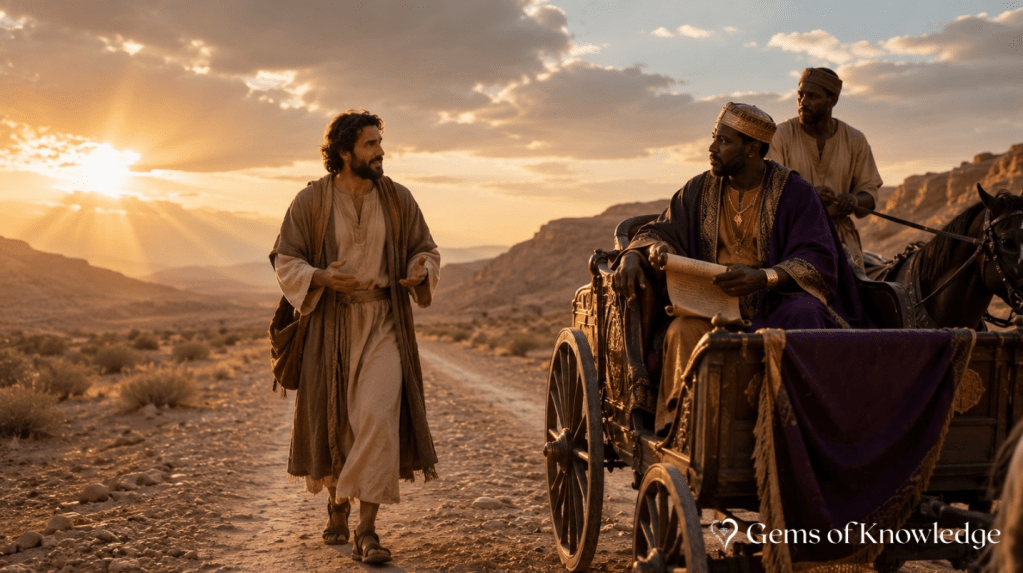
Alt...
Philip walks beside the Ethiopian official's chariot on a desert road, explaining the Scriptures as the Holy Spirit leads their encounter.
![[?]](https://fsmandfsmwo.blog/wp-content/uploads/2012/07/cropped-cropped-us-flag-1.jpg)
Devotion – “A Forgotten Key to Reading Scripture About Christ” – 04/22/2026

COMMENTS
Have you ever heard someone say, ” Oh, the King James Bible is too hard to read.” Maybe it was something like, “I don’t need to read my Bible; the Holy Spirit guides me.” It seems folks will manufacture any excuse to avoid being in the Word. So let’s take a quick look at these two excuses to see if they have any Biblical basis.
Is the KJV really too hard to understand? My opinion (which does not matter) is no, it is not. Yes, it is full of archaic language; some of the words have different meanings today, and we must be willing to study to read it. The fact is, every version of the Bible requires that we make a real effort to understand it.
Paul said,
“We must study or give due diligence
to be an approved workman…”
that makes the number two excuse invalid. How do we study so we might be approved by God? We rely not on our own skills or strength, but on those of the Holy Spirit (John 14:26):
But the Helper (Comforter, Advocate, Intercessor—Counselor, Strengthener, Standby), the Holy Spirit, whom the Father will send in My name [in My place, to represent Me and act on My behalf], He will teach you all things. And He will help you remember everything that I have told you.
That makes the first excuse invalid. especially in the modern world we live in today.
With technology so abundant and free, there is little excuse for anyone not to be in the world daily. One of the best, easy-to-use (navigate) sites, again in my opinion, is Bible Hub
The study of the Bible is known as Hermeneutics. Biblical hermeneutics is the study of the principles and methods of interpreting the text of the Bible. Second Timothy 2:15 commands believers to be involved in hermeneutics: “Do your best to present yourself to God as one approved, a worker who . . . correctly handles the word of truth.” The purpose of biblical hermeneutics is to help us to know how to properly interpret, understand, and apply the Bible.
Hermeneutics is concerned with the big picture, topics like salvation, sin, sovereignty, etc.
The category of study alongside Hermeneutics is Exegesis.
Biblical exegesis involves a detailed, methodical study of Scripture to draw out the intended meaning of each text. The English term “exegesis” comes from a Greek word meaning “to guide or lead out.” The process requires careful analysis of language, history, culture, and context to discern what the author originally intended and how the audience first understood the message. As 2 Timothy 2:15 advises, “Make every effort to present yourself approved to God, an unashamed workman who accurately handles the word of truth.”
Within Exegesis, there is a sub-topic of Parative Exegesis:
Partitive exegesis is a hermeneutical (interpretive) method used in Christian theology—especially in reading passages about Jesus—to distinguish between the divine and human natures of Christ while maintaining their unity in His person.
Core Idea: The practice “parts” or separates biblical statements about Christ into their appropriate nature—either divine or human—without splitting the one person of the Son. It affirms that Jesus is both fully God and fully man, united in person but distinct in nature, without confusion, change, division, or separation.
Purpose: Partitive exegesis arose in the early church to resolve the tension between Christ’s divine attributes (e.g., omnipotence, eternity) and His human experiences (e.g., hunger, death, suffering). It ensures that:
Divine titles and attributes are applied to His divine nature.
Human qualities are applied to His human nature.
Both natures are preserved in the one person of Christ Patheos.
Biblical and Theological Basis: The method is rooted in Scripture’s own way of describing Christ, which sometimes attributes divine titles to human actions (e.g., “the first and the last” in Revelation 1:17–18) or human experiences to divine persons (e.g., “Son of Man ascending to where He was before” in John 6:62).
Early church figures like Origen, Athanasius, the Cappadocians, Cyril of Alexandria, and especially Gregory of Nazianzus developed and defended partitive exegesis. Gregory’s “partitive rule” explicitly assigns sublime, transcendent expressions to the divine nature and more earthly or lowly ones to the human nature, while keeping the one person in view http://www.centerforbaptistrenewal.com.
Example: Divine nature: “Before Abraham was, I am” (John 8:58) — eternal, self-existent God.
Human nature: “I thirst” (John 19:28) — human experience of thirst.
Both natures: “Redeemer” or “King” — titles that apply to both Founders Ministries.
Summary: Partitive exegesis is a disciplined, Scripture-based approach to reading about Christ that preserves the distinction between His divine and human natures while affirming their unity. It is a safeguard against heresy and a way to interpret the incarnation faithfully.
The real-world application of this is not to make everyone a Biblical Scholar, a theologian, or a preacher/teacher. It is, however, commanded by God that we be able to defend our faith ( 1 Peter 3:15
What is biblical hermeneutics?
Daily Devotional – Couch Potato Christian – Faithful Steward Ministries and FSM Women’s Outreach
DEVOTION
What Is Partitive Exegesis? How the Church Has Read Scripture on Christ

“You just had to be there!”
We fall back on this excuse when words fail to capture the precise reality of an experience—often a comedic interaction or visual beauty. The reality is that reality itself is often hard to describe. We do our best to describe it with words, but we’ve all experienced the frustration of falling short.
This is especially true when we use our words to describe God. Herman Bavinck asks, “The moment we dare to speak about God, the question arises: How can we?”[1] The same question can be asked of the person of Christ: When we dare to speak about the One who is both infinite God and finite man, how can we?
Scripture tells us Jesus slept, ate, walked, and learned new things. But it also tells us He created the universe, sustains it, and is omniscient. You can see the dilemma—how do we accurately describe Jesus when He has these seemingly contradictory categories?
We can navigate this difficulty through a practice known as partitive exegesis. Partitive exegesis presupposes that Christ’s two natures are unified in His person without confusion, change, division, or separation. Therefore, we must recognize and maintain the distinction between Christ’s two natures when we read the Bible.[2] While that may sound complicated, this practice arises from Scripture itself—it is an inspired way of describing the reality of the incarnation…
Continued via link above
- What is biblical hermeneutics? | GotQuestions.org ↩︎
- What is Biblical Exegesis? ↩︎
- Google Copilot AI-generated response. ↩︎
The 3rd Woe: From Warning to Full-Scale Judgment (VE)
Introduction The eschatological climax of the New Testament Apocalypse does not unfold as a series of isolated, random catastrophes. Instead, it operates as a perfectly synchronized legal and physical assault against the kingdom of darkness. Central to this divine choreography is the structural relationship between the 7th Trumpet and the 7th Bowl. These two pivotal events function as "two sides of the same coin." They share an identical celestial origin and cosmic signature, yet they differ […] [SENSITIVE CONTENT]
Introduction
The eschatological climax of the New Testament Apocalypse does not unfold as a series of isolated, random catastrophes. Instead, it operates as a perfectly synchronized legal and physical assault against the kingdom of darkness. Central to this divine choreography is the structural relationship between the 7th Trumpet and the 7th Bowl. These two pivotal events function as “two sides of the same coin.” They share an identical celestial origin and cosmic signature, yet they differ radically in their scale, intent, and tactical execution.
While the 7th Trumpet serves as the cosmic “flash”—the legal eviction notice served from the courtroom of heaven—the 7th Bowl acts as the earthly “bang,” executing the physical annihilation of the 8th Beast, his ten kings, and the harlot system of Babylon. By exploring this transition from heavenly decree to planetary destruction, we can map out how these judgments converge to terminate the times of the Gentiles and fulfill the ancient prophecies of Daniel.
“Two Sides of the Same Coin” (Similarities) and then how they function differently (Differences). 7th Trumpet vs 7th Bowl
The Heavenly Pattern: Shared Similarities
These elements prove that both events are two stages of the same divine intervention. They share a “divine signature” that marks the end of the age.
- The Source of Authority: Both judgments originate directly from the Temple of God in Heaven. This confirms that the destruction of the 8th Beast is a holy act sanctioned by the throne of God.
- The Atmospheric Signature: Both are announced by lightnings, voices, and thunderings. This is the same cosmic atmosphere seen at Mount Sinai, signaling that God has descended to deal with His enemies.
- The Earthly Shaking: Both events trigger a Great Earthquake. This represents the literal “shaking” of the Beast’s kingdom, proving that no earthly foundation is secure when the 7th angel sounds.
- The Finality of the Mystery: Both mark a “finish line.” The 7th Trumpet finishes the Mystery of God, while the 7th Bowl finishes the Wrath of God. Once they occur, the era of human rebellion is over.
Table 1: Similarities (The Heavenly Pattern)
These points show that both events originate from the same divine source and carry the same “signature” of God’s presence.

The Tactical Shift: Key Differences
The differences between these two events show the progression from a legal declaration to the final physical strike on the 8th Beast and his 10 kings.
- The Divine Proclamation:
- The 7th Trumpet is a transfer of power: “The kingdom of the world has become the kingdom of our Lord.” It is the legal announcement that Christ is now the rightful King.
- The 7th Bowl is the completion of the work: “It is done!” It is the signal that the battle is over and the 8th Beast has been defeated.
- The Action of the Temple:
- The 7th Trumpet is about Revelation. The temple opens so the Ark of the Covenant can be seen, reminding the world of God’s promises to Israel.
- The 7th Bowl is about Execution. The temple is no longer being “viewed”; instead, the command of destruction comes out from the throne to finish the job.
- The Scale of the Earthquake:
- The 7th Trumpet earthquake is severe but specific. It destroys 1/10 of the city and serves as a final warning.
- The 7th Bowl earthquake is planetary. It is the greatest shaking in human history. It is so intense that every island disappears and every mountain is leveled, literally erasing the geography of the Beast’s empire.
- The Severity of the Hail:
- The 7th Trumpet mentions “great hail” as a standard atmospheric judgment.
- The 7th Bowl describes 100-pound hailstones. This is the final “stoning” of the blasphemous 8th Beast and his followers, who respond by cursing God rather than repenting.
- The Fate of Babylon:
- The 7th Trumpet marks the beginning of the end for the city in the Land of Shinar.
- The 7th Bowl sees the city split into three parts. God “remembers” Babylon and gives her the cup of the wine of the fierceness of His wrath, ending the system that began at the Tower of Babel.

Table 2: Differences (The Shift from Decree to Destruction)
These points show the progression from the 8th Beast’s legal defeat to his physical annihilation.

The 7th Trumpet and 7th Bowl not just as similar events, but as a convergence where the “Heavenly Decree” meets the “Earthly Execution.” They converge at the point where God’s patience ends and His physical reign begins.
Here is how they converge into a single, final conclusion for the age:
1. The Convergence of “The Finish”
Both events serve as the absolute “finish line” for two different divine processes.
- The 7th Trumpet finishes the “Mystery of God” (Rev 10:7). This is the end of the age where God allowed evil to exist and the Beast to rule. It is the end of God’s silence.
- The 7th Bowl finishes the “Wrath of God” (Rev 15:1). This is the end of the physical plagues.
- The Convergence: They meet at the moment of Total Completion. When the 7th Trumpet says “The Kingdom has become,” and the 7th Bowl says “It is done,” they are both describing the exact same transition from the 8th Beast’s rule to Christ’s rule.
2. The Convergence at the Great City (Babylon)
The 8th Beast’s base of operations—the city in the Land of Shinar—is the target where both judgments collide.
- The 7th Trumpet introduces the “Third Woe,” which is the final destruction of the world system.
- The 7th Bowl physically executes that destruction by splitting the city into three parts.
- The Convergence: The 7th Trumpet provides the Legal Verdict (the city must fall), and the 7th Bowl provides the Physical Impact (the city actually falls). They converge to destroy the “base” of wickedness that began at Babel.
3. The Convergence of the Temple and the Throne
These two judgments unite the worship of Heaven with the justice of Earth.
- The 7th Trumpet opens the Temple in heaven so we can see the Ark of the Covenant. This shows God is acting because of His holy promises.
- The 7th Bowl sends a voice out of that same Temple from the Throne. This shows God is acting because of His sovereign power.
- The Convergence: They converge to show that God’s Faithfulness (the Ark) and God’s Authority (the Throne) are working together to remove the 8th Beast and the 10 kings.
4. The Convergence of the “Great Shake”
Both judgments utilize a “Great Earthquake” to dismantle the status quo.
- The 7th Trumpet earthquake signals that the foundations of the world are being loosened.
- The 7th Bowl earthquake is the “greatest ever,” leveling mountains and islands.
- The Convergence: They converge to Terraform the Earth. They don’t just destroy; they flatten the earth to prepare it for the Millennial Kingdom, removing every high place and stronghold where the 8th Beast once sat.

Summary
The 7th Trumpet and the 7th Bowl are like the flash and the bang of a single lightning strike. The 7th Trumpet is the “Flash” in heaven—the legal announcement that the 8th Beast is done. The 7th Bowl is the “Bang” on earth—the physical destruction of his kingdom. They converge to ensure that not a single trace of the “New Testament Sea Beast” remains when Christ returns.
It unites the Danielic timelines with the entities of Revelation into a single, cohesive “Final Countdown.”
The Final Countdown: Fulfilling the Vision of Daniel and Revelation
To understand the end of the age, we must see the convergence of the “Legal Lease” (the 70th week) and the “Physical Execution” (the 7 Bowls). Here is how all entities—the Beast, the Whore, the military, and the marked—are concluded through the lens of Daniel’s prophecies.
1. The 70th Week: The Global Operating Window
The “70th Week” of Daniel 9 is the final seven-year period. In this framework, it is the specific “lease” and time allotted for all beasts, the whore, individuals with the mark of the beast, and the military and nations to operate before the 7th Trumpet sounds. It is the climax of human and demonic rebellion.
“He will confirm a covenant with many for one ‘seven.’ In the middle of the ‘seven’ he will put an end to sacrifice and offering. And at the temple he will set up an abomination that causes desolation…” (Daniel 9:27)
The Fulfillment: The 7th Trumpet sounds at the end of this “seven,” legally ending the collective lease of the entire Beast system. This declaration shifts the world from the “permitted rule” of the 8th Beast to the “rightful rule” of Christ.
“The seventh angel sounded his trumpet, and there were loud voices in heaven, which said: ‘The kingdom of the world has become the kingdom of our Lord and of his Messiah, and he will reign for ever and ever.’” (Revelation 11:15)
2. The 1,260-Day War: The Remnant Focus
Focusing on the remnant makes it clear that while the 8th Beast has global authority, there is a specific group of believers he is actively hunting during a 1,260-day window (the latter half of the 70th week).
The Remnant Battle (Rev 12:17 / Dan 12:7):
For 42 months (1,260 days), the 8th Beast is permitted to make war specifically against the remnant. During this time, the remnant is often “nourished” or protected, yet they remain the primary target of the Beast’s fury until the lease expires at the 7th Trumpet.

The rebellion that began in the Land of Shinar with Nimrod and was revived by the 8th Beast (Apollyon) is finally scrubbed from the earth. The 144,000 and Great Multitude (the Church) return with Christ to rule, while the Refined 1/3 Remnant—who survived the 6th Trumpet and the 7th Bowl—become the subjects of the most peaceful kingdom the world has ever known.
“I will bring the one-third through the fire, will refine them as silver is refined, and test them as gold is tested. They will call on My name, and I will answer them. I will say, ‘This is My people’; and each one will say, ‘The Lord is my God.’” (Zechariah 13:9)
Conclusion: The Ultimate Convergence of Sovereignty and Justice
Ultimately, the 7th Trumpet and the 7th Bowl converge at the precise intersection where God’s long-suffering patience ends and His physical, localized reign begins. They are not competing timelines, but a unified mechanism of cosmic justice. The Trumpet establishes the unalterable legal verdict based on the covenant faithfulness of the Ark; the Bowl unleashes the irresistible sovereign power issued from the Throne.
Together, they form a sweeping terraforming project—both spiritually and geographically—shaking loose the foundations of human rebellion, splitting geopolitical Babylon into three parts, and flattening every mountain and island of human pride. When the legal lease of the 70th week expires, the executionary wrath of the Bowls ensures that not a single trace of the Beast’s empire remains to pollute the dawn of the Millennial Kingdom. The transfer of the kingdoms of this world is completed, and the decree “It is done!” echoes across a restored creation.
Appendix: The Structural Mechanics of the Final Countdown
I. The “Flash and Bang” Parallel Chronology
The relationship between the Trumpets and the Bowls is not purely chronological (one after the other), but recursive and intensifying (recapitulation). The 7th Trumpet establishes the Heavenly Verdict, while the 7th Bowl executes the Earthly Verdict.

II. Comparative Timeline of the 70th Week vs. Judgment Extended Windows
- The 1,260 Days (3.5 Years / 42 Months): The legal operating window of the 8th Beast’s unrestricted authority and his war against the holy remnant (Dan 7:25, Rev 13:5).
- The 1,290 Days (Dan 12:11): An extra 30 days added to the timeline, traditionally understood as the window where the legal lease expires (7th Trumpet) and the executionary wrath (The Bowls) begins to pour out, systematically dismantling the Desolation.
- The 1,335 Days (Dan 12:12): An extra 45 days extending beyond the 1,290 days, culminating in the literal physical establishment and blessing of the Millennial Kingdom on a terraformed earth.
Glossary of Eschatological Terms and Entities
Prophetic Entities
- The 8th Beast: The final, satanically empowered global dictator who emerges from the historical lineage of the seven previous world empires (Gog/Apollylon, Gog of Magog/Assyria, Babylon, Medo-Persia, Greece, Rome, Revival/Clay-Iron). He commands global worship and military compliance.
- The Whore (Mystery Babylon): The counterfeit, apostate religious and economic system that rides and directs the initial stages of the Beast’s empire. Her headquarters are historically tied to the land of Shinar (Babel). She is ultimately betrayed and burned by the Beast’s alliance.
- The 10 Kings: A geopolitical coalition of ten rulers who hand their sovereignty, military might, and authority over to the 8th Beast to form a unified global military force.
- The Remnant: The faithful, covenant-keeping community of believers targeted by the Beast during the 1,260-day window who refuse the mark and keep the testimony of God.
- The Marked: The global population that willingly receives the brand or character-identifier of the Beast (the Mark), permanently aligning themselves with the earthly system and automatically triggering the executionary wrath of the Bowls.
Theological and Structural Concepts
- The 3rd Woe: The final and most terrifying of the three strategic target judgments (Woes) announced in heaven. It encompasses the entirety of the 7th Trumpet and the swift deployment of the 7 Bowls of Wrath.
- The Legal Lease: The prophetic principle that God grants a specific, legally binding block of time (Daniel’s 70th Week) to human rebellion and demonic dominion before stepping in to reclaim absolute ownership of the planet.
- The Mystery of God: The period of human history where God allows evil, injustice, and the suffering of His people to go on seemingly unchecked without immediate physical intervention. This mystery is declared “finished” at the sounding of the 7th Trumpet.
- Terraforming Judgment: A specific type of divine intervention that physically reshapes the global geography—such as erasing mountains and islands via the greatest earthquake in human history—to prepare the planet for the localized, physical reign of Christ.
- Weight of a Talent (100 lbs): The extreme weight measurement of the catastrophic hailstones used in the 7th Bowl, symbolizing the final, physical “stoning” penalty prescribed under biblical law for ultimate blasphemy.
« Previous | Read Next: The 3rd Woe: From Warning to Full-Scale Judgment (VF) »