Search results for tag #language
![[?]](https://cdn.masto.host/zirkus/accounts/avatars/111/192/373/629/540/829/original/9ff4f5b9781a0e3a.jpg)
Hi!, I'm a bot posting selections from Francis Grose’s 1785 “Dictionary Of The Vulgar Tongue”, a compilation of slang terms, the coded language of the underclass and the demi-monde.
[18th-century-content warning: possible racism, animal cruelty, homophobia, sexism, slut-shaming. Let me know of any problems.]
#FollowFriday #books #literature #dictionaries #history #society #crime #language #slang #18thCentury
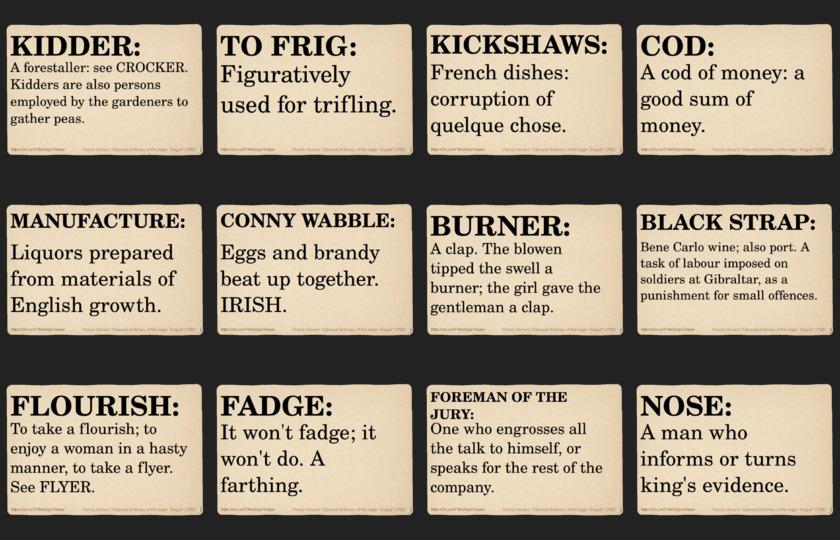
Alt...
Montage of dictionary items posted by this account
![[?]](https://cdn.masto.host/mastodonie/accounts/avatars/113/193/322/038/743/882/original/fa8860c1a121cf5b.png)
Hiberno-English word/phrase of the day:
Clip o' the reel
(also: kip of the reel)
This idiom describes an activity that would occasion disturbance and craic. "The same old clip o' the reel when the girls came home from the dance."
The phrase comes directly from traditional Irish music and dance culture. A "reel" is a fast-paced, high-energy traditional dance in 4/4 time. Thus calling something a "clip o' the reel" means it has that same energetic and lively rhythm.
![[?]](https://friendica.world/photo/profile/wistquotes.png?ts=1766199542)
A quotation from Anthony Burgess
Languages never stand still. Modern spelling crystallizes lost pronunciations: the visual never quite catches up with the aural.
Anthony Burgess (1917-1993) English novelist
A Mouthful of Air: Language, Languages … Especially English, ch. 21 “Sounds from the Past” (1992)
More about this quote: wist.info/burgess-anthony/7114…
#quote #quotes #quotation #qotd #burgess #anthonyburgess #artifact #evolution #language #linguistics #orthography #passageoftime #pronunciation #spelling #timelag
MUMMER. The mouth.
A selection from Francis Grose’s “Dictionary Of The Vulgar Tongue” (1785)
--
#books #literature #dictionaries #history #society #language #slang @histodons
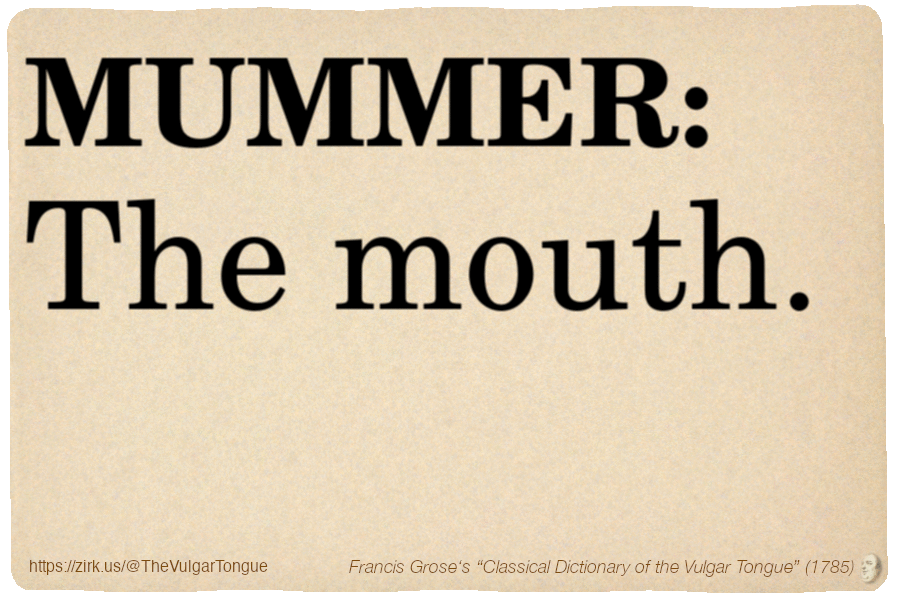
Alt...
Image imitating a page from an old document, text (as in main toot):
MUMMER. The mouth.
A selection from Francis Grose’s “Dictionary Of The Vulgar Tongue” (1785)
GOLD DROPPERS. Who drop a piece of gold, which they pick up in the presence of some unexperienced person, this they pretend to have found, and they invite him to a public house to partake of it: when there, comrades drop in, and propose cards, or some other game.
A selection from Francis Grose’s “Dictionary Of The Vulgar Tongue” (1785)
--
#books #literature #dictionaries #history #society #language #slang @histodons
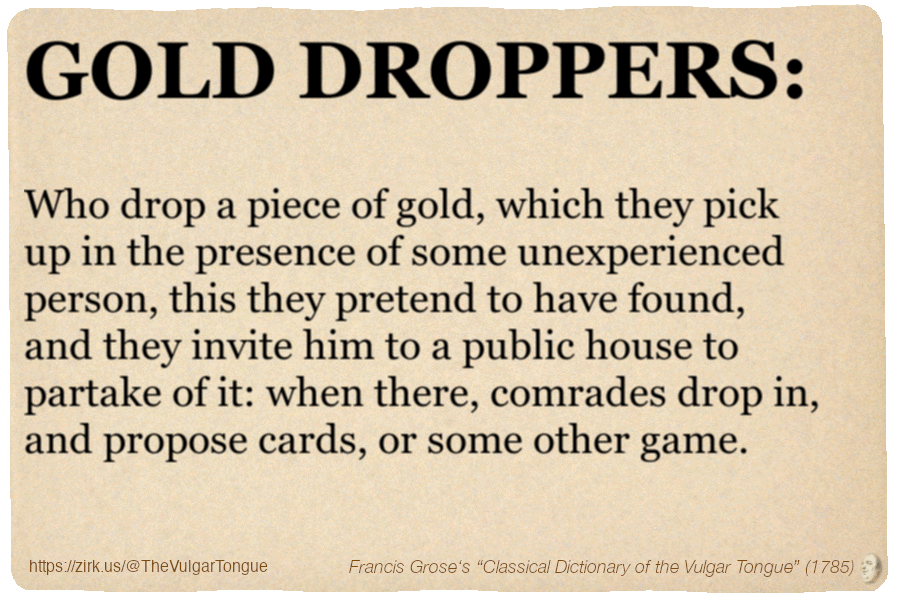
Alt...
Image imitating a page from an old document, text (as in main toot):
GOLD DROPPERS. Who drop a piece of gold, which they pick up in the presence of some unexperienced person, this they pretend to have found, and they invite him to a public house to partake of it: when there, comrades drop in, and propose cards, or some other game.
A selection from Francis Grose’s “Dictionary Of The Vulgar Tongue” (1785)
Hiberno-English word/phrase of the day:
Clatter
The first meaning of "clatter" is "a large amount" of something (esp. children). This definition possibly comes form clatter's meaning as a "pile of loose stones or boulders; débris and rocks".
Example: "a young mother with a clatter of kids told me ... her Catholic doctor refused point-blank to advise other than the rhythm method." (1970 December 22, in The Irish Times)
SNOOZING KEN. A brothel. The swell was spiced in a snoozing ken of his screens; the gentleman was robbed of his bank notes in a brothel.
A selection from Francis Grose’s “Dictionary Of The Vulgar Tongue” (1785)
--
#books #literature #dictionaries #history #society #language #slang @histodons
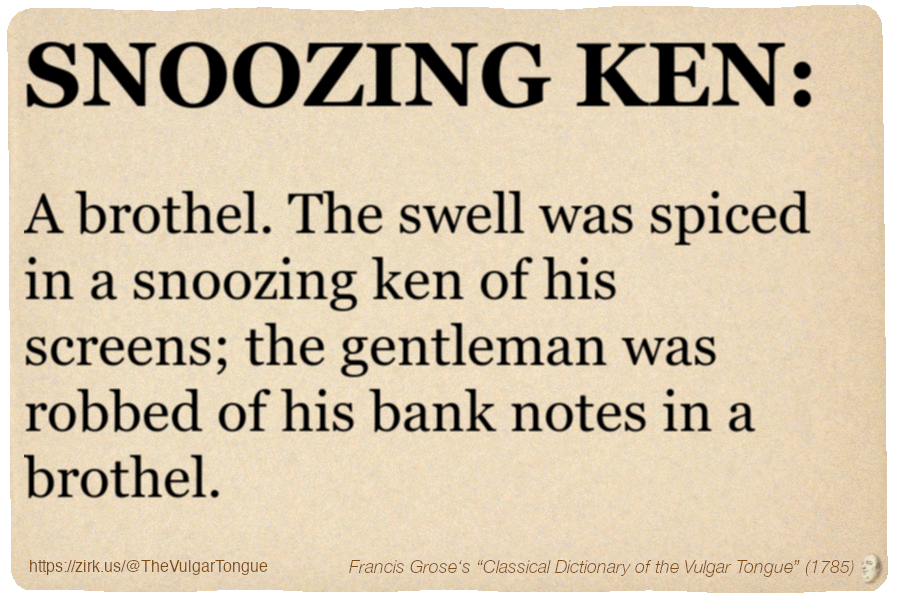
Alt...
Image imitating a page from an old document, text (as in main toot):
SNOOZING KEN. A brothel. The swell was spiced in a snoozing ken of his screens; the gentleman was robbed of his bank notes in a brothel.
A selection from Francis Grose’s “Dictionary Of The Vulgar Tongue” (1785)
![[?]](https://babka-mastodon.nyc3.cdn.digitaloceanspaces.com/accounts/avatars/109/554/492/947/534/560/original/cccb05f65e8f3af8.png)
Let’s journey together through Hebrew Colors 💛🩷🩵💜🧡
Read my latest article and discover a unique biblical connection.
Click the link 👇🏻
#Colors #LearnHebrew #Language #Bible

RING. A circle formed for boxers, wrestlers, and cudgel-players, by a man styled Vinegar; who goes round the circle, striking at random with his whip to prevent the populace from crowding in.
A selection from Francis Grose’s “Dictionary Of The Vulgar Tongue” (1785)
--
#books #literature #dictionaries #history #society #language #slang @histodons
Alt...
Image imitating a page from an old document, text (as in main toot):
RING. A circle formed for boxers, wrestlers, and cudgel-players, by a man styled Vinegar; who goes round the circle, striking at random with his whip to prevent the populace from crowding in.
A selection from Francis Grose’s “Dictionary Of The Vulgar Tongue” (1785)
Hiberno-English word/phrase of the day:
Clash of the Ash
This is a phrase used to signify, romantically, the game of hurling: hurleys are traditionally made from the wood of the ash tree. The tree is supposed to be 30 years old, and the wood taken from where the roots spread, so that the grain of the wood will not go with the length of the stick, making it liable to split.
![[?]](https://files.mastodon.social/accounts/avatars/115/070/625/860/923/251/original/9629d01039476748.png)
Language is overrated. In this Substack piece, I scrutinise language and the fact that much of language is extraneous. As for spoken language, many utterances are not strictly necessary, though they are functional.
https://brywillis634737.substack.com/p/pass-the-salt
I shake hands with #Austin, #Derrida, #Searle, #Wittgenstein, #Nietzsche, and #Barthes on this journey – even a bout with #Pinker.
#philosophy #language #languageinsufficiency #salt #justice #blog #podcast #artificialintelligence #robots #parsing
CRANK. Gin and water; also, brisk, pert.
A selection from Francis Grose’s “Dictionary Of The Vulgar Tongue” (1785)
--
#books #literature #dictionaries #history #society #language #slang @histodons
Alt...
Image imitating a page from an old document, text (as in main toot):
CRANK. Gin and water; also, brisk, pert.
A selection from Francis Grose’s “Dictionary Of The Vulgar Tongue” (1785)
BEVER. An afternoon's luncheon; also a fine hat; beaver's fur making the best hats.
A selection from Francis Grose’s “Dictionary Of The Vulgar Tongue” (1785)
--
#books #literature #dictionaries #history #society #language #slang @histodons
Alt...
Image imitating a page from an old document, text (as in main toot):
BEVER. An afternoon's luncheon; also a fine hat; beaver's fur making the best hats.
A selection from Francis Grose’s “Dictionary Of The Vulgar Tongue” (1785)
Hiberno-English word/phrase of the day:
Circling Shannon
This is a euphemism for being unwell, extremely drunk, and incapable of action, arising from an incident at Shannon Airport in 1994 when the Russian President Boris Yeltsin was unable to leave the plane, while the Irish Taoiseach Albert Reynolds waited.
BEGGAR MAKER. A publican, or ale-house keeper.
A selection from Francis Grose’s “Dictionary Of The Vulgar Tongue” (1785)
--
#books #literature #dictionaries #history #society #language #slang @histodons
Alt...
Image imitating a page from an old document, text (as in main toot):
BEGGAR MAKER. A publican, or ale-house keeper.
A selection from Francis Grose’s “Dictionary Of The Vulgar Tongue” (1785)
CHIMNEY CHOPS. An abusive appellation for a negro.
A selection from Francis Grose’s “Dictionary Of The Vulgar Tongue” (1785)
--
#books #literature #dictionaries #history #society #language #slang @histodons
Alt...
Image imitating a page from an old document, text (as in main toot):
CHIMNEY CHOPS. An abusive appellation for a negro.
A selection from Francis Grose’s “Dictionary Of The Vulgar Tongue” (1785)
I am trying something new on Substack.
I’ve been working on an essay about understanding.
The premise is simple enough: LLMs are routinely described as subhuman because, among other alleged deficiencies, they lack consciousness and don’t understand.
#philosophy #language #understanding #linguistics #llms #aidebate #artificialintelligence #blog #podcast #substack #essay #preview #criticalanalysis #consciousness #meaning

GRINAGOG, THE CAT'S UNCLE. A foolish grinning fellow, one who grins without reason.
A selection from Francis Grose’s “Dictionary Of The Vulgar Tongue” (1785)
--
#books #literature #dictionaries #history #society #language #slang @histodons
Alt...
Image imitating a page from an old document, text (as in main toot):
GRINAGOG, THE CAT'S UNCLE. A foolish grinning fellow, one who grins without reason.
A selection from Francis Grose’s “Dictionary Of The Vulgar Tongue” (1785)
GO, THE. The dash. The mode. He is quite the go, he is quite varment, he is prime, he is bang up, are synonimous expressions.
A selection from Francis Grose’s “Dictionary Of The Vulgar Tongue” (1785)
--
#books #literature #dictionaries #history #society #language #slang @histodons
Alt...
Image imitating a page from an old document, text (as in main toot):
GO, THE. The dash. The mode. He is quite the go, he is quite varment, he is prime, he is bang up, are synonimous expressions.
A selection from Francis Grose’s “Dictionary Of The Vulgar Tongue” (1785)
FINGER IN EYE. To put finger in eye; to weep: commonly applied to women. The more you cry the less you'll p-ss; a consolatory speech used by sailors to their doxies. It is as great a pity to see a woman cry, as to see a goose walk barefoot; another of the same kind.
A selection from Francis Grose’s “Dictionary Of The Vulgar Tongue” (1785)
--
#books #literature #dictionaries #history #society #language #slang @histodons
Alt...
Image imitating a page from an old document, text (as in main toot):
FINGER IN EYE. To put finger in eye; to weep: commonly applied to women. The more you cry the less you'll p-ss; a consolatory speech used by sailors to their doxies. It is as great a pity to see a woman cry, as to see a goose walk barefoot; another of the same kind.
A selection from Francis Grose’s “Dictionary Of The Vulgar Tongue” (1785)
BULLY. A cowardly fellow, who gives himself airs of great bravery. A bully huff cap; a hector. See HECTOR.
A selection from Francis Grose’s “Dictionary Of The Vulgar Tongue” (1785)
--
#books #literature #dictionaries #history #society #language #slang @histodons
Alt...
Image imitating a page from an old document, text (as in main toot):
BULLY. A cowardly fellow, who gives himself airs of great bravery. A bully huff cap; a hector. See HECTOR.
A selection from Francis Grose’s “Dictionary Of The Vulgar Tongue” (1785)
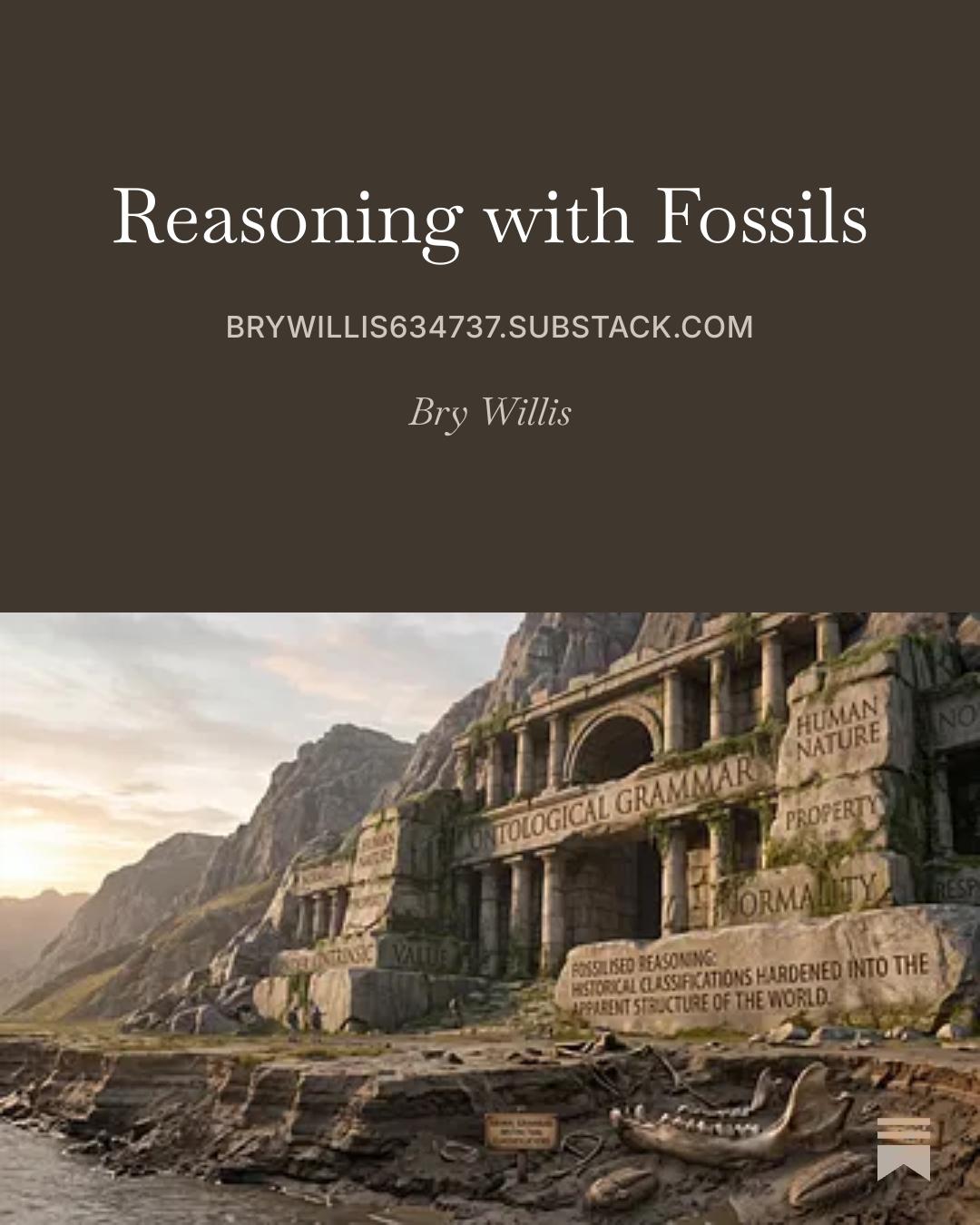
I've long been fascinated with the notions of LOGIC and REASON, especially where they fall woefully short. I realise that not everyone is a philosopher or a trained critical thinker.
https://brywillis634737.substack.com/p/reasoning-with-fossils?utm_source=masto&utm_medium=social
#philosophy #language #reason #logic #argument #debate #video #podcast #blog #history #enlightenment #foundations #fossils
CUR. A cut or curtailed dog. According to the forest laws, a man who had no right to the privilege of the chase, was obliged to cut or law his dog: among other modes of disabling him, one was by depriving him of his tail: a dog so cut was called a cut or curtailed dog.
A selection from Francis Grose’s “Dictionary Of The Vulgar Tongue” (1785)
--
#books #literature #dictionaries #history #society #language #slang @histodons
Alt...
Image imitating a page from an old document, text (as in main toot):
CUR. A cut or curtailed dog. According to the forest laws, a man who had no right to the privilege of the chase, was obliged to cut or law his dog: among other modes of disabling him, one was by depriving him of his tail: a dog so cut was called a cut or curtailed dog.
A selection from Francis Grose’s “Dictionary Of The Vulgar Tongue” (1785)
FAM LAY. Going into a goldsmith's shop, under pretence of buying a wedding ring, and palming one or two, by daubing the hand with some viscous matter.
A selection from Francis Grose’s “Dictionary Of The Vulgar Tongue” (1785)
--
#books #literature #dictionaries #history #society #language #slang @histodons
Alt...
Image imitating a page from an old document, text (as in main toot):
FAM LAY. Going into a goldsmith's shop, under pretence of buying a wedding ring, and palming one or two, by daubing the hand with some viscous matter.
A selection from Francis Grose’s “Dictionary Of The Vulgar Tongue” (1785)
Hi!, I'm a bot posting selections from Francis Grose’s 1785 “Dictionary Of The Vulgar Tongue”, a compilation of slang terms, the coded language of the underclass and the demi-monde.
[18th-century-content warning: possible racism, animal cruelty, homophobia, sexism, slut-shaming. Let me know of any problems.]
#FollowFriday #books #literature #dictionaries #history #society #crime #language #slang #18thCentury
Alt...
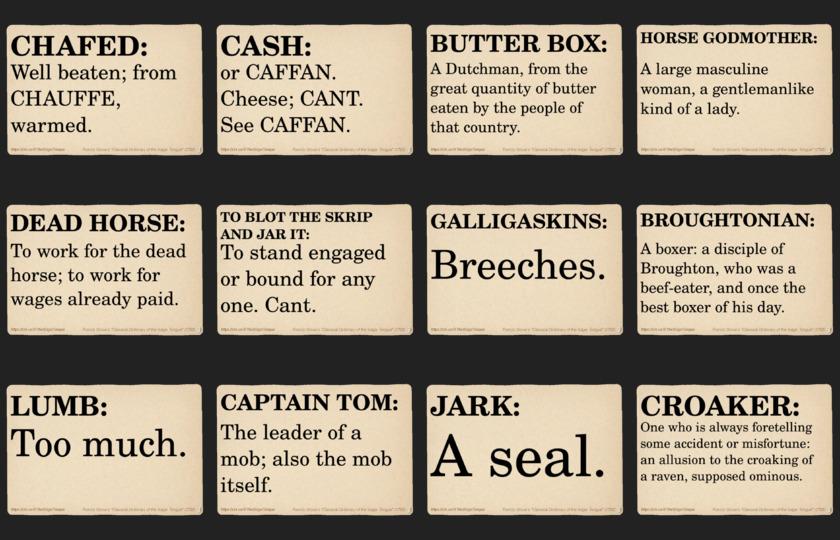
Montage of dictionary items posted by this account
![[?]](https://fediscience.org/system/accounts/avatars/115/216/268/428/504/940/original/0c690457c8e65be1.png)
💁🏻♀️ TIL: 🧱🧠 Play-based #preschool programs help #children develop emotional regulation and social skills that last into elementary #school, according to researchers.
Dramatic #play improves emotion regulation and #language development, while constructive play predicts higher #math achievement. The benefits extend well beyond early #childhood, supporting learning through #highschool.
#learning #emotions #problemsolving #preschool #kindergarten #education #parenting #teaching
TO LEAK. To make water.
A selection from Francis Grose’s “Dictionary Of The Vulgar Tongue” (1785)
--
#books #literature #dictionaries #history #society #language #slang @histodons
Alt...
Image imitating a page from an old document, text (as in main toot):
TO LEAK. To make water.
A selection from Francis Grose’s “Dictionary Of The Vulgar Tongue” (1785)
NOTE. He changed his note; he told another sort of a story.
A selection from Francis Grose’s “Dictionary Of The Vulgar Tongue” (1785)
--
#books #literature #dictionaries #history #society #language #slang @histodons
Alt...
Image imitating a page from an old document, text (as in main toot):
NOTE. He changed his note; he told another sort of a story.
A selection from Francis Grose’s “Dictionary Of The Vulgar Tongue” (1785)
Hiberno-English word/phrase of the day:
Carnaptious
(Also: "curnoptious")
"Carnaptious" is an adjective meaning "irritable", "cranky," "bad-tempered".
Its origins are unclear but the Oxford English Dictionary suggest that it could be a form of English ‘captious’ which has a similar meaning and gives its roots as Scottish and Irish dialect. OED also has the earliest attestation from the Ulster Journal of Archaeology of 1858: “A nivver seen wan so curnaptious.”
![[?]](https://media.mas.to/accounts/avatars/112/170/221/330/719/403/original/8a8a992078704499.jpg)
What Do the Protests Achieve? | Learn Albanian with Reddit Post Translation
Post from a month ago, but translates something that Albanians are posting online about what the protest is about.
https://www.youtube.com/watch?v=JfqGzeXcjAo
#Albania #USpol #Corruption #Balkans #Europe #FlamingoRevolution #Environment #Language
BELCHER. A red silk handkerchief, intermixed with yellow and a little black. The kiddey flashes his belcher; the young fellow wears a silk handkerchief round his neck.
A selection from Francis Grose’s “Dictionary Of The Vulgar Tongue” (1785)
--
#books #literature #dictionaries #history #society #language #slang @histodons
Alt...
Image imitating a page from an old document, text (as in main toot):
BELCHER. A red silk handkerchief, intermixed with yellow and a little black. The kiddey flashes his belcher; the young fellow wears a silk handkerchief round his neck.
A selection from Francis Grose’s “Dictionary Of The Vulgar Tongue” (1785)
JARVIS. A hackney coachman.
A selection from Francis Grose’s “Dictionary Of The Vulgar Tongue” (1785)
--
#books #literature #dictionaries #history #society #language #slang @histodons
Alt...
Image imitating a page from an old document, text (as in main toot):
JARVIS. A hackney coachman.
A selection from Francis Grose’s “Dictionary Of The Vulgar Tongue” (1785)
Hiberno-English word/phrase of the day:
Caorán
(Also: cadhrán, caofrán, caofróg)
"Caorán" are small pieces of turf used to kindle a fire (mostly used in Co. Galway). In Kerry it usually refers to a broken sod of turf or a bit of turf, lighted and sent around the neighbourhood as a signal.
Example of use: "Don't bring in all the big sods - throw the caoráns in too".
DOWSER. Vulgar pronunciation of DOUCEUR.
A selection from Francis Grose’s “Dictionary Of The Vulgar Tongue” (1785)
--
#books #literature #dictionaries #history #society #language #slang @histodons
Alt...
Image imitating a page from an old document, text (as in main toot):
DOWSER. Vulgar pronunciation of DOUCEUR.
A selection from Francis Grose’s “Dictionary Of The Vulgar Tongue” (1785)
TO CLIP. To hug or embrace: to clip and cling. To clip the coin; to diminish the current coin. To clip the king's English; to be unable to speak plain through drunkenness.
A selection from Francis Grose’s “Dictionary Of The Vulgar Tongue” (1785)
--
#books #literature #dictionaries #history #society #language #slang @histodons
Alt...
Image imitating a page from an old document, text (as in main toot):
TO CLIP. To hug or embrace: to clip and cling. To clip the coin; to diminish the current coin. To clip the king's English; to be unable to speak plain through drunkenness.
A selection from Francis Grose’s “Dictionary Of The Vulgar Tongue” (1785)
![[?]](https://mefisocial.files.fedi.monster/accounts/avatars/109/734/946/806/170/980/original/e5d3e15e8b3b9f35.jpg)
Ok, I was fully prepared for this to be completely made up...and yet... it is true.
Fritz #Zwicky really did coin the phrases "dark matter" and "spherical bastards". What a froopy dude!
#physics #language #semantics #sphericalbastards #darkmatter #astrophysics

Alt...
Swiss scientist Fritz Zwicky coined the term
"dark matter" which is impressive, but he
also coined the term "spherical bastard" to
describe people who are bastards no
matter which way you look at them, and |
think that should be celebrated more.
USED UP. Killed: a military saying, originating from a message sent by the late General Guise, on the expedition at Carthagena, where he desired the commander in chief to order him some more grenadiers, for those he had were all used up.
A selection from Francis Grose’s “Dictionary Of The Vulgar Tongue” (1785)
--
#books #literature #dictionaries #history #society #language #slang @histodons
Alt...
Image imitating a page from an old document, text (as in main toot):
USED UP. Killed: a military saying, originating from a message sent by the late General Guise, on the expedition at Carthagena, where he desired the commander in chief to order him some more grenadiers, for those he had were all used up.
A selection from Francis Grose’s “Dictionary Of The Vulgar Tongue” (1785)
This sequence is intended as a conceptual decomposition:
world event or stimulus → salience → attention → embodied presentation → perception or event construction → apprehension as ‘an experience’ → conceptual framing → verbal representation
https://brywillis634737.substack.com/p/before-the-word-the-model
#philosophy #language #experience #video #blog #substack #mind #perception #linguistics #determinism #thought #realism #reality #consciousness #vocabulary #cognition #biology #speech #mediation #model #neuroscience #flow #cognitive