Search results for tag #christianity
![[?]](https://gemsofknowledge.com/wp-content/uploads/2025/09/cropped-gemsofknowledge.png)
It Is Easy to Hear the One You Love
Think about someone you love deeply.You recognize their voice instantly. You notice when something is wrong. You can often tell what they're thinking before they even say it. Why? Because you've spent time with them. You've listened to them. You care about what they think, feel, and want. The goal isn't merely hearing words - The goal is knowing the person. The same is true with God. Do we love Him enough to listen? Click here to read the full devotional. ✨ [SENSITIVE CONTENT]
Today’s One Year Bible Verses: 1 Kings 19:1–21, Acts 12:1–23, Psalm 136:1–26, Proverbs 17:14–15
Listening In Love
After spending time with the Lord this morning, He whispered this Gem of Knowledge to my heart:
“It is easy to hear Me when you love Me and listen – It’s easy to hear someone when you love them, listen, and care about what they think, feel, or want. You listen to know them. Amen.”
As I thought about those words, I realized how true they are in our everyday relationships.
Think about someone you love deeply.
You recognize their voice instantly. You notice when something is wrong. You can often tell what they’re thinking before they even say it. Why? Because you’ve spent time with them. You’ve listened to them. You care about what they think, feel, and want.
The goal isn’t merely hearing words – The goal is knowing the person.
The same is true with God.
Many people desperately want to hear God’s voice, but sometimes we approach it backward. We focus on techniques, methods, formulas, or signs. We search for ways to hear Him when what He really desires is relationship.
We hear Him best when we love Him, spend time with Him, and genuinely care about what He wants to say.
Today’s reading gives us one of the most beautiful examples of this truth in all of Scripture.
Elijah had just experienced an incredible victory on Mount Carmel. Fire fell from heaven. The prophets of Baal were defeated. Yet shortly afterward, Elijah found himself discouraged, exhausted, and afraid.
He fled into the wilderness and eventually found himself standing before the Lord on Mount Sinai.
Then something remarkable happened.
A mighty wind tore through the mountains, but God was not in the wind.
An earthquake shook the ground, but God was not in the earthquake.
A fire blazed, but God was not in the fire.
Then came a gentle whisper…and Elijah heard Him.
The whisper was not louder than the wind. It was not more powerful than the earthquake, nor was it more consuming than the fire.
Elijah recognized it was God’s voice.
Why?
Because he knew the One who was speaking. The relationship had already been built, so the whisper was enough.
How often are we waiting for the wind, the earthquake, or the fire while God is speaking in a whisper?
The noise of life can make us think God must speak loudly to get our attention. Yet often He speaks most clearly in quiet moments when our hearts are turned toward Him.
In Acts 12 Peter sat imprisoned, so the church gathered and prayed. They were seeking God because they loved Him and trusted Him. Their focus wasn’t on formulas. Their focus was on the Lord. Because of this, God moved powerfully on Peter’s behalf.
Throughout Scripture, the people who heard God most clearly were not necessarily the most educated, gifted, or important. They were the ones who knew Him personally and intimately.
Psalm 136 repeats the phrase:
“His faithful love endures forever.” (NLT)
Twenty-six times the psalmist reminds us of God’s enduring love.
This is so important because love is the foundation of relationship and relationship is the foundation of hearing.
The more we know Him, the more familiar His voice becomes.
The more we love Him, the more we care about what He thinks, feels, and wants.
The more we listen, the easier it becomes to recognize when He speaks.
Perhaps hearing God is not as complicated as we sometimes make it.
Perhaps it begins with loving Him enough to listen. 💎
Action (5 Minutes with God)
Do you love God enough to give Him 5 minutes of your time today? If so, ask Him:
- “Lord, what do You want me to know about this personally?”
- Journal what He gives you through His Holy Spirit.
- Then ask, “What do You want me to do?”
- Journal what He reveals – then do it!
Let today be a day of listening and observing Him. Focus on knowing Him rather than just getting answers.
Prayer
Dear Lord, thank You that You desire a relationship with me. Help me love You more deeply and care about what You think, feel, and want. Teach me to quiet the noise around me and spend time listening for Your voice. Help me recognize Your whisper because I know Your heart. Draw me closer to You and deepen our relationship each day. In your mighty name I pray, Amen.
To read more 5 Minutes with God devotionals click here.
If Gems of Knowledge has blessed your walk with Christ, please subscribe or consider partnering with us today. Your gift helps keep these devotionals free for everyone and carries God’s Word to more hearts. Every seed matters—thank you for sowing into this work! 💛
Test everything by the Word and the Spirit (John 16:13)

Alt...
Elijah standing at the mouth of a cave as a gentle whisper of wind brushes past him while he listens for God's voice in a peaceful mountain landscape.
![[?]](https://i0.wp.com/dailyintheword.blog/wp-content/uploads/2026/05/cropped-blogtitleimage.jpg?fit=512%2C512&ssl=1)
The Fear of the Lord: Wisdom’s Beginning and Humility’s Crown
A Theological Commentary on Proverbs 15:33 Proverbs 15:33 declares, “The fear of the Lord is instruction in wisdom, and humility comes before honor.” Though brief, this proverb stands among the most profound theological summaries in the wisdom literature. It unites two central biblical themes that echo throughout both Testaments: the necessity of reverent submission before God and the paradoxical path by which true exaltation is attained. The verse presents a theology of discipleship in […] [SENSITIVE CONTENT]

A Theological Commentary on Proverbs 15:33
Proverbs 15:33 declares, “The fear of the Lord is instruction in wisdom, and humility comes before honor.” Though brief, this proverb stands among the most profound theological summaries in the wisdom literature. It unites two central biblical themes that echo throughout both Testaments: the necessity of reverent submission before God and the paradoxical path by which true exaltation is attained. The verse presents a theology of discipleship in miniature. It teaches that wisdom is inseparable from worship, that education begins with reverence rather than intellect, and that lasting honor is granted only through humility.
The Book of Proverbs repeatedly portrays wisdom not as the accumulation of information but as the art of living rightly before God. Unlike the speculative philosophies of the ancient world, biblical wisdom is covenantal and relational. It begins with acknowledging God’s sovereign authority over creation and human existence. Proverbs 1:7 establishes the foundation of the entire book by proclaiming that “the fear of the Lord is the beginning of knowledge,” while Proverbs 9:10 similarly teaches that “the fear of the Lord is the beginning of wisdom.” Proverbs 15:33 deepens this theological vision by describing the fear of the Lord as instruction itself, suggesting that reverence toward God is not merely the entrance into wisdom but the ongoing school in which wisdom is continually learned.
The Hebrew expression translated “fear of the Lord” is יִרְאַת יְהוָה (yirat Yahweh). This phrase has often been misunderstood as describing terror or dread. Yet within biblical theology it signifies reverence, awe, covenant loyalty, worshipful submission, and joyful obedience. The fear of the Lord recognizes both God’s infinite holiness and His covenant faithfulness. It acknowledges that God alone possesses absolute authority and therefore deserves complete trust and obedience.
This fear is fundamentally theological because it is rooted in God’s character rather than in human emotion. The believer fears God because God is infinitely glorious, righteous, sovereign, and just. Such fear produces worship rather than paralysis. It creates dependence rather than despair. It leads not away from God but toward Him.
The structure of Proverbs consistently presents wisdom as impossible apart from this reverent relationship. Human intellect alone cannot discover ultimate truth because wisdom originates in God’s own nature. Since God created the world through wisdom, only those who submit themselves to the Creator can truly understand the moral order embedded within creation.
This theological principle distinguishes biblical wisdom from secular philosophy. Human reasoning may achieve remarkable scientific or philosophical accomplishments, yet without acknowledging God it remains fundamentally incomplete. Scripture consistently critiques autonomous human wisdom that seeks understanding apart from divine revelation. The Tower of Babel illustrates collective human intelligence detached from reverence, while Solomon’s own decline later demonstrates that intellectual brilliance cannot preserve a heart that has ceased fearing the Lord.
The expression “instruction in wisdom” introduces another significant theological dimension. The Hebrew word translated “instruction” often carries the sense of discipline, correction, training, or moral formation. It implies that wisdom is acquired through a lifelong process of divine education. God teaches His people through Scripture, providence, correction, suffering, and obedience.
Wisdom therefore cannot be reduced to academic study or intellectual achievement. It is spiritual formation. It shapes character before conduct and heart before action. The fear of the Lord becomes the classroom in which believers learn dependence upon God.
This educational process frequently includes painful experiences. Throughout Scripture, God’s discipline functions not as punishment alone but as loving instruction. Trials expose pride, reveal weakness, and cultivate reliance upon divine grace. Theologically, suffering becomes one of God’s most effective instruments for teaching wisdom because it dismantles human self-sufficiency.
This concept finds fulfillment in New Testament teaching, where endurance produces maturity and spiritual completeness. God’s instruction often arrives through circumstances that human wisdom would avoid but divine wisdom ordains for sanctification.
The second half of the proverb states, “and humility comes before honor.” Here the wisdom tradition presents one of Scripture’s most enduring paradoxes. Human instinct seeks honor through self-promotion, status, achievement, and recognition. God’s kingdom reverses this pattern by establishing humility as the prerequisite for true exaltation.
The Hebrew concept of humility encompasses lowliness, meekness, dependence, and submission before God. It is not self-hatred or false modesty but accurate self-understanding in light of God’s greatness. The humble person recognizes creaturely dependence and therefore rejects prideful autonomy.
Throughout Scripture, pride consistently appears as humanity’s fundamental rebellion against God. The fall in Genesis may be understood as an act of pride in which humanity sought independence from divine authority. Pride refuses creaturely limitation and desires equality with God. Humility, conversely, embraces dependence and gladly submits to divine lordship.
This theological framework explains why humility precedes honor. God opposes pride because it challenges His rightful sovereignty, but He exalts humility because it reflects truth. Humility aligns human beings with reality, acknowledging that every gift, achievement, ability, and blessing originates from God.
The biblical narrative repeatedly demonstrates this principle. Joseph endured years of suffering before being elevated in Egypt. Moses spent decades in obscurity before leading Israel. David experienced exile before kingship. Esther approached the throne in humility before receiving influence. Daniel maintained faithful dependence upon God before receiving honor among pagan rulers.
These narratives reveal that God’s kingdom consistently operates through unexpected reversals. Exaltation follows surrender. Leadership emerges from servanthood. Greatness arises through self-denial.
This theme reaches its theological climax in the person of Jesus Christ. The incarnation itself reveals divine humility, as the eternal Son willingly assumed human nature and entered a fallen world in weakness. His earthly ministry consistently rejected worldly status and power, embracing service, sacrifice, and obedience.
The cross represents the ultimate expression of humility preceding honor. Christ humbled Himself unto death, even death on a cross. Therefore God highly exalted Him and bestowed upon Him the name above every name. The resurrection and ascension demonstrate that divine honor follows perfect humility.
Christ therefore becomes both the model and source of the humility described in Proverbs 15:33. Believers are called not merely to imitate humility externally but to participate in the humility of Christ through union with Him. Christian sanctification increasingly conforms believers to the character of the crucified and risen Lord.
Within systematic theology, this proverb contributes significantly to the doctrine of sanctification. Spiritual growth is not measured primarily by intellectual knowledge or ministerial success but by increasing reverence toward God and increasing humility before others.
Theological education itself must therefore remain rooted in the fear of the Lord. Seminaries, churches, and Christian institutions face continual temptation to substitute academic accomplishment for spiritual transformation. Proverbs 15:33 reminds scholars and ministers alike that wisdom begins not with scholarly credentials but with worship.
History provides numerous examples of brilliant theological minds whose ministries collapsed because intellectual achievement outpaced spiritual humility. Conversely, many faithful servants with limited formal education profoundly influenced the Church through deep reverence for God and humble dependence upon His Spirit.
The proverb also contributes to biblical anthropology by defining humanity’s proper relationship to God. Human beings flourish not through independence but through dependence. Modern culture often celebrates self-expression, self-determination, and self-sufficiency as ultimate virtues. Scripture offers a radically different vision in which true humanity emerges through submission to God.
This theological anthropology challenges contemporary assumptions about identity and fulfillment. Freedom is not found in autonomy but in obedience. Greatness is not achieved through self-exaltation but through humble service. Human dignity arises not from self-definition but from being created and redeemed by God.
Ecclesiologically, the proverb offers profound guidance for church leadership. Spiritual authority in Scripture consistently arises from humility rather than domination. Jesus warned His disciples against adopting worldly models of leadership based on power and status. Instead, greatness in His kingdom belongs to servants.
Church leaders who lose the fear of the Lord inevitably become consumed by reputation, influence, and personal ambition. Ministry then becomes self-centered rather than Christ-centered. Humility protects leaders from this temptation by continually reminding them that all authority belongs ultimately to God.
Likewise, congregations flourish when characterized by reverence and humility. Communities shaped by the fear of the Lord become places where correction is welcomed, forgiveness is practiced, and service is esteemed above recognition. Such churches display the character of Christ before a watching world.
Eschatologically, the promise that humility comes before honor points beyond present experience toward God’s final vindication of His people. Many faithful believers experience obscurity, suffering, rejection, or persecution during their earthly lives. Scripture assures them that divine honor awaits those who remain humble before God.
This future orientation protects believers from seeking immediate recognition. The New Testament repeatedly encourages perseverance by directing attention toward eternal reward rather than temporal acclaim. God’s judgment will reveal the true significance of lives hidden from worldly attention but precious in His sight.
The paradox of humility preceding honor also reflects the already-but-not-yet nature of God’s kingdom. Believers presently embrace humility while anticipating future glorification. They follow a crucified Messiah while awaiting the fullness of His reign. Their present lowliness prepares them for future participation in His glory.
Ultimately, Proverbs 15:33 presents a comprehensive theology of spiritual formation rooted in God’s character and fulfilled in Christ. The fear of the Lord provides the foundation upon which wisdom is built, while humility becomes the pathway leading to divine honor. These realities cannot be separated because genuine reverence inevitably produces humility, and authentic humility naturally reflects reverence toward God.
The verse exposes the futility of self-made wisdom and self-exalting ambition while inviting believers into God’s gracious school of discipleship. It teaches that wisdom is learned through worship, maturity through submission, and greatness through service. The entire Christian life unfolds under this paradoxical principle.
For the Church today, this ancient proverb remains profoundly relevant. In a culture captivated by visibility, influence, and self-promotion, Scripture calls believers back to reverent dependence upon God. In an age of information, it reminds us that wisdom cannot be downloaded but must be formed through lifelong communion with the Lord. In a society that prizes achievement above character, it declares that humility remains the indispensable preparation for lasting honor.
Thus Proverbs 15:33 stands not merely as a practical saying but as a theological summary of the kingdom of God itself. Those who fear the Lord enter the true school of wisdom, and those who walk humbly before Him will one day receive honor from the only Judge whose approval endures forever.

Alt...
The Fear of the Lord: Wisdom’s Beginning and Humility’s Crown
![[?]](https://files.mastodon.social/accounts/avatars/110/540/252/708/905/804/original/2589fba324f877a2.jpeg)
Do believers have the power to heal others, as seen in Acts, where Peter heals a lame man? How does the Bible answer that question? Click or tap the link to read more.
#afaithfulsower #christianity #Bible #Jesus #dailydevotional
https://afaithfulsower.org/2026/06/17/never-hesitate-there-is-power-in-the-name-of-jesus/
![[?]](https://s3.us-west-1.wasabisys.com/thereslife/accounts/avatars/113/483/449/915/421/635/original/bc3a4db9a538bd99.jpg)
Feeling pressured? Lost someone dear to you?
The latest Bible studies in my #FindHope series point us to Biblical truths that help us in these difficult circumstances.
Why not take a look 👇?
https://downiefamily.wixsite.com/wherebreadisfound/meditations/categories/hope
#hope #biblestudy #christianity
The School of Holy Humility
A Bible Study Reflecting on Proverbs 15:33 The wisdom literature of Scripture repeatedly reminds God's people that true wisdom is never merely intellectual achievement but a transformed way of living before the Lord. Proverbs does not simply teach skill for success or techniques for prosperity; it reveals the path of righteousness that flows from reverence for God. Among its many profound statements stands Proverbs 15:33: "The fear of the Lord is instruction in wisdom, and humility comes […] [SENSITIVE CONTENT]

A Bible Study Reflecting on Proverbs 15:33
The wisdom literature of Scripture repeatedly reminds God’s people that true wisdom is never merely intellectual achievement but a transformed way of living before the Lord. Proverbs does not simply teach skill for success or techniques for prosperity; it reveals the path of righteousness that flows from reverence for God. Among its many profound statements stands Proverbs 15:33:
“The fear of the Lord is instruction in wisdom, and humility comes before honor.”
This single verse captures the very heart of biblical discipleship. It presents a progression that is often contrary to human instinct. The world teaches that honor comes through self-promotion, confidence, achievement, and personal ambition. Scripture teaches that honor is preceded by humility and that wisdom begins not with self-confidence but with the fear of the Lord.
The verse joins together three inseparable realities: reverence for God, the acquisition of wisdom, and the cultivation of humility. These are not isolated virtues but interconnected expressions of a heart transformed by God’s grace.
The opening phrase declares that “the fear of the Lord is instruction in wisdom.” Throughout Proverbs, the fear of the Lord serves as the foundation of all genuine understanding. This fear is not the terror of a criminal before a judge but the reverent awe of a child before a loving Father whose holiness inspires worship, obedience, and trust.
To fear God is to recognize His absolute sovereignty over creation. It is to acknowledge that He alone possesses perfect wisdom, perfect justice, perfect mercy, and perfect authority. Such fear does not drive believers away from God but draws them near in reverent dependence.
Modern society often celebrates independence and self-sufficiency. The biblical worldview begins with dependence upon God. Human beings are creatures, not creators. They are finite, not infinite. They are recipients of grace, not masters of destiny.
The fear of the Lord therefore becomes the classroom in which wisdom is taught. It is the environment where hearts are reshaped by divine truth. Wisdom is not merely accumulated information but rightly ordered living under God’s authority.
This instruction is lifelong. No believer graduates from the school of God’s wisdom. Every season of life presents new lessons in trust, obedience, patience, and submission. The elderly saint and the young believer alike remain students under the instruction of their heavenly Teacher.
The language of instruction suggests discipline and correction as well as education. God often teaches His children through experiences that expose weakness, pride, impatience, or misplaced confidence. Trials become classrooms where faith matures and wisdom deepens.
This understanding prevents believers from interpreting hardship merely as punishment or misfortune. Instead, every circumstance becomes an opportunity for divine instruction. The God who disciplines His children is the God who loves them and desires their maturity.
Wisdom gained apart from reverence for God is incomplete. Human intelligence can achieve remarkable scientific advancement, technological innovation, and philosophical insight, yet still fail to understand the deepest realities of existence. Scripture insists that true wisdom begins by placing God at the center of all thought and life.
The second half of the verse presents an equally important truth: “humility comes before honor.”
This principle appears throughout both Testaments. God consistently exalts the humble while opposing the proud. Pride seeks elevation through self-exaltation. Humility waits upon God’s timing and God’s approval.
Humility is often misunderstood. It is not self-hatred or the denial of one’s gifts and abilities. Biblical humility is the accurate recognition of one’s place before God. It acknowledges that every ability, every opportunity, every blessing, and every accomplishment ultimately comes from His gracious hand.
The humble person does not deny strength but understands its source. He does not refuse responsibility but carries it with gratitude and dependence. He does not seek applause because his identity rests securely in God’s acceptance rather than human recognition.
Humility also produces teachability. Pride assumes it already knows enough. Humility remains eager to learn. Pride resists correction. Humility welcomes instruction. Pride protects reputation at all costs. Humility values truth above appearances.
This explains why humility naturally follows the fear of the Lord. As God’s greatness becomes clearer, human pride loses its foundation. Standing before divine holiness exposes the limitations of human wisdom and power.
The prophets experienced this repeatedly. Isaiah cried that he was undone when he beheld God’s glory. Job repented in dust and ashes after encountering the majesty of the Lord. Peter fell before Jesus confessing his own sinfulness. The closer believers come to God, the less room remains for pride.
The promise that honor follows humility reveals one of God’s remarkable reversals. The kingdom of God operates according to values that frequently overturn worldly expectations.
Jesus taught that those who exalt themselves will be humbled, while those who humble themselves will be exalted. His own life perfectly embodied this principle. Though possessing divine glory, He humbled Himself by taking human flesh, embracing servanthood, and submitting to death on a cross. Because of that humility, the Father highly exalted Him.
The cross itself stands as history’s greatest demonstration that God’s pathway to glory passes through humility. The Savior’s humiliation became the means of humanity’s redemption and His own exaltation.
For believers, this pattern continues. God often shapes servants through hidden seasons before public usefulness. Moses spent decades in the wilderness before leading Israel. David tended sheep and fled from Saul before ascending the throne. Joseph endured slavery and imprisonment before governing Egypt. Each learned humility before receiving honor.
This divine pattern protects God’s servants from destruction. Leadership without humility becomes tyranny. Influence without humility becomes manipulation. Knowledge without humility becomes arrogance. Success without humility often leads to spiritual collapse.
The church especially must recover this understanding. Ministry is not a platform for personal recognition but an opportunity for sacrificial service. Spiritual authority is exercised through love, gentleness, and faithful obedience rather than domination or self-promotion.
Humility also transforms relationships within the body of Christ. Pride creates competition, jealousy, division, and resentment. Humility produces unity, patience, forgiveness, and mutual encouragement. A humble believer can rejoice in another’s success because personal identity is secure in Christ rather than dependent upon comparison.
Families likewise flourish where humility governs daily interactions. Husbands and wives who willingly seek forgiveness preserve unity. Parents who admit mistakes teach integrity. Children who honor authority cultivate wisdom. Pride hardens hearts, but humility opens the way for reconciliation.
In the workplace humility produces honesty, diligence, cooperation, and integrity. Rather than pursuing advancement through manipulation or selfish ambition, believers work faithfully as servants of Christ, trusting God with outcomes and recognition.
The pursuit of humility, however, presents a paradox. Genuine humility cannot be manufactured through outward behavior while secretly seeking admiration for being humble. Such false humility remains another form of pride.
Instead, true humility grows naturally through continual contemplation of God’s greatness and grace. As believers remember their sinfulness, Christ’s sacrifice, and God’s undeserved mercy, pride gradually loses its grip.
Prayer cultivates humility because prayer acknowledges dependence. Worship cultivates humility because worship exalts God rather than self. Scripture cultivates humility because it confronts human assumptions with divine truth. Service cultivates humility because it redirects attention toward the needs of others.
The gospel itself provides the deepest foundation for humility. Salvation is entirely by grace. No one earns forgiveness. No one deserves adoption into God’s family. No one contributes righteousness sufficient for acceptance before God. Every spiritual blessing comes through Christ alone.
Therefore boasting has no place among God’s people except boasting in the Lord. The cross forever silences human pride because it reveals both the seriousness of sin and the immeasurable greatness of divine mercy.
Honor, according to Proverbs, ultimately comes from God rather than humanity. Earthly recognition is temporary and often unreliable. Public opinion changes quickly. Human praise fades. Worldly success disappears with time.
God’s honor is different. He sees hidden faithfulness that others overlook. He remembers acts of quiet obedience unknown to the world. He rewards perseverance that receives little earthly recognition.
Many faithful servants labor for decades without public acclaim, yet heaven records every act of love, every prayer offered in secret, every sacrifice made for Christ’s kingdom. The honor God gives is eternal because it rests upon His perfect knowledge and righteous judgment.
This truth liberates believers from the exhausting pursuit of human approval. They are free to serve quietly, love sacrificially, forgive generously, and obey faithfully because their ultimate audience is God Himself.
Proverbs 15:33 therefore offers a complete vision for spiritual maturity. Wisdom begins with reverent fear of the Lord. That reverence produces humility. Humility prepares the way for honor bestowed by God. The entire process is one of grace transforming the human heart into the likeness of Christ.
In a culture captivated by self-promotion and personal achievement, this verse calls believers back to the forgotten beauty of reverence and humility. It reminds the church that greatness in God’s kingdom is measured not by applause but by faithfulness, not by status but by service, not by power but by obedience.
Those who bow low before God discover that they stand secure in His favor. Those who surrender pride receive wisdom that cannot be obtained through human effort alone. Those who seek God’s glory rather than their own find themselves honored by the One whose judgment alone endures forever.
The path may appear hidden and difficult, but it leads toward eternal blessing. The fear of the Lord remains the beginning of wisdom, and humility still walks before honor. God’s order has never changed, and those who embrace it discover the joy, stability, and peace that belong to all who walk humbly with their God.

Alt...
The School of Holy Humility
Have you ever been hurt by the words of others? Have you ever hurt others with your words? Kind words make a difference. Click or tap the link to read more.
#afaithfulsower #Jesus #Prayer #Christianity, #dailydevotional
https://afaithfulsower.org/2026/06/18/kind-words-make-a-difference/
A Life Crowned with Humility
A Devotional Meditation on Proverbs 15:33 Proverbs 15:33 declares, “The fear of the Lord is instruction in wisdom, and humility comes before honor.” In a single sentence, the Holy Spirit weaves together four profound realities that shape the life of every believer: the fear of the Lord, wisdom, humility, and honor. These themes are not isolated virtues but are intimately connected, revealing the pathway by which God forms His people into vessels fit for His kingdom. The modern world […] [SENSITIVE CONTENT]

A Devotional Meditation on Proverbs 15:33
Proverbs 15:33 declares, “The fear of the Lord is instruction in wisdom, and humility comes before honor.” In a single sentence, the Holy Spirit weaves together four profound realities that shape the life of every believer: the fear of the Lord, wisdom, humility, and honor. These themes are not isolated virtues but are intimately connected, revealing the pathway by which God forms His people into vessels fit for His kingdom.
The modern world often reverses this order. Society teaches that honor comes through self-promotion, wisdom through education alone, and influence through personal ambition. Success is measured by visibility, applause, and recognition. Yet Scripture consistently overturns human assumptions. The kingdom of God moves in the opposite direction. Heaven’s wisdom begins with reverence, and heaven’s honor follows humility rather than pride.
The fear of the Lord is one of the richest concepts in Scripture. It is not a terror that drives sinners away from God but a reverent awe that draws believers near with holy respect. It is the recognition that God alone is sovereign, holy, righteous, and worthy of complete obedience. This fear acknowledges His majesty, His authority over creation, His perfect justice, and His immeasurable mercy. It is the attitude that bows the heart before the Creator while trusting fully in His goodness.
Throughout Scripture, the fear of the Lord is described as the beginning of wisdom because wisdom cannot exist apart from knowing God rightly. Human knowledge may accumulate facts, skills, and information, but true wisdom understands life from God’s perspective. Wisdom discerns eternal realities beyond temporary circumstances. It recognizes that every decision is ultimately spiritual and that every path leads either toward God or away from Him.
The fear of the Lord therefore becomes “instruction in wisdom.” It is the classroom where God Himself teaches His children. Every trial, every blessing, every disappointment, and every unexpected turn becomes part of His divine curriculum. The believer learns that God’s ways are higher than human reasoning and that surrender produces greater understanding than self-confidence.
This instruction often comes through seasons that expose human weakness. God humbles His people not to destroy them but to refine them. Pride blinds the heart, while humility opens the eyes to divine truth. The Lord patiently removes illusions of self-sufficiency so that dependence upon Him becomes the believer’s greatest strength.
Humility is one of the defining characteristics of genuine spirituality. It is not self-hatred or insecurity, nor is it the denial of God’s gifts and abilities. Biblical humility is the proper understanding of oneself before God. It recognizes that every breath, every talent, every opportunity, and every blessing flows from divine grace. Humility gladly acknowledges that apart from the Lord, humanity possesses nothing worthy of boasting.
This humility stands in sharp contrast to the pride that entered the world through rebellion against God. Pride seeks independence, self-exaltation, and personal glory. It competes for attention and demands recognition. Humility, however, quietly serves, willingly submits, and joyfully gives glory to God alone.
The Scriptures repeatedly demonstrate that God opposes the proud but gives grace to the humble. This is not because humility earns divine favor but because humble hearts are prepared to receive what proud hearts reject. Grace flows into empty hands, not clenched fists. God delights to fill those who know their need of Him.
The second half of Proverbs 15:33 presents a timeless principle: “Humility comes before honor.” This divine sequence appears throughout biblical history. Joseph endured slavery and imprisonment before he ruled Egypt. Moses spent decades in obscurity before leading Israel. David shepherded sheep before wearing a crown. The prophets suffered rejection before their words were vindicated. Even the apostles learned servanthood before leading the early church.
Above all, this pattern finds its perfect fulfillment in Jesus Christ. Though eternally equal with the Father, He humbled Himself by taking the form of a servant, entering human history, bearing the cross, and submitting Himself completely to the Father’s will. His path descended into suffering before ascending into glory. The resurrection and exaltation followed the humility of Calvary.
The cross itself reveals the paradox of God’s kingdom. What appeared to be defeat became victory. What seemed to be weakness displayed infinite strength. What looked like shame became eternal honor. In Christ, believers see that God’s economy is entirely different from the world’s calculations.
This truth provides great encouragement for those who labor faithfully without recognition. Much of God’s work is accomplished in hidden places where only heaven observes. Quiet acts of obedience, unseen prayers, unnoticed sacrifices, faithful service, and humble love are never overlooked by the Lord. While human applause fades quickly, God’s approval endures forever.
The pursuit of earthly honor can become a dangerous temptation even within the church. Ministry itself can become corrupted when leaders seek prominence instead of faithfulness. Scripture consistently calls believers to lower themselves before God rather than elevate themselves before people. Christ taught that the greatest among His followers would be the servant of all. Greatness in God’s kingdom is measured not by influence but by surrender.
Humility also transforms relationships among believers. It enables forgiveness instead of bitterness, patience instead of anger, gentleness instead of harshness, and unity instead of division. Pride builds walls while humility builds bridges. Pride insists on being right, while humility seeks reconciliation. Pride demands its own way, but humility considers others more important than itself.
The promise of honor should not be misunderstood as earthly prosperity or public recognition. God’s honor often consists of something far greater: His presence, His approval, His eternal reward, and conformity to the image of Christ. Some saints receive little recognition during their earthly lives, yet they are honored greatly in heaven. Others may appear insignificant before the world while occupying places of tremendous significance in God’s eternal purposes.
The believer therefore walks by faith rather than by visible reward. The fear of the Lord teaches wisdom because it directs the eyes beyond temporary success toward eternal glory. It reminds the heart that God’s timing is perfect and His purposes are always good. Every act of humble obedience becomes an investment in eternity.
As believers meditate on Proverbs 15:33, they are invited into a lifelong journey of reverent worship and joyful surrender. Wisdom grows where the fear of the Lord is cultivated. Humility flourishes where grace is understood. Honor arrives not as something grasped by ambition but as a gift bestowed by the God who exalts the lowly.
The pathway of Christ remains the pathway of His disciples. It is the road of humble service, quiet faithfulness, steadfast obedience, and unwavering trust. Though the world may overlook such lives, heaven does not. The Lord sees every hidden act of love, every silent prayer, every costly sacrifice, and every surrendered ambition. In His perfect time, He will honor those who have sought not their own glory but His alone.
Prayer
Heavenly Father, teach Your people to walk in the holy fear that leads to true wisdom. Deliver every heart from pride and self-reliance, and clothe Your servants with the humility that reflects the character of Christ. Grant grace to trust Your timing, to seek Your glory above all else, and to serve with joyful obedience whether seen or unseen. May every life become a testimony to Your transforming power until the day You welcome Your faithful children into eternal honor through Jesus Christ our Lord. Amen.

Alt...
A Life Crowned with Humility
The Fear of the Lord That Leads to Glory
A Prayer Inspired by Proverbs 15:33 Gracious and Eternal Father, We come before You with reverence and thanksgiving, confessing that You alone are holy, righteous, and worthy of all honor and praise. Before the foundations of the earth were laid, You existed in perfect majesty, needing nothing from Your creation, yet in boundless mercy You chose to reveal Yourself to humanity through Your Word, Your providence, and ultimately through Your Son, our Lord Jesus Christ. You are the One whose […] [SENSITIVE CONTENT]

A Prayer Inspired by Proverbs 15:33
Gracious and Eternal Father,
We come before You with reverence and thanksgiving, confessing that You alone are holy, righteous, and worthy of all honor and praise. Before the foundations of the earth were laid, You existed in perfect majesty, needing nothing from Your creation, yet in boundless mercy You chose to reveal Yourself to humanity through Your Word, Your providence, and ultimately through Your Son, our Lord Jesus Christ. You are the One whose wisdom established the heavens, whose power sustains every living thing, and whose steadfast love endures forever.
Today we bow before You, mindful of the truth that the fear of the Lord is instruction in wisdom and that humility comes before honor. Teach our hearts to understand these sacred words, not merely as principles for successful living but as eternal realities that shape every aspect of discipleship. Deliver us from shallow religion that seeks blessings without surrender and recognition without repentance. Lead us instead into the deep and joyful reverence that delights in Your holiness and treasures Your presence above every earthly ambition.
Lord, we confess that our generation often celebrates self-promotion while neglecting humility. We are tempted to measure greatness by influence, wealth, popularity, and achievement rather than by faithfulness and obedience. Forgive us for every proud thought, every selfish desire, every hidden arrogance, and every moment when we have sought our own glory instead of Yours. Search our hearts and expose every place where pride has quietly taken root. Remove every idol of self-sufficiency and replace it with dependence upon Your grace.
Teach us the holy fear that Scripture describes—not the fear that drives us from You, but the fear that draws us nearer with awe and wonder. May we never become casual about Your holiness or indifferent toward Your commands. Let us remember that You are the Creator of heaven and earth, the Judge of all humanity, and yet also our loving Father through Christ. May this reverence produce obedience, worship, purity, and joyful submission in every part of our lives.
Grant us wisdom, O God. We acknowledge that true wisdom cannot be purchased through education, discovered by human philosophy, or earned through experience alone. Wisdom begins with knowing You. It grows as we walk with You and submit ourselves to the transforming work of Your Spirit. Illuminate our minds with the truth of Your Word and guard us from the deception of worldly thinking that promises fulfillment while leading only to emptiness.
When we are faced with difficult decisions, guide us by Your wisdom rather than our emotions. When confusion surrounds us, anchor us in Your truth. When temptation entices us with shortcuts and compromise, remind us that Your ways are higher than ours and Your purposes are always good. Let us become people who seek Your counsel before acting, Your approval before speaking, and Your kingdom before our own desires.
Lord Jesus Christ, You demonstrated perfect humility by taking the form of a servant and becoming obedient unto death, even death on a cross. Though You possessed all glory from eternity, You willingly embraced suffering to redeem sinners like us. Shape our lives after Your example. Help us to serve without demanding recognition, to love without seeking repayment, and to sacrifice without expecting applause. Make us content to be hidden if only Your name is exalted.
Teach Your Church to embrace humility once again. Let pastors lead with gentleness instead of pride. Let elders shepherd with compassion rather than authority alone. Let teachers instruct with patience instead of arrogance. Let every believer remember that every spiritual gift is a grace received rather than an achievement earned. Keep us from comparing ourselves with one another, for all that we possess has come from Your generous hand.
We pray for those whose hearts are burdened with shame and failure. Remind them that true humility is not self-hatred but honest dependence upon God. Lift up those who have fallen into sin and restore them through repentance and grace. Let them discover that Your mercy is greater than their guilt and that Your forgiveness restores the brokenhearted. Teach them that those who humble themselves before You will never be cast away.
We pray also for those who walk in success and prosperity. Guard them from the subtle poison of pride. Remind them that every blessing comes from above and that every talent, opportunity, and accomplishment is ultimately a gift entrusted by Your hand. May gratitude replace entitlement, and stewardship replace self-glorification.
Strengthen families with the wisdom that comes from fearing You. Let parents teach their children not only through instruction but through faithful example. May husbands and wives model humility toward one another, seeking forgiveness quickly and extending grace generously. Let homes become places where Your Word is honored, Your name is praised, and Your peace reigns.
We pray for leaders in every sphere of society. Give them humble hearts that recognize their accountability before You. Grant wisdom to govern with justice, integrity, and compassion. Restrain the arrogance that so often corrupts power and replace it with servant-hearted leadership that seeks the good of others above personal ambition.
Lord, preserve us from chasing the empty honors of this passing world. The applause of people fades, earthly success disappears, and human reputation is fragile, but Your approval endures forever. Teach us to seek treasures that cannot be stolen, honors that cannot decay, and crowns that are laid at the feet of Christ. Let our greatest desire be to hear the words, “Well done, good and faithful servant.”
As we walk through seasons of suffering, remind us that humility often grows in hidden valleys rather than on mountaintops. Use trials to refine our character, disappointments to deepen our faith, and weakness to reveal the sufficiency of Your strength. May every hardship become another lesson in trusting You rather than ourselves.
Fill us afresh with the Holy Spirit, that our lives would reflect the beauty of Christlike humility. Let kindness replace harshness, patience replace irritation, generosity replace selfishness, and love replace indifference. May the fruit of the Spirit flourish within us until our lives become a testimony to the transforming power of the gospel.
Above all, fix our eyes upon the coming kingdom where every knee shall bow before Jesus Christ and every tongue confess that He is Lord. On that day all human pride will vanish, and only Your glory will remain. Prepare us for that eternal kingdom by teaching us to walk humbly with You now, finding our identity not in worldly honor but in being children redeemed by grace.
Receive our worship, strengthen our faith, deepen our wisdom, and keep us in holy reverence all the days of our lives. May our hearts delight in You alone, and may our lives bring honor to the One who humbled Himself to save us and now reigns forever in majesty.
In the precious and glorious name of Jesus Christ our Lord we pray.
Amen.

Alt...
The Fear of the Lord That Leads to Glory
The Secret Known to Heaven
A Poem Inspired by Psalm 4:3 Before the dawn awakes the hills,Before the lark ascends the sky,Before the streams renew their songs,Or morning clouds are lifted high,The Lord has marked a chosen bandWhose names upon His heart remain,Whom mercy gathered by His handAnd love shall never lose again. The kingdoms rise with boastful pride,Their banners fade, their towers fall;The cedar bends before the storm,The mighty answer to the small.Yet one decree no age can break,No tyrant's hand can […] [SENSITIVE CONTENT]

A Poem Inspired by Psalm 4:3
Before the dawn awakes the hills,
Before the lark ascends the sky,
Before the streams renew their songs,
Or morning clouds are lifted high,
The Lord has marked a chosen band
Whose names upon His heart remain,
Whom mercy gathered by His hand
And love shall never lose again.
The kingdoms rise with boastful pride,
Their banners fade, their towers fall;
The cedar bends before the storm,
The mighty answer to the small.
Yet one decree no age can break,
No tyrant’s hand can overturn:
The Lord preserves His faithful ones,
And keeps the lamps for which they burn.
The world may count them poor and weak,
Forgotten by the crowds that pass;
It sees but dust upon their feet,
And winter lying on the grass.
It cannot read the hidden seal
That Heaven’s own finger has impressed,
The sacred mark no eye can steal,
The quiet honor of the blessed.
The Shepherd knows each wandering lamb
Though cliffs divide and shadows grow;
No desert wind can hide the voice
That only faithful ears shall know.
He calls them through the darkest vale,
He gathers all the torn and worn,
And every promise shall prevail
Until eternal light is born.
The sailor lost upon the sea,
Who sees no star through driving rain,
May think the heavens have turned away
And left him to the waves again.
Yet far above the rolling night,
Beyond the thunder’s dreadful cry,
The steadfast stars still keep their course
Across the chambers of the sky.
So saints who walk through grief and fire,
Who wrestle doubt from breaking breath,
May scarcely see the Father’s smile
While passing through the gates of death.
Yet hidden from the mortal eye
The covenant remains the same;
The Lord remembers every tear
And calls His children each by name.
The olive tree upon the hill
Still drinks though roots are hid from sight;
Its strength is secret in the earth,
Its branches reach the open light.
So grace descends in silent streams
Where human wisdom cannot see,
And souls made holy by the Lord
Grow upward toward eternity.
The proud pursue the empty wind,
The applause of passing tongues and kings;
They build their nests in brittle reeds
And trust the frailty fortune brings.
But blessed is the humble heart
That waits upon the Lord alone,
For Heaven has made its dwelling there
And claimed that spirit as its own.
The night is long for many souls
Who seek the path with weary feet;
Their prayers ascend through lonely hours
Where silence and surrender meet.
Yet every whispered cry is heard
Before it leaves the trembling breast;
The Father bends to hear His child,
And grants the faithful heart its rest.
No jewel kept in royal halls,
No crown adorned with earthly gold,
Can match the worth of one redeemed
Whom everlasting arms enfold.
The angels know the hidden worth
Of those the Lamb has called His own,
For Heaven counts by grace alone,
Not by the splendor men have shown.
The mountains weather into dust,
The rivers change their ancient bed,
The flowers bow to autumn’s hand,
The living join the silent dead.
Yet still the love that chose the saints
Before the world’s foundations stood
Will hold them fast through endless years,
Secured by everlasting good.
Therefore let anxious spirits cease
Their endless search for mortal praise;
Let every restless heart find peace
Within the Ancient of all Days.
The Judge of earth is also Friend,
The King is Shepherd, strong and mild;
He hears the prayer of those He loves,
And welcomes every trusting child.
When evening folds the fields in blue,
And stars appear in silent grace,
The faithful need not fear the dark
Who walk beneath their Maker’s face.
For every step through shadowed lands
Is measured by His sovereign care,
And every sigh that sorrow breathes
Becomes a holy answered prayer.
At last the eastern skies shall blaze
With light no sunset shall remove;
The gathered saints shall stand complete
Within the everlasting love.
Then every hidden thing shall shine,
And every faithful soul shall see
The God who set His people apart
Has kept them through eternity.
O blessed truth that still remains
When every earthly comfort flies:
The Lord who fashioned sea and star
Still watches with unfailing eyes.
His own are never lost or left,
Though storms may veil the shining sun;
For He who calls the righteous His
Will keep them safely, every one.

Alt...
The Secret Known to Heaven
The One Who Knew Her Name
A Short Story Inspired by Psalm 4:3 The waiting room at Mercy General Hospital was almost empty. It was nearly midnight, and the vending machines hummed louder than the conversations. Rain tapped softly against the windows while fluorescent lights painted everything in shades of pale gray. Emily sat alone in a plastic chair with a paper cup of cold coffee in her hands. She had worked at the hospital for nearly twelve years, cleaning hallways, emptying trash bins, and polishing floors […] [SENSITIVE CONTENT]

A Short Story Inspired by Psalm 4:3
The waiting room at Mercy General Hospital was almost empty.
It was nearly midnight, and the vending machines hummed louder than the conversations. Rain tapped softly against the windows while fluorescent lights painted everything in shades of pale gray.
Emily sat alone in a plastic chair with a paper cup of cold coffee in her hands.
She had worked at the hospital for nearly twelve years, cleaning hallways, emptying trash bins, and polishing floors until they reflected the ceiling lights. Most people walked past her without looking up. Doctors hurried by discussing test results. Nurses rushed from room to room. Families stared at their phones or prayed silently.
No one remembered the woman pushing the mop bucket.
She did not mind, at least not most days.
But tonight was different.
Earlier that afternoon she had learned that the hospital was reducing staff. Budget cuts. Automation. Outsourcing.
Her supervisor had smiled sadly as he handed her the envelope.
“We appreciate everything you’ve done.”
She had nodded politely.
The words sounded kind enough, but they could not pay rent.
Now she sat waiting while her elderly father underwent emergency surgery upstairs.
Everything she had carefully held together for years seemed to be unraveling at once.
She stared at the floor she had polished only hours before.
No one noticed the work that made the hospital shine.
Maybe no one noticed her either.
The automatic doors slid open.
An elderly janitor walked inside carrying another mop bucket. He worked the overnight shift in another building and often crossed over to help when needed.
His name was Samuel.
His back was bent with age, but his eyes always carried unusual peace.
He saw Emily sitting alone and quietly took the chair beside her.
“I heard about your father.”
She nodded.
“And your job.”
Another nod.
For several minutes they simply listened to the rain.
Finally Samuel reached into his pocket and pulled out a small worn Bible held together with tape.
Its pages looked as though they had survived decades of tears and prayers.
He opened it without searching.
“I read this every time I think nobody sees me.”
He smiled and handed it to her.
The verse was underlined many times.
The Lord has set apart the godly for Himself; the Lord hears when I call to Him.
Emily read it again.
And again.
She whispered the words slowly until they seemed to fill the empty waiting room.
Samuel closed the Bible.
“When I started here thirty years ago,” he said, “I thought I had failed God. I wanted to be a missionary. I wanted to preach. Instead I pushed a mop.”
He chuckled softly.
“I spent years believing my life was too small to matter.”
Emily looked at him.
“What changed?”
“I realized I was measuring my importance by who noticed me instead of by who claimed me.”
The words settled into the silence.
Samuel continued.
“The Lord never asked me to be famous. He only asked me to be faithful.”
A nurse walked through the waiting room carrying paperwork.
She smiled warmly at Samuel.
“Mr. Harris?”
He stood.
She handed him a folded card.
“My daughter wanted you to have this.”
Samuel looked surprised.
Inside was a handwritten note.
Thank you for talking with me last winter when my mother died. I was ready to quit nursing that night. You prayed with me and reminded me that God had not abandoned me. I never forgot.
Emily watched as tears quietly filled the old man’s eyes.
“I hardly remember that conversation,” he whispered.
The nurse smiled.
“I do.”
She disappeared down the hallway.
Samuel folded the note carefully and placed it inside his Bible.
“You never know,” he said, “what God is doing while you’re cleaning the floor.”
The surgery lasted another three hours.
Emily prayed more during those hours than she had prayed in months.
Not elegant prayers.
Simple ones.
Lord, help.
Lord, stay with us.
Lord, don’t let me forget that You know my name.
Just before dawn the surgeon appeared.
The operation had gone well.
Her father would recover.
Emily closed her eyes and quietly thanked God.
When she looked around to find Samuel, he was already gone.
Only his mop bucket remained leaning against the wall.
On top of it sat the little Bible.
Inside was a note.
Keep this until you no longer need the reminder.
She smiled through fresh tears.
The weeks that followed were difficult.
The final paycheck came.
Applications went unanswered.
Savings disappeared faster than she imagined possible.
Yet every morning before searching for work she opened the taped Bible and read the same verse.
The Lord has set apart the godly for Himself.
The Lord hears when I call to Him.
She began volunteering at a neighborhood food pantry simply to stay busy.
She organized shelves, swept floors, carried boxes, and listened to lonely people who mostly needed someone to hear them.
Months later the director asked if she would consider becoming the pantry coordinator.
The position paid less than her old hospital job but included housing assistance and health insurance.
She accepted with gratitude.
One afternoon she noticed an elderly man sitting outside the pantry.
His clothes were worn, and his eyes carried quiet exhaustion.
She handed him a meal and sat beside him.
He began speaking about losing his wife, his work, and nearly all hope.
Emily listened for over an hour.
Before he left she reached into her bag and removed the small Bible.
She opened to the familiar page.
The verse was still underlined.
The edges were still stained with years of use.
She read it aloud.
The old man wiped away tears.
“I needed to hear that today.”
Emily smiled.
“So did I.”
As she watched him walk away, she realized something beautiful.
For years she had believed her greatest fear was being forgotten by the world.
Instead, she discovered the greatest comfort was belonging to a God who never forgets His own.
The applause of people fades.
Job titles disappear.
Buildings crumble.
Names are eventually erased from plaques and office doors.
But those whom the Lord has set apart remain forever known by Him.
And there is no greater place to belong than in the memory, the love, and the faithful care of God Himself.

Alt...
The One Who Knew Her Name
The Shepherd Who Belongs to God
A Message to Church Leaders from Psalm 4:3 "But know that the Lord has set apart the godly for himself; the Lord hears when I call to him." The work of shepherding God's people has never been easy. Every generation of spiritual leaders has faced opposition, misunderstanding, discouragement, and moments of deep loneliness. The demands of ministry often seem endless, while the visible results may appear painfully small. The heart of a pastor or church leader can become weary from carrying […] [SENSITIVE CONTENT]

A Message to Church Leaders from Psalm 4:3
“But know that the Lord has set apart the godly for himself; the Lord hears when I call to him.”
The work of shepherding God’s people has never been easy. Every generation of spiritual leaders has faced opposition, misunderstanding, discouragement, and moments of deep loneliness. The demands of ministry often seem endless, while the visible results may appear painfully small. The heart of a pastor or church leader can become weary from carrying burdens that few people ever see. Yet in the midst of such pressures, Scripture offers a remarkable word of encouragement through the voice of David: “But know that the Lord has set apart the godly for himself; the Lord hears when I call to him.”
This verse does not merely provide comfort for private devotion; it speaks directly to every servant entrusted with the care of God’s people. It reminds those who labor in Christ’s church that their identity is not determined by the approval of congregations, the size of ministries, the praise of peers, or the criticism of opponents. Their identity is grounded in the sovereign choice of God Himself.
The opening words, “But know,” call for certainty. David does not offer a possibility or a hopeful wish. He declares a truth that must anchor the soul. Ministry requires conviction because the storms of leadership constantly tempt servants to doubt their calling. When criticism grows loud, when attendance declines, when conflict erupts, or when personal exhaustion settles over the heart, uncertainty becomes a dangerous companion.
God answers uncertainty with certainty.
“Know that the Lord has set apart the godly for himself.”
Every faithful shepherd should meditate on those words until they become part of the foundation of ministry. God Himself sets apart His servants. Ministry is not merely a profession, a career path, or a collection of responsibilities. It is a sacred calling established by divine grace.
Throughout Scripture, God continually separates people for His purposes. Abraham was called out from among the nations. Moses was called from the wilderness. Samuel was called while still a child. Jeremiah was consecrated before his birth. The apostles were chosen by Christ Himself. Paul described himself as one who had been set apart for the gospel.
The pattern is unmistakable. God calls, God appoints, and God sanctifies His servants for His work.
Church leaders therefore belong first to God before they belong to any congregation, denomination, or ministry organization. This truth guards the heart against two opposite dangers.
The first danger is pride.
When ministry flourishes, the temptation is to believe success belongs to human ability. Leadership skills, education, strategic planning, communication gifts, and organizational excellence all have value, but none of these explain the calling of God. The shepherd who remembers that he has been set apart by grace alone will walk humbly before the Lord. Every opportunity to preach, teach, counsel, or lead is a gift entrusted by divine mercy rather than earned by personal achievement.
The second danger is despair.
Many faithful leaders serve in obscurity. They labor in small churches, struggling congregations, difficult communities, or isolated mission fields. They may compare themselves to larger ministries and conclude that their work has little significance. Yet God’s measure of faithfulness has never depended upon public recognition.
The God who called Elijah also called the widow who shared her last meal.
The God who called Paul also called Ananias.
The God who called Peter also called ordinary believers whose names remain unknown to history.
Greatness in God’s kingdom is measured by obedience rather than visibility.
The Lord who sets apart His servants also claims them for Himself. The verse does not simply say that God sets apart the godly for ministry. It says He sets them apart for Himself.
This changes everything.
The first calling of every pastor is not to preach.
The first calling of every elder is not to govern.
The first calling of every missionary is not to travel.
The first calling of every ministry leader is to belong to God.
Leadership can become dangerously occupied with activity while neglecting communion. Programs multiply while prayer diminishes. Meetings fill calendars while quiet fellowship with Christ disappears. Sermons are prepared while hearts become spiritually dry.
Yet ministry without intimacy eventually becomes mechanical.
The greatest need of the church is not merely capable leaders but holy leaders who live consciously before the face of God.
The Lord desires shepherds whose hearts belong entirely to Him.
This relationship sustains ministry through every changing season. Congregations change. Staff members come and go. Buildings age. Budgets fluctuate. Public opinion shifts. Physical strength declines.
But the Lord remains unchanged.
The leader who belongs to God possesses an unshakable foundation beneath every circumstance.
Psalm 4 was written during a time of opposition and distress. David faced enemies who questioned his honor and challenged his leadership. Their accusations threatened both his reputation and his authority.
Church leaders understand similar experiences.
Misunderstandings spread quickly.
Criticism often travels farther than encouragement.
Faithful decisions may be unpopular.
Biblical conviction may invite hostility.
Even sincere efforts may be misinterpreted.
The temptation is to spend enormous energy defending oneself.
David chooses another path.
He rests in God’s knowledge of him.
The Lord knows those who belong to Him.
Human judgment is often incomplete, but divine knowledge is perfect.
The church leader does not ultimately answer to public opinion but to the Chief Shepherd who sees every hidden sacrifice, every quiet prayer, every unseen tear, every lonely hospital visit, every late-night counseling session, every sermon prepared in weakness, every faithful act of service that receives little earthly applause.
Nothing escapes God’s attention.
No labor done for Christ is forgotten.
No act of faithful obedience is wasted.
This confidence frees leaders from the exhausting pursuit of constant approval. While accountability and humility remain essential, the servant of God must ultimately find security in God’s acceptance rather than man’s applause.
The verse concludes with another precious promise: “The Lord hears when I call to him.”
Leadership often carries burdens that cannot be shared publicly.
Some concerns involve confidential counseling.
Some involve family struggles.
Some involve financial pressures.
Some involve discouragement over spiritual stagnation.
Some involve fears about the future.
Many leaders quietly carry these burdens while continuing to minister faithfully to others.
Yet there is One who always listens.
The Lord hears.
This simple statement carries profound significance.
God does not merely tolerate the prayers of His servants. He hears them.
He hears prayers offered in crowded sanctuaries and empty offices.
He hears prayers whispered while driving home after difficult meetings.
He hears prayers spoken beside hospital beds.
He hears prayers offered through tears after conflict.
He hears prayers uttered in joy after witnessing repentance and salvation.
The Shepherd of Israel never slumbers nor sleeps.
His attention never wanders.
His compassion never weakens.
His faithfulness never fails.
Prayer therefore remains the greatest resource of spiritual leadership.
Many books are written about church growth, organizational development, communication strategies, and leadership principles. While such resources have their place, Scripture repeatedly points leaders toward dependence upon God through prayer.
Prayer acknowledges that ministry belongs to God.
Prayer confesses that wisdom comes from God.
Prayer admits that strength comes from God.
Prayer recognizes that fruit belongs to God.
The greatest leaders throughout biblical history were not merely gifted speakers or skilled administrators. They were men and women who knew how to seek the face of God.
The modern church desperately needs leaders who recover the priority of prayer.
Not prayer as routine.
Not prayer as ceremony.
Not prayer as obligation.
But prayer as dependence.
The church has always advanced most powerfully when God’s servants have first knelt before His throne.
Psalm 4:3 also invites leaders to cultivate quiet confidence instead of anxious striving.
Much of contemporary ministry culture rewards visible productivity and measurable success. Leaders may feel pressure to constantly produce more programs, greater attendance, larger budgets, broader influence, or expanding platforms.
Yet God’s kingdom often grows quietly.
Seeds germinate beneath unseen soil.
Roots develop before branches appear.
Fruit matures slowly.
The kingdom advances through patient faithfulness empowered by God’s Spirit.
Church leaders should therefore resist the temptation to measure ministry solely by numerical success. Faithfulness remains heaven’s primary measure.
The Lord who sets apart His servants is also the Lord who determines the harvest.
Some plant.
Some water.
God gives the increase.
This truth produces peace.
It frees leaders from unhealthy comparison.
It liberates them from impossible expectations.
It allows them to labor diligently while trusting God’s sovereign purposes.
The Lord who calls also sustains.
The Lord who appoints also equips.
The Lord who hears also answers according to His perfect wisdom.
Therefore church leaders should not lose heart.
Continue preaching Christ even when the culture rejects truth.
Continue teaching Scripture when entertainment seems more attractive.
Continue praying when results appear delayed.
Continue loving difficult people.
Continue serving unnoticed.
Continue visiting the sick.
Continue comforting the grieving.
Continue discipling the young.
Continue encouraging the weary.
Continue standing upon God’s Word.
Continue trusting the Lord who called you.
The church does not ultimately belong to pastors, elders, boards, denominations, or movements.
The church belongs to Christ.
Its leaders belong to Christ.
Its future belongs to Christ.
Psalm 4:3 reminds every shepherd that before standing before people, he stands before God. Before hearing human opinions, he has been heard by heaven itself. Before receiving earthly assignments, he has been set apart by divine grace.
May every church leader find renewed courage in this eternal truth: the Lord knows His own, the Lord claims His own, and the Lord hears the cries of His own servants. Such confidence is sufficient for every trial, every responsibility, every disappointment, and every opportunity that lies ahead until the Chief Shepherd appears in glory and says to every faithful servant, “Well done.”

Alt...
The Shepherd Who Belongs to God
The Lord Knows Those Who Belong to Him
A Sermon Reflecting on Psalm 4:3 The words of Psalm 4:3 shine like a bright light in the middle of uncertainty and opposition: “But know that the Lord has set apart the godly for himself; the Lord hears when I call to him.” In a world where identities are constantly questioned and where the approval of others often seems to determine a person's worth, this verse anchors the believer in the unchanging reality of God's covenant love. It is a declaration of divine election, intimate […] [SENSITIVE CONTENT]

A Sermon Reflecting on Psalm 4:3
The words of Psalm 4:3 shine like a bright light in the middle of uncertainty and opposition: “But know that the Lord has set apart the godly for himself; the Lord hears when I call to him.” In a world where identities are constantly questioned and where the approval of others often seems to determine a person’s worth, this verse anchors the believer in the unchanging reality of God’s covenant love. It is a declaration of divine election, intimate relationship, faithful protection, and confident prayer. It reminds God’s people that they are neither forgotten nor abandoned, but are known, treasured, and heard by the Lord Himself.
David wrote this psalm during a time of distress. Enemies surrounded him, false accusations were spoken against him, and his honor was under attack. Yet instead of allowing fear to dominate his heart, he turned his attention toward the character of God. Rather than measuring his security by his circumstances, he measured it by the faithfulness of the One who had called him.
This is a lesson every believer needs. The world measures success by popularity, wealth, influence, and recognition. God measures differently. His eyes look upon those who trust Him, who seek Him, and who walk with Him in humble obedience. The believer’s confidence rests not in human applause but in divine acceptance.
The psalm begins this declaration with the words, “But know.” David speaks with certainty. This is not wishful thinking or emotional optimism. It is settled truth. The believer is invited to possess an assurance that is rooted in God’s revealed character rather than shifting human emotions. Faith rests upon what God has said, and God has spoken clearly.
There are many voices in the world competing for attention. Some tell believers that they are insignificant. Others suggest that God is distant or indifferent. Still others insist that faith is irrelevant in a modern society. Against every competing voice stands the unchanging testimony of Scripture: the Lord knows His own.
The phrase “the Lord has set apart the godly for himself” carries profound theological significance. To be set apart is to be distinguished, chosen, and consecrated for God’s own purposes. Throughout Scripture, holiness is fundamentally about belonging to God. The holy things in the tabernacle were separated unto Him. The priests were consecrated unto Him. Israel was called to be a holy nation because they belonged to Him. Likewise, every believer in Christ has been set apart by divine grace.
This separation is not based upon human merit. David himself understood his own weakness and failures. The godly are not sinless people who have earned God’s favor through flawless obedience. They are those who trust in God’s mercy, walk in covenant fellowship with Him, and seek His righteousness. In the fullness of biblical revelation, believers understand that this standing comes through Jesus Christ, whose perfect righteousness is credited to all who believe.
The gospel transforms this ancient psalm into an even greater promise. Through Christ, believers become God’s treasured possession. They are adopted into His family, justified by His grace, sanctified by His Spirit, and destined for eternal glory. They are no longer strangers but sons and daughters.
This truth should reshape the way Christians understand themselves. Many struggle with insecurity because they seek their identity in unstable places. Careers change. Friendships disappoint. Health fades. Financial security disappears. Even earthly achievements eventually pass away. But the identity that God gives remains forever.
The believer belongs to the Lord.
Nothing could be more comforting than this reality. Before the foundation of the world, God knew His people. Through the work of Christ, He redeemed them. By the Holy Spirit He seals them. Through His providence He preserves them. One day He will glorify them. Every stage of salvation is held securely in His sovereign hands.
To belong to God is not merely to possess a religious affiliation. It is to live under His loving authority and gracious care. Just as a shepherd watches over his sheep, so the Lord watches over His people. Just as a father cares for his children, so God cares for those who trust Him. His knowledge is not detached observation but covenant love expressed through faithful action.
The second half of the verse declares, “The Lord hears when I call to him.”
The God who sets His people apart also listens to their prayers.
This truth is astonishing. The Creator of galaxies hears the whispered cries of His children. The King of heaven inclines His ear toward ordinary believers. The sovereign ruler over history receives the prayers offered in humble faith.
Prayer is possible because relationship exists.
Throughout Scripture, prayer is not presented as a mechanical formula but as the conversation of covenant fellowship. God’s people pray because they know the One to whom they speak. They approach Him not as distant strangers but as beloved children.
This confidence should transform the believer’s prayer life. Too often prayer becomes weak because people imagine God as reluctant, distracted, or unconcerned. Yet Scripture repeatedly presents God as attentive to His children. He hears before words are fully spoken. He knows every burden before it is expressed. He understands every sorrow before tears begin to fall.
This does not mean that God always answers exactly as expected. Divine wisdom often chooses a better path than human understanding. Sometimes He answers immediately. Sometimes He delays. Sometimes He redirects. Sometimes He says no because He intends something greater. Yet His hearing is never absent, and His love never fails.
The believer can therefore pray with confidence even in silence, darkness, or uncertainty.
David’s life demonstrates this repeatedly. He faced betrayal, warfare, exile, grief, and personal failure. Yet through every season he continued to seek the Lord because he trusted God’s faithfulness more than his own circumstances.
The church today desperately needs this confidence. Many believers face opposition from an increasingly secular culture. Some experience ridicule for biblical convictions. Others endure loneliness because of their faith. Many struggle with anxiety about the future, broken relationships, financial pressures, illness, or disappointment.
Psalm 4:3 speaks directly into every one of these situations.
The Lord has not abandoned His people.
He has set them apart for Himself.
He hears when they call.
These truths produce remarkable courage. When identity is secure in God, the fear of human opinion loses its power. When acceptance comes from heaven, rejection on earth becomes bearable. When divine love is certain, earthly disappointments no longer define life.
This assurance also produces holiness. Those who belong to God should live as those who belong to God. Separation from the world is not isolation from people but dedication to God’s purposes. Christians are called to reflect God’s character in their speech, conduct, compassion, integrity, and worship.
The church is meant to be visibly different because it belongs to a different kingdom.
The world often celebrates pride, but believers pursue humility. The world rewards selfish ambition, but believers practice sacrificial love. The world seeks revenge, but believers extend forgiveness. The world builds identity around self-expression, but believers find identity in Christ.
Such distinctiveness is not always easy. It may invite criticism or misunderstanding. Yet the Christian remembers that being set apart is a privilege rather than a burden. The believer’s greatest honor is not worldly success but belonging to the living God.
This verse also teaches perseverance. Prayer often becomes difficult when answers seem delayed. Doubts arise. Questions multiply. Weariness settles into the heart.
Psalm 4:3 reminds the weary believer to keep calling upon the Lord.
The God who hears has not changed.
His timing remains perfect.
His wisdom remains flawless.
His love remains steadfast.
Even when heaven appears silent, God is still at work accomplishing His good purposes. Every unanswered prayer is held within the mystery of divine providence, where infinite wisdom governs every detail for eternal good.
The greatest demonstration of this truth is found at the cross of Jesus Christ. On that dark day it appeared that evil had triumphed. Yet God was accomplishing redemption for the world. The apparent silence of heaven concealed the greatest act of grace in history. Through Christ’s suffering came humanity’s salvation.
The same God continues to work through circumstances that believers cannot yet understand.
Therefore the church should pray boldly.
Families should pray together with confidence.
Pastors should preach with confidence.
Missionaries should serve with confidence.
Saints should endure suffering with confidence.
Not because circumstances are easy, but because God remains faithful.
Psalm 4:3 ultimately directs the heart toward eternal security. God’s people are His forever. Nothing can separate them from His love. Death cannot sever the relationship He has established. Trials cannot cancel His promises. The powers of darkness cannot overcome His grace.
The believer’s confidence rests not in personal strength but in divine faithfulness.
The God who called His people will keep them.
The God who hears their prayers will never ignore their cries.
The God who set them apart will complete His saving work.
Therefore Christians may walk through life with peaceful confidence. They may face uncertainty without despair, opposition without fear, suffering without hopelessness, and even death without terror, because they know to whom they belong.
Psalm 4:3 calls every believer to rest in the certainty that God’s covenant love is stronger than every earthly trial. It invites the church to abandon anxious striving and to embrace joyful trust. The Lord has claimed His people as His own possession, and He remains attentive to every prayer that rises from hearts that seek Him.
In every generation this truth remains unchanged: those who belong to the Lord are never forgotten, never abandoned, and never unheard. The God who sets apart His faithful ones continues to hold them securely in His everlasting love, and His ears remain open to every cry that ascends to His throne of grace.

Alt...
The Lord Knows Those Who Belong to Him
The God Who Knows His Own
A Theological Commentary on Psalm 4:3 Psalm 4:3 declares, “But know that the LORD has set apart the godly for himself; the LORD hears when I call to him.” In this single verse, David condenses several of the most profound themes of biblical theology: divine election, covenant relationship, holiness, providence, prayer, and assurance. The verse functions as both a declaration to David’s opponents and a confession of faith before God. It stands at the center of Psalm 4, providing the […] [SENSITIVE CONTENT]

A Theological Commentary on Psalm 4:3
Psalm 4:3 declares, “But know that the LORD has set apart the godly for himself; the LORD hears when I call to him.” In this single verse, David condenses several of the most profound themes of biblical theology: divine election, covenant relationship, holiness, providence, prayer, and assurance. The verse functions as both a declaration to David’s opponents and a confession of faith before God. It stands at the center of Psalm 4, providing the theological foundation upon which the psalmist’s confidence rests amid hostility and uncertainty.
The opening command, “But know,” carries significant rhetorical force. David contrasts the ignorance of the wicked with the certainty possessed by the faithful. The preceding verses address those who love vanity and pursue falsehood, while verse three introduces the decisive corrective: there is a reality established by God that cannot be overturned by human opposition. The Hebrew imperative conveys not merely intellectual awareness but settled recognition. David calls his hearers to acknowledge a divine truth that governs history regardless of appearances.
This emphasis on knowledge reflects a recurring biblical pattern. Throughout Scripture, the knowledge of God is never merely speculative or philosophical but covenantal and relational. To know God is to recognize His sovereign authority and covenant faithfulness. Likewise, to know that God has set apart His faithful ones is to understand the nature of redemption itself.
The phrase “the LORD has set apart” employs the covenant name Yahweh, emphasizing God’s personal relationship with His people. This is not the distant deity of philosophical abstraction but the God who revealed Himself to Moses, entered into covenant with Israel, and remains faithful to His promises throughout generations. The use of the covenant name grounds David’s confidence in the unchanging character of God rather than in his own circumstances.
The Hebrew verb translated “set apart” carries the idea of separation for a sacred purpose. It appears throughout the Old Testament in contexts involving holiness and divine ownership. Something set apart belongs uniquely to God and is reserved for His service. The temple vessels were set apart. The priests were set apart. Israel as a nation was set apart among the peoples of the earth. Here David applies this covenantal language to the individual believer, declaring that God has personally distinguished His faithful servant for Himself.
This concept reaches back to the earliest pages of Scripture. God separated light from darkness, land from sea, Israel from the nations, and eventually His church from the world. Divine separation is always purposeful rather than arbitrary. God distinguishes His people because He intends to display His glory through them and to draw them into fellowship with Himself.
The phrase “for himself” deepens this theology significantly. God does not merely rescue believers from judgment; He claims them as His own possession. The ultimate purpose of redemption is communion with God. Salvation is not merely deliverance from danger but entrance into covenant fellowship with the Creator.
This language echoes numerous passages throughout Scripture. God tells Israel that they are His treasured possession among all peoples. The prophets describe Israel as God’s inheritance and beloved vineyard. The New Testament develops the same idea by describing believers as purchased by Christ’s blood, adopted into God’s family, and called a people for His own possession. Redemption always moves toward relationship.
This covenant ownership also establishes identity. Human identity is often sought through achievement, social status, ethnicity, nationality, or personal accomplishment. Biblical theology grounds identity elsewhere. The believer belongs to God because God has chosen, redeemed, and sanctified him. The faithful are defined not primarily by what they do but by whose they are.
The expression “the godly” deserves careful theological attention. The Hebrew term has often been translated “saints,” “faithful ones,” or “godly.” It derives from the covenant concept of hesed, often translated steadfast love or covenant loyalty. The godly person is not sinless but one who lives within covenant relationship with God and responds to divine grace with faithfulness.
This distinction guards against legalism. David is not teaching that God sets apart those who have achieved moral perfection. The Psalms repeatedly acknowledge human weakness, sin, and dependence upon divine mercy. Rather, the godly are those whose lives are marked by covenant trust, repentance, and devotion to God.
Theologically, this points toward the doctrine of justification by faith. The righteous throughout Scripture stand before God not because of intrinsic merit but because of God’s gracious covenant acceptance. Abraham believed God, and it was counted to him as righteousness. David himself celebrates the blessedness of the one whose sins are forgiven. The godly are recipients of grace before they become practitioners of holiness.
At the same time, the verse affirms the necessity of sanctification. Those whom God sets apart become increasingly separated from the patterns of worldly rebellion. Holiness is both positional and progressive. God declares His people holy because they belong to Him, and then He progressively transforms them into the likeness of His character.
The second half of the verse shifts from divine election to divine communion: “The LORD hears when I call to him.” The connection between these clauses is vital. Because God has set apart His people, He hears their prayers. Divine hearing is presented as a covenant privilege arising from belonging to God.
Throughout the Old Testament, hearing signifies more than auditory perception. When Scripture says that God hears, it implies attentive action, covenant concern, and saving intervention. God heard Israel’s cries in Egypt and delivered them. He heard Hannah’s prayer and gave her a son. He heard Elijah’s prayer and answered with fire from heaven. Divine hearing consistently leads toward divine action according to God’s wisdom.
Prayer therefore rests upon relationship rather than ritual. David’s confidence does not arise from eloquence, sacrifice, or religious performance but from covenant belonging. God hears because David belongs to Him.
This principle becomes foundational for biblical spirituality. Prayer is not an attempt to persuade an unwilling deity but communion between a Father and His children. The believer approaches God with confidence because reconciliation has already been established by divine grace.
The New Testament expands this truth through the work of Christ. Jesus teaches His disciples to pray, “Our Father.” Paul describes believers as crying, “Abba, Father,” through the Spirit of adoption. The Epistle to the Hebrews invites Christians to approach the throne of grace with confidence because of the ministry of the great High Priest. The privilege anticipated in Psalm 4:3 finds its fullest realization in the mediatorial work of Jesus Christ.
Christological interpretation enriches the verse further. Jesus Himself is the perfectly set apart One. He is the Holy One of God, consecrated by the Father before the foundation of the world. His entire earthly ministry demonstrates complete devotion to the Father’s will. In His high priestly prayer, Christ declares that He sanctifies Himself for His people so that they also may be sanctified in truth.
Believers participate in this sanctification through union with Christ. They are set apart because they belong to the One who is perfectly holy. The church’s identity derives not from institutional existence but from participation in Christ’s own holiness through the Holy Spirit.
Ecclesiologically, this verse contributes significantly to the doctrine of the church. The church is not merely a voluntary association of religious individuals but the community set apart by divine calling. Peter echoes this theology when he calls believers “a chosen race, a royal priesthood, a holy nation, a people for his own possession.” The church exists because God has separated a people unto Himself through the gospel.
This separation, however, never implies withdrawal from the world. Israel was chosen to bless the nations. The church is called to be salt and light within society. Being set apart means distinctiveness of character while remaining engaged in God’s mission. Holiness is missional rather than isolationist.
The verse also contributes to the doctrine of perseverance. David speaks confidently despite opposition because his security rests in God’s sovereign action. God has set apart His faithful servant; therefore enemies cannot ultimately prevail. This confidence anticipates the New Testament assurance that those whom God foreknew, He predestined, called, justified, and glorified.
The believer’s assurance does not arise from personal consistency but from divine faithfulness. God’s covenant commitment secures His people through every trial. This does not eliminate suffering but transforms its meaning. The faithful may endure hardship while remaining secure within God’s sovereign love.
From a pastoral perspective, Psalm 4:3 offers profound comfort for believers experiencing rejection, persecution, or uncertainty. Human opinion often fluctuates. Reputation may be damaged unjustly. Friends may disappoint. Institutions may fail. Yet the believer’s identity rests upon God’s irreversible declaration that He has set apart His people for Himself.
This truth also corrects pride. Since separation originates in divine grace rather than human achievement, boasting is excluded. Election leads not to arrogance but to humility and gratitude. The believer recognizes that every spiritual blessing originates in God’s sovereign mercy.
Furthermore, the certainty that God hears prayer encourages perseverance in communion with Him. Prayer becomes an act of covenant confidence rather than desperate uncertainty. The believer prays not to earn God’s attention but because God has already granted His attention through covenant grace.
The psalm as a whole moves from distress to peace. David begins amid conflict and misunderstanding yet concludes by lying down in peace because God alone makes him dwell in safety. Verse three functions as the theological pivot enabling this transition. Divine election leads to divine hearing, which produces divine peace.
This sequence reflects the broader movement of biblical redemption. God chooses a people for Himself, enters into covenant relationship with them, hears their cries, redeems them through His mighty acts, sanctifies them by His Spirit, and ultimately brings them into eternal communion with Himself. Psalm 4:3 encapsulates this redemptive trajectory in remarkably concise language.
For systematic theology, the verse intersects with multiple doctrines simultaneously. It touches election through God’s sovereign setting apart, ecclesiology through the identity of God’s covenant people, sanctification through holiness, pneumatology through the transforming work implied in covenant faithfulness, Christology through ultimate fulfillment in Christ’s consecration, soteriology through divine grace, and practical theology through the assurance of answered prayer.
In conclusion, Psalm 4:3 stands as one of the Psalter’s richest affirmations of covenant identity and divine faithfulness. It reminds believers that their security lies not in worldly success but in belonging to God. It teaches that holiness begins with divine calling before it becomes human conduct. It assures the faithful that the God who has claimed them as His own also listens attentively to their prayers. Above all, it reveals a God whose purpose is not merely to rescue sinners but to possess them as His treasured people, drawing them into eternal fellowship with Himself through His steadfast covenant love. In this brief verse, the heart of biblical redemption is proclaimed with remarkable clarity: God sets apart His people for Himself, and because they belong to Him, He never ceases to hear their cries.

Alt...
The God Who Knows His Own
Stop Striving and Start Trusting God
Are you exhausted from trying to make everything happen? The world teaches us to strive, struggle, compete, and push harder. God's Kingdom operates differently. Through faith, trust, and simple obedience, we discover the freedom of letting God carry the results. Jesus has already overcome every opposing force. He has already won every battle. He has already secured every victory. There is no competition for His throne, no rival to His authority, and no obstacle beyond His power. Nothing can stand against Him! In God's Kingdom, we are not called to strive. We are called to trust. Click here to read the full devotional. ✨ [SENSITIVE CONTENT]
Today’s One Year Bible Verses: 1 Kings 18:1–46, Acts 11:1–30, Psalm 135:1–21, Proverbs 17:12–13
Nothing Stands Against Him
After worship this morning, the Lord told me to look up the definition of striving when He whispered this Gem of Knowledge to me:
“It’s silly to think about striving. Look up the definition. It doesn’t even exist in My Kingdom. Here it is simply doing or not doing. Period.”
Well, that certainly got my attention.
So I looked it up.
Striving means to make great efforts, exert yourself vigorously, struggle to achieve a goal, contend against opposing forces, or compete for a prize or position.
As I read those definitions, something immediately stood out to me.
Vigorously. Strenuous. Struggle. Contending. Competing.
The Lord was right.
None of these things exist in His Kingdom. Jesus has already overcome every opposing force. He has already won every battle. He has already secured every victory. There is no competition for His throne, no rival to His authority, and no obstacle beyond His power.
Nothing can stand against Him.
In God’s Kingdom, we are not called to strive. We are called to trust. We are called to obey.
As I continued reading today’s Scriptures, I noticed something fascinating: God wasn’t asking anyone to strive. He was simply asking them to do what He said.
The contrast is especially clear on Mount Carmel. The prophets of Baal spent hours striving. They shouted louder. They danced harder. They cut themselves. They exhausted themselves trying to force a response from a god who could not answer.
Everything about their actions was striving.
Meanwhile, Elijah simply obeyed.
He rebuilt the altar.
He prepared the sacrifice.
He drenched it with water.
Then he prayed.
That was it.
Elijah did not strive to make fire fall from heaven. He did not manipulate the situation or manufacture a miracle. He simply did what God told him to do and trusted God with the outcome.
And God responded.
Fire fell from heaven, consumed the sacrifice, the altar, the stones, the dust, and even the water in the trench. The people fell on their faces declaring, “The Lord—he is God! Yes, the Lord is God!” (1 Kings 18:39, NLT).
What a powerful reminder that God’s power is not released through our striving. It is released through our obedience.
We see the same principle in Acts 11. Peter was criticized for entering the home of Gentiles. He could have argued, defended himself, or tried to convince everyone through his own efforts. Instead, he simply shared what God had shown him and what God had done.
The believers recognized God’s hand in the situation and glorified Him.
Again, we see the pattern:
Not striving.
Not forcing.
Not manipulating.
Simply obeying and allowing God to work.
Psalm 135 declares:
“The Lord does whatever pleases him throughout all heaven and earth.” (Psalm 135:6, NLT)
What freedom there is in that truth. The success of God’s plans does not depend on our ability to strive harder. It depends on His power.
So many of us are exhausted because we are trying to do God’s job. We are striving to change people, fix situations, control outcomes, and make things happen. Meanwhile, God is simply asking us to obey the next thing He has placed before us.
The burden of producing results belongs to Him…The responsibility of obedience belongs to us. 💎
Action (5 Minutes with God)
Give 5 minutes of your day today and surrender to the Lord. Ask Him:
- “Lord, what do You want me to know about this personally?”
- Journal what He gives you through His Holy Spirit.
- Then ask, “What do You want me to do?”
- Journal what He reveals – then do it!
Ask the Lord to reveal an area where you have been striving instead of trusting. Surrender the outcome to Him and focus only on the next step of obedience He has placed before you.
Prayer
Father, thank You for reminding me that I do not have to carry burdens You never intended me to carry. Forgive me for the times I have tried to force outcomes, control circumstances, or accomplish things in my own strength. Help me trust You more fully. Teach me to walk in simple obedience and leave the results in Your hands. Thank You that You have already overcome every obstacle and secured every victory. In Jesus’ mighty name I pray, Amen.
To read more 5 Minutes with God devotionals click here.
If Gems of Knowledge has blessed your walk with Christ, please subscribe or consider partnering with us today. Your gift helps keep these devotionals free for everyone and carries God’s Word to more hearts. Every seed matters—thank you for sowing into this work! 💛
Test everything by the Word and the Spirit (John 16:13)
Alt...
A dramatic Mount Carmel scene showing the frantic prophets of Baal beside their altar while Elijah stands peacefully as God's fire falls from heaven upon his altar.
The God Who Sets Apart the Godly
A Bible Study Reflecting on Psalm 4:3 Psalm 4:3 declares, “But know that the Lord has set apart the godly for himself; the Lord hears when I call to him.” Though brief, this verse contains profound theological truths about divine election, covenant relationship, God's intimate knowledge of His people, and the assurance of answered prayer. It stands as a declaration of confidence in the midst of opposition and uncertainty, reminding believers that their security is found not in […] [SENSITIVE CONTENT]

A Bible Study Reflecting on Psalm 4:3
Psalm 4:3 declares, “But know that the Lord has set apart the godly for himself; the Lord hears when I call to him.” Though brief, this verse contains profound theological truths about divine election, covenant relationship, God’s intimate knowledge of His people, and the assurance of answered prayer. It stands as a declaration of confidence in the midst of opposition and uncertainty, reminding believers that their security is found not in circumstances but in God’s sovereign grace.
The context of Psalm 4 is one of distress. David is surrounded by adversaries who question his integrity and seek his downfall. Yet instead of allowing fear or resentment to dominate his heart, he directs his confidence toward God. The psalm moves from anxiety to peace because David knows something deeper than his circumstances. He knows the character of God.
Verse three serves as the theological center of the psalm. It explains why David refuses to despair. His confidence is rooted in the truth that God has established a special covenant relationship with His people and that God faithfully responds when they seek Him.
The opening words, “But know,” function as a command. David is calling both himself and his enemies to recognize a divine reality that transcends human opinion. God’s truth stands independent of public approval or earthly power. Human judgment fluctuates, but God’s purposes remain fixed forever.
Throughout Scripture, knowledge of God is not merely intellectual information but covenant understanding. To know something in the biblical sense is to embrace it as reality that shapes one’s life. David insists that everyone recognize what God Himself has declared.
The statement that “the Lord has set apart the godly for himself” introduces one of Scripture’s recurring themes: God distinguishes His people from the world for His own purposes.
The phrase “set apart” carries the idea of separation, consecration, and ownership. It points toward holiness, not merely as moral purity but as belonging exclusively to God. In the Old Testament, priests were set apart, the temple was set apart, the Sabbath was set apart, and Israel itself was set apart from the nations. Holiness fundamentally means belonging to God before it means behaving differently.
This understanding reaches back to God’s covenant with Abraham, where God sovereignly chose one man and one family through whom He would bless the nations. Israel did not become God’s people because of numerical strength or moral superiority but because of God’s gracious love and sovereign choice.
David applies this covenant principle personally. He knows that his relationship with God is grounded in God’s initiative rather than human merit. This gives him tremendous confidence during times of attack.
The term translated “godly” comes from a Hebrew word associated with covenant faithfulness, steadfast love, and devotion. It describes those who live within the covenant relationship established by God’s grace. The godly are not sinless individuals but people who belong to God and seek to walk faithfully before Him.
This distinction is important because Scripture consistently teaches that righteousness is never self-generated. Even in the Old Testament, believers lived by faith in God’s promises. Their standing before God rested upon His mercy rather than their perfection.
The New Testament expands this truth through Jesus Christ. Believers are called saints, literally “holy ones,” because they have been sanctified by God’s grace through faith. Their holiness is first positional before it becomes practical. God declares them His own and then progressively transforms them into Christ’s likeness.
Psalm 4:3 therefore anticipates the New Testament doctrine of sanctification. God separates His people unto Himself and then works within them to produce lives that reflect His character.
The words “for himself” deserve careful attention. God does not merely rescue people from judgment; He rescues them into relationship with Himself.
The purpose of redemption has always been communion with God. Humanity was created to know God, worship Him, enjoy His fellowship, and reflect His glory. Sin shattered that fellowship, introducing alienation and spiritual death. Yet throughout redemptive history, God continually acts to restore His people to Himself.
When Israel left Egypt, God’s repeated declaration through Moses was, “Let my people go, that they may serve me.” Deliverance was never an end in itself but the means by which God’s people entered deeper fellowship with Him.
Likewise, Christ redeems believers so that they may become God’s treasured possession. Salvation is relational before it is merely judicial. Eternal life itself is defined as knowing God and Jesus Christ whom He has sent.
David’s confidence rests in belonging to God. If God has claimed him as His own possession, then no earthly opposition can ultimately prevail against him.
This truth offers profound comfort for believers today. Identity is one of the great struggles of modern culture. People seek significance through achievement, popularity, wealth, status, or personal success. Yet all such foundations are unstable.
Scripture offers a different identity. Believers belong to God. They are His children, His workmanship, His inheritance, His temple, His bride, and His people. Their value comes not from what they accomplish but from the One who has claimed them as His own.
The second half of the verse declares, “The Lord hears when I call to him.”
This statement reveals another remarkable aspect of covenant relationship. The God who created the universe listens attentively to His people.
Throughout pagan religions, gods were often viewed as distant, indifferent, or unpredictable. Worshippers attempted to manipulate them through rituals and sacrifices. Biblical faith presents an entirely different picture.
The Lord is personal, attentive, compassionate, and faithful. He hears because He loves His people. Prayer is not an attempt to persuade an unwilling deity but communion with a loving Father who delights to hear His children.
The assurance that God hears prayer appears repeatedly throughout Scripture. Abraham interceded for Sodom. Moses pleaded for Israel. Hannah cried out for a son. Elijah prayed for rain. Daniel prayed in exile. The prophets continually called God’s people to seek Him.
Jesus elevated this confidence even further by teaching His disciples to pray, “Our Father in heaven.” The intimacy implied by that relationship transforms prayer from obligation into privilege.
The promise that God hears does not imply that He always answers according to human expectations. Divine wisdom often leads to answers that differ from immediate desires. Yet God’s hearing always includes loving attention, perfect understanding, and sovereign action for His glory and His people’s ultimate good.
David speaks with certainty rather than doubt. He does not say that perhaps God will hear or that he hopes God will listen. He declares confidently that the Lord hears.
This confidence emerges from God’s covenant faithfulness. Since God has chosen His people and claimed them as His own, He remains attentive to their cries.
The relationship between holiness and prayer is also significant. The one whom God has set apart enjoys fellowship with God through prayer. Communion with God naturally flows from belonging to Him.
Prayer is therefore more than asking for blessings. It is the expression of covenant relationship. Children speak with their Father because they belong to Him. Citizens approach their king because they live under his authority. Sheep follow their shepherd because they know his voice.
Likewise, believers pray because they belong to God and have been invited into His presence.
This truth also encourages perseverance in difficult seasons. There are moments when God appears silent, circumstances remain unchanged, and suffering continues longer than expected. Psalm 4 reminds believers that apparent silence does not equal divine absence.
God hears every prayer uttered in faith. He stores every tear, remembers every cry, and works through every circumstance according to His perfect wisdom. Faith rests not upon visible evidence but upon the trustworthy character of God.
The practical implications of this verse extend into every area of Christian living.
First, believers should live with confidence rather than insecurity. Their identity rests upon God’s gracious choice rather than human approval. Criticism, rejection, and misunderstanding cannot alter the fact that God has set apart His people for Himself.
Second, believers should pursue holiness because they belong to God. Separation from sin is not legalistic obligation but grateful response to divine grace. Those who belong to God should increasingly reflect His character in their thoughts, words, and actions.
Third, believers should cultivate a vibrant prayer life. Since God hears His people, prayer becomes one of the greatest privileges of the Christian life. The throne of grace remains continually open through Christ our High Priest.
Fourth, believers should find peace amid adversity. David’s enemies surrounded him, yet his confidence remained unshaken because he knew who held his future. Likewise, Christians may face uncertainty, opposition, illness, or suffering while resting securely in God’s covenant love.
Finally, this verse points ultimately to Jesus Christ. He is the perfectly Holy One, eternally set apart by the Father. Through His death and resurrection, sinners are brought into covenant relationship with God and become His holy people. In Christ, believers are chosen, sanctified, adopted, and welcomed into the Father’s presence.
The certainty David experienced finds its fullest expression in the gospel. Those who trust Christ belong forever to God. Nothing can separate them from His love. Their prayers ascend before His throne, their lives remain under His sovereign care, and their future rests securely in His hands.
Psalm 4:3 therefore stands as a timeless declaration of divine grace and covenant assurance. God sets apart His people for Himself, establishes them in His love, hears their cries, and faithfully preserves them through every trial. The believer’s confidence does not rest upon personal strength but upon the unchanging faithfulness of the Lord who knows His own, calls them by name, and invites them continually into His presence.

Alt...
The God Who Sets Apart the Godly
The Lord Who Knows His Own
A Devotional Meditation on Psalm 4:3 The words of Psalm 4:3 shine like a lamp in the darkness of uncertainty: "But know that the Lord has set apart the godly for himself; the Lord hears when I call to him." In a world where identities are often shaped by achievement, popularity, wealth, or influence, this verse reminds the people of God that their deepest identity rests not in what they accomplish but in whom they belong. David speaks with unwavering confidence, not because his circumstances […] [SENSITIVE CONTENT]

A Devotional Meditation on Psalm 4:3
The words of Psalm 4:3 shine like a lamp in the darkness of uncertainty: “But know that the Lord has set apart the godly for himself; the Lord hears when I call to him.” In a world where identities are often shaped by achievement, popularity, wealth, or influence, this verse reminds the people of God that their deepest identity rests not in what they accomplish but in whom they belong. David speaks with unwavering confidence, not because his circumstances are easy, but because God’s covenant love is certain.
The psalm itself is born in the midst of conflict. David is surrounded by opposition, misunderstanding, and false accusations. Enemies seek to shame him and undermine his confidence. Yet instead of allowing fear to govern his heart, he anchors himself in the character of God. His certainty is expressed in a simple but profound declaration: the Lord has set apart the godly for Himself.
The phrase “set apart” carries the idea of separation for a holy purpose. Throughout Scripture, God continually distinguishes a people for His own possession. Israel was chosen not because of greatness or superiority, but because of God’s gracious love and sovereign purpose. Likewise, the Church is described as a holy nation and a royal priesthood, called out of darkness into marvelous light. God’s people belong to Him because He has claimed them through His grace.
This truth reaches its fullest expression in Christ. Through His death and resurrection, believers are redeemed from sin and brought into the family of God. They are no longer strangers and enemies but beloved children. Their standing before God is not established by personal merit but by divine mercy. The blood of Christ has marked them as His own, and nothing in heaven or earth can erase that seal.
There is great comfort in knowing that God does not merely tolerate His people but treasures them. Human relationships often fluctuate with circumstances and emotions. Affection rises and falls, loyalty can weaken, and friendships sometimes fade. The love of God, however, remains steadfast. His covenant faithfulness never changes because it rests upon His own unchanging character.
The psalmist does not simply say that God notices the righteous; he declares that God has set them apart for Himself. This language speaks of intimacy and possession. The believer belongs to the Lord. The Creator of heaven and earth delights in calling His redeemed people His inheritance, His treasured possession, His beloved flock. Such grace exceeds all human understanding.
This reality also shapes the Christian life. Being set apart means being called into holiness. God does not separate His people merely for privilege but for transformation. Holiness is not simply the avoidance of sin but the joyful pursuit of conformity to Christ. Those whom God claims He also sanctifies. The Holy Spirit continually works within believers to shape their desires, renew their minds, and produce the fruit of righteousness.
The doctrine of sanctification is therefore woven into the words of this psalm. God’s people are separated from the dominion of darkness and brought into His marvelous kingdom. They are called to reflect His character before the world. Their speech, conduct, relationships, and priorities are increasingly shaped by the One who has called them.
The second half of the verse offers another remarkable promise: “The Lord hears when I call to him.” The God who sets apart His people also listens to them. Divine election is joined with divine communion. The God who claims His children invites them into continual fellowship through prayer.
Prayer is one of the greatest privileges granted to believers. The sovereign King of the universe bends His ear toward His children. This is not because of eloquent words or perfect faith but because they approach Him through the righteousness of Christ. Jesus has opened the way into the Father’s presence, removing every barrier that sin erected.
This promise does not imply that God grants every request exactly as desired, but it assures believers that every cry is heard by infinite wisdom and perfect love. The Father never ignores the prayers of His children. Sometimes He answers immediately. Sometimes He answers differently than expected. Sometimes He delays for purposes hidden from human understanding. Yet every prayer enters His presence and is received with fatherly care.
This confidence transforms anxiety into trust. When troubles multiply and circumstances become overwhelming, believers need not wonder whether heaven is silent. The Lord hears. His attention never wanders. His compassion never fails. His wisdom never errs. The One who governs galaxies also attends to the whispered prayers of the weary saint.
The psalm invites God’s people to rest in this certainty. The world may reject them, misunderstand them, or oppose them, but they remain known by God. Human approval cannot add to their value, nor can human criticism diminish it. Their identity is secure because it rests upon God’s eternal purpose.
This truth also humbles the heart. There is no room for pride in belonging to God, for salvation is entirely a work of grace. The believer stands only because God has chosen, redeemed, justified, and sanctified through Christ. Every blessing flows from divine mercy rather than human achievement. Such grace produces worship rather than self-exaltation.
The certainty of God’s hearing also encourages perseverance in prayer. Many believers grow discouraged when answers seem delayed or circumstances remain difficult. Yet Psalm 4:3 calls them to continue crying out to the Lord with confidence. Prayer is not merely asking for gifts but drawing near to the Giver Himself. Communion with God becomes both the means of grace and the source of peace.
Ultimately this verse points beyond David to Jesus Christ, the perfectly righteous One who was eternally beloved by the Father. Through union with Christ, believers share in that covenant relationship. They are accepted because He is accepted, loved because He is loved, heard because He intercedes continually before the Father. The security celebrated in Psalm 4:3 rests upon the finished work of Christ and His ongoing ministry as the believer’s Advocate.
Therefore, the church may live with quiet confidence in an unstable world. God’s people are never abandoned, never forgotten, and never outside His care. They have been set apart for Him, and their prayers ascend before His throne continually. Such truth steadies the soul amid trials and fills the heart with hope that cannot be shaken.
Short Prayer
Heavenly Father, thank You for setting apart Your people through Your grace and for making them Your own through Jesus Christ. Strengthen hearts to live in holiness, to rest in Your unfailing love, and to approach Your throne with confidence, knowing that You hear every prayer. May every life reflect the glory of the One who has called His people out of darkness into His marvelous light. In the name of Christ our Savior, Amen.

Alt...
The Lord Who Knows His Own
![[?]](https://s0.wp.com/wp-content/plugins/activitypub/8.3.0/assets/img/wp-logo.png?m=1779103677i) amgbengaezekieloladosu » 🌐
amgbengaezekieloladosu » 🌐
@megafeastamerica-dmgts.wordpress.com@megafeastamerica-dmgts.wordpress.com
” Capacities Development”
Everybody is looking for something special and unique in our world of influence to humanity. To lean on and build hope of a good day with current situations they might found themselves. Toward enrich themselves or Nation economy, citizens has an equal role of their own leadership capacities that is not only to be for government alone. In other to reduce more burden on government. Some Nations are developed today because of the contributions of their own citizens without laying heavy […] [SENSITIVE CONTENT]
Everybody is looking for something special and unique in our world of influence to humanity. To lean on and build hope of a good day with current situations they might found themselves. Toward enrich themselves or Nation economy, citizens has an equal role of their own leadership capacities that is not only to be for government alone. In other to reduce more burden on government.
Some Nations are developed today because of the contributions of their own citizens without laying heavy burden on the government of their nation.
During my studying days, in one of the neighboring country then before changing my Nationality as an American citizen.
In this country, every citizen has their own role to offer government the opportunity of their own leadership skills and capacities. One day we want to cook for lunch in the house. So I was thinking to myself that we have to go the nearby market place to get some food stuff as an African.
To my surprised, we are asked to go the farm house garden where we can get what we needs for the lunch preparation. So we did that and the lunch was prepared.
Then I said to one of my friend then,
I thought we are going to the nearby market to get these food stuff and he said to me that, here in my country, home has small farm garden to support the family for family use alone and if it is for commercial value, we have to go the market to get that. This way is to support the income as a family in other to build dream and hope.
Developing human capacities can not be given to government alone because citizens has their own contributions to the development.
As I was saying about my experience toward Nation building purposes. I was in one of our University studying center to study in Europe before I became an American citizen.
There come this day the students are watching TV NEWS, about an erosion that destroy the goiter in the community. I saw how erosion had damaged the road which makes me wonder how this will be fixed as I said to one of my friend with me there that day.
That it will take a while before government we come fix this road and the goiter been damage by erosion.
Quickly he replied me,
No, the people in that community can wait for the government to come because its what they can do themselves without waiting for the government to do that for the community involved. They we have to contribute money to fixed the goiter and the road then forward the bills to the government to reduce it from the annual taxes.
” You can only start the journey with your contribution toward building a nation of your dream with your own little coins”
Gbenga Ezekiel Oladosu
American National Award Winning Author
Mega Feast Bestselling Author
Honored as(WordPress “World Famous Author” Receive views from 50+ Different Countries)
The God Who Sets Apart His Faithful Ones
A Prayer Inspired by Psalm 4:3 Gracious and everlasting Father, we come before You with humble hearts, acknowledging that You alone are the holy God who calls sinners into Your marvelous light. You are the Lord of covenant mercy, the Keeper of every promise, and the Shepherd who never abandons the flock You have gathered by Your own hand. Before the foundations of the world were laid, Your wisdom ordained a people for Yourself, not because of their merit, but because of the immeasurable […] [SENSITIVE CONTENT]

A Prayer Inspired by Psalm 4:3
Gracious and everlasting Father, we come before You with humble hearts, acknowledging that You alone are the holy God who calls sinners into Your marvelous light. You are the Lord of covenant mercy, the Keeper of every promise, and the Shepherd who never abandons the flock You have gathered by Your own hand. Before the foundations of the world were laid, Your wisdom ordained a people for Yourself, not because of their merit, but because of the immeasurable riches of Your grace. You have loved us with an everlasting love, and through Your Son, Jesus Christ, You have called us from darkness into the kingdom of Your beloved Son.
We praise You for the glorious truth that You know those who belong to You. When the world misunderstands us, You understand. When our hearts condemn us, Your mercy is greater than our hearts. When fear whispers that we are forgotten, Your Word declares that You have set apart the godly for Yourself and that You hear when Your children call upon You. What comfort there is in belonging to You. What peace is found in resting beneath the shadow of Your faithfulness.
Lord, we confess that we often seek acceptance from the voices around us more than from Your voice. We are tempted to measure our worth by earthly success, by the opinions of others, or by fleeting achievements that vanish like morning mist. Forgive us for forgetting that our true identity is found in Christ alone. Remind us that our lives are hidden with Him, secured by His finished work, and sustained by His intercession before Your throne.
Teach us to treasure the privilege of being Your people. Let us never take lightly the grace that has redeemed us. You have called us not only out of sin but into communion with Yourself. You have invited us into fellowship with the Father through the Son by the power of the Holy Spirit. You have made us temples of Your presence and heirs of eternal glory. Such mercy is beyond our understanding, yet we receive it with grateful hearts.
Father, strengthen every weary believer who feels isolated or overlooked today. Remind them that they are never alone. Though the world may reject them, they are embraced by the everlasting arms of God. Though trials surround them, they are kept by Your sovereign power. Though they walk through valleys of uncertainty, Your rod and Your staff continue to comfort them. May Your Spirit bear witness within them that they are Your beloved children, adopted through Christ and sealed for the day of redemption.
We pray for those who labor in ministry, who pour themselves out for others while quietly carrying burdens that few can see. Renew their strength and fill them with fresh assurance that their work in the Lord is never in vain. Let them hear Your gentle voice reminding them that they have been set apart for holy service and that every act of faithfulness is precious in Your sight. Guard them from discouragement and protect them from pride, keeping their eyes fixed upon Christ alone.
We pray for those who suffer persecution for the sake of the gospel. Grant them courage to stand firm, knowing that they belong to a kingdom that cannot be shaken. Let them find comfort in the certainty that You hear every whispered prayer, every cry of anguish, and every silent tear. May they know that their suffering is not hidden from Your eyes and that You are preparing an eternal weight of glory beyond all comparison.
Lord, sanctify Your Church in every place. Make us a people who reflect Your holiness with humility and love. Help us to walk differently from the world, not because we seek to appear righteous, but because Your grace is transforming us into the image of Christ. May our words be marked by truth, our actions by compassion, our worship by sincerity, and our lives by joyful obedience. Let our communities become living testimonies that You are still calling people to Yourself and setting apart those who trust in Your name.
We lift before You those who have wandered far from You. Draw them by Your irresistible grace. Break through hardened hearts with the gentle power of the gospel. Remove the blindness that sin has caused and awaken within them a longing for the Savior who alone can forgive and restore. Let prodigals return home and let skeptics become worshipers as they discover the beauty of Your mercy.
Give us confidence in prayer, O Lord. Since You hear the cries of Your children, may we never hesitate to come before You. In moments of joy, let us praise You. In moments of grief, let us cling to You. In seasons of waiting, let us trust You. In times of uncertainty, let us rest in Your wisdom. Teach us that every prayer offered in faith ascends before Your throne through the mediation of Jesus Christ, our great High Priest, who ever lives to intercede for us.
Help us to live each day with the quiet assurance that we belong to You. May that truth steady us when storms arise, humble us when blessings abound, and comfort us when loneliness presses in upon our souls. Let the certainty of Your covenant love cast out every fear and silence every accusation of the enemy. May we walk through this world as pilgrims whose citizenship is in heaven, awaiting the glorious appearing of our Savior.
And when our earthly journey is complete, receive us into the fullness of Your presence, where faith will become sight and prayer will become endless praise. Until that day, keep our hearts steadfast, our hands faithful, and our eyes fixed upon Christ, who loved us and gave Himself for us. May all that we are and all that we do bring glory to Your holy name.
We ask these things through Jesus Christ our Lord, who calls His own by name and keeps them forever.
Amen.

Alt...
The God Who Sets Apart His Faithful Ones
The Prayer for Heavenly Wisdom
A Poem Inspired by Ephesians 1:15-17 When first the morning gilds the eastern sky,And silent fields awake beneath the light,The faithful soul may lift its inward cryBeyond the veil that hides eternal sight.Not seeking treasures fashioned here below,Nor crowns that wither in the passing years,But yearning still the deeper truth to know,The wisdom born beyond all mortal spheres. O Father high, whose glory none can dim,Whose endless ages neither fade nor cease,The saints have raised their […] [SENSITIVE CONTENT]

A Poem Inspired by Ephesians 1:15-17
When first the morning gilds the eastern sky,
And silent fields awake beneath the light,
The faithful soul may lift its inward cry
Beyond the veil that hides eternal sight.
Not seeking treasures fashioned here below,
Nor crowns that wither in the passing years,
But yearning still the deeper truth to know,
The wisdom born beyond all mortal spheres.
O Father high, whose glory none can dim,
Whose endless ages neither fade nor cease,
The saints have raised their songs and trust to Him,
Whose sovereign hand commands both storm and peace.
Before His throne the lowly heart appears,
Not clothed in pride nor earthly strength displayed,
But carrying hopes and consecrated tears,
And all the longing faith itself has made.
For love is seen where hidden roots have grown,
Within the vineyard planted by His grace;
Its fruit is known by gentleness alone,
Reflecting something of the Master’s face.
The hands that serve, the lips that softly bless,
The feet that walk where sorrow’s burdens lie,
Declare the riches of true righteousness
More loud than all the wisdom earth can buy.
Yet greater still the prayer the Spirit wakes:
That hearts might know the Lord in deeper ways;
That every veil which human blindness makes
Might vanish in His everlasting blaze.
For knowledge born of books may quickly fade,
And reason falter at the edge of night,
But heavenly wisdom grants the soul its aid,
Illumined by the everlasting Light.
Who can ascend the mountain of His mind?
Who measures all the counsels of His will?
The eagle leaves the valleys far behind,
Yet Heaven’s vast heights rise infinitely still.
The wisest sage who traced the stars above
Stands silent where God’s mysteries unfold;
For every secret hidden in His love
Outshines the rarest gems and finest gold.
The Spirit comes with quiet, gentle breath,
No trumpet sounding through the crowded square,
But enters hearts once shadowed unto death,
To kindle holy understanding there.
The weary eyes begin at last to see
The hand unseen that governs every hour;
The captive soul discovers it is free
By grace alone and resurrection power.
Then pride must fall like leaves in autumn’s wind,
Its boasting scattered over barren ground.
The humble child alone is fit to find
The hidden spring where living joys abound.
The scholar kneels beside the shepherd boy,
The ruler bows beside the widow poor,
For heaven’s wisdom grants the selfsame joy
To all who seek the everlasting Door.
The saints whose footsteps marked the ages past
Walk still before us through the pages worn;
Their witness shines though earthly breath has passed,
Like stars that linger long before the morn.
They trusted not in kingdoms built by men,
Nor leaned upon the strength of sword or throne,
But sought the face of God again and again,
Content that Christ should claim them as His own.
So let the Church in every age arise,
Not drunk with earthly glory’s fading wine,
But fixing all her hope beyond the skies
Upon the grace of Majesty Divine.
Let shepherds pray for wisdom from above,
Let teachers seek the Spirit’s holy flame,
Let every labor blossom into love
That magnifies the Savior’s precious name.
The poor in heart shall find abundant store,
The broken shall discover healing streams,
The faint shall walk with vigor evermore,
The old shall dream God’s everlasting dreams.
The child shall learn that Heaven’s richest art
Is not in power nor wealth that rust destroys,
But in the quiet, consecrated heart
That treasures God above all earthly joys.
There waits a kingdom hidden from the proud,
Prepared before creation’s dawn began,
Where saints shall gather as a countless crowd,
The final harvest of redemption’s plan.
There every question shall be answered clear,
Each mystery unveiled before His face;
The wisdom sought through faith and patient prayer
Will bloom forever in unending grace.
Until that dawn, O Lord of light, impart
The gift no human intellect can raise.
Plant holy knowledge deep within the heart,
And teach Thy people all Thy wondrous ways.
May faith increase and steadfast love endure,
As rivers flowing from the throne above,
Till every soul made holy, bright, and pure
Is filled with wisdom, revelation, love.

Alt...
The Prayer for Heavenly Wisdom
The Letter in the Drawer
A Short Story Inspired by Ephesians 1:15-17 The old church building sat between a laundromat and a grocery store, its brick walls weathered by decades of rain and summer heat. Most people hurried past without noticing it, distracted by phones, schedules, and the endless demands of another ordinary day. Inside, however, life quietly continued. Every Tuesday afternoon, a small group gathered around a long wooden table in the fellowship hall. There were retirees, young parents, a mechanic who […] [SENSITIVE CONTENT]

A Short Story Inspired by Ephesians 1:15-17
The old church building sat between a laundromat and a grocery store, its brick walls weathered by decades of rain and summer heat. Most people hurried past without noticing it, distracted by phones, schedules, and the endless demands of another ordinary day.
Inside, however, life quietly continued.
Every Tuesday afternoon, a small group gathered around a long wooden table in the fellowship hall. There were retirees, young parents, a mechanic who always smelled faintly of engine oil, a nurse coming off the night shift, and a college student who never spoke much but never missed a meeting.
Their pastor, Samuel, never began with announcements.
He always began by asking the same question.
“Who needs prayer this week?”
At first people shared obvious requests: illness, employment, finances, struggling marriages. But after months together, something changed.
They began praying for things no doctor could diagnose.
Pray that my son would know God instead of merely knowing about Him.
Pray that I would stop pretending everything is fine.
Pray that I would have wisdom.
Pray that I would understand why God has been so patient with me.
The prayers became quieter and deeper.
Samuel noticed.
One rainy Tuesday he brought a stack of old envelopes.
“I found these while cleaning my office,” he said. “They belonged to Pastor William, who served here forty years ago.”
Everyone looked curiously at the faded handwriting.
Samuel opened one carefully.
Inside was a single page.
It wasn’t a sermon outline or church budget or committee notes.
It was a list of names.
Beside every name were the same words.
Lord, let them know You more deeply.
Nothing else.
Another envelope held another list.
Again the same prayer.
And another.
For nearly twenty years, the old pastor had apparently kept writing the names of his congregation and praying that they would know God more fully.
No requests for larger attendance.
No petitions for bigger buildings.
No dreams of influence.
Only that people would know the Lord.
The room grew silent.
Even the rain outside seemed to pause.
Emily, the youngest member of the group, finally asked, “Why would someone pray the same thing for twenty years?”
Samuel smiled.
“Maybe because he believed it was the greatest gift God could give.”
That night everyone went home quietly.
Emily lived alone in a tiny apartment above a coffee shop. She was twenty-three, studying business management while working evenings as a barista.
Her life looked successful from the outside.
Inside, she felt exhausted.
She knew Bible verses.
She attended church faithfully.
She volunteered.
But she secretly feared she knew Christianity better than she knew Christ.
The old pastor’s prayer followed her home.
Let them know You more deeply.
She couldn’t stop thinking about it.
The next morning she bought a journal.
On the first page she wrote only four words.
Teach me to know.
Nothing more.
Weeks passed.
Her prayers changed.
Instead of asking God to fix every problem, she began asking Him to reveal Himself.
She started reading Scripture more slowly.
Instead of racing through chapters, she would sit with a single sentence for an hour.
Sometimes she closed the Bible without answers but with unexpected peace.
At work customers came and went in endless streams.
Most disappeared from memory before they reached the door.
One afternoon an elderly woman ordered tea and sat alone for hours reading.
Before leaving, she smiled at Emily.
“You look tired.”
Emily laughed politely.
“I am.”
The woman nodded knowingly.
“Rest doesn’t always come from sleeping.”
Then she left.
The words lingered.
Emily realized how desperately she had been chasing information while neglecting intimacy with God.
She knew theology.
She knew church history.
She knew apologetics.
But she had forgotten to simply sit with the One she claimed to love.
Months later Samuel announced that the church basement needed cleaning before renovations.
Everyone volunteered.
Boxes filled with forgotten Sunday school materials and cracked folding chairs were hauled outside.
In one dusty cabinet Emily discovered another envelope.
Inside was another list from Pastor William.
Most of the names belonged to people long gone.
Some had died.
Others had moved away decades before.
At the bottom, written in shaky handwriting, were these words.
If they know the Lord, everything else will find its proper place.
Emily stared at the sentence until tears blurred the ink.
It seemed so simple.
The world taught people to seek success, certainty, security, influence, popularity, and comfort.
The old pastor had spent years asking for something entirely different.
That evening she walked through downtown as the city lights reflected across wet sidewalks.
People rushed everywhere.
Headphones covered ears.
Conversations happened through screens.
Everyone seemed connected and isolated at the same time.
She wondered how many people had mistaken information for wisdom and activity for purpose.
Passing a park bench, she noticed an elderly man feeding birds.
Without knowing why, she sat beside him.
They watched silently as sparrows hopped across the grass.
After several minutes he spoke.
“The birds always know where to find food.”
She nodded politely.
“They trust every morning that it will be there.”
Another long silence.
“People don’t seem to trust like that anymore.”
Then he stood and walked away.
Emily smiled to herself.
The city suddenly felt less noisy.
Not because the traffic had stopped but because her heart had slowed down.
The next Tuesday the prayer group met again.
Samuel asked his usual question.
“Who needs prayer?”
Emily surprised herself by speaking first.
“I don’t need prayer for my circumstances.”
Everyone looked up.
“I need prayer that I would know God better.”
The room remained quiet for a moment.
Then the mechanic nodded.
“So do I.”
The nurse spoke next.
“So do I.”
The retired teacher whispered,
“So do I.”
One by one every person around the table asked for the same thing.
No one mentioned promotions.
No one mentioned possessions.
No one asked for easier lives.
Only deeper knowledge of the Father.
Samuel looked around the room, unable to hide his smile.
Without opening his notes, without planning a speech, he simply prayed.
“Lord, give us wisdom that comes from You. Open the eyes of our hearts. Teach us not merely to speak about You but to walk with You. Let our faith become more than habit and our worship become more than routine. Let us know You.”
Outside, the city remained busy.
Cars hurried through intersections.
Stores closed for the night.
People chased tomorrow before finishing today.
But inside the old brick church between the laundromat and the grocery store, something invisible was growing.
Not larger crowds.
Not greater influence.
Not worldly success.
Only hearts slowly learning that the greatest blessing God can give is Himself.

Alt...
The Letter in the Drawer
Praying for Hearts to Know God
A Message to Church Leaders from Ephesians 1:15-17 Church leadership has always required far more than organizational ability, persuasive speech, or strategic planning. The church of Jesus Christ is not sustained by human wisdom but by the power and presence of God. Every generation is tempted to believe that the next program, the next innovation, or the next charismatic personality will secure the future of the church, yet the apostle Paul points leaders in a very different direction. In […] [SENSITIVE CONTENT]

A Message to Church Leaders from Ephesians 1:15-17
Church leadership has always required far more than organizational ability, persuasive speech, or strategic planning. The church of Jesus Christ is not sustained by human wisdom but by the power and presence of God. Every generation is tempted to believe that the next program, the next innovation, or the next charismatic personality will secure the future of the church, yet the apostle Paul points leaders in a very different direction. In Ephesians 1:15-17, he demonstrates that the greatest ministry a shepherd can offer the flock is not merely instruction but intercession. He prays that believers would know God more deeply through the Spirit of wisdom and revelation.
This passage speaks with particular force to pastors, elders, ministry directors, missionaries, teachers, and every servant entrusted with spiritual leadership. The health of God’s people depends not only upon faithful preaching and sound doctrine but also upon leaders who labor before the throne of grace on behalf of those they serve. Paul reminds us that ministry begins with prayer because spiritual understanding is always God’s gift before it becomes humanity’s possession.
Paul begins by acknowledging the faith and love that he has heard about among the Ephesian believers. Their faith in the Lord Jesus and their love toward all the saints are evidence that God’s grace is already active among them. Yet Paul is not satisfied that they merely possess faith. He longs for maturity, depth, wisdom, and greater knowledge of God Himself.
This should shape the priorities of every church leader. It is possible to rejoice over growing attendance while neglecting spiritual maturity. It is possible to celebrate financial stability while disciples remain spiritually immature. It is possible to have gifted volunteers, attractive facilities, and well-organized ministries while the people lack intimacy with Christ.
Paul sees beyond outward success. He desires transformed hearts.
Leaders today must ask whether they are measuring ministry according to heaven’s standards or according to the world’s standards. The kingdom of God cannot be measured by numbers alone. Its true evidence is growing holiness, increasing love, deeper faith, expanding wisdom, and an ever-increasing knowledge of God.
Paul says that because of their faith and love, he does not cease giving thanks for them while remembering them in his prayers. There is profound encouragement here for every spiritual shepherd.
Leadership often becomes consumed by meetings, administration, counseling, planning, and problem-solving. These responsibilities are necessary, but they must never replace prayer. The greatest work a leader accomplishes is often invisible. Congregations may never know the hours spent praying for their spiritual growth, but heaven records every petition.
Prayer protects leaders from believing that transformation is ultimately their responsibility. Only God changes hearts. Only God opens blind eyes. Only God produces lasting fruit. Prayer acknowledges complete dependence upon divine grace.
The greatest leaders throughout Scripture understood this truth. Moses interceded for Israel after their rebellion. Samuel declared that ceasing to pray for God’s people would itself be sin. David continually sought the Lord before acting. Elijah prayed until heaven responded. Daniel prayed despite persecution. Jesus Himself often withdrew to lonely places for communion with the Father. The apostles devoted themselves to prayer and the ministry of the Word.
The church flourishes where its leaders pray.
Paul’s prayer is remarkable because it is centered upon knowing God rather than merely receiving blessings from God. Modern believers often pray for health, provision, protection, success, and relief from hardship. While such prayers are appropriate, Paul’s deepest desire reaches beyond temporary needs toward eternal realities.
He asks that “the God of our Lord Jesus Christ, the Father of glory, may give you the Spirit of wisdom and revelation in the knowledge of Him.”
This is leadership at its highest level.
The greatest gift leaders can desire for their congregations is not larger buildings, larger budgets, or larger ministries, but larger visions of God Himself.
The Christian life is never merely about acquiring information. It is about knowing a Person. Theology serves doxology. Doctrine serves worship. Knowledge should produce awe, humility, obedience, and joy.
Many churches struggle because people know about God but have not deeply encountered His majesty. They know Bible stories but not biblical intimacy. They know church traditions but not the living Christ. They know theological vocabulary but not communion with the Father.
Paul’s prayer reminds leaders that their highest calling is to help people know God.
The phrase “Father of glory” reveals the majesty of the One to whom Paul prays. God possesses infinite glory, eternal holiness, perfect wisdom, limitless power, and incomparable beauty. Every attribute of God surpasses human comprehension.
Yet this glorious God invites His children into relationship.
The church leader who regularly contemplates God’s glory will preach differently, counsel differently, lead differently, and endure suffering differently. Small frustrations lose their power when viewed against the greatness of God. Ministry disappointments cannot extinguish hope when leaders remember the sovereign Lord who rules over history.
Church leadership becomes exhausting whenever leaders forget the greatness of God and begin relying upon their own strength.
Paul’s prayer redirects our attention upward.
The Spirit of wisdom and revelation does not imply new revelation that adds to God’s completed Word. Rather, Paul speaks of the Holy Spirit illuminating the truth already revealed so that believers understand and embrace it more fully.
The Spirit opens minds that would otherwise remain blind.
Church leaders teach Scripture faithfully, but illumination belongs to God alone. The most gifted preacher cannot produce repentance apart from the Spirit. The most eloquent sermon cannot regenerate hearts. The clearest exposition cannot create faith unless the Holy Spirit works within the hearer.
This truth should produce both humility and confidence.
Humility arises because leaders recognize that success does not depend upon personal brilliance.
Confidence arises because God’s Spirit faithfully accomplishes what human effort never could.
Every sermon preparation should begin with prayer for illumination. Every Bible study should depend upon the Spirit’s guidance. Every counseling session should seek divine wisdom. Every leadership decision should rest upon dependence rather than self-confidence.
Paul prays specifically for wisdom.
Wisdom differs from knowledge. Knowledge accumulates facts. Wisdom rightly applies truth. Knowledge understands Scripture intellectually. Wisdom lives Scripture faithfully.
Churches today possess unprecedented access to information. Books, podcasts, seminars, conferences, online resources, and theological libraries abound. Yet information alone cannot produce spiritual maturity.
Many know much while understanding little.
True wisdom comes from God and produces holiness.
Church leaders must therefore pursue wisdom above popularity, influence, or innovation. Wise leadership discerns eternal priorities amid temporary distractions. Wise leadership shepherds patiently instead of reacting impulsively. Wise leadership speaks truth with grace and confronts error with humility.
Wisdom sees ministry through the lens of eternity.
Paul also prays for revelation in the knowledge of God.
The Christian life is a lifelong journey into the inexhaustible riches of God’s character. No believer ever graduates from knowing God. The oldest saint continues discovering fresh dimensions of divine mercy, holiness, faithfulness, justice, and love.
Likewise, leaders never outgrow the need to know Christ more deeply.
The greatest danger in ministry is becoming professionally familiar with sacred things while personally distant from God. It is possible to prepare sermons without worship, lead meetings without prayer, explain doctrine without adoration, and organize ministries without dependence upon the Spirit.
Paul’s prayer calls leaders back to first love.
Ministry cannot substitute for communion with God.
Church leaders must guard private devotion with extraordinary care. Congregations often receive what their leaders cultivate. If shepherds pursue intimacy with God, that pursuit often spreads throughout the flock. If leaders become spiritually dry, churches eventually reflect the same condition.
Leadership always reproduces itself.
Paul’s prayer also reminds leaders that spiritual growth is progressive. The Ephesian believers already possessed genuine faith, yet Paul still prayed that they would know God more fully.
Growth never ends.
Church leaders should therefore remain patient with themselves and with others. Sanctification is God’s lifelong work. Maturity develops over years of faithful obedience, suffering, repentance, worship, and prayer.
This perspective encourages perseverance.
Many pastors become discouraged because transformation appears slow. They preach faithfully for years yet see only gradual change. They disciple individuals who struggle repeatedly. They labor through seasons that appear unfruitful.
Paul’s prayer teaches leaders to keep praying.
God works patiently.
Seeds planted today may produce fruit decades later.
No faithful prayer is wasted.
No faithful sermon is forgotten.
No faithful act of love escapes God’s notice.
Leaders should therefore labor without despair, trusting that the Spirit continues working even when visible results seem absent.
This passage also reveals the beautiful relationship between theology and pastoral care. Paul’s theology is profound, yet it never becomes detached from people. His understanding of God’s sovereignty does not lessen prayer but intensifies it. His doctrinal depth fuels pastoral compassion.
Church leaders should reject the false choice between theological depth and practical ministry.
The deepest theology produces the strongest shepherding.
People hunger for truth that nourishes their souls. They need more than motivational speeches or cultural commentary. They need leaders who have stood in God’s presence and who faithfully proclaim His Word.
Paul’s prayer demonstrates that leaders serve best when their hearts overflow with gratitude, humility, dependence, and love.
The contemporary church faces countless challenges: secularism, division, moral confusion, declining biblical literacy, consumerism, and cultural hostility toward the gospel. Yet the answer remains what it has always been.
The church needs leaders who pray.
The church needs leaders who long for people to know God.
The church needs leaders who rely upon the Holy Spirit rather than human ingenuity.
The church needs leaders whose ministries flow from worship rather than ambition.
The church needs leaders whose greatest desire is not earthly success but eternal transformation.
May every pastor preach so that people know God more deeply.
May every elder shepherd with wisdom from above.
May every teacher seek illumination from the Holy Spirit.
May every missionary proclaim Christ in dependence upon divine power.
May every ministry leader remember that lasting fruit grows from prayerful dependence rather than human effort.
The God whom Paul calls the Father of glory still delights to answer such prayers. He continues giving wisdom to those who ask. He continues revealing the riches of His grace through His Spirit. He continues drawing His people into deeper fellowship with Himself.
Therefore, let church leaders never become satisfied with outward success while neglecting inward transformation. Let them pray continually that the people entrusted to their care would receive spiritual wisdom, heavenly insight, and ever-growing knowledge of the living God.
For when God’s people truly know Him, they will worship with greater joy, serve with greater faithfulness, endure with greater hope, love with greater sincerity, and proclaim Christ with greater boldness until the whole earth is filled with the knowledge of the glory of the Lord.

Alt...
Praying for Hearts to Know God
The Prayer That Leads to Knowing God
A Sermon Reflecting on Ephesians 1:15–17 The Christian life is not merely about beginning well; it is about growing continually in the knowledge of God. Many people long for greater peace, greater joy, greater confidence, and greater purpose, yet they seek these things through circumstances, possessions, achievements, or experiences. The Apostle Paul reminds the church that the deepest need of every believer is not first a change in outward circumstances but a deeper understanding of the […] [SENSITIVE CONTENT]

A Sermon Reflecting on Ephesians 1:15–17
The Christian life is not merely about beginning well; it is about growing continually in the knowledge of God. Many people long for greater peace, greater joy, greater confidence, and greater purpose, yet they seek these things through circumstances, possessions, achievements, or experiences. The Apostle Paul reminds the church that the deepest need of every believer is not first a change in outward circumstances but a deeper understanding of the God who has already revealed Himself through Jesus Christ.
In Ephesians 1:15–17, Paul writes:
“For this reason, ever since I heard about your faith in the Lord Jesus and your love for all God’s people, I have not stopped giving thanks for you, remembering you in my prayers. I keep asking that the God of our Lord Jesus Christ, the glorious Father, may give you the Spirit of wisdom and revelation, so that you may know him better.”
These verses reveal one of the greatest prayers ever recorded in Scripture. It is not a prayer for wealth, safety, success, or earthly comfort. It is a prayer that believers would know God more deeply.
This prayer remains desperately needed today.
The church often measures spiritual maturity by activity. We count attendance, ministries, programs, and accomplishments. Yet Paul measures maturity differently. He begins by recognizing two visible evidences of genuine faith: faith in the Lord Jesus and love for all God’s people.
Faith and love always belong together.
True faith does not remain hidden inside the heart. It produces love toward others. A person cannot claim to love Christ while refusing to love His church. The vertical relationship with God transforms the horizontal relationships with others.
Paul had heard about the Ephesian believers. Their faith had become known. Their love had become evident. Their lives demonstrated the reality of the gospel.
This reminds every believer that Christianity is never merely intellectual agreement with doctrine. It is a transformed life. Saving faith produces visible fruit. It changes attitudes, priorities, relationships, and character.
Jesus Himself declared that the world would recognize His disciples by their love for one another. Love is the evidence that grace has entered the heart.
Yet even though the Ephesian church displayed remarkable maturity, Paul does not assume they have reached the end of their spiritual journey. Instead, he prays for even greater growth.
This should encourage every believer.
No matter how long someone has walked with Christ, there is always more of God to know. Infinite wisdom cannot be exhausted by finite minds. Throughout eternity believers will continue discovering new depths of God’s glory, holiness, mercy, justice, grace, and love.
The Christian life is a lifelong pursuit of knowing God.
Paul says that he never stopped giving thanks for them and remembering them in prayer.
The heart of a pastor is revealed here.
Spiritual leadership is not merely preaching sermons or organizing ministries. It is carrying God’s people before the throne of grace. Paul understood that spiritual transformation is ultimately the work of God, not human effort.
Every church needs leaders who pray.
Every family needs parents who pray.
Every believer needs friends who pray.
Prayer acknowledges our dependence upon God. It confesses that only the Holy Spirit can change hearts, enlighten minds, and transform lives.
The greatest ministry often happens unseen when believers faithfully intercede for one another before God.
Paul’s thanksgiving is equally significant. Gratitude recognizes God’s work wherever it appears. Instead of focusing on problems, Paul celebrates God’s grace already evident in the Ephesian believers.
Thanksgiving strengthens faith because it reminds us that God is actively working among His people.
Then Paul reveals the central request of his prayer.
He asks that “the God of our Lord Jesus Christ, the glorious Father, may give you the Spirit of wisdom and revelation.”
This phrase has generated much discussion, but its meaning is profoundly beautiful.
Paul is not praying for secret knowledge available only to a select few. He is praying that the Holy Spirit would illuminate the truth God has already revealed in Christ.
Wisdom in Scripture is more than information. It is the ability to see life from God’s perspective.
Many people possess knowledge but lack wisdom.
Knowledge tells us facts.
Wisdom teaches us how to live.
Knowledge can fill the mind.
Wisdom transforms the heart.
The Holy Spirit enables believers to understand spiritual realities that human reasoning alone cannot comprehend. Through Scripture He opens blind eyes, convicts hearts, strengthens faith, and reveals the beauty of Christ.
Revelation here is not new doctrine beyond Scripture but spiritual illumination. The same Bible that once appeared ordinary suddenly comes alive through the Spirit’s work. Familiar verses speak with fresh power. Old truths become new discoveries. The character of God shines with increasing clarity.
This is why believers should approach Scripture prayerfully.
The Bible is not merely literature to be analyzed but divine revelation to be received.
Academic study has value, but spiritual understanding comes through the illumination of the Holy Spirit.
The goal of Paul’s prayer is simple yet profound: “that you may know him better.”
This is the center of the Christian life.
God does not merely invite people to know about Him.
He invites them to know Him personally.
There is a vast difference between information and relationship.
A person may memorize theological systems and historical facts while remaining spiritually distant from God.
Conversely, even a simple believer with limited education may possess deep intimacy with Christ through humble faith and obedience.
Christianity is fundamentally relational.
Eternal life itself is defined by Jesus in these terms: that they may know the only true God and Jesus Christ whom He has sent.
Everything else flows from this relationship.
Holiness grows from knowing God.
Joy grows from knowing God.
Peace grows from knowing God.
Hope grows from knowing God.
Assurance grows from knowing God.
Love grows from knowing God.
The more believers understand God’s character, the more their own lives are transformed into His likeness.
This knowledge is never merely intellectual.
It changes behavior.
A person who truly knows God’s holiness cannot casually embrace sin.
A person who knows God’s mercy learns to forgive.
A person who knows God’s patience becomes patient.
A person who knows God’s generosity becomes generous.
A person who knows God’s love begins loving others sacrificially.
Doctrine always leads to discipleship.
Theology always shapes practice.
Paul’s prayer also reminds the church that spiritual growth is supernatural.
Modern culture emphasizes self-improvement through discipline, education, and motivation. While these have value, Scripture teaches that genuine spiritual transformation is accomplished by the Holy Spirit.
Human effort alone cannot produce spiritual sight.
The Spirit opens blind eyes.
The Spirit softens hard hearts.
The Spirit convicts of sin.
The Spirit reveals Christ.
The Spirit grants wisdom.
The Spirit produces holiness.
Therefore believers should pray constantly for His illuminating work.
Reading Scripture should begin with humble dependence.
Worship should begin with humble dependence.
Preaching should begin with humble dependence.
Every decision should begin with humble dependence.
Without God’s Spirit, human wisdom remains insufficient.
This passage also teaches the importance of continual growth.
Paul writes to believers who already possess faith and love, yet he prays they will know God better.
No Christian should ever become spiritually complacent.
There is no graduation ceremony in discipleship.
The oldest saint and the newest convert both stand as learners before the infinite majesty of God.
Every season of life provides new opportunities to know Him.
In joy we discover His goodness.
In suffering we discover His faithfulness.
In weakness we discover His strength.
In failure we discover His mercy.
In uncertainty we discover His sovereignty.
In waiting we discover His patience.
Every circumstance becomes a classroom where God reveals more of Himself.
This truth also reshapes our prayers.
Many prayers focus almost entirely upon physical needs. Scripture certainly invites believers to bring every concern before God, yet Paul’s example challenges the church to pray more deeply.
Pray that families would know God better.
Pray that children would know God better.
Pray that churches would know God better.
Pray that missionaries would know God better.
Pray that leaders would know God better.
Pray that suffering believers would know God better.
Pray that new believers would know God better.
The greatest blessing anyone can receive is not temporary success but increasing intimacy with the living God.
Such knowledge produces lasting stability.
Cultures change.
Governments change.
Economies change.
Health changes.
Relationships change.
But the believer anchored in the knowledge of God remains secure because God’s character never changes.
He is eternally faithful.
He is eternally holy.
He is eternally merciful.
He is eternally just.
He is eternally loving.
He is eternally sovereign.
The storms of life cannot overthrow the soul that knows its God.
The church today needs this prayer more than ever. Information has never been more accessible, yet spiritual wisdom often seems increasingly rare. Technology fills minds with endless data while many hearts remain spiritually empty.
The answer is not more information but deeper revelation of God through His Spirit and His Word.
Believers should never settle for shallow Christianity.
God calls His people into ever-deepening fellowship with Himself.
Every page of Scripture invites them closer.
Every act of worship invites them closer.
Every prayer invites them closer.
Every trial invites them closer.
Every act of obedience invites them closer.
The Christian journey is ultimately the journey of knowing God.
Paul’s prayer remains the prayer of every faithful church and every faithful believer.
May God grant His people wisdom that sees His truth clearly.
May He grant revelation that opens hearts to His glory.
May He deepen faith that trusts Him completely.
May He enlarge love that reflects His own heart.
May every believer grow continually in the knowledge of the Father of glory through Jesus Christ our Lord.
For there is no greater treasure than knowing Him, no greater wisdom than walking with Him, and no greater joy than being transformed into the likeness of the One who loved us before the foundation of the world and who calls His people into everlasting fellowship with Himself.

Alt...
The Prayer That Leads to Knowing God
The Prayer for Wisdom and Revelation
A Theological Commentary on Ephesians 1:15-17 Ephesians 1:15–17 stands as one of the most profound apostolic prayers in the New Testament. Rather than merely introducing the theological arguments that follow, these verses reveal the pastoral heart of Paul and establish a framework for understanding Christian knowledge, spiritual growth, and divine revelation. The apostle's prayer is not primarily concerned with external prosperity, physical safety, or even ministerial success. Instead, he […] [SENSITIVE CONTENT]

A Theological Commentary on Ephesians 1:15-17
Ephesians 1:15–17 stands as one of the most profound apostolic prayers in the New Testament. Rather than merely introducing the theological arguments that follow, these verses reveal the pastoral heart of Paul and establish a framework for understanding Christian knowledge, spiritual growth, and divine revelation. The apostle’s prayer is not primarily concerned with external prosperity, physical safety, or even ministerial success. Instead, he prays that believers might know God more deeply through the gracious work of the Holy Spirit. In these few verses, Paul unites doctrine, worship, and prayer into a single theological vision that continues to shape Christian understanding of sanctification and spiritual maturity.
The passage reads:
“For this reason, ever since I heard about your faith in the Lord Jesus and your love for all God’s people, I have not stopped giving thanks for you, remembering you in my prayers. I keep asking that the God of our Lord Jesus Christ, the glorious Father, may give you the Spirit of wisdom and revelation, so that you may know him better.”
These verses appear immediately after Paul’s magnificent blessing in Ephesians 1:3–14, where he celebrates God’s eternal plan of redemption through election, adoption, redemption through Christ’s blood, forgiveness of sins, and the sealing ministry of the Holy Spirit. The prayer naturally arises from the theology that precedes it. Doctrine leads to doxology, and doxology leads to intercession.
Paul begins with the words, “For this reason.” The phrase connects the prayer with everything that has already been proclaimed regarding God’s saving work. Because God has chosen, redeemed, forgiven, and sealed His people, Paul is compelled to pray that believers would increasingly understand the riches they already possess in Christ. The prayer therefore is not for new salvation but for deeper comprehension of existing salvation.
This distinction is critically important for Pauline theology. The Christian life does not begin with human understanding and then proceed toward salvation. Rather, salvation is God’s gracious gift, and spiritual understanding follows as believers grow into the knowledge of what God has already accomplished. The prayer is therefore rooted in grace from beginning to end.
Paul next refers to hearing about the faith and love of the Ephesian believers. Faith toward Christ and love toward fellow believers form the two great evidences of authentic Christianity. Throughout the New Testament these two virtues appear together repeatedly because they summarize the believer’s relationship both vertically and horizontally. Faith unites the believer to Christ, while love expresses that union within the community of believers.
The sequence is equally significant. Faith produces love. Love does not create faith; rather, genuine trust in Christ transforms the heart and manifests itself through sacrificial concern for others. This reflects Jesus’ own teaching that love for God and neighbor summarize the entire Law.
Paul’s thanksgiving demonstrates another important theological principle. Gratitude is the natural response to evidence of God’s grace. He does not congratulate the Ephesians primarily for their achievement but thanks God for His work within them. The emphasis remains consistently on divine initiative rather than human accomplishment.
The apostle then says, “I have not stopped giving thanks for you, remembering you in my prayers.” The present tense suggests ongoing action rather than occasional remembrance. Prayer characterizes Paul’s ministry. His letters repeatedly reveal that intercession was not peripheral but central to his apostolic calling.
This persistent prayer reflects Paul’s understanding of sanctification. Spiritual growth depends upon God’s continued activity just as much as initial conversion does. The same grace that saves also enlightens, strengthens, and transforms believers throughout their lives.
The content of Paul’s prayer reveals his deepest pastoral concern. He prays that “the God of our Lord Jesus Christ, the glorious Father, may give you the Spirit of wisdom and revelation.”
The expression “the God of our Lord Jesus Christ” emphasizes Christ’s incarnational role within redemption history. According to His divine nature, the Son shares equality with the Father, but according to His incarnate humanity, Christ worships and obeys the Father as the representative Head of redeemed humanity. Paul’s language therefore reflects the mystery of the incarnation rather than any denial of Christ’s deity.
The title “the glorious Father” literally means “the Father of glory.” Glory throughout Scripture represents the visible manifestation of God’s infinite holiness, majesty, and perfection. God is not merely glorious; He is the source from whom all glory proceeds. Every created beauty, every display of divine power, every revelation of holiness originates in Him.
By invoking God under this title, Paul reminds believers that true wisdom originates only from God’s own self-disclosure. Human reason, while valuable, cannot ascend into divine truth apart from revelation. Theology therefore begins not with human speculation but with God’s gracious unveiling of Himself.
The phrase “the Spirit of wisdom and revelation” has generated considerable theological discussion. Some interpreters understand “Spirit” to refer to the Holy Spirit Himself, while others suggest it describes a disposition or attitude produced by God.
The broader context strongly favors understanding this as a reference to the Holy Spirit. Throughout Ephesians the Holy Spirit occupies a central role in salvation and sanctification. Earlier in the chapter believers have been sealed by the Holy Spirit of promise, and later Paul will describe the Spirit’s indwelling ministry and His role in uniting the church.
If this interpretation is correct, Paul prays not for a different Spirit but for the fuller ministry of the Holy Spirit already dwelling within believers. The Spirit who regenerates also illumines. The Spirit who seals also teaches. The Spirit who unites believers to Christ also opens their understanding to perceive divine realities.
The word “wisdom” carries rich biblical significance. In Scripture wisdom is never merely intellectual knowledge or philosophical sophistication. Rather, wisdom is the God-given ability to perceive reality from God’s perspective and to live accordingly.
The wisdom literature of the Old Testament repeatedly declares that “the fear of the Lord is the beginning of wisdom.” Wisdom therefore begins with reverence, humility, and submission to divine authority. It is practical, moral, and theological simultaneously.
Within Paul’s theology, Christ Himself embodies divine wisdom. In Him “are hidden all the treasures of wisdom and knowledge.” Consequently, the Spirit’s ministry of wisdom is fundamentally Christ-centered. The Spirit does not direct attention toward Himself but reveals the beauty, sufficiency, and glory of Christ.
The companion term “revelation” likewise deserves careful consideration. Revelation here should not necessarily be understood as new canonical revelation equivalent to Scripture. Rather, it refers to God’s ongoing illumination of truths already revealed in Christ and recorded in the apostolic witness.
The distinction between revelation and illumination is helpful. Objective revelation has been given through God’s redemptive acts and apostolic testimony. Subjective illumination occurs as the Holy Spirit enables believers to understand, embrace, and apply that revelation personally.
The Spirit therefore functions as the divine Teacher who opens the eyes of the heart to perceive realities that would otherwise remain spiritually hidden.
This understanding harmonizes with Paul’s teaching elsewhere that natural humanity cannot receive the things of the Spirit because they are spiritually discerned. Spiritual understanding requires supernatural illumination.
Paul identifies the ultimate purpose of this wisdom and revelation with remarkable simplicity: “that you may know him better.”
This statement forms the theological center of the passage. Christianity is fundamentally relational before it is informational. Eternal life itself is defined by Jesus as knowing the only true God and Jesus Christ whom He has sent.
Knowledge in biblical thought extends far beyond intellectual accumulation. The Hebrew concept underlying biblical knowledge involves personal relationship, covenant fellowship, experiential intimacy, and faithful obedience. To know God is to live in communion with Him.
Paul therefore does not pray that believers merely acquire theological information, although sound doctrine remains essential. Rather, he prays that theological truth would deepen personal fellowship with the living God.
This emphasis distinguishes biblical theology from abstract philosophy. The goal of theology is worship. The goal of doctrine is communion. The goal of revelation is relationship.
The paradox is striking. Paul writes to Christians whose faith and love are already exemplary, yet he prays that they may know God better. Spiritual maturity never exhausts the possibility of further growth. The infinite God can never be fully comprehended by finite creatures.
Consequently, the Christian life involves perpetual movement into deeper knowledge of God’s character and grace. Every new insight into divine truth leads to greater worship, greater humility, and greater love.
This dynamic reflects the doctrine of sanctification. Growth in holiness is inseparable from growth in the knowledge of God. As believers behold God’s glory, they are transformed into His image by the Spirit.
The passage also challenges contemporary assumptions regarding spiritual maturity. Modern culture often equates knowledge with information acquisition or academic achievement. Paul’s prayer points toward a richer understanding. Genuine knowledge involves transformation of the whole person through encounter with divine reality.
Likewise, spiritual maturity cannot be reduced to emotional experience or external activity. It consists fundamentally in progressively knowing God through the ministry of the Holy Spirit as revealed in Jesus Christ.
The Trinitarian structure of the passage deserves special attention. Paul addresses the Father, through the mediation of the Lord Jesus Christ, requesting the ministry of the Holy Spirit. The entire Trinity participates in the believer’s growth in knowledge.
The Father is the source of wisdom, the Son is the object through whom God is known, and the Spirit is the agent who grants illumination. The prayer therefore reflects the cooperative work of the triune God in redemption and sanctification.
From a pastoral perspective, these verses also redefine Christian priorities. Paul’s greatest concern is not worldly success but spiritual perception. He does not ask primarily for easier circumstances but for deeper understanding. Such priorities challenge contemporary ministry to value spiritual formation above external achievement.
The prayer also affirms the necessity of dependence upon divine grace in theological study. Human scholarship, historical research, and linguistic expertise all possess genuine value, yet without the Spirit’s illumination they remain insufficient for true knowledge of God. Academic theology and spiritual devotion must therefore remain inseparably united.
For seminary education especially, this passage provides a corrective against reducing theology to intellectual exercise alone. Theological reflection should always culminate in worship, obedience, and communion with God. The greatest theologians in Christian history have consistently been those who combined rigorous intellectual engagement with profound spiritual devotion.
Finally, Ephesians 1:15–17 reminds believers that prayer itself is an instrument of theological formation. Paul teaches doctrine by praying doctrine. His intercession shapes the church’s understanding of God even as it seeks God’s blessing. Prayer and theology therefore belong together, each enriching the other.
The apostle’s words continue to summon the church toward a deeper pursuit of God Himself. Faith and love mark the beginning of the Christian journey, but wisdom and revelation draw believers ever more deeply into the inexhaustible riches of divine fellowship. The highest blessing for which the church can pray is not merely greater knowledge about God but greater knowledge of God. Such knowledge comes only through the gracious ministry of the Holy Spirit, who continually opens the eyes of believers to behold the glory of the Father revealed in Jesus Christ. In that knowledge the church finds both its greatest privilege and its eternal destiny.

Alt...
The Prayer for Wisdom and Revelation
The God Who Fights for You
We often ask God to help us fight our battles, but how often do we stop to realize He already has? The cross was not simply an act of love. It was an act of war. Jesus stepped onto a battlefield we could never win. He took on sin, death, hell, and the grave itself. He willingly put His life on the line so that we could have life and life more abundant (John 10:10). No one has ever fought for us the way Jesus has. Click here to read the full devotional. ✨ [SENSITIVE CONTENT]
Today’s One Year Bible Verses: 1 Kings 15:25–17:24, Acts 10:24–48, Psalm 134:1–3, Proverbs 17:9–11
You’re Not Fighting Alone
Have you ever felt like you were fighting a battle completely alone?
Maybe it was a financial struggle, a health issue, a broken relationship, or a season filled with uncertainty. You prayed. You worried. You searched for answers. Yet the burden still felt heavy on your shoulders.
As I prayed about today’s Scriptures, the Lord spoke these words to my heart:
“I am the one fighting for you. I put My life on the line for you. No one or nothing else will love you like I do or do the things I am willing to do for you. Amen.”
I paused and thought about that for a moment.
We often ask God to help us fight our battles, but how often do we stop to realize He already has?
The cross was not simply an act of love. It was an act of war.
Jesus stepped onto a battlefield we could never win. He took on sin, death, hell, and the grave itself. He willingly put His life on the line so that we could have life and life more abundant (John 10:10).
No one has ever fought for us the way Jesus has.
And as I continued reading today’s Scriptures, I realized that truth was woven throughout every story.
Consider Elijah.
A famine had gripped the land. Resources were scarce. The future looked uncertain. Yet while Elijah could only see the drought around him, God was already fighting for him.
God commanded ravens to bring food.
God prepared a widow to provide shelter.
God multiplied flour and oil when there was none left.
At every turn, God was already one step ahead.
Elijah wasn’t sustaining himself – God was sustaining him.
Then came perhaps the widow’s greatest battle. Her son became sick and died. There was nothing she could do to save him. No amount of effort, money, or determination could change the situation.
But God could.
Through Elijah, the Lord restored the boy’s life and turned hopelessness into rejoicing.
The battle belonged to God all along.
We see the same truth in Acts. Cornelius was seeking God. Peter was seeking God. Neither man knew what the Lord was doing behind the scenes.
Cornelius didn’t know God was preparing Peter- Peter didn’t know God was preparing Cornelius. Yet God was orchestrating every detail.
While they were simply being obedient, God was fighting for something far greater than either of them could see. He was opening the door of salvation to the Gentiles and changing the course of history.
How often does God do the same for us?
How many times has He protected us from dangers we never knew existed?
How many prayers has He answered before we even thought to ask?
How many doors has He opened or closed for our good?
Sometimes we imagine God’s protection only looks like dramatic miracles or giving us what we want in the moment, but often it looks like provision we didn’t expect.
A closed door that keeps us from the wrong path.
A conversation at just the right moment.
Strength when we should have fallen apart.
Peace when there should have been none.
The truth is, God is fighting battles for us every day that we never even know existed.
The Creator of heaven and earth is some unknown, far-distant God. He is near you, involved, watching, protecting, and fighting for you.
And if we ever question His love, we need only look at the cross. After all, as today’s Gem reminds us: “I put My life on the line for you.”
No one has ever loved us like that.
No one ever will. 💎
Action (5 Minutes with God)
Give at least 5 minutes of your time today to be with the One who loves beyond measure, Jesus. Ask Him:
- “Lord, what do You want me to know about this personally?”
- Journal what He gives you through His Holy Spirit.
- Then ask, “What do You want me to do?”
- Journal what He reveals – then do it!
Give Him your battles, burdens, worries, and stress – just surrender it all at His feet. Then thank Him for the ways He is already working behind the scenes for you, even when you cannot yet see it.
Prayer
Father, thank You for loving me enough to fight for me. Thank You for sending Jesus to do what I could never do for myself. Forgive me for the times I try to carry battles You never intended me to carry alone. Help me trust You more deeply and remember that You are always working, always providing, always protecting, and always loving me. Thank You for being my Defender, my Provider, and my Savior. In Jesus’ name I pray, Amen.
To read more 5 Minutes with God devotionals click here.
If Gems of Knowledge has blessed your walk with Christ, please subscribe or consider partnering with us today. Your gift helps keep these devotionals free for everyone and carries God’s Word to more hearts. Every seed matters—thank you for sowing into this work! 💛
Test everything by the Word and the Spirit (John 16:13)

Alt...
A discouraged woman sits on a park bench while Jesus stands behind her protecting her from unseen spiritual attacks and darkness.
The Spirit of Wisdom and Revelation
A Bible Study Reflecting on Ephesians 1:15–17 The opening chapter of Ephesians is one of the richest theological passages in the New Testament. The apostle Paul begins by lifting the eyes of believers to the eternal purposes of God, praising the Father for choosing His people before the foundation of the world, celebrating the redeeming work of Christ, and rejoicing in the sealing ministry of the Holy Spirit. The passage overflows with worship because salvation is entirely the work of […] [SENSITIVE CONTENT]

A Bible Study Reflecting on Ephesians 1:15–17
The opening chapter of Ephesians is one of the richest theological passages in the New Testament. The apostle Paul begins by lifting the eyes of believers to the eternal purposes of God, praising the Father for choosing His people before the foundation of the world, celebrating the redeeming work of Christ, and rejoicing in the sealing ministry of the Holy Spirit. The passage overflows with worship because salvation is entirely the work of God’s grace from beginning to end. After celebrating these magnificent truths, Paul immediately turns to prayer. His response to doctrine is devotion, and his response to theology is intercession.
Ephesians 1:15–17 reads:
“For this reason, because I have heard of your faith in the Lord Jesus and your love toward all the saints, I do not cease to give thanks for you, remembering you in my prayers, that the God of our Lord Jesus Christ, the Father of glory, may give you the Spirit of wisdom and of revelation in the knowledge of him.”
These verses reveal the heart of a faithful pastor and apostle. Paul does not merely teach truth; he prays that believers will experience its transforming power. He understands that spiritual maturity is not simply the accumulation of information but the gracious work of God opening hearts and minds to know Him more deeply.
The phrase “for this reason” points back to everything Paul has already written. Because God has blessed His people with every spiritual blessing in Christ, chosen them before creation, adopted them into His family, redeemed them through Christ’s blood, forgiven their sins, revealed His will, and sealed them with the Holy Spirit, Paul cannot help but pray for them. Theology naturally leads to prayer because the greatness of God’s grace creates dependence rather than pride.
Paul says that he has heard of their faith in the Lord Jesus and their love toward all the saints. These two qualities have always been distinguishing marks of genuine Christianity. Faith reaches upward toward Christ while love reaches outward toward His people. One demonstrates trust in the Savior, while the other demonstrates the transforming power of salvation within the believer’s life.
Faith in Christ is never merely intellectual agreement with facts about Jesus. Biblical faith is wholehearted reliance upon His person and work. It embraces Him as Lord and Savior and rests entirely upon His finished work on the cross. Such faith produces visible fruit, and among the clearest evidences of authentic faith is love for fellow believers.
Love for the saints reflects the character of Christ Himself. Jesus declared that the world would know His disciples by their love for one another. The church is not simply an organization but a family united by grace. Every believer has been redeemed by the same blood, adopted into the same family, and indwelt by the same Holy Spirit. Love within the church therefore becomes a testimony to the reality of the gospel.
Paul’s encouragement reminds believers that true spirituality cannot be separated from relationships. It is possible to possess great theological knowledge while lacking genuine love, but such religion contradicts the very nature of Christ. The gospel that reconciles sinners to God also reconciles believers to one another.
The apostle then says, “I do not cease to give thanks for you.” Gratitude fills Paul’s prayers. He thanks God because every evidence of spiritual life originates in divine grace. Faith is God’s gift. Love is God’s work. Spiritual growth is God’s accomplishment.
Paul’s example teaches that prayer should include thanksgiving as much as petition. The believer who constantly remembers God’s work in others develops a spirit of encouragement rather than criticism. Instead of focusing on failures, Paul rejoices over the evidence of grace already visible within the church.
His thanksgiving also demonstrates confidence in God’s continuing work. The God who began the work of salvation will continue to complete it. Every evidence of grace becomes a reason for praise because it reveals God’s faithfulness.
Paul also says that he remembers them in his prayers. His concern extends beyond physical needs into the deepest realities of spiritual life. He prays not primarily for prosperity, comfort, or success but for greater knowledge of God.
This emphasis challenges many modern assumptions about prayer. Much contemporary praying centers upon circumstances, yet Paul focuses upon transformation. He understands that changed hearts are more important than changed situations. A believer who knows God deeply can endure suffering with hope, face opposition with courage, and serve faithfully through every season of life.
The central request of Paul’s prayer appears in verse seventeen: “that the God of our Lord Jesus Christ, the Father of glory, may give you the Spirit of wisdom and of revelation in the knowledge of him.”
This statement contains profound theological significance. Paul addresses God as “the God of our Lord Jesus Christ,” emphasizing the incarnate humanity of Christ while maintaining His divine nature. Jesus, in His humanity, perfectly worshiped and obeyed the Father. The phrase highlights the beautiful relationship within the Trinity and reminds believers that Christ’s mediatorial work brings them into fellowship with God.
Paul also calls Him “the Father of glory.” Glory throughout Scripture refers to the fullness of God’s majesty, holiness, beauty, and infinite perfection. He is the source of all glory because all excellence originates in Him. Every display of divine power, mercy, wisdom, justice, and love reflects His glorious character.
When believers approach God in prayer, they come before the Father of glory. This reality transforms prayer from routine religious activity into worshipful communion with the infinitely majestic Creator and Redeemer.
Paul asks that God would give “the Spirit of wisdom and revelation.” Scholars have discussed whether this refers directly to the Holy Spirit or to a spirit of wisdom produced by Him. The broader context strongly supports understanding this as the ministry of the Holy Spirit Himself, who illuminates the hearts of believers so they may understand divine truth.
This does not imply new revelation beyond Scripture. Rather, the Holy Spirit opens the believer’s understanding to grasp the truths already revealed by God. Scripture itself remains complete, sufficient, and authoritative. Yet fallen human understanding cannot fully appreciate spiritual realities without divine illumination.
Wisdom in Scripture is more than intelligence. It is the ability to see reality from God’s perspective and to live accordingly. Biblical wisdom joins truth with obedience and knowledge with godliness. It transforms doctrine into daily living.
Revelation here refers to God’s gracious unveiling of spiritual truth to the believer’s heart. The Holy Spirit removes blindness and enables believers to see the beauty and significance of Christ. He causes Scripture to come alive, not by changing its meaning but by changing the reader’s understanding.
Paul’s ultimate goal is expressed in the final phrase: “in the knowledge of him.” Everything centers upon knowing God Himself.
The Greek word used here suggests deep, personal, experiential knowledge rather than superficial acquaintance. Christianity is fundamentally relational rather than merely informational. Eternal life itself is described by Jesus as knowing the only true God and Jesus Christ whom He has sent.
Many people seek knowledge about God while neglecting knowledge of God. They may master theological systems, historical facts, or doctrinal formulations without cultivating intimacy with the Lord. Paul desires something deeper. He longs for believers to know God’s character, His heart, His purposes, His holiness, His mercy, His faithfulness, and His love.
Such knowledge changes every aspect of life.
Knowing God produces humility because His greatness exposes human weakness. Pride cannot survive prolonged contemplation of divine majesty.
Knowing God produces worship because the soul naturally delights in the beauty of His holiness. True worship flows from seeing God as He truly is.
Knowing God produces obedience because love always seeks to please its beloved. Obedience becomes joyful rather than burdensome when it arises from knowing God’s goodness.
Knowing God produces endurance because His promises become anchors for the soul during suffering. Circumstances may change, but God’s character never changes.
Knowing God produces hope because His sovereign purposes extend beyond present difficulties into eternal glory.
The practical implications of Paul’s prayer remain deeply relevant for believers today. Churches often pursue growth through better programs, stronger leadership, or more effective strategies. While these have their place, Paul’s greatest concern is spiritual illumination. The church needs people whose hearts are captivated by the knowledge of God.
Individual believers likewise need more than information. The modern world provides unprecedented access to biblical resources, sermons, books, podcasts, and theological education. Yet spiritual maturity requires more than accumulated content. It requires the Holy Spirit opening the heart to see the glory of God revealed in Christ.
This passage also reminds believers that spiritual growth depends upon divine grace. No one can force spiritual understanding through intellectual effort alone. Study is essential, but illumination comes from God. Prayer therefore becomes indispensable. Christians should regularly ask the Father of glory to deepen their understanding of His Word and enlarge their vision of His Son.
Paul’s prayer encourages believers to prioritize eternal realities above temporary concerns. Physical needs matter, but spiritual knowledge matters even more. Material blessings fade, but knowing God grows richer throughout eternity.
The Christian life is not a journey away from theology into practical experience. Rather, it is a journey in which theology becomes increasingly practical because knowing God reshapes every thought, desire, decision, and relationship. The deepest need of every believer is not merely more activity but greater intimacy with the living God.
Ephesians 1:15–17 therefore stands as both a prayer and an invitation. It calls believers to thank God for His grace, to pray continually for one another, to seek wisdom from the Holy Spirit, and above all to pursue an ever-deepening knowledge of the Father of glory through Jesus Christ. Such knowledge is inexhaustible because God Himself is infinite. Throughout this life and into eternity, the redeemed will continue discovering the immeasurable riches of His grace, the beauty of His holiness, the greatness of His wisdom, and the endless depths of His love. The more believers know Him, the more they will worship Him, trust Him, serve Him, and reflect His glory to a watching world.

Alt...
The Spirit of Wisdom and Revelation
amgbengaezekieloladosu » 🌐
@megafeastamerica-dmgts.wordpress.com@megafeastamerica-dmgts.wordpress.com
“The Strategy”
Focus indicates the movement and the path to growth which illustrate the opportunity it might give to us as individuals or Nation for the national interest to grow Nation economy and human capacity. Life gives warrant to strategies that we might win someday and we might lose someday. Each football player has the trained strategies to better the position been given to him in a football matches for a good result for the team. The leadership of every co-operation needs a team building as a […] [SENSITIVE CONTENT]
Focus indicates the movement and the path to growth which illustrate the opportunity it might give to us as individuals or Nation for the national interest to grow Nation economy and human capacity. Life gives warrant to strategies that we might win someday and we might lose someday. Each football player has the trained strategies to better the position been given to him in a football matches for a good result for the team.
The leadership of every co-operation needs a team building as a brilliant strategies to growth. Self-centered leading can never gives a better result or desire want of opportunity we long for in every organization. Even to the creation of a family we kind of desire to live for.
Success require strategies that can be attributed to the instrument of enhance capacities involved. At the same time to associate with the growth of national interest of Nations. Creating capacity in human work force as leader of a Nation needs adequate strategies to succeed beyond the former administration to reach out to the heart of citizens. Everybody can not be a born leader, and each born leader needs to be trained as a unique strategies to bring out the inner abilities to a better governance of people group.
In as much, each trained leaders need a strategies toward mentorship process from past successful leaders as way of submissions to learn out the classroom phase of life and thinking outside the box.
Army does not go to a war without a strategical plans to win the battle of defending the national interest and value of their Nation or win the coupe of overthrowing the government of their own country if their desire is not met.
“So the co-existent of every individualism is depend in the strategies been given for living purposes”
Gbenga Ezekiel Oladosu
American National Award Winning Author
Mega Feast Bestselling Author
Honored as(WordPress “World Famous Author” Receive views from 50+ Different Countries)
![[?]](https://choosejoyadventure.wordpress.com/wp-content/uploads/2025/11/cropped-choose-joy-6.png)
Doing More or Becoming More?
The Choice Every Christian Must Make In today's world, we are constantly encouraged to pursue our dreams, follow our passions, and do what makes us happy. While there is nothing inherently wrong with pursuing goals and ambitions, followers of Jesus must ask a deeper question: Am I becoming who God created me to be? There is a significant difference between doing what you want and becoming who God wants you to become. The Christian life requires both. God has given us gifts, talents, […] [SENSITIVE CONTENT]
The Choice Every Christian Must Make
In today’s world, we are constantly encouraged to pursue our dreams, follow our passions, and do what makes us happy. While there is nothing inherently wrong with pursuing goals and ambitions, followers of Jesus must ask a deeper question:
Am I becoming who God created me to be?
There is a significant difference between doing what you want and becoming who God wants you to become. The Christian life requires both. God has given us gifts, talents, desires, and opportunities to steward. But He is far more concerned with our character than our accomplishments.
Too often, we measure success by what we achieve. God measures success by who we are becoming.
The reality is that many people can build successful careers, lead ministries, grow businesses, and accomplish impressive things while neglecting the condition of their hearts. Yet Scripture repeatedly reminds us that character matters.
Your character is not separate from your destiny.
It is your destiny.
The person you are becoming determines how you will handle influence, relationships, challenges, victories, and disappointments. God is not simply preparing a destination for you; He is preparing you for the destination.
This raises another important question:
Are you working to win, or are you working to build your identity?
Many of us spend enormous amounts of energy trying to prove ourselves. We want to win the approval of others, win the promotion, win the recognition, or win the argument. But followers of Christ do not work from a place of insecurity. We work from a place of identity.
Our identity is not something we create.
It is something we receive.
Because of Christ, we are already loved, chosen, forgiven, and accepted. When we truly understand who we are in Him, we stop striving to earn what has already been given through grace.
The goal is no longer to build an identity through performance.
The goal is to live out the identity God has already spoken over us.
This is why what captures our attention matters so much.
Where your attention goes, your energy flows.
Whatever consistently occupies your mind will eventually shape your heart. Whatever shapes your heart will influence your decisions. And your decisions will determine the direction of your life.
If our attention is consumed by social media, comparison, achievement, entertainment, or the opinions of others, our spiritual growth will suffer. But when our attention is fixed on Christ, our hearts begin to reflect His character.
Jesus gave us the picture in John 15 when He described Himself as the vine and His followers as the branches.
A branch does not strain to produce fruit.
It remains connected to the vine.
The fruit is the natural result of the connection.
The same is true for us.
The question is not merely what are you doing for God.
The question is: What are you building into your life to stay connected to Him?
Are you creating space for prayer?
Are you spending time in God’s Word?
Are you worshiping beyond Sunday mornings?
Are you surrounding yourself with people who challenge you to grow spiritually?
Are you creating rhythms that draw you closer to Jesus?
Connection to the vine does not happen accidentally. It happens intentionally.
Every day, we are becoming someone. We are either being shaped by the world around us or transformed by the Spirit within us.
The life God desires for us is not simply about accomplishing more.
It is about becoming more like Christ.
So today, pause and ask yourself:
Am I only doing what I want to do?
Or am I becoming who God created me to become?
Because at the end of the day, success is not measured by what you built, earned, or achieved.
It is measured by whether you faithfully became the person God called you to be.
Stay connected to the Vine.
The fruit will follow.
With love and joy,
Laura

Alt...
Doing More or Becoming More?
The God Who Gives the Spirit of Wisdom
A Devotional Meditation on Ephesians 1:15-17 The opening chapter of Ephesians lifts the heart toward the eternal purposes of God. Before Paul ever addresses the practical life of the church, he begins with worship, thanksgiving, and prayer. After celebrating the immeasurable blessings believers possess in Christ, he turns his attention to intercession, praying that God's people would grow deeper in their understanding of the One who has redeemed them. Ephesians 1:15-17 reveals that […] [SENSITIVE CONTENT]

A Devotional Meditation on Ephesians 1:15-17
The opening chapter of Ephesians lifts the heart toward the eternal purposes of God. Before Paul ever addresses the practical life of the church, he begins with worship, thanksgiving, and prayer. After celebrating the immeasurable blessings believers possess in Christ, he turns his attention to intercession, praying that God’s people would grow deeper in their understanding of the One who has redeemed them.
Ephesians 1:15-17 reveals that Christian maturity is not measured merely by outward activity or religious knowledge, but by an ever-increasing knowledge of God Himself. Paul writes:
“Wherefore I also, after I heard of your faith in the Lord Jesus, and love unto all the saints, cease not to give thanks for you, making mention of you in my prayers; That the God of our Lord Jesus Christ, the Father of glory, may give unto you the spirit of wisdom and revelation in the knowledge of him.”
The apostle begins with gratitude. He rejoices because he has heard of the believers’ faith in Christ and their love for all the saints. These two qualities belong together. Faith reaches upward toward Christ while love reaches outward toward His people. Genuine conversion produces both. One cannot claim to know Christ while refusing to love His church, for the grace that unites believers to the Savior also unites them to one another.
Paul does not merely congratulate them for their spiritual progress. Instead, he continues praying for them. This teaches an important truth: no believer ever graduates from needing prayer. Even faithful Christians require continual growth in grace and understanding. The Christian life is not static but dynamic, drawing ever closer to the infinite riches of God.
His prayer centers upon the character of God Himself. He addresses “the God of our Lord Jesus Christ, the Father of glory.” This magnificent title reminds us that all glory originates with God. He is the source of every perfect gift, every ray of truth, every act of redemption, and every expression of divine majesty. His glory is not borrowed or acquired; it is His eternal nature. The splendor of heaven reflects only a small measure of His infinite holiness and beauty.
Paul asks that God would grant “the spirit of wisdom and revelation in the knowledge of him.” This request deserves careful reflection. The apostle is not praying for secret information unavailable to ordinary believers, nor is he seeking mystical experiences detached from Scripture. Rather, he prays that through the work of the Holy Spirit, believers would increasingly understand the God who has already revealed Himself through Christ and His Word.
Biblical wisdom is far more than intelligence or education. It is the God-given ability to see reality from heaven’s perspective. It recognizes God’s hand in history, His sovereignty over circumstances, and His purposes in both joy and suffering. Wisdom enables believers to interpret life through the lens of divine truth rather than human opinion.
Revelation here points to spiritual illumination. The truths of Scripture may be read with the eyes, but they must also be opened by the Spirit to the heart. The same words that appear ordinary to one person become life-giving treasures to another because the Spirit enlightens the mind to behold the glory of God in Christ.
The ultimate goal of Paul’s prayer is not merely greater theological knowledge but greater knowledge of God Himself. Christianity is fundamentally relational before it is informational. Eternal life, according to Jesus, consists in knowing the only true God and Jesus Christ whom He has sent. The Christian faith invites believers into an ever-deepening fellowship with the Creator and Redeemer of all things.
This knowledge is inexhaustible. The finite mind can never fully comprehend the infinite God, yet throughout eternity His people will continually discover new depths of His mercy, wisdom, holiness, justice, and love. Every page of Scripture, every act of providence, every answer to prayer, and every display of grace becomes another opportunity to know Him more fully.
Many pursue knowledge that perishes. They devote themselves to mastering countless subjects while neglecting the knowledge that gives eternal life. The greatest education is the knowledge of God. Every other discipline finds its proper place only when understood in relation to Him who created all things.
Paul’s prayer also teaches that spiritual growth is ultimately a gift from God. Human effort alone cannot produce divine wisdom. Study, discipline, and meditation are valuable, but illumination comes from above. The Spirit opens blind eyes, softens hardened hearts, and makes eternal truths living realities within the soul.
This should encourage every believer who desires deeper communion with God. Growth is not reserved for scholars or pastors but is available to every child of God who humbly seeks Him. The Father delights to reveal Himself to those who hunger for His presence. The Spirit patiently teaches, convicts, comforts, and transforms as believers abide in Christ and dwell upon His Word.
The prayer of Ephesians also reminds the church that its greatest need is not worldly success, influence, or recognition. The church’s greatest need is to know God more deeply. Programs may organize, strategies may assist, and resources may expand ministry, but only the knowledge of God produces lasting transformation. Hearts captivated by His glory become instruments through which His grace is displayed to the world.
As believers behold more of God’s majesty, they become increasingly conformed to the image of Christ. Worship grows richer, obedience becomes more joyful, suffering is endured with greater hope, and love for others deepens. The knowledge of God is never merely intellectual; it shapes every aspect of life.
Paul’s ancient prayer remains profoundly relevant today. In a world overflowing with information yet starving for wisdom, believers are called to seek the One who alone satisfies the deepest longings of the human soul. To know God is to possess a treasure beyond measure, a hope beyond disappointment, and a joy beyond circumstance.
May every heart continually seek the wisdom that comes from above, the revelation that comes through the Holy Spirit, and the knowledge that leads into ever greater worship of the Father of glory, whose grace has been fully revealed in Jesus Christ.
Prayer
Father of glory, grant to Your people the spirit of wisdom and revelation that we may know You more fully through Your Son. Open our minds to understand Your truth, soften our hearts to receive Your grace, and shape our lives according to Your holy will. Let the knowledge of Christ fill us with worship, strengthen us in faith, and lead us into deeper love for Your church and for the world You have called us to serve. Through Jesus Christ our Lord. Amen.

Alt...
The God Who Gives the Spirit of Wisdom
The Prayer That Knows the Father of Glory
A Prayer Inspired by Ephesians 1:15-17 Gracious and eternal Father, the God of our Lord Jesus Christ, the Father of glory, we come before You with humble hearts, filled with gratitude that You have made Yourself known through Your Son and have called us into the fellowship of Your everlasting kingdom. Before the foundations of the world were laid, You purposed to redeem a people for Yourself, and in the fullness of time You revealed Your grace through Jesus Christ, who died and rose again so […] [SENSITIVE CONTENT]

A Prayer Inspired by Ephesians 1:15-17
Gracious and eternal Father, the God of our Lord Jesus Christ, the Father of glory, we come before You with humble hearts, filled with gratitude that You have made Yourself known through Your Son and have called us into the fellowship of Your everlasting kingdom. Before the foundations of the world were laid, You purposed to redeem a people for Yourself, and in the fullness of time You revealed Your grace through Jesus Christ, who died and rose again so that sinners might become sons and daughters by adoption. Every blessing we possess flows from Your sovereign mercy, and every hope we cherish rests securely upon Your unchanging promises.
We worship You because You are infinitely wise, holy, righteous, and good. Your wisdom established the heavens, Your power sustains every star in its place, and Your providence governs every detail of history according to Your perfect will. Nothing escapes Your notice, and nothing can frustrate Your eternal purpose. You are the God who speaks light into darkness, life into death, and hope into despair. Your faithfulness has never failed, and Your covenant love endures forever.
Lord, we thank You for the faith that You have planted in the hearts of Your people through the gospel of Jesus Christ. We praise You that You have drawn us from spiritual blindness into marvelous light and have opened our hearts to trust in the Savior who loved us and gave Himself for us. We thank You that faith is not merely the work of human effort but the gracious gift of Your Spirit, awakening dead hearts to believe and rejoice in the glory of Christ.
We thank You also for the love that You produce among Your saints. Left to ourselves, our hearts are selfish and divided, but by Your transforming grace You teach us to bear one another’s burdens, to forgive as we have been forgiven, and to seek the good of others above ourselves. Thank You for every act of kindness that reflects the character of Christ, for every quiet sacrifice made in obedience to Your Word, and for every unseen work of compassion that glorifies Your name. May the Church continue to be known not merely by its words but by its Christlike love, demonstrating to a broken world that the gospel truly changes lives.
Father, we pray that You would give Your people the Spirit of wisdom and revelation in the knowledge of You. Though we have believed, we confess that we still know You imperfectly. Too often our understanding is shallow, our worship distracted, and our vision clouded by earthly concerns. Draw us deeper into the knowledge of Your holiness and grace. Teach us to treasure Your character above every earthly possession and to delight ourselves in Your presence above every temporary pleasure.
Grant us wisdom that comes from above, pure and peaceable, full of mercy and good fruit. Give us discernment to recognize truth in an age of confusion and courage to stand upon Your Word when the culture rejects it. Keep us from being captivated by empty philosophies or distracted by passing trends that cannot satisfy the soul. Anchor our minds in the truth of Scripture and shape our thinking by the mind of Christ, so that every decision, every ambition, and every relationship may reflect Your kingdom.
Lord, grant us revelation through the illumination of Your Holy Spirit as we open the Scriptures. We ask not for new truth beyond what You have spoken but for clearer sight of the truth You have already revealed. Open the eyes of our hearts to behold the beauty of Christ in every page of Your Word. Let us see His majesty in the promises, His mercy in the sacrifices, His righteousness in the law fulfilled, and His victory in the resurrection. May our understanding move beyond information into transformation, producing lives marked by holiness and joyful obedience.
Teach us to know You personally and intimately. Guard us from reducing Christianity to mere religious habit or intellectual exercise. May our relationship with You grow daily through prayer, worship, repentance, and meditation upon Your Word. Let our hearts become increasingly sensitive to the leading of Your Spirit, eager to obey Your commands and quick to confess our sins when we fall short. May our fellowship with You become our greatest delight and our deepest source of strength.
Strengthen those who are weary in faith today. Some struggle beneath heavy burdens of grief, illness, disappointment, loneliness, or uncertainty. Remind them that You are near to the brokenhearted and that Your grace is sufficient for every weakness. Lift their eyes beyond present circumstances to the eternal inheritance that awaits all who belong to Christ. Let hope arise where despair has lingered, and let confidence return where fear has taken root.
We pray for Your Church throughout the world. Unite believers in truth and love. Protect pastors, elders, missionaries, teachers, and servants of the gospel who labor faithfully in difficult places. Fill them with wisdom from above and sustain them with joy that cannot be extinguished by opposition or hardship. May the proclamation of Christ continue to spread among every nation, tribe, language, and people until the earth is filled with the knowledge of the glory of the Lord.
Father, protect us from spiritual complacency. Do not allow us to settle for shallow faith or comfortable religion. Awaken within us a greater hunger for Your presence and a deeper longing for holiness. May we seek first Your kingdom and Your righteousness, trusting that You will provide everything necessary for life and godliness. Teach us to value eternal treasures above temporary success and to measure our lives not by worldly achievement but by faithful obedience to Christ.
Give us hearts that continually overflow with thanksgiving. In seasons of abundance and in seasons of hardship, remind us that every good gift comes from Your hand. Even when we cannot understand Your providence, help us to trust Your goodness. Even when the path is difficult, help us to remember that You are conforming us to the image of Your beloved Son. Let gratitude replace complaint, worship overcome anxiety, and hope triumph over discouragement.
May our lives become living testimonies of Your grace. Let our speech reflect the gentleness of Christ, our actions display His compassion, and our decisions reveal His wisdom. May our homes become places where Your Word is honored, our churches become communities marked by love and truth, and our daily work become an offering of worship to Your glory.
Above all, deepen our knowledge of You until every lesser affection fades beside the surpassing worth of knowing Christ Jesus our Lord. Let our hearts rest securely in Your sovereign love, our minds be renewed by Your truth, and our souls be satisfied in Your presence until the day when faith becomes sight and we stand before Your throne in everlasting joy.
We ask these things through Jesus Christ our Savior and Lord, who lives and reigns with You and the Holy Spirit, one God forever and ever.
Amen.

Alt...
The Prayer That Knows the Father of Glory
The Voice That Would Not Wear a Crown
A Poem Inspired by John 1:21 They asked him by the river's winding side,Where desert winds through silent cedars sighed,"Art thou the prophet? Art thou heaven's flame?Art thou the one foretold with ancient name?" The waters paused beneath the morning light,The reeds stood still as though they sensed the sight,And all creation seemed to hold its breathBefore the answer born of truth and faith. He wore no jewel upon his weathered brow,No royal garment clothed his shoulders now,No scepter […] [SENSITIVE CONTENT]

A Poem Inspired by John 1:21
They asked him by the river’s winding side,
Where desert winds through silent cedars sighed,
“Art thou the prophet? Art thou heaven’s flame?
Art thou the one foretold with ancient name?”
The waters paused beneath the morning light,
The reeds stood still as though they sensed the sight,
And all creation seemed to hold its breath
Before the answer born of truth and faith.
He wore no jewel upon his weathered brow,
No royal garment clothed his shoulders now,
No scepter gleamed within his calloused hand,
No armies waited at his stern command.
The dust of wilderness adorned his feet,
The stones had heard his lonely prayers repeat,
The stars had watched him through the midnight cold,
Yet none had taught his heart to cherish gold.
He answered not with riddles darkly spun,
Nor sought to hide beneath another sun;
The words were plain as streams that downward run:
“I am not he. The promised One will come.”
How strange the world that hungers after praise,
That builds its towers from another’s gaze,
That crowns itself with leaves that quickly die
And trades the truth to hear the crowd reply.
But he whose soul before his Maker bends
Needs not the applause that swiftly ends;
The humble know what proud hearts seldom see:
The greatest strength is honest clarity.
He would not steal what heaven had not given,
Nor seize the titles written down in heaven;
His glory rested not in what men heard,
But in obedience to the Father’s word.
The eagle need not claim the lion’s throne,
Nor cedar boast of harvest not its own;
The moon reflects a light not born within,
Yet fills the dark with silver over sin.
So stood the herald by the Jordan’s shore,
Content to be no less and nothing more;
A voice that echoed through the barren land,
Preparing hearts by God’s eternal hand.
He knew the Lamb would soon appear at last,
The shadows flee, the ancient waiting past;
Why grasp a crown that time would soon remove,
When greater joy was found in faithful love?
The mountains never envy stars above,
The rivers do not covet soaring doves;
Each finds its purpose where the Maker wills,
Among the valleys or the silent hills.
How many souls have wandered from the way,
Desiring fame that fades like autumn day?
How many hands have reached for borrowed light
And lost the peace that walks with what is right?
The desert preacher teaches still today,
Though centuries have worn his bones away;
His simple answer thunders through the years
To quiet pride and calm ambitious fears.
The world says climb until thy name is known,
Build monuments of polished marble stone;
But heaven whispers through the sacred page,
“Be faithful in thy humble pilgrimage.”
For every prophet has his measured hour,
And every servant has appointed power;
The highest honor granted mortal clay
Is simply to obey from day to day.
The dawn requires the darkness to depart,
Yet first the smallest rays awake the heart;
So every witness pointing toward the Son
Prepares the world until His work is done.
Blessed are those who gladly stand aside
When Christ appears in majesty and pride,
Who find no grief when all eyes turn above,
But rejoice to magnify redeeming love.
The Baptist’s answer lingers like a psalm
Across the restless generations’ storm:
“I am not he,” the faithful still may sing,
And lose themselves to find the coming King.
When all the borrowed honors fade like mist,
When every earthly crown no longer exists,
The truest greatness ever earth shall know
Is found in hearts content to simply show
The path that leads beyond themselves alone,
Beyond the fading kingdoms men have known,
Until the Lamb whom prophets long foretold
Receives the worship worth far more than gold.
Then every voice that pointed toward His face,
However hidden in its little place,
Shall find eternal joy beyond all worth,
For heaven remembers faithful souls on earth.
Not every star is called to rule the night,
Yet every star reflects the Maker’s light;
And every humble witness, true and small,
Has served the Lord who reigns above them all.

Alt...
The Voice That Would Not Wear a Crown
The Name He Would Not Wear
A Short Story Inspired by John 1:21 The email arrived at 5:42 on a rainy Tuesday morning. Ethan Sawyer stared at the subject line for nearly a minute before opening it. WE'D LIKE YOU TO LEAD. He rubbed his eyes, leaned back in his chair, and sighed. Outside his apartment window, traffic crawled through the gray streets while people hurried beneath umbrellas, each carrying invisible burdens. The invitation came from a rapidly growing online ministry that had become famous for charismatic […] [SENSITIVE CONTENT]

A Short Story Inspired by John 1:21
The email arrived at 5:42 on a rainy Tuesday morning.
Ethan Sawyer stared at the subject line for nearly a minute before opening it.
WE’D LIKE YOU TO LEAD.
He rubbed his eyes, leaned back in his chair, and sighed. Outside his apartment window, traffic crawled through the gray streets while people hurried beneath umbrellas, each carrying invisible burdens.
The invitation came from a rapidly growing online ministry that had become famous for charismatic personalities and viral videos. Millions followed its content. Their current host had resigned, and someone had recommended Ethan.
He wasn’t famous. He pastored a small neighborhood church squeezed between a laundromat and a tire shop. Attendance hovered around sixty on a good Sunday. Most of his congregation were elderly, immigrants, recovering addicts, or exhausted parents trying to survive another week.
He loved them.
The ministry’s message was flattering.
You have the authenticity people are looking for. We believe you could become one of the defining Christian voices of your generation.
His phone buzzed almost immediately.
It was from his friend Caleb.
“DID YOU SEE IT?? CALL ME!!”
Within an hour they were sitting in a coffee shop downtown.
Caleb nearly spilled his drink in excitement.
“This is huge! Do you realize what this means? Conferences. Books. Podcasts. Television. Millions of people.”
Ethan smiled politely.
“I know.”
“You’d finally have influence.”
The word lingered in the air.
Influence.
It sounded noble.
Almost holy.
Caleb leaned closer.
“This could change everything.”
Ethan looked through the window where a janitor was sweeping rainwater away from the entrance of the subway station. No one noticed him. He simply kept pushing water toward the drain.
“I wonder,” Ethan quietly said, “whether everything needs changing.”
Caleb laughed.
“You sound like an old monk.”
Maybe he did.
But the conversation haunted him.
That night he reread the Gospel of John before bed.
He reached the passage where religious leaders questioned John the Baptist.
“Are you Elijah?”
“I am not.”
“Are you the Prophet?”
“No.”
John refused every title people tried to place upon him.
He accepted only one description.
A voice.
Not the Messiah.
Not Elijah.
Not the Prophet.
Just a voice pointing somewhere else.
Ethan closed his Bible and turned off the lamp.
Sleep did not come easily.
The following weeks became strangely complicated.
Word leaked out about the invitation.
Church members congratulated him.
Neighbors suddenly wanted coffee.
Old classmates resurfaced online.
Journalists emailed.
A publisher asked whether he had considered writing a book.
His inbox filled faster than he could answer.
People began introducing him differently.
“This is Pastor Ethan. You’ve probably heard of him.”
One evening after Bible study, Mrs. Rodriguez, an eighty-year-old widow with failing eyesight, asked him to walk her home.
She shuffled beside him slowly, leaning on her cane.
Halfway there she asked, “Pastor, are you leaving us?”
He hesitated.
“I don’t know.”
She nodded.
“I’ve been praying.”
“What are you praying?”
“That God won’t let the world steal our shepherd.”
The words landed heavily.
They reached her apartment building.
Before going inside she took his hand.
“When my husband died, you came every Tuesday for months.”
Ethan remembered.
She continued.
“When my son stopped speaking to me, you listened.”
He remembered that too.
“When I had surgery, you sat with me until midnight.”
She smiled.
“You’ve already reached millions.”
He looked confused.
She tapped her chest.
“You reached mine.”
She disappeared into the building.
Ethan stood alone on the sidewalk while rain began falling again.
The next Sunday attendance was unusually low.
A flu virus had spread through the neighborhood.
Only thirty-four people came.
The livestream camera malfunctioned.
The microphone failed halfway through the sermon.
Children cried.
Someone dropped a tray of coffee cups in the fellowship hall.
Nothing looked impressive.
Afterward Ethan helped stack folding chairs.
As he carried the last one into storage, a teenage boy named Marcus approached.
Marcus had spent years bouncing between foster homes before finding stability with his aunt.
He rarely spoke.
That morning he handed Ethan a folded piece of notebook paper.
It simply read:
“I think I believe now.
Thank you for not giving up on me.”
No signature.
No explanation.
Just those words.
Ethan sat alone in the empty sanctuary long after everyone left.
The room was silent except for the hum of the air conditioner.
He looked at the cross above the platform.
Not once in the Gospels did Jesus ask His followers to become celebrities.
He called them servants.
Witnesses.
Lights.
Salt.
Seeds.
Voices.
Always pointing beyond themselves.
Never drawing attention to themselves.
His phone rang.
The ministry director.
He answered.
“We’re excited,” the voice said. “We’ve prepared contracts and announcements. We just need your answer.”
Ethan closed his eyes.
For several seconds neither spoke.
Finally he said, “Thank you for believing in me.”
“We do.”
“But I think you’ve mistaken who I am.”
Silence.
He continued.
“I don’t think I’m supposed to become the message.”
Another pause.
“So you’re declining?”
“Yes.”
“You’d have extraordinary influence.”
“I already have influence.”
“You realize what you’re giving up?”
Ethan smiled.
“I hope so.”
After hanging up he felt unexpectedly peaceful.
Weeks passed.
Life returned to normal.
The leaking roof still leaked.
The copier still jammed every Thursday.
The church sign still flickered because nobody could afford to replace the wiring.
The homeless shelter still needed volunteers.
The youth group still ate too much pizza.
The elderly still needed rides to doctor’s appointments.
The city hardly noticed the little church.
He was content.
Months later Ethan visited the city park one afternoon.
A festival had filled the sidewalks with music and food trucks.
Near the entrance stood a young street musician playing acoustic guitar.
People stopped briefly, listened, smiled, and continued walking.
Behind the musician stood an enormous fountain, sparkling in the sunlight.
Children laughed around it.
Tourists photographed it.
No one photographed the musician.
Yet his melody filled the entire square.
Ethan stood listening for several minutes.
The musician never looked disappointed.
He simply played.
His song pointed everyone toward joy without demanding attention for himself.
Ethan walked away quietly.
For the first time in years he understood that greatness in the kingdom of God often sounds like background music—heard by many, noticed by few, yet changing the atmosphere wherever it is played.
Some people spend their lives trying to become someone extraordinary.
Others discover the deeper miracle of becoming exactly who God intended them to be.
One seeks applause.
The other becomes a faithful voice.
And a faithful voice, though it may never make headlines, can still prepare hearts for the coming of the King.

Alt...
The Name He Would Not Wear
The Courage to Remain Only a Voice
A Message to Church Leaders from John 1:21 John 1:21 records a remarkable exchange between John the Baptist and those sent to question him: “And they asked him, ‘What then? Are you Elijah?’ He said, ‘I am not.’ ‘Are you the Prophet?’ And he answered, ‘No.’” Few passages in Scripture reveal the heart of faithful ministry more clearly than this simple conversation. John the Baptist stood at the center of one of history’s greatest spiritual awakenings. Crowds traveled […] [SENSITIVE CONTENT]

A Message to Church Leaders from John 1:21
John 1:21 records a remarkable exchange between John the Baptist and those sent to question him: “And they asked him, ‘What then? Are you Elijah?’ He said, ‘I am not.’ ‘Are you the Prophet?’ And he answered, ‘No.’”
Few passages in Scripture reveal the heart of faithful ministry more clearly than this simple conversation. John the Baptist stood at the center of one of history’s greatest spiritual awakenings. Crowds traveled into the wilderness to hear him preach. Religious leaders investigated him. Ordinary people confessed their sins and sought baptism. Yet when questioned about his identity, John refused every title that might elevate himself above the role God had assigned him.
His greatness was found not in what he claimed but in what he denied.
For every pastor, elder, missionary, evangelist, teacher, and ministry leader, John’s answer remains profoundly relevant. Ministry in every generation carries with it the temptation to seek significance through reputation rather than obedience. The world measures influence through visibility, popularity, and recognition. The kingdom of God measures faithfulness by humility, surrender, and steadfast obedience to Christ.
John could have allowed misunderstandings to flourish. He could have accepted the admiration of the crowds. He could have welcomed the speculation that surrounded his ministry. Instead, he consistently redirected every question away from himself and toward the coming Messiah.
Church leaders today must embrace the same posture.
Modern ministry often exists within a culture that prizes personality over character and celebrity over servanthood. Churches can unintentionally build ministries around gifted individuals instead of the glory of Christ. Technology allows messages to spread instantly across the world, but it also creates opportunities for pride, comparison, and self-promotion.
The question is not whether leaders possess gifts. God delights in giving gifts to His church. The question is whether those gifts ultimately point people toward Christ or toward the one exercising them.
John understood that every calling has boundaries established by God Himself. He knew exactly who he was, but perhaps even more importantly, he knew who he was not.
There is remarkable freedom in knowing one’s God-given identity.
Many leaders become exhausted because they are trying to become someone else. They compare themselves with larger churches, more gifted preachers, more successful ministries, or more influential leaders. They feel pressure to become innovators, visionaries, entrepreneurs, celebrities, counselors, administrators, scholars, and public personalities all at once.
Yet God never asks His servants to become someone else.
He calls each servant to faithfulness within the assignment He has given.
John did not need to become Elijah because God had called him to be John.
He did not need to become the Prophet because God had already given him a unique mission.
His contentment rested in obedience rather than comparison.
The same truth liberates church leaders today.
The shepherd of a small rural congregation is no less valuable than the pastor of a large metropolitan church. The missionary laboring quietly among an unreached people is no less significant than the internationally known evangelist. The faithful Sunday school teacher who serves for decades without public recognition is equally precious in the sight of God.
Kingdom value is never measured by public visibility.
It is measured by faithful obedience.
John’s refusal also teaches leaders the importance of theological clarity. He did not allow confusion to linger. He answered plainly and honestly. His “I am not” was as important as his later declaration, “Behold, the Lamb of God.”
Church leaders today live in an age filled with confusion. False doctrine spreads rapidly. Cultural pressures constantly attempt to redefine biblical truth. The temptation exists to soften difficult doctrines in order to gain acceptance or avoid controversy.
But faithful shepherds must speak with clarity.
Truth requires courage.
Humility does not mean uncertainty.
Gentleness does not require compromise.
John’s confidence rested not in himself but in the Word of God. Because he knew God’s truth, he could answer boldly without fear of human opinion.
Leaders must cultivate this same confidence through diligent study of Scripture, continual prayer, and dependence upon the Holy Spirit. Congregations do not primarily need creative personalities or entertaining communicators. They need shepherds who know God’s Word and proclaim it faithfully.
John’s example also exposes the danger of identity becoming attached to ministry success.
Many leaders subconsciously define themselves by attendance numbers, budgets, building projects, social media influence, or denominational recognition. When ministry appears successful, their confidence rises. When difficulties emerge, their sense of worth collapses.
John demonstrates another way.
His identity rested entirely in God’s calling.
Later in his ministry, when crowds began leaving him to follow Jesus, John did not panic. He did not launch a campaign to retain followers. He did not criticize Christ’s growing popularity.
Instead, he declared that Jesus must increase while he himself must decrease.
Such words reveal a heart fully surrendered to God’s purposes.
Healthy leadership rejoices when Christ becomes more visible, even if the leader becomes less visible.
This attitude requires continual surrender.
The human heart naturally desires appreciation and recognition. Pastors often labor tirelessly with little encouragement. Missionaries sacrifice comforts for years without visible fruit. Elders carry burdens that few people understand.
The desire for affirmation is understandable.
Yet ultimate satisfaction must come from the approval of God rather than the applause of people.
When leaders know they are loved by Christ, accepted through grace, and called according to His purposes, they are freed from the exhausting pursuit of human recognition.
John’s ministry further reminds church leaders that preparation is often hidden.
Before the multitudes gathered around him, John spent years in the wilderness.
God shaped his character before expanding his influence.
Modern ministry often reverses this order. Public platforms are built rapidly while private character remains undeveloped. The result can be spiritual collapse under the weight of influence.
God’s kingdom operates differently.
Character precedes credibility.
Holiness precedes usefulness.
Private faithfulness prepares servants for public responsibility.
Church leaders must therefore guard their personal walk with God above every other ministry activity.
Prayer cannot become secondary.
Scripture cannot become merely material for sermons.
Worship cannot become simply preparation for leading others.
The soul of the shepherd must remain nourished by personal communion with Christ.
Otherwise ministry gradually becomes performance rather than worship.
John’s humility also illustrates the necessity of surrendering personal ambition.
Every leader possesses dreams and expectations regarding ministry. Some desire growth, influence, publications, conferences, or expanded opportunities.
There is nothing inherently wrong with large visions when they arise from submission to God.
The danger appears when ambition becomes more important than obedience.
John never sought prominence.
He sought faithfulness.
He did not seek followers.
He sought repentance.
He did not seek personal honor.
He sought God’s glory.
His ministry succeeded precisely because it pointed away from himself.
The church desperately needs this kind of leadership.
Congregations are strengthened when pastors consistently direct attention toward Christ instead of themselves.
Churches flourish when elders lead through servant-hearted humility rather than personal authority.
Ministries become spiritually healthy when leaders celebrate Christ’s kingdom instead of their own accomplishments.
John’s answer also reminds leaders that saying “no” is sometimes an act of faithfulness.
He refused identities that did not belong to him.
Likewise, church leaders must sometimes decline opportunities, expectations, and demands that fall outside God’s calling.
Not every invitation should be accepted.
Not every program should be implemented.
Not every criticism should be answered.
Not every comparison deserves attention.
Discernment often requires the courage to say, “This is not my assignment.”
Healthy boundaries protect long-term ministry.
Leaders who attempt to meet every expectation eventually become ineffective in the work God actually entrusted to them.
John knew his lane.
He remained within it.
His obedience prepared the way for the Savior.
Finally, John 1:21 reminds every church leader that ministry exists for one supreme purpose: to make Christ known.
Every sermon should lead people toward Christ.
Every Bible study should magnify Christ.
Every counseling session should point hearts toward Christ.
Every ministry program should serve Christ’s mission.
Every act of leadership should exalt Christ above all else.
The church has never needed impressive personalities as much as it needs faithful witnesses.
It has never needed celebrity pastors as much as holy shepherds.
It has never needed larger platforms as much as deeper humility.
John stood before the religious authorities and simply confessed who he was not.
His refusal became part of his testimony.
His humility became part of his authority.
His honesty became part of his influence.
May every church leader possess the same quiet confidence.
May every pastor find joy not in titles but in obedience.
May every elder embrace servanthood rather than status.
May every missionary labor without seeking applause.
May every teacher delight in making Christ more visible than themselves.
And may the church once again be led by men and women who understand that the greatest privilege of ministry is not to be admired, but to faithfully point others to the Lamb of God.
For when Christ alone is exalted, His church is strengthened, His gospel advances, and His name receives the glory that belongs to Him alone.

Alt...
The Courage to Remain Only a Voice
The Freedom of Knowing Who We Are
A Sermon Reflecting on John 1:21 John 1:21 says, “And they asked him, ‘What then? Are you Elijah?’ He said, ‘I am not.’ ‘Are you the Prophet?’ And he answered, ‘No.’” There is remarkable power in simple words spoken with complete certainty. When the religious leaders questioned John the Baptist, they were attempting to fit him into categories they already understood. They knew the prophecies concerning Elijah’s return. They anticipated the coming of the great Prophet […] [SENSITIVE CONTENT]

A Sermon Reflecting on John 1:21
John 1:21 says, “And they asked him, ‘What then? Are you Elijah?’ He said, ‘I am not.’ ‘Are you the Prophet?’ And he answered, ‘No.’”
There is remarkable power in simple words spoken with complete certainty. When the religious leaders questioned John the Baptist, they were attempting to fit him into categories they already understood. They knew the prophecies concerning Elijah’s return. They anticipated the coming of the great Prophet like Moses. They expected dramatic figures who would usher in the age of God’s salvation. Standing before them was a man whose ministry was shaking the nation, calling sinners to repentance and preparing hearts for the coming Messiah.
Naturally they wanted to know who he was.
John answered with astonishing simplicity.
“I am not.”
He denied being Elijah in the literal sense they imagined. He denied being the expected Prophet. He refused titles that would have elevated his reputation and increased his influence. Instead, he embraced the role God had actually given him, even if it appeared smaller than the expectations of others.
This brief exchange reveals one of the great spiritual lessons of Scripture. The greatest servants of God are not those who seek greatness for themselves but those who gladly accept the place God has assigned to them.
The world is obsessed with identity. Every generation asks, “Who am I?” People search through careers, relationships, possessions, achievements, popularity, political movements, philosophies, and endless forms of self-expression trying to answer that question. Many spend their entire lives attempting to become someone impressive in the eyes of others.
The kingdom of God offers an entirely different answer.
Identity is not discovered through self-exaltation but through submission to God. Our worth is not established by what others think about us but by what God says about us. Our significance comes not from standing in the spotlight but from faithfully carrying out His purpose.
John understood this.
His ministry was enormously successful by earthly standards. Crowds gathered from every direction. Religious leaders came to investigate him. Ordinary people confessed their sins and were baptized. Soldiers, tax collectors, and citizens alike sought his counsel. His influence spread throughout Judea.
Yet he never confused popularity with purpose.
Many people lose themselves when success arrives. Recognition becomes addictive. Praise becomes necessary. Applause becomes the measure of faithfulness. Pride quietly grows where humility once flourished.
John resisted all of these temptations.
He understood that he was only a voice crying in the wilderness.
He was never the message.
He was never the Savior.
He was never the Light.
He simply pointed to Christ.
This is one of the greatest challenges facing the modern church. There is tremendous pressure to build personalities rather than proclaim Christ. Ministries are often measured by numbers, influence, and visibility rather than faithfulness and holiness. Leaders may become celebrities instead of servants. Churches may seek entertainment instead of repentance.
John’s example stands in sharp contrast to these tendencies.
He did not seek followers for himself.
He sought disciples for Jesus.
He did not gather attention around his own ministry.
He directed every eye toward the Lamb of God.
His greatness was found in his willingness to disappear so that Christ might be seen more clearly.
This is the pattern established throughout Scripture.
The greatest leader in Israel was Moses, yet Moses repeatedly fell on his face before God in humility.
David was Israel’s greatest king, yet he confessed himself to be nothing without the Lord.
The Apostle Paul counted all his accomplishments as loss compared to knowing Christ.
Most importantly, Jesus Himself humbled Himself, taking the form of a servant and becoming obedient unto death, even death on a cross.
The path upward in God’s kingdom is always downward through humility.
John demonstrates that humility is not weakness.
Humility is strength under submission to God.
Only secure people can honestly say, “I am not.”
Insecure people constantly seek affirmation because they fear insignificance.
Secure believers rest in God’s calling and do not need to pretend to be more than they are.
John did not need borrowed titles.
He did not need exaggerated credentials.
He did not need religious prestige.
He simply needed to obey God.
That freedom is available to every believer today.
Many Christians exhaust themselves trying to become someone else. They compare themselves with pastors, teachers, authors, musicians, missionaries, and leaders. Social media intensifies these comparisons until people begin believing that ordinary faithfulness has little value.
But Scripture tells a different story.
God delights in quiet obedience.
The widow who gives two coins pleases Him.
The servant who remains faithful with little receives His reward.
The unknown believer who prays faithfully matters in His kingdom.
The elderly saint who quietly encourages others fulfills an important ministry.
The parent who teaches children about Christ serves an eternal purpose.
The church member who never stands behind a pulpit but faithfully loves others reflects the heart of Christ.
God never asks His children to become someone else.
He asks them to be faithful where He has placed them.
John knew exactly who he was because he knew exactly whose he was.
That certainty gave him remarkable courage.
He could confront kings.
He could rebuke sin.
He could preach repentance without compromise.
He could endure rejection.
He could eventually face imprisonment and death.
His confidence did not come from public opinion but from divine calling.
There is tremendous peace in accepting God’s assignment.
Much anxiety comes from trying to control how others perceive us. We want respect, admiration, influence, and recognition. We fear being overlooked. We fear insignificance. We fear that our lives will not matter.
John’s example reminds us that faithfulness matters more than fame.
God does not evaluate ministry according to popularity.
He evaluates according to obedience.
Many of heaven’s greatest heroes remain unknown on earth.
Many whose names fill history books may receive little reward in eternity.
Jesus Himself warned that those who exalt themselves will be humbled, while those who humble themselves will be exalted.
John lived this truth long before Jesus publicly taught it.
His refusal to claim greatness became the very evidence of his greatness.
His denial of glory became his glory.
His humility became his strength.
There is another lesson hidden within John’s response.
He knew the importance of truth.
He refused to manipulate people’s expectations for personal advantage.
Many could have benefited from allowing the rumors to continue. Claiming to be Elijah or the expected Prophet would have increased his authority overnight.
Instead, he simply answered truthfully.
Integrity always values truth above opportunity.
Followers of Christ are called to the same standard.
We must resist exaggeration.
We must reject false appearances.
We must avoid creating images that are inconsistent with reality.
Authenticity honors God.
Our culture often rewards image over substance, appearance over character, and branding over integrity. Yet God still looks upon the heart.
John’s honest confession points believers back toward sincerity before God.
The Christian life is not about becoming impressive.
It is about becoming holy.
It is not about gaining followers.
It is about following Christ.
It is not about constructing an identity.
It is about receiving one from the Father.
John’s ministry also teaches that every servant has a unique assignment.
He was not Elijah.
He was not the Prophet.
He was not the Messiah.
He was John.
He was God’s appointed messenger.
Nothing more.
Nothing less.
This is enough.
God has never intended every believer to fulfill the same role.
The church is described as a body precisely because every member has a different function. Eyes cannot become hands. Hands cannot become feet. Every member contributes uniquely to the whole.
Problems arise when believers envy someone else’s calling instead of embracing their own.
The enemy delights in comparison because comparison produces discouragement, jealousy, pride, and division.
The Holy Spirit produces gratitude for God’s individual calling.
When we accept the place God has assigned us, joy replaces envy.
Peace replaces striving.
Contentment replaces competition.
The church flourishes when every believer serves faithfully according to God’s design.
John understood that his ministry was temporary.
He came to prepare the way.
His mission would eventually end.
He even declared that Christ must increase while he must decrease.
What remarkable spiritual maturity.
The world teaches us to hold onto influence as long as possible.
John willingly stepped aside when Jesus arrived.
He celebrated becoming smaller because Christ was becoming greater.
This remains the ultimate purpose of every Christian life.
Every sermon should point to Christ.
Every ministry should point to Christ.
Every act of kindness should point to Christ.
Every conversation should point to Christ.
Every spiritual gift should point to Christ.
Our lives become most beautiful when they become signposts directing people toward Jesus rather than mirrors reflecting ourselves.
John 1:21 challenges every believer to examine the heart.
Are we seeking titles or truth?
Recognition or faithfulness?
Promotion or obedience?
Popularity or holiness?
The kingdom of God is filled with ordinary people who perform extraordinary acts of faithfulness through the power of God’s Spirit. They may never become famous. Their names may never appear in books. Their accomplishments may never receive public applause.
Yet heaven knows them.
God sees every hidden act of obedience.
Every unseen sacrifice.
Every quiet prayer.
Every unnoticed kindness.
Every faithful witness.
Every humble servant.
And on the day Christ returns, many who seemed small in this world will shine with eternal glory.
John the Baptist teaches us that true greatness is found not in claiming honor but in surrendering it. True identity is not found by asking the world who we are but by listening to the voice of God. Real freedom comes when we stop trying to become someone impressive and simply become someone faithful.
The church today desperately needs believers who are content to be voices that point beyond themselves. It needs disciples who find joy in making Christ visible rather than making themselves visible. It needs servants who gladly say, “I am not the Savior,” because they know the One who is.
May our lives, like John’s, become faithful witnesses that direct every searching heart to Jesus Christ, the Lamb of God who takes away the sin of the world. And may our greatest ambition never be that people remember our names, but that through our witness they come to know His.

Alt...
The Freedom of Knowing Who We Are
The Question That Clarified the Mission
A Theological Commentary on John 1:21 John 1:21 stands as one of the most fascinating moments in the opening chapter of John's Gospel. The verse reads: "And they asked him, 'What then? Are you Elijah?' He said, 'I am not.' 'Are you the Prophet?' And he answered, 'No.'" Though brief, this exchange reveals profound theological truths concerning messianic expectation, prophetic identity, biblical fulfillment, and the humility of authentic ministry. The verse occurs during the interrogation of […] [SENSITIVE CONTENT]

A Theological Commentary on John 1:21
John 1:21 stands as one of the most fascinating moments in the opening chapter of John’s Gospel. The verse reads:
“And they asked him, ‘What then? Are you Elijah?’ He said, ‘I am not.’ ‘Are you the Prophet?’ And he answered, ‘No.'”
Though brief, this exchange reveals profound theological truths concerning messianic expectation, prophetic identity, biblical fulfillment, and the humility of authentic ministry. The verse occurs during the interrogation of John the Baptist by priests and Levites sent from Jerusalem to determine his identity and authority. Their questions expose the hopes and misunderstandings of first-century Judaism, while John’s answers direct attention away from himself and toward Christ.
This passage is not merely historical dialogue; it is theological proclamation. It demonstrates that God’s redemptive plan unfolds according to divine revelation rather than human expectation. John’s refusal to claim titles that were not his reveals a servant whose entire existence was defined by pointing others to Jesus rather than promoting himself.
The Context of the Inquiry
The Gospel of John opens with an exalted presentation of Christ as the eternal Word who was with God and was God. The majestic prologue culminates in the declaration that the Word became flesh and dwelt among humanity. Before Jesus begins His public ministry, however, the Gospel introduces John the Baptist as the divinely appointed witness.
John 1:6-8 emphasizes that John “was not that Light, but was sent to bear witness of that Light.” This distinction becomes essential throughout the chapter. John’s role is significant but secondary. He occupies a unique position in redemptive history as the final Old Testament prophet and the first herald of the Messiah.
The religious authorities were accustomed to evaluating prophetic claims carefully. Israel had experienced centuries without prophetic voices after Malachi, making John’s appearance in the wilderness especially remarkable. His clothing resembled Elijah’s. His message called for repentance. His baptism attracted enormous crowds. Naturally, many wondered whether he was one of the anticipated eschatological figures.
The questions in verse 21 therefore arise from genuine messianic expectation rooted in Scripture.
Messianic Expectations in First-Century Judaism
The Jewish people anticipated several figures associated with the coming kingdom of God.
First, they awaited the Messiah, the promised son of David who would restore Israel and establish God’s reign.
Second, they expected Elijah to return before the Day of the Lord, based upon the prophecy of Malachi 4:5-6. Elijah’s departure into heaven without experiencing death contributed to the expectation of his literal return.
Third, many anticipated “the Prophet,” based upon Moses’ prophecy in Deuteronomy 18:15 concerning a prophet like himself whom God would raise up.
Some Jewish traditions distinguished these figures from one another, expecting separate individuals who would appear during the final days. Others blended these expectations together in various combinations.
The delegation’s questions therefore reflect serious theological investigation rather than idle curiosity. They seek to determine whether John’s remarkable ministry fulfills one of these ancient promises.
The Question Concerning Elijah
The first question concerns Elijah.
“Are you Elijah?”
The significance of Elijah cannot be overstated. Elijah represented prophetic courage, covenant faithfulness, and divine confrontation against idolatry. His ministry challenged kings, called Israel back to God, and culminated in his mysterious ascension into heaven.
Malachi’s prophecy promised that Elijah would come before the great Day of the Lord. Consequently, many expected the historical Elijah himself to return.
John’s answer appears straightforward.
“I am not.”
At first glance, this creates tension with Jesus’ later statement that John was indeed Elijah who was to come if the people would receive him (Matthew 11:14). Jesus also declared that Elijah had already come, referring to John the Baptist (Matthew 17:12-13).
This apparent contradiction has generated extensive theological discussion.
The resolution lies in understanding that John denied being Elijah literally or personally. He was not the historical prophet returned from heaven. Rather, according to Jesus, he fulfilled Elijah’s prophetic role and ministry.
The angel Gabriel had already explained this before John’s birth, declaring that he would go before the Lord “in the spirit and power of Elijah” (Luke 1:17).
John therefore denies literal identity while Jesus affirms typological fulfillment.
This distinction illustrates an important principle of biblical interpretation. Prophetic fulfillment often transcends literalistic expectation while perfectly accomplishing divine intention. John is Elijah not by reincarnation or physical return but by prophetic office and covenant mission.
The Spirit and Power of Elijah
Luke’s description provides significant theological insight.
The spirit and power of Elijah refers not to personal identity but to prophetic function. John embodies Elijah’s courage, message, and ministry.
Like Elijah, John ministers in the wilderness.
Like Elijah, he confronts corrupt leadership.
Like Elijah, he calls Israel to repentance.
Like Elijah, he prepares the people for divine visitation.
The continuity lies in mission rather than personhood.
This demonstrates God’s pattern of raising faithful servants throughout history who continue previous prophetic traditions without becoming identical to their predecessors. God’s work advances through continuity of revelation and covenant purpose rather than mere repetition.
The Question Concerning the Prophet
The delegation then asks another question.
“Are you the Prophet?”
This reference almost certainly alludes to Deuteronomy 18:15, where Moses prophesied:
“The Lord your God will raise up for you a prophet like me from among your brethren.”
Jewish interpretation often regarded this coming prophet as a distinct eschatological figure.
Again John answers simply:
“No.”
His denial is significant because it preserves the uniqueness of Jesus Christ.
The New Testament repeatedly identifies Jesus Himself as the fulfillment of Moses’ prophecy. Peter explicitly applies Deuteronomy 18 to Christ in Acts 3:22-23. Stephen likewise identifies Jesus as the promised Prophet in Acts 7:37.
John refuses titles that belong exclusively to Christ.
His humility preserves theological truth.
His ministry gains credibility precisely because he declines honors that would obscure the Messiah’s identity.
The Theology of Witness
One of the central themes of John’s Gospel is witness.
The Gospel repeatedly presents testimony from various witnesses:
John the Baptist
The Father
The Scriptures
The miracles
The disciples
The Holy Spirit
Each witness points beyond itself to Jesus Christ.
John the Baptist serves as the first human witness introduced in the Gospel narrative.
Witnesses do not become the subject of their testimony.
Their credibility depends upon directing attention elsewhere.
This theological principle defines authentic Christian ministry.
The preacher points to Christ.
The church points to Christ.
The Scriptures point to Christ.
The Holy Spirit points to Christ.
Whenever ministry becomes self-promoting rather than Christ-exalting, it departs from the pattern established by John the Baptist.
His repeated denials emphasize this truth.
“I am not the Christ.”
“I am not Elijah.”
“I am not the Prophet.”
His greatness consists partly in knowing precisely who he is not.
The Humility of John
John’s humility deserves careful theological reflection.
In a culture that prized honor and recognition, John consistently rejects opportunities for self-exaltation.
Crowds gather around him.
Religious leaders investigate him.
National attention focuses upon him.
Yet he continually redirects attention toward another.
Later he declares:
“He must increase, but I must decrease.”
This humility reflects profound theological understanding.
John recognizes that God’s kingdom centers upon Christ rather than human servants.
The greatest ministry is not one that attracts followers to itself but one that leads people away from itself toward Jesus.
Such humility arises from genuine knowledge of God.
Those who behold divine glory become less concerned with personal status.
John’s self-understanding emerges from his understanding of God’s redemptive plan.
The Identity of the Forerunner
John’s refusals lead naturally to his positive identification in the following verse.
He declares himself to be “the voice of one crying in the wilderness.”
This quotation from Isaiah 40:3 shifts emphasis from identity to function.
He is not primarily someone important.
He is someone sent.
His significance derives entirely from his mission.
This represents a profound biblical theology of vocation.
God calls individuals not primarily to status but to service.
Calling is defined by obedience rather than prominence.
John finds satisfaction in fulfilling God’s assignment rather than acquiring impressive titles.
His identity rests in divine commission.
This remains true for Christian ministry today.
Pastors, teachers, missionaries, and believers derive identity from union with Christ and obedience to His calling rather than ecclesiastical position or public recognition.
Prophetic Fulfillment and Divine Sovereignty
John 1:21 also illustrates the complexity of biblical prophecy.
God’s promises find fulfillment in ways that often exceed human expectation.
Many anticipated Elijah literally.
God provided one who ministered in Elijah’s spirit and power.
Many expected a political deliverer.
God sent a suffering Savior.
Many sought earthly revolution.
God established a spiritual kingdom.
Divine fulfillment proves richer and deeper than literalistic anticipation.
This pattern teaches careful humility in prophetic interpretation.
Scripture remains completely trustworthy.
Its fulfillment, however, often unfolds according to divine wisdom rather than human assumption.
John’s ministry illustrates both continuity and discontinuity between the Old and New Covenants.
He stands at the threshold between promise and fulfillment.
His ministry concludes one era while inaugurating another.
Christological Significance
Although Jesus is not explicitly mentioned in this verse, He remains its theological center.
Every denial by John magnifies Christ.
John is not Elijah literally.
John is not the Prophet.
John is not the Messiah.
The questions eliminate alternatives until attention rests solely upon Jesus.
This negative testimony serves positive Christology.
The uniqueness of Christ emerges more clearly as every competing identity disappears.
Jesus alone fulfills every office completely.
He is the true Prophet greater than Moses.
He is the royal Son of David.
He is the suffering Servant.
He is the eternal Word.
He is the Lamb of God.
He is the Light of the world.
John’s ministry exists to illuminate this uniqueness.
The Ecclesiological Implications
The church likewise exists as witness rather than destination.
Just as John pointed beyond himself, so the church points beyond itself.
Its purpose is not institutional self-preservation but proclamation of Christ.
Its success cannot be measured merely by numbers, influence, or cultural acceptance.
Faithfulness consists in bearing true witness.
Whenever churches cultivate celebrity personalities or organizational self-glorification, they risk repeating the very misunderstandings John rejected.
The Baptist reminds the church that greatness lies in transparency to Christ.
The best witness is one through whom Christ becomes more visible.
The greatest preacher disappears behind the gospel he proclaims.
The greatest theologian magnifies Scripture rather than personal originality.
The greatest servant seeks God’s glory above personal reputation.
Practical Theological Reflections
John 1:21 offers enduring lessons for theological education and ministry.
First, identity must arise from divine calling rather than public expectation. The crowds attempted to define John according to their own categories, but John accepted only God’s definition of his ministry.
Second, humility protects theological integrity. By refusing inappropriate titles, John preserved the uniqueness of Christ.
Third, prophetic ministry requires clarity concerning one’s limitations. John understood both his authority and his boundaries.
Fourth, faithful witness always directs attention toward Jesus rather than the witness.
Finally, God’s kingdom advances through servants who gladly occupy supporting roles while Christ receives center stage.
These principles remain essential for pastors, professors, missionaries, and every believer entrusted with gospel witness.
Conclusion
John 1:21 captures a remarkable moment of theological clarity. Faced with public curiosity and religious investigation, John the Baptist refuses every title that does not belong to him. His answers appear negative, yet they serve the highest positive purpose by preserving the unique identity of Jesus Christ.
His refusal to claim Elijah’s literal identity demonstrates the richness of prophetic fulfillment. His rejection of the title “the Prophet” protects the exclusive messianic role of Christ. His humility models authentic discipleship. His witness establishes the pattern for Christian ministry throughout the ages.
In an age captivated by influence, reputation, and recognition, John the Baptist offers a radically different vision of greatness. The greatest servant is not the one who attracts attention but the one who faithfully directs all attention to Christ. The greatest theologian is not the one who constructs an impressive identity but the one who, like John, knows that every true ministry exists only to prepare the way for the Lord.
Thus John 1:21 is far more than an exchange of questions and answers. It is a theological declaration that every authentic servant of God must decrease so that the glory of the Son of God may increase, for only Christ fulfills every promise, satisfies every expectation, and stands as the sole hope of redemption for the world.

Alt...
The Question That Clarified the Mission
amgbengaezekieloladosu » 🌐
@megafeastamerica-dmgts.wordpress.com@megafeastamerica-dmgts.wordpress.com
” The Structure”
Every day things never be the same as Lorena is working hard to support her family after the death of her husband James. She understood the place of hope and a better day has well, she can't just stop dreaming to see her children Katy and John have good education in the absent of their father. Her working hard makes the kids knows the value of their mother and this gave the kids they same reason too, to support her. Has they also have the knowledge of the absence of their father […] [SENSITIVE CONTENT]
Every day things never be the same as Lorena is working hard to support her family after the death of her husband James. She understood the place of hope and a better day has well, she can’t just stop dreaming to see her children Katy and John have good education in the absent of their father. Her working hard makes the kids knows the value of their mother and this gave the kids they same reason too, to support her. Has they also have the knowledge of the absence of their father James.
Lorena believes of a better day and a better opportunity. As she save to own a house someday to better support her children. Then she start to save every little coins towards a goal of owning a house to move out of a rental apartment.
In the same way, like of every government of every countries depends on structure because every failed governments lack structure for their government and her citizen. That’s while some people believes that democracy had failed them and they will rather look for another system of government like military or communist
Today, some countries leaders are leading their countries in communist disguised system of government because the past administration lack structures to value every citizens toward a developmental goal of their countries.
For a good governance to citizen of every countries there should be adequate structure which supported the interest of citizens
Lorena had a determination toward success in the absent of her husband James and she also makes her children believes they can make it, to move out of a rental apartment to their own house.
People needs a leader who can make them believe even though they don’t want to believe or gives a try for another day of dreaming.
Gbenga Ezekiel Oladosu
American National Award Winning Author
Mega Feast Bestselling Author
Honored as (WordPress “World Famous Author” Receive views from 50+ Different Countries)
The Courage to Be Only a Witness
A Bible Study Reflecting on John 1:21 John 1:21 records a remarkable exchange between John the Baptist and the religious leaders who came to question him: “And they asked him, ‘What then? Are you Elijah?’ He said, ‘I am not.’ ‘Are you the Prophet?’ And he answered, ‘No.’ Though the verse contains only a handful of words, it reveals profound truths about identity, humility, prophecy, and the nature of faithful ministry. In a world that often seeks recognition, status, and […] [SENSITIVE CONTENT]

A Bible Study Reflecting on John 1:21
John 1:21 records a remarkable exchange between John the Baptist and the religious leaders who came to question him: “And they asked him, ‘What then? Are you Elijah?’ He said, ‘I am not.’ ‘Are you the Prophet?’ And he answered, ‘No.’ Though the verse contains only a handful of words, it reveals profound truths about identity, humility, prophecy, and the nature of faithful ministry. In a world that often seeks recognition, status, and influence, John stands as a servant who refuses titles that do not belong to him. His brief answers become a testimony to the holiness of truthfulness and the beauty of pointing beyond oneself to Christ.
The setting of this passage is important. Jerusalem’s religious authorities had sent priests and Levites to investigate John because his ministry had become impossible to ignore. Crowds were flocking to him in the wilderness. His preaching carried unusual authority, and many wondered whether he was the long-awaited Messiah. Israel had lived under centuries of foreign domination and prophetic silence, nurturing expectations that God would soon send His promised Deliverer. Every unusual preacher became the object of speculation.
John had already denied being the Christ. Yet the investigators continued questioning him. If he was not the Messiah, perhaps he was Elijah returned from heaven. If not Elijah, perhaps he was the Prophet promised by Moses. Their questions reveal the messianic expectations that surrounded first-century Judaism and demonstrate how deeply the people longed for God’s intervention.
The question concerning Elijah comes from the prophecy of Malachi, which declared that Elijah would come before the great and dreadful day of the Lord. Since Elijah had been taken into heaven without experiencing death, many expected his literal return. The people therefore wondered if John might be that ancient prophet reappearing to prepare Israel.
John’s answer is immediate and unambiguous: “I am not.”
At first glance, this response creates a puzzle because Jesus later declared that John came in the spirit and power of Elijah and fulfilled Elijah’s prophetic role. The key lies in understanding the difference between literal identity and prophetic ministry. John was not Elijah reincarnated or physically returned from heaven. He was not the historical prophet himself. Rather, he ministered with Elijah’s boldness, courage, simplicity, and call to repentance. Jesus affirmed John’s prophetic function while John himself denied being Elijah in a literal sense.
This distinction teaches an important principle about biblical prophecy. God’s promises often find fulfillment in ways that transcend popular expectations. The people anticipated one form of fulfillment while God accomplished something greater through typology and divine purpose. John’s ministry mirrored Elijah’s ministry without requiring Elijah’s literal return.
The second question asked whether John was “the Prophet.” This title refers back to Moses’ promise in Deuteronomy that God would raise up a prophet like Moses from among His people. Many Jewish interpreters expected this figure to appear as a separate eschatological leader. John again answers with a simple and decisive “No.”
Once again John refuses to claim a role that belongs to another. He will not enlarge his ministry through exaggeration. He will not manipulate public expectation for greater influence. He will not accept honors that God has not given him.
There is something profoundly refreshing about such honesty. Human nature often seeks to enlarge personal significance. People naturally desire admiration, authority, and prestige. Ministries, careers, and reputations can become vehicles for self-promotion. John represents the opposite spirit. He understands that greatness in God’s kingdom is found not in attracting attention to oneself but in directing attention toward Christ.
The Gospel of John consistently presents John the Baptist as the witness rather than the Light. Earlier in the chapter we read that he came to testify concerning the Light but was not himself the Light. His entire identity is rooted in witness rather than prominence. He exists not to become the center but to point to the true center.
This theme runs throughout John’s ministry. Later he will say that Jesus must increase while he must decrease. Few statements summarize Christian discipleship more completely. The goal of faithful ministry is never personal elevation but the exaltation of Christ.
John’s refusal to claim false identities also demonstrates the importance of contentment with God’s calling. Every servant of God has a unique assignment. Moses was not Joshua. David was not Isaiah. Peter was not Paul. Each fulfilled a distinct role within God’s redemptive plan. Confusion and disappointment often arise when people attempt to become what God never intended them to be.
John accepted the ministry God had given him. He was the voice crying in the wilderness, preparing the way of the Lord. That calling was sufficient. He needed nothing more because obedience itself was enough.
Modern culture often pressures individuals to create larger identities than reality permits. Social media encourages the cultivation of image over substance. Professional life rewards branding and self-promotion. Success is often measured by visibility rather than faithfulness. Against this background, John the Baptist appears almost shocking. He rejects every opportunity for self-exaltation and instead embraces simplicity, truthfulness, and humility.
Theologically, this passage also reveals the relationship between revelation and expectation. The religious leaders possessed Scripture, yet their understanding remained incomplete. They recognized promises about Elijah and the Prophet, but they struggled to interpret how God’s purposes would unfold. This pattern appears repeatedly throughout Scripture. Human expectations often differ from divine fulfillment because God consistently acts with wisdom beyond human imagination.
The same principle remains true today. Believers may formulate expectations about how God should work in history, in the church, or in personal circumstances. Yet God’s sovereign purposes often unfold differently than anticipated. Faith requires trust not only in God’s promises but also in God’s methods.
John’s negative answers also display remarkable confidence. His identity is secure enough that he does not need borrowed significance. He does not fear becoming less important because his confidence rests in God’s assignment rather than public opinion.
This confidence stands in contrast to the insecurity that frequently characterizes human relationships. Insecurity seeks validation through comparison, competition, and recognition. Secure identity allows service without envy and obedience without applause. John’s ministry demonstrates such security. His joy comes from preparing the way for another.
The simplicity of his answers also reflects integrity. He speaks only what is true. He does not shade the truth for strategic advantage. He does not exploit ambiguity. In an age where public figures often manipulate language for personal benefit, John’s straightforward honesty shines brightly.
Integrity has always been central to biblical faithfulness. God desires truth in the inward being. The ninth commandment prohibits false witness because truth reflects God’s own character. Jesus Himself is the Truth. Therefore every disciple is called to truthful speech, transparent motives, and honest representation.
John’s example invites believers to examine their own identities. Much human anxiety arises from misplaced identity. People define themselves by occupation, achievements, popularity, possessions, education, or influence. When these temporary realities change, identity collapses. Scripture instead locates identity in relationship with God and participation in His redemptive purposes.
John understood who he was because he understood who he was not. He was not the Christ. He was not Elijah in the literal sense. He was not the Prophet. By rejecting false identities, he embraced his true identity as God’s messenger.
There is wisdom in this pattern. Spiritual maturity often requires learning to say no to identities that God has not assigned. Envy begins when people covet another person’s calling. Pride emerges when people seek titles they have not earned. Contentment grows when believers embrace God’s unique purpose for their own lives.
The passage also points toward Christ by contrast. Every denial by John creates anticipation for the One who truly fulfills God’s promises. John is not Elijah returned, yet he prepares the way. John is not the Prophet, yet he announces the One greater than Moses. John is not the Messiah, yet he identifies the Lamb of God who takes away the sin of the world.
Thus John’s ministry functions like an arrow pointing away from himself toward Jesus. His greatness lies precisely in his refusal to occupy the place that belongs to Christ alone.
This principle remains essential for Christian ministry today. Churches exist not to glorify personalities but to proclaim Christ. Preaching exists not to entertain audiences but to reveal the gospel. Leadership exists not to build celebrity but to cultivate faithful disciples. Every authentic ministry echoes John’s confession by directing attention beyond itself.
Practical application emerges naturally from these truths. Believers are called to embrace humility without insecurity. Humility is not self-hatred or denial of God’s gifts. Rather, humility recognizes that every gift exists for God’s glory and the service of others. John possessed extraordinary gifts, yet he refused to use them for self-exaltation.
The passage also encourages discernment regarding expectations. God’s work may not always match human assumptions. His timing, methods, and instruments frequently surprise those who think they understand His plans. Faith remains open to God’s wisdom even when divine fulfillment differs from human prediction.
Furthermore, John’s honesty challenges the church to recover simplicity and integrity. Christian witness loses credibility when exaggerated claims replace truthful testimony. The power of the gospel rests not in manufactured spectacle but in faithful proclamation of Christ crucified and risen.
John’s example further reminds believers that obscurity is not failure. Much of God’s work occurs through hidden faithfulness rather than public recognition. The kingdom advances through quiet obedience as well as visible leadership. The greatest measure of success is not influence but faithfulness to God’s calling.
In the end, John 1:21 teaches that knowing one’s place before God is a profound act of worship. John could deny false honors because he delighted in God’s true purpose for his life. He found joy not in becoming famous but in becoming faithful. His refusal to claim greatness became one of the greatest testimonies ever spoken.
The world continually asks people to define themselves through achievement, status, and recognition. The gospel offers another way. Identity is found not in becoming extraordinary by human standards but in belonging to Christ and serving His kingdom with humility and truth. Like John the Baptist, every believer is ultimately called to be a witness—a voice that points beyond itself to the Savior.
John’s simple words, “I am not,” prepare the way for the greater confession that dominates the rest of the Gospel: Jesus alone is the Christ, the Son of God, and the Savior of the world. Every faithful disciple finds freedom not by claiming His place but by joyfully pointing others to Him.

Alt...
The Courage to Be Only a Witness
A Christ-Centered Life
What's at the center of your life? Whatever sits at the center of your heart will eventually shape your thoughts, decisions, priorities, and direction. When Christ is at the center, everything else begins to find its proper place. 💎 *"Everything is filtered through Me and revolves around Me."* Click here to read the full devotional.✨ [SENSITIVE CONTENT]
Today’s One Year Bible Verses: 1 Kings 14:1–15:24, Acts 10:1–23, Psalm 133:1–3, Proverbs 17:7–8
He Lives In Your Heart
Many of us would quickly say Jesus is important to us. We attend church, read our Bibles, pray, and seek to follow Him. But is he really the center of our lives?
After the Holy Spirit whispered this Gem of knowledge to me this morning, I found myself really questioning my life and positioning of Him:
“To be centered in Christ means I live in your center—your heart. Every beat of your life is from Me and with Me. Everything is filtered through Me and revolves around Me.”
I sat with those words for a moment and began to wonder, “Is Christ truly at my center? Do I love a Christ-centered life?”
The center is the place from which everything else flows…so what is at my center?
When Christ lives at the center of our hearts, every decision is filtered through Him. Every relationship is influenced by Him. Every plan, desire, concern, and priority revolves around Him. He is no longer simply part of our lives—He becomes the foundation of our lives.
We see a beautiful example of this in today’s reading from Acts.
Cornelius was a respected Roman officer, yet his life revolved around God. He prayed, gave generously, and sought the Lord with sincerity. At the same time, Peter was spending time in prayer, allowing God to prepare his heart for something entirely new.
What strikes me is that both men had Christ at their center. Because of that, they were able to hear His voice, they were willing to obey His leading, and God was able to orchestrate a divine appointment neither of them could have planned on their own.
When Christ is truly at the center, our lives become less about our plans and more about His purposes
The 1 Kings today we see the opposite.
Some allowed God to remain at the center of their hearts, while others slowly replaced Him with other priorities, desires, and influences.
The problem was not merely their actions – The problem was what occupied their center. Whatever sits at the center of our hearts will ultimately direct the course of our lives.
That is why this Gem is so powerful:
“Every beat of your life is from Me and with Me. Everything is filtered through Me and revolves around Me.”
God never intended to simply occupy a corner of our lives. He desires to be the center of them. 💎
Action (5 Minutes with God)
Take 5 minutes to be with the Lord today. Ask Him:
- “Lord, what do You want me to know about this personally?”
- Journal what He gives you through His Holy Spirit.
- Then ask, “What do You want me to do?”
- Journal what He reveals – then do it!
Invite Jesus to be the center of your life and surrender all things to Him> There you will find rest and joy.
Prayer
Father, thank You for reminding me that You desire more than a place in my life—you desire to be at the center of it. Forgive me for the times I allow worries, ambitions, distractions, or even good things to take Your place. Help me filter every decision, relationship, and priority through You. Let every beat of my life be from You and with You. Teach me to keep my heart centered on Christ so that everything I do brings glory to You. In Jesus’ name I pray, Amen.
To read more 5 Minutes with God devotionals click here.
If Gems of Knowledge has blessed your walk with Christ, please subscribe or consider partnering with us today. Your gift helps keep these devotionals free for everyone and carries God’s Word to more hearts. Every seed matters—thank you for sowing into this work! 💛
Test everything by the Word and the Spirit (John 16:13)
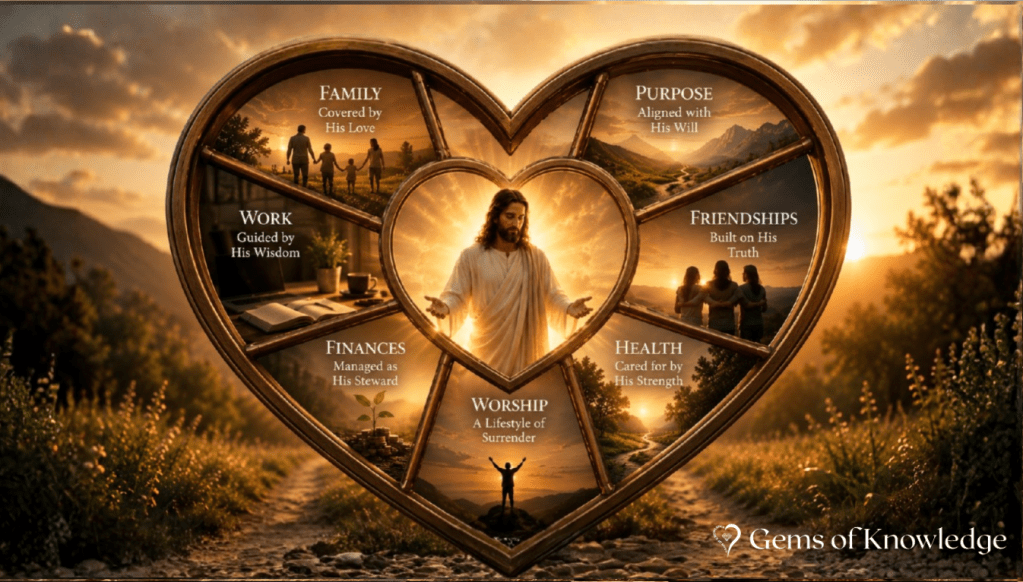
Alt...
A heart-shaped wheel with spokes leading to Jesus at the center, symbolizing every area of life revolving around Christ.
The Freedom of Knowing Who We Are
A Devotional Meditation on John 1:21 John 1:21 presents one of the most remarkable moments of humility in all of Scripture. The religious leaders questioned John the Baptist, asking, “What then? Are you Elijah?” He answered, “I am not.” “Are you the Prophet?” And he answered, “No.” Their questions reveal humanity’s persistent desire to define people by titles, expectations, and earthly categories. John’s answers reveal something far greater: a life that is secure in the […] [SENSITIVE CONTENT]

A Devotional Meditation on John 1:21
John 1:21 presents one of the most remarkable moments of humility in all of Scripture. The religious leaders questioned John the Baptist, asking, “What then? Are you Elijah?” He answered, “I am not.” “Are you the Prophet?” And he answered, “No.” Their questions reveal humanity’s persistent desire to define people by titles, expectations, and earthly categories. John’s answers reveal something far greater: a life that is secure in the calling of God and free from the need for self-exaltation.
The delegation from Jerusalem was searching for someone extraordinary. Israel longed for the fulfillment of ancient promises. Malachi had spoken of Elijah’s coming before the great day of the Lord, and Moses had foretold the coming of a great Prophet whom God would raise up. The religious leaders wanted to know whether John claimed to be one of these expected figures.
John answered with remarkable simplicity. He denied every opportunity to elevate himself. He refused to become more than what God had called him to be.
His words expose one of the deepest struggles of the human heart. People often seek identity through recognition, status, reputation, or comparison with others. They desire titles that command respect and positions that bring admiration. Even within the life of faith there can be a temptation to measure spiritual worth by visibility, influence, or prominence.
John rejected all of these temptations.
He understood that true greatness is not found in becoming someone impressive before others but in faithfully fulfilling the purpose assigned by God. His confidence did not come from public opinion but from divine calling. He was content to be exactly what God intended him to be.
There is profound theological significance in this exchange. Throughout Scripture, God often works through those who willingly decrease so that His glory may increase. Abraham left his homeland without knowing where he would go. Moses protested his own inadequacy. David was overlooked among his brothers. The prophets often labored without earthly success. The apostles described themselves as servants rather than celebrities.
The kingdom of God operates by different standards than the kingdoms of the world. Heaven values faithfulness over fame, obedience over applause, humility over ambition. John embodies this kingdom principle before the ministry of Jesus even fully begins.
His refusal also demonstrates remarkable theological clarity. John knew that he was not the fulfillment of Israel’s hope. He was merely preparing the way for the One who was. Every denial pointed beyond himself toward Christ. His ministry was never about gathering followers for his own sake but directing all attention toward the Lamb of God.
The greatest servants of God understand that they are signposts rather than destinations. They point beyond themselves toward the Savior. Their lives become instruments through which others encounter Christ rather than monuments built for personal honor.
John’s humility also protects him from the subtle danger of spiritual pride. Religious influence can become intoxicating. Crowds gathered around John. People traveled into the wilderness to hear him preach. Many wondered whether he himself might be the Messiah. Yet he consistently refused every false identity.
This unwavering honesty teaches that humility is not self-hatred but truthful self-understanding. John neither exaggerated nor diminished his role. He simply accepted God’s assignment with joyful obedience. He knew both his limitations and his purpose.
Such humility flows from a proper understanding of God’s sovereignty. If God appoints every calling, every gift, every opportunity, and every season of ministry, then comparison becomes unnecessary. The Creator distributes His grace according to His wisdom. One plants while another waters, but God gives the increase. Some labor in public while others serve unseen. Every faithful act offered to God possesses eternal value regardless of human recognition.
John’s example challenges the modern desire for visibility. Contemporary culture often encourages constant self-promotion, measuring success by followers, influence, popularity, or applause. Even spiritual service can become vulnerable to these pressures.
Yet the kingdom of Christ invites believers into another way. It invites contentment in hidden obedience. It celebrates quiet faithfulness. It honors those who simply fulfill the work entrusted to them without seeking personal glory.
The questions directed at John continue to echo throughout every generation. People ask, “Who are you?” Society defines identity through achievement, occupation, wealth, education, politics, or social status. Scripture answers differently. The believer’s identity is found in belonging to Christ and serving His purposes.
John knew exactly who he was because he knew exactly whose servant he was.
There is deep freedom in such certainty. When identity rests upon God’s calling rather than human approval, criticism loses its power to destroy and praise loses its power to corrupt. The servant stands secure because the Master is pleased.
John’s repeated denials also reveal a heart fully satisfied with Christ’s coming glory. He did not envy the One who would eclipse his ministry. Instead, he rejoiced that his own influence would diminish if Jesus would be exalted. His ministry was successful precisely because it prepared others to leave him and follow Christ.
Such joyful self-forgetfulness reflects the very heart of Christian discipleship. Every ministry, every sermon, every act of service, every expression of compassion ultimately exists for one purpose: to direct people toward Jesus Christ.
The church today desperately needs the spirit of John the Baptist. It needs leaders who seek faithfulness rather than fame, servants who rejoice when Christ receives the glory, believers who embrace obscurity if Christ is honored, and disciples who understand that their highest privilege is not to be admired but to point others to the Savior.
John’s simple answers, “I am not,” become profound declarations of theological wisdom. They clear away every distraction until only Christ remains at the center. In denying false identities, John prepared the world to recognize the true Redeemer.
The same calling remains for every believer today. The goal is not to become indispensable, unforgettable, or celebrated. The goal is to become faithful witnesses whose lives consistently direct attention away from themselves and toward the Son of God who alone is worthy of worship.
May every heart learn the quiet joy of knowing its God-given place, embracing its God-given calling, and finding complete satisfaction in making much of Christ rather than self.
Prayer
Heavenly Father, teach Your people the beauty of humility and the joy of faithful obedience. Guard every heart from pride, comparison, and the desire for human applause. Grant grace to serve with contentment wherever You have placed us, pointing always to Jesus Christ and seeking only His glory. May our lives become faithful witnesses that lead others to the Savior, and may Your name alone be exalted in all we do. Amen.

Alt...
The Freedom of Knowing Who We Are
The Bible says you can be transformed through Christ; you become a new creation! Click or tap the link to read more.
#afaithfulsower #christianity #Bible #Jesus #dailydevotion
The God Who Calls Us to Faithful Witness
A Prayer Inspired by John 1:21 Heavenly Father, We come before You with reverence, gratitude, and awe. You are the eternal God who was before all things and through whom all things exist. You are the Lord of history, the Author of redemption, and the One who speaks truth into a world often filled with confusion and uncertainty. We praise You because Your purposes never fail and Your wisdom is beyond measure. Your plans stretch from eternity past into eternity future, and every promise You […] [SENSITIVE CONTENT]

A Prayer Inspired by John 1:21
Heavenly Father,
We come before You with reverence, gratitude, and awe. You are the eternal God who was before all things and through whom all things exist. You are the Lord of history, the Author of redemption, and the One who speaks truth into a world often filled with confusion and uncertainty. We praise You because Your purposes never fail and Your wisdom is beyond measure. Your plans stretch from eternity past into eternity future, and every promise You have made finds its fulfillment in Your perfect will.
Today we reflect upon the testimony of John the Baptist, who was questioned by those who sought to define him according to their expectations. When they asked him, “What then? Are you Elijah?” he answered, “I am not.” When they asked, “Are you the Prophet?” he answered, “No.” In his response we see a remarkable humility, honesty, and submission to Your purpose. He refused titles that did not belong to him. He declined honors that were not his to claim. He would not build an identity upon misunderstanding or speculation. Instead, he embraced the role You had given him and faithfully pointed others to the One who was greater than himself.
Lord, we confess that we often struggle with this same temptation. We desire recognition. We long to be important. We sometimes measure our worth by the opinions of others rather than by Your calling upon our lives. We are tempted to create identities based upon human expectations rather than divine purpose. Forgive us for the times we have sought glory that belongs only to You.
Teach us the humility of John the Baptist. Give us hearts that are content with the place You have assigned to us. Help us to understand that faithfulness is greater than fame and obedience is more valuable than recognition. Deliver us from the need to impress others and free us to live for Your approval alone.
Father, we thank You that every believer has a calling. Though not all are prophets, pastors, teachers, or leaders, every follower of Christ has been entrusted with the sacred privilege of bearing witness to the truth. You have called us to reflect the light of Christ in our homes, workplaces, churches, and communities. You have invited us to participate in Your redemptive work by speaking words of grace, showing acts of compassion, and living lives that reveal the beauty of the gospel.
Grant us courage to fulfill that calling. In a world that often resists truth, strengthen us to stand firm. In a culture that frequently celebrates self-promotion, help us to practice humility. In an age filled with noise and distraction, teach us to lift up the name of Jesus with clarity and conviction.
Lord Jesus Christ, we thank You that John’s ministry was never ultimately about himself. His purpose was to prepare the way for You. His mission was to point beyond himself to the Lamb of God who takes away the sin of the world. We praise You because You are the fulfillment of every promise, the answer to every longing, and the Savior of all who trust in You.
We thank You that You came not merely as a teacher or prophet but as the eternal Word made flesh. You entered our broken world. You walked among sinners. You bore our griefs and carried our sorrows. You lived the life we could never live and died the death we deserved to die. Through Your resurrection You conquered sin, death, and the grave. Through Your ascension You reign as Lord over all creation.
Because of Your finished work, we no longer need to establish our own significance. Our identity is secure in You. We are beloved children of God. We are redeemed by grace. We are adopted into Your family. We belong to Christ. Help us to rest in this truth whenever insecurity threatens our hearts.
Father, we pray for Your Church throughout the world. Guard Your people from the temptation to build ministries around personalities rather than around Christ. Protect us from pride, competition, and self-exaltation. Raise up leaders who delight in serving rather than being served. Raise up pastors who faithfully preach Christ rather than themselves. Raise up believers whose greatest joy is not personal recognition but the advancement of Your kingdom.
May our churches become communities where Christ is exalted above all else. Let every sermon point to Him. Let every ministry reflect His character. Let every act of service reveal His love. Let every gathering proclaim His gospel. Teach us that our highest purpose is not to make a name for ourselves but to glorify the name that is above every name.
Lord, we pray for those who feel overlooked, forgotten, or insignificant. Remind them that faithfulness in Your kingdom is never wasted. You see every act of obedience. You notice every quiet sacrifice. You remember every prayer offered in faith. You value every servant who labors in hidden places for Your glory.
Strengthen those who serve without applause. Encourage those who labor without recognition. Comfort those who wonder whether their efforts matter. Remind them that Your eyes are upon them and that You delight in the humble and faithful hearts of Your people.
We also pray for those who are searching for purpose and direction. Like the questioners who came to John, many are asking, “Who am I?” and “Why am I here?” Lord, reveal Yourself to them. Show them that true identity is not found in success, status, possessions, or achievements. It is found in relationship with You. Lead them to discover the joy of knowing Christ and serving Him wholeheartedly.
Father, make us people of truth. Give us integrity in our words and sincerity in our witness. Help us to speak honestly about ourselves and faithfully about You. Keep us from exaggeration, deception, and pride. Let our lives be marked by authenticity and grace.
Fill us with the Holy Spirit so that our witness may be effective. Empower us to speak of Christ with wisdom and love. Open doors for gospel conversations. Prepare hearts to receive the good news. Use our lives as instruments through which others may encounter the transforming power of Jesus Christ.
Lord, as John faithfully prepared the way for the coming of the Messiah, help us to prepare hearts for Your kingdom. May our words, actions, and attitudes point others toward the Savior. Let us become signposts that direct people to Christ rather than drawing attention to ourselves.
As we journey through this life, keep us anchored in humility and grounded in grace. Remind us daily that our value comes not from what we accomplish but from whose we are. Help us to live with confidence because we belong to Christ and with humility because all we have is a gift from Your hand.
We look forward to the day when every earthly title will fade away, every human achievement will pass, and every false source of identity will disappear. On that day, only Christ will remain exalted. Until then, teach us to live as faithful witnesses, humble servants, and joyful disciples.
May our lives echo the spirit of John the Baptist. May we decrease so that Christ may increase. May we find our greatest joy not in being known but in making Him known. May our hearts be satisfied not with earthly honor but with the privilege of serving our King.
We ask all these things in the name of Jesus Christ, the eternal Word, the Lamb of God, the Savior of the world, and the Lord of glory.
Amen.

Alt...
The God Who Calls Us to Faithful Witness