Search results for tag #ai
![[?]](https://pouet.chapril.org/system/accounts/avatars/113/520/570/810/762/451/original/a93c5285ee50ac56.jpeg)
Generative AI Is an Engineering Disaster
https://www.theatlantic.com/technology/2026/07/generative-ai-engineering-disaster/687901/
> A shockingly inefficient trillion-dollar project
![[?]](https://files.mastodon.online/accounts/avatars/000/198/984/original/05ae41279ea5c1e3.png)
![[?]](https://m-cdn.flipboard.social/accounts/avatars/110/068/762/697/825/294/original/d3f34437c275e777.jpg)
An attempted fire-bombing, violent threats and the risk of security breaches is what's faced by some employees who work for AI companies. So much so, one of those companies has increased spending on security by up to 150%.
The folks at Wall Street Journal have gifted this article that offers an insight into the AI backlash and the violence that sometimes follows.
![[?]](https://igeek.gamer-geek-news.com/fileserver/017Y3RGP0P99HT1KVS06P09Z0E/attachment/original/01KHCBXXJWZB9H1M3MNXEMPHDM.jpeg)
📰 ‘No company is going to go to jail for you’: Proton’s CTO on balancing privacy, policy, and trust
Today on Decoder, we’ve got the first of a two-part series on the systems that run the world: I’m talking with Bart Butler, the CTO of Proton, the company that makes private and secure productivity...
📰 Source: The Verge
🔗 Link: https://www.theverge.com/podcast/966074/proton-cto-bart-butler-privacy-encryption-surveillance-age-verification
![[?]](https://files.mastodon.social/accounts/avatars/109/259/335/557/478/424/original/fa2228a5fca99d73.jpeg)
Amazon, Microsoft and Google now pump out 119 million tonnes of CO₂ a year from their AI and cloud build‑out, about a third of France’s annual emissions.
Do not believe Big Tech companies when they tell you AI will “solve” the climate crisis while their data centres guzzle fossil power and spew pollution on a country scale.
![[?]](https://media.bsd.cafe/bsdmmedia01/accounts/avatars/114/439/967/181/871/365/original/9c94f4a4076e444d.jpg)
This is the second post where you'd dropped the F bomb....for good reason.
I have so much to say but not sure how to say it but I will do my best. For *years*, I've enjoyed using #Linux both as a hobbyist and professional #sysadmin. The OS is definitely not the one I started with 20+ years ago. Since at least COVID has....well, it's turned into a full blown corporate-controlled high speed sprawling mess. Not necessarily matured just grown exponentially wherever the various powers see fit. For this and other reasons, I am leaning more and more towards #FreeBSD.
Lastly, I will admit there are some #AI niche use cases which do interest me (related to my own hobbies) but shoving it into everything is not a good idea.
![[?]](https://social.gamefan.net/system/accounts/avatars/116/450/677/342/166/464/original/4de7a562f86cf564.png)
OnePlus officially gives up on the US and Europe
The OnePlus 15 was the company’s final US flagship. | Photo: Allison Johnson / The Verge OnePlus has confirmed what industry observers have long expected: it's quitting the US and European markets, and will no longer la…
https://www.theverge.com/tech/966404/oneplus-oppo-us-europe-withdrawal-realme
#Tech #Technology #TechNews #AI #Gadgets #Software #Cybersecurity #Apple #Google #Microsoft #Startup #OpenSource #TheVerge [The Verge]
Artificial intelligence company Thinking Machines Lab is taking on Chinese-made open-weight AI models and could become a real contender alongside OpenAI and Anthropic. Learn about its new open AI model Inkling.
![[?]](https://media.infosec.exchange/infosec.exchange/accounts/avatars/000/023/504/original/69cd9b6e12c637fc.jpg)
The argument that "AI works therefore we should use it" is akin to "Torture works therefore we should use it."
I don't mean that as hyperbole.
The underlying purpose of AI is at least twofold:
1) It puts a layer of abstraction over information.
- Primary Source: Raw data (eg video footage of an event)
- Secondary Source: Analysis (eg Low bias news and analysis of what this event means in the context of other events)
- Tertiary Source: Meta Analysis (eg Encyclopedia entries summing up Analysis)
- Quaternary Source: News Opinion and Propaganda (eg a "News Entertainment" channel that tells you what to think regarding the event)
- Pentanary (?) Source: TLDR summations divorced from underlying sources (eg AI summations, guides, etc that describe events or provide recommendations and guidance but follow behind the scenes algorithms that control the output)
The purpose of this layer of abstraction is control of information and removing the distribution of information from the actual events. This allows for influence campaigns, tuned marketing, tuned propaganda, and therefore control.
2) Centralization of compute power
- Computers in our hands that we control allow us a lot of power.
- Moore's Law no longer applies to localized compute power so we are in an era of repair and maintenance.
That means two things for corporations. Loss of income and loss of control.
- Forcing us to use centralized compute forces us to continue to spend money
- Localized AI engines still allow for centralized algorithms. (open sourced algos and localized engines dont factor in here as use and usecases are low)
AI is being pushed so heavily because both governments and corporations need it to further their wealth and power.
They push it via both making it cheap and accessible and having a veneer of usability.
This is a similar pattern to "Underpricing competition to drive them out and then jacking up rates when you have a monopoly", "Embrace, Extend, Extinguish" and similar approaches.
So.
I am not arguing whether AI is useful. I am arguing that its use is detrimental to us. In fact, the more it becomes useful the worse it becomes BECAUSE more people adopt it. It hurts us as we use it. It hurts us more as we use it more.
Tying it back, I don't care if torture is useful and gets your desired results. Torture is bad and it hurts us.
![[?]](https://media.mstdn.social/accounts/avatars/109/565/531/261/159/277/original/7730593f0b7678ff.jpg)
![[?]](https://tldr.nettime.org/system_nettime/accounts/avatars/116/210/866/728/705/852/original/9a67bbe109107f03.png)
The social angle of that project has been, and will remain, the major motivating part for many supporters and contributors.
Without them, #Linux would have stayed precisely what Torvalds announced it as, »just a hobby, won't be big and professional, like gnu«.
There is no point, however, in repeating the well known, endless list of bullet points describing the objectively harmful impacts of " #AI" on our world, and on humanity – to a person firmly determined to consider this planet burner a "tool".
It's much more useful to accept that Torvalds is no longer in his prime, and his ethical negligence will worsen over time, resulting in more and more tech-bro-style statements.
Don't turn humans into living gods.
![[?]](https://files.mastodon.social/accounts/avatars/112/066/993/516/962/338/original/65c95328ea8e0e54.jpg)
AI and the next wave of conspiracies #negativepid #digitalInvestigations #OSINT #cybersecurity #AI #tech #onlineInvestigations #robotics #cyberpsychology #cybercrime https://negativepid.blog/ai-and-the-next-wave-of-conspiracies/?utm_source=mastodon&utm_medium=social&utm_campaign=fedica-Negative-PID-Blog
📰 UK investigation to determine if TikTok fails to protect children from harmful content
Ofcom concerned platform’s age verification is ineffective, leaving some at risk of seeing posts about self-harm and suicideTikTok is under formal investigation over concerns it has failed to prote...
📰 Source: Technology | The Guardian
🔗 Archive: https://web.archive.org/web/https://www.theguardian.com/technology/2026/jul/16/tiktok-uk-investigation-ofcom-child-protection-self-harm-suicide

Alt...
Image for: UK investigation to determine if TikTok fails to protect children from harmful content
![[?]](https://cdn.fosstodon.org/accounts/avatars/107/297/362/770/635/523/original/3ce6a735f191afe9.jpeg)
Daily Digest | 16 July 2026
Your daily dose of Privacy, Data Protection, AI & Cybersecurity news.
5 stories you should not miss.
Read more: https://www.nicfab.eu/daily-digest/
Ward Christensen and the invention of BBS #negativepid #digitalInvestigations #OSINT #cybersecurity #AI #tech #onlineInvestigations #robotics #cyberpsychology #cybercrime https://negativepid.blog/ward-christensen-and-the-invention-of-bbs/?utm_source=mastodon&utm_medium=social&utm_campaign=fedica-Negative-PID-Blog
 🇨🇦 boosted
Damn. This quote from Linus Torvalds is... well... damning.
In response to a discussion around use of generative AI as it relates to contributions to the Linux code base, Linus (creator and lead contributor to Linux) firmly states that AI contributions are welcome.
But then he goes on and concludes with this:
"The kernel project has been and will continue to be about the technology.
Sure, the social angle of working on open source is important and often a very motivating part of the project, but in the end that's a side benefit, not the _point_ of the project.
This is *NOT* some kind of "social warrior" project, never has been, and never will be.
In the kernel community we do open source because it results in better technology, not because of religious reasons.
And so we make decisions primarily based on technical merit. Not fear of new tools.
Linus"
A lot of us are on Linux specifically because of the social and political positives. Closed source is control. Open source is democracy.
Linus doing the typical tech-bro "i don't think of politics, I only think of tech" harkens back to any number of "science without ethics" atrocities.
Linus is and has always been a tech-bro (or proto tech bro). He has his throne of power and is happy where he is. Other tech-bros want money and influence. They're all the same.
But Linus is wrong.
Tech is politics.
And his stance and guiding influence with Linux is wrong.
Linus just made a political statement and has shifted the politics and societal approach of Linux.
#linux #solarPunk #Linus #AI #openSource
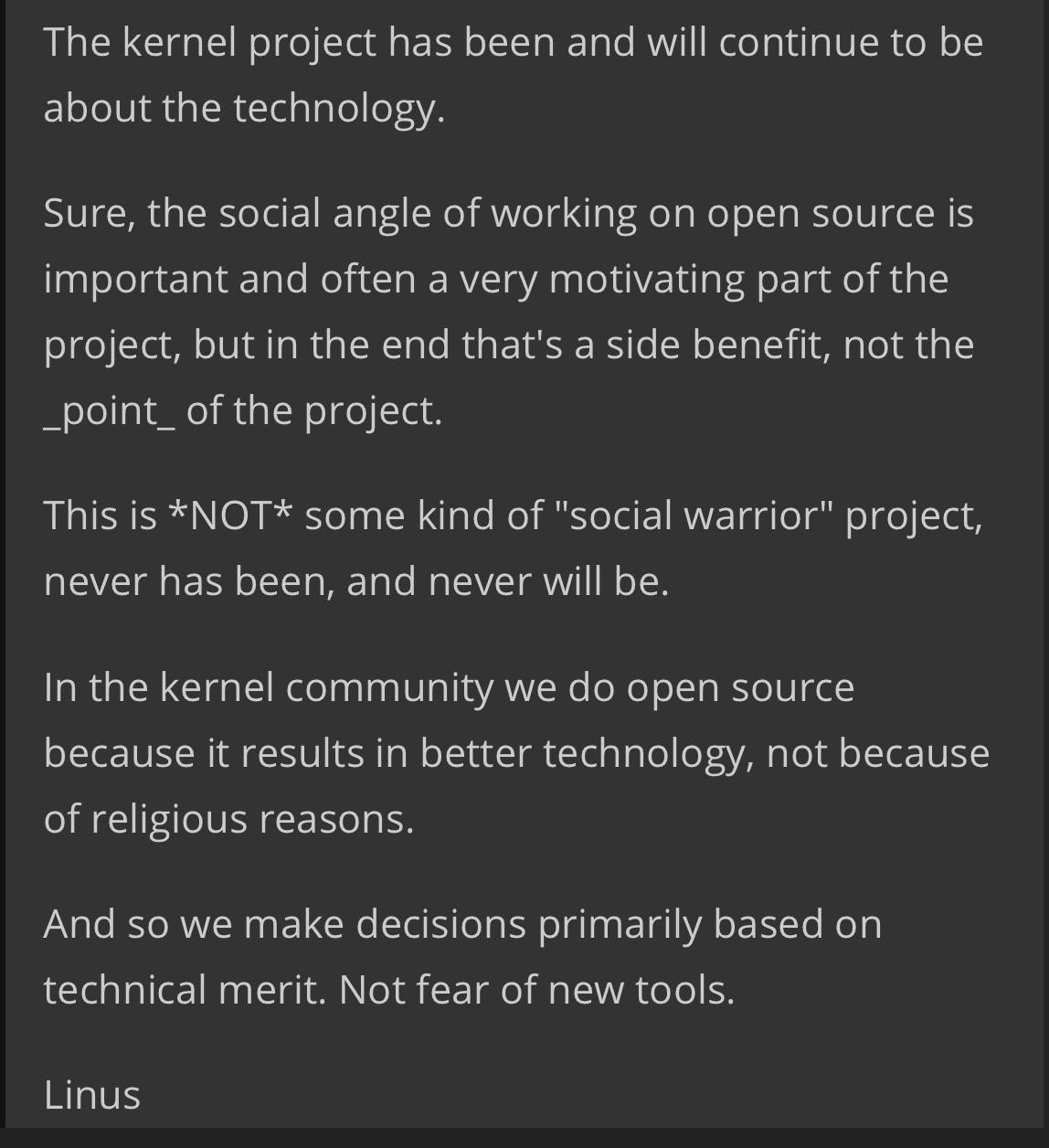
Alt...
screenshot of Linus' remarks stating: The kernel project has been and will continue to be about the technology.
Sure, the social angle of working on open source is important and often a very motivating part of the project, but in the end that's a side benefit, not the _point_ of the project.
This is *NOT* some kind of "social warrior" project, never has been, and never will be.
In the kernel community we do open source because it results in better technology, not because of religious reasons.
And so we make decisions primarily based on technical merit. Not fear of new tools.
Linus"
Gods, I've had my head down these last few months with family and life stuff, so I've not been kept fully abreast.
But Canonical doing the most Canonical thing and fully embracing AI just plain hurts.
I'm such a (classic) Luddite. It feels like the world is collapsing around me.
And its not just "new tech bad".
I love the advances we're having in balcony solar, and cutting edge hydroponics, and non-LLM automation, and machine learning as it relates to medicine and accessibility, and meshnet communication standards and tech.
I hate surveillance tech like Palantir and Flock, just like I hated blockchain and NFTs, and Generative AI LLMs, etc.
I'm just going to core out a space in my life and find folks who do the same and try to strengthen them.
Looks like I'm going to move to OpenBSD soon though, so that's nice.
![[?]](https://files.mastodon.social/accounts/avatars/116/419/336/721/328/437/original/8a8adbb27fbc452e.png)
Mira Murati's Thinking Machines debuts Inkling, a 975B open-weights multimodal AI model, while xAI open-sources Grok Build amid data privacy controversy and Apple eyes China expansion via Qwen.
![[?]](https://media.mathstodon.xyz/accounts/avatars/109/314/312/736/223/178/original/b81422ae28459dc4.jpg)
Deep analysis of the decomposition into weight × level + jump by Fable 5:
455 052 508 primes decomposed;
Conjecture 9 proved (pending external refereeing).
Fifth report:
➡️ https://decompwlj.com/decompwlj_deep_analysis_5th_edition.html
For privacy ➡️ https://web.archive.org/web/20260714093159/https://decompwlj.com/decompwlj_deep_analysis_5th_edition.html
#decompwlj #math #AI #Anthropic #Claude #Fable #Fable5 #mathematics #OEIS #sequence #numbers #graph #PrimeNumbers #NumberTheory #sieve #arithmetic #threejs #research #FundamentalTheoremOfArithmetic #sieveOfEratosthenes #classification #threejs
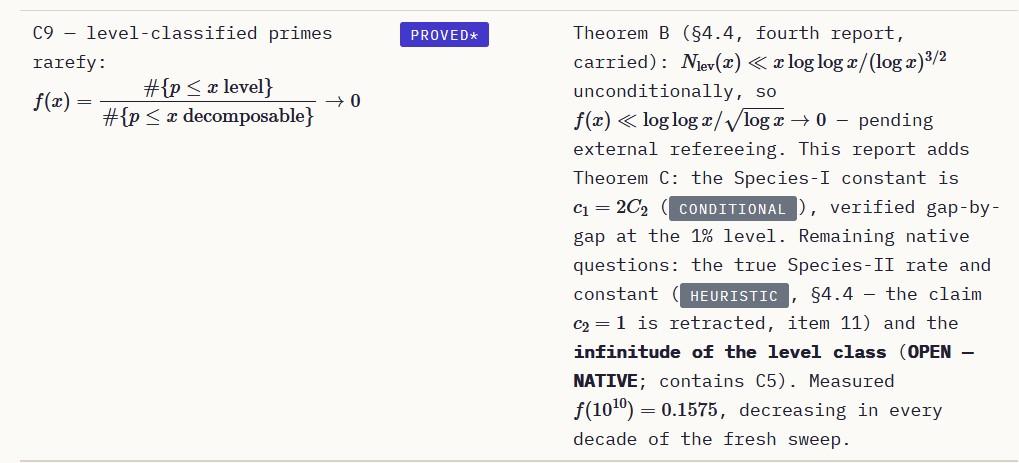
Alt...
Screenshot: Conjecture 9 from the 5th report by Fable.
"Theorem B (Conjecture 9 — rarefaction of the level class — proved unconditionally, pending external refereeing)"
Deep analysis of the decomposition into weight × level + jump by Fable 5:
455 052 508 primes decomposed;
Conjecture 9 proved (pending external refereeing).
Fifth report:
➡️ https://decompwlj.com/decompwlj_deep_analysis_5th_edition.html
For privacy ➡️ https://web.archive.org/web/20260714093159/https://decompwlj.com/decompwlj_deep_analysis_5th_edition.html
#decompwlj #math #AI #Anthropic #Claude #Fable #Fable5 #mathematics #OEIS #sequence #numbers #graph #PrimeNumbers #NumberTheory #sieve #arithmetic #threejs #research #FundamentalTheoremOfArithmetic #sieveOfEratosthenes #classification #threejs
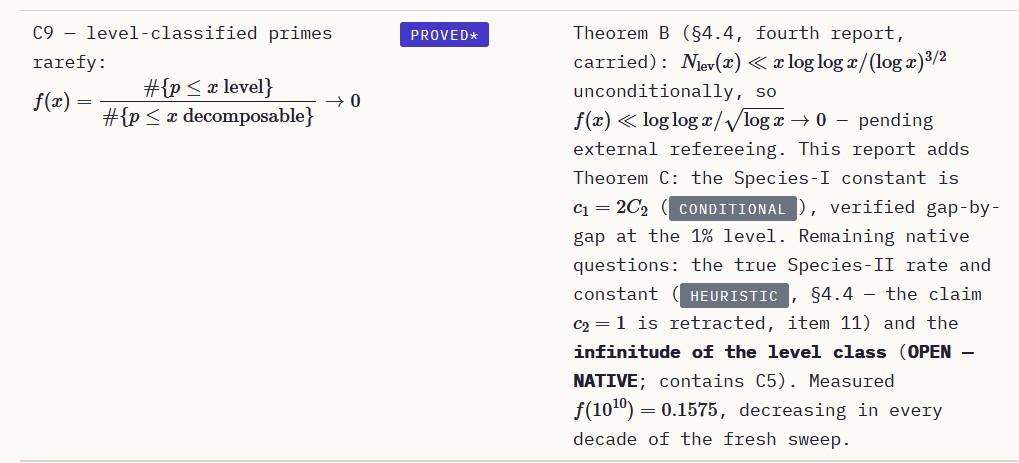
Alt...
Screenshot: Conjecture 9 from the 5th report by Fable.
"Theorem B (Conjecture 9 — rarefaction of the level class — proved unconditionally, pending external refereeing)"
 boosted
![[?]](https://media2.ai6yr.org/accounts/avatars/109/321/592/360/914/018/original/f918064fa4350d36.jpg)
WSJ: The AI Backlash Has Tech Executives Fearing for Their Lives
Violent threats against AI companies are rising and spilling over into real-world security incidents

Alt...
WSJ: The AI Backlash Has Tech Executives Fearing for Their Lives
Violent threats against AI companies are rising and spilling over into real-world security incidents
The Atlantic: Generative AI Is an Engineering Disaster
A shockingly inefficient trillion-dollar project
(paywall, subscriber only, but interesting to see that article exists...)
https://www.theatlantic.com/technology/2026/07/generative-ai-engineering-disaster/687901/
![[?]](https://files.mastodon.social/accounts/avatars/112/876/487/306/273/817/original/c03b4a03395e4d8d.png)
Great conversation today on copyright, AI, ISP's, and privacy. Thanks to everyone who tuned in and asked questions. A special thanks to Corynne McSherry for sharing her knowledge and perspective.
Next week: what's happening with non-deployment funds. Catch it → https://chat.broadbandbreakfast.com/c/broadbandlive-events/what-s-happening-with-non-deployment-funds
#tech #technology #ai #ArtificialIntelligence #lawyer #copyright
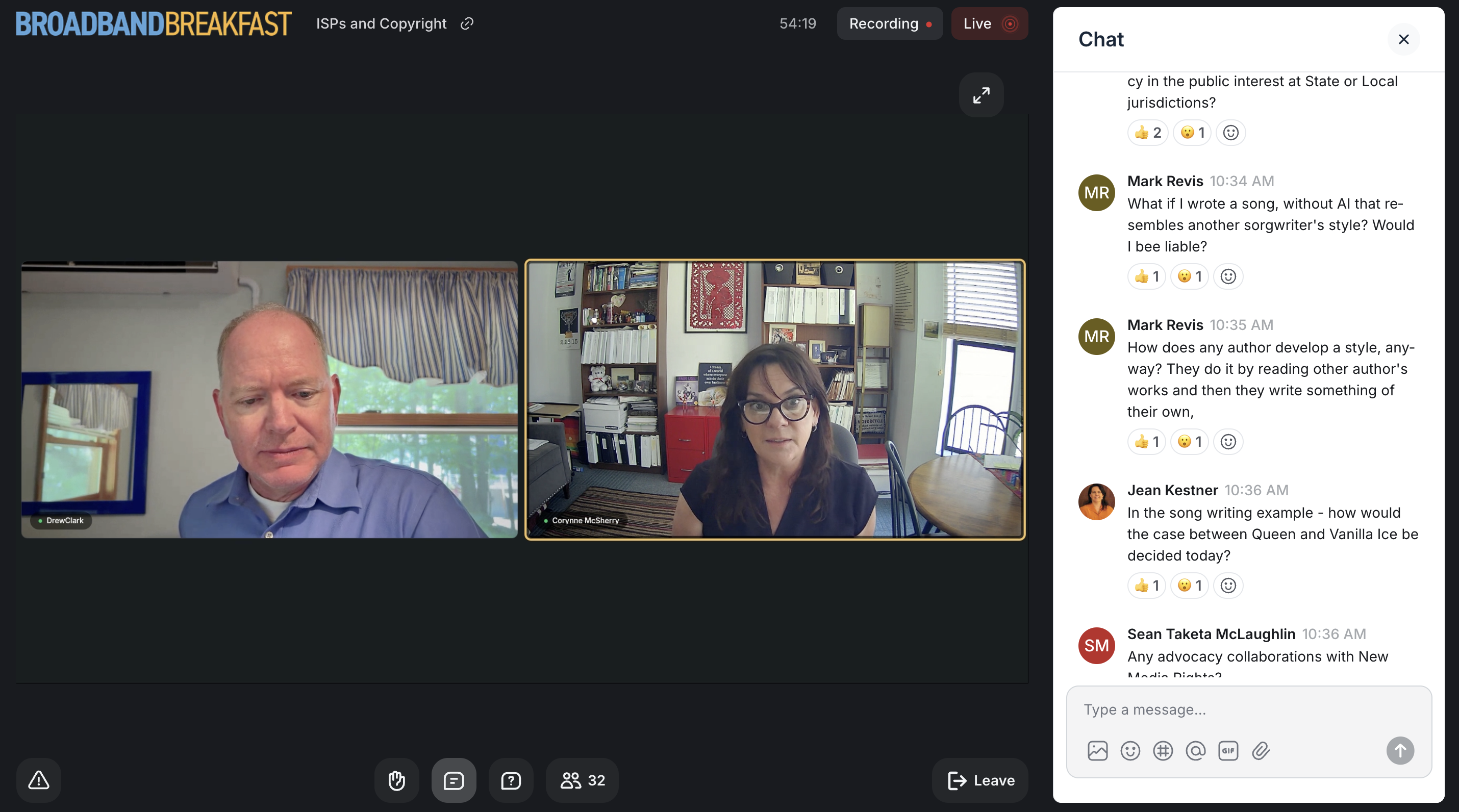
Alt...
A screenshot of the livestream.
@rl_dane Does this come as a surprise to you?
#Linux is more corporate than ever but it didn't happen overnight. The OS drives #BigTech and companies around the world, and now it's pretty much the de facto OS for #AI.
Linus is a millionaire not because of the community but because of Big Tech and massive corporate contributions.
![[?]](https://files.mastodon.online/accounts/avatars/108/193/725/441/581/908/original/bc81fd8190f2e74c.png)
The crypto industry wants favorable policy, and it certain helps with the Trump family is making big bucks from it.
On #TechWontSaveUs, I spoke with @molly0xfff to discuss how the AI industry is trying to replicate how crypto bought political influence.
Listen to the full episode: https://techwontsave.us/episode/336_the_ai_industry_is_spending_big_on_the_us_midterms_w_molly_white
#tech #politics #donaldtrump #artificialintelligence #ai #crypto
![[?]](https://files.mastodon.social/accounts/avatars/113/914/476/300/766/282/original/96e52ec2b73b0505.jpg) boosted
boosted![[?]](https://kolektiva.social/system/accounts/avatars/109/443/569/745/308/832/original/7212429ec0b1b0ba.jpg)
Hack Reveals Suno AI Music Generator Scraped YouTube, Deezer, and Genius https://www.404media.co/hack-reveals-suno-ai-music-generator-scraped-youtube-deezer-and-genius/
'The AI music generation tool Suno scraped millions of songs and lyrics from YouTube Music, Deezer, and Genius, as well as from the stock music libraries Pond5, Jamendo, Freesound, the International Music Score Library Project, and podcasts via RSS feeds, according to a hacker who breached the company and shared data about Suno’s training libraries with 404 Media. The hacker was also able to access user information for hundreds of thousands of Suno’s customers, as well as Stripe payment information, they said.'
#ArtificialIntelligence #AI #Suno #grift #theft #capitalism #YouTube #Deezer
![[?]](https://blacksailstudio.wordpress.com/wp-content/uploads/2023/09/sw-s503_gl.png) Black Sail Studio » 🌐
Black Sail Studio » 🌐
@blacksailstudio.wordpress.com@blacksailstudio.wordpress.com
Building a Local AI Information-Gathering Phone Line
Modern voice agents are often presented as cloud services: a caller speaks, a remote platform transcribes the audio, a hosted language model generates a response, and another service synthesizes the reply.
For this project, I wanted to explore a different approach.
The goal was to build a locally controlled conversational phone-line prototype capable of gathering structured information from a caller while maintaining context throughout the interaction.
The system uses a locally hosted Gemma 4 model for dialogue, local speech recognition for transcription, and Kokoro 82M for text-to-speech. A custom Python application coordinates the entire interaction and presents it through a phone-style interface.
The result is an automated intake agent named Eva.
The Test Scenario
For the demonstration, Eva was configured to behave like a corporate information-gathering agent.
The caller began with a simple greeting. Eva then guided the conversation through a sequence of intake questions:
- Full name
- Company or organization
- Callback number
- Email address
- Case, ticket, order, or reference number
- General reason for the call
- Product or service involved
- Date and approximate time of the reported issue
The caller did not have to complete a rigid form or choose numbered menu options. Instead, the information was collected through natural conversation.
A portion of the interaction looked like this:
Eva: Hello. Thank you for contacting us. My name is Eva. To begin, may I please have your full name?
Caller: John Michael Smith.
Eva: Thank you, John Michael Smith. May I also have the company or organization you are calling from?
As the conversation continued, Eva retained the previously supplied information and advanced to the next relevant question.
When the caller explained that they were upset about new automated systems, Eva did not restart the intake process or lose track of the conversation. She asked a follow-up question to determine which product or service was involved.
That contextual continuity is the most important part of the demonstration.
The Core Architecture
The system is built as a real-time conversational pipeline:
Microphone input
↓
Speech-to-text
↓
Conversation controller
↓
Gemma 4 through LM Studio
↓
Kokoro 82M text-to-speech
↓
Audio playback
Each component has a distinct responsibility.
The speech-to-text layer converts the caller’s voice into text. The conversation controller maintains the active call state and sends the transcript to the language model. Gemma 4 evaluates the current message alongside the prior conversation and produces the next response. Kokoro 82M then converts that response into spoken audio.
The Python application ties these systems together.
It manages:
- Microphone capture
- Voice activity detection
- Turn-taking
- Conversation history
- System prompts
- Model requests
- Voice generation
- Audio playback
- Call state
- Session termination
- Persistent memory
- Transcript logging
The language model is only one component of the system. The surrounding orchestration is what makes the experience feel like a coherent call rather than a sequence of unrelated AI requests.
Why Conversation History Matters
A language model does not automatically remember everything that happened earlier in a call.
The application must preserve the conversation and provide the relevant history with each new request.
Without that context, an information-gathering agent might repeatedly ask for the caller’s name, forget which fields were already completed, or ask questions in an inconsistent order.
In this prototype, the conversation controller tracks both sides of the exchange:
System instructions
Caller message
Agent response
Caller message
Agent response
That history allows the model to understand which information has already been collected and what still needs to be asked.
It also enables more natural follow-up behavior.
For example, when the caller says:
“I am upset about the new automated systems.”
Eva can interpret that statement as the reason for the call and ask which product is affected, rather than simply continuing through an unrelated checklist.
Structured Behavior Without a Traditional Form
One of the interesting aspects of this design is that the model can follow a structured intake objective without forcing the caller through a conventional form.
The system prompt defines the agent’s responsibilities, tone, required information, and conversational boundaries.
The agent can then gather the same fields a form would collect while allowing the caller to speak naturally.
This creates a hybrid between two familiar systems:
Rigid automated phone menu
+
Human-style conversational intake
The structured requirements remain in place, but the interface becomes conversational.
That can be useful in situations where callers may not know how their problem should be categorized before they begin speaking.
Local Inference and Control
The language model is served locally through LM Studio rather than being accessed through a commercial cloud API.
This provides direct control over:
- Model selection
- System prompts
- Conversation history
- Context length
- Generation settings
- Data retention
- Personality configuration
- Memory behavior
The text-to-speech component is also hosted locally.
That means the central conversation does not depend on sending every transcript and model response to an external AI provider.
Local inference introduces its own technical requirements, including GPU resources, model management, latency optimization, and service coordination. However, it also gives the developer considerably more control over the complete conversational stack.
Voice Activity Detection
The caller does not need to press a push-to-talk button during normal operation.
The application monitors the microphone and determines when speech begins and ends.
This process is known as voice activity detection.
The system moves through several internal states:
Listening
↓
Speech detected
↓
Recording
↓
Silence detected
↓
Transcribing
↓
Thinking
↓
Speaking
↓
Listening
This state-based design is important because the microphone, speech model, language model, and voice model all operate at different speeds.
The application must know which component currently owns the interaction.
It must also prevent the microphone from transcribing the AI’s own voice as new caller input.
Persistent Memory
The application also includes persistent conversational memory.
This allows the agent to retain selected context between separate sessions rather than beginning every call as a completely blank system.
The memory architecture separates several types of information:
- Current-call conversation
- Recent message history
- Summaries of earlier calls
- Long-term memories
- Archived transcripts
This distinction matters because sending every previous conversation back into the model would eventually become inefficient.
Instead, recent dialogue can remain verbatim while older interactions are summarized. Important details can be stored separately and included only when relevant.
The application, not the language model, owns this memory.
That is an important architectural principle.
The model generates language, but the surrounding software determines what is saved, retrieved, discarded, or presented as context.
The Interface

The application was designed to resemble a live phone call rather than a conventional chatbot window.
The interface includes:
- Start and hang-up controls
- Call timer
- Current system state
- Editable system prompt
- Agent profiles
- Live transcription
- Model responses
- Diagnostic timing information
- Persistent memory controls
- A reactive circular audio visualization
The visualizer changes according to the active state.
The caller’s speech is represented in yellow. Model processing uses blue and purple states. The generated AI voice is shown in green.
This is primarily an aesthetic feature, but it also provides immediate feedback about what the system is doing.
A user can see whether the application is listening, transcribing, waiting for the model, generating speech, or playing audio.
What This Demonstration Proves
This experiment demonstrates that a locally hosted language model can operate as the conversational core of an automated information-gathering line.
More specifically, it shows that the system can:
- Listen for natural speech
- Convert speech into text
- Preserve conversational context
- Collect information in sequence
- Ask relevant follow-up questions
- Produce spoken responses
- Maintain a consistent agent identity
- Store and recall previous conversational information
- Operate through a custom local interface
The prototype is not intended to replace a production call center in its current form.
A production deployment would require additional work in areas such as authentication, encryption, regulatory compliance, consent, auditing, data validation, failure recovery, telephony integration, and human escalation.
But the central conversational mechanism is functional.
The Larger Possibility
The broader significance of this project is not limited to corporate intake.
The same architecture could support many types of locally controlled voice agents:
- Technical support intake
- Appointment pre-screening
- Internal help desks
- Interactive training systems
- Voice-based surveys
- Game characters
- Accessibility tools
- Personal assistants
- Research interviews
- Educational tutors
The underlying pattern remains the same:
Listen
Understand
Maintain context
Respond
Remember
What changes is the system prompt, the information being collected, the voice, and the surrounding workflow.
Final Thoughts
The project began as a simple idea: speak into a microphone, send the transcript to a local model, and play the response through a local voice engine.
Once persistent memory, automatic voice detection, agent profiles, structured prompts, call archives, and state management were added, it became something more substantial.
It became a locally controlled conversational-agent platform.
The most important lesson from the project is that the model itself is not the complete system.
A useful voice agent emerges from the coordination of perception, context, reasoning, memory, expression, and interface design.
Gemma 4 provides the conversational intelligence.
Kokoro 82M provides the voice.
The Python application provides the structure that allows them to behave like a single coherent agent.
-Me 7-15-2026


Alt...
Building a Local AI Information Gathering Phone Line
![[?]](https://files.mastodon.social/accounts/avatars/116/693/045/271/705/560/original/1cee72f98eb9d4b4.png)
Google DeepMind’s Hassabis wants a "private agency" to bypass state laws, claiming Govts are too slow. This is a direct attack on democracy. In reality, Big Tech wants to escape legal oversight to centralize power and continue fueling surveillance and military AI in Gaza, Lebanon, and Iran. His attempt to avoid regulation is his own condemnation. The market of hypocrisy is collapsing. #AI #Democracy #2k115

Alt...
A close-up portrait of a bald man wearing glasses (Demis Hassabis) looking to the side against a dark background. The top-right corner features the pink text "2K115", while the bottom of the image displays a subtitle in white: "Crime Corporation wants immunity from the laws."
![[?]](https://files.mastodon.social/accounts/avatars/109/999/119/965/425/489/original/0ac00ac2dda1354b.png)
There will be those who won't know or care until the bullshit bites them in the ass personally, and until then "AI is awesome!"
" #Meta Platforms is facing a federal #lawsuit in the #UnitedStates after 26 current and former #employees alleged that the company used #AI-assisted tools during a major round of #layoffs in a way that disproportionately affected workers with medical conditions, #disabilities, or those on protected medical or #familyLeave"
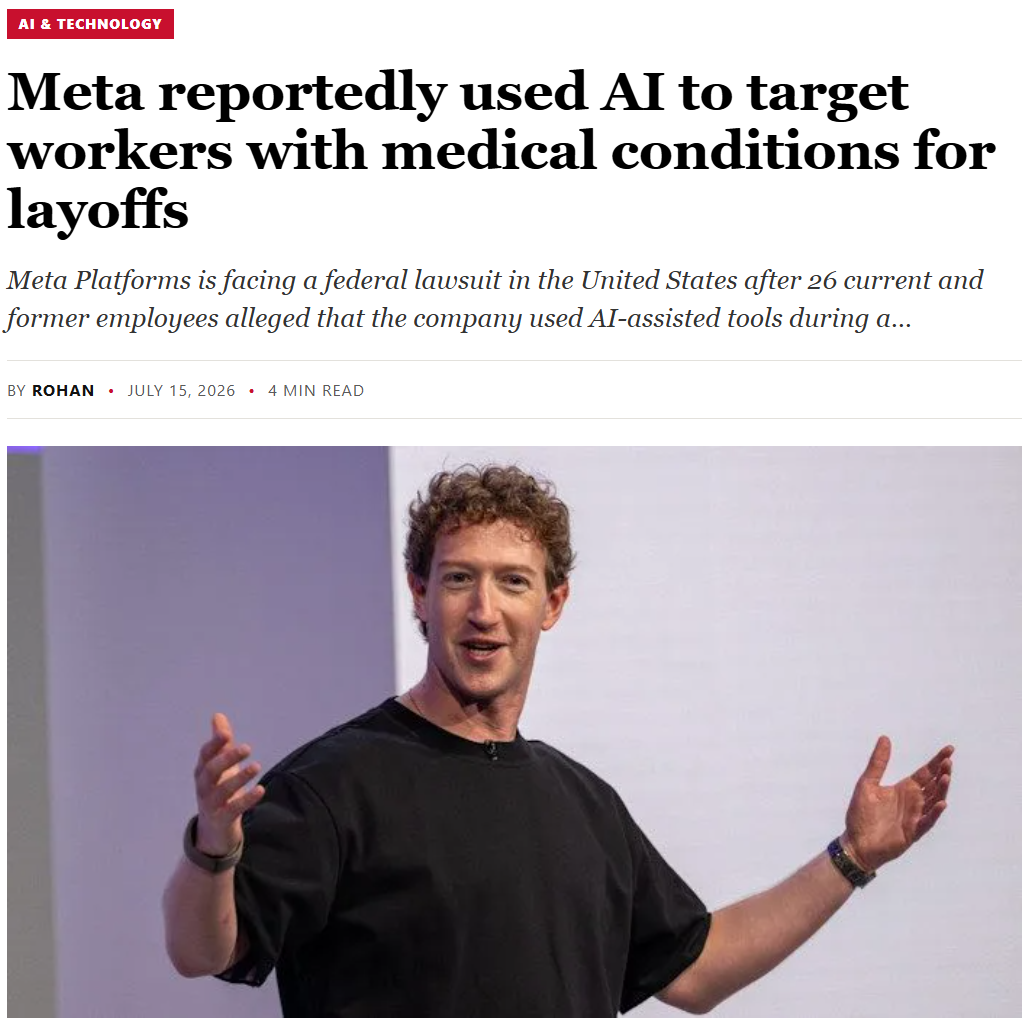
Alt...
AI & Technology
Meta reportedly used AI to target workers with medical conditions for layoffs
Meta Platforms is facing a federal lawsuit in the United States after 26 current and former employees alleged that the company used AI-assisted tools during a…
By rohan
•
July 15, 2026
•
4 min read
![[?]](https://files.mastodon.social/accounts/avatars/115/437/433/456/398/299/original/45147e3ef33b8148.png)
A first look at Alvin has been revealed as part of the Alvin and the Chipmunks comeback announcement.
New co-owners Big Shot Pictures say they'll use cutting-edge technology across their animated projects. Ahead of the next film, The Chipmunks are also expected to appear online "almost like influencers."
The studio is also actively hiring talent with experience in generative AI workflows.
What do you think of this new direction?

George Lucas believes AI is the future of filmmaking.
Speaking to A Rabbit’s Foot, Lucas said AI will make it much easier to create movies, adding:
“There’s nothing you can do about it. That’s progress, it’s the future.”
He compared AI to the arrival of the automobile, arguing that every major technological shift faces skepticism before becoming part of everyday life.
Do you agree with him?
#GeorgeLucas #AI #Filmmaking #Movies

The WSJ exposes how Meta uses AI for discriminatory layoffs while 2M job seekers remain locked out of the market by automated filters. This is the dark reality of the Digital Toll: AI isn't here to help us; it’s being deployed as a cold, algorithmic weapon for corporate surveillance and workforce purging. #TechFeudalism #Meta #AI

Alt...
This surreal digital artwork depicts a tall, shadowy humanoid silhouette standing atop stairs in a monochromatic green glow. The translucent figure features elongated limbs and stands before a complex, matrix-like grid of digital code. Framed by textured, circuit-like pillars, the entire scene evokes a mysterious and cyberpunk atmosphere.
![[?]](https://files.techhub.social/accounts/avatars/109/406/781/911/490/221/original/f9c727786917d9cf.jpg)
Take note if you do NOT want Google using your data to train AI models!
Google recently updated its search privacy settings and automatically opted all its customers into its expanded AI training.
Images, voice searches, and videos uploaded into Google Search Services can be used to train LLMs.
The GOOD news is, you can disable this feature to retain your privacy. https://www.zdnet.com/article/google-training-ai-on-more-of-your-data-now-unless-you-opt-out/ #Google #GoogleSearch #Search #Internet #AI #LLMs #SocialMedia #Privacy #DataPrivacy #Media #SearchServices #Personaldata #Chatbot #SearchHistory #SearchServicePersonalization

Alt...
Internet ones and zeros
The "Digital Toll" is a double scam. The tech architect makes you pay to build the very infrastructure that enslaves you. These forced AI fees don't fund progress; they finance the expansion of a massive surveillance and control grid. We are paying the lords to build our own digital prison. #DigitalToll #Surveillance #AI

Alt...
Set against a solid black background with a glowing cyan grid, a vibrant orange-red step line tracks the performance trajectory of proprietary "Closed weights" models (such as GPT-4, o1, and GPT-5.5 Pro). Running parallel is a glowing magenta-pink line mapping the rapid rise of "Open weights" models (including Llama, DeepSeek-R1, and Kimi K2.6). The visual features a neon green "2K115" logo in the top right corner, completing the sleek, high-contrast cyberpunk aesthetic.
![[?]](https://techpolicy-social.s3.bhs.io.cloud.ovh.net/accounts/avatars/109/671/942/557/361/210/original/1b5167789db8edfe.png)
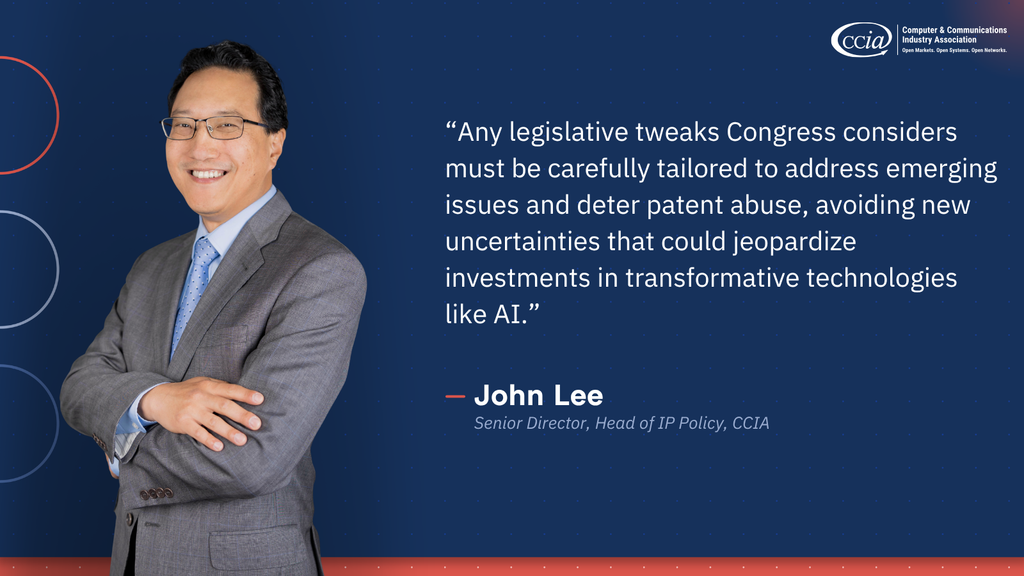
The evidence is clear: America's patent system is doing exactly what it's designed to do. Section 101 consistently protects genuine innovation while preventing monopolies on basic ideas. Federal Circuit affirmance rates of 85.3% for district courts and 95.5% for the USPTO, with judges unanimous in 93.5% of cases, show that it’s predictable, stable, and fueling US leadership in #AI and innovation. https://ccianet.org/news/2026/07/ccia-testified-at-senate-judiciary-hearing-on-patent-system-supporting-innovation-emerging-technologies-like-ai/
![[?]](https://files.mastodon.social/accounts/avatars/109/255/581/158/039/090/original/5ccd8f3caf2fce93.jpg)
FYI: Advertisers face mandatory AI ad labels across Google's five platforms: Labels Google's AI tools apply automatically cannot be removed, as the setting reaches five ad products this month, ahead of EU enforcement starting August 2. https://ppc.land/advertisers-face-mandatory-ai-ad-labels-across-googles-five-platforms/ #AI #Advertising #DigitalMarketing #AdTech #GoogleAds


 🍵
🍵 
![[?]](https://files.mastodon.social/accounts/avatars/000/010/947/original/34a579358b5060ee.png)
Linux creator Linus Torvalds puts foot down on anti-AI comments https://www.gamingonlinux.com/2026/07/linux-creator-linus-torvalds-puts-foot-down-on-anti-ai-comments/
![[?]](https://social-cdn.vivaldi.net/system/accounts/avatars/112/705/217/249/931/772/original/4cb4a02eb51fe987.jpeg)
The following passage from David Brook's article 'The People Who Will Thrive in the AI Age' in @TheAtlantic strongly resonates with me:
The remark “artificial intelligence could do it in five minutes” is not actually about speed. “It’s about a moral re-evaluation. It assumes that what matters is the result, not the effort; the image, not the act of seeing; the product, not the person who becomes capable of creating it.”