Search results for tag #privacy
![[?]](https://acn.social/system/accounts/avatars/116/246/238/447/700/099/original/8adca9c4cd3e3fe3.jpg)
Within EU is now discussed Chat Control. My take on it: private one-on-one chats should remain private, but I would focus on chat groups. Those could be analyzed for security purposes, the discussion being upwards how many members. Should it be 5 or 10 or more? Bigger groups can be used for malicious intent, therefore the measures could make sense. The chat control could be also random, not for every single message or media shared, with ofc the possibility to report. Just so it discourages ill intentions, but still keep conversations private to a certain extent. Maybe a flag, if medias are repeatedly shared over many groups. Where do you draw the line on #privacy of your #message and what is #private , what is #public ? When does one piece of information become public?
![[?]](https://files.mastodon.social/accounts/avatars/115/742/434/865/105/205/original/ba2fa15026c28d18.jpeg)
Foliate is a free, open-source eBook reader for Linux with support for EPUB, MOBI, PDF, CBZ, FB2, and more.
It includes dark mode, annotations, dictionary lookup, text-to-speech, bookmarks, and reading progress, all without requiring an account or sending your reading data to the cloud.
More details: https://digitalescapetools.com/tools/tool.html?id=foliate
#OpenSource #Linux #eBooks #Privacy #FOSS #Reading

Alt...
Screenshot of the Foliate project page showing the app logo, the tagline "Read books in style," and a preview of its clean eBook reading interface with a table of contents and an open book.
![[?]](data:image/png;base64, iVBORw0KGgoAAAANSUhEUgAAAEAAAABAAQAAAACCEkxzAAAAUUlEQVQoz43R0QkAMQwCUDdw/y3dwEvsvzlL4X1IoQkAisKmwfAFT3RgJHbQezpSRoXEqeqCL9BJBf7h3QbOCCxV5EVWMEMwG7K1/WODtlvxAYTtEsDU9F34AAAAAElFTkSuQmCC)
![[?]](https://files.mastodon.social/accounts/avatars/116/140/345/381/171/560/original/3df3aa308e108c44.jpeg)
🧠 Mental and intellectual privacy is a precursor to Freedom of Thought (FoT) and it's what we must protect to keep the Thought Police at bay.
#privacy #privacymatters #freedomofthought #mentalprivacy #intellectualprivacy

Alt...
Text describes freedom of thought.
🤖 Meta's Muse Image Defaults to Public Instagram Photos, Sparking Privacy Backlash
Meta's Muse Image AI uses public Instagram photos by default, prompting privacy concerns. Learn how to opt-out now.

Alt...
Meta's Muse Image Defaults to Public Instagram Photos, Sparking Privacy Backlash
![[?]](https://weredreaming.com/mookie/s/avatar-c033319a3a3d5098e5af08a922200981.png)
![[?]](https://lemmy.ml/pictrs/image/2bb2096b-6c63-4d4c-9809-c21c052af30c.gif)
I think hell just froze over "Cop EXPOSES TRUTH About Flock Cameras & Is Forced To Resign!"
Cross posted from lemmy.ml/post/49840657
Cross posted from lemmy.ml/post/49840439
Credit where credit is due.
![[?]](https://nbg1.your-objectstorage.com/tno-mastodon/accounts/avatars/111/434/264/745/920/273/original/52ff85db085a2a1d.jpg)
![[?]](https://tldr.nettime.org/system_nettime/accounts/avatars/109/528/493/326/851/300/original/ebc905e283d49e82.jpg)
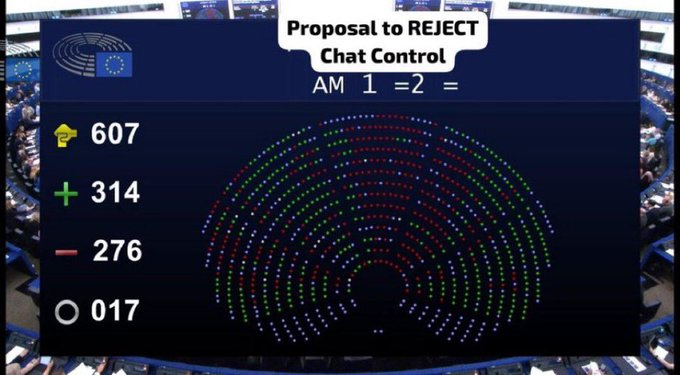
“ Today, the European Parliament allowed the suspicionless mass scanning of private communications (“Chat Control 1.0”) to pass, a measure it had rejected twice in March. Although a majority of voting Members of the European Parliament (MEPs) actually opposed the regulation (314 against, 276 in favor, 17 abstentions), the motion to reject it failed to secure the required absolute majority of 361 votes. As a result, mass scanning is now permitted again until 2028.
A symbolic exemption was adopted for encrypted communications—though in practice, service providers do not scan these anyway. Furthermore, while a majority of voting MEPs wanted to restrict the scanning of private communications strictly to suspects identified by the judiciary (322 to 255 votes), this amendment likewise fell short of the required absolute majority.
Dr. Patrick Breyer, civil rights activist and former Member of the European Parliament (MEP), warns of the consequences:
“The fact that Chat Control is moving forward against the will of the majority of voting MEPs is a farce and damages democracy.””
![[?]](https://files.mastodon.social/accounts/avatars/116/438/335/712/255/336/original/b81951b4c3bf8fbb.png)
🚨 NEWS: Meta corregge il led di privacy dei Ray-Ban smart glasses mentre prepara un modello sempre acceso senza spia luminosa
Ecco i punti chiave in breve:
💡 Meta ha risolto un problema di privacy critico sui suoi occhiali intelligenti Ray-Ban con un aggiornamento obbligatorio che ripristina il funzionamento del LED indicatore di regist...
#meta #privacy #rayBan #smartGlasses #led

#Meta Patents AI Device That Tracks Your Emotions, Watches You Take Your Meds
https://www.404media.co/meta-patents-ai-device-that-tracks-your-emotions-watches-you-take-your-meds/
![[?]](https://static.piaille.fr/accounts/avatars/116/812/044/304/979/508/original/c60ed955bbfd165a.jpg)
New article about how to protect your Privacy under Chat Control V1
https://gnualex.wstr.fr/#how-to-protect-your-privacy-on-chat-control-10
![[?]](https://futurism.com/wp-content/uploads/2025/09/favicon.png?quality=85&w=192)
Flock Cameras Screw Up, Swarm Innocent Man With Armed Police
"Once these systems have you in their crosshairs, there's pretty much only one way it can go."
The post Flock Cameras Screw Up, Swarm Innocent Man With Armed Police appeared first on Futurism.

Alt...
Flock Cameras Screw Up, Swarm Innocent Man With Armed Police
![[?]](https://cdn.fosstodon.org/accounts/avatars/115/532/410/310/000/993/original/08065bd1d1c34cad.png)
Apple's ‘Hide My Email’ Feature May Reveal Users’ Real Addresses
This vulnerability has been know over a year by now, if you want to be anonymous use ArcaneChat instead!
Keep the family safe 🤗💜✨
#ArcaneChat #privacy #anonymous #anonymity #decentralization #email #encryption #europe #european

![[?]](https://apobangpo.space/system/accounts/avatars/115/820/569/493/647/893/original/0470bfed0d253119.jpg)
“But I’ve learned from this experience, taking this kind of job means losing some of the privacy that most of us expect,” he said. “The American people have a right to know if their leaders are facing health challenges that might affect their ability to perform their duties even temporarily.”
https://www.cnn.com/2026/07/07/politics/mitch-mcconnell-joe-biden-health-problems
#healthcare #PublicHealth #privacy #infosec #PaidLeave #UScongress #USpol
UPDATE: this doesn't include e2ee comms for now
BREAKING: The EU has passed “Chat Control 1.0”
This makes it MANDATORY for companies to scan private messages and submit them to EU authorities.
This is so absurd it is hard to believe it is even happening. And we need more than ever apps that are decentralized without a central point of failure
#Europe #ChatControl #privacy #onlineSafety #freedom #security #autonomy #eu #email #decentralization
Governments aren't trying to break VPN encryption. They're trying to detect that you're using a VPN in the first place. That's why the real battle has shifted from encryption to obfuscation.
In this deep dive, I explain:
• Why age verification laws are putting VPNs in the spotlight
• How Deep Packet Inspection (DPI) actually identifies VPN traffic
• Why WireGuard and OpenVPN are fingerprintable
• How Shadowsocks evolved into VLESS + REALITY + XTLS Vision + uTLS
• Why this protocol stack is becoming the gold standard for censorship resistance
If you've ever wondered how modern VPNs stay one step ahead of DPI, this is for you.
#CyberSecurity #VPN #Privacy #Networking #NetSec #Linux #DPI #TLS #InternetFreedom #InfoSec
![[?]](https://media.infosec.exchange/infosec.exchange/accounts/avatars/110/560/511/618/170/134/original/4f33ba36608d1311.png)
The more I browse the internet, the more I realize that the new normal is that privacy is the responsibility of the user, that websites, including cybersecurity companies whose professed profession is to protect, have no obligation to serve it to you, meaning that if you don't know better (which is a lot of people and the companies in question are banking on that), your data will be shared and sold, and that's only the tip of the data-peddling iceberg.
We get to the point where you thank your stars that the company in question is actually giving you some sort of notice of data "theft" and a limited option to exercise your rights over data that has already been siphoned. Isn't that what ransomware criminals do, except maybe for the semantics of the extortion part?
Why would you trust any company that has all the tracking and third-party sale and sharing options turned on by default? Have you ever tried to get a look at some of the notorious third-party buyers that some "security" companies are all too happy to do business with? Why would you even call yourselves "cybersecurity" companies instead of "data exfiltration" companies? #privacy #security #tracking
![[?]](https://media.mas.to/accounts/avatars/109/442/454/487/918/952/original/d8a5f7a5f95ae2cb.png)
Google's new remote attestation scheme is every bit as terrible as its old remote attestation scheme
#Google owes its existence to the open web, but today, its technological “innovations” have much to do with locking users into a “walled garden.” The latest of these is “reCAPTCHA Mobile Verification,” an experimental initiative that will let companies block users if they are running independent, "de-googled" versions of #Android. These “indie Android” versions are favored by people who want to protect their #privacy and their attention by blocking #trackers and #ads. Worse, this is just the latest in a line of similarly user-hostile measures.
#remoteAttestation #recaptcha #advertising
![[?]](https://files.mastodon.social/accounts/avatars/116/288/047/331/063/768/original/cb19ff2b21b4875d.png)
Google Maps doesn't have to be your default. A recent test of five alternatives highlights apps like Organic Maps for ad-free offline routing and Reitti for self-hosting your location timeline. Specialized open-source tools are filling the privacy gaps. #Tech #OpenSource #Privacy #GoogleMaps
https://blazetrends.com/why-apple-maps-and-openstreetmap-alternatives-are-breaking-googles-navigation-monopoly/?fsp_sid=48310
![[?]](https://mst-gts.airikr.me/fileserver/01HXQ9K4V66SFN8WF3SVYC18X6/attachment/original/01KVASV5K2G14N26KDR6EPDC2G.webp)


 [
[Today is a very sad day. Chat Control 1.0 is now an active law in EU: https://lemmy.ml/post/49817266
![[?]](https://files.mastodon.social/accounts/avatars/108/243/340/664/949/652/original/d4175ecdd0540a79.jpg)
A poke in the eye with a sharp stick.
Connecting The Meta Privacy Dots
#Meta #Tech #Privacy #smartglasses
https://warnercrocker.com/2026/07/09/connecting-the-meta-privacy-dots/

![[?]](https://warnercrocker.com/wp-content/uploads/2025/03/cropped-headshot2.jpeg) Life on the Wicked Stage: Act 3 » 🌐
Life on the Wicked Stage: Act 3 » 🌐
@warnercrocker.com@warnercrocker.com
Connecting The Meta Privacy Dots
As dangerous as it is, I find it somewhat humorous to watch the reactions to some of the actions Meta is taking to gather up and reprocess what we see and hear. Especially from the always hungry for some new cool tech crowd. On the one hand you can’t blame someone from wanting the next new thing to play with. On the other you also can’t blame tech companies for taking advantage of hobbyists’ hunger.

Every where you turn on the Internet, everyone is posting about Meta changing its Instagram policy so that unless Instagram users opted out, any of their content on that platform was now free for the grabbing by anyone using Meta’s AI tools to create and distribute. You can imagine the possible nasty outcomes of what that would be like. Certainly if you’ve been paying even a smidgen of attention to the goings on with Grok.
It’s also been interesting to watch the small avalanche of users on other social media announcing that they are taking their Instagram accounts private, opting out by flipping the designated switches, or just bailing on Instagram altogether.
Almost parallel to this policy change happening word spread from Joanna Stern, among others, about a trend (and apparent underground business opportunity) of users of Meta’s smart glasses who were disabling the mechanism that displayed the warning light when the camera was recording. Talk about a poke in the eye with a sharp stick.
Meta quickly moved to put the kibosh on that with a software update that disabled the cameras if the warning light was tampered with. (I wonder if it works if you just taped over the camera?)
Privacy focused tech geeks were all over that, praising Meta for moving so swiftly to counter the hack.
But hold on a minute. These stories don’t end there. According to a report from The Financial Times, Meta is testing ‘super sensing’ AI glasses that can record video and audio continuously.
Here’s a quote:
The $1.5tn social media platform has been advancing a new hardware line of smart glasses that would continuously record audio while taking photos every few seconds, according to multiple people familiar with the matter. A user could then use AI to help query what they saw or heard, or recall their day.
And the worm continues to turn:
With Meta’s current AI smart glasses, an LED in the corner of the frame lights up to signal to others when a wearer is taking photographs or filming.
However, executives are currently planning not to activate the LED when the super-sensing features are being used, according to multiple people familiar with the matter. That would make it harder for bystanders to know when they were being recorded, potentially intensifying the privacy concerns surrounding the technology. Those plans could still change, however, several people said.
It’s pretty easy to connect the dots between these two stories. Mark Zuckerberg wants anything and everything he can on you, and he doesn’t care how it’s used once he has his paws on it and his data centers crunching it. The privacy implications are certainly real, even if you don’t use a Meta product but fall within camera or microphone range of someone who does.
We’ve heard all of this before in different contexts. Microsoft caught all kinds of hell for Windows Recall, a feature that continually monitored and recorded what was on your screen. I’m old enough to remember the hue and cry about Google Glasses back in the day.
It’s a bit eerie how those at the time very visceral reactions seem to have softened in this new era of folks rushing to turn over their data to the AI crunchers in order to better plan a party. Should be quite interesting to watch party videos if this prototype Meta is testing ever comes to reality and becomes accepted.
I predict we’re going to keep hearing about this kind of thing again and again as the tech companies keep thirsting after any morsel of data about you, what you do, and where you do it. For their purposes that thirst will never be quenched.
It used to be “their purposes” was simply defined as selling or brokering your data for advertising purposes, because despite all of the grand promises of how this can help users, it’s always been about making a buck hustling your data for advertisting. Add AI into the mix, and it’s also about continuing to feed and train that beast to help them with that same ultimate goal.
Apple is rumored to be working on a version of AirPods Pro that contains cameras, apparently for AI purposes. All the talk you hear about Apple and others creating pendants, pins, other wearables, and counter top robots all follow the track to the same end point regardless of how the user benefits are packaged and hyped. Even if some follow Apple’s announced approach of keeping your data on whatever device is recording your every moment, those that don’t, like Meta, will spoil any potential benefit. Heck, in the long run, that’s type of spoilage is probably going to be a good thing in this era of overreaching.
It’s a damn shame really. Because there are certainly legitimate accessibilty uses for this kind of technology. But I have to say, it sure feels like that’s going to be just another hyped up smokescreen to try and mask the real purposes behind all of this.
Thanks for reading. You can subscribe to this blog if you care to. You can also find more of my writings on a variety of topics on Medium at this link, including in the publications Ellemeno and Rome. I can also be found on social media under my name as above. This site does not use affilate links.
#ai #airpods #Apple #ArtificialIntelligence #cameras #Internet #Meta #privacy #security #Smartglasses #SocialMedia #technology
![[?]](https://files.mastodon.green/accounts/avatars/109/258/048/381/846/891/original/97290ecebc04985d.png)
RE: https://loops.video/v/gMKfZjMBDu
@EUCommission I’m absolutely furious about #chatcontrol
EU failed it’s promises about #democracy, #privacy and putting people first.
You didn’t listen. Instead you put corrupt authoritarian and industry lobbyists before the ideals you promised you’d stand behind.
My only consolidation is that it will fail spectacularly, it will do so quickly, it will become a privacy and hacking disaster, and a lot of activists will get to tell you: ”We told you so!”
![[?]](https://media.mas.to/accounts/avatars/109/330/456/928/545/748/original/2d73344615ec5e1e.png)
![[?]](https://infosec.pub/pictrs/image/0f60a096-c189-43fa-bcbb-1b86ee5e244f.jpeg)
Procedural trick before summer break: EU Parliament reactivates Chat Control 1.0
cross-posted from: feddit.uk/post/52022085
After a long dispute, the EU Parliament has voted in an expedited procedure to extend the controversial exception rule for the indiscriminate scanning of chats.
On the last day of session before the parliamentary summer break, the EU Parliament narrowly voted to extend the long-controversial legal basis for Chat Control 1.0 for another approximately two years. Amendments that would have completely rejected an initiative by the Council of Ministers did not find the required absolute majority at the very beginning of the vote. Later, only two correction proposals managed to overcome this hurdle, stipulating that the scanning of private chat messages should not occur with end-to-end encryption.
The plan is exclusively for “special technology for the sole purpose of detecting and removing known online material of child sexual abuse.” Photos or videos not previously captured would therefore not be searched for. Ultimately, 276 representatives voted against the member states’ motion to reactivate Chat Control, 286 voted in favor, and 30 abstained.
The result paves the way to quickly reinstate a transitional regulation that expired in April. This exception regulation allows tech giants like Meta, Google, or Microsoft to voluntarily search private chats, emails, and messenger services for material related to child sexual abuse without specific suspicion.
The development had already become apparent on Tuesday. With a narrow majority of 331 to 304 votes with eleven abstentions, MEPs voted for an urgency motion that enabled Thursday’s vote. Tug-of-war in the background
Behind the scenes of the decision was an unprecedented political tug-of-war that has caused consternation among civil rights advocates and opposition politicians alike. As recently as March, MEPs had, after tough negotiations in the Council of the EU, let an extension of the interim regulation fail, thus sealing the temporary end of Chat Control 1.0. That the same text was quickly brought back onto the agenda just before the summer break is thanks to a strategic maneuver by the Christian Democratic EPP group around President Roberta Metsola, supported by the Council and the EU Commission.
Critics speak of a democratic foul play. Although the majority of MEPs actually present in the chamber voted against the proposal, it passed. Fierce resistance against the procedure also emerged within the liberal Renew group until the very end. MEP Irena Joveva emphasized that the House cannot simply wave through mass surveillance of the population. It is about protecting both children and citizens’ privacy. Rapporteur Birgit Sippel (SPD) also condemned the short-notice expedited procedure without the involvement of the responsible committee, calling it unfair maneuvering.
The vote has direct consequences for the approximately 450 million EU citizens. According to critics, large US tech corporations, which lobbied heavily for the exception rule in the run-up, are now once again receiving a legal free pass to automatically scan private digital mailboxes billions of times. While the amendment successfully introduced by the Greens ensures that fully encrypted communication should formally remain protected, it does little to change the fundamental problem of the dossier. No acute protection gap
An evaluation report by the EU Commission gives the previous practice of Chat Control a very poor assessment. The Brussels government institution itself admits that after years of application, no proof of the proportionality of the measures can be provided. Only a tiny fraction of the messages scanned worldwide – just 0.00000077 percent in the EU – actually contained illegal material.
On the other hand, there is immense susceptibility to errors: the false positive rates of the filter technologies used are up to 20 percent, leading to mass suspicion of serious crimes for innocent citizens. The Commission could not demonstrate a clear link between automated reports and real convictions or the rescue of abused children. For civil rights advocate Patrick Breyer, it is clear: “Suspicionless chat control is as unacceptable as randomly opening all letters.”
The role of the German government also raises questions. While it was always stated in Berlin that suspicionless chat controls are an absolute taboo in a state governed by the rule of law, the coalition buckled in the Brussels bodies and paved the way for the current expedited procedure. The argument often made by proponents that the expiry of the regulation in April would have led to an acute legal gap is refuted by new figures: the Federal Criminal Police Office did not record any drop in suspicious activity reports after its expiry in spring. “Black day for civil rights”
The reactivation of Chat Control 1.0 also casts a shadow over the parallel negotiations on Chat Control 2.0. This is intended to create a permanent and mandatory legal basis for all providers. EU MEP Erik Marquardt (Greens) speaks of a black day for civil rights: the political horse-trading is blocking targeted, effective measures such as an EU child protection center and the strengthening of law enforcement agencies. Green Party MP Jeanne Dillschneider also demands: “We finally need effective child protection in the digital space. This important concern must not be played off against the fundamental rights of all.”
The temporary exception provision now restricts the confidentiality of digital communication for another 24 months. It overrides core areas of the European e-Privacy Directive.
![[?]](https://media.infosec.exchange/infosec.exchange/accounts/avatars/109/287/703/066/543/520/original/0084db33a1521fa5.jpeg)

Your phone’s location history is not just metadata!
This week on the Shared Security Podcast, we discuss the Supreme Court’s geofence warrant/location privacy ruling and why it matters for anyone carrying a smartphone.
A geofence warrant starts with a place, not a named suspect. That means location data can potentially sweep ordinary people into an investigation simply because their phone was near a location at a certain time.
We also talk about the bigger privacy picture: app permissions, weather apps, ad tracking, data brokers, Google’s location history changes, and the practical steps you can take to reduce your location data footprint.
Watch this episode on YouTube:
https://youtu.be/jCtdE72ymII?si=CzXPkQxlRuzJDUb_
Listen and subscribe wherever you like to get your podcasts:
https://sharedsecurity.net/subscribe
https://sharedsecurity.net/2026/07/06/the-supreme-court-just-put-limits-on-geofence-warrants/
#podcast #geofencewarrants #supremecourt #cybersecurity #privacy
![[?]](https://files.mastodon.social/accounts/avatars/116/306/723/250/896/134/original/dc8c4716ee826384.png)
@Tutanota The #Cyberfascists need to be jailed!
I'll never forgive nor forget this betrayal to you, @europarl_en !
- And I will actively sabotage this #cyberfascist shitshow by any means necessary!
How people interpret this ain't my problem...
- I merely exercise my inalienable #HumanRights to #privacy!!!
A win for corporate America and the surveillance industry. And you dare talk about digital sovereignty?
"Due to the outcome of the vote, 'Chat Control 1.0', which was temporarily paused after EU institutions could not agree to extend it, will now be revived. It is a temporary exception that lets U.S. tech firms scan direct messages on services such as Instagram, Discord, Snapchat, Gmail and iCloud without a warrant or prior suspicion."
More:
Heise Online: Procedural trick before summer break: EU Parliament reactivates Chat Control 1.0 https://www.heise.de/en/news/Procedural-trick-before-summer-break-EU-Parliament-reactivates-Chat-Control-1-0-11359605.html #privacy #chatcontrol #surveillance
![[?]](https://files.mastodon.social/accounts/avatars/110/040/853/498/247/843/original/1ce81d46b54d7bc1.png)
Alberta wants AI government, but still expects citizens to trust spoofable calls, callback numbers, exposed voter data, and broken verification systems.
That is not modernization.
That is old process wearing new technology.
Modernization cannot mean scanning old code while leaving old risks untouched.
https://open.substack.com/pub/lawrencenault/p/alberta-wants-ai-government-it-still
![[?]](https://i0.wp.com/rbfirehose.com/wp-content/uploads/2021/01/cropped-Blank-512-x-512.png?fit=512%2C512&ssl=1)
Vogue Business: Do Smart Glasses Have a Surveillance Problem?. “Big Tech has been borrowing from fashion’s playbook to improve its image, and the new Kylie partnership and glasses line launch is its biggest pivot to fashion and culture yet. Beneath the question of whether Jenner can finally make Meta’s smart glasses cool, there’s a much more challenging question for Meta and its rivals. […]
https://rbfirehose.com/2026/07/09/vogue-business-do-smart-glasses-have-a-surveillance-problem/![[?]](https://files.mastodon.social/accounts/avatars/109/909/391/093/212/804/original/67dc6f5bd36c19ad.png)
#Privacy Derangement Syndrome is a pejorative term used to describe negative, irrational reactions to learning that your citizens have access to any kind of anonymity or privacy in their affairs, and immediately voting them away.
aka the same people who want you to upload your real ID any time you use the internet also just gave themselves the right to have a look at everything you've every written, drawn or have taken a picture of.
https://brusselssignal.eu/2026/07/european-parliament-approves-mini-chat-control/
![[?]](https://files.mastodon.social/accounts/avatars/116/803/569/854/912/671/original/1304f0108d03e4d9.png)
Is your internet freedom being restricted? 🌍
Experience truly borderless browsing with Celestride. Powered by advanced VLESS+Reality tunnels to bypass deep packet inspection (DPI) and censorship seamlessly.
✅ Zero-logs policy
✅ Anonymous registration
✅ Blazing fast 10 Gbps nodes
Take control of your privacy today!
🔗 https://celestride.pro
#Technology #Privacy #CyberSecurity #InfoSec #TechNews #VPN #OpenSource #Mastodon #DigitalRights #Web3