Search results for tag #privacy
![[?]](https://media.bsd.cafe/bsdmmedia01/accounts/avatars/113/508/940/914/201/063/original/94cf855aa8db9c98.webp)
The threat of age verification is becoming increasingly real. More and more states are seeking to introduce identity checks through the back door under the guise of age control, ostensibly for the protection of children. And an increasing number of providers, as well as open-source projects, are implementing this—partly in preemptive obedience—or are at least laying the groundwork for it.
So far, the Fediverse remains a safe haven, an island of bliss. But what if the state seeks to control the age of users here as well? Unfortunately, the Fediverse is not immune to such attacks, because instances are operated by people who, in the worst-case scenario, could face legal penalties.
Would like to hear your thoughts on this.
![[?]](https://media.infosec.exchange/infosec.exchange/accounts/avatars/116/751/833/194/065/934/original/99306ec0cfb9064f.png)
Free 10-minute privacy audit. No account, no email. Just a checklist to see exactly where you stand. https://indigoprivacy.com/audit #privacy #indigoprivacy
![[?]](https://files.mastodon.social/accounts/avatars/116/751/863/753/392/750/original/be14ea1ddc815e7d.png)
Free 10-minute privacy audit. No account, no email. Just a checklist to see exactly where you stand. https://indigoprivacy.com/audit #privacy #indigoprivacy
![[?]](https://s3.eu-central-003.backblazeb2.com/social-lol-media/accounts/avatars/114/043/586/214/955/480/original/8ba534c0e47d8e83.png)

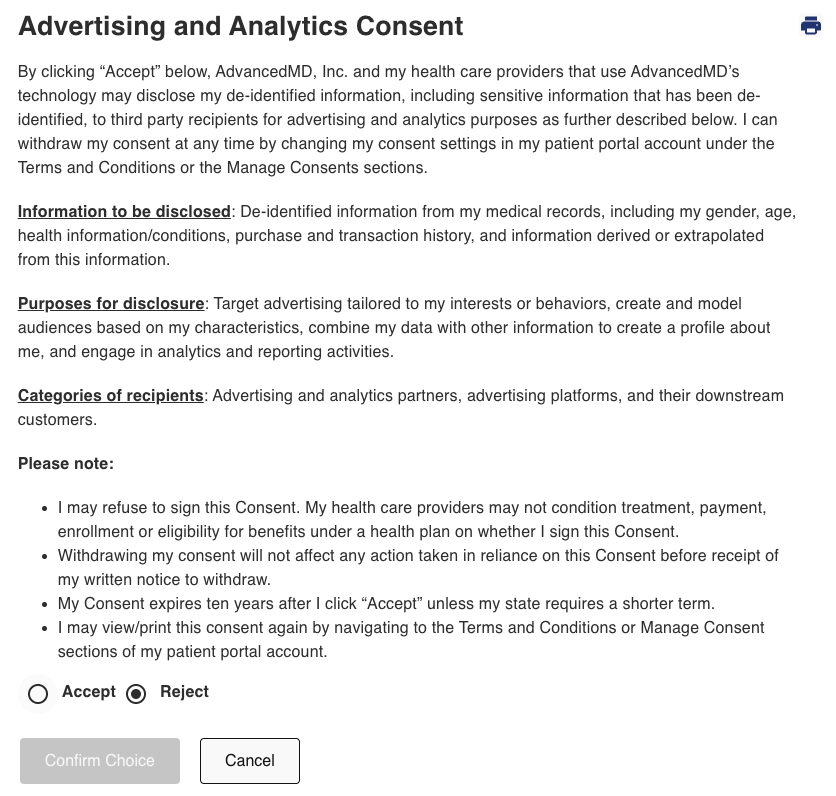
I made an account with my new psychiatrist's online portal and got hit with this nightmare of a privacy consent form. Read it.
This should be so incredibly illegal, even if the patient consents. It's honestly making me second guess seeing this psychiatrist at all, even though I rejected the consent form.
The platform is Advanced MD btw.
Alt...
A screenshot of the privacy consent form. It's a bit long, so the summary is that, by clicking "accept", you, the patient, allow Advanced MD to use and disclose your de-identified medical records to third parties and their downstream customers for advertising and analytics, including your gender, age, health information/conditions, purchase and transaction history, and information derived or extrapolated from this information.
![[?]](https://files.mastodon.social/accounts/avatars/110/884/114/483/169/490/original/53023fd0f8ad4b53.jpeg)
In the Soviet union the citizens are monitored constantly. USA is headed or already this is being done we do not know the whole extent. Flock cameras monitoring vehicles movements. Credit card’s tracking your purchases & locations. New automobile’s computers keeping track. Even the city’s are getting CCTV coverage. Facial recognition software is everywhere. Privacy is a joke on the internet. How does this feel America? The new USA is scary. #USA #surveillance #fascism #America #american #privacy
Your smart TV likely reports everything you watch back to the manufacturer, including content from HDMI-connected devices. #privacy #iot #smarttv #indigoprivacy
![[?]](https://nbg1.your-objectstorage.com/tno-mastodon/accounts/avatars/111/434/264/745/920/273/original/52ff85db085a2a1d.jpg)
The #UK’s New Under-16 #SocialMediaBan Will Cause More Harm Than It Prevents
#SocialMedia #AgeVerification #privacy #cyberscurity #politics
#EFF Joins 60+ Groups Urging the #UK to Halt Face Estimation at the Border
https://www.eff.org/deeplinks/2026/06/joins-60-groups-urging-uk-halt-face-estimation-border
#immigration #politics #privacy #FRT #FacialRecognition #biometrics #AgeVerification
Smart meters report your electricity usage in 15-minute intervals, enough resolution to infer whether you're home, awake, or running specific appliances. #privacy #smartgrid #iot #surveillance #indigoprivacy
![[?]](https://files.mastodon.social/accounts/avatars/116/288/047/331/063/768/original/cb19ff2b21b4875d.png)
Pixel owners are ditching $100 Otter.ai subscriptions for Google Recorder's offline Gemini Nano transcription. Local NPU processing ensures total audio privacy without cloud servers. #GoogleRecorder #OtterAI #Privacy #TechNews #Android
https://blazetrends.com/google-recorder-kills-the-100-otter-ai-subscription-with-gemini-nano-update/?fsp_sid=38181
#Telegram ban in #India sparks a rush to VPNs, rival apps
https://techcrunch.com/2026/06/18/telegram-ban-in-india-sparks-a-rush-to-vpns-rival-apps/
#Canada Is Forging Ahead with Its Dangerous #Surveillance Bill
https://www.eff.org/deeplinks/2026/06/canada-forging-ahead-its-dangerous-surveillance-bill
Field Notes from a Year of #OPSEC Training
https://www.eff.org/deeplinks/2026/06/field-notes-year-opsec-training
![[?]](https://files.mastodon.social/accounts/avatars/115/742/434/865/105/205/original/ba2fa15026c28d18.jpeg)
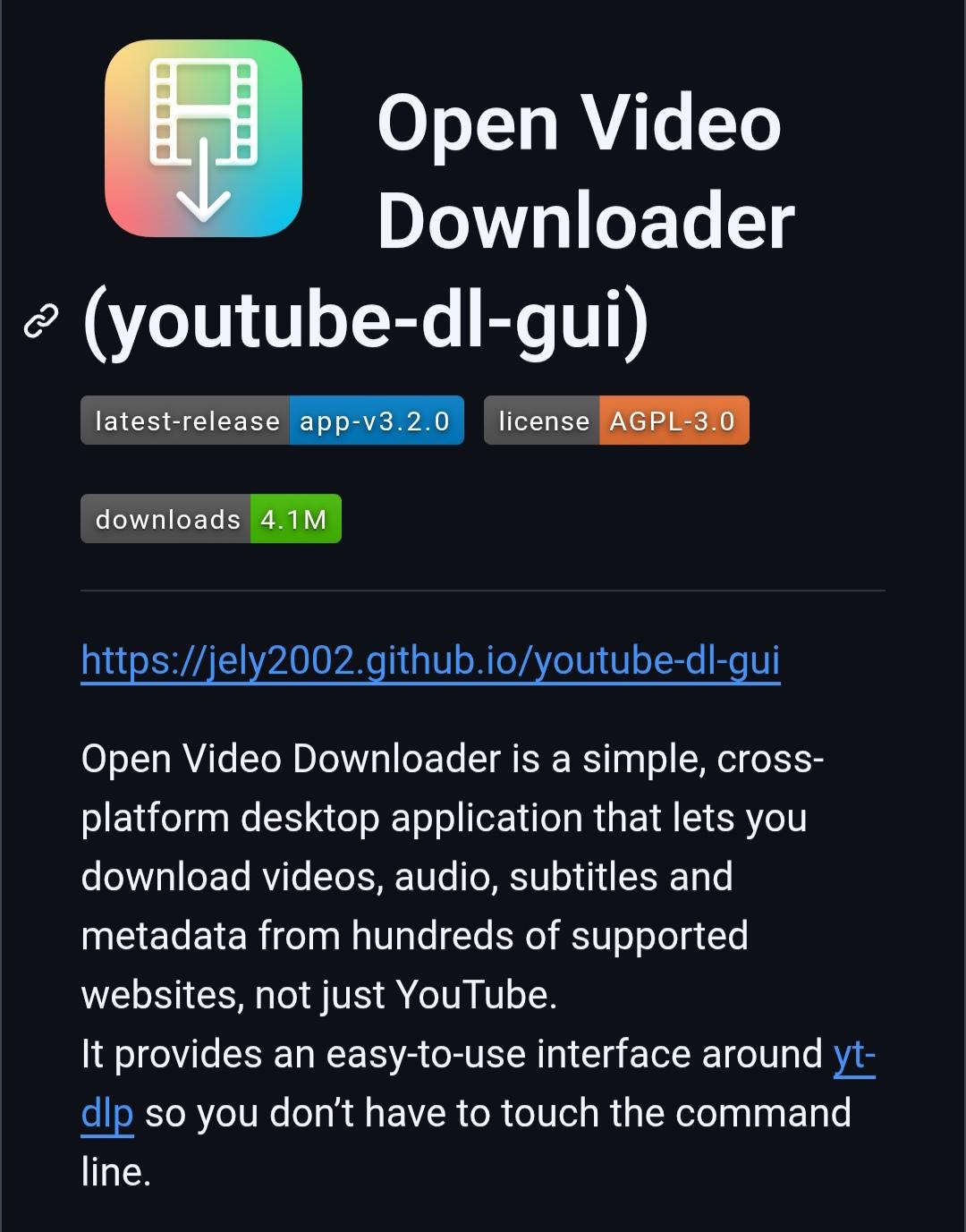
Open Video Downloader is a free and open-source desktop app for downloading videos, audio, subtitles, playlists, and metadata from hundreds of websites.
Built on top of yt-dlp, it offers a simple graphical interface , no command line required. Available for Windows, macOS, and Linux under the AGPL-3.0 license.
More details: https://digitalescapetools.com/tools/tool.html?id=open-video-downloader
#OpenSource #Privacy #Linux #Windows #macOS #ytdlp #VideoTools
Alt...
Screenshot of the Open Video Downloader project page. The page shows the application's colorful icon featuring a film strip and download arrow, alongside the title “Open Video Downloader (youtube-dl-gui).” Below are badges indicating version 3.2.0, AGPL-3.0 license, and over 4.1 million downloads. The description explains that Open Video Downloader is a cross-platform desktop application that can download videos, audio, subtitles, and metadata from hundreds of supported websites. It highlights that the app provides a simple graphical interface built on top of yt-dlp, eliminating the need for command-line usage.
![[?]](https://infosec.pub/pictrs/image/0f60a096-c189-43fa-bcbb-1b86ee5e244f.jpeg)
Canada Is Forging Ahead with Its Dangerous Surveillance Bill
With no serious debate, including on proposed amendments, Canada is blazing full speed ahead with Bill C-22, which would threaten encryption and increase surveillance. Also known as the Lawful Access Bill, Bill C-22 is currently moving forward quickly to a vote despite the many, many criticisms civil liberty groups and the tech industry have hurled at it.
As we’ve discussed before, Bill C-22 is dangerous on multiple levels. It pushes for requirements for metadata retention, expands information sharing with foreign governments, and establishes a mechanism that allows Canada’s Ministry of Public Safety to demand that companies create backdoors, effectively breaking encryption. That mechanism was a key facet of Part 2 in Bill C-22, and the government prevented it from being independently debated.
In a deep analysis of the bill, Citizen Lab and the Canadian Civil Liberties Association detail every one of flaws of this proposal, concluding that most elements are unsalvageable.
A wide range of tech companies agree. Signal, Apple, Google, and several VPN providers oppose the bill, and some have said they’d likely be forced to either cut Canadians off from certain features or shut down services in Canada altogether.
The Canadian government wants this dangerous, complicated, overreaching bill passed before June 19. Bill C-22 is riddled with privacy problems that affect millions of people. It should be debated and studied fully, not jammed through on an arbitrary deadline.
OpenMedia is offering a tool for Canadians to contact their elected representatives about the bill. Actions taken on OpenMedia’s website are governed by OpenMedia’s privacy policy, not EFF’s.
Some local police have access to an ICE facial recognition app
cross-posted from: infosec.pub/post/48272905
Federal immigration officers often use facial recognition technology to identify immigrants in the field. Now, a newly revealed document from the Department of Homeland Security outlines plans to give local police working on its behalf the same type of technology.
The document, first reported earlier this month by the tech news outlet 404 media, is a Privacy Threshold Analysis, which is essentially a federal report assessing whether the privacy implications of a tool warrant further government study.
The tool in question is a mobile app called the ICE Task Force Module, which allows local police to scan the faces of people they stop in their communities.
The app then compares the facial scan against more than 250 million government records. Those include the State Department’s visa records and records from the Traveler Verification Service, used by the Transportation Security Administration at airports to verify identities on international flights.
Once police scan a person’s face, the app then instructs an officer either to “not detain or arrest,” or it gives the officer a reference code to obtain more information from ICE.
The photos captured by the app are then stored in an internal DHS system for 15 years, the document states.
…
Those local officers, called “ICE non-federal law enforcement officers” in the document, are likely participants in the federal 287(g) program. A subset of that program, the Task Force Model, gives local police the authority to arrest immigrants on ICE’s behalf during their routine police duties. There are about 1,300 police agencies participating in the Task Force Model nationwide.
The DHS analysis “raises more questions than I think it answers,” says Clare Garvie, deputy director of the Technology Law and Policy Program at New York University School of Law’s Policing Project.
For one, the document says the app launched last September, which suggests police are already using it.
It also seems to work similarly to Mobile Fortify, a facial recognition app that ICE and officers with Customs and Border Protection already use, but it’s unclear whether the new app uses the same technology or something entirely its own.
…
Privacy experts told NPR that allowing local police to conduct similar surveillance could create a chilling effect on freedom of speech, if people begin to worry they’ll face repercussions for attending protests, for instance, or for legally observing ICE activity in their communities.
Homeland Security Secretary Markwayne Mullin acknowledged at a congressional hearing this month that the agency has used facial recognition technology on protesters and had been able to identify people who were present at protests in Oregon who were also at the recent protests outside the Delaney Hall Detention Facility in Newark, N.J.
What’s more, Garvie says, facial recognition technology is not always accurate, and there have been cases of people detained by ICE who were wrongly identified by the technology.
…
“This app wouldn’t work if they didn’t have databases to pull people’s pictures from and compare against,” says Cooper Quintin, a senior staff technologist with the Electronic Frontier Foundation, a nonprofit that advocates for digital privacy. “They’re playing semantics. They’re certainly not being forthright. You know, do they have a database of protesters? Maybe they don’t call it that.”
He says allowing police to use this technology to do immigration enforcement is a significant expansion of ICE’s operations.
“It makes this sort of face surveillance ubiquitous on American streets,” Quintin says. “I don’t think that Americans should tolerate law enforcement being able to scan anyone’s face at any time for any reason to try to determine their identity. This is the new form of ‘papers, please.’”
“Digital Colonialism”: U.S. Demands to Access Africans’ Data Raise Privacy, Sovereignty Concerns
https://www.propublica.org/article/trump-state-department-africa-uganda-aid-medical-data-privacy
![[?]](https://files.mastodon.social/accounts/avatars/001/097/892/original/0a8075185d53ecad.png) James House-Lantto (He/Him) [(He/Him)] » 🌐
James House-Lantto (He/Him) [(He/Him)] » 🌐
@Theeo123@mastodon.social
Discord will begin testing new forms of Age verification, face scans will still be an option, but now they will trial accepting Google Wallet & credit Card Checks. Face scans will now occur On-Device with a new vendor named "Incode"
![[?]](https://i0.wp.com/rbfirehose.com/wp-content/uploads/2021/01/cropped-Blank-512-x-512.png?fit=512%2C512&ssl=1)
ProPublica: “Digital Colonialism”: U.S. Demands to Access Africans’ Data Raise Privacy, Sovereignty Concerns. “Frank Ssekamwa says the United States presented his country with an impossible choice. If it accepted the terms of a new health agreement, Uganda would have to give the U.S. access to the data of millions of his fellow citizens — a decision he worries would make their personal […]
https://rbfirehose.com/2026/06/20/digital-colonialism-u-s-demands-to-access-africans-data-raise-privacy-sovereignty-concerns-propublica/![[?]](https://files.mastodon.social/accounts/avatars/108/407/833/047/564/824/original/44e20e7456c1a91d.png)
🎤 Call for speakers: Join the community! 🎤
Mobifree & Murena present: The Fair Tech Summit Europe
📆 Oct 6th, 2026 – One day conference on fair tech in Luxembourg
Slots available for: ethical tech makers, privacy advocates, open-source contributors
Share your knowledge via:
🔸 Longer talks
🔸 Short insights into your work
🔸 Roundtable discussions
👉 Apply: https://fairtechsummit.org/#register
Too busy/shy to speak? Submit your brand logo for our digital poster instead!
![[?]](https://cdn.masto.host/lingolol/accounts/avatars/115/645/018/233/576/898/original/480df0748b4dcc97.jpg)
#Privacy
#Enshittification
#Computers
AMD will reinstate memory encryption on Ryzen 9000 CPUs through a BIOS update in July — TSME is coming back after 'valuable community feedback'