Search results for tag #surveillance

@Tupp_ed Hi Simon, I beg of you: can I please just print this and hand it out in my workplace when I'm delivering data protection training..?
https://mcgarrsolicitors.ie/2026/07/07/can-employers-monitor-staff-on-cctv-gdpr-rules-for-ireland/

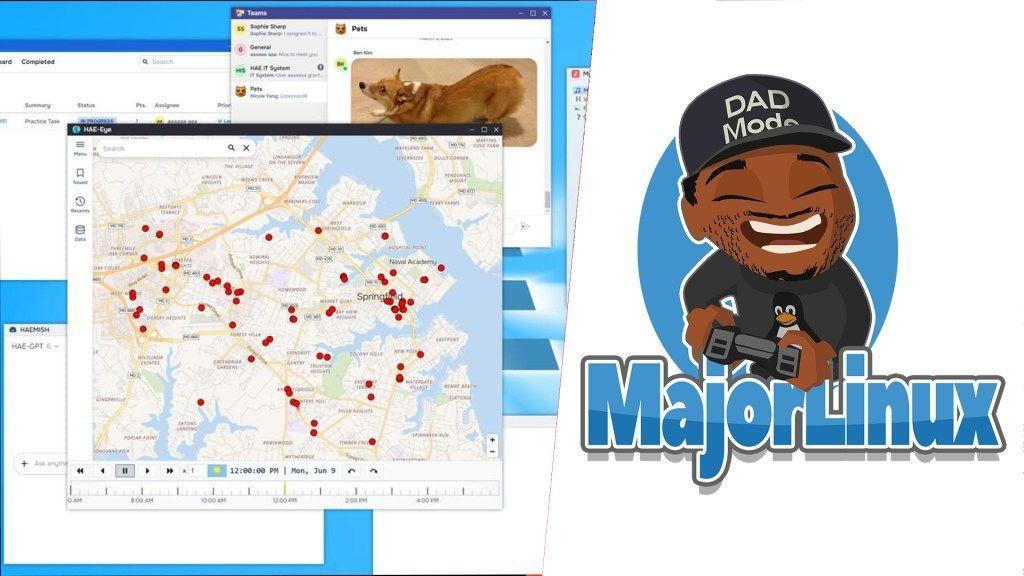
This game could be used as a huge explainer into how surveillance capitalism works and how people are exploited on both sides of the screen.
MajorOffline: Hae Stack – MajorLinux
#Gaming #HaeStack #Investigation #PointAndClick #Political #Privacy #Puzzle #Steam #SteamNextFest #Surveillance #Capitalism #Tech #YouTube

"AI surveillance raises a range of public policy challenges: technical biases, unauditable systems, and inflexible automated law and social rule enforcement that can promote discrimination and undermine transparency, accountability and the rule of law. But we believe the most urgent and long-term impact will be its broader chilling effects.
In a new book, Chilling Effects: Repression, Conformity, and Power in the Digital Age, Jon Penney explains how surveillance, technology and power can be weaponized to influence behavior at scale. Surveillance, personalization, uncertainty and authority are all key mechanisms to increase the scale and impact of chilling effects. They cause people to self-censor their words and actions, to become more conformist and compliant and thus easier to manage and control. And the effects are additive: the more mechanisms employed, and the more powerful the form, the greater the chill.
Computerization has long allowed data collectors to track our locations, collect lists of whom we communicate with, and monitor our spending habits – unless we use cash. What’s new is an unprecedented fusion of each of these mechanisms, persistent and unrelenting. AI brings an analytical ability to spy on the contents of our communications, and to answer sophisticated questions about our whereabouts and activities: actions that previously required human analysts are now automated. The result will be a kind of supercharged societal level of chilling effects where fear, self-censorship and groupthink reign, and dissent, creativity and innovation become increasingly rare."
https://www.theguardian.com/commentisfree/2026/jul/06/ai-surveillance-policy
#AI #Surveillance #ChillingEffects #SelfCensorship #PoliceState

"Innocent shoppers should not have to submit to Orwellian identity checks just to buy a loaf of bread or pick up nappies. The mass rollout of live facial recognition across Sainsbury's stores is a shameful decision that treats customers like suspects, putting millions of law-abiding people at serious risk of privacy intrusions and humiliating false shoplifting accusations."

#Flock Defense "No Expectation of #Privacy In Public" Is Wrong (Public Report)
Online, Flock draws far more critics than defenders. But among those who do, the most common argument is a familiar one: there is no expectation of privacy in public, and license plates are visible to anyone on the road, so what's the problem? It is a reasonable instinct. It is also an oversimplification, and not what courts are being asked to decide.
#alpr #surveillance #flocksafety

#AI #surveillance is being supercharged – and it will chill social progress - https://www.theguardian.com/commentisfree/2026/jul/06/ai-surveillance-policy "These systems will soon be able to track our public and private lives. But we can make the policy choices to reject it"

AI glasses with built-in cameras are making people uneasy about being recorded in public without consent. Critics say they blur everyday life into surveillance, and the pushback is real: workplace bans, public callouts, and apps that scan for hidden cameras.
#privacy #smartglasses #surveillance #consent #indigoprivacy

AI glasses with built-in cameras are making people uneasy about being recorded in public without consent. Critics say they blur everyday life into surveillance, and the pushback is real: workplace bans, public callouts, and apps that scan for hidden cameras.
#privacy #smartglasses #surveillance #consent #indigoprivacy
#FlockSafety Credibility Lost as it Repeatedly Lies to City Councils, #Police Departments, and Public Across the Country
The #ACLU documents how an automatic license plate reader company has lied about its operations, signaling a need for reputable governments to avoid working with #Flock Safety.
#alpr #privacy #security #surveillance
Want to know what surveillance tech your local police use? The Atlas of Surveillance is a free EFF database that maps drones, license plate readers, and facial recognition by city and county. Search your area at atlasofsurveillance.org
Want to know what surveillance tech your local police use? The Atlas of Surveillance is a free EFF database that maps drones, license plate readers, and facial recognition by city and county. Search your area at atlasofsurveillance.org
Commercial surveillance software sold to domestic abusers is installed by 70% of victims without their knowledge, according to domestic violence organization surveys.
Commercial surveillance software sold to domestic abusers is installed by 70% of victims without their knowledge, according to domestic violence organization surveys.
"Since 2020, Palantir, the controversial US data surveillance firm with links to Israeli abuses in occupied Palestine, has won over £670m in contracts with British civil and defence industries, raising both ethical and national-security concerns among politicians and campaigners.
Chief among those are a £330m contract with the NHS and a £240m deal with the Ministry of Defence (MoD), alongside a £15m contract related to Britain’s nuclear deterrent.
Despite a lack of transparency around the extent of Palantir’s deals in the UK’s public services, at least 34 contracts have been uncovered within sectors including the police, child social care, refugee schemes and the environment.
In January 2024, Palantir announced a partnership with the Israeli Ministry of Defence to deploy its technology in support of “war related missions” that use drone-fired missiles to target civilians in Gaza, including journalists and aid workers.
In April 2025, Palantir's chief executive Alex Karp responded to accusations that Palantir technology had enabled the killing of Palestinians in Gaza by saying “mostly terrorists, that’s true”."
Dear Diary - today a surveillance pole spawned in my yard. No warning. Quiet. Legal. Irreversible. https://www.yahoo.com/news/us/articles/woman-surprised-flock-surveillance-tower-185000752.html?.tsrc=daily_mail&segment_id=DY_VTO_50_Supernova&ncid=crm_19908-1475736-20260629-0--A&bt_ee=utFdBbF39cHCLuB4at4AI%2FUoSRgbTt8Ch%2B7Q9RImTlgL2ThvE3FuX%2BRSKiUir%2FNW&bt_ts=1782739085527&guccounter=1 #surveillance #tech #scifi
Microsoft to assist European Commission in defense of EU-US data-sharing agreement - https://www.theregister.com/networks/2026/06/29/microsoft-to-assist-european-commission-in-defense-of-eu-us-data-sharing-agreement/5263737 yeah, I bet it is... #privacy #surveillance
Reverse phone warrants compel phone companies to identify the subscriber behind a number, a frequently used investigative tool that courts rarely scrutinize.
Flock Safety runs an estimated 80,000 to 100,000 AI cameras across the US, scanning license plates more than 20 billion times a month. Communities are pushing back, and more than 70 cities have dropped or rejected contracts, 55 this year alone.
Flock Safety runs an estimated 80,000 to 100,000 AI cameras across the US, scanning license plates more than 20 billion times a month. Communities are pushing back, and more than 70 cities have dropped or rejected contracts, 55 this year alone.
“Bry was specifically asked about the military arming drones but the question reveals a disturbing truth: whether police arm drones domestically is currently based more on the internal ethical commitments of companies than it is any laws created by elected officials. Combining Skydio’s huge amount of police contracts, including supplying entire fleets for Drone as First Responders (DFR) programs, and the tendency of military technologies like surveillance aerostats to get redeployed on U.S. soil, creates a real recipe for the emergence of armed police drones.
The other piece on the chess board to keep our eye on is the introduction of weaponized drones as a tool of school safety. A company called Campus Guardian Angel will run pilot programs in schools in Georgia and Florida in Fall 2026 to introduce drones that are designed to swarm, distract, crash into, and even shoot irritants at potential school shooters. This comes just years after a large national backlash that got the large police tech company Axon to pause its development of drones armed with tasers as a solution to school shootings.”
https://www.eff.org/deeplinks/2026/06/lawmakers-must-act-now-prevent-armed-police-drones
“The thing is, when working on decentralized tech, I always believed it was important because we had serious risks from centralization, surveillance, etc from governments and corporations, potentially co-conspiring. But what I hadn't anticipated is that as things became more centralized, the will to fight for the internet as something in the public interest too would evaporate.
When I have conversations with family members and friends who haven't yet thought much about the age verification and similar bills and their consequences, they've said "well, someone has to hold corporations like Meta" responsible. To which I say, "but what about all the smaller, non-corporate parts of the internet?" To which, many people are surprised, because they've simply forgotten about those things.
When the internet and computing becomes five corporations to most people, they begin to treat it as the concerns of reigning in five corporations.“
https://dustycloud.org/blog/what-happened-to-the-fight-for-the-internet/
#AgeVerification #Surveillance #OpenWeb #Decentralization #DigitalRights #Oligopolies #Fediverse #Privacy
The Supreme Court ruled 6-3 that police need a narrow warrant before sweeping up everyone's phone location data. Geofence warrants that pull every phone near a crime scene now face Fourth Amendment limits.
#privacy #surveillance #fourthamendment #indigoprivacy #scotus #supremecourt

Don’t write anything you can phone. Don’t phone anything you can talk. Don’t talk anything you can whisper. Don’t whisper anything you can smile. Don’t smile anything you can nod. Don’t nod anything you can wink.
Earl Kemp Long (1895-1960) American politician, orator.
(Attributed)
More about this quote: wist.info/long-earl/6396/
#quote #quotes #quotation #qotd #earllong #hueylong #communication #detection #discretion #offtherecord #secrecy #trail #evidence #surveillance

🚨 🚨 🚨 UK ONLINE SAFETY ACT - BUT IN THE EU?! APPARENTLY STARTING NOW 🚨 🚨 🚨
Appears i had suspected right and big platforms think the UK Online Safety Act equivalent for the EU has already been decided by the EU commission in July 2025, with a deadline of July 2026 (a few days): https://support.reddithelp.com/hc/en-us/articles/50368431806484-European-Union-Digital-Services-Act-DSA
See here, I link regulations: https://leminal.space/post/31858818/21120139
How that went for the UK previously: https://www.theguardian.com/commentisfree/2025/aug/09/uk-online-safety-act-internet-censorship-world-following-suit https://www.aljazeera.com/opinions/2025/11/6/britain-calls-it-safety-it-is-censorship
Might be the beginning of the end of anonymous public discourse in the EU...
#EU #authoritarianism #censorship #ageverification #surveillance #privacy #masssurveillance

Visited one of the World Cup host cities? Well, your face, behaviour and devices have likely been monitored by governments and private companies. @TheConversationUS looks at the technology used to widen surveillance during one of the largest sporting events in history.

🛡️ #Cybersecurity news & tips across the #fediverse
“#MissKittyPolitics
When you're handed the synopsis of the decisions ahead of time.
When the first word of every sentence is cut off because the #Surveillance software is slow.
RE: https://bsky.app/profile/did:...”
https://bsky.brid.gy/r/https://bsky.app/profile/did:plc:hc7tndm7gduompba65aps75k/post/3mpjri4yj3g2r
🤖 via RSS feed. Not an endorsement.
"The Supreme Court ruled on Monday that people have an expectation of privacy from the government as their mobile devices track them throughout their daily activities, even when that information is shared with companies like Google and Apple.
The 6-3 decision in Chatrie v. United States extends Fourth Amendment protections to data that people hand over to tech companies, meaning police need a warrant to obtain it. Justices Samuel Alito, Amy Coney Barrett and Clarence Thomas dissented.
The Trump administration argued that users did not have an expectation of privacy after voluntarily sharing their location data with companies like Google.
“An individual has a reasonable expectation of privacy in records about his cell phone’s location, and police intrude on that constitutionally protected interest when they demand the information — even though for only a limited time, and from a third-party tech company,” Justice Elena Kagan wrote for the majority.
The case involves a 2019 bank robbery in Virginia, where police arrested Okello Chatrie after using a geofence warrant to locate all devices near the scene of the crime."
https://www.politico.com/news/2026/06/29/supreme-court-location-data-ruling-00979929
 Lasse Gismo (Friendica Antifa) » 🌐
@lassegismo@lassegismo-social.dnsuser.info
The Realities of AI Video #Surveillance
#Schneier on Security
von Bruce Schneier, Dienstag, 30. Juni 2026 um 14:05
0:55 Minuten
The Financial Times has a good article on how AI is changing the capabilities of video surveillance, with information from both Israel/Iran and Russia.
I wrote about this sort of thing a few years ago, how AI enables mass spying in the way that computers and networks enabled mass surveillance. The interesting development in the article is that AI allows people to
Joint Terrorism Task Forces composed of federal and local law enforcement share surveillance data on individuals who have not been charged with any crime. #privacy #surveillance #indigoprivacy
Joint Terrorism Task Forces composed of federal and local law enforcement share surveillance data on individuals who have not been charged with any crime. #privacy #surveillance #indigoprivacy

Honest Government Ad: Palantir https://www.youtube.com/watch?v=mBW9QCVDSjY #Palantir #Surveillance #Fascism

 🐦🔥nemo™🐦⬛ 🇺🇦🍉
The Wall Boycott Assistant helps people “know what’s really on your phone” by scanning installed apps for ties to companies you may want to avoid (HQ, founders, investors, or BDS categories). One-tap checks run with an offline database—no accounts. 🌐📱🛡️ #AppScanner #DigitalSafety #OpenSource https://play.google.com/store/apps/details?id=com.thewallboycott.android&hl=en
https://github.com/theWallProject/mono
Don’t forget 🇮🇱⚠️ that Israel is facing serious allegations of mass atrocities 🩸❌. Israel-based firms have produced widely condemned spyware (e.g., Pegasus) that has been exported to government clients and reportedly misused to spy on Palestinians and many others 🇵🇸👁️. The broader pattern is that advanced surveillance tools are proliferating with too little accountability—across governments and political networks
#Israel #MassAtrocities #HumanRights #Palestinians #Surveillance #Spyware #CyberSecurity #Pegasus #Privacy #Accountability #RightsAndDignity #StopViolence #FreedomOfSpeech #DigitalRights #Security


Google is apparently testing a new reCAPTCHA method that prompts you to turn on your device's camera to prove you are human by scanning your hands.
I assume this will eventually be mandatory, just like the current reCAPTCHA.
https://reclaimthenet.org/googles-new-recaptcha-wants-your-camera-access-and-21-points-of-your-hand

Facial recognition technology can expose political orientation from naturalistic facial images

RE: https://mastodon.social/@_elena/116837769511681692
Also, please remember that all #WSocial has to do to win is have the benefit of the doubt.
Don’t give them that.
If they have it, with so much money and political influence, they can scale.
If they scale, they can reach network effects.
If they reach network effects, there’s zero you can do to stop them.
Fine! So what?
Well, they have mandatory identity verification.
Once they have network effects, the European Commission can say “any social network that doesn’t implement mandatory identity verification is henceforth illegal in the EU. We have our own “sovereign” network, WSocial, that implements it and if any other networks want to operate in the EU, they must too. Facebook, etc., will implement it in a heartbeat. The fediverse? It’ll be illegal.
So, yeah, maybe don’t give them the benefit of the doubt.
Actively resist them.
Don’t engage with people on there.
Warn your friends.
They’re not building a social network. They’re building the infrastructure for a police state backed by the European Commission.
#WSocial #mandatoryIdentityVerification #surveillance #EU #EuropeanCommission

Some people are always concerned about the "phone listening to you." However, keeping data private isn’t just about what we say.
That ad might not appear to specific people via microphone. Apps, platforms, trackers, searches, location, watch time, and clicks can build a profile that feels almost personal.
Prediction can feel like surveillance when enough data is collected.
#PrivacyAwareness #DigitalPrivacy #DataProtection #Surveillance

"A little white box would sit under a table or chair and silently monitor for danger. It seemed like an easy way to help my dad preserve his independence and give me peace of mind from Europe."
Steven Blum for Architectural Digest and WIRED: https://www.architecturaldigest.com/story/sensi-ai-seniors-homecare-aging-in-place
@eff , #TEDIC and #CEJIL Challenge #Secrecy in the Use of #FaceRecognition in #Paraguay
Seeking #transparency and #accountability in Paraguay’s use of facial recognition, EFF, the Association of Technology, Education, Development, Research, Communication (TEDIC), and the Centre for Justice and International Law (CEJIL) filed a complaint with the Inter-American Commission on #HumanRights against the state for arbitrarily denying access to information about its implementation and use of the technology as a tool for mass #surveillance that erodes people’s #privacy #rights.
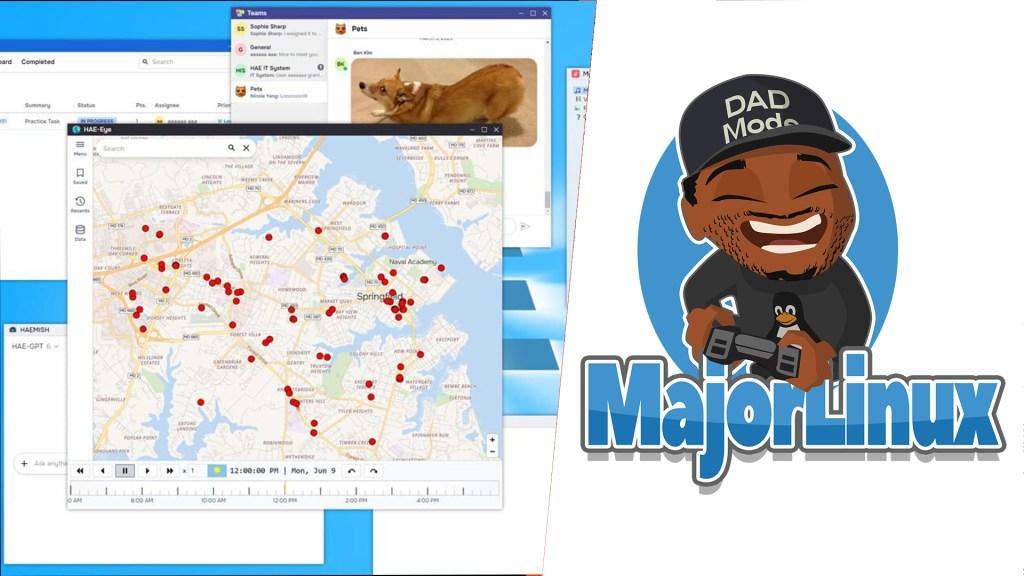
This game could be used as a huge explainer into how surveillance capitalism works and how people are exploited on both sides of the screen.
MajorOffline: Hae Stack – MajorLinux
https://majorlinux.com/majoroffline-hae-stack/
#Gaming #HaeStack #Investigation #PointAndClick #Political #Privacy #Puzzle #Steam #SteamNextFest #Surveillance #Capitalism #Tech #YouTube

Analysis of the underlying source code for four of the websites written by the secretive National Design Studio (NDS)
found that on at least two of them,
the studio installed a commercial tool called PostHog
that closely tracks what every visitor does on the site.
Another tool, apparently made in-house, sends user data to a destination that is not visible on the public internet.
The NDS apparently removed this tracking software after the Guardian reached out to the White House with a detailed series of questions on the NDS’s operations on 4 June.
On 17 June, White House spokesperson Liz Huston responded:
“All National Design Studio personnel comply with all legal requirements in their important work to improve how citizens interact with their government.”
The studio has also built versions of services legally assigned to other agencies,
including a passports website,
and a copy of
💥Login.gov,
the gateway more than 150 million Americans use to sign in to federal services,
-- the latter reportedly being overseen by a former Doge engineer who moved to the studio.
The NDS has also apparently built a copy of
💥vote.gov,
the federal voter-registration site that by law belongs to an independent bipartisan commission
inside a website site only accessible with a White House login.
🔥A federal voter-registration system run from inside the White House,
with identity and citizenship checks routed through systems the administration controls,
could let an incumbent see who is registering,
or check their registration, in the weeks before an election.
Public ownership records maintained by the Cybersecurity and Infrastructure Security Agency (Cisa)
list the executive office of the president as the registrant of the studio’s sites,
including passports.gov and the vote.gov copy,
👉meaning that the office controls the domains.
Questions remain about the sort of access that this could give the White House to voter registration data.
John Davisson, senior counsel at the Electronic Privacy Information Center (EPIC),
said the studio’s approach risked creating a second version
“a whole sort of second skunk-works version of the federal government
with all these shady tracking technologies
and outside of the parameters of normal federal privacy laws”.
A skunk works is a figurative term for an experimental department within a larger organization with freedom to operate outside normal procedure.
The Guardian sent a detailed list of questions about the NDS to the White House Press Office for the attention of Gebbia and the White House chief of staff, Susie Wiles,
who has oversight of the studio.
Separately, the Guardian sent a request to Gebbia’s presumed email at the NDS
(no addresses are publicly listed).
There was no response.
The use of commercial tools on the sites departs from federal web-team conventions.
Davisson, the senior counsel at the EPIC, described the studio’s work as
“trying to establish their own sort of fly-by-night version of what federal agencies normally do with added tracking technologies
and less oversight”.
This is most apparent in the NDS’s employment of user tracking prior to outreach from the Guardian,
such that when a member of the public visited one of the studio’s federal websites,
a commercial tool called PostHog recorded what they did on the page.
PostHog’s session-recording feature,
which can replay every click, scroll and keystroke of a visitor’s time on a webpage,
is installed in the code of all four sites and enabled on two of them.
On the remaining two, the recording is held inactive only by a single setting inside PostHog’s dashboard,
which can be changed by whoever controls the website at any time.
The Guardian emailed PostHog for comment on its apparent provision of tracking tools to the NDS, but received no response.
Adblockers and similar privacy tools are used by millions of people to limit what third parties can learn about them as they browse.
Most of them work by intercepting requests that a visitor’s browser makes to known tracking services
– and blocking them before any data leaves the device.
Website source code shows that PostHog has been configured on
NDS-run sites to route analytics requests through an address on the federal website itself,
rather than through PostHog’s own servers.
Because the request appears to go to the site the user is already visiting, rather than to a recognisable third-party address, adblockers don’t flag it.
As PostHog explains in its own documentation,
this works “because ad blockers haven’t visited your domain to catalog your setup.
They don’t know what to block.”
In other words, the technique is specifically designed to evade privacy tools
– by presenting commercial tracking as ordinary website activity.
Serge Egelman, research director of the Usable Security and Privacy Group at the International Computer Science Institute (ICSI), explained:
“The issue there is that over the last several years,
due to abuses relating to this type of data collection,
there’s basically an arms race with tools being released to allow consumers to try and exert some control over what data gets collected.”
Egelman said that he had not looked specifically at the PostHog tool or its deployment on federal websites,
but he did point to a lawsuit involving the addition of commercial tracking technology to a state government website.
“I testified on Meta where the [Meta] Pixel was put on the California DMV website.
And Meta was able to obtain information about when people are requesting, say, disability placards,
reinstating a suspended license, things like that
– sensitive information that’s actually protected by federal law.”
He added: “It’s not like someone going to the DMV website expects a private company to receive their personal data and then be allowed to use that however they want.”
PostHog comes with a separate feature called session recording,
which plays back every click, scroll and keystroke a visitor makes,
like a video recording of their entire visit.
Princeton University researchers who first documented the technology in 2017 wrote that watching such a recording was “as if someone is looking over your shoulder”.
On the Trump Accounts and TrumpRX websites, the feature has been built into the page code and is held inactive only by a single setting inside PostHog’s dashboard.
The NDS can turn it on at any time, on either site, without making changes in the underlying website code.
Separately, until the Guardian sought comment on this reporting, the NDS’s own website, ndstudio.gov,
ran a 539-line piece of bespoke code that recorded visitors’ clicks, form entries and navigation;
assigned each visitor a session identifier;
and forwarded the captured data to an address that does not appear anywhere on the public internet.
The script’s source code refers to it as AutoMonitor.
A 2002 federal law,
the E-Government Act,
requires any federal agency that collects personal information through a website to first publish a written privacy impact assessment
explaining what it collects and where the information goes.
The Privacy Act of 1974 requires a separate, parallel public notice,
a “system of records notice”,
describing the records the agency keeps.
A 2010 office of management and budget memorandum extended both requirements to federal agencies’ use of commercial
web-tracking tools, including the kind that PostHog provides.
The Guardian could find no such filings for the studio’s web-tracking layer.
None of the four sites carry a privacy impact assessment naming PostHog or describing the IP addresses and on-site activity the tool collects.
None of the four are covered by a system of records notice that addresses what is collected or where it goes.
The one published privacy instrument that relates to any of the four programmes,
a treasury notice for the Trump Accounts programme,
describes how the children’s-investment programme is administered
but does not name PostHog and does not describe the tracking on trumpaccounts.gov at all.
Davisson, the EPIC attorney,
called the studio’s failure to publish such a notice
“a pretty clearcut violation of section 208” of the E-Government Act,
adding: “There’s just no suggestion that they’re trying to comply in good faith with any of their obligations when it comes to the collection of personal information.”
It’s not known what data was collected from users of the government websites while the tools were live,
whether it was retained
and who has custody of the data.
Some of the NDS’s work is even more opaque,
including an apparent redesign of the federal government’s voting registration hub.
A sign-in page run by the studio on a White House-controlled web address carries the title
“Log in to vote.gov preview”.
Above the password field is a notice: “For official use only. Actions will be recorded in accordance with applicable law.”
Vote.gov is a federal voter registration website.
By law it belongs to the Election Assistance Commission (EAC),
an independent, bipartisan body that Congress established in 2002 after the disputed 2000 election.
Congress created the commission specifically so no sitting president would control the federal voter-registration system.
The studio’s version has been live on White House systems since
17 September 2025, according to public records of secure web addresses.
Late last year, the NDS began presenting its system to state election directors.
The first such briefing, on 17 October, was on a call of the National Association of State Election Directors (NASED).
Call notes summarising the meeting record members representing states of both parties expressing
“serious concerns with this project not complying with state law”
and noting that
“the developers do not seem to want to spend the time to understand election official concerns”.
Brianna Schletz,
the Election Assistance Commission’s executive director,
reportedly told state directors on the same call that the conversations were “informal”,
and that commissioners would later vote on whether to stay involved.
No record of any such vote has since appeared in the commission’s public proceedings.
Asked for comment by the Guardian,
a NASED spokesperson, Amy Cohen,
confirmed by email that
“NASED held a call in October joined by representatives from the National Design Studio and members of the EAC leadership team”.
Cohen added:
“NASED does not have a position on this project.
NASED has had no further communication with the National Design Studio on this or any other project;
both NASED as an organization and our members in their individual capacities engage with the EAC regularly about a variety of different topics and projects.”
Six days after the
17 October meeting,
on 23 October,
a National Design Studio engineer, Akash Bobba,
reportedly briefed the system on a recorded conference call organised by the
National Association of Secretaries of State.
Under the studio’s design, voters would be required to verify their identity through Login.gov,
the federal sign-in gateway,
and to have their citizenship checked against a database run by the Department of Homeland Security.
Asked on the call what the federal government would retain of the personal information voters entered into the system,
Bobba reportedly said that
“clear data retention policies” would be given to states ahead of implementation,
but conceded:
“I don’t know what they retain and what they are logging.”
The Election Assistance Commission has been part of the discussions.
Its chair, Donald Palmer, reportedly said the commission was
“facilitating discussion with state election officials on modernizing an accessible tool to provide a verifiable digital registration option”.
The Guardian contacted the Election Assistance Commission for comment but received no response.
The EPIC’s Davisson said:
“With vote.gov, that’s the province of the Election Assistance Commission.
But if you’re centralizing that in the White House, the White House is going to have sort of access to that backbone of data.
He added:
“Doing that outside of the appropriate channels,
I think, is definitely going to
– it’s dangerous
and it’s going to erode trust.”
The Help America Vote Act of 2002 put
voter-registration administration under an independent bipartisan commission,
structurally outside the reach of any sitting president.
The studio’s version appears to collapse this arm’s-length arrangement.
The Guardian has not seen what is on the other side of the sign-in,
but published Cisa records show who runs the system it lives on,
which is under White House control.
The commission Congress put in charge of vote.gov has not decided to formally participate in the initiative.
The build itself is on White House systems.
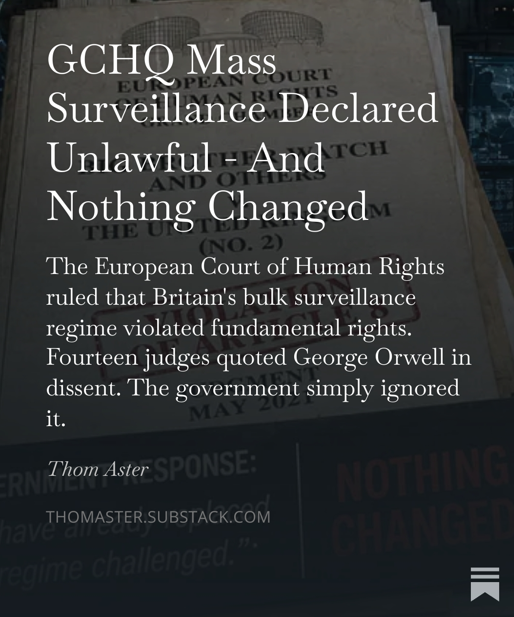
The European Court of Human Rights ruled GCHQ's mass surveillance UNLAWFUL.
14 judges dissented. Three quoted Orwell's 1984:
"There was of course no way of knowing whether you were being watched at any given moment."
https://thomaster.substack.com/p/gchq-mass-surveillance-declared-unlawful
#GCHQ #Surveillance #ECHR #Privacy #BigBrotherWatch #Liberty #Orwell #InvestigatoryPowersAct #Snowden #HumanRights
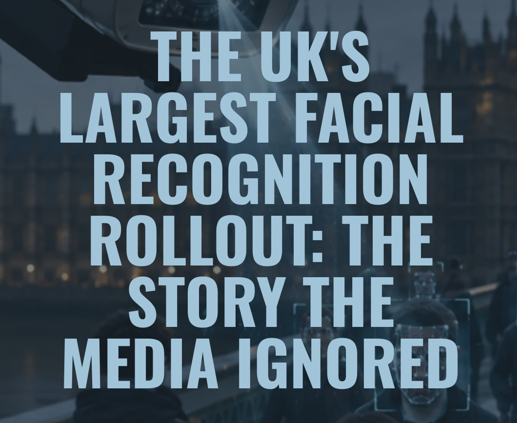
UK launched largest facial recognition programme in British history: 27 police forces, £26m, LFR in knife crime hotspots. Algorithm has documented racial bias, scans everyone, 50 vans deployed. Mainstream coverage: almost none.
https://thomaster.substack.com/p/the-uks-largest-facial-recognition
#FacialRecognition #LFR #Surveillance #Police #KnifeCrime #Privacy #AI #UKPolitics

✊️ It's time to reclaim the word "Palantir" for J.R.R. Tolkien: a humanist breakdown of surveillance architecture https://www.zig.art/p/its-time-to-reclaim-the-word-palantir
The “nothing to hide” argument—that you shouldn’t fear surveillance unless you’re hiding wrongdoing—is a fallacy. Privacy protects everyday life from misuse, errors, and abuse. #Privacy #Surveillance https://en.wikipedia.org/wiki/Nothing_to_hide_argument 🤔🛡️
TikTok collects keystroke patterns, clipboard contents, and device identifiers beyond what most users realize when they agree to its terms. #privacy #tiktok #tracking #surveillance #indigoprivacy
A much younger Aral delivers a warning about where surveillance tech is headed twelve years ago.
The terms I use might have evolved as I did since then (“free” as in freedom, instead of “open” as in open for business, “design” instead of “user experience”, “people” instead of “consumers”) but I’m still working on realising the exact same goal with Small Tech and the Small Web.
https://www.youtube.com/watch?app=desktop&v=yHoLopZSYJw
(Apologies for the YouTube link. Please feel free to rip and rehost if you like.)
💕

Edge Ops, the ICE vendor behind a new immigrant-tracking system, appears to have used stock photos, unverifiable executives, and questionable claims to market itself. https://www.levernews.com/the-ice-surveillance-firm-with-missing-executives-and-phantom-clients/ #surveillance
"Today (Wednesday 24 June) the European Commission announced a new reform proposal for Europol – the EU’s policing agency – expanding Europol’s operational powers and weakening key data protection safeguards to the tune of €3 billion.
This is the 3rd Europol reform in six years changing Europol’s mandate to increase its powers and budget. This puts the European Commission increasingly at odds with the boundaries set in the EU treaties, which provide only for Europol to remain in a supportive role to Member States’ police authorities and competent solely for serious forms of criminality.
The Commission’s proposal claims that “interference with the rights to privacy and protection of personal data… remains both necessary and proportionate,” however under the proposed changes, anyone could have their personal data stored and processed by this obscure EU police cooperation agency.
Despite acknowledging the most recent Europol reform in 2022 already massively expanded the agency’s mandate, the proposal charges ahead with significant deregulatory measures to further weaken data protection laws and expand operational powers:"
https://protectnotsurveil.eu/resources/press-release-europol-mandate-overhault-2026/
#EU #PoliceState #Europol #Surveillance #Privacy #FundamentalRights
FinFisher and Hacking Team commercial spyware sold to governments have been used to surveil civil society organizations in over 30 countries. #privacy #surveillance #indigoprivacy

📲 Computer vision is a privacy-degrading corporate activity. Maintaining Freedom of Thought, privacy, dignity and self-determination requires deliberate rejection of surveillance tech that multiplies "computer vision" capabilities in our day-to-day lives.
#privacy #privacymatters #panopticon #surveillance #surveillancecapitalism #freedomofthought #computervision
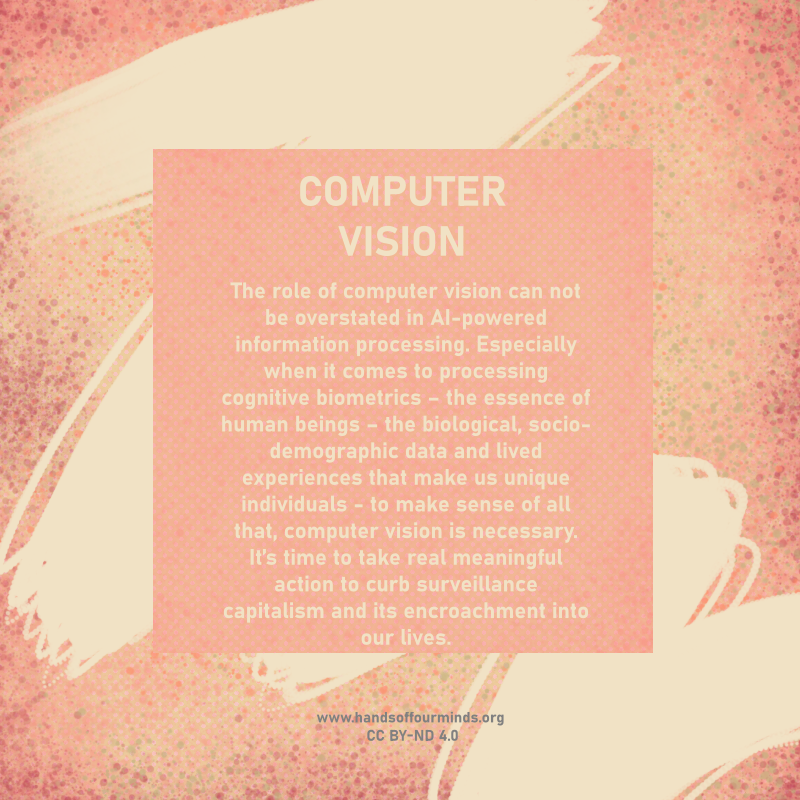
Alt...
The text explains the role of computer vision in processing cognitive biometrics and calls to action to prevent surveillance capitalism's encroachment into our lives.
Rick Beato can have some pretty crazy takes on audio, but he pretty much lays out EVERYTHING needed to know about AI:
1. Home computers will be able to do EVERYTHING ChatGPT does without an internet connection.
2. In the US, "flock cameras" are being setup for data centres. They are not for AI. They are for surveillance.
3. If you can't afford external hard drives, too bad. You're stuck with cloud storage (not secure) or cleaning up your external drives every few months.
Anyway, enjoy the video:
https://youtu.be/aXy8mQeuObk

“For most of history, surveillance ran into the same wall: payroll. A Soviet censor could open your letter. He could not open everyone’s letter, because steaming envelopes takes hands and there were never enough hands. The Stasi got closest, running files on a share of the East German population large enough that historians still argue the exact fraction, and it took warehouses of paper and a network of informants the size of an army to do it. The ceiling was human. Reading you cost a person a day, and a person’s day costs money.”
“What protected the ordinary person was the price of attention. You were boring, and boring was expensive to read.”
“AI removed the ceiling. A model reads every message at a cost rounding to zero, sorts them, flags the interesting ones, and never asks for a raise. The thing that made mass reading impossible was arithmetic, and the arithmetic just inverted. Two variables remain: who holds the data, and what they say when the state asks.”
(Denis Stetskov)
https://techtrenches.dev/p/the-cost-of-reading-everyone-just

https://inv.nadeko.net/watch?v=k7JWIhJG5Xw
(https://youtu.be/k7JWIhJG5Xw)
#AfterSkool #AI #Surveillance #Illustration