Search results for tag #tech
Learning time series analysis through CDR #negativepid #digitalInvestigations #OSINT #cybersecurity #AI #tech #onlineInvestigations #robotics #cyberpsychology #cybercrime https://negativepid.blog/learning-time-series-analysis-through-cdr/?utm_source=mastodon&utm_medium=social&utm_campaign=fedica-Negative-PID-Blog

U.S. bill could make foreign piracy sites impossible to access.
A new Republican bill would target foreign sites distributing pirated TV shows, movies, anime, sports, books, software and more. Court-ordered blocking could reach ISPs, DNS providers and certain large VPN services, meaning a VPN may not bypass it.

Micron just hit 512GB on a single DDR5 server DIMM
Its new RDIMM reaches up to 9,200 MT/s and cuts operating power by over 60% vs. four 128GB modules. A 24-slot dual-socket server could reach 12TB of DDR5. AMD/Intel validation is underway, with volume production expected in H2 2027.


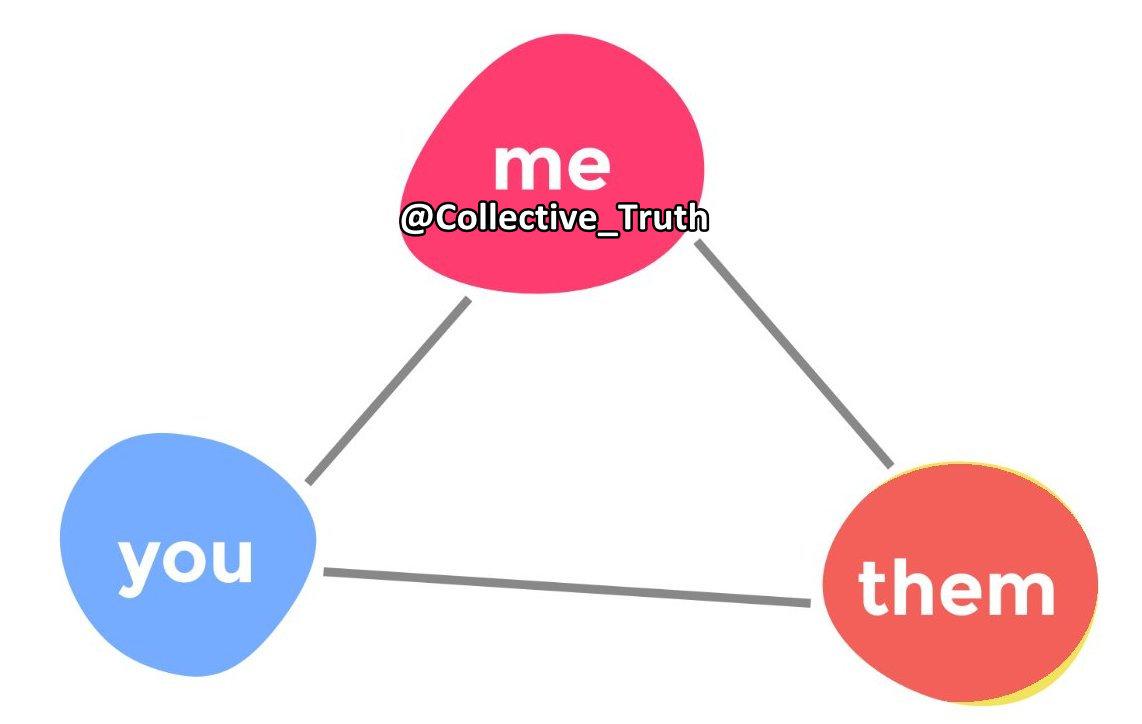
#Build the Social #Mindset = fix people's #Logic.
Fixing the #Mindset = Fixing the #World.
Be Social, add caring 2-ways mindsets.
#Tech is not enough alone.
It needs to be more socially social (#develop people, not just #dev tech).
E.G. #Mastodon is software but they are not directly using it's people to #pioneer the #social side itself (on top of the cold #software).
People don't know how to socialise online, so need help.
Making #friends / #friendship = Improving #Mind #Trust

An insight into online relationships #negativepid #digitalInvestigations #OSINT #cybersecurity #AI #tech #onlineInvestigations #robotics #cyberpsychology #cybercrime https://negativepid.blog/an-insight-into-online-relationships/?utm_source=mastodon&utm_medium=social&utm_campaign=fedica-Negative-PID-Blog

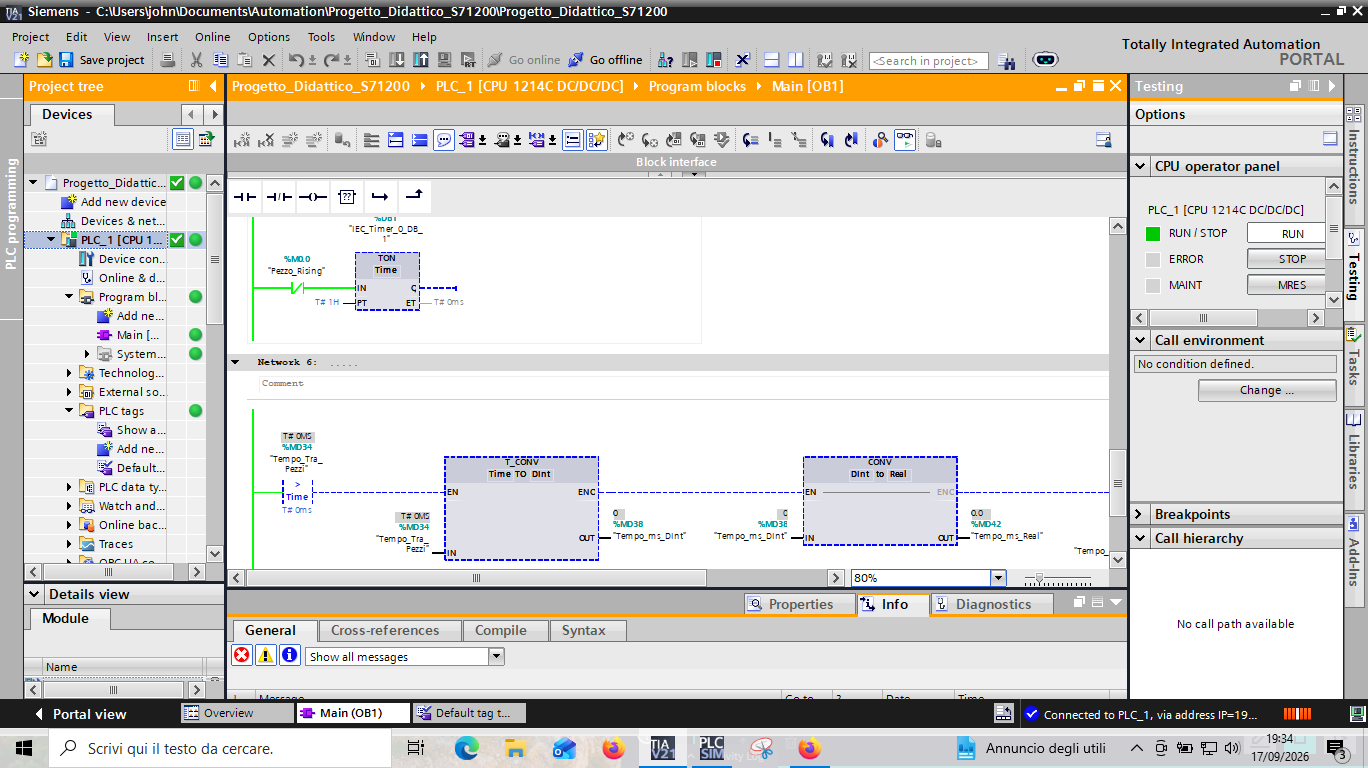
Working on a new PLC project in TIA Portal for a Siemens S7-1200! ⚙️💻
Currently building real-time production monitoring logic: edge detection, piece timing, and live productivity calculation in Ladder Logic (LAD). Everything is running and simulated on PLCSIM.
#PLC #Automation #IndustrialAutomation #Siemens #TIAPortal #Engineering #LadderLogic #PLCSIM #Tech
Alt...
TIAPortal

🇪🇺 The new digital ID & biometric verification law, called EU KIDS ACT must be stopped!
It is a serious #HumanRights nightmare, especially for #Privacy & would negatively change the internet forever.
We need to stand together & fight this dystopian, authoritarian mass-surveillance movement!
It's all the same push as in Australia, the US et. - wherever you are, resist it ✊
#STOPEUKIDSACT NOW!
https://cdn.netzpolitik.org/wp-upload/2026/09/2026-09-15_COM_EU-Kids-Act_COM-2026-681-3.pdf
@eff @Tutanota @openrightsgroup
#EUKidsAct #Tech #News #EU #Ageverification

Alt...
A square graphic design. The flag of the EU, on top is written in mostly white: #STOP EU KIDS ACT. EU is red and the bottom and top sides are also red.

New Linux beta of Orion web browser continues ploughing away at parity with the macOS version.
New in v0.4.3: browser toolbar editing, find in page and easy access to release notes.
Plus, ofc, bug fixes. Lots of 'em.
https://www.omgubuntu.co.uk/2026/09/orion-browser-linux-043-update?v1
Phishing attacks: what attackers already know about your business #negativepid #digitalInvestigations #OSINT #cybersecurity #AI #tech #onlineInvestigations #robotics #cyberpsychology #cybercrime https://negativepid.blog/phishing-attacks-what-attackers-already-know-about-your-business/?utm_source=mastodon&utm_medium=social&utm_campaign=fedica-Negative-PID-Blog
Learning link analysis with TXLEAN #negativepid #digitalInvestigations #OSINT #cybersecurity #AI #tech #onlineInvestigations #robotics #cyberpsychology #cybercrime https://negativepid.blog/learning-link-analysis-with-txlean/?utm_source=mastodon&utm_medium=social&utm_campaign=fedica-Negative-PID-Blog
Regain access to your website with WP-CLI #negativepid #digitalInvestigations #OSINT #cybersecurity #AI #tech #onlineInvestigations #robotics #cyberpsychology #cybercrime https://negativepid.blog/how-to-regain-access-to-your-website-with-wp-cli/?utm_source=mastodon&utm_medium=social&utm_campaign=fedica-Negative-PID-Blog
OSs for cybersecurity professionals #negativepid #digitalInvestigations #OSINT #cybersecurity #AI #tech #onlineInvestigations #robotics #cyberpsychology #cybercrime https://negativepid.blog/oss-for-cybersecurity-professionals/?utm_source=mastodon&utm_medium=social&utm_campaign=fedica-Negative-PID-Blog

Kevin Mitnick, the ghost in the wires #negativepid #digitalInvestigations #OSINT #cybersecurity #AI #tech #onlineInvestigations #robotics #cyberpsychology #cybercrime https://negativepid.blog/kevin-mitnick-the-ghost-in-the-wires/?utm_source=mastodon&utm_medium=social&utm_campaign=fedica-Negative-PID-Blog

New opportunity to work with ORG 🚀
We're looking for an independent consultant or small consultancy to produce a report for organisations to reduce their dependence on large technology infrastructure providers and towards a collaborative open source model.
Closing date: 30 September.
Apply now ⬇️

Oracle has made another round of layoffs, on top of the 21,000 people (13 percent of its workforce) it cut in the fiscal year that ended on May 31. Here's more from The Next Web.
Microsoft is all in on AI, but it wants to be seen as a responsible actor in the industry. Today, the tech giant posted a provisional code of conduct that would impose restrictions on its AI models. The announcement comes days after Anthropic and OpenAI leaders agreed to pump the brakes on development. Here’s more from @CNBC:
Who's reading your ChatGPT messages? OpenAI has hundreds of contractors reviewing conversations with the aim of improving the chatbot's responses to users. While the company says it tries to remove personal information, sensitive details can still get through. @404mediaco breaks down how it works.
How the Internet reshaped crime #negativepid #digitalInvestigations #OSINT #cybersecurity #AI #tech #onlineInvestigations #robotics #cyberpsychology #cybercrime https://negativepid.blog/how-the-internet-reshaped-criminal-activity/?utm_source=mastodon&utm_medium=social&utm_campaign=fedica-Negative-PID-Blog
How to install and enable an SSH Server #negativepid #digitalInvestigations #OSINT #cybersecurity #AI #tech #onlineInvestigations #robotics #cyberpsychology #cybercrime https://negativepid.blog/how-to-install-and-enable-an-ssh-server/?utm_source=mastodon&utm_medium=social&utm_campaign=fedica-Negative-PID-Blog
We’ve all probably watched a foreign-language film and couldn’t help but notice, maybe even get distracted by, the audio not being in sync with the actors’ mouths. Prime Video has an answer to that with AI-powered lip syncing that will be available on the English dub of the German series “Maxton Hall.” Read more from @Futurism, which is sure the dubbing “won’t result in nightmarish hallucinations of facial disfigurement.”

Search Usenet newsgroup archives — text posts from 1981 to present…
#usenet #internet #online #RetroGaming #RetroComputing #RetroGames #RetroTech #VintageComputing #retro #history #commodore #amiga #IT #1980s #1990s #tech #technology #vintage #nostalgia #digital
The SolarWinds Supply Chain Attack #negativepid #digitalInvestigations #OSINT #cybersecurity #AI #tech #onlineInvestigations #robotics #cyberpsychology #cybercrime https://negativepid.blog/the-solarwinds-supply-chain-attack/?utm_source=mastodon&utm_medium=social&utm_campaign=fedica-Negative-PID-Blog

Some of my Donkey Kong works over the years, in different styles. 🐵
#DonkeyKong #DK #nintendo #mario #GameDev #gaming #games #game #gamer #RetroGaming #RetroComputing #RetroGames #VintageComputing #retro #history #1980s #tech #technology #vintage #nostalgia #digital #DigitalArt #graphics #CharacterDesign #design #artwork #art #artist #arte #arts #GraphicDesign #MastoArt #FediArt #CreativeToots #ArtistsOnMastodon

Alt...
The four levels of the Donkey Kong arcade game, interpreted as voxel art.

Alt...
Style experiment featuring Mario running across a detail of Donkey Kong level 1.

Alt...
A whimsical cartoon-style 3D tribute to Donkey Kong, standing on a construction site element from the arcade game.
The Colonial Pipeline Ransomware Attack #negativepid #digitalInvestigations #OSINT #cybersecurity #AI #tech #onlineInvestigations #robotics #cyberpsychology #cybercrime https://negativepid.blog/the-colonial-pipeline-ransomware-attack/?utm_source=mastodon&utm_medium=social&utm_campaign=fedica-Negative-PID-Blog
Anthropic CEO Dario Amodei calls for an immediate slowdown in AI development, warning of potentially devastating consequences in a matter of months. Read more from @Axios@flipboard.com:

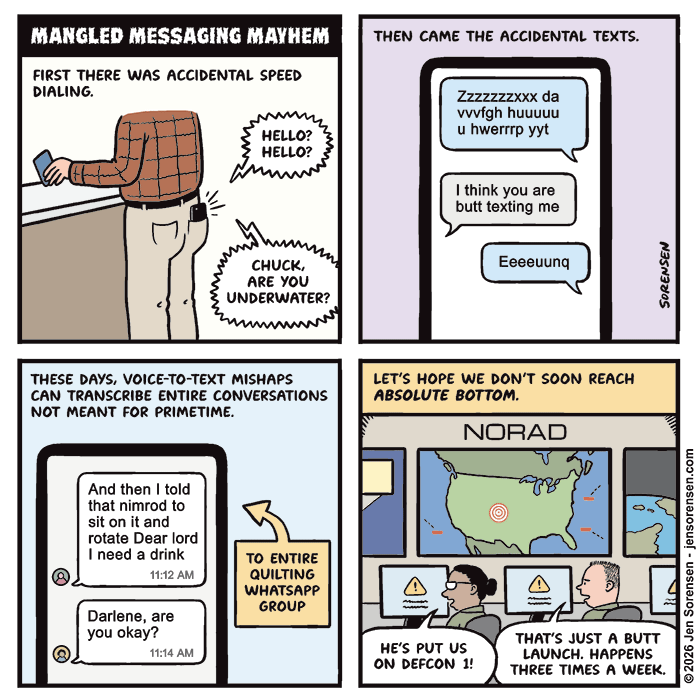
This week's comic: Mangled Messaging Mayhem
#technology #phones #texting #communication #tech #cartoon #comic #humor
Alt...
Mangled messaging mayhem
First there was accidental speed dialing.
Hello? Hello?
Chuck, are you underwater?
Then came the accidental texts.
ZZZZZZZXXX da
VVVFGH huuuuu
U Hwerrrp YYT
I think you are butt texting me
Eeeeuunq
These days, voice-to-text mishaps can transcribe entire conversations not meant for primetime.
And then I told that Nimrod to sit on it and rotate dear Lord I need a drink
11:12 am
Darlene, are you okay?
11:14 am
To entire quilting WhatsApp group
Let’s hope we don’t soon reach absolute bottom.
NORAD
He’s put us on Defcon 1!
That’s just a butt launch. Happens three times a week.
©2026 Jen Sorensen – Jensorensen.com
The essential guide to ISO 27001 #negativepid #digitalInvestigations #OSINT #cybersecurity #AI #tech #onlineInvestigations #robotics #cyberpsychology #cybercrime https://negativepid.blog/the-essential-guide-to-iso-27001-compliance/?utm_source=mastodon&utm_medium=social&utm_campaign=fedica-Negative-PID-Blog
Understanding the MO of cybercriminals #negativepid #digitalInvestigations #OSINT #cybersecurity #AI #tech #onlineInvestigations #robotics #cyberpsychology #cybercrime https://negativepid.blog/understanding-the-mo-of-cybercriminals/?utm_source=mastodon&utm_medium=social&utm_campaign=fedica-Negative-PID-Blog
Cyberwarfare: the invisible war #negativepid #digitalInvestigations #OSINT #cybersecurity #AI #tech #onlineInvestigations #robotics #cyberpsychology #cybercrime https://negativepid.blog/cyberwarfare-the-silent-wars-of-cyberspace/?utm_source=mastodon&utm_medium=social&utm_campaign=fedica-Negative-PID-Blog
The iPhone Duo is making headlines now that Apple has shown it can develop ultra-thin device connected by a sturdy hinge — for a price, of course. What will the tech giant do with the device next? Devindra Hardawar of @Engadget has some ideas:
What the heck is going on with Matt Mullenweg and Automattic? Here's @Sarahp for @Techcrunch on the latest in the tech saga, which started on Wednesday with a blog post from CEO Mullenweg announcing that the board had "conspired" to put him on a paid leave of absence, and continues today as he claims he's back in control.


Social media crimes: the case of Manti Te’o #negativepid #digitalInvestigations #OSINT #cybersecurity #AI #tech #onlineInvestigations #robotics #cyberpsychology #cybercrime https://negativepid.blog/social-media-crimes-the-case-of-manti-teo/?utm_source=mastodon&utm_medium=social&utm_campaign=fedica-Negative-PID-Blog
The meme culture: the power of humour #negativepid #digitalInvestigations #OSINT #cybersecurity #AI #tech #onlineInvestigations #robotics #cyberpsychology #cybercrime https://negativepid.blog/the-meme-culture-language-power-and-politics-of-internet-humor/?utm_source=mastodon&utm_medium=social&utm_campaign=fedica-Negative-PID-Blog
Albert Gonzales, a hacker in the USSS #negativepid #digitalInvestigations #OSINT #cybersecurity #AI #tech #onlineInvestigations #robotics #cyberpsychology #cybercrime https://negativepid.blog/albert-gonzales-a-hacker-in-the-secret-service/?utm_source=mastodon&utm_medium=social&utm_campaign=fedica-Negative-PID-Blog
Steganography, the art of digital hiding #negativepid #digitalInvestigations #OSINT #cybersecurity #AI #tech #onlineInvestigations #robotics #cyberpsychology #cybercrime https://negativepid.blog/steganography-the-art-of-digital-concealment/?utm_source=mastodon&utm_medium=social&utm_campaign=fedica-Negative-PID-Blog

October sees the release of four movies about tech moguls: Aaron Sorkin's "The Social Reckoning," about Mark Zuckerberg, Luca Guadagnino's "Artificial," about Sam Altman, Alex Gibney's "Musk," a documentary about Elon Musk, and Nathan Fielder and Lance Oppenheim's "You Can See Everything," a documentary about Elizabeth Holmes. Here's @THR's report about the fearsome foursome. Which of the four would you most like to watch? Tell us more in the comments.
| "The Social Reckoning": | 1 |
| "Artificial": | 0 |
| "Musk": | 0 |
| "You Can See Everything": | 0 |
| No thanks to all of them: | 0 |
Hackers and computer integrity crimes #negativepid #digitalInvestigations #OSINT #cybersecurity #AI #tech #onlineInvestigations #robotics #cyberpsychology #cybercrime https://negativepid.blog/hackers-and-computer-integrity-crimes/?utm_source=mastodon&utm_medium=social&utm_campaign=fedica-Negative-PID-Blog

Apple shares more details about Apple Intelligence usage limits and terms
Apple today published a new support article that provides more detail on Apple Intelligence usage terms, limits, and restrictions. Here’s what the company says. more…
#Tech #Technology #TechNews #AI #Gadgets #Software #Cybersecurity #Apple #Google #Microsoft #Startup #9to5Mac [9to5Mac]
Web hosting and data residency in Europe #negativepid #digitalInvestigations #OSINT #cybersecurity #AI #tech #onlineInvestigations #robotics #cyberpsychology #cybercrime https://negativepid.blog/web-hosting-and-data-residency-in-europe/?utm_source=mastodon&utm_medium=social&utm_campaign=fedica-Negative-PID-Blog
Sometimes, its the tail wagging the dog...
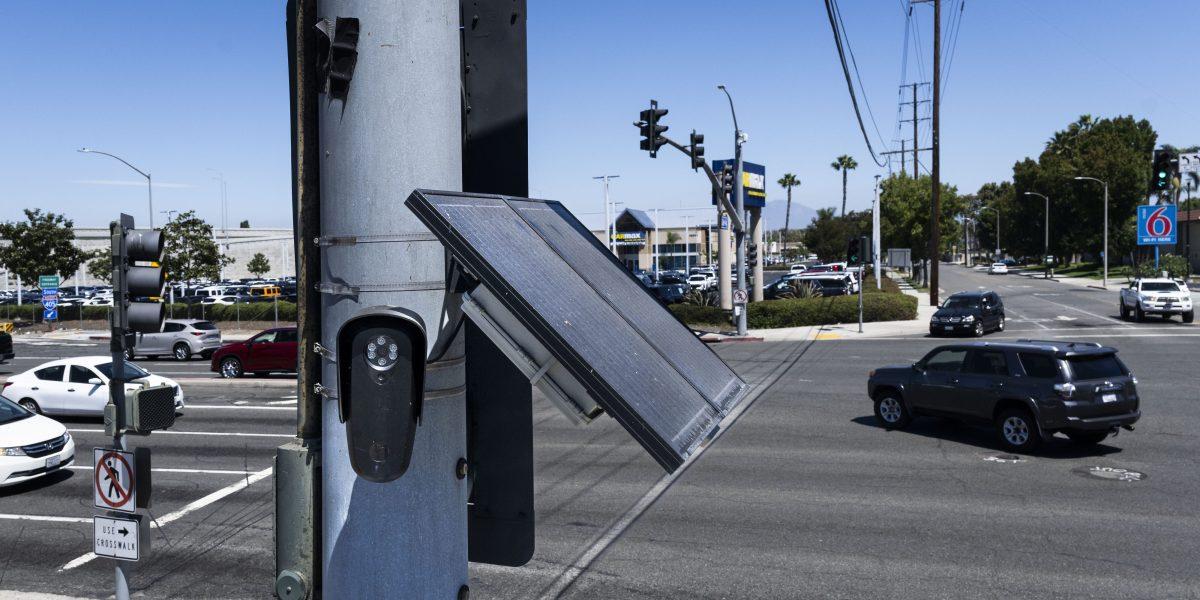
Flock Donations to Local Politicians’ Groups Skyrocket as Protests Against AI Cameras Mount
https://theintercept.com/2026/09/04/flock-camera-surveillance-protest-donations/
#Flock #Politicians #Protests #AI #Surveillance #ACAB #Tech
The end of social media advocacy #negativepid #digitalInvestigations #OSINT #cybersecurity #AI #tech #onlineInvestigations #robotics #cyberpsychology #cybercrime https://negativepid.blog/the-jessica-colotl-case-and-the-end-of-social-media-advocacy/?utm_source=mastodon&utm_medium=social&utm_campaign=fedica-Negative-PID-Blog
A map of mass surveillance programs #negativepid #digitalInvestigations #OSINT #cybersecurity #AI #tech #onlineInvestigations #robotics #cyberpsychology #cybercrime https://negativepid.blog/a-global-map-of-mass-surveillance-programs/?utm_source=mastodon&utm_medium=social&utm_campaign=fedica-Negative-PID-Blog
Fringe to frontline ideology on the net #negativepid #digitalInvestigations #OSINT #cybersecurity #AI #tech #onlineInvestigations #robotics #cyberpsychology #cybercrime https://negativepid.blog/from-fringe-to-frontline-the-internet-as-an-ideological-battleground/?utm_source=mastodon&utm_medium=social&utm_campaign=fedica-Negative-PID-Blog
Floating nuclear startup Bluecore lands $50M funding before setting sail
Startup wants to take atomic power generation on a barge to wherever the need is
#Tech #Technology #TechNews #AI #Gadgets #Software #Cybersecurity #Apple #Google #Microsoft #Startup #TheRegister [The Register]
Ubuntu is testing x86-64-v3 ISO builds for 26.10.
It's a step up from the v1 baseline currently, and since most CPUs sold in the last decade support v3, modern machines stand to benefit.
Daily builds only for now.
https://www.omgubuntu.co.uk/2026/09/ubuntu-amd64v3-iso-downloads?v1
At the International Ocean Film Tour #negativepid #digitalInvestigations #OSINT #cybersecurity #AI #tech #onlineInvestigations #robotics #cyberpsychology #cybercrime https://negativepid.blog/at-the-international-ocean-film-tour-vol-11/?utm_source=mastodon&utm_medium=social&utm_campaign=fedica-Negative-PID-Blog
What sources can you trust in an investigation? #negativepid #digitalInvestigations #OSINT #cybersecurity #AI #tech #onlineInvestigations #robotics #cyberpsychology #cybercrime https://negativepid.blog/what-sources-can-you-trust-in-an-investigation/?utm_source=mastodon&utm_medium=social&utm_campaign=fedica-Negative-PID-Blog
The most mysterious song on the Internet #negativepid #digitalInvestigations #OSINT #cybersecurity #AI #tech #onlineInvestigations #robotics #cyberpsychology #cybercrime https://negativepid.blog/the-most-mysterious-song-on-the-internet/?utm_source=mastodon&utm_medium=social&utm_campaign=fedica-Negative-PID-Blog

Citizen Astronomy (CAst)
by ÖgetayKayali
https://github.com/OgetayKayali/citizen-astronomy
Every clear night, amateur telescopes around the world capture photons that professional observatories never will -- the right patch of sky, at the right moment, with enough patience to notice something change. Citizen Astronomy turns those images into science.
CAst is a desktop application (Windows installer primary; unsigned macOS .app zip available for alpha testers) that takes folders of FITS and XISF images and gives you the tools to measure variable stars, discover moving asteroids, build Hertzsprung-Russell diagrams, and explore the sky -- all from one guided interface, no command-line scripting required.
Please read more details in ALT-Texts of images. These images are just a few examples of the sophisticated use-cases of this software!
Another nice example:
https://defcon.social/@grobi/117234604503277917
Topic> Useful Code
https://defcon.social/@grobi/114797042323081686
or expand post & scroll up ^
#space #tech #science #astronomy #astrophotography #code #python #unix #linux #windows #commandline #plotting #github #apod

Alt...
Profile at GitHub of Ögetay Kayalı the developer behind Citizen Astronomy (CAst)

Alt...
Entry screen of Citizen Astronomy (CAst)
CAst is organized around dedicated modes, each built for a different kind of observing or exploration. Choose a science workflow when you want measurements and exports, or open a visualization tool when you want to understand a field, the sky, or a stack.

Alt...
Differential Photometry
Example of produced light curves in Citizen Astronomy (CAst)
Open a folder of time-series images, and CAst scans your frames, identifies field stars through Gaia DR3 and VSX catalogs, performs aperture photometry with adaptive FWHM-scaled apertures, and produces differential light curves. Fit periods with Lomb-Scargle, refine comparison stars, bin for signal-to-noise, and export science-ready AAVSO reports.

Alt...
Sky Explorer
Open any plate-solved image and turn it into an annotated field census. CAst queries SIMBAD, Gaia DR3, VSX, the NASA Exoplanet Archive, and JPL Horizons for objects inside your footprint, then overlays them on the frame with a searchable results table. Switch object-type modes from Simple deep-sky classes to Scientific SIMBAD codes, compare against DSS or Hα survey cutouts with an interactive divider, mark magnitude reach with Mag Limit, add manual annotations, export stills or comparison animations, and build size-aware object collages from catalog angular sizes.
TOPIC>
Useful Code
The Sequencer: Detect one-dimensional sequences in complex datasets
The Sequencer reveals the main sequence in a dataset if one exists. To do so, it reorders objects within a set to produce the most elongated manifold describing their similarities which are measured in a multi-scale manner and using a collection of metrics. To be generic, it combines information from four different metrics: the Euclidean Distance, the Kullback-Leibler Divergence, the Monge-Wasserstein or Earth Mover Distance, and the Energy Distance. It considers different scales of the data by dividing each object in the input data into separate parts (chunks), and estimating pair-wise similarities between the chunks. It then aggregates the information in each of the chunks into a single estimator for each metric+scale.
https://github.com/dalya/Sequencer
#space #tech #science #astronomy #code #python #unix #linux #commandline #plotting
Alt...
Shuffled image rows
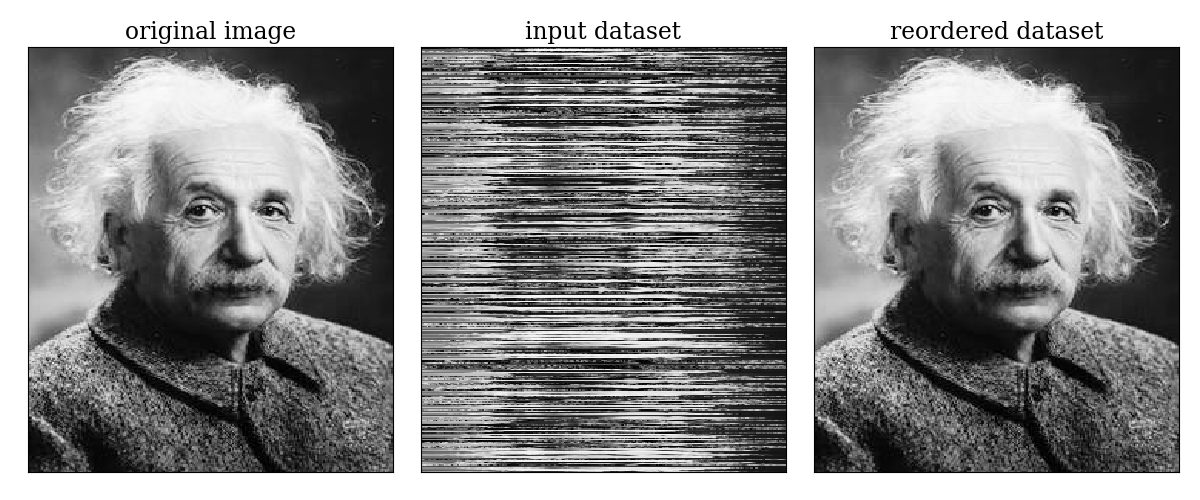
The Sequencer reorders the objects in the input dataset according to a detected sequence, if such sequence exists in the dataset. A good example of a perfect one-dimensional sequence is a natural image: the rows within a natural image form a well-defined sequence. Therefore, we can shuffle the rows in a natural image, and apply the Sequencer to the shuffled dataset. The following figure shows the result of applying the Sequencer to a shuffled natural image. The left panel shows the original image. The middle panel shows the same image after we have shuffled its rows. The shuffled image serves as the input dataset to the Sequencer, where each row is considered as a separate object. The output of the Sequencer is shown in the right panel, where we reordered the rows according to the detected sequence. The Sequencer successfully identified the one-dimensional trend spanned by the different rows.
Command Line Orbit Plotting
OK Binaries Interactive Catalog
https://github.com/mb2448/ok-binaries/
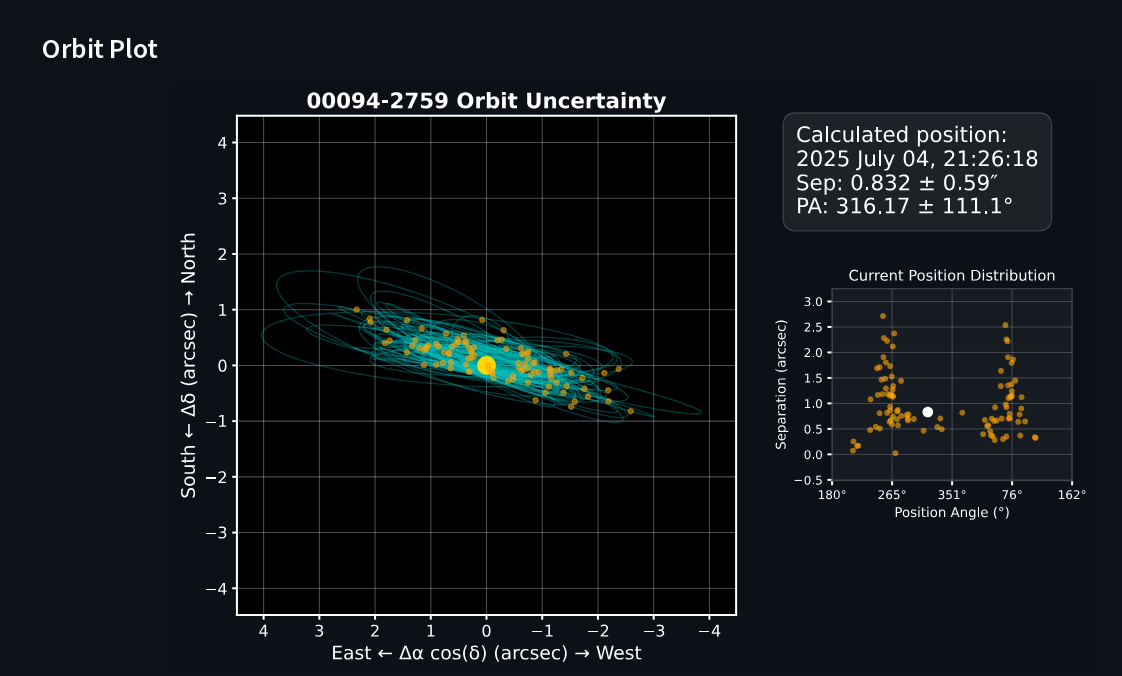
OK Binaries is a tool for identifying suitable calibration binaries from the Washington Double Star (WDS) Sixth Orbit Catalog. It calculates orbital positions at any epoch, propagates uncertainties using Monte Carlo sampling, and generates orbit plots. The web app includes automated daily updates of binary positions and a searchable interface with filters for position, magnitude, separation, and other orbital parameters. OK Binaries can be used online, as a standalone offline browser app, or via the command line.
https://github.com/mb2448/ok-binaries/
https://ok-binaries.streamlit.app/
#space #tech #science #astronomy #code #python #unix #linux #commandline #plotting
Alt...
WDS 00094-2759 - BU 391AB
HIP 761 • HD 493
Orbital Elements
Period (P) 575.65y ± 247.6
Periastron (T) 2087.66 ± 104.9
Semi-major axis (a) 1.614″ ± 0.49
Eccentricity (e) 0.5022 ± 0.31
Inclination (i) 98.72° ± 3.9
Longitude of periastron (ω) 272.7° ± 42.6
Node (Ω) 76.73° ± 6.5
Additional Information
Grade: 4 (1=Definitive, 9=Indeterminate)
Equinox: —
Last observation: 2013
Reference: Izm2019
Notes
kap 1 Scl
CLUES: Clustering tool for analyzing spectral data
CLUES (CLustering UnsupErvised with Sequencer) analyzes spectral and IFU data. This fully interpretable clustering tool uses machine learning to classify and reduce the effective dimensionality of data sets. It combines multiple unsupervised clustering methods with multiscale distance measures using Sequencer (ascl:2105.006) to find representative end-member spectra that can be analyzed with detailed mineralogical modeling and follow-up observations. CLUES has been used on Spitzer IRS data and debris disk science, and can be applied to other high-dimensional spectral data sets, including mineral spectroscopy in general areas of astrophysics and remote sensing.
https://github.com/Ompha/CLUES
https://ui.adsabs.harvard.edu/abs/2021ApJ...916...91B/abstract
https://ui.adsabs.harvard.edu/abs/2025ApJS..276...65L/abstract
#space #tech #science #astronomy #code #python #JupyterNotebook #unix #linux

Alt...
Welcome
Ha! You've stumbled upon this machine-learning classification tools for spectra and IFU data!
Thanks to Sam Van Kooten
https://github.com/svank
wispr-analysis
Shared tools for WISPR data analysis
Some highlights
plot_utils.py
+ plot_WISPR:
Aims to be a versatile function that does the Right Thing for plotting WISPR images, with colorbar bounds that are adjusted for inner and outer FOV and for L2 or L3 images, a square-root-scaled colorbar, and WCS coordinate support
+ *_axis_dates: Helper util for labeling a temporal axis with dates.
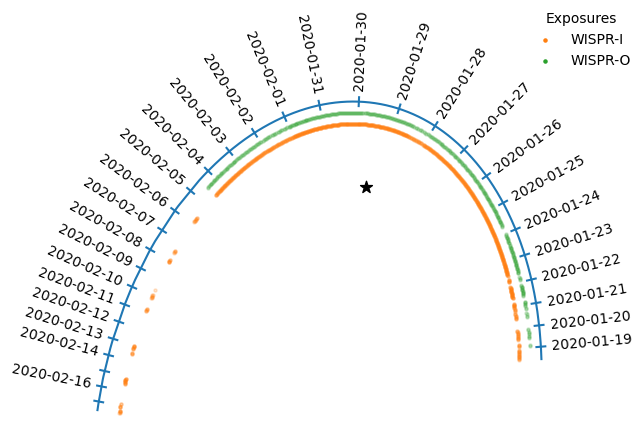
+ plot_orbit:
Reads a directory (or nested set of directories) of WISPR files and plots a diagram showing the orbital path of PSP and the locations where images were taken, like this:
projections.py
+ reproject_to_radial: Proof-of-concept code for reprojecting data into a radial coordinate system (where each row of the output array is a radial line out from the Sun.
data_cleaning.py
+ dust_streak_filter: Code for identifying debris streaks in the WISPR images
+ clean_fits_files: Function to batch-run dust_streak_filter on a directory of images.
composites.py
+ gen_composite: Reprojects an inner- and outer-FOV image into a common coordinate system
utils.py
+ to_timestamp: Parse a timestamp from a handful of formats, including the timestamps inside WISPR headers, or entire WISPR filenames. Returns a numerical timestamp.
+ collect_files: Walks a directory of WISPR files (or a directory of subdirectories of WISPR images), identifies all the WISPR images, sorts them, and separates them by inner and outer FOVs.
+ ignore_fits_warnings: Suppresses the warnings Astropy raises when reading WISPR FITS files or parsing WCS data.
https://github.com/svank/wispr_analysis
Documentation:
https://svank.github.io/wispr_analysis/
#space #code #python #science #astronomy #astrophysics #tech #NASA
Alt...
Some highlights
plot_utils.py
+ plot_WISPR:
Aims to be a versatile function that does the Right Thing for plotting WISPR images, with colorbar bounds that are adjusted for inner and outer FOV and for L2 or L3 images, a square-root-scaled colorbar, and WCS coordinate support
*_axis_dates: Helper util for labeling a temporal axis with dates.
+ plot_orbit:
Reads a directory (or nested set of directories) of WISPR files and plots a diagram showing the orbital path of PSP and the locations where images were taken, like this:
projections.py
+ reproject_to_radial: Proof-of-concept code for reprojecting data into a radial coordinate system (where each row of the output array is a radial line out from the Sun.
data_cleaning.py
+ dust_streak_filter: Code for identifying debris streaks in the WISPR images
clean_fits_files: Function to batch-run dust_streak_filter on a directory of images.
composites.py
+ gen_composite: Reprojects an inner- and outer-FOV image into a common coordinate system
utils.py
+ to_timestamp: Parse a timestamp from a handful of formats, including the timestamps inside WISPR headers, or entire WISPR filenames. Returns a numerical timestamp.
+ collect_files: Walks a directory of WISPR files (or a directory of subdirectories of WISPR images), identifies all the WISPR images, sorts them, and separates them by inner and outer FOVs.
+ ignore_fits_warnings: Suppresses the warnings Astropy raises when reading WISPR FITS files or parsing WCS data.
2025-08-20
Leandro Beraldo e Silva released four days ago:
lberaldoesilva/tropygal version 0.1.4
Entropy estimates and distribution functions for galactic dynamics
tropygal is a pure-python package for entropy estimates in the context of galactic dynamics, but can be used in other contexts too. It also provides functions for analytical distribution functions and density of states for models that have analytical expressions.
** Acknowledgements
Development of tropygal was supported by the following research grants:
+ NASA ATP awards 80NSSC20K0509 and 80NSSC24K0938
+ U.S. NSF AAG grant AST-2009122
+ STFC Ernest Rutherford fellowship (ST/X004066/1)
+ JSPS KAKENHI Grant Numbers JP24K07101, JP21K13965, and JP21H00053
+ CNPq (309723/2020-5)
+ Heising Simons Foundation grant # 2022-3927
** Funding agencies:
+ NASA ATP - NASA Astrophysical Theory Program (US)
+ NSF - National Science Foundation (US)
+ STFC - Science and Technology Facilities Council (UK)
+ JSPS - Japan Society for the Promotion of Science (Japan)
+ CNPq – Conselho Nacional de Desenvolvimento Científico e Tecnológico (Brasil)
+ Heising Simons Foundation (US)
https://github.com/lberaldoesilva/tropygal
https://tropygal.readthedocs.io/en/latest/
https://link.springer.com/epdf/10.1007/BF00773669?sharing_token=c10vjrwKcPemuJugFt8GPPe4RwlQNchNByi7wbcMAY4It9IZvz0cQPRbyx9xcOC67oJ1uYrQB3lur75MCDwqdPXd8sWtzve-hL8JYGekYHqhITNJ3f12mXyjbTmMIqid10HwkWoYRAWdltK0BTwIew%3D%3D
https://www.mdpi.com/1099-4300/18/1/13
#space #code #python #science #astronomy #astrophysics #tech #NASA
PIRATES
(Polarimetric Image Reconstruction AI for Tracing Evolved Structures)
uses machine learning to perform image reconstruction.
It uses MCFOST to generate models, then uses those models to build, train, iteratively fit, and evaluate PIRATES performance.
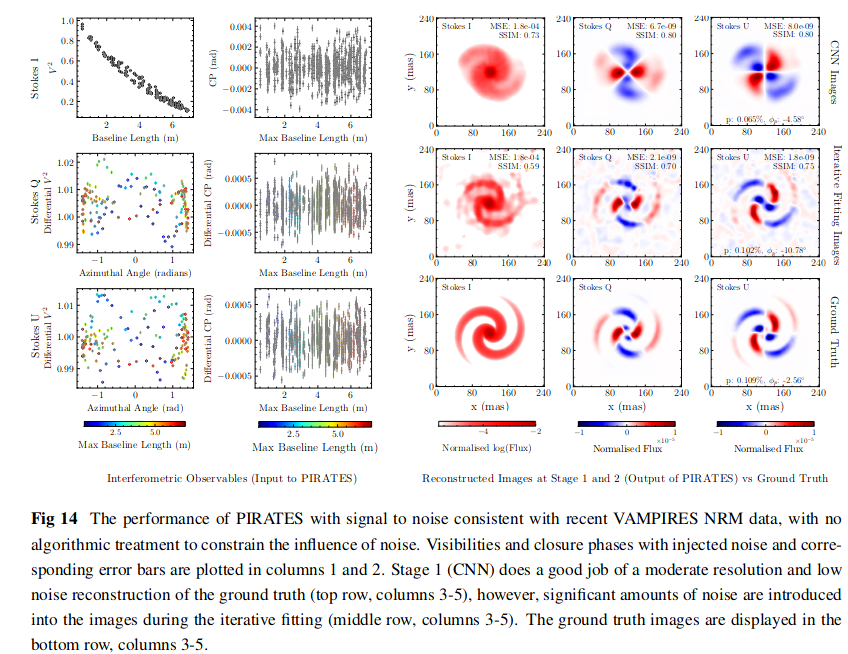
Optical interferometric image reconstruction is a challenging, ill-posed optimization problem which usually relies on heavy regularization for convergence. Conventional algorithms regularize in the pixel domain, without cognizance of spatial relationships or physical realism, with limited utility when this information is needed to reconstruct images. Here we present PIRATES (Polarimetric Image Reconstruction AI for Tracing Evolved Structures), the first image reconstruction algorithm for optical polarimetric interferometry. PIRATES has a dual structure optimized for parsimonious reconstruction of high fidelity polarized images and accurate reproduction of interferometric observables. The first stage, a convolutional neural network (CNN), learns a physically meaningful prior of self-consistent polarized scattering relationships from radiative transfer images. The second stage, an iterative fitting mechanism, uses the CNN as a prior for subsequent refinement of the images with respect to their polarized interferometric observables. Unlike the pixel-wise adjustments of traditional image reconstruction codes, PIRATES reconstructs images in a latent feature space, imparting a structurally derived implicit regularization.
https://github.com/SAIL-Labs/PIRATES
https://ui.adsabs.harvard.edu/abs/2025arXiv250511950L/abstract
https://arxiv.org/pdf/2505.11950
https://arxiv.org/abs/2505.11950
CREDITS:
Lilley, Lucinda ; Norris, Barnaby ; Tuthill, Peter ; Spalding, Eckhart ; Lucas, Miles ; Zhang, Manxuan ; Millar-Blanchaer, Maxwell ; Pinte, Christophe ; Bottom, Michael ; Guyon, Olivier ; Lozi, Julien ; Deo, Vincent ; Vievard, Sébastien ; Wong, Alison P. ; Ahn, Kyohoon ; Ashcraft, Jaren
#space #code #python #science #astronomy #astrophysics #tech

Alt...
Optical interferometric image reconstruction is a challenging, ill-posed optimization problem which usually relies on heavy regularization for convergence. Conventional algorithms regularize in the pixel domain, without cognizance of spatial relationships or physical realism, with limited utility when this information is needed to reconstruct images. Here we present PIRATES (Polarimetric Image Reconstruction AI for Tracing Evolved Structures), the first image reconstruction algorithm for optical polarimetric interferometry. PIRATES has a dual structure optimized for parsimonious reconstruction of high fidelity polarized images and accurate reproduction of interferometric observables. The first stage, a convolutional neural network (CNN), learns a physically meaningful prior of self-consistent polarized scattering relationships from radiative transfer images. The second stage, an iterative fitting mechanism, uses the CNN as a prior for subsequent refinement of the images with respect to their polarized interferometric observables. Unlike the pixel-wise adjustments of traditional image reconstruction codes, PIRATES reconstructs images in a latent feature space, imparting a structurally derived implicit regularization. We demonstrate that PIRATES can reconstruct high fidelity polarized images of a broad range of complex circumstellar environments, in a physically meaningful and internally consistent manner, and that latent space regularization can effectively [..]
Alt...
The performance of PIRATES with signal to noise consistent with recent VAMPIRES NRM data, with no
algorithmic treatment to constrain the influence of noise. Visibilities and closure phases with injected noise and corre-
sponding error bars are plotted in columns 1 and 2. Stage 1 (CNN) does a good job of a moderate resolution and low
noise reconstruction of the ground truth (top row, columns 3-5), however, significant amounts of noise are introduced
into the images during the iterative fitting (middle row, columns 3-5). The ground truth images are displayed in the
bottom row, columns 3-5.
nazgul is a joint effort by:
* J. Michael Burgess
* Ewan Cameron
* Dmitry Svinkin
https://github.com/grburgess/nazgul
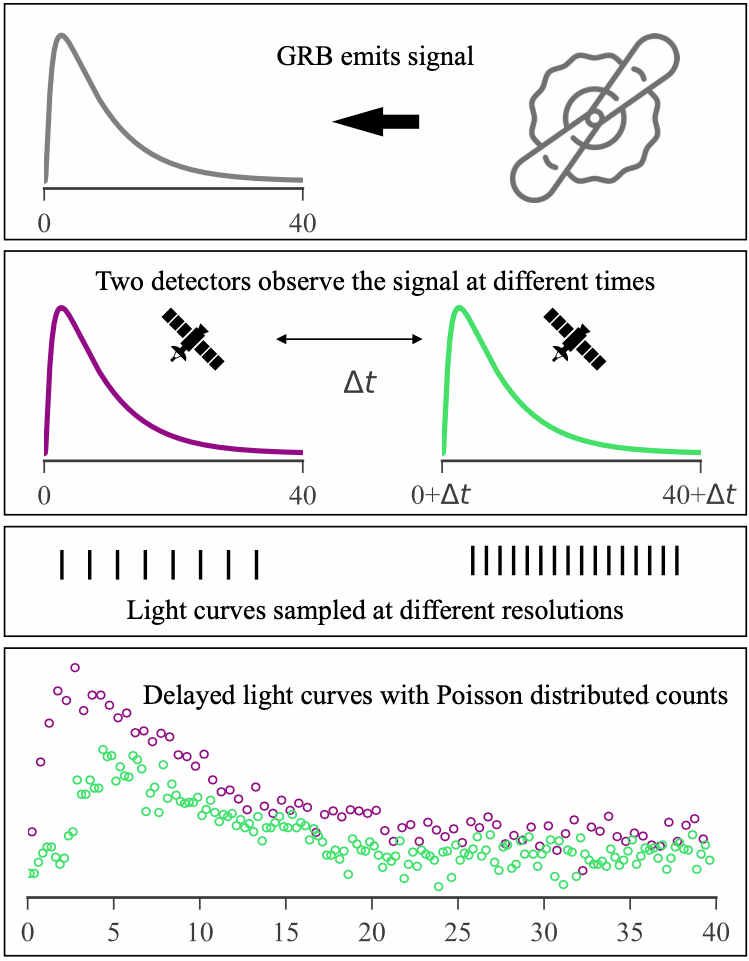
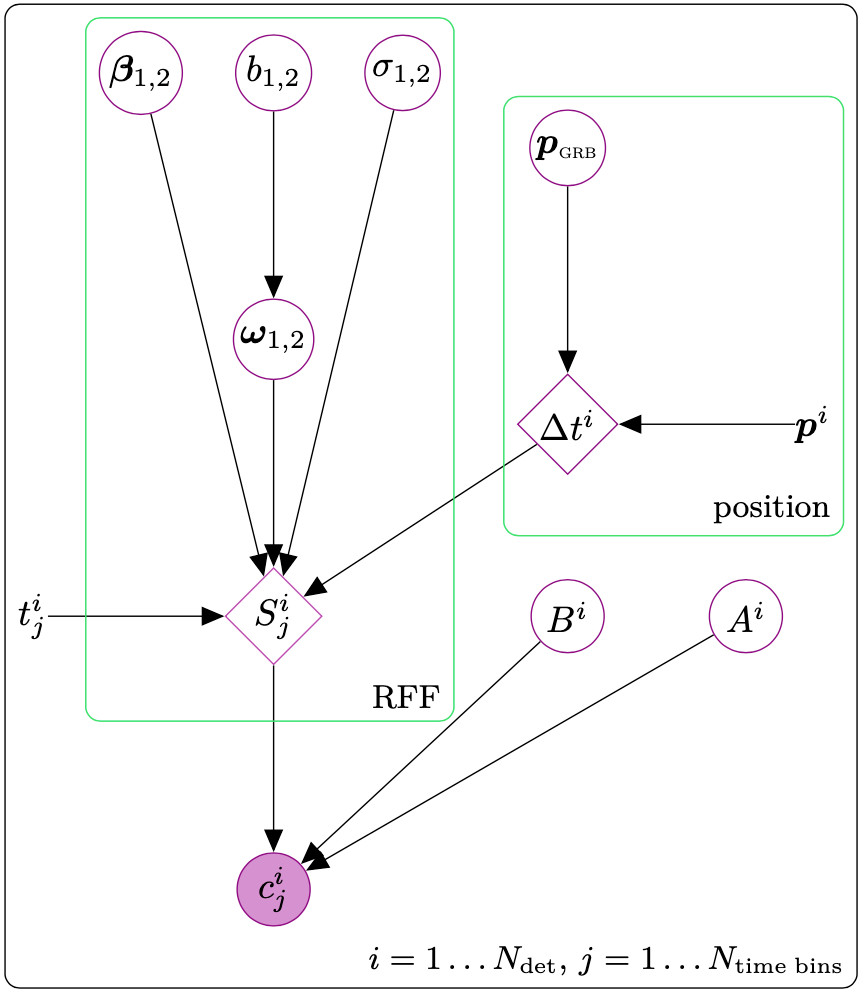
Nazgul is a framework for performing GRB localization via fitting non-parametric models to their data time-series and computing the time delay between them. It is currentrly built upon the magic of Stan and implements a parallel version of non-stationary Random Fourier Features. The idea is get away from heuristic methods such as cross-correlation which do not have a self-consistent statitical model.
The idea is that satellites throughout the Sol system observe gamma-ray bursts at different times due to the finite speed of light. This creates a time delay in their observed light curves which can be used to triangulate the gamma-ray burst position on the sky. These triangulation create annuli or rings on the sky which Nazgul searches for so that it, in the darkness, it can bind them to a location on the sky.
Left image:
The heriarchical model is shown below and details can be found in here https://arxiv.org/abs/2009.08350. If you find the method and/or code useful in your research we ask that you please cite the paper.
Right image:
The sister program to simulate time-delayed light curves is pyIPN and can be used to generate time-delayed light curves for algorithm testing.
https://github.com/grburgess/pyipn
#space #code #python #science #astronomy #astrophysics #tech #NASA
Alt...
The heriarchical model is shown below and details can be found in here. If you find the method and/or code useful in your research we ask that you please cite the paper.
Alt...
The sister program to simulate time-delayed light curves is pyIPN and can be used to generate time-delayed light curves for algorithm testing.
Astro Catalog
by Sylvain Villet
https://github.com/sylvainvillet
https://app.astrobin.com/u/SylvainV
https://app.astrobin.com/forum/topic/191541
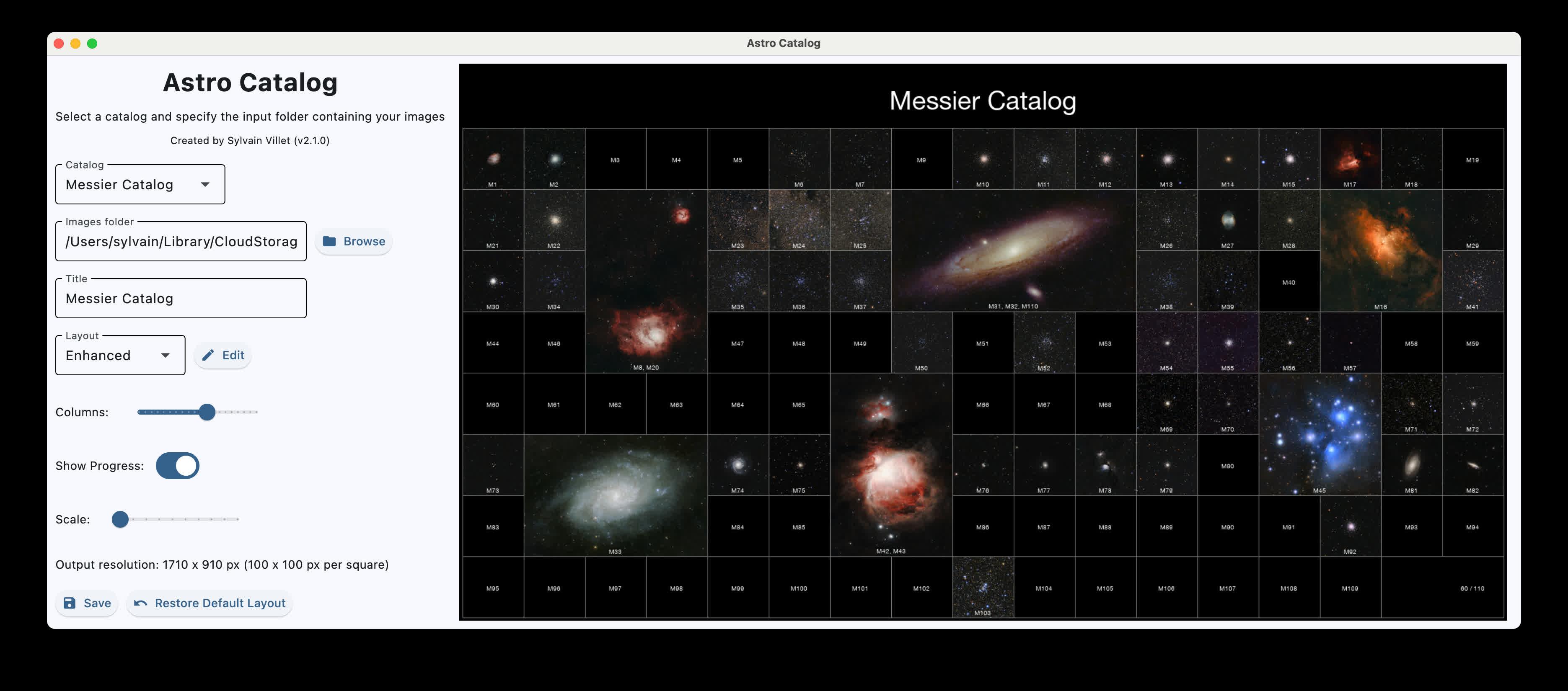
This project generates a mosaic of Messier or Caldwell objects, using images from a local folder.
The script arranges the objects into a configurable grid, supports larger slots for extended targets (e.g. Andromeda), and overlays labels and a title.
Perfect for creating a large-format print.
Features:
+ Loads Messier or Caldwell object images from a folder (M31.jpg, M-31.png, M_31.tif, etc.)
+ Places objects on a grid with configurable layout
+ Supports multi-cell slots for large objects (e.g. M31, M42, M45)
+ Supports grouping multiple objects in one slot for objects close to each other (e.g. M42 and M43, M31 and M32)
+ Adds a title and progress counter if it's not completed yet
+ Draws labels on images and placeholders for missing ones
+ Adjustable size of the final image
+ Saves as JPEG, PNG or TIFF
https://github.com/sylvainvillet/astro-catalog#features
#space #tech #science #astronomy #astrophotography #photography #code #python #unix #linux #commandline #plotting
Alt...
This project generates a mosaic of Messier or Caldwell objects, using images from a local folder.
The script arranges the objects into a configurable grid, supports larger slots for extended targets (e.g. Andromeda), and overlays labels and a title.
Perfect for creating a large-format print.
Features:
+ Loads Messier or Caldwell object images from a folder (M31.jpg, M-31.png, M_31.tif, etc.)
+ Places objects on a grid with configurable layout
+ Supports multi-cell slots for large objects (e.g. M31, M42, M45)
+ Supports grouping multiple objects in one slot for objects close to each other (e.g. M42 and M43, M31 and M32)
+ Adds a title and progress counter if it's not completed yet
+ Draws labels on images and placeholders for missing ones
+ Adjustable size of the final image
+ Saves as JPEG, PNG or TIFF
Social media crimes: The Tinder Swindler #negativepid #digitalInvestigations #OSINT #cybersecurity #AI #tech #onlineInvestigations #robotics #cyberpsychology #cybercrime https://negativepid.blog/social-media-crimes-the-tinder-swindler/?utm_source=mastodon&utm_medium=social&utm_campaign=fedica-Negative-PID-Blog
The Unfavorable Semicircle channel #negativepid #digitalInvestigations #OSINT #cybersecurity #AI #tech #onlineInvestigations #robotics #cyberpsychology #cybercrime https://negativepid.blog/the-unfavorable-semicircle-channel/?utm_source=mastodon&utm_medium=social&utm_campaign=fedica-Negative-PID-Blog
You haven’t lived until you’ve talked on a push button phone, watched an instant photograph develop and walked to the store with a boombox on your shoulder. @Techcrunch tells us more about the blending of nostalgic tech design with modern functionality:
Finding yourself continually paying to get your phone repaired? Now might be a good time to go big and buy a new one. But it can be difficult to know when it’s worth it to give up your old, cracked device. @Engadget helps you out with the decision:
Internet fandoms: fun and radicalization #negativepid #digitalInvestigations #OSINT #cybersecurity #AI #tech #onlineInvestigations #robotics #cyberpsychology #cybercrime https://negativepid.blog/internet-fandoms-from-fun-to-radicalization/?utm_source=mastodon&utm_medium=social&utm_campaign=fedica-Negative-PID-Blog
Cookie consent: What do we agree to? #negativepid #digitalInvestigations #OSINT #cybersecurity #AI #tech #onlineInvestigations #robotics #cyberpsychology #cybercrime https://negativepid.blog/cookies-what-do-we-agree-to-when-we-click-accept/?utm_source=mastodon&utm_medium=social&utm_campaign=fedica-Negative-PID-Blog
South Korea is moving forward with its “AI for All” program, aiming to provide the entire population with free, unlimited access to AI services.
SK Telecom, Kakao & KT selected
Beta service: September 2026
Nationwide rollout: By the end of 2026
512 NVIDIA B200 GPUs from the government
The goal? Make AI something everyone in Korea can use in everyday life, from chatbots to AI agents that can help with government services.
#AI #SouthKorea #Tech #GeekRealmHub

ARGs: between game and reality #negativepid #digitalInvestigations #OSINT #cybersecurity #AI #tech #onlineInvestigations #robotics #cyberpsychology #cybercrime https://negativepid.blog/args-blurring-the-lines-between-game-and-reality/?utm_source=mastodon&utm_medium=social&utm_campaign=fedica-Negative-PID-Blog

🦮
" A 12-year-old in California built a working printer for blind readers out of a Lego robot kit for his school science fair, after finding that the machines sold for the job cost about $2,000; the parts in his version came to roughly $350 in shops
A twelve-year-old just proved that assistive technology doesn't need to cost thousands when ingenuity and a Lego kit can do the job for under four hundred dollars."
Heads up, gamers. Next month, Windows 11 will enable a security feature that will apparently slow down games. PC World has more:
A group of inexperienced hikers set out to summit California’s 14,000-foot-high Mount Shasta. They got their beta (climber slang for information) from Gemini. The good news? They made it! The bad news? Well, it’s only bad if you consider learning the hard way a bad thing. @TechRadar has more:
Protecting endangered species with OSINT #negativepid #digitalInvestigations #OSINT #cybersecurity #AI #tech #onlineInvestigations #robotics #cyberpsychology #cybercrime https://negativepid.blog/how-eia-stopped-endangered-species-trafficking-with-osint/?utm_source=mastodon&utm_medium=social&utm_campaign=fedica-Negative-PID-Blog

VMs won't contain cyber-capable agents
https://blog.trailofbits.com/2026/08/26/vms-wont-contain-cyber-capable-agents/
AI agents appear to be breaking out of their intended constraints more frequently. So, who’s responsible for figuring out what happened during these incidents? AI safety researchers are arguing with greater urgency for independent investigations. @Techcrunch has more:
How social media changed in twenty years #negativepid #digitalInvestigations #OSINT #cybersecurity #AI #tech #onlineInvestigations #robotics #cyberpsychology #cybercrime https://negativepid.blog/how-social-media-changed-over-the-last-twenty-years/?utm_source=mastodon&utm_medium=social&utm_campaign=fedica-Negative-PID-Blog
Social media crimes: the Megan Meier case #negativepid #digitalInvestigations #OSINT #cybersecurity #AI #tech #onlineInvestigations #robotics #cyberpsychology #cybercrime https://negativepid.blog/social-media-crimes-the-megan-meier-case/?utm_source=mastodon&utm_medium=social&utm_campaign=fedica-Negative-PID-Blog

@eff This is NOT all that is going on, EFF account-minder, and I reject your softened and euphemized framing of this issue. This isn't about "training" or "transformation" or any positive purpose, it's about capturing and destroying information, grabbing the books and other works and stuffing them into the machine and then making sure nobody else can use the stuff for their own rackets.
This is a fraud. The entire #tech sector is consecrated to CHEATING. You can't honestly say that there's a positive "transformative" purpose in the GenAI obsession.
There's no reason at all at work. Their thing isn't an "AGI superintelligence" and they know it. When do we stop pretending that this is just kind-hearted software engineers wanting to change the world? They exist, but not anywhere powerful in U.S. business or technology.
When influence turns dark: trust and control #negativepid #digitalInvestigations #OSINT #cybersecurity #AI #tech #onlineInvestigations #robotics #cyberpsychology #cybercrime https://negativepid.blog/when-influence-turns-dark-trust-and-control/?utm_source=mastodon&utm_medium=social&utm_campaign=fedica-Negative-PID-Blog
It’s easy to forget those small things you don’t really want to do. Like flossing. Ah, but flossing is very important and may have just gotten a little easier, if pricier, though. Mat Smith of @Engadget tells us about his experience using a tech-loaded toothbrush to floss fake teeth at a trade show.
How to install WordPress on a Linux VM #negativepid #digitalInvestigations #OSINT #cybersecurity #AI #tech #onlineInvestigations #robotics #cyberpsychology #cybercrime https://negativepid.blog/how-to-install-wordpress-on-a-linux-vm/?utm_source=mastodon&utm_medium=social&utm_campaign=fedica-Negative-PID-Blog
The advantages of accurate weather forecasts range from better crop yields to taking that extra water bottle on a long, hot hike. Weather forecasting may have reached a higher degree of accuracy now that scientists at Google have released an AI model that can see atmospheric changes more clearly and predict weather behavior more often. @Techcrunch has the details, including when we users will get access to these forecasts:
Monitoring illegal fishing with OSINT #negativepid #digitalInvestigations #OSINT #cybersecurity #AI #tech #onlineInvestigations #robotics #cyberpsychology #cybercrime https://negativepid.blog/monitoring-illegal-fishing-with-osint-tools/?utm_source=mastodon&utm_medium=social&utm_campaign=fedica-Negative-PID-Blog