soc.octade.net is a Fediverse instance that uses the ActivityPub protocol. In other words, users at this host can communicate with people that use software like Mastodon, Pleroma, Friendica, etc. all around the world.

This server runs the snac software and there is no automatic sign-up process.

Admin email
social@octade.net

Search results for tag #literature

[?]Project Gutenberg » 🌐
@gutenberg_org@mastodon.social

Black Achilles

The Greeks didn’t have modern ideas of race. Did they see themselves as white, black – or as something else altogether?

by Tim Whitmarsh

aeon.co/essays/when-homer-envi

Books about Achilles at PG:
gutenberg.org/ebooks/subjects/

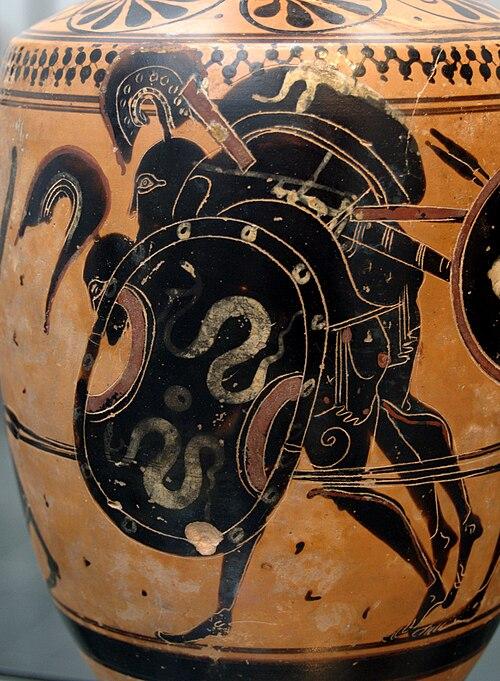
Ajax carries off the body of Achilles, Attic black-figure lekythos from Sicily, c. 510 BCE (Staatliche Antikensammlungen, Munich).

A terracotta amphora fragment showing two helmeted warriors in black-figure style carrying the body of a fallen soldier. Large round shields decorated with serpent motifs dominate the scene.

Alt...Ajax carries off the body of Achilles, Attic black-figure lekythos from Sicily, c. 510 BCE (Staatliche Antikensammlungen, Munich). A terracotta amphora fragment showing two helmeted warriors in black-figure style carrying the body of a fallen soldier. Large round shields decorated with serpent motifs dominate the scene.

    [?]The Vulgar Tongue » 🤖 🌐
    @TheVulgarTongue@zirk.us

    TO CROW. To brag, boast, or triumph. To crow over any one; to keep him in subjection: an image drawn from a cock, who crows over a vanquished enemy. To strut like a crow in a gutter; to walk proudly, or with an air of consequence.

    A selection from Francis Grose’s “Dictionary Of The Vulgar Tongue” (1785)

    --
    @histodons

    Image imitating a page from an old document, text (as in main toot):

TO CROW. To brag, boast, or triumph. To crow over any one; to keep him in subjection: an image drawn from a cock, who crows over a vanquished enemy. To strut like a crow in a gutter; to walk proudly, or with an air of consequence.

A selection from Francis Grose’s “Dictionary Of The Vulgar Tongue” (1785)

    Alt...Image imitating a page from an old document, text (as in main toot): TO CROW. To brag, boast, or triumph. To crow over any one; to keep him in subjection: an image drawn from a cock, who crows over a vanquished enemy. To strut like a crow in a gutter; to walk proudly, or with an air of consequence. A selection from Francis Grose’s “Dictionary Of The Vulgar Tongue” (1785)

      [?]The Vulgar Tongue » 🤖 🌐
      @TheVulgarTongue@zirk.us

      GOBBLER. A turkey cock.

      A selection from Francis Grose’s “Dictionary Of The Vulgar Tongue” (1785)

      --
      @histodons

      Image imitating a page from an old document, text (as in main toot):

GOBBLER. A turkey cock.

A selection from Francis Grose’s “Dictionary Of The Vulgar Tongue” (1785)

      Alt...Image imitating a page from an old document, text (as in main toot): GOBBLER. A turkey cock. A selection from Francis Grose’s “Dictionary Of The Vulgar Tongue” (1785)

        [?]Project Gutenberg » 🌐
        @gutenberg_org@mastodon.social

        How JD Salinger’s Experience of WWII Suffused All of His Writing, Even Catcher in the Rye

        Jasper Craven Explores the Role of War in Influencing American Literary Masculinity

        lithub.com/how-jd-salingers-ex

        Books about American fiction -- 20th century at PG:
        gutenberg.org/ebooks/subject/5

        Portrait of American author J. D. Salinger photographed by Lotte at Atelier Jacobi in New York City, October 11, 1950 (source: Fine Books & Collections). The photo was used as an author portrait on the first-edition dust jacket of Salinger's 1951 novel The Catcher in the Rye. It was removed from subsequent editions of the novel at the author's request.

This is a black-and-white photograph of J.D. Salinger, shown with dark slicked-back hair, wearing a tweed jacket, white collared shirt, and tie, with a slight, subtle smile.

        Alt...Portrait of American author J. D. Salinger photographed by Lotte at Atelier Jacobi in New York City, October 11, 1950 (source: Fine Books & Collections). The photo was used as an author portrait on the first-edition dust jacket of Salinger's 1951 novel The Catcher in the Rye. It was removed from subsequent editions of the novel at the author's request. This is a black-and-white photograph of J.D. Salinger, shown with dark slicked-back hair, wearing a tweed jacket, white collared shirt, and tie, with a slight, subtle smile.

          oheso boosted

          [?]The Vulgar Tongue » 🤖 🌐
          @TheVulgarTongue@zirk.us

          GAMON AND PATTER. Common place talk of any profession; as the gamon and patter of a horse-dealer, sailor, &c.

          A selection from Francis Grose’s “Dictionary Of The Vulgar Tongue” (1785)

          --
          @histodons

          Image imitating a page from an old document, text (as in main toot):

GAMON AND PATTER. Common place talk of any profession; as the gamon and patter of a horse-dealer, sailor, &c.

A selection from Francis Grose’s “Dictionary Of The Vulgar Tongue” (1785)

          Alt...Image imitating a page from an old document, text (as in main toot): GAMON AND PATTER. Common place talk of any profession; as the gamon and patter of a horse-dealer, sailor, &c. A selection from Francis Grose’s “Dictionary Of The Vulgar Tongue” (1785)

            [?]The Vulgar Tongue » 🤖 🌐
            @TheVulgarTongue@zirk.us

            HERE AND THEREIAN. One who has no settled place of residence.

            A selection from Francis Grose’s “Dictionary Of The Vulgar Tongue” (1785)

            --
            @histodons

            Image imitating a page from an old document, text (as in main toot):

HERE AND THEREIAN. One who has no settled place of residence.

A selection from Francis Grose’s “Dictionary Of The Vulgar Tongue” (1785)

            Alt...Image imitating a page from an old document, text (as in main toot): HERE AND THEREIAN. One who has no settled place of residence. A selection from Francis Grose’s “Dictionary Of The Vulgar Tongue” (1785)

              Light boosted

              [?]Project Gutenberg » 🌐
              @gutenberg_org@mastodon.social

              Kafka's Screwball Tragedy: Investigations of a Philosophical Dog

              "Investigations of a Dog" is a funny and deeply philosophical tale of a lone, maladjusted dog who defies scientific dogma and pioneers an original research program in pursuit of the mysteries of his self and his world.

              By: Aaron Schuster (from the archives)

              thereader.mitpress.mit.edu/kaf

              Books by Kafka at PG:
              gutenberg.org/ebooks/author/17

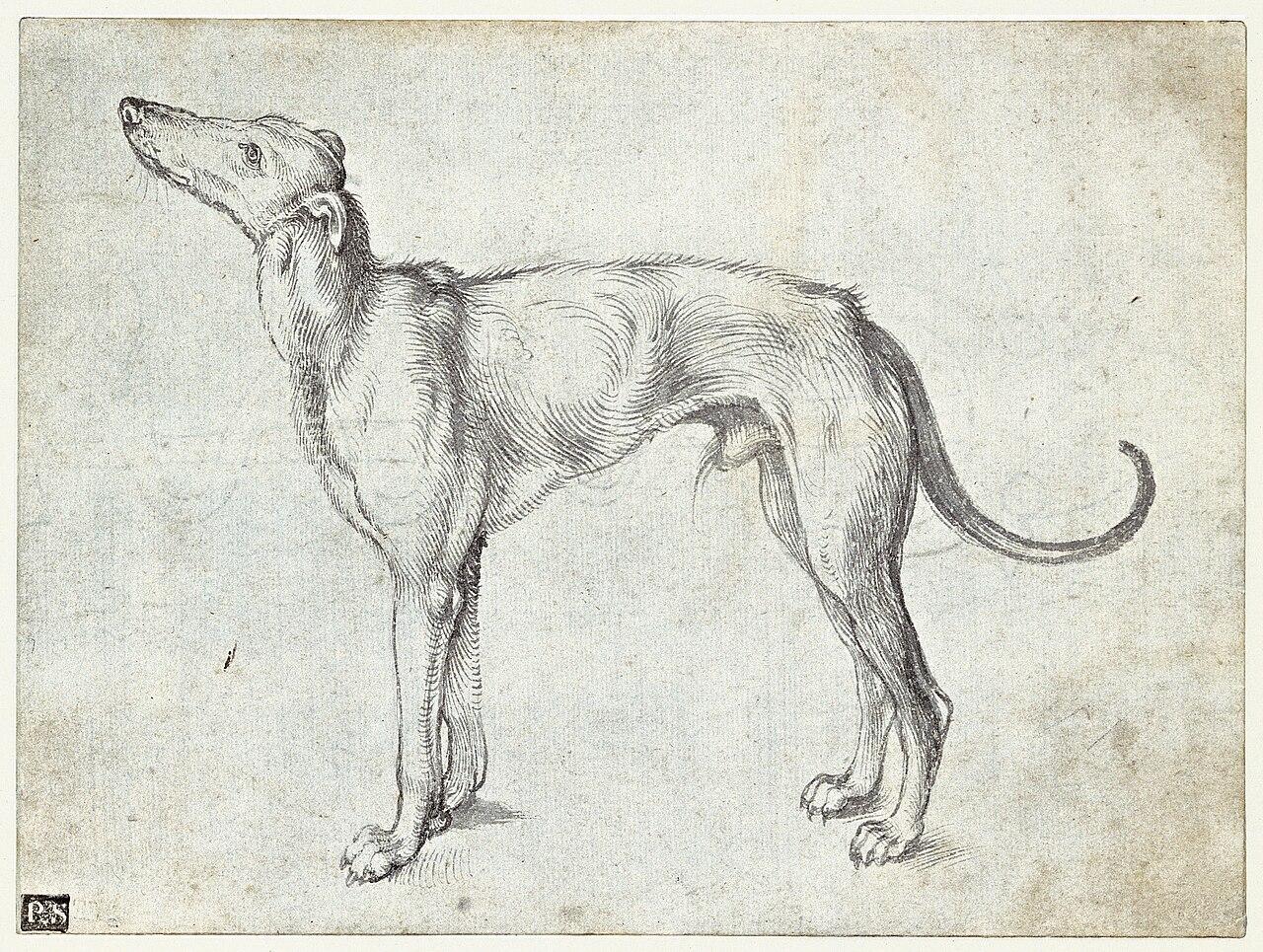
              Albrecht Dürer, "A greyhound," 1501.

A detailed pen-and-ink sketch showing a slender greyhound in profile, head raised alertly.

              Alt...Albrecht Dürer, "A greyhound," 1501. A detailed pen-and-ink sketch showing a slender greyhound in profile, head raised alertly.

                [?]The Vulgar Tongue » 🤖 🌐
                @TheVulgarTongue@zirk.us

                HUMP. To hump; once a fashionable word for copulation.

                A selection from Francis Grose’s “Dictionary Of The Vulgar Tongue” (1785)

                --
                @histodons

                Image imitating a page from an old document, text (as in main toot):

HUMP. To hump; once a fashionable word for copulation.

A selection from Francis Grose’s “Dictionary Of The Vulgar Tongue” (1785)

                Alt...Image imitating a page from an old document, text (as in main toot): HUMP. To hump; once a fashionable word for copulation. A selection from Francis Grose’s “Dictionary Of The Vulgar Tongue” (1785)

                  [?]דאָס איז נישט קיין פּײַפּ » 🌐
                  @dukepaaron@babka.social

                  "A bumper crop of new kids’ about the is hitting shelves in 2026, surprising close observers of children’s .

                  “It is unusual for multiple books to be in the same year, especially of consistently high quality. It’s very exciting,” said , a Jewish and host of the of Life , which describes itself as “a podcast about Jewish (mostly).”

                  noted with appreciation that one of the books was coming from a mainstream secular press, rather than from the smaller boutique presses that tend to release books about Jewish holidays.

                  She offered a possible explanation for the surging interest in the harvest holiday in particular: “Sukkot is family- and environmentally friendly, and I think that is a big part of its appeal.”

                  But the new books showcase a wide range of Jewish traditions and values..."

                  jta.org/2026/08/07/culture/fro

                    [?]The Vulgar Tongue » 🤖 🌐
                    @TheVulgarTongue@zirk.us

                    TO HUFF. To reprove, or scold at any one; also to bluster, bounce, ding, or swagger. A captain huff; a noted bully. To stand the huff; to be answerable for the reckoning in a public house.

                    A selection from Francis Grose’s “Dictionary Of The Vulgar Tongue” (1785)

                    --
                    @histodons

                    Image imitating a page from an old document, text (as in main toot):

TO HUFF. To reprove, or scold at any one; also to bluster, bounce, ding, or swagger. A captain huff; a noted bully. To stand the huff; to be answerable for the reckoning in a public house.

A selection from Francis Grose’s “Dictionary Of The Vulgar Tongue” (1785)

                    Alt...Image imitating a page from an old document, text (as in main toot): TO HUFF. To reprove, or scold at any one; also to bluster, bounce, ding, or swagger. A captain huff; a noted bully. To stand the huff; to be answerable for the reckoning in a public house. A selection from Francis Grose’s “Dictionary Of The Vulgar Tongue” (1785)

                      Light boosted

                      [?]Project Gutenberg » 🌐
                      @gutenberg_org@mastodon.social

                      Science, religion, and political omens: the meaning of eclipses in ancient Rome

                      by Javier Andreu Pintado

                      Romans could predict eclipses, but still interpreted them as signs from the gods.

                      theconversation.com/science-re

                      Books about eclipses (next eclipse will take place on August 12) at PG:
                      gutenberg.org/ebooks/subjects/

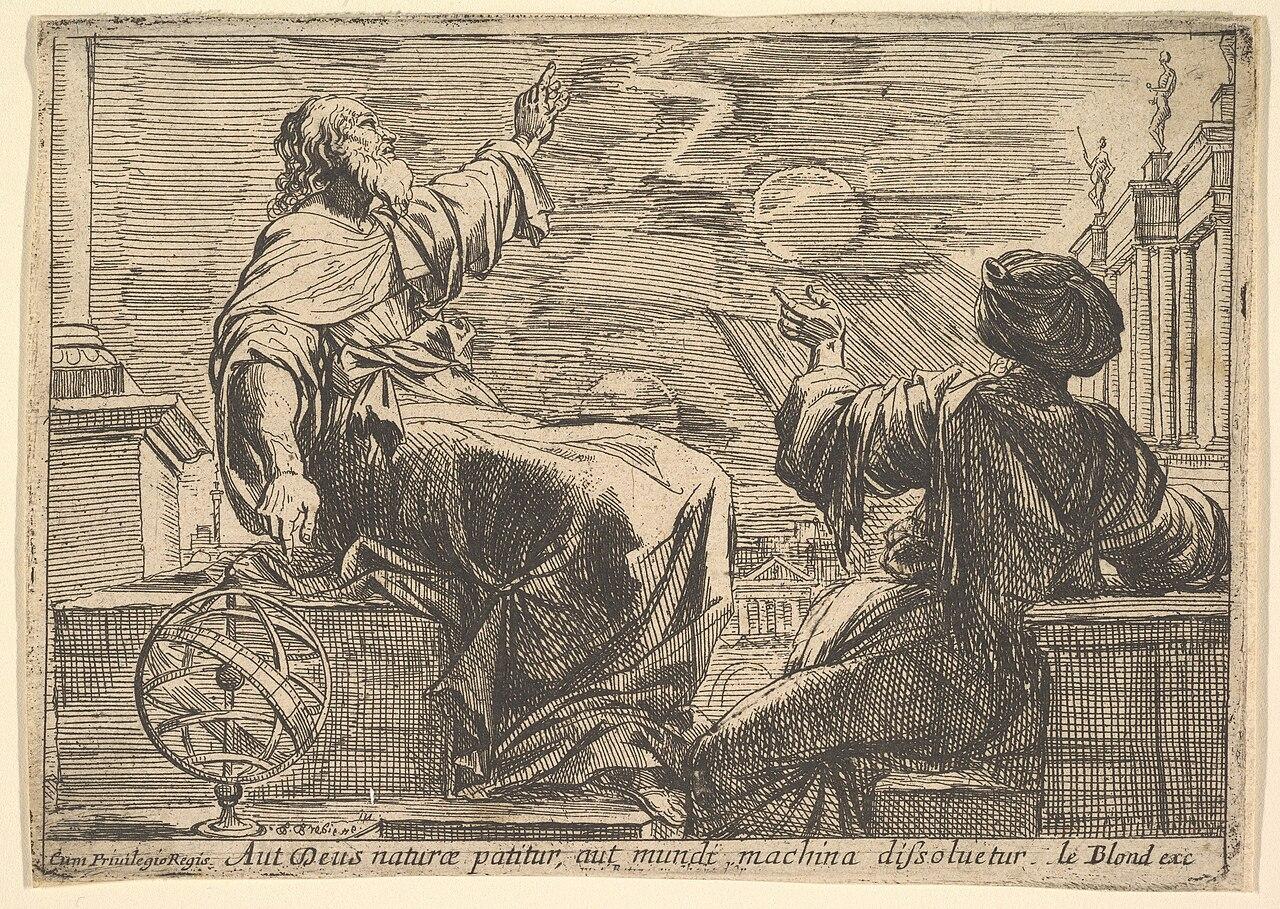
                      Two philosophers watching an eclipse, etching by Pierre Brébiette.

It is showing two robed, bearded figures gesturing dramatically toward the sky where a solar eclipse is depicted, with an armillary sphere at their feet and classical architecture in the background. The Latin inscription reads "Aut Deus naturae patitur, aut mundi machina dissoluetur" ("Either God suffers in nature, or the machine of the world will be dissolved").

                      Alt...Two philosophers watching an eclipse, etching by Pierre Brébiette. It is showing two robed, bearded figures gesturing dramatically toward the sky where a solar eclipse is depicted, with an armillary sphere at their feet and classical architecture in the background. The Latin inscription reads "Aut Deus naturae patitur, aut mundi machina dissoluetur" ("Either God suffers in nature, or the machine of the world will be dissolved").

                        [?]The Vulgar Tongue » 🤖 🌐
                        @TheVulgarTongue@zirk.us

                        MAGGOTTY. Whimsical, capricious.

                        A selection from Francis Grose’s “Dictionary Of The Vulgar Tongue” (1785)

                        --
                        @histodons

                        Image imitating a page from an old document, text (as in main toot):

MAGGOTTY. Whimsical, capricious.

A selection from Francis Grose’s “Dictionary Of The Vulgar Tongue” (1785)

                        Alt...Image imitating a page from an old document, text (as in main toot): MAGGOTTY. Whimsical, capricious. A selection from Francis Grose’s “Dictionary Of The Vulgar Tongue” (1785)

                          [?]The Vulgar Tongue » 🤖 🌐
                          @TheVulgarTongue@zirk.us

                          HORN COLIC. A temporary priapism.

                          A selection from Francis Grose’s “Dictionary Of The Vulgar Tongue” (1785)

                          --
                          @histodons

                          Image imitating a page from an old document, text (as in main toot):

HORN COLIC. A temporary priapism.

A selection from Francis Grose’s “Dictionary Of The Vulgar Tongue” (1785)

                          Alt...Image imitating a page from an old document, text (as in main toot): HORN COLIC. A temporary priapism. A selection from Francis Grose’s “Dictionary Of The Vulgar Tongue” (1785)

                            [?]Project Gutenberg » 🌐
                            @gutenberg_org@mastodon.social

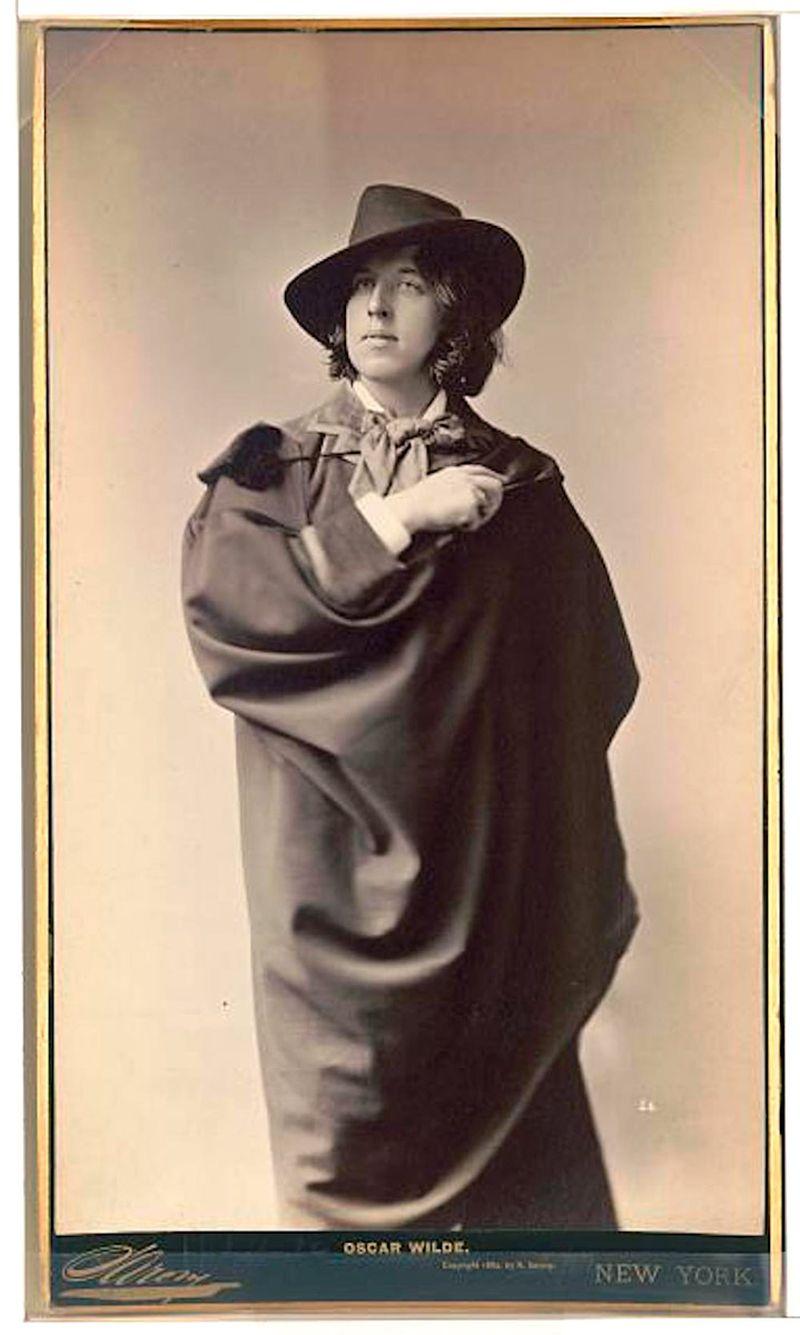
                            9 Supernatural Creatures in the Works of Oscar Wilde

                            Mermaids, giants, and witches are some of the supernatural characters readers encounter in the words of the brilliant writer Oscar Wilde.

                            thecollector.com/supernatural-

                            Wilde at PG:

                            gutenberg.org/ebooks/author/111

                            This photograph of Oscar Wilde in a dramatic pose, taken by Napoleon Sarony around 1882, shows him standing and facing slightly to the left. Wilde has medium-length wavy hair and wears a wide-brimmed fedora-style hat. He has a large dark cape over his shoulders and a light-colored cravat or neck scarf tied in a big bow. His right hand is lifted near his chest, holding the cape in place.

                            Alt...This photograph of Oscar Wilde in a dramatic pose, taken by Napoleon Sarony around 1882, shows him standing and facing slightly to the left. Wilde has medium-length wavy hair and wears a wide-brimmed fedora-style hat. He has a large dark cape over his shoulders and a light-colored cravat or neck scarf tied in a big bow. His right hand is lifted near his chest, holding the cape in place.

                              oheso boosted

                              [?]Project Gutenberg » 🌐
                              @gutenberg_org@mastodon.social

                              Who were the Luddites? Their legacy ripples through politics, cultural commentary and literature

                              by Brian Lewis

                              theconversation.com/who-were-t

                              Books about Luddites at PG:
                              gutenberg.org/ebooks/subjects/

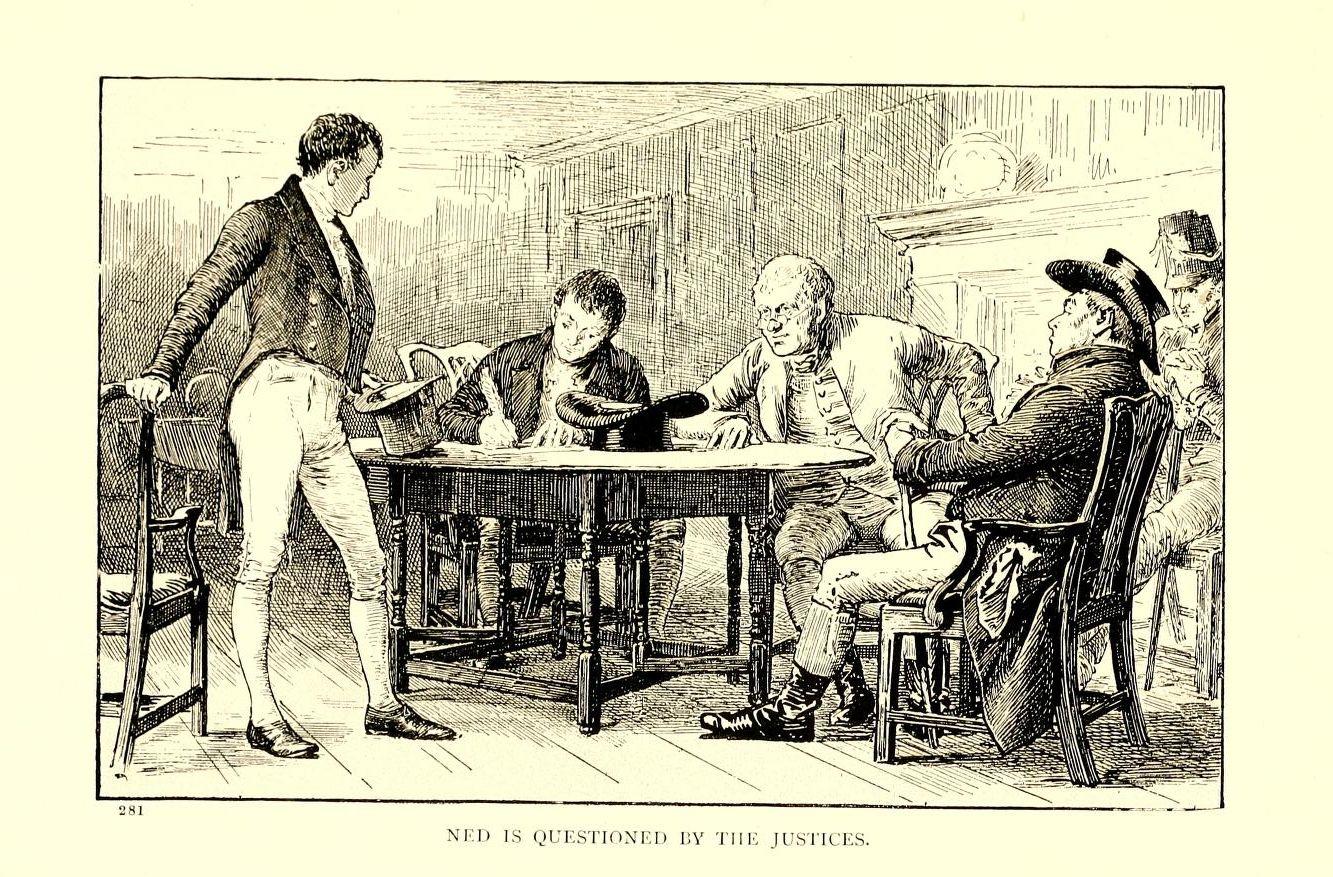
                              Ned is questioned by the justices.

Title: Through the Fray: A Tale of the Luddite Riots

Author: G. A. Henty

It is showing a young man standing before a table where several older, formally dressed men are seated, questioning him in what appears to be a courtroom or inquiry scene.

                              Alt...Ned is questioned by the justices. Title: Through the Fray: A Tale of the Luddite Riots Author: G. A. Henty It is showing a young man standing before a table where several older, formally dressed men are seated, questioning him in what appears to be a courtroom or inquiry scene.

                                oheso boosted

                                [?]Project Gutenberg » 🌐
                                @gutenberg_org@mastodon.social

                                How storytelling can help us grasp climate change

                                As glaciers melt, a writer considers what stories can do that data cannot

                                by Adam Loften, Emmanuel Vaughan-Lee

                                aeon.co/videos/as-glaciers-mel

                                More information about Vatnajökull:
                                en.wikipedia.org/wiki/Vatnaj%C

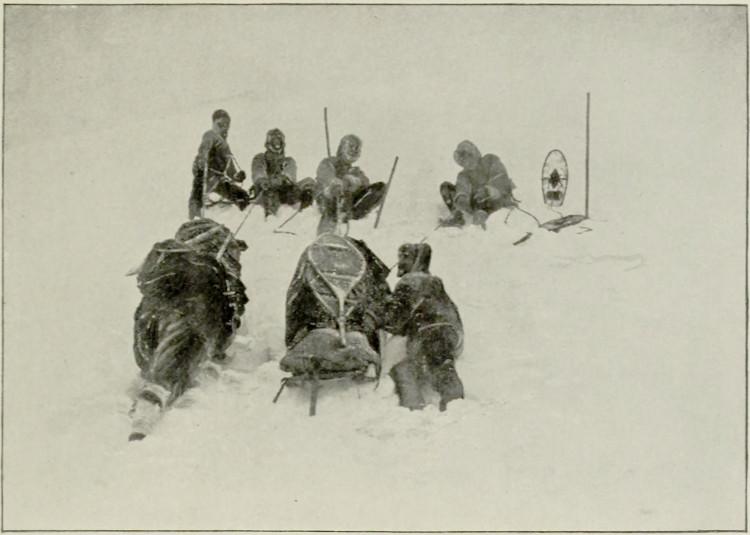
                                Ascending Icy Mountains.

Title: Through the first Antarctic night, 1898-1899

a narrative of the voyage of the "Belgica" among newly discovered lands and over an unknown sea about the south pole

Author: Frederick Albert Cook

A photograph showing polar expedition members in heavy fur-lined coats, gathered in deep snow with sledges and equipment, including what appears to be snowshoes on a stand.

                                Alt...Ascending Icy Mountains. Title: Through the first Antarctic night, 1898-1899 a narrative of the voyage of the "Belgica" among newly discovered lands and over an unknown sea about the south pole Author: Frederick Albert Cook A photograph showing polar expedition members in heavy fur-lined coats, gathered in deep snow with sledges and equipment, including what appears to be snowshoes on a stand.

                                  oheso boosted

                                  [?]The Vulgar Tongue » 🤖 🌐
                                  @TheVulgarTongue@zirk.us

                                  VALENTINE. The first woman seen by a man, or man seen by a woman, on St. Valentine's day, the 14th of February, when it is said every bird chuses his mate for the ensuing year.

                                  A selection from Francis Grose’s “Dictionary Of The Vulgar Tongue” (1785)

                                  --
                                  @histodons

                                  Image imitating a page from an old document, text (as in main toot):

VALENTINE. The first woman seen by a man, or man seen by a woman, on St. Valentine's day, the 14th of February, when it is said every bird chuses his mate for the ensuing year.

A selection from Francis Grose’s “Dictionary Of The Vulgar Tongue” (1785)

                                  Alt...Image imitating a page from an old document, text (as in main toot): VALENTINE. The first woman seen by a man, or man seen by a woman, on St. Valentine's day, the 14th of February, when it is said every bird chuses his mate for the ensuing year. A selection from Francis Grose’s “Dictionary Of The Vulgar Tongue” (1785)

                                    [?]The Vulgar Tongue » 🤖 🌐
                                    @TheVulgarTongue@zirk.us

                                    CURE ARSE. A dyachilon plaister, applied to the parts galled by riding.

                                    A selection from Francis Grose’s “Dictionary Of The Vulgar Tongue” (1785)

                                    --
                                    @histodons

                                    Image imitating a page from an old document, text (as in main toot):

CURE ARSE. A dyachilon plaister, applied to the parts galled by riding.

A selection from Francis Grose’s “Dictionary Of The Vulgar Tongue” (1785)

                                    Alt...Image imitating a page from an old document, text (as in main toot): CURE ARSE. A dyachilon plaister, applied to the parts galled by riding. A selection from Francis Grose’s “Dictionary Of The Vulgar Tongue” (1785)

                                      [?]Project Gutenberg » 🌐
                                      @gutenberg_org@mastodon.social

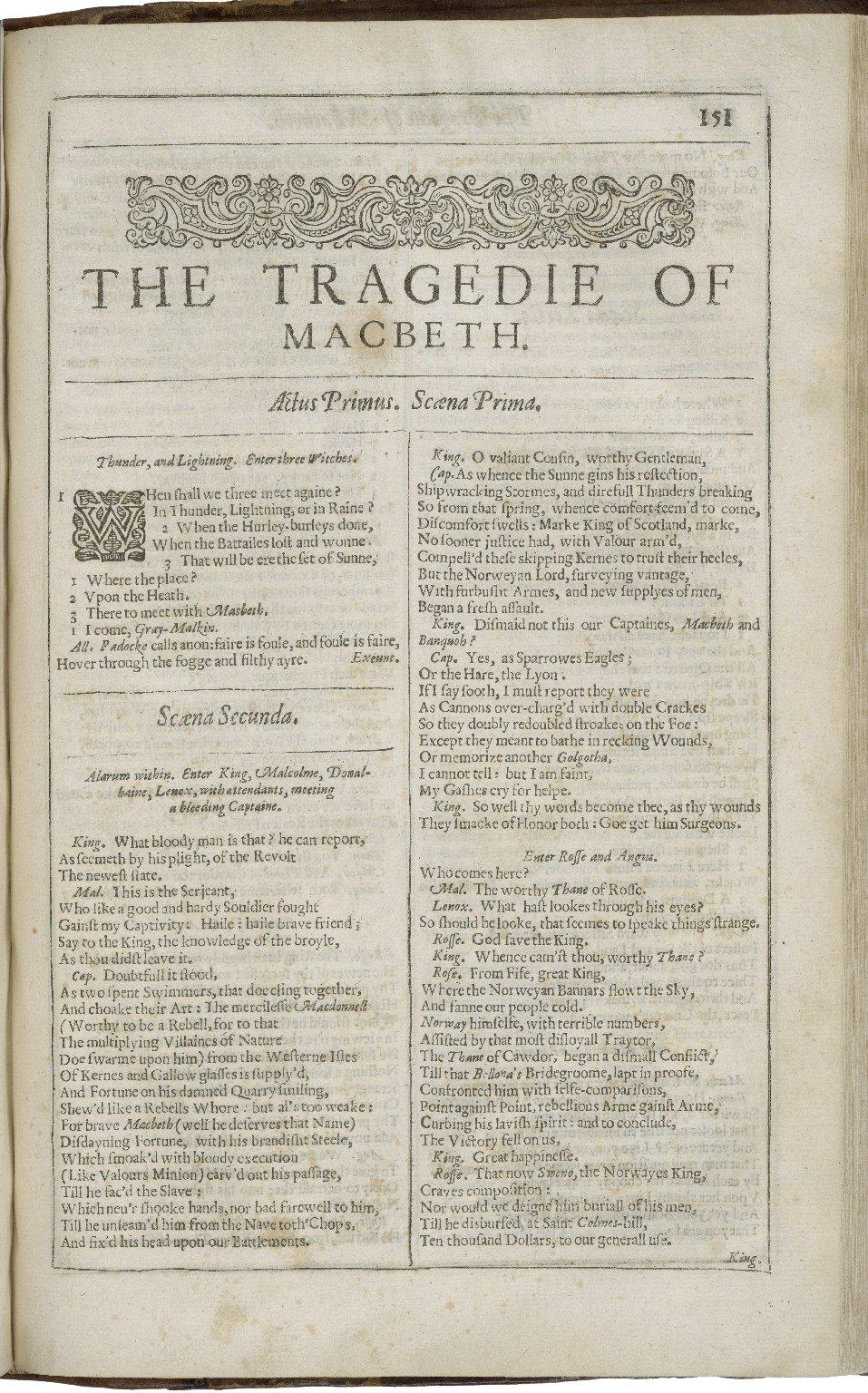
                                      "Fair is foul, and foul is fair;
                                      Hover through the fog and filthy air."
                                      Witches, Scene I

                                      This Week in Literary History: William Shakespeare’s Macbeth is Performed for the First Time (Probably)

                                      Toil and Trouble

                                      lithub.com/this-week-in-litera

                                      Macbeth by William Shakespeare at PG:
                                      gutenberg.org/ebooks/1533

                                      The title page of Macbeth, printed in the Second Folio of 1632.

It is showing the opening scenes with the three witches and King Duncan receiving news of battle, printed in early modern typography with decorative header ornamentation, on page 151.

                                      Alt...The title page of Macbeth, printed in the Second Folio of 1632. It is showing the opening scenes with the three witches and King Duncan receiving news of battle, printed in early modern typography with decorative header ornamentation, on page 151.

                                        [?]Project Gutenberg » 🌐
                                        @gutenberg_org@mastodon.social

                                        The Case for Aesthetic Education

                                        Why Friedrich Schiller believed art belongs at the heart of education—and why it matters for equal opportunity today.

                                        By: Marco Elvis Joven Domínguez

                                        daily.jstor.org/the-case-for-a

                                        Books by Friedrich Schiller at PG:
                                        gutenberg.org/ebooks/author/289

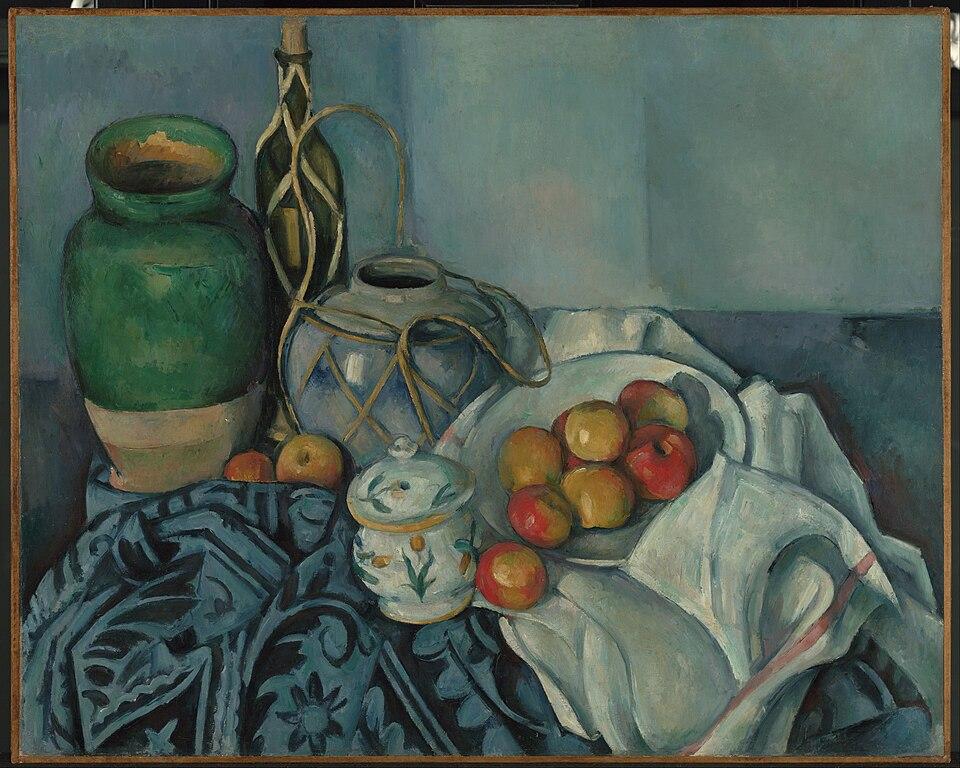
                                        Still Life with Apples by Paul Cézanne.

A green ceramic jar, a wine bottle wrapped in wicker, a wicker-wrapped jug, a small floral-patterned sugar bowl, and a bowl of red and yellow apples, all arranged on a table draped with a patterned blue cloth and white fabric.

                                        Alt...Still Life with Apples by Paul Cézanne. A green ceramic jar, a wine bottle wrapped in wicker, a wicker-wrapped jug, a small floral-patterned sugar bowl, and a bowl of red and yellow apples, all arranged on a table draped with a patterned blue cloth and white fabric.

                                          [?]The Vulgar Tongue » 🤖 🌐
                                          @TheVulgarTongue@zirk.us

                                          BLIND HARPERS. Beggars counterfeiting blindness, playing on fiddles, &c.

                                          A selection from Francis Grose’s “Dictionary Of The Vulgar Tongue” (1785)

                                          --
                                          @histodons

                                          Image imitating a page from an old document, text (as in main toot):

BLIND HARPERS. Beggars counterfeiting blindness, playing on fiddles, &c.

A selection from Francis Grose’s “Dictionary Of The Vulgar Tongue” (1785)

                                          Alt...Image imitating a page from an old document, text (as in main toot): BLIND HARPERS. Beggars counterfeiting blindness, playing on fiddles, &c. A selection from Francis Grose’s “Dictionary Of The Vulgar Tongue” (1785)

                                            [?]The Vulgar Tongue » 🤖 🌐
                                            @TheVulgarTongue@zirk.us

                                            DUMMEE. A pocket book. A dummee hunter. A pick-pocket, who lurks about to steal pocket books out of gentlemen's pockets. Frisk the dummee of the screens; take all the bank notes out of the pocket book.

                                            A selection from Francis Grose’s “Dictionary Of The Vulgar Tongue” (1785)

                                            --
                                            @histodons

                                            Image imitating a page from an old document, text (as in main toot):

DUMMEE. A pocket book. A dummee hunter. A pick-pocket, who lurks about to steal pocket books out of gentlemen's pockets. Frisk the dummee of the screens; take all the bank notes out of the pocket book.

A selection from Francis Grose’s “Dictionary Of The Vulgar Tongue” (1785)

                                            Alt...Image imitating a page from an old document, text (as in main toot): DUMMEE. A pocket book. A dummee hunter. A pick-pocket, who lurks about to steal pocket books out of gentlemen's pockets. Frisk the dummee of the screens; take all the bank notes out of the pocket book. A selection from Francis Grose’s “Dictionary Of The Vulgar Tongue” (1785)

                                              [?]Project Gutenberg » 🌐
                                              @gutenberg_org@mastodon.social

                                              “Funes the Memorious" and Other Cases of Extraordinary Memory

                                              In Jorge Luis Borges's story of barely 12 pages, the celebrated writer plays with the infinite in a context of vast labyrinths of memory and the consequences of having an unlimited capacity to remember.

                                              thereader.mitpress.mit.edu/bor

                                              Books by Pliny, the Elder at PG:
                                              gutenberg.org/ebooks/author/50

                                              Title page of the first volume of a 1669 edition of Pliny’s “Naturalis historia.”

It includes commentary by various classical scholars and features an ornate printer's emblem with an eagle in the center, surrounded by decorative floral engravings.

                                              Alt...Title page of the first volume of a 1669 edition of Pliny’s “Naturalis historia.” It includes commentary by various classical scholars and features an ornate printer's emblem with an eagle in the center, surrounded by decorative floral engravings.

                                                [?]The Vulgar Tongue » 🤖 🌐
                                                @TheVulgarTongue@zirk.us

                                                POT-WABBLERS. Persons entitled to vote for members of parliament in certain boroughs, from having boiled their pots therein. These boroughs are called pot-wabbling boroughs.

                                                A selection from Francis Grose’s “Dictionary Of The Vulgar Tongue” (1785)

                                                --
                                                @histodons

                                                Image imitating a page from an old document, text (as in main toot):

POT-WABBLERS. Persons entitled to vote for members of parliament in certain boroughs, from having boiled their pots therein. These boroughs are called pot-wabbling boroughs.

A selection from Francis Grose’s “Dictionary Of The Vulgar Tongue” (1785)

                                                Alt...Image imitating a page from an old document, text (as in main toot): POT-WABBLERS. Persons entitled to vote for members of parliament in certain boroughs, from having boiled their pots therein. These boroughs are called pot-wabbling boroughs. A selection from Francis Grose’s “Dictionary Of The Vulgar Tongue” (1785)

                                                  [?]The Vulgar Tongue » 🤖 🌐
                                                  @TheVulgarTongue@zirk.us

                                                  Hi!, I'm a bot posting selections from Francis Grose’s 1785 “Dictionary Of The Vulgar Tongue”, a compilation of slang terms, the coded language of the underclass and the demi-monde.

                                                  [18th-century-content warning: possible racism, animal cruelty, homophobia, sexism, slut-shaming. Let me know of any problems.]

                                                  Montage of dictionary items posted by this account

                                                  Alt...Montage of dictionary items posted by this account

                                                    [?]The Vulgar Tongue » 🤖 🌐
                                                    @TheVulgarTongue@zirk.us

                                                    MUMMER. The mouth.

                                                    A selection from Francis Grose’s “Dictionary Of The Vulgar Tongue” (1785)

                                                    --
                                                    @histodons

                                                    Image imitating a page from an old document, text (as in main toot):

MUMMER. The mouth.

A selection from Francis Grose’s “Dictionary Of The Vulgar Tongue” (1785)

                                                    Alt...Image imitating a page from an old document, text (as in main toot): MUMMER. The mouth. A selection from Francis Grose’s “Dictionary Of The Vulgar Tongue” (1785)

                                                      [?]Project Gutenberg » 🌐
                                                      @gutenberg_org@mastodon.social

                                                      How Geoffrey Chaucer’s “Canterbury Tales” Defined Old English Literature

                                                      Geoffrey Chaucer’s Canterbury Tales have come to define Old English literature and offer a unique window into life in medieval England.

                                                      thecollector.com/chaucer-cante

                                                      Chaucer at PG:

                                                      gutenberg.org/ebooks/search/?q

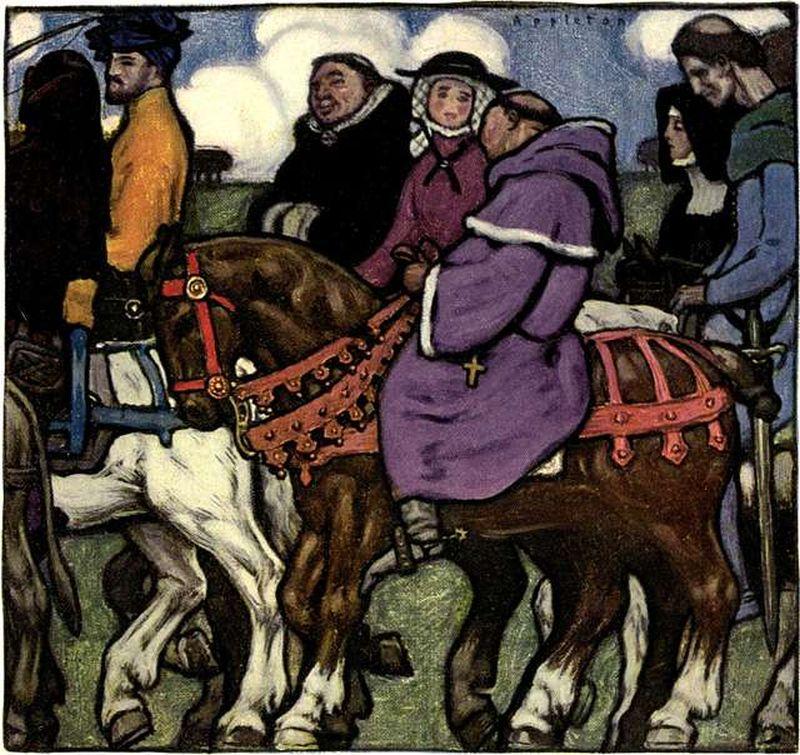
                                                      Walter Appleton Clark created this illustration in 1904 for Percy MacKaye’s modern version of Geoffrey Chaucer’s The Canterbury Tales. The image shows a group of medieval pilgrims riding together on horseback. In the center, a heavy-set pilgrim wears a thick purple hooded habit with white trim and rides a large brown horse. To his right, a woman in a dark hat and a white wimple over a mauve dress rides alongside him. Next to her, a broad-faced man in dark clothes looks her way. On the left edge, someone in a bright yellow tunic and a large blue headwrap looks ahead. On the far right, a monk or friar rides with another companion.

                                                      Alt...Walter Appleton Clark created this illustration in 1904 for Percy MacKaye’s modern version of Geoffrey Chaucer’s The Canterbury Tales. The image shows a group of medieval pilgrims riding together on horseback. In the center, a heavy-set pilgrim wears a thick purple hooded habit with white trim and rides a large brown horse. To his right, a woman in a dark hat and a white wimple over a mauve dress rides alongside him. Next to her, a broad-faced man in dark clothes looks her way. On the left edge, someone in a bright yellow tunic and a large blue headwrap looks ahead. On the far right, a monk or friar rides with another companion.

                                                        [?]The Vulgar Tongue » 🤖 🌐
                                                        @TheVulgarTongue@zirk.us

                                                        GOLD DROPPERS. Who drop a piece of gold, which they pick up in the presence of some unexperienced person, this they pretend to have found, and they invite him to a public house to partake of it: when there, comrades drop in, and propose cards, or some other game.

                                                        A selection from Francis Grose’s “Dictionary Of The Vulgar Tongue” (1785)

                                                        --
                                                        @histodons

                                                        Image imitating a page from an old document, text (as in main toot):

GOLD DROPPERS. Who drop a piece of gold, which they pick up in the presence of some unexperienced person, this they pretend to have found, and they invite him to a public house to partake of it: when there, comrades drop in, and propose cards, or some other game.

A selection from Francis Grose’s “Dictionary Of The Vulgar Tongue” (1785)

                                                        Alt...Image imitating a page from an old document, text (as in main toot): GOLD DROPPERS. Who drop a piece of gold, which they pick up in the presence of some unexperienced person, this they pretend to have found, and they invite him to a public house to partake of it: when there, comrades drop in, and propose cards, or some other game. A selection from Francis Grose’s “Dictionary Of The Vulgar Tongue” (1785)

                                                          [?]The Vulgar Tongue » 🤖 🌐
                                                          @TheVulgarTongue@zirk.us

                                                          SNOOZING KEN. A brothel. The swell was spiced in a snoozing ken of his screens; the gentleman was robbed of his bank notes in a brothel.

                                                          A selection from Francis Grose’s “Dictionary Of The Vulgar Tongue” (1785)

                                                          --
                                                          @histodons

                                                          Image imitating a page from an old document, text (as in main toot):

SNOOZING KEN. A brothel. The swell was spiced in a snoozing ken of his screens; the gentleman was robbed of his bank notes in a brothel.

A selection from Francis Grose’s “Dictionary Of The Vulgar Tongue” (1785)

                                                          Alt...Image imitating a page from an old document, text (as in main toot): SNOOZING KEN. A brothel. The swell was spiced in a snoozing ken of his screens; the gentleman was robbed of his bank notes in a brothel. A selection from Francis Grose’s “Dictionary Of The Vulgar Tongue” (1785)

                                                            [?]Project Gutenberg » 🌐
                                                            @gutenberg_org@mastodon.social

                                                            Ernest Hemingway’s Personal Library Contained Thousands of Books—Here Are Some of the Authors

                                                            From Shakespeare to Virginia Woolf, these are just a few of the legendary writers that lined Hemingway's bookshelves.

                                                            mentalfloss.com/literature/aut

                                                            All of these authors are at PG:

                                                            gutenberg.org/

                                                            This photo shows Ernest Hemingway in 1950. He appears older, with short gray hair and a white beard and mustache. A curved scar or scratch is visible on his forehead. He is dressed in a dark shirt and a burgundy vest or jacket.

                                                            Alt...This photo shows Ernest Hemingway in 1950. He appears older, with short gray hair and a white beard and mustache. A curved scar or scratch is visible on his forehead. He is dressed in a dark shirt and a burgundy vest or jacket.

                                                              [?]Project Gutenberg » 🌐
                                                              @gutenberg_org@mastodon.social

                                                              Jules Verne’s Empty Dream of Spaceflight

                                                              In “From the Earth to the Moon,” scientific advancement is treated as destiny — but no one quite asks why.

                                                              By: Malka Older

                                                              thereader.mitpress.mit.edu/jul

                                                              From the Earth to the Moon at PG:
                                                              gutenberg.org/ebooks/83

                                                              An original illustration by Henri de Montaut from the 1868 edition of Jules Verne’s “From the Earth to the Moon." 

Illustration depicting a segmented, cylindrical spacecraft/projectile traveling through starry space toward the Moon, which looms large in the upper left with detailed craters visible.

                                                              Alt...An original illustration by Henri de Montaut from the 1868 edition of Jules Verne’s “From the Earth to the Moon." Illustration depicting a segmented, cylindrical spacecraft/projectile traveling through starry space toward the Moon, which looms large in the upper left with detailed craters visible.

                                                                Light boosted

                                                                [?]Project Gutenberg » 🌐
                                                                @gutenberg_org@mastodon.social

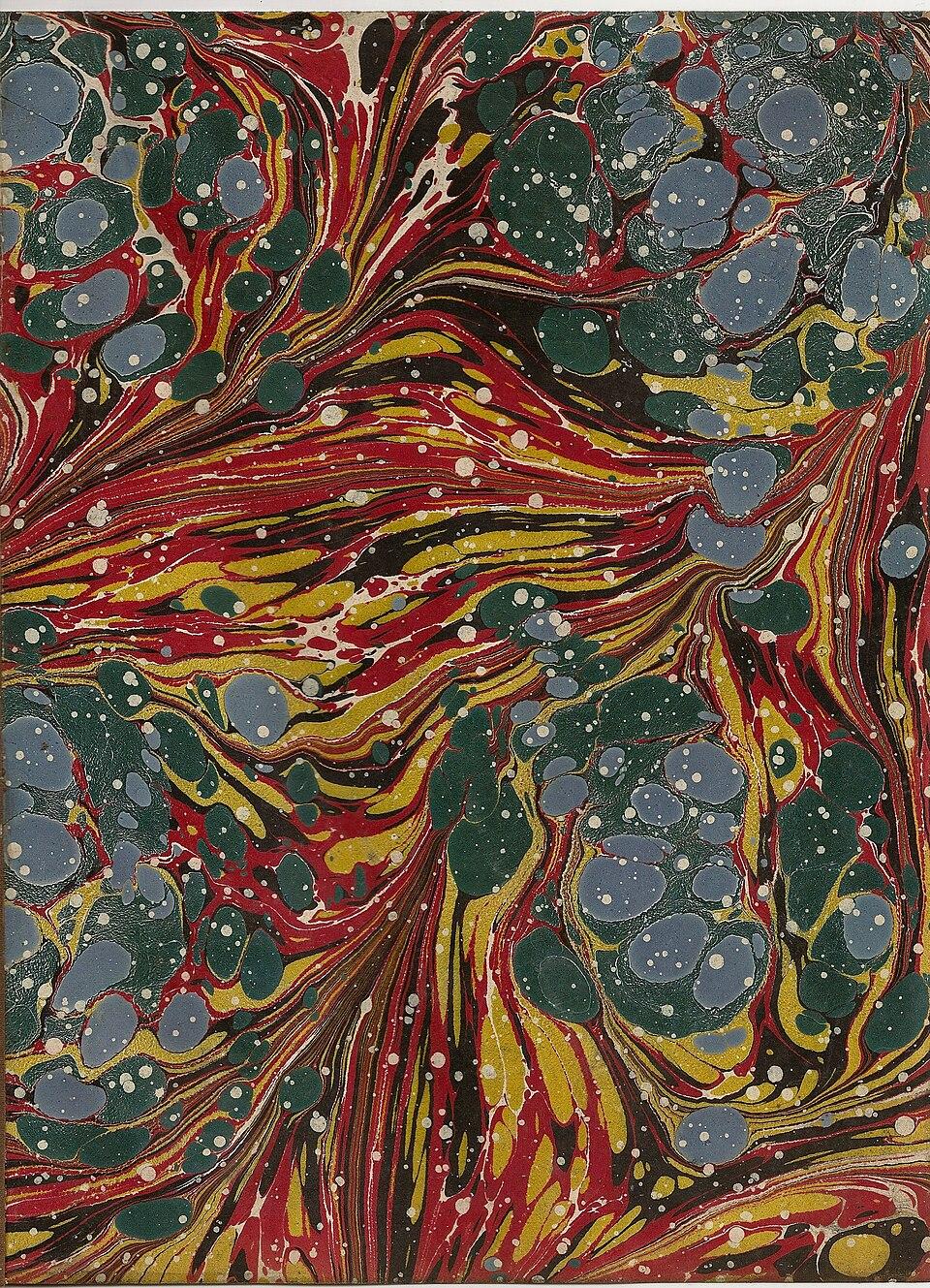
                                                                Marvelous Marbled Paper

                                                                What is marbling? Marbling involves floating paints or pigments on a liquid bath and moving the paint around to create designs before laying down paper to pick up the patterns.

                                                                by Allison Rein

                                                                aip.org/library/ex-libris-univ

                                                                Endpaper from a book published in Scotland in 1842. Encyclopedia Britannica 7th edition.

A traditional marbled paper, featuring swirling patterns of red, gold, dark green, and blue-gray with white speckled dots throughout, created using the technique of floating colored inks/paints on water and transferring the pattern to paper.

                                                                Alt...Endpaper from a book published in Scotland in 1842. Encyclopedia Britannica 7th edition. A traditional marbled paper, featuring swirling patterns of red, gold, dark green, and blue-gray with white speckled dots throughout, created using the technique of floating colored inks/paints on water and transferring the pattern to paper.

                                                                  [?]The Vulgar Tongue » 🤖 🌐
                                                                  @TheVulgarTongue@zirk.us

                                                                  RING. A circle formed for boxers, wrestlers, and cudgel-players, by a man styled Vinegar; who goes round the circle, striking at random with his whip to prevent the populace from crowding in.

                                                                  A selection from Francis Grose’s “Dictionary Of The Vulgar Tongue” (1785)

                                                                  --
                                                                  @histodons

                                                                  Image imitating a page from an old document, text (as in main toot):

RING. A circle formed for boxers, wrestlers, and cudgel-players, by a man styled Vinegar; who goes round the circle, striking at random with his whip to prevent the populace from crowding in.

A selection from Francis Grose’s “Dictionary Of The Vulgar Tongue” (1785)

                                                                  Alt...Image imitating a page from an old document, text (as in main toot): RING. A circle formed for boxers, wrestlers, and cudgel-players, by a man styled Vinegar; who goes round the circle, striking at random with his whip to prevent the populace from crowding in. A selection from Francis Grose’s “Dictionary Of The Vulgar Tongue” (1785)

                                                                    [?]The Vulgar Tongue » 🤖 🌐
                                                                    @TheVulgarTongue@zirk.us

                                                                    CRANK. Gin and water; also, brisk, pert.

                                                                    A selection from Francis Grose’s “Dictionary Of The Vulgar Tongue” (1785)

                                                                    --
                                                                    @histodons

                                                                    Image imitating a page from an old document, text (as in main toot):

CRANK. Gin and water; also, brisk, pert.

A selection from Francis Grose’s “Dictionary Of The Vulgar Tongue” (1785)

                                                                    Alt...Image imitating a page from an old document, text (as in main toot): CRANK. Gin and water; also, brisk, pert. A selection from Francis Grose’s “Dictionary Of The Vulgar Tongue” (1785)

                                                                      [?]Project Gutenberg » 🌐
                                                                      @gutenberg_org@mastodon.social

                                                                      5 Timeless Historical Fiction Books to Read After the ‘Odyssey’

                                                                      These classic tales of fictionalized history are able to stand the test of time.

                                                                      mentalfloss.com/literature/boo

                                                                      "A Tale of Two Cities"

                                                                      gutenberg.org/ebooks/98

                                                                      "Les Misérables"

                                                                      gutenberg.org/ebooks/135

                                                                      "War and Peace"

                                                                      gutenberg.org/ebooks/2600

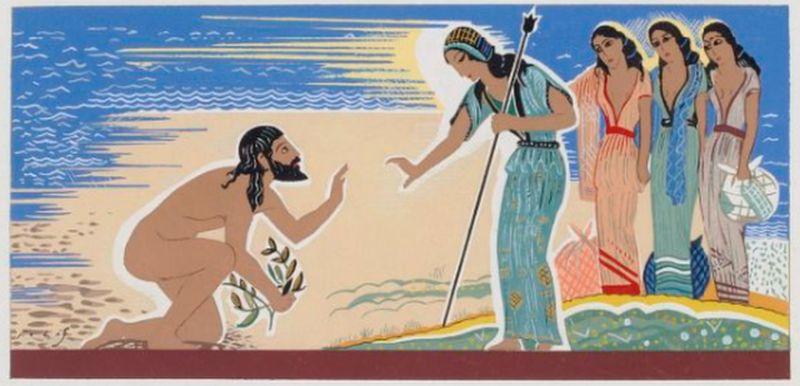
                                                                      This illustration by François-Louis Schmied was created for Homer's "Odyssey." It shows Odysseus meeting the Phaeacian princess Nausicaa on the shore of Scheria. Odysseus is naked and kneeling, holding an olive branch in his right hand and raising his left hand. Nausicaa stands in the center with a tall staff or walking spear. She appears unafraid of Odysseus, while three of her maids stand close behind her.

                                                                      Alt...This illustration by François-Louis Schmied was created for Homer's "Odyssey." It shows Odysseus meeting the Phaeacian princess Nausicaa on the shore of Scheria. Odysseus is naked and kneeling, holding an olive branch in his right hand and raising his left hand. Nausicaa stands in the center with a tall staff or walking spear. She appears unafraid of Odysseus, while three of her maids stand close behind her.

                                                                        [?]Project Gutenberg » 🌐
                                                                        @gutenberg_org@mastodon.social

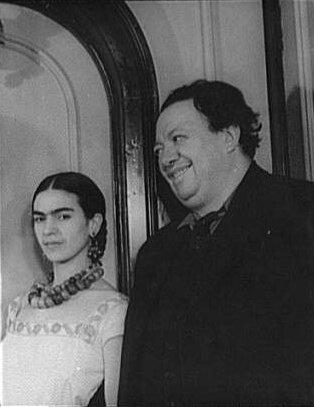
                                                                        Frida Kahlo and Diego Rivera’s Blue House in Coyoacán Was a Refuge for Leon Trotsky... Until It Wasn‘t

                                                                        H. Keith Melton and Nigel West on Trotsky and Kahlo‘s Simmering Affair Amidst Political Turmoil
                                                                        lithub.com/frida-kahlo-and-die

                                                                        Kahlo with husband Diego Rivera in 1932

by Carl Van Vechten

Kahlo is shown wearing a chunky beaded necklace and traditional-style dress, while Rivera stands beside her smiling, dressed in a dark suit.

                                                                        Alt...Kahlo with husband Diego Rivera in 1932 by Carl Van Vechten Kahlo is shown wearing a chunky beaded necklace and traditional-style dress, while Rivera stands beside her smiling, dressed in a dark suit.

                                                                          [?]Project Gutenberg » 🌐
                                                                          @gutenberg_org@mastodon.social

                                                                          Beatrix Potter's 160 years of Lake District legacy

                                                                          For many readers, Beatrix Potter's classic children's books provide their very first introduction to this iconic landscape. Marking 160 years since her birth, her enduring legacy in her beloved Cumbria continues to be celebrated.

                                                                          by Federica Bedendo, Mike Zeller, and Joshua Steer

                                                                          bbc.co.uk/news/articles/crk52l

                                                                          Books by Beatrix Potter at PG:
                                                                          gutenberg.org/ebooks/author/292

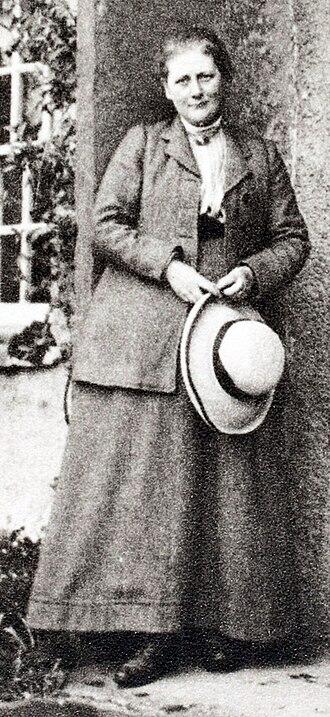
                                                                          Beatrix Potter in 1913.

This is a photograph of author and illustrator Beatrix Potter, shown standing outside near a stone doorway and window, dressed in a long dark skirt, jacket, and holding a wide-brimmed hat in her hands.

                                                                          Alt...Beatrix Potter in 1913. This is a photograph of author and illustrator Beatrix Potter, shown standing outside near a stone doorway and window, dressed in a long dark skirt, jacket, and holding a wide-brimmed hat in her hands.

                                                                            [?]The Vulgar Tongue » 🤖 🌐
                                                                            @TheVulgarTongue@zirk.us

                                                                            BEVER. An afternoon's luncheon; also a fine hat; beaver's fur making the best hats.

                                                                            A selection from Francis Grose’s “Dictionary Of The Vulgar Tongue” (1785)

                                                                            --
                                                                            @histodons

                                                                            Image imitating a page from an old document, text (as in main toot):

BEVER. An afternoon's luncheon; also a fine hat; beaver's fur making the best hats.

A selection from Francis Grose’s “Dictionary Of The Vulgar Tongue” (1785)

                                                                            Alt...Image imitating a page from an old document, text (as in main toot): BEVER. An afternoon's luncheon; also a fine hat; beaver's fur making the best hats. A selection from Francis Grose’s “Dictionary Of The Vulgar Tongue” (1785)

                                                                              [?]The Vulgar Tongue » 🤖 🌐
                                                                              @TheVulgarTongue@zirk.us

                                                                              BEGGAR MAKER. A publican, or ale-house keeper.

                                                                              A selection from Francis Grose’s “Dictionary Of The Vulgar Tongue” (1785)

                                                                              --
                                                                              @histodons

                                                                              Image imitating a page from an old document, text (as in main toot):

BEGGAR MAKER. A publican, or ale-house keeper.

A selection from Francis Grose’s “Dictionary Of The Vulgar Tongue” (1785)

                                                                              Alt...Image imitating a page from an old document, text (as in main toot): BEGGAR MAKER. A publican, or ale-house keeper. A selection from Francis Grose’s “Dictionary Of The Vulgar Tongue” (1785)

                                                                                [?]The Vulgar Tongue » 🤖 🌐
                                                                                @TheVulgarTongue@zirk.us

                                                                                CHIMNEY CHOPS. An abusive appellation for a negro.

                                                                                A selection from Francis Grose’s “Dictionary Of The Vulgar Tongue” (1785)

                                                                                --
                                                                                @histodons

                                                                                Image imitating a page from an old document, text (as in main toot):

CHIMNEY CHOPS. An abusive appellation for a negro.

A selection from Francis Grose’s “Dictionary Of The Vulgar Tongue” (1785)

                                                                                Alt...Image imitating a page from an old document, text (as in main toot): CHIMNEY CHOPS. An abusive appellation for a negro. A selection from Francis Grose’s “Dictionary Of The Vulgar Tongue” (1785)

                                                                                  [?]The Vulgar Tongue » 🤖 🌐
                                                                                  @TheVulgarTongue@zirk.us

                                                                                  GRINAGOG, THE CAT'S UNCLE. A foolish grinning fellow, one who grins without reason.

                                                                                  A selection from Francis Grose’s “Dictionary Of The Vulgar Tongue” (1785)

                                                                                  --
                                                                                  @histodons

                                                                                  Image imitating a page from an old document, text (as in main toot):

GRINAGOG, THE CAT'S UNCLE. A foolish grinning fellow, one who grins without reason.

A selection from Francis Grose’s “Dictionary Of The Vulgar Tongue” (1785)

                                                                                  Alt...Image imitating a page from an old document, text (as in main toot): GRINAGOG, THE CAT'S UNCLE. A foolish grinning fellow, one who grins without reason. A selection from Francis Grose’s “Dictionary Of The Vulgar Tongue” (1785)

                                                                                    [?]The Vulgar Tongue » 🤖 🌐
                                                                                    @TheVulgarTongue@zirk.us

                                                                                    GO, THE. The dash. The mode. He is quite the go, he is quite varment, he is prime, he is bang up, are synonimous expressions.

                                                                                    A selection from Francis Grose’s “Dictionary Of The Vulgar Tongue” (1785)

                                                                                    --
                                                                                    @histodons

                                                                                    Image imitating a page from an old document, text (as in main toot):

GO, THE. The dash. The mode. He is quite the go, he is quite varment, he is prime, he is bang up, are synonimous expressions.

A selection from Francis Grose’s “Dictionary Of The Vulgar Tongue” (1785)

                                                                                    Alt...Image imitating a page from an old document, text (as in main toot): GO, THE. The dash. The mode. He is quite the go, he is quite varment, he is prime, he is bang up, are synonimous expressions. A selection from Francis Grose’s “Dictionary Of The Vulgar Tongue” (1785)

                                                                                      [?]The Vulgar Tongue » 🤖 🌐
                                                                                      @TheVulgarTongue@zirk.us

                                                                                      FINGER IN EYE. To put finger in eye; to weep: commonly applied to women. The more you cry the less you'll p-ss; a consolatory speech used by sailors to their doxies. It is as great a pity to see a woman cry, as to see a goose walk barefoot; another of the same kind.

                                                                                      A selection from Francis Grose’s “Dictionary Of The Vulgar Tongue” (1785)

                                                                                      --
                                                                                      @histodons

                                                                                      Image imitating a page from an old document, text (as in main toot):

FINGER IN EYE. To put finger in eye; to weep: commonly applied to women. The more you cry the less you'll p-ss; a consolatory speech used by sailors to their doxies. It is as great a pity to see a woman cry, as to see a goose walk barefoot; another of the same kind.

A selection from Francis Grose’s “Dictionary Of The Vulgar Tongue” (1785)

                                                                                      Alt...Image imitating a page from an old document, text (as in main toot): FINGER IN EYE. To put finger in eye; to weep: commonly applied to women. The more you cry the less you'll p-ss; a consolatory speech used by sailors to their doxies. It is as great a pity to see a woman cry, as to see a goose walk barefoot; another of the same kind. A selection from Francis Grose’s “Dictionary Of The Vulgar Tongue” (1785)

                                                                                        [?]Project Gutenberg » 🌐
                                                                                        @gutenberg_org@mastodon.social

                                                                                        How Shakespeare and his contemporaries used music to rouse emotions

                                                                                        by Shirley Bell

                                                                                        Shakespeare used music in a multitude of ways to delight, amuse, relax, confuse and frighten his audiences.

                                                                                        theconversation.com/how-shakes

                                                                                        Books by Shakespeare at PG:
                                                                                        gutenberg.org/ebooks/author/65

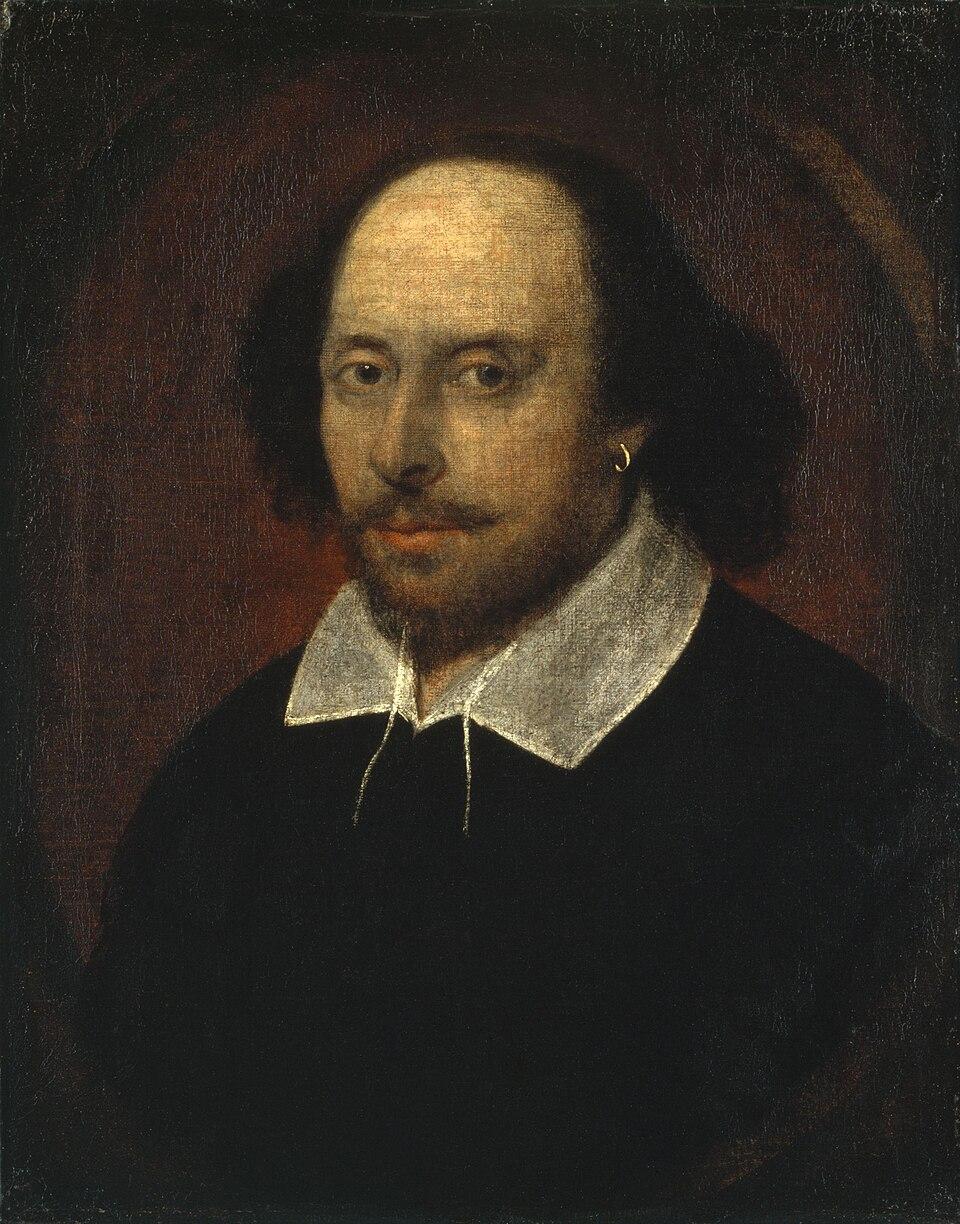
                                                                                        The Chandos portrait, likely depicting Shakespeare, c. 1611

It shows Shakespeare with a receding hairline, dark curly hair, a gold hoop earring, mustache and small beard, wearing a black doublet with a white collar against a dark background.

                                                                                        Alt...The Chandos portrait, likely depicting Shakespeare, c. 1611 It shows Shakespeare with a receding hairline, dark curly hair, a gold hoop earring, mustache and small beard, wearing a black doublet with a white collar against a dark background.

                                                                                          [?]Project Gutenberg » 🌐
                                                                                          @gutenberg_org@mastodon.social

                                                                                          DNA and Archeological Research Reveal the Overlooked History of Japan’s Women Warriors

                                                                                          By Sage Helene

                                                                                          mymodernmet.com/japan-women-sa

                                                                                          Books about Japanese fiction at PG:
                                                                                          gutenberg.org/ebooks/subject/3

                                                                                          "Hangakujo". The female warrior samurai Hangaku Gozen by Yoshitoshi (1839-1892). From the series "Yoshitoshi mushaburui: A series of warriors by Yoshitoshi." Published in "The Floating world of Ukiyo-e," essays by Sandy Kita, New York, 2001, no. 72, p. 135. Exhibited at "The Floating world of Ukiyo-e: shadows, dreams and substances," organized by the Library of Congress, 2001.

A woodblock print depicting an onna-musha (female samurai warrior) mounted on a rearing white horse. She wears red and black lacquered armor with a quiver of arrows on her back, and holds a bow.

                                                                                          Alt..."Hangakujo". The female warrior samurai Hangaku Gozen by Yoshitoshi (1839-1892). From the series "Yoshitoshi mushaburui: A series of warriors by Yoshitoshi." Published in "The Floating world of Ukiyo-e," essays by Sandy Kita, New York, 2001, no. 72, p. 135. Exhibited at "The Floating world of Ukiyo-e: shadows, dreams and substances," organized by the Library of Congress, 2001. A woodblock print depicting an onna-musha (female samurai warrior) mounted on a rearing white horse. She wears red and black lacquered armor with a quiver of arrows on her back, and holds a bow.

                                                                                            [?]The Vulgar Tongue » 🤖 🌐
                                                                                            @TheVulgarTongue@zirk.us

                                                                                            BULLY. A cowardly fellow, who gives himself airs of great bravery. A bully huff cap; a hector. See HECTOR.

                                                                                            A selection from Francis Grose’s “Dictionary Of The Vulgar Tongue” (1785)

                                                                                            --
                                                                                            @histodons

                                                                                            Image imitating a page from an old document, text (as in main toot):

BULLY. A cowardly fellow, who gives himself airs of great bravery. A bully huff cap; a hector. See HECTOR.

A selection from Francis Grose’s “Dictionary Of The Vulgar Tongue” (1785)

                                                                                            Alt...Image imitating a page from an old document, text (as in main toot): BULLY. A cowardly fellow, who gives himself airs of great bravery. A bully huff cap; a hector. See HECTOR. A selection from Francis Grose’s “Dictionary Of The Vulgar Tongue” (1785)

                                                                                              [?]The Vulgar Tongue » 🤖 🌐
                                                                                              @TheVulgarTongue@zirk.us

                                                                                              CUR. A cut or curtailed dog. According to the forest laws, a man who had no right to the privilege of the chase, was obliged to cut or law his dog: among other modes of disabling him, one was by depriving him of his tail: a dog so cut was called a cut or curtailed dog.

                                                                                              A selection from Francis Grose’s “Dictionary Of The Vulgar Tongue” (1785)

                                                                                              --
                                                                                              @histodons

                                                                                              Image imitating a page from an old document, text (as in main toot):

CUR. A cut or curtailed dog. According to the forest laws, a man who had no right to the privilege of the chase, was obliged to cut or law his dog: among other modes of disabling him, one was by depriving him of his tail: a dog so cut was called a cut or curtailed dog.

A selection from Francis Grose’s “Dictionary Of The Vulgar Tongue” (1785)

                                                                                              Alt...Image imitating a page from an old document, text (as in main toot): CUR. A cut or curtailed dog. According to the forest laws, a man who had no right to the privilege of the chase, was obliged to cut or law his dog: among other modes of disabling him, one was by depriving him of his tail: a dog so cut was called a cut or curtailed dog. A selection from Francis Grose’s “Dictionary Of The Vulgar Tongue” (1785)

                                                                                                Peter boosted

                                                                                                [?]Project Gutenberg » 🌐
                                                                                                @gutenberg_org@mastodon.social

                                                                                                The 32 Most Iconic Poems in the English Language

                                                                                                Plus Some Bonus Poems, Because We Love You

                                                                                                by Emily Temple (from the archives)

                                                                                                lithub.com/the-32-most-iconic-

                                                                                                Books in Poetry at PG:
                                                                                                gutenberg.org/ebooks/bookshelf

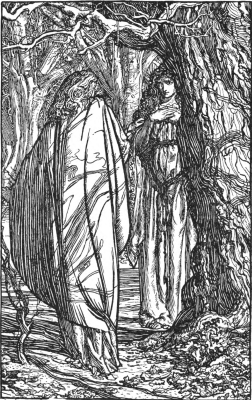
                                                                                                Title: Poetry of the Supernatural

Author: Various

A black-and-white pen-and-ink illustration,  showing two robed, ghostly or tree-spirit-like figures standing among gnarled trees in a dark forest.

                                                                                                Alt...Title: Poetry of the Supernatural Author: Various A black-and-white pen-and-ink illustration, showing two robed, ghostly or tree-spirit-like figures standing among gnarled trees in a dark forest.

                                                                                                  [?]The Vulgar Tongue » 🤖 🌐
                                                                                                  @TheVulgarTongue@zirk.us

                                                                                                  FAM LAY. Going into a goldsmith's shop, under pretence of buying a wedding ring, and palming one or two, by daubing the hand with some viscous matter.

                                                                                                  A selection from Francis Grose’s “Dictionary Of The Vulgar Tongue” (1785)

                                                                                                  --
                                                                                                  @histodons

                                                                                                  Image imitating a page from an old document, text (as in main toot):

FAM LAY. Going into a goldsmith's shop, under pretence of buying a wedding ring, and palming one or two, by daubing the hand with some viscous matter.

A selection from Francis Grose’s “Dictionary Of The Vulgar Tongue” (1785)

                                                                                                  Alt...Image imitating a page from an old document, text (as in main toot): FAM LAY. Going into a goldsmith's shop, under pretence of buying a wedding ring, and palming one or two, by daubing the hand with some viscous matter. A selection from Francis Grose’s “Dictionary Of The Vulgar Tongue” (1785)

                                                                                                    [?]The Vulgar Tongue » 🤖 🌐
                                                                                                    @TheVulgarTongue@zirk.us

                                                                                                    Hi!, I'm a bot posting selections from Francis Grose’s 1785 “Dictionary Of The Vulgar Tongue”, a compilation of slang terms, the coded language of the underclass and the demi-monde.

                                                                                                    [18th-century-content warning: possible racism, animal cruelty, homophobia, sexism, slut-shaming. Let me know of any problems.]

                                                                                                    Montage of dictionary items posted by this account

                                                                                                    Alt...Montage of dictionary items posted by this account

                                                                                                      [?]The Vulgar Tongue » 🤖 🌐
                                                                                                      @TheVulgarTongue@zirk.us

                                                                                                      TO LEAK. To make water.

                                                                                                      A selection from Francis Grose’s “Dictionary Of The Vulgar Tongue” (1785)

                                                                                                      --
                                                                                                      @histodons

                                                                                                      Image imitating a page from an old document, text (as in main toot):

TO LEAK. To make water.

A selection from Francis Grose’s “Dictionary Of The Vulgar Tongue” (1785)

                                                                                                      Alt...Image imitating a page from an old document, text (as in main toot): TO LEAK. To make water. A selection from Francis Grose’s “Dictionary Of The Vulgar Tongue” (1785)

                                                                                                        [?]Project Gutenberg » 🌐
                                                                                                        @gutenberg_org@mastodon.social

                                                                                                        Beatrix Potter was obsessed with fungi – and she was quite the naturalist

                                                                                                        by Joni Wildman

                                                                                                        Her illustrations remain beautiful works of art, but they also show how the best natural history drawings make us notice things we might otherwise miss.

                                                                                                        theconversation.com/beatrix-po

                                                                                                        Books by Beatrix Potter at PG:
                                                                                                        gutenberg.org/ebooks/author/292

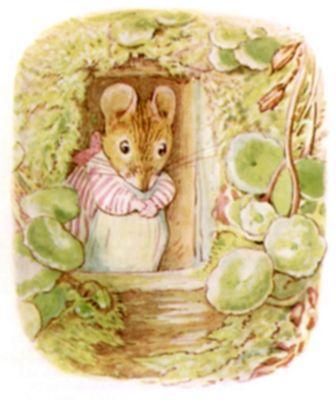
                                                                                                        Title: The Tale of Mrs. Tittlemouse

Author: Beatrix Potter

Illustration showing an anthropomorphic mouse dressed in a pink-and-white striped garment, peeking out from a small doorway surrounded by round green leaves (like nasturtiums).
                                                                                                        Alt...Title: The Tale of Mrs. Tittlemouse Author: Beatrix Potter Illustration showing an anthropomorphic mouse dressed in a pink-and-white striped garment, peeking out from a small doorway surrounded by round green leaves (like nasturtiums).

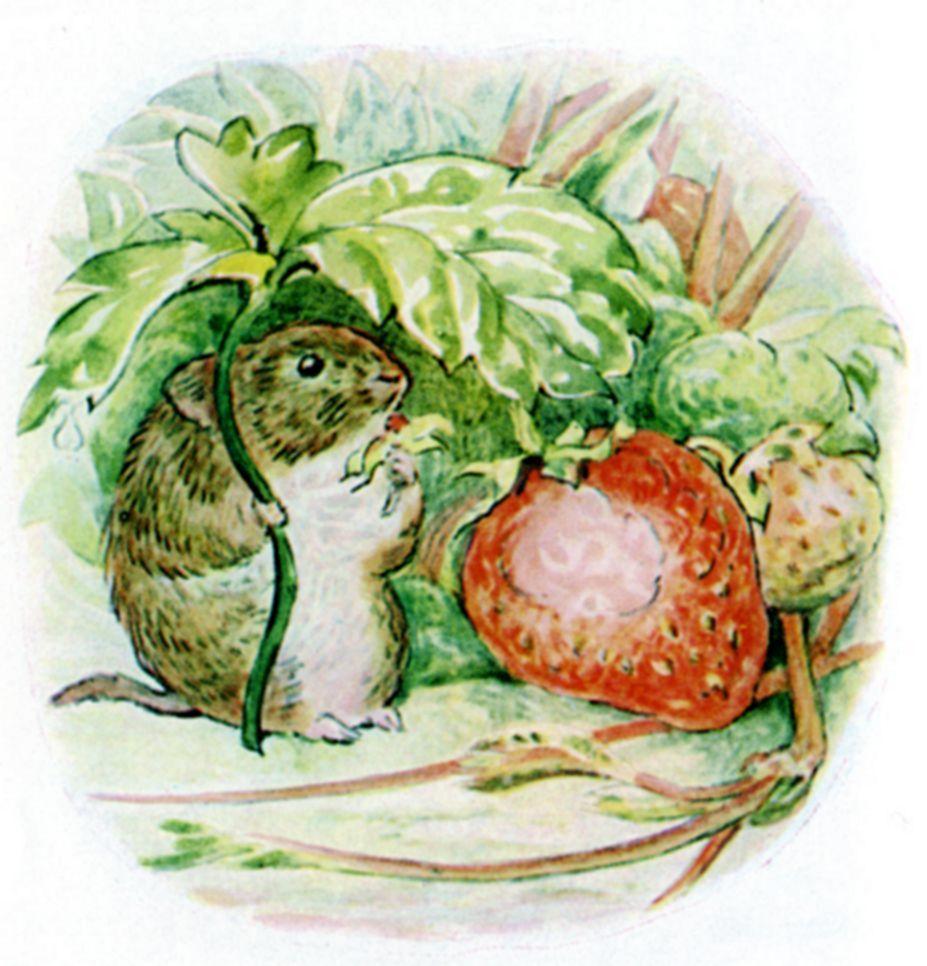
                                                                                                        Title: The Tale of Johnny Town-Mouse

Author: Beatrix Potter

Illustration showing a small brown field mouse standing upright, nibbling on a bit of foliage beside a large ripe strawberry that appears sliced open, with more strawberries and greenery in the background.

                                                                                                        Alt...Title: The Tale of Johnny Town-Mouse Author: Beatrix Potter Illustration showing a small brown field mouse standing upright, nibbling on a bit of foliage beside a large ripe strawberry that appears sliced open, with more strawberries and greenery in the background.

                                                                                                          [?]Project Gutenberg » 🌐
                                                                                                          @gutenberg_org@mastodon.social

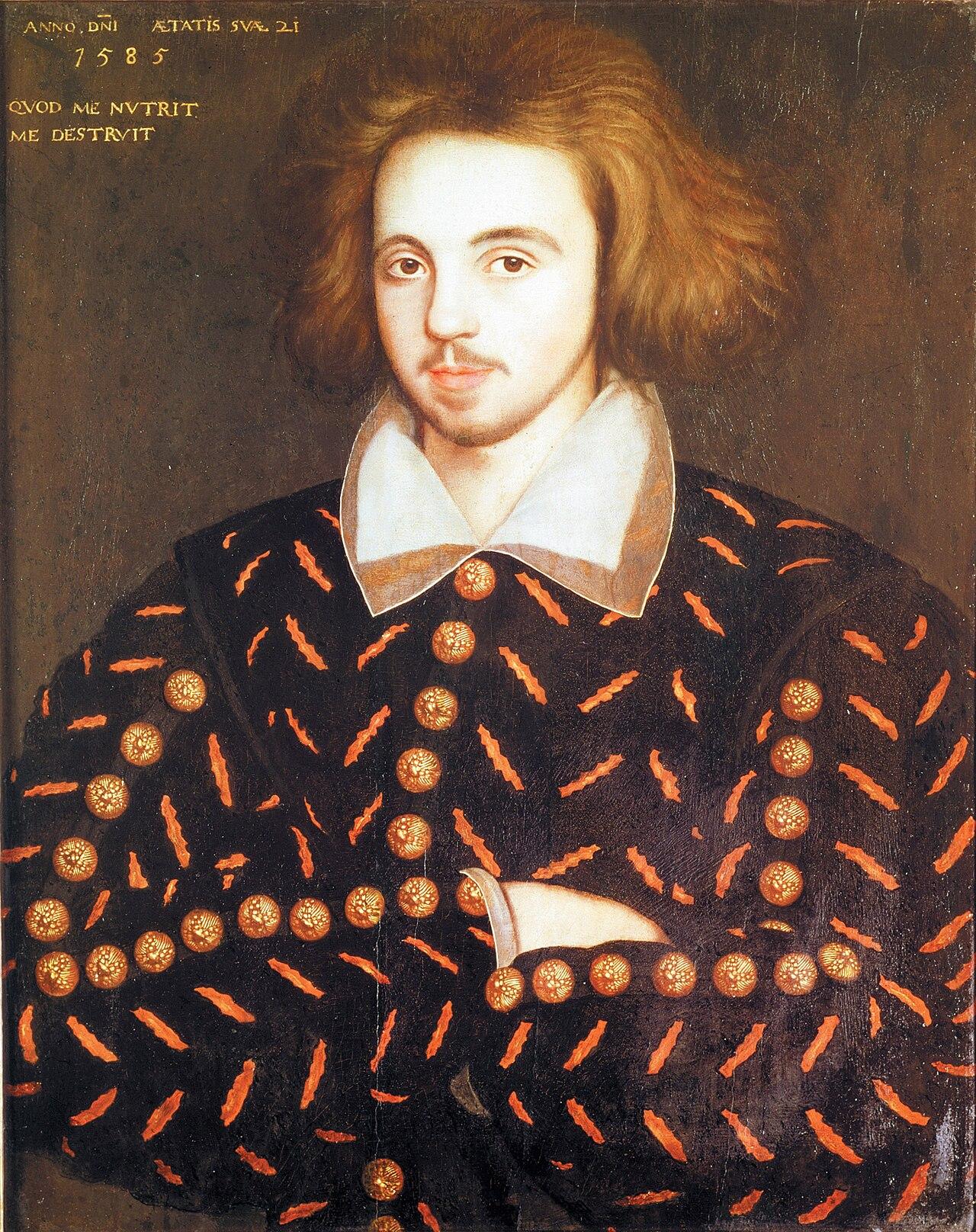
                                                                                                          Christopher Marlowe: alienated skeptic, government spy, counterfeiter, dead at 29. Shakespeare's debt to the man was simply inestimable.

                                                                                                          By Brooke Allen

                                                                                                          hudsonreview.com/2026/07/renai

                                                                                                          Books by Christopher Marlowe at PG:
                                                                                                          gutenberg.org/ebooks/author/410

                                                                                                          Anonymous portrait, possibly of Marlowe, at Corpus Christi College, Cambridge.

Marlowe is shown with long, wavy auburn hair, a white ruffled collar, and an ornate black doublet with gold buttons and slashed orange-red decoration. The Latin motto "Quod me nutrit me destruit" ("That which nourishes me destroys me") appears in the upper left corner

                                                                                                          Alt...Anonymous portrait, possibly of Marlowe, at Corpus Christi College, Cambridge. Marlowe is shown with long, wavy auburn hair, a white ruffled collar, and an ornate black doublet with gold buttons and slashed orange-red decoration. The Latin motto "Quod me nutrit me destruit" ("That which nourishes me destroys me") appears in the upper left corner

                                                                                                            [?]The Vulgar Tongue » 🤖 🌐
                                                                                                            @TheVulgarTongue@zirk.us

                                                                                                            NOTE. He changed his note; he told another sort of a story.

                                                                                                            A selection from Francis Grose’s “Dictionary Of The Vulgar Tongue” (1785)

                                                                                                            --
                                                                                                            @histodons

                                                                                                            Image imitating a page from an old document, text (as in main toot):

NOTE. He changed his note; he told another sort of a story.

A selection from Francis Grose’s “Dictionary Of The Vulgar Tongue” (1785)

                                                                                                            Alt...Image imitating a page from an old document, text (as in main toot): NOTE. He changed his note; he told another sort of a story. A selection from Francis Grose’s “Dictionary Of The Vulgar Tongue” (1785)

                                                                                                              [?]The Vulgar Tongue » 🤖 🌐
                                                                                                              @TheVulgarTongue@zirk.us

                                                                                                              BELCHER. A red silk handkerchief, intermixed with yellow and a little black. The kiddey flashes his belcher; the young fellow wears a silk handkerchief round his neck.

                                                                                                              A selection from Francis Grose’s “Dictionary Of The Vulgar Tongue” (1785)

                                                                                                              --
                                                                                                              @histodons

                                                                                                              Image imitating a page from an old document, text (as in main toot):

BELCHER. A red silk handkerchief, intermixed with yellow and a little black. The kiddey flashes his belcher; the young fellow wears a silk handkerchief round his neck.

A selection from Francis Grose’s “Dictionary Of The Vulgar Tongue” (1785)

                                                                                                              Alt...Image imitating a page from an old document, text (as in main toot): BELCHER. A red silk handkerchief, intermixed with yellow and a little black. The kiddey flashes his belcher; the young fellow wears a silk handkerchief round his neck. A selection from Francis Grose’s “Dictionary Of The Vulgar Tongue” (1785)

                                                                                                                [?]Project Gutenberg » 🌐
                                                                                                                @gutenberg_org@mastodon.social

                                                                                                                Beyond Greece and Rome

                                                                                                                A dramatic shift in perspective is producing a much bigger, broader and more exciting view of ‘the ancient world’

                                                                                                                by Carlos Noreña

                                                                                                                aeon.co/essays/uncovering-a-gl

                                                                                                                Books about Ancient World at PG:
                                                                                                                gutenberg.org/ebooks/search/?q

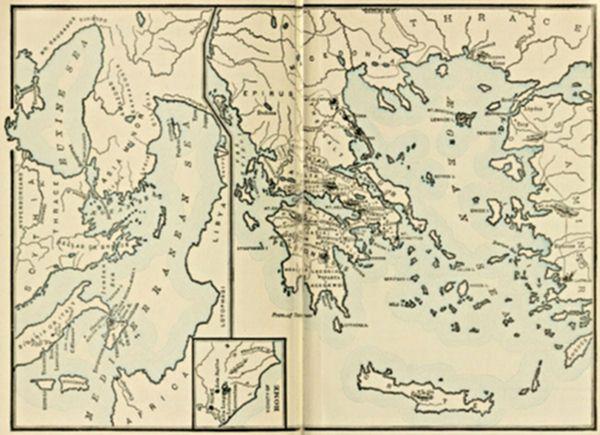
                                                                                                                Myths of Greece and Rome

Author: H. A. Guerber

This is an old historical map of ancient Greece and the surrounding Aegean region, showing Epirus, Macedonia, Thrace, the Greek mainland, and various islands (including Crete at the bottom), bordered by the Mediterranean and Euxine (Black) Sea. It includes an inset map showing the "Vicinity of Rome" in the lower left corner.

                                                                                                                Alt...Myths of Greece and Rome Author: H. A. Guerber This is an old historical map of ancient Greece and the surrounding Aegean region, showing Epirus, Macedonia, Thrace, the Greek mainland, and various islands (including Crete at the bottom), bordered by the Mediterranean and Euxine (Black) Sea. It includes an inset map showing the "Vicinity of Rome" in the lower left corner.

                                                                                                                  [?]The Vulgar Tongue » 🤖 🌐
                                                                                                                  @TheVulgarTongue@zirk.us

                                                                                                                  JARVIS. A hackney coachman.

                                                                                                                  A selection from Francis Grose’s “Dictionary Of The Vulgar Tongue” (1785)

                                                                                                                  --
                                                                                                                  @histodons

                                                                                                                  Image imitating a page from an old document, text (as in main toot):

JARVIS. A hackney coachman.

A selection from Francis Grose’s “Dictionary Of The Vulgar Tongue” (1785)

                                                                                                                  Alt...Image imitating a page from an old document, text (as in main toot): JARVIS. A hackney coachman. A selection from Francis Grose’s “Dictionary Of The Vulgar Tongue” (1785)

                                                                                                                    [?]The Vulgar Tongue » 🤖 🌐
                                                                                                                    @TheVulgarTongue@zirk.us

                                                                                                                    DOWSER. Vulgar pronunciation of DOUCEUR.

                                                                                                                    A selection from Francis Grose’s “Dictionary Of The Vulgar Tongue” (1785)

                                                                                                                    --
                                                                                                                    @histodons

                                                                                                                    Image imitating a page from an old document, text (as in main toot):

DOWSER. Vulgar pronunciation of DOUCEUR.

A selection from Francis Grose’s “Dictionary Of The Vulgar Tongue” (1785)

                                                                                                                    Alt...Image imitating a page from an old document, text (as in main toot): DOWSER. Vulgar pronunciation of DOUCEUR. A selection from Francis Grose’s “Dictionary Of The Vulgar Tongue” (1785)

                                                                                                                      [?]Project Gutenberg » 🌐
                                                                                                                      @gutenberg_org@mastodon.social

                                                                                                                      The Secret Lives of Insects

                                                                                                                      Can fruit flies have dialects? Can dung beetles navigate by the stars? Find surprising answers in this collection of stories about bugs and people.

                                                                                                                      By: The Editors

                                                                                                                      daily.jstor.org/the-secret-liv

                                                                                                                      La vie des abeilles & The Life of the Bee by Maurice Maeterlinck
                                                                                                                      gutenberg.org/ebooks/38527
                                                                                                                      gutenberg.org/ebooks/4511

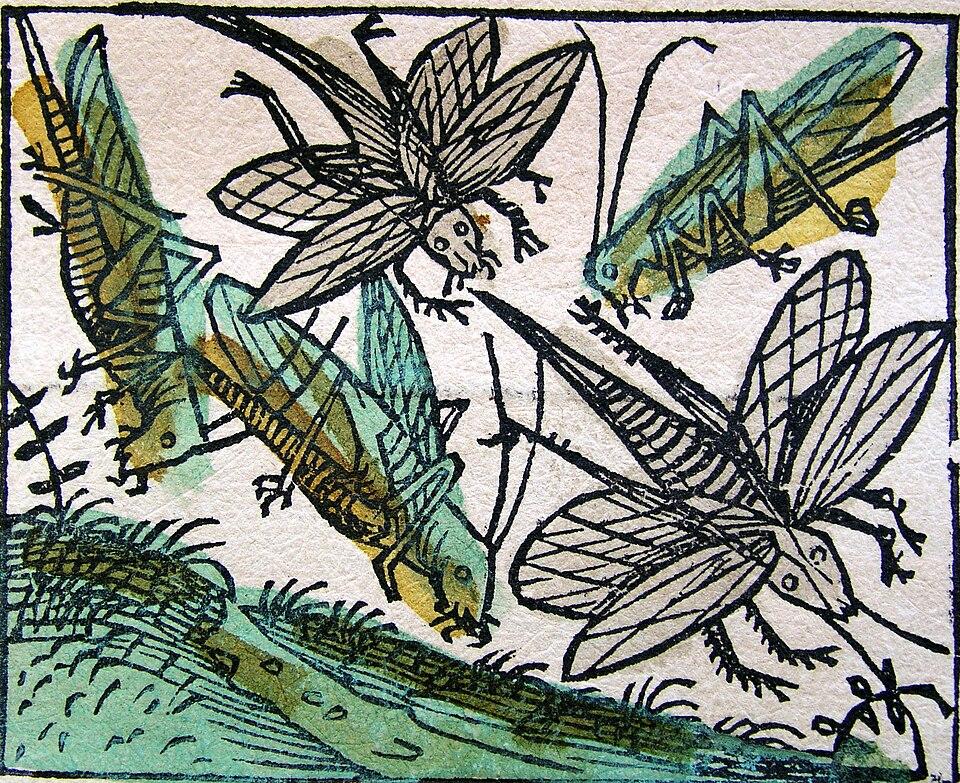
                                                                                                                      Locusts in the fifteenth century 

Illustration from the Nuremberg Chronicle, by Hartmann Schedel (1440-1514)

It shows several large, stylized flying locusts with detailed wings and legs, colored in green, gold, and gray tones, hovering over grassy terrain.

                                                                                                                      Alt...Locusts in the fifteenth century Illustration from the Nuremberg Chronicle, by Hartmann Schedel (1440-1514) It shows several large, stylized flying locusts with detailed wings and legs, colored in green, gold, and gray tones, hovering over grassy terrain.

                                                                                                                        [?]Project Gutenberg » 🌐
                                                                                                                        @gutenberg_org@mastodon.social

                                                                                                                        On the Duplicitous Heroine in Wilkie Collins’s No Name

                                                                                                                        Is Magdalen Vanstone a Detective Using Her Acting Skills or, by Victorian Standards,... a Criminal?

                                                                                                                        by Olivia Rutigliano

                                                                                                                        lithub.com/on-the-duplicitous-

                                                                                                                        No Name by Wilkie Collins at PG:
                                                                                                                        gutenberg.org/ebooks/1438

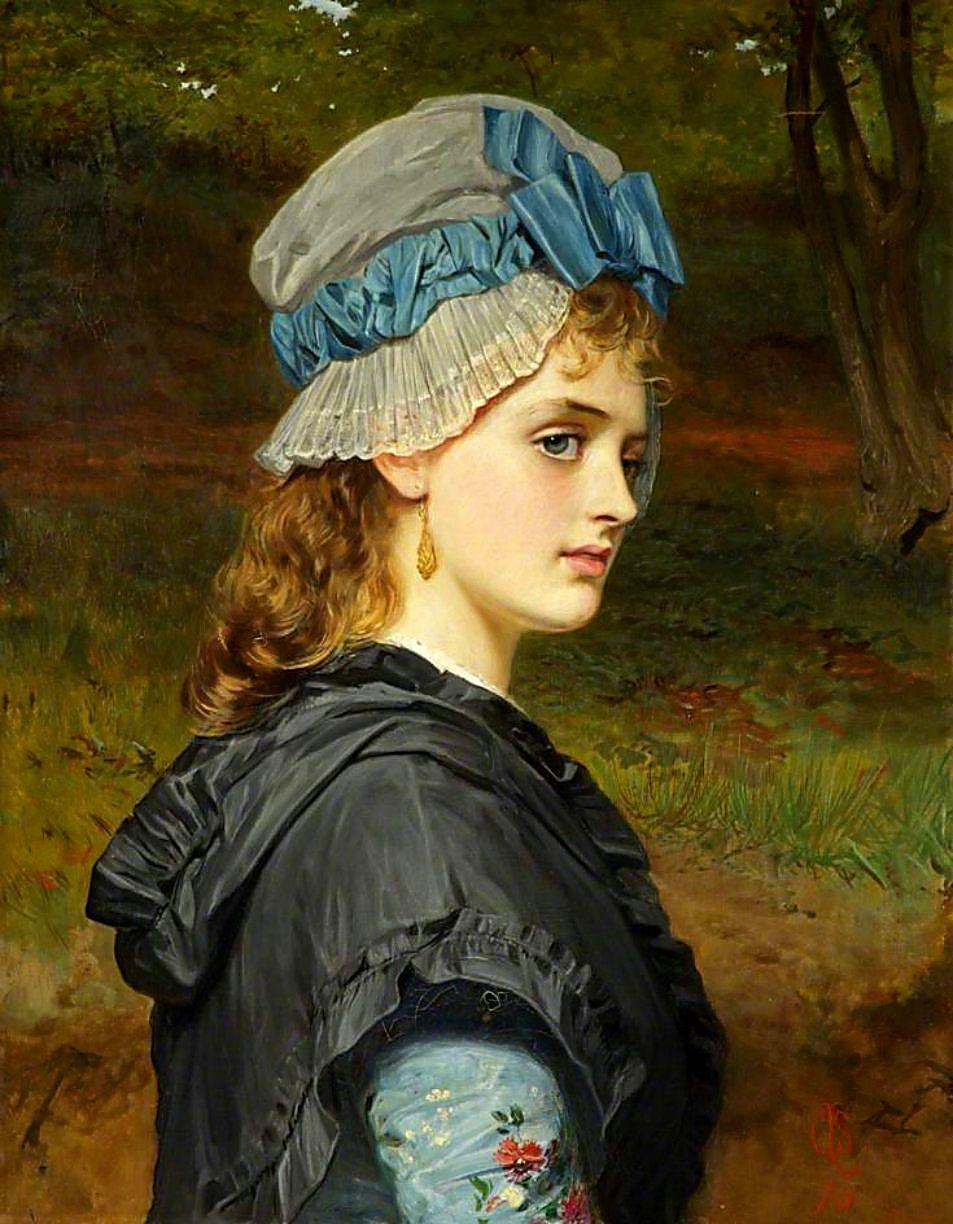
                                                                                                                        Charles Sillem Lidderdale - A Girl's Head

A Victorian portrait of a young woman in profile, wearing a light bonnet trimmed with blue ribbon and lace, a gold drop earring, and a black cloak over a floral-patterned blue dress, set against a soft woodland background.

                                                                                                                        Alt...Charles Sillem Lidderdale - A Girl's Head A Victorian portrait of a young woman in profile, wearing a light bonnet trimmed with blue ribbon and lace, a gold drop earring, and a black cloak over a floral-patterned blue dress, set against a soft woodland background.

                                                                                                                          [?]The Vulgar Tongue » 🤖 🌐
                                                                                                                          @TheVulgarTongue@zirk.us

                                                                                                                          TO CLIP. To hug or embrace: to clip and cling. To clip the coin; to diminish the current coin. To clip the king's English; to be unable to speak plain through drunkenness.

                                                                                                                          A selection from Francis Grose’s “Dictionary Of The Vulgar Tongue” (1785)

                                                                                                                          --
                                                                                                                          @histodons

                                                                                                                          Image imitating a page from an old document, text (as in main toot):

TO CLIP. To hug or embrace: to clip and cling. To clip the coin; to diminish the current coin. To clip the king's English; to be unable to speak plain through drunkenness.

A selection from Francis Grose’s “Dictionary Of The Vulgar Tongue” (1785)

                                                                                                                          Alt...Image imitating a page from an old document, text (as in main toot): TO CLIP. To hug or embrace: to clip and cling. To clip the coin; to diminish the current coin. To clip the king's English; to be unable to speak plain through drunkenness. A selection from Francis Grose’s “Dictionary Of The Vulgar Tongue” (1785)

                                                                                                                            [?]The Vulgar Tongue » 🤖 🌐
                                                                                                                            @TheVulgarTongue@zirk.us

                                                                                                                            USED UP. Killed: a military saying, originating from a message sent by the late General Guise, on the expedition at Carthagena, where he desired the commander in chief to order him some more grenadiers, for those he had were all used up.

                                                                                                                            A selection from Francis Grose’s “Dictionary Of The Vulgar Tongue” (1785)

                                                                                                                            --
                                                                                                                            @histodons

                                                                                                                            Image imitating a page from an old document, text (as in main toot):

USED UP. Killed: a military saying, originating from a message sent by the late General Guise, on the expedition at Carthagena, where he desired the commander in chief to order him some more grenadiers, for those he had were all used up.

A selection from Francis Grose’s “Dictionary Of The Vulgar Tongue” (1785)

                                                                                                                            Alt...Image imitating a page from an old document, text (as in main toot): USED UP. Killed: a military saying, originating from a message sent by the late General Guise, on the expedition at Carthagena, where he desired the commander in chief to order him some more grenadiers, for those he had were all used up. A selection from Francis Grose’s “Dictionary Of The Vulgar Tongue” (1785)

                                                                                                                              [?]Project Gutenberg » 🌐
                                                                                                                              @gutenberg_org@mastodon.social

                                                                                                                              8 Famous Women Writers Who Wrote Under Male Pseudonyms

                                                                                                                              Historically, female writers have faced barriers to publication and prejudicial attitudes, leading some to adopt male pseudonyms.

                                                                                                                              thecollector.com/famous-women-

                                                                                                                              6 of these writers are at PG:

                                                                                                                              gutenberg.org/

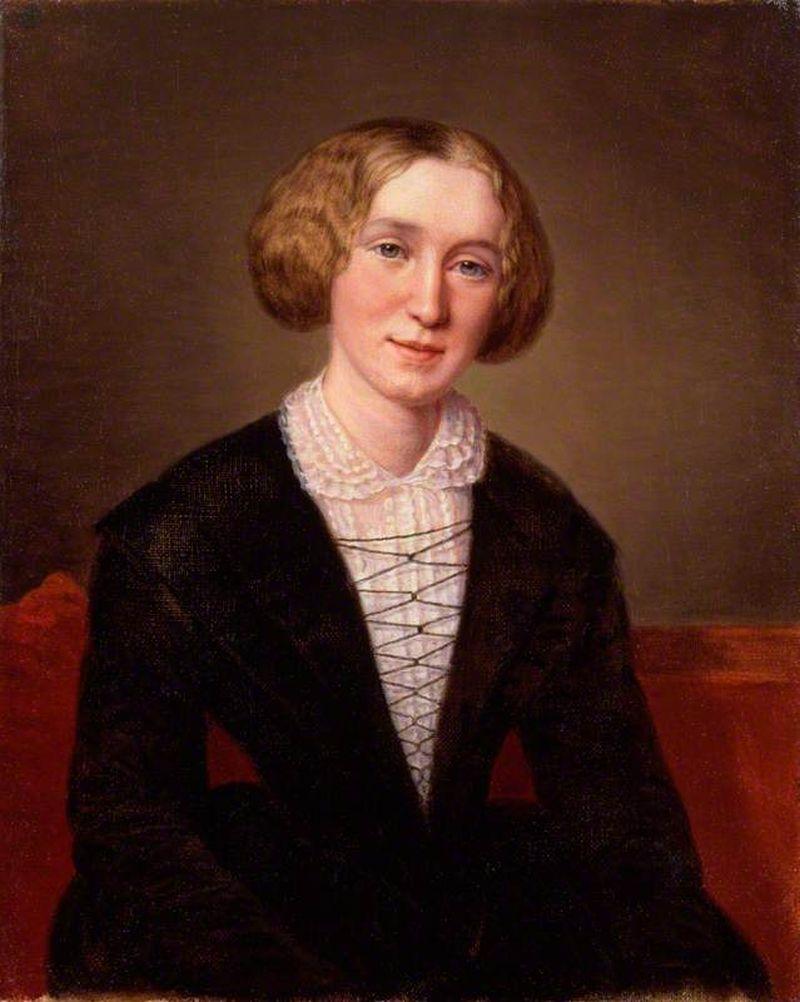
                                                                                                                              George Eliot

                                                                                                                              This painting by François d'Albert-Durade shows George Eliot from the waist up, her body turned slightly to the right. She has a long nose and blue eyes. Her brown hair is parted in the middle and covers her ears. She wears a dark black jacket or coat with a criss-cross pattern over a white frilly blouse.

                                                                                                                              Alt...This painting by François d'Albert-Durade shows George Eliot from the waist up, her body turned slightly to the right. She has a long nose and blue eyes. Her brown hair is parted in the middle and covers her ears. She wears a dark black jacket or coat with a criss-cross pattern over a white frilly blouse.

                                                                                                                                [?]Project Gutenberg » 🌐
                                                                                                                                @gutenberg_org@mastodon.social

                                                                                                                                An Integral Part of the Story: A Short History of Short Fiction by American Women

                                                                                                                                Arielle Zibrak Explores the Diverse Literary Landscape of 19th- and Early 20th-Century Female Writers in the United States (from the archives)

                                                                                                                                lithub.com/an-integral-part-of

                                                                                                                                Books in Short Stories at PG:
                                                                                                                                gutenberg.org/ebooks/bookshelf

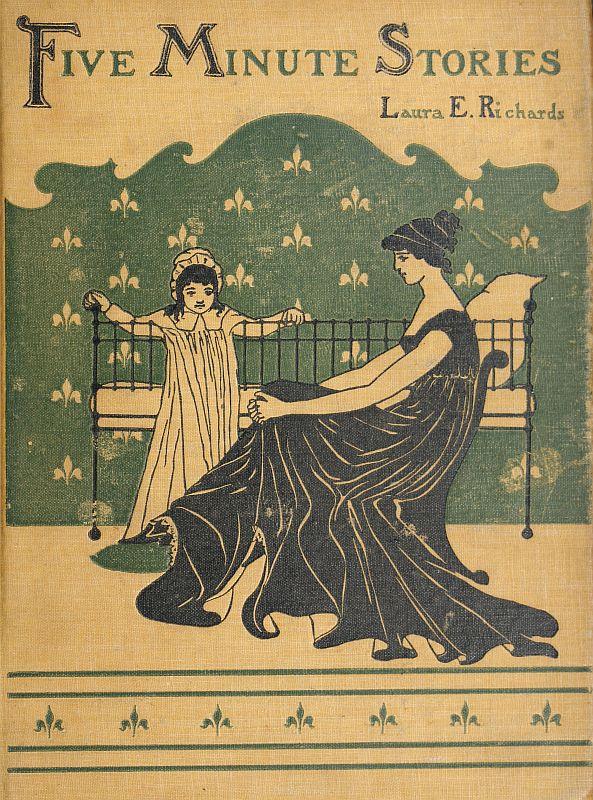
                                                                                                                                Cover image of Five Minute Stories

Author: Laura Elizabeth Howe Richards

Illustrator: Etheldred B. Barry

Albertine Randall Wheelan

It is showing an illustration of a woman in a dark flowing dress sitting beside a child in a nightgown standing at a crib, set against a green fleur-de-lis patterned background.

                                                                                                                                Alt...Cover image of Five Minute Stories Author: Laura Elizabeth Howe Richards Illustrator: Etheldred B. Barry Albertine Randall Wheelan It is showing an illustration of a woman in a dark flowing dress sitting beside a child in a nightgown standing at a crib, set against a green fleur-de-lis patterned background.

                                                                                                                                  oheso boosted

                                                                                                                                  [?]The Vulgar Tongue » 🤖 🌐
                                                                                                                                  @TheVulgarTongue@zirk.us

                                                                                                                                  CLOUTED SHOON. Shoes tipped with iron.

                                                                                                                                  A selection from Francis Grose’s “Dictionary Of The Vulgar Tongue” (1785)

                                                                                                                                  --
                                                                                                                                  @histodons

                                                                                                                                  Image imitating a page from an old document, text (as in main toot):

CLOUTED SHOON. Shoes tipped with iron.

A selection from Francis Grose’s “Dictionary Of The Vulgar Tongue” (1785)

                                                                                                                                  Alt...Image imitating a page from an old document, text (as in main toot): CLOUTED SHOON. Shoes tipped with iron. A selection from Francis Grose’s “Dictionary Of The Vulgar Tongue” (1785)

                                                                                                                                    [?]The Vulgar Tongue » 🤖 🌐
                                                                                                                                    @TheVulgarTongue@zirk.us

                                                                                                                                    BLIND CHEEKS. The breech. Buss blind cheeks; kiss mine arse.

                                                                                                                                    A selection from Francis Grose’s “Dictionary Of The Vulgar Tongue” (1785)

                                                                                                                                    --
                                                                                                                                    @histodons

                                                                                                                                    Image imitating a page from an old document, text (as in main toot):

BLIND CHEEKS. The breech. Buss blind cheeks; kiss mine arse.

A selection from Francis Grose’s “Dictionary Of The Vulgar Tongue” (1785)

                                                                                                                                    Alt...Image imitating a page from an old document, text (as in main toot): BLIND CHEEKS. The breech. Buss blind cheeks; kiss mine arse. A selection from Francis Grose’s “Dictionary Of The Vulgar Tongue” (1785)

                                                                                                                                      muddle 🥣 boosted

                                                                                                                                      [?]Project Gutenberg » 🌐
                                                                                                                                      @gutenberg_org@mastodon.social

                                                                                                                                      How Jane Austen Blew a Hole Through the Romance Genre She Created

                                                                                                                                      Catherine Cliff on Austen‘s Third Model of Spinsterhood: Being a Self-Made Woman

                                                                                                                                      lithub.com/how-jane-austen-ble

                                                                                                                                      "Emma" at PG:

                                                                                                                                      gutenberg.org/ebooks/158

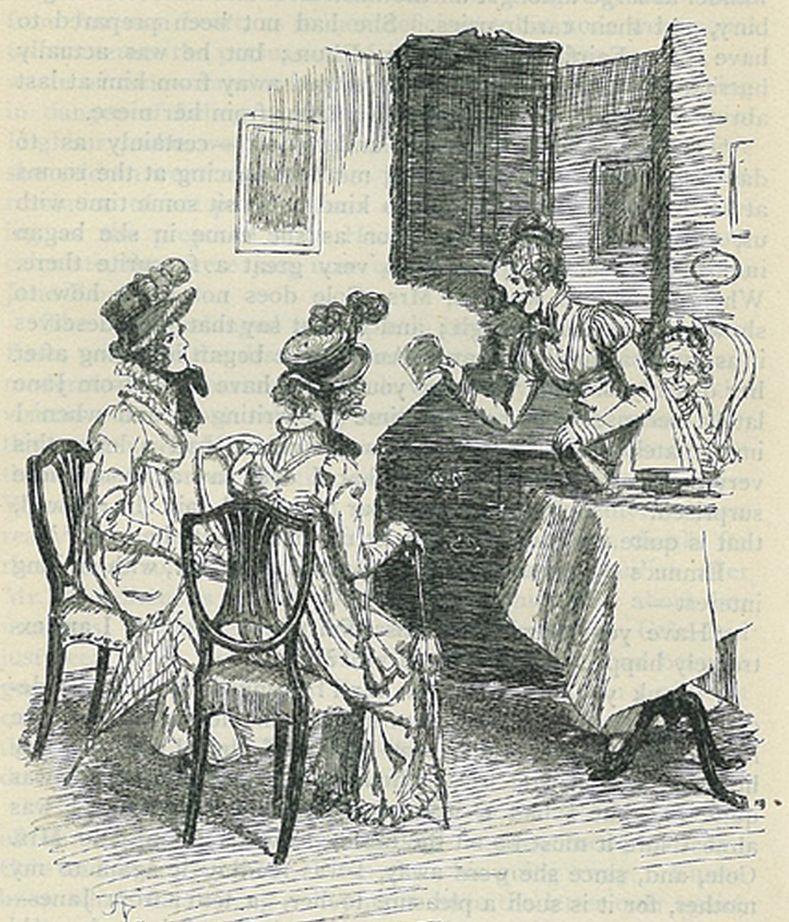
                                                                                                                                      Illustration for the Macmillan edition of Jane Austen's "Emma," Volume 2, Chapter 1. Emma and Harriet visit Miss Bates, who is delighted to read them the letter she has just received from her niece, Miss Fairfax, announcing that she is coming to spend some time at Highbury. "We had a letter this very morning"

                                                                                                                                      Alt...Illustration for the Macmillan edition of Jane Austen's "Emma," Volume 2, Chapter 1. Emma and Harriet visit Miss Bates, who is delighted to read them the letter she has just received from her niece, Miss Fairfax, announcing that she is coming to spend some time at Highbury. "We had a letter this very morning"

                                                                                                                                        [?]Project Gutenberg » 🌐
                                                                                                                                        @gutenberg_org@mastodon.social

                                                                                                                                        Homer Haunted, by Henry Power

                                                                                                                                        Splendid literary criticism, dull politics

                                                                                                                                        by Henry Oliver

                                                                                                                                        commonreader.co.uk/p/homer-hau

                                                                                                                                        The Iliad by Homer at PG:
                                                                                                                                        gutenberg.org/ebooks/6130

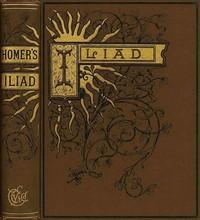
                                                                                                                                        This is an ornate vintage book cover for "Homer's Iliad," featuring decorative gold leaf swirl designs on a brown leather-textured background, with the title "ILIAD" displayed in an illuminated-style banner at the top.

                                                                                                                                        Alt...This is an ornate vintage book cover for "Homer's Iliad," featuring decorative gold leaf swirl designs on a brown leather-textured background, with the title "ILIAD" displayed in an illuminated-style banner at the top.

                                                                                                                                          [?]Project Gutenberg » 🌐
                                                                                                                                          @gutenberg_org@mastodon.social

                                                                                                                                          Who Owns Women Detectives?

                                                                                                                                          Now that Miss Marple and Nancy Drew’s early novels are entering the public domain, what comes next for them?

                                                                                                                                          By Ellen O’Connell Whittet

                                                                                                                                          lareviewofbooks.org/article/wo

                                                                                                                                          Books by Carolyn Keene and Agatha Christie at PG:
                                                                                                                                          gutenberg.org/ebooks/author/58
                                                                                                                                          gutenberg.org/ebooks/author/451

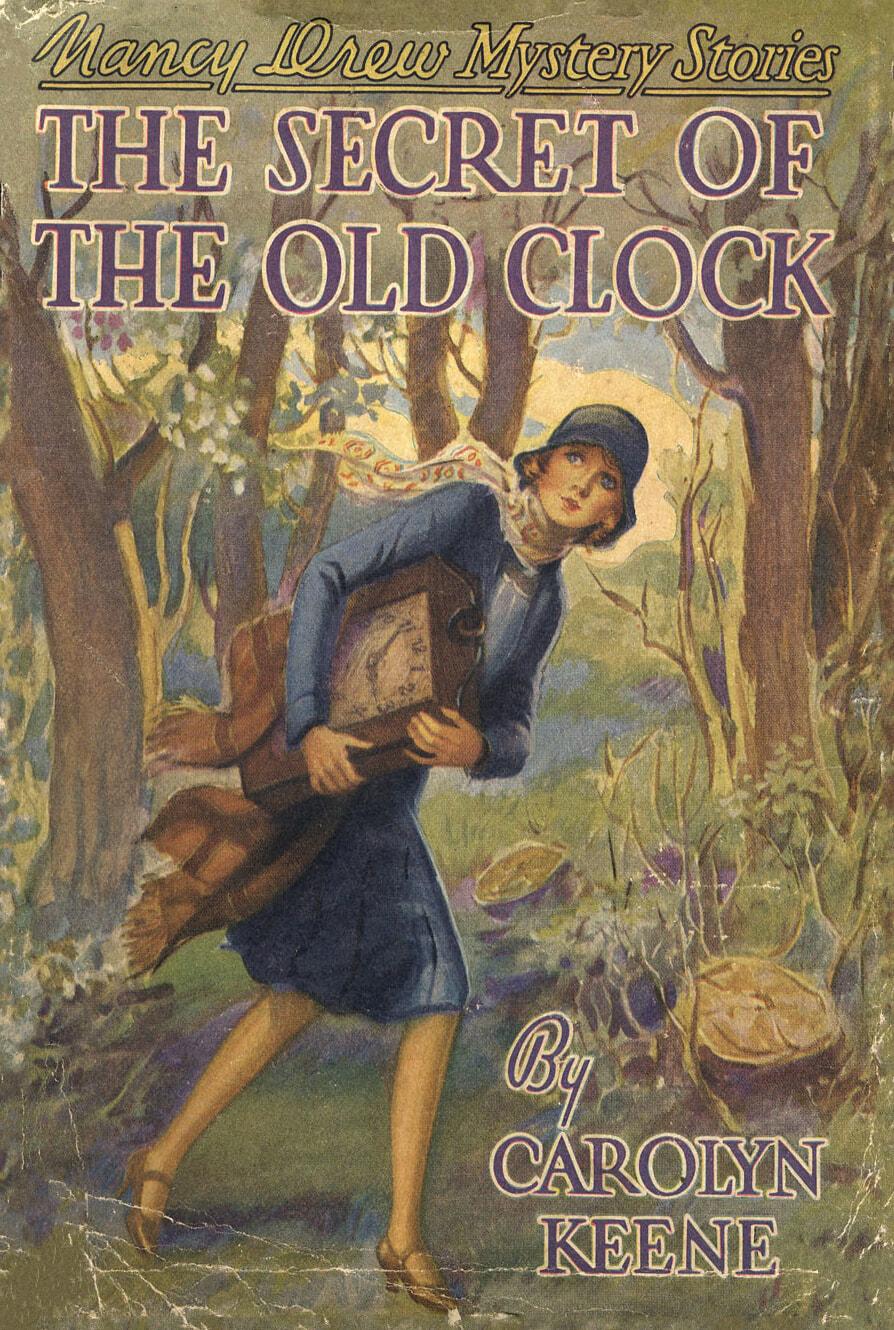
                                                                                                                                          Book cover for "The Secret of the Old Clock," a Nancy Drew Mystery Story by Carolyn Keene, showing Nancy in a blue outfit walking through a wooded area with a tan bag over her shoulder.

                                                                                                                                          Alt...Book cover for "The Secret of the Old Clock," a Nancy Drew Mystery Story by Carolyn Keene, showing Nancy in a blue outfit walking through a wooded area with a tan bag over her shoulder.

                                                                                                                                            [?]The Vulgar Tongue » 🤖 🌐
                                                                                                                                            @TheVulgarTongue@zirk.us

                                                                                                                                            BRUISER. A boxer; one skilled in the art of boxing - also an inferior workman among chasers.

                                                                                                                                            A selection from Francis Grose’s “Dictionary Of The Vulgar Tongue” (1785)

                                                                                                                                            --
                                                                                                                                            @histodons

                                                                                                                                            Image imitating a page from an old document, text (as in main toot):

BRUISER. A boxer; one skilled in the art of boxing - also an inferior workman among chasers.

A selection from Francis Grose’s “Dictionary Of The Vulgar Tongue” (1785)

                                                                                                                                            Alt...Image imitating a page from an old document, text (as in main toot): BRUISER. A boxer; one skilled in the art of boxing - also an inferior workman among chasers. A selection from Francis Grose’s “Dictionary Of The Vulgar Tongue” (1785)

                                                                                                                                              [?]The Vulgar Tongue » 🤖 🌐
                                                                                                                                              @TheVulgarTongue@zirk.us

                                                                                                                                              GLIMMER. Fire. CANT.

                                                                                                                                              A selection from Francis Grose’s “Dictionary Of The Vulgar Tongue” (1785)

                                                                                                                                              --
                                                                                                                                              @histodons

                                                                                                                                              Image imitating a page from an old document, text (as in main toot):

GLIMMER. Fire. CANT.

A selection from Francis Grose’s “Dictionary Of The Vulgar Tongue” (1785)

                                                                                                                                              Alt...Image imitating a page from an old document, text (as in main toot): GLIMMER. Fire. CANT. A selection from Francis Grose’s “Dictionary Of The Vulgar Tongue” (1785)

                                                                                                                                                [?]Project Gutenberg » 🌐
                                                                                                                                                @gutenberg_org@mastodon.social

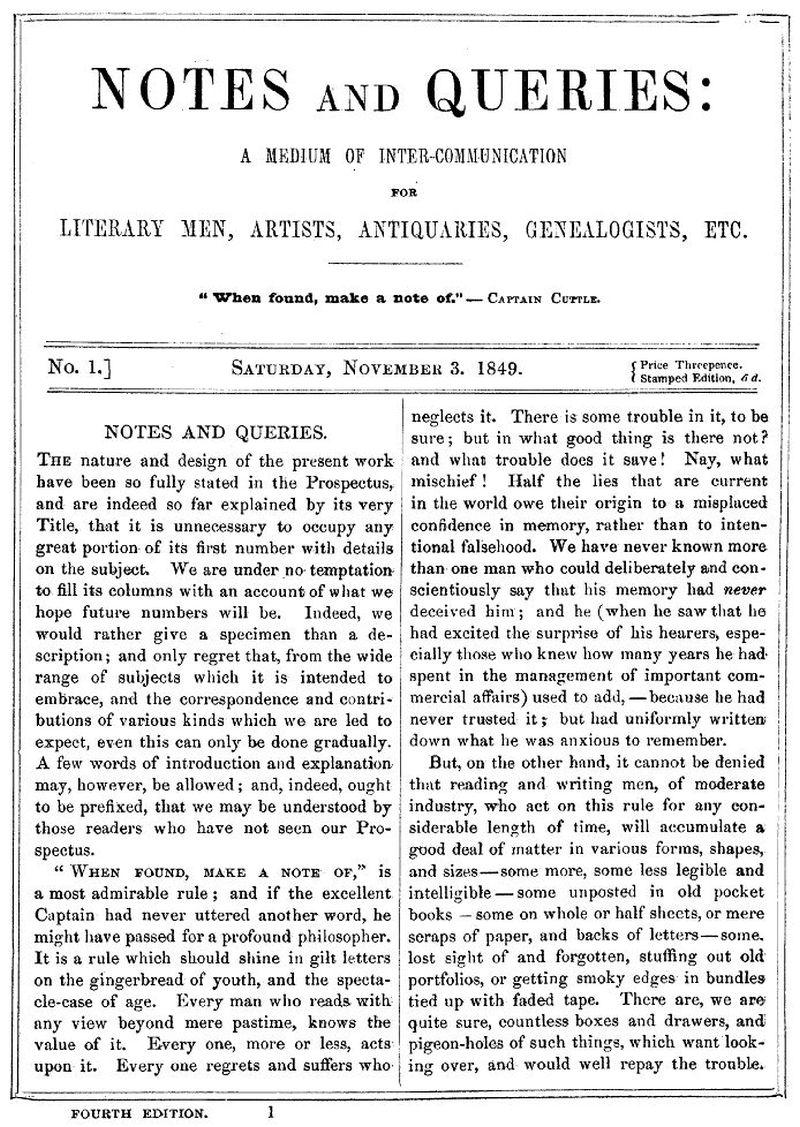
                                                                                                                                                Choice Notes on History from Notes and Queries (1858)

                                                                                                                                                publicdomainreview.org/collect

                                                                                                                                                Issues of the journal "Notes and Queries" at PG:

                                                                                                                                                gutenberg.org/ebooks/search/?q

                                                                                                                                                The 1st page of "Notes and Queries" from Saturday, November 3, 1849. Its header says: "NOTES AND QUERIES: A Medium of Inter-Communication for Literary Men, Artists, Antiquaries, Genealogists, Etc. "When found, make a note of." - Captain Cuttle

                                                                                                                                                Alt...The 1st page of "Notes and Queries" from Saturday, November 3, 1849. Its header says: "NOTES AND QUERIES: A Medium of Inter-Communication for Literary Men, Artists, Antiquaries, Genealogists, Etc. "When found, make a note of." - Captain Cuttle

                                                                                                                                                  [?]Project Gutenberg » 🌐
                                                                                                                                                  @gutenberg_org@mastodon.social

                                                                                                                                                  Who was Homer, author of the Odyssey?

                                                                                                                                                  by Tom Hercules Davies

                                                                                                                                                  theconversation.com/who-was-ho

                                                                                                                                                  The Odyssey by Homer at PG:
                                                                                                                                                  gutenberg.org/ebooks/1727

                                                                                                                                                  Hesiod, the Homeric Hymns, and Homerica by Hesiod at PG:
                                                                                                                                                  gutenberg.org/ebooks/348

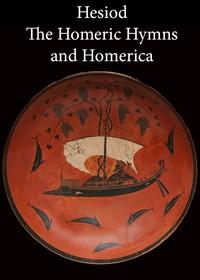
                                                                                                                                                  This is a book cover for "Hesiod, The Homeric Hymns and Homerica," featuring an image of an ancient Greek red-figure pottery design showing a ship with dolphins, set against a black background with the title in white text at top.

Title: Hesiod, the Homeric Hymns, and Homerica

Author: Hesiod

Translator: Hugh G. Evelyn-White

                                                                                                                                                  Alt...This is a book cover for "Hesiod, The Homeric Hymns and Homerica," featuring an image of an ancient Greek red-figure pottery design showing a ship with dolphins, set against a black background with the title in white text at top. Title: Hesiod, the Homeric Hymns, and Homerica Author: Hesiod Translator: Hugh G. Evelyn-White

                                                                                                                                                    [?]The Vulgar Tongue » 🤖 🌐
                                                                                                                                                    @TheVulgarTongue@zirk.us

                                                                                                                                                    AUTEM MORT. A married woman; also a female beggar with several children hired or borrowed to excite charity. CANT.

                                                                                                                                                    A selection from Francis Grose’s “Dictionary Of The Vulgar Tongue” (1785)

                                                                                                                                                    --
                                                                                                                                                    @histodons

                                                                                                                                                    Image imitating a page from an old document, text (as in main toot):

AUTEM MORT. A married woman; also a female beggar with several children hired or borrowed to excite charity. CANT.

A selection from Francis Grose’s “Dictionary Of The Vulgar Tongue” (1785)

                                                                                                                                                    Alt...Image imitating a page from an old document, text (as in main toot): AUTEM MORT. A married woman; also a female beggar with several children hired or borrowed to excite charity. CANT. A selection from Francis Grose’s “Dictionary Of The Vulgar Tongue” (1785)

                                                                                                                                                      [?]The Vulgar Tongue » 🤖 🌐
                                                                                                                                                      @TheVulgarTongue@zirk.us

                                                                                                                                                      PIN. In or to a merry pin; almost drunk: allusion to a sort of tankard, used in the north, having silver pegs or pins set at equal distances from the top to the bottom:every person drinking out of one of these tankards, was to swallow the quantity contained between two pins.

                                                                                                                                                      A selection from Francis Grose’s “Dictionary Of The Vulgar Tongue” (1785)

                                                                                                                                                      --
                                                                                                                                                      @histodons

                                                                                                                                                      Image imitating a page from an old document, text (as in main toot):

PIN. In or to a merry pin; almost drunk: allusion to a sort of tankard, used in the north, having silver pegs or pins set at equal distances from the top to the bottom:every person drinking out of one of these tankards, was to swallow the quantity contained between two pins.

A selection from Francis Grose’s “Dictionary Of The Vulgar Tongue” (1785)

                                                                                                                                                      Alt...Image imitating a page from an old document, text (as in main toot): PIN. In or to a merry pin; almost drunk: allusion to a sort of tankard, used in the north, having silver pegs or pins set at equal distances from the top to the bottom:every person drinking out of one of these tankards, was to swallow the quantity contained between two pins. A selection from Francis Grose’s “Dictionary Of The Vulgar Tongue” (1785)

                                                                                                                                                        [?]Matters of Interpretation » 🌐
                                                                                                                                                        @hermeneutrix.com@hermeneutrix.com

                                                                                                                                                        A thought on beauty and meaning

                                                                                                                                                        I had a thought about literary structure and its relationship to meaning, prompted by the texts we studied this week for Bible study (John 2:1-5 and John 19:25-27).

                                                                                                                                                        Sometimes, it seems, a literary feature like a chiasm or an inclusio or alliteration or something of that kind doesn’t have any meaning beyond itself. It’s there just because it’s beautiful, and that beauty is good and pleasing in itself.

                                                                                                                                                        But sometimes these literary devices do mean something, in the sense that they communicate something to us beyond what’s being said directly, said in so many words. And it struck me that the “bookends” created by the appearance of “the mother of Jesus” in John 2 and John 19 are one of those times.

                                                                                                                                                        Those bookends seem to point us toward the idea that the task of “the mother of Jesus” is to bring Jesus into the world. Practically and physically, obviously, but also over and over again, pragmatically and spiritually. In John 2, she brings Jesus into the world by prompting his doing of his first sign. Then, in John 19, she brings Jesus into the world by accepting the role of mother to the nascent body of Christ, the new community created in Jesus’ redefinition of mother-child relationship from the cross.

                                                                                                                                                        The literary bookends are beautiful, yes. But more beauty emerges in the unfolding of this meaning, which is also … beautiful.

                                                                                                                                                        Image: “Duomo Mandorla 13,” Miguel Hermoso Cuesta, CC BY-SA 4.0, via Wikimedia Commons [cropped]

                                                                                                                                                          [?]Project Gutenberg » 🌐
                                                                                                                                                          @gutenberg_org@mastodon.social

                                                                                                                                                          6 Masterpieces by Henry James That Defined Modern Literature

                                                                                                                                                          Why is Henry James known as the Master? Discover six of the novelist's greatest works, each laden with psychological complexity and tightly wrought prose.

                                                                                                                                                          thecollector.com/henry-james-m

                                                                                                                                                          James at PG:

                                                                                                                                                          gutenberg.org/ebooks/author/113

                                                                                                                                                          This 1922 painting by Annie Swynnerton shows Henry James from the waist up, turned to the left. He appears as a mature, bald man dressed in a high-collared white shirt, a dark necktie or cravat, and a black coat or waistcoat.

                                                                                                                                                          Alt...This 1922 painting by Annie Swynnerton shows Henry James from the waist up, turned to the left. He appears as a mature, bald man dressed in a high-collared white shirt, a dark necktie or cravat, and a black coat or waistcoat.

                                                                                                                                                            Lightfighter boosted

                                                                                                                                                            [?]Project Gutenberg » 🌐
                                                                                                                                                            @gutenberg_org@mastodon.social

                                                                                                                                                            How Medical Racism Impacted the Work of Langston Hughes and Zora Neale Hurston

                                                                                                                                                            Jesse Waggoner on the Harlem Renaissance's Contributions to Modern Disability Rights

                                                                                                                                                            lithub.com/how-medical-racism-

                                                                                                                                                            Books by Langston Hughes and Zora Neale Hurston at PG:
                                                                                                                                                            gutenberg.org/ebooks/author/86
                                                                                                                                                            gutenberg.org/ebooks/author/63

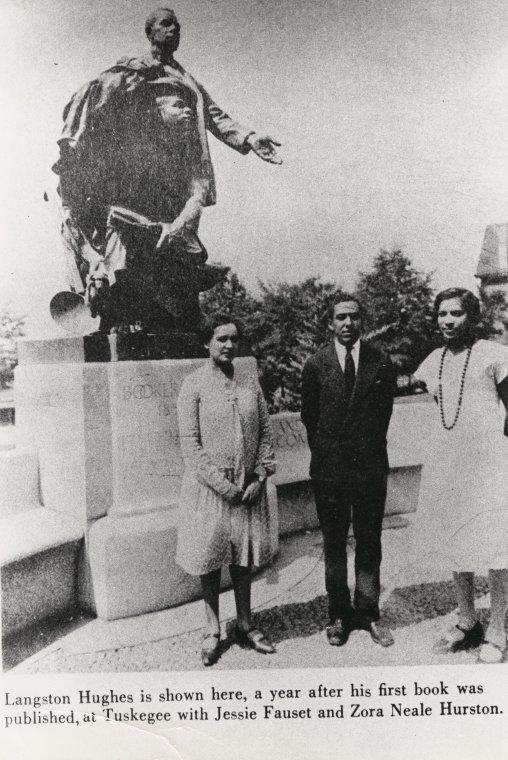
                                                                                                                                                            Langston Hughes at Tuskegee Institute with Jessie Fauset (left) and Zora Neale Hurston, 1927.

Langston Hughes stands with writers Jessie Fauset (left) and Zora Neale Hurston (right) at Tuskegee Institute, in front of the Booker T. Washington statue, one year after Hughes published his first book. Black-and-white photo, all three dressed formally.

                                                                                                                                                            Alt...Langston Hughes at Tuskegee Institute with Jessie Fauset (left) and Zora Neale Hurston, 1927. Langston Hughes stands with writers Jessie Fauset (left) and Zora Neale Hurston (right) at Tuskegee Institute, in front of the Booker T. Washington statue, one year after Hughes published his first book. Black-and-white photo, all three dressed formally.

                                                                                                                                                              [?]The Vulgar Tongue » 🤖 🌐
                                                                                                                                                              @TheVulgarTongue@zirk.us

                                                                                                                                                              NICKNAME. A name given in ridicule or contempt: from the French nom de niqne. Niqne is a movement of the head to mark a contempt for any person or thing.

                                                                                                                                                              A selection from Francis Grose’s “Dictionary Of The Vulgar Tongue” (1785)

                                                                                                                                                              --
                                                                                                                                                              @histodons

                                                                                                                                                              Image imitating a page from an old document, text (as in main toot):

NICKNAME. A name given in ridicule or contempt: from the French nom de niqne. Niqne is a movement of the head to mark a contempt for any person or thing.

A selection from Francis Grose’s “Dictionary Of The Vulgar Tongue” (1785)

                                                                                                                                                              Alt...Image imitating a page from an old document, text (as in main toot): NICKNAME. A name given in ridicule or contempt: from the French nom de niqne. Niqne is a movement of the head to mark a contempt for any person or thing. A selection from Francis Grose’s “Dictionary Of The Vulgar Tongue” (1785)

                                                                                                                                                                [?]The Vulgar Tongue » 🤖 🌐
                                                                                                                                                                @TheVulgarTongue@zirk.us

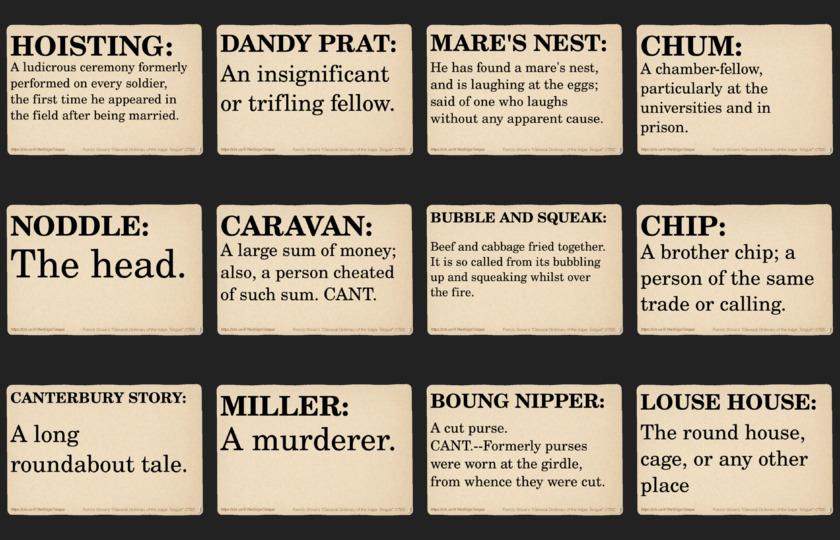
                                                                                                                                                                Hi!, I'm a bot posting selections from Francis Grose’s 1785 “Dictionary Of The Vulgar Tongue”, a compilation of slang terms, the coded language of the underclass and the demi-monde.

                                                                                                                                                                [18th-century-content warning: possible racism, animal cruelty, homophobia, sexism, slut-shaming. Let me know of any problems.]

                                                                                                                                                                Montage of dictionary items posted by this account

                                                                                                                                                                Alt...Montage of dictionary items posted by this account

                                                                                                                                                                  [?]The Vulgar Tongue » 🤖 🌐
                                                                                                                                                                  @TheVulgarTongue@zirk.us

                                                                                                                                                                  LEFT-HANDED WIFE. A concubine; an allusion to an ancient German custom, according to which, when a man married his concubine, or a woman greatly his inferior, he gave her his left hand.

                                                                                                                                                                  A selection from Francis Grose’s “Dictionary Of The Vulgar Tongue” (1785)

                                                                                                                                                                  --
                                                                                                                                                                  @histodons

                                                                                                                                                                  Image imitating a page from an old document, text (as in main toot):

LEFT-HANDED WIFE. A concubine; an allusion to an ancient German custom, according to which, when a man married his concubine, or a woman greatly his inferior, he gave her his left hand.

A selection from Francis Grose’s “Dictionary Of The Vulgar Tongue” (1785)

                                                                                                                                                                  Alt...Image imitating a page from an old document, text (as in main toot): LEFT-HANDED WIFE. A concubine; an allusion to an ancient German custom, according to which, when a man married his concubine, or a woman greatly his inferior, he gave her his left hand. A selection from Francis Grose’s “Dictionary Of The Vulgar Tongue” (1785)

                                                                                                                                                                    [?]Project Gutenberg » 🌐
                                                                                                                                                                    @gutenberg_org@mastodon.social

                                                                                                                                                                    Charles Brockden Brown Declares Independence

                                                                                                                                                                    Ed Simon explores Charles Brockden Brown’s Wieland; or, The Transformation: An American Tale, often considered the first American Gothic novel.

                                                                                                                                                                    By Ed Simon

                                                                                                                                                                    theparisreview.org/blog/2026/0

                                                                                                                                                                    Books by Charles Brockden Brown (including Wieland) at PG:
                                                                                                                                                                    gutenberg.org/ebooks/author/416

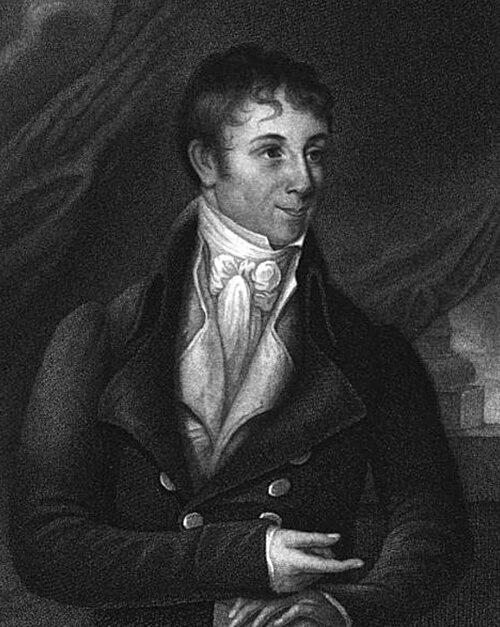
                                                                                                                                                                    Engraving of American writer Charles Brockden Brown. From The Life of Charles Brockden Brown by William Dunlap. Published by James P. Parke, 1815.

This is an engraving portrait of Charles Brockden Brown, an early American novelist, shown wearing early 19th-century formal attire with a large white cravat and dark coat, set against a draped curtain background.

                                                                                                                                                                    Alt...Engraving of American writer Charles Brockden Brown. From The Life of Charles Brockden Brown by William Dunlap. Published by James P. Parke, 1815. This is an engraving portrait of Charles Brockden Brown, an early American novelist, shown wearing early 19th-century formal attire with a large white cravat and dark coat, set against a draped curtain background.

                                                                                                                                                                      [?]Project Gutenberg » 🌐
                                                                                                                                                                      @gutenberg_org@mastodon.social

                                                                                                                                                                      The Letters of Heloise: Love, Learning, and Life as a Medieval Woman

                                                                                                                                                                      Heloise’s letters reveal a medieval woman caught between enduring love, religious duty, and the expectations of her age. Andrea Maraschi explores how they also showcase her remarkable learning and her willingness to express thoughts and emotions rarely preserved in medieval women’s writing.

                                                                                                                                                                      By Andrea Maraschi

                                                                                                                                                                      medievalists.net/2026/07/the-l

                                                                                                                                                                      Letters of Heloise at PG:
                                                                                                                                                                      gutenberg.org/ebooks/search/?q

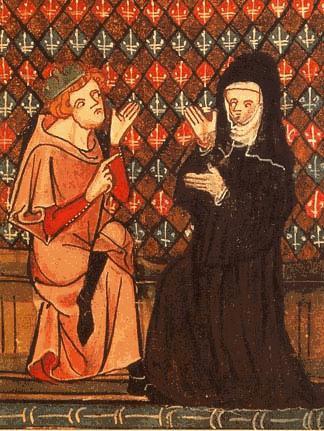
                                                                                                                                                                      Abelard and Héloïse in a manuscript of the Roman de la Rose (14th century).

It is showing a man in a pink/orange robe kneeling and gesturing toward a woman in black nun's habit, both with raised hands in a conversational or devotional pose, set against a decorative patterned background with fleur-de-lis motifs.

                                                                                                                                                                      Alt...Abelard and Héloïse in a manuscript of the Roman de la Rose (14th century). It is showing a man in a pink/orange robe kneeling and gesturing toward a woman in black nun's habit, both with raised hands in a conversational or devotional pose, set against a decorative patterned background with fleur-de-lis motifs.

                                                                                                                                                                        [?]The Vulgar Tongue » 🤖 🌐
                                                                                                                                                                        @TheVulgarTongue@zirk.us

                                                                                                                                                                        BLEEDING CULLY. One who parts easily with his money, or bleeds freely.

                                                                                                                                                                        A selection from Francis Grose’s “Dictionary Of The Vulgar Tongue” (1785)

                                                                                                                                                                        --
                                                                                                                                                                        @histodons

                                                                                                                                                                        Image imitating a page from an old document, text (as in main toot):

BLEEDING CULLY. One who parts easily with his money, or bleeds freely.

A selection from Francis Grose’s “Dictionary Of The Vulgar Tongue” (1785)

                                                                                                                                                                        Alt...Image imitating a page from an old document, text (as in main toot): BLEEDING CULLY. One who parts easily with his money, or bleeds freely. A selection from Francis Grose’s “Dictionary Of The Vulgar Tongue” (1785)

                                                                                                                                                                          [?]The Vulgar Tongue » 🤖 🌐
                                                                                                                                                                          @TheVulgarTongue@zirk.us

                                                                                                                                                                          CROSS BUTTOCK. A particular lock or fall in the Broughtonian art, which, as Mr. Fielding observes, conveyed more pleasant sensations to the spectators than the patient.

                                                                                                                                                                          A selection from Francis Grose’s “Dictionary Of The Vulgar Tongue” (1785)

                                                                                                                                                                          --
                                                                                                                                                                          @histodons

                                                                                                                                                                          Image imitating a page from an old document, text (as in main toot):

CROSS BUTTOCK. A particular lock or fall in the Broughtonian art, which, as Mr. Fielding observes, conveyed more pleasant sensations to the spectators than the patient.

A selection from Francis Grose’s “Dictionary Of The Vulgar Tongue” (1785)

                                                                                                                                                                          Alt...Image imitating a page from an old document, text (as in main toot): CROSS BUTTOCK. A particular lock or fall in the Broughtonian art, which, as Mr. Fielding observes, conveyed more pleasant sensations to the spectators than the patient. A selection from Francis Grose’s “Dictionary Of The Vulgar Tongue” (1785)

                                                                                                                                                                            [?]Project Gutenberg » 🌐
                                                                                                                                                                            @gutenberg_org@mastodon.social

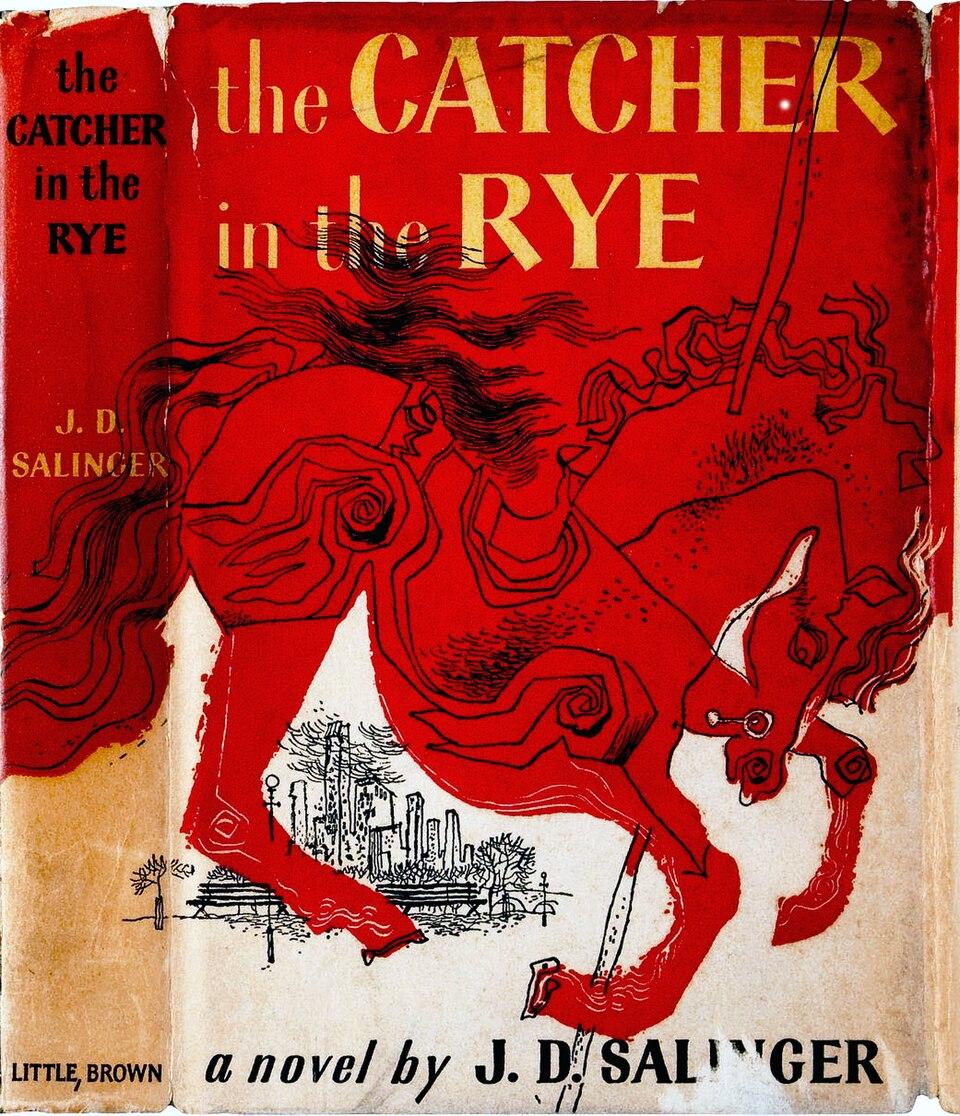
                                                                                                                                                                            ‘I felt Holden was talking to me alone’: The Catcher in the Rye at 75

                                                                                                                                                                            JD Salinger’s wry, subversive classic inspired novelist Joseph O’Connor to be a writer. He reflects on why this story of a disaffected teenager remains as fresh and transgressive as ever
                                                                                                                                                                            theguardian.com/books/2026/jul

                                                                                                                                                                            First-edition cover of The Catcher in the Rye (1951) by the American author J. D. Salinger.

IThis cover is featuring a stylized red carousel horse illustration against a city skyline, with bold red and cream coloring.

                                                                                                                                                                            Alt...First-edition cover of The Catcher in the Rye (1951) by the American author J. D. Salinger. IThis cover is featuring a stylized red carousel horse illustration against a city skyline, with bold red and cream coloring.

                                                                                                                                                                              oheso boosted

                                                                                                                                                                              [?]The Vulgar Tongue » 🤖 🌐
                                                                                                                                                                              @TheVulgarTongue@zirk.us

                                                                                                                                                                              BELLOWS. The lungs.

                                                                                                                                                                              A selection from Francis Grose’s “Dictionary Of The Vulgar Tongue” (1785)

                                                                                                                                                                              --
                                                                                                                                                                              @histodons

                                                                                                                                                                              Image imitating a page from an old document, text (as in main toot):

BELLOWS. The lungs.

A selection from Francis Grose’s “Dictionary Of The Vulgar Tongue” (1785)

                                                                                                                                                                              Alt...Image imitating a page from an old document, text (as in main toot): BELLOWS. The lungs. A selection from Francis Grose’s “Dictionary Of The Vulgar Tongue” (1785)

                                                                                                                                                                                [?]דאָס איז נישט קיין פּײַפּ » 🌐
                                                                                                                                                                                @dukepaaron@babka.social

                                                                                                                                                                                “ is the last great of ,” said , ’s artistic director. “His form a rich body of work that echoes the , , and as well as . A with a humanist sensibility and profound knowledge, he has experimented with genres such as and adventure while retaining his own identity and voice. Celebrating James at the Locarno Festival means paying tribute to a unique and unmistakable , a filmmaker who speaks the language of and knows how to pass it on to future generations.”

                                                                                                                                                                                hollywoodreporter.com/movies/m

                                                                                                                                                                                  [?]The Vulgar Tongue » 🤖 🌐
                                                                                                                                                                                  @TheVulgarTongue@zirk.us

                                                                                                                                                                                  ACTIVE CITIZEN. A louse.

                                                                                                                                                                                  A selection from Francis Grose’s “Dictionary Of The Vulgar Tongue” (1785)

                                                                                                                                                                                  --
                                                                                                                                                                                  @histodons

                                                                                                                                                                                  Image imitating a page from an old document, text (as in main toot):

ACTIVE CITIZEN. A louse.

A selection from Francis Grose’s “Dictionary Of The Vulgar Tongue” (1785)

                                                                                                                                                                                  Alt...Image imitating a page from an old document, text (as in main toot): ACTIVE CITIZEN. A louse. A selection from Francis Grose’s “Dictionary Of The Vulgar Tongue” (1785)

                                                                                                                                                                                    [?]Project Gutenberg » 🌐
                                                                                                                                                                                    @gutenberg_org@mastodon.social

                                                                                                                                                                                    This Week in Literary History:
                                                                                                                                                                                    O. Henry is Released from Prison

                                                                                                                                                                                    “If he had simply gone back to Austin when he was summoned to stand trial, he would have been acquitted.”

                                                                                                                                                                                    lithub.com/this-week-in-litera

                                                                                                                                                                                    O. Henry at PG:

                                                                                                                                                                                    gutenberg.org/ebooks/author/634

                                                                                                                                                                                    O. Henry (William Sydney Porter) appears from the chest up in the photograph. He leans slightly to the right, resting his head on his right hand. His hair is short, wavy, and parted in the middle, with a handlebar mustache. He wears a dark, textured three-piece suit with a vest and matching jacket. Underneath, he has a white dress shirt with a tall wing collar. His dark necktie is held by a decorative stickpin just below the collar.

                                                                                                                                                                                    Alt...O. Henry (William Sydney Porter) appears from the chest up in the photograph. He leans slightly to the right, resting his head on his right hand. His hair is short, wavy, and parted in the middle, with a handlebar mustache. He wears a dark, textured three-piece suit with a vest and matching jacket. Underneath, he has a white dress shirt with a tall wing collar. His dark necktie is held by a decorative stickpin just below the collar.

                                                                                                                                                                                      [?]Project Gutenberg » 🌐
                                                                                                                                                                                      @gutenberg_org@mastodon.social

                                                                                                                                                                                      The world’s first influencers were French and they emerged after the Revolution

                                                                                                                                                                                      by Emma Schwak

                                                                                                                                                                                      Influencer culture is not a thing of the past, and yet the movers and shakers of post-revolutionary France are proof that writing lifestyle columns and trending is a centuries-old pursuit.

                                                                                                                                                                                      theconversation.com/the-worlds

                                                                                                                                                                                      Books about Madame Récamier at PG:
                                                                                                                                                                                      gutenberg.org/ebooks/search/?q

                                                                                                                                                                                      A painting by Jacques-Louis David of French socialite and Neoclassical icon Madame Récamier whose salon in Paris attracted leading literary and political circles in the early 19th-century.

A famous 1800 portrait of Madame Récamier, reclining on a Neoclassical daybed in a simple white empire-waist gown, with a bronze floor lamp beside her.

                                                                                                                                                                                      Alt...A painting by Jacques-Louis David of French socialite and Neoclassical icon Madame Récamier whose salon in Paris attracted leading literary and political circles in the early 19th-century. A famous 1800 portrait of Madame Récamier, reclining on a Neoclassical daybed in a simple white empire-waist gown, with a bronze floor lamp beside her.

                                                                                                                                                                                        [?]Project Gutenberg » 🌐
                                                                                                                                                                                        @gutenberg_org@mastodon.social

                                                                                                                                                                                        How a forgotten Toronto story shows Hemingway beginning to invent himself as a fiction writer

                                                                                                                                                                                        During his four years with the Toronto Star, Hemingway produced nearly 200 pieces, 170 under his own name plus around 30 with verified pseudonym bylines.

                                                                                                                                                                                        by Irene Gammel

                                                                                                                                                                                        theconversation.com/how-a-forg

                                                                                                                                                                                        Books by Hemingway
                                                                                                                                                                                        gutenberg.org/ebooks/author/50

                                                                                                                                                                                        Hemingway´s wood-cut from portrait by henry strater.

Title: In our time

Author: Ernest Hemingway

Editor: Ezra Pound

Illustrator: Henry Strater

A stylized woodcut portrait of a bearded man, rendered with bold cross-hatching and line textures

                                                                                                                                                                                        Alt...Hemingway´s wood-cut from portrait by henry strater. Title: In our time Author: Ernest Hemingway Editor: Ezra Pound Illustrator: Henry Strater A stylized woodcut portrait of a bearded man, rendered with bold cross-hatching and line textures

                                                                                                                                                                                          [?]The Vulgar Tongue » 🤖 🌐
                                                                                                                                                                                          @TheVulgarTongue@zirk.us

                                                                                                                                                                                          WHIFFLERS. Ancient name for fifers; also persons at the universities who examine candidates for degrees. A whiffling cur, a small yelping cur.

                                                                                                                                                                                          A selection from Francis Grose’s “Dictionary Of The Vulgar Tongue” (1785)

                                                                                                                                                                                          --
                                                                                                                                                                                          @histodons

                                                                                                                                                                                          Image imitating a page from an old document, text (as in main toot):

WHIFFLERS. Ancient name for fifers; also persons at the universities who examine candidates for degrees. A whiffling cur, a small yelping cur.

A selection from Francis Grose’s “Dictionary Of The Vulgar Tongue” (1785)

                                                                                                                                                                                          Alt...Image imitating a page from an old document, text (as in main toot): WHIFFLERS. Ancient name for fifers; also persons at the universities who examine candidates for degrees. A whiffling cur, a small yelping cur. A selection from Francis Grose’s “Dictionary Of The Vulgar Tongue” (1785)

                                                                                                                                                                                            [?]The Vulgar Tongue » 🤖 🌐
                                                                                                                                                                                            @TheVulgarTongue@zirk.us

                                                                                                                                                                                            COVENT GARDEN ABBESS. A bawd.

                                                                                                                                                                                            A selection from Francis Grose’s “Dictionary Of The Vulgar Tongue” (1785)

                                                                                                                                                                                            --
                                                                                                                                                                                            @histodons

                                                                                                                                                                                            Image imitating a page from an old document, text (as in main toot):

COVENT GARDEN ABBESS. A bawd.

A selection from Francis Grose’s “Dictionary Of The Vulgar Tongue” (1785)

                                                                                                                                                                                            Alt...Image imitating a page from an old document, text (as in main toot): COVENT GARDEN ABBESS. A bawd. A selection from Francis Grose’s “Dictionary Of The Vulgar Tongue” (1785)

                                                                                                                                                                                              oheso boosted

                                                                                                                                                                                              [?]The Vulgar Tongue » 🤖 🌐
                                                                                                                                                                                              @TheVulgarTongue@zirk.us

                                                                                                                                                                                              BARREL FEVER. He died of the barrel fever; he killed himself by drinking.

                                                                                                                                                                                              A selection from Francis Grose’s “Dictionary Of The Vulgar Tongue” (1785)

                                                                                                                                                                                              --
                                                                                                                                                                                              @histodons

                                                                                                                                                                                              Image imitating a page from an old document, text (as in main toot):

BARREL FEVER. He died of the barrel fever; he killed himself by drinking.

A selection from Francis Grose’s “Dictionary Of The Vulgar Tongue” (1785)

                                                                                                                                                                                              Alt...Image imitating a page from an old document, text (as in main toot): BARREL FEVER. He died of the barrel fever; he killed himself by drinking. A selection from Francis Grose’s “Dictionary Of The Vulgar Tongue” (1785)

                                                                                                                                                                                                [?]The Vulgar Tongue » 🤖 🌐
                                                                                                                                                                                                @TheVulgarTongue@zirk.us

                                                                                                                                                                                                CLANK NAPPER. A silver tankard stealer. See RUM BUBBER.

                                                                                                                                                                                                A selection from Francis Grose’s “Dictionary Of The Vulgar Tongue” (1785)

                                                                                                                                                                                                --
                                                                                                                                                                                                @histodons

                                                                                                                                                                                                Image imitating a page from an old document, text (as in main toot):

CLANK NAPPER. A silver tankard stealer. See RUM BUBBER.

A selection from Francis Grose’s “Dictionary Of The Vulgar Tongue” (1785)

                                                                                                                                                                                                Alt...Image imitating a page from an old document, text (as in main toot): CLANK NAPPER. A silver tankard stealer. See RUM BUBBER. A selection from Francis Grose’s “Dictionary Of The Vulgar Tongue” (1785)

                                                                                                                                                                                                  [?]Project Gutenberg » 🌐
                                                                                                                                                                                                  @gutenberg_org@mastodon.social

                                                                                                                                                                                                  in 1811, William Makepeace Thackeray is born. He "was an English novelist and illustrator. He is known for his satirical works, particularly his 1847–1848 novel Vanity Fair, a panoramic portrait of British society, and the 1844 novel The Luck of Barry Lyndon, which was adapted for a 1975 film by Stanley Kubrick."

                                                                                                                                                                                                  en.wikipedia.org/wiki/William_

                                                                                                                                                                                                  Thackeray at PG:

                                                                                                                                                                                                  gutenberg.org/ebooks/author/313

                                                                                                                                                                                                  This 1855 daguerreotype by Jesse Harrison Whitehurst shows William Makepeace Thackeray from the chest up, looking directly at the camera. He has light, wavy hair parted to the side and noticeable sideburns. He wears round, thin-rimmed glasses, a dark jacket or overcoat over a dark vest, a white-collared shirt, and a dark cravat or bow tie. His expression is serious.

                                                                                                                                                                                                  Alt...This 1855 daguerreotype by Jesse Harrison Whitehurst shows William Makepeace Thackeray from the chest up, looking directly at the camera. He has light, wavy hair parted to the side and noticeable sideburns. He wears round, thin-rimmed glasses, a dark jacket or overcoat over a dark vest, a white-collared shirt, and a dark cravat or bow tie. His expression is serious.

                                                                                                                                                                                                    [?]Project Gutenberg » 🌐
                                                                                                                                                                                                    @gutenberg_org@mastodon.social

                                                                                                                                                                                                    Harriet Beecher Stowe Wrote a Work of Fiction That Seemed So Real That It Changed the History of the Country

                                                                                                                                                                                                    To fight against slavery, the author collected true stories then picked up a pen and distilled them into “Uncle Tom’s Cabin”

                                                                                                                                                                                                    by Geraldine Brooks

                                                                                                                                                                                                    smithsonianmag.com/history/har

                                                                                                                                                                                                    Uncle Tom's Cabin at PG:
                                                                                                                                                                                                    gutenberg.org/ebooks/203

                                                                                                                                                                                                    Eliza comes to tell Uncle Tom that he is sold, and that she is running away to save her child.

Title: Uncle Tom's Cabin

Author: Harriet Beecher Stowe

A 19th-century engraving depicting a rural scene: a woman in a shawl carrying an infant walks with a dog beside her, encountering two men on a path near a hedgerow. One man appears to be blowing or playing something held in cupped hands, while the other gestures toward her. A house is visible in the distant background.

                                                                                                                                                                                                    Alt...Eliza comes to tell Uncle Tom that he is sold, and that she is running away to save her child. Title: Uncle Tom's Cabin Author: Harriet Beecher Stowe A 19th-century engraving depicting a rural scene: a woman in a shawl carrying an infant walks with a dog beside her, encountering two men on a path near a hedgerow. One man appears to be blowing or playing something held in cupped hands, while the other gestures toward her. A house is visible in the distant background.

                                                                                                                                                                                                      [?]The Vulgar Tongue » 🤖 🌐
                                                                                                                                                                                                      @TheVulgarTongue@zirk.us

                                                                                                                                                                                                      NORTHUMBERLAND. Lord Northumberland's arms; a black eye: so called in the last century.

                                                                                                                                                                                                      A selection from Francis Grose’s “Dictionary Of The Vulgar Tongue” (1785)

                                                                                                                                                                                                      --
                                                                                                                                                                                                      @histodons

                                                                                                                                                                                                      Image imitating a page from an old document, text (as in main toot):

NORTHUMBERLAND. Lord Northumberland's arms; a black eye: so called in the last century.

A selection from Francis Grose’s “Dictionary Of The Vulgar Tongue” (1785)

                                                                                                                                                                                                      Alt...Image imitating a page from an old document, text (as in main toot): NORTHUMBERLAND. Lord Northumberland's arms; a black eye: so called in the last century. A selection from Francis Grose’s “Dictionary Of The Vulgar Tongue” (1785)

                                                                                                                                                                                                        [?]The Vulgar Tongue » 🤖 🌐
                                                                                                                                                                                                        @TheVulgarTongue@zirk.us

                                                                                                                                                                                                        BUTTOCK BROKER. A bawd, or match-maker. CANT.

                                                                                                                                                                                                        A selection from Francis Grose’s “Dictionary Of The Vulgar Tongue” (1785)

                                                                                                                                                                                                        --
                                                                                                                                                                                                        @histodons

                                                                                                                                                                                                        Image imitating a page from an old document, text (as in main toot):

BUTTOCK BROKER. A bawd, or match-maker. CANT.

A selection from Francis Grose’s “Dictionary Of The Vulgar Tongue” (1785)

                                                                                                                                                                                                        Alt...Image imitating a page from an old document, text (as in main toot): BUTTOCK BROKER. A bawd, or match-maker. CANT. A selection from Francis Grose’s “Dictionary Of The Vulgar Tongue” (1785)

                                                                                                                                                                                                          oheso boosted

                                                                                                                                                                                                          [?]The Vulgar Tongue » 🤖 🌐
                                                                                                                                                                                                          @TheVulgarTongue@zirk.us

                                                                                                                                                                                                          CROSS DISHONEST. A cross cove; any person who lives by stealing or in a dishonest manner.

                                                                                                                                                                                                          A selection from Francis Grose’s “Dictionary Of The Vulgar Tongue” (1785)

                                                                                                                                                                                                          --
                                                                                                                                                                                                          @histodons

                                                                                                                                                                                                          Image imitating a page from an old document, text (as in main toot):

CROSS DISHONEST. A cross cove; any person who lives by stealing or in a dishonest manner.

A selection from Francis Grose’s “Dictionary Of The Vulgar Tongue” (1785)

                                                                                                                                                                                                          Alt...Image imitating a page from an old document, text (as in main toot): CROSS DISHONEST. A cross cove; any person who lives by stealing or in a dishonest manner. A selection from Francis Grose’s “Dictionary Of The Vulgar Tongue” (1785)

                                                                                                                                                                                                            [?]Standard Ebooks » 🌐
                                                                                                                                                                                                            @standardebooks@mastodon.social

                                                                                                                                                                                                            Honestly, I think we are both emerging from our own personal Château d'Ifs.


                                                                                                                                                                                                            A public domain image of the James brothers posing for a Kodak in matching coats and hats in hand. Meme text reads,"When bro and you are reading the same old book."

                                                                                                                                                                                                            Alt...A public domain image of the James brothers posing for a Kodak in matching coats and hats in hand. Meme text reads,"When bro and you are reading the same old book."

                                                                                                                                                                                                              [?]The Vulgar Tongue » 🤖 🌐
                                                                                                                                                                                                              @TheVulgarTongue@zirk.us

                                                                                                                                                                                                              HARK-YE-ING. Whispering on one side to borrow money.

                                                                                                                                                                                                              A selection from Francis Grose’s “Dictionary Of The Vulgar Tongue” (1785)

                                                                                                                                                                                                              --
                                                                                                                                                                                                              @histodons

                                                                                                                                                                                                              Image imitating a page from an old document, text (as in main toot):

HARK-YE-ING. Whispering on one side to borrow money.

A selection from Francis Grose’s “Dictionary Of The Vulgar Tongue” (1785)

                                                                                                                                                                                                              Alt...Image imitating a page from an old document, text (as in main toot): HARK-YE-ING. Whispering on one side to borrow money. A selection from Francis Grose’s “Dictionary Of The Vulgar Tongue” (1785)

                                                                                                                                                                                                                [?]Project Gutenberg » 🌐
                                                                                                                                                                                                                @gutenberg_org@mastodon.social

                                                                                                                                                                                                                10 Small Towns for Bookworms in the United States

                                                                                                                                                                                                                The United States has many must-visit small towns for all bookworms, aspiring writers, and lovers of literature alike.

                                                                                                                                                                                                                thecollector.com/small-towns-b

                                                                                                                                                                                                                Many of these authors are at PG:

                                                                                                                                                                                                                gutenberg.org/

                                                                                                                                                                                                                Emily Dickinson’s house in Amherst, Massachusetts, is now a museum. The building features Federal-style or Greek Revival architecture and is made of yellow brick. Its windows have dark green wooden shutters, and three narrow arched windows sit at the top. The front porch is covered and supported by white columns, while a second porch is on the right side. Two light-colored chimneys rise from the roof. The house stands on a grassy lawn with trees behind it.

                                                                                                                                                                                                                Alt...Emily Dickinson’s house in Amherst, Massachusetts, is now a museum. The building features Federal-style or Greek Revival architecture and is made of yellow brick. Its windows have dark green wooden shutters, and three narrow arched windows sit at the top. The front porch is covered and supported by white columns, while a second porch is on the right side. Two light-colored chimneys rise from the roof. The house stands on a grassy lawn with trees behind it.

                                                                                                                                                                                                                  [?]The Vulgar Tongue » 🤖 🌐
                                                                                                                                                                                                                  @TheVulgarTongue@zirk.us

                                                                                                                                                                                                                  GOOSE RIDING. A goose, whose neck is greased, being suspended by the legs to a cord tied to two trees or high posts, a number of men on horseback, riding full speed, attempt to pull off the head: which if they effect, the goose is their prize.

                                                                                                                                                                                                                  A selection from Francis Grose’s “Dictionary Of The Vulgar Tongue” (1785)

                                                                                                                                                                                                                  --
                                                                                                                                                                                                                  @histodons

                                                                                                                                                                                                                  Image imitating a page from an old document, text (as in main toot):

GOOSE RIDING. A goose, whose neck is greased, being suspended by the legs to a cord tied to two trees or high posts, a number of men on horseback, riding full speed, attempt to pull off the head: which if they effect, the goose is their prize. 

A selection from Francis Grose’s “Dictionary Of The Vulgar Tongue” (1785)

                                                                                                                                                                                                                  Alt...Image imitating a page from an old document, text (as in main toot): GOOSE RIDING. A goose, whose neck is greased, being suspended by the legs to a cord tied to two trees or high posts, a number of men on horseback, riding full speed, attempt to pull off the head: which if they effect, the goose is their prize. A selection from Francis Grose’s “Dictionary Of The Vulgar Tongue” (1785)

                                                                                                                                                                                                                    [?]The Vulgar Tongue » 🤖 🌐
                                                                                                                                                                                                                    @TheVulgarTongue@zirk.us

                                                                                                                                                                                                                    Hi!, I'm a bot posting selections from Francis Grose’s 1785 “Dictionary Of The Vulgar Tongue”, a compilation of slang terms, the coded language of the underclass and the demi-monde.

                                                                                                                                                                                                                    [18th-century-content warning: possible racism, animal cruelty, homophobia, sexism, slut-shaming. Let me know of any problems.]

                                                                                                                                                                                                                    Montage of dictionary items posted by this account

                                                                                                                                                                                                                    Alt...Montage of dictionary items posted by this account

                                                                                                                                                                                                                      [?]The Vulgar Tongue » 🤖 🌐
                                                                                                                                                                                                                      @TheVulgarTongue@zirk.us

                                                                                                                                                                                                                      HABERDASHER OF PRONOUNS. A schoolmaster, or usher.

                                                                                                                                                                                                                      A selection from Francis Grose’s “Dictionary Of The Vulgar Tongue” (1785)

                                                                                                                                                                                                                      --
                                                                                                                                                                                                                      @histodons

                                                                                                                                                                                                                      Image imitating a page from an old document, text (as in main toot):

HABERDASHER OF PRONOUNS. A schoolmaster, or usher.

A selection from Francis Grose’s “Dictionary Of The Vulgar Tongue” (1785)

                                                                                                                                                                                                                      Alt...Image imitating a page from an old document, text (as in main toot): HABERDASHER OF PRONOUNS. A schoolmaster, or usher. A selection from Francis Grose’s “Dictionary Of The Vulgar Tongue” (1785)

                                                                                                                                                                                                                        [?]Project Gutenberg » 🌐
                                                                                                                                                                                                                        @gutenberg_org@mastodon.social

                                                                                                                                                                                                                        Children’s books about Black people’s everyday, joyful lives are sometimes banned – but they help all kids explore what it means to be human

                                                                                                                                                                                                                        by Wintre Foxworth Johnson, Brooke Harris Garad, Jennifer D. Turner, Tiffany D. Meadows

                                                                                                                                                                                                                        theconversation.com/childrens-

                                                                                                                                                                                                                        Books in Children´s Literature at PG:
                                                                                                                                                                                                                        gutenberg.org/ebooks/bookshelf

                                                                                                                                                                                                                        “SHE SAW A WHOLE TROOP OF SPRIGGANS HOLDING AN ELFIN FAIR”

Title: The Book of Elves and Fairies for Story-Telling and Reading Aloud and for the Children's Own Reading

Author: Frances Jenkins Olcott

Illustrator: Milo Winter

A fairy-tale illustration by Milo Winter showing a tall witch-like old woman in a black top hat, plaid shawl, and red cloak with a basket on her arm, bending down to greet a group of tiny, elegantly dressed courtly figures  gathered around a ribboned maypole amid tulips and toadstools.

                                                                                                                                                                                                                        Alt...“SHE SAW A WHOLE TROOP OF SPRIGGANS HOLDING AN ELFIN FAIR” Title: The Book of Elves and Fairies for Story-Telling and Reading Aloud and for the Children's Own Reading Author: Frances Jenkins Olcott Illustrator: Milo Winter A fairy-tale illustration by Milo Winter showing a tall witch-like old woman in a black top hat, plaid shawl, and red cloak with a basket on her arm, bending down to greet a group of tiny, elegantly dressed courtly figures gathered around a ribboned maypole amid tulips and toadstools.

                                                                                                                                                                                                                          [?]The Vulgar Tongue » 🤖 🌐
                                                                                                                                                                                                                          @TheVulgarTongue@zirk.us

                                                                                                                                                                                                                          DAISY KICKERS. Ostlers at great inns.

                                                                                                                                                                                                                          A selection from Francis Grose’s “Dictionary Of The Vulgar Tongue” (1785)

                                                                                                                                                                                                                          --
                                                                                                                                                                                                                          @histodons

                                                                                                                                                                                                                          Image imitating a page from an old document, text (as in main toot):

DAISY KICKERS. Ostlers at great inns.

A selection from Francis Grose’s “Dictionary Of The Vulgar Tongue” (1785)

                                                                                                                                                                                                                          Alt...Image imitating a page from an old document, text (as in main toot): DAISY KICKERS. Ostlers at great inns. A selection from Francis Grose’s “Dictionary Of The Vulgar Tongue” (1785)

                                                                                                                                                                                                                            [?]The Vulgar Tongue » 🤖 🌐
                                                                                                                                                                                                                            @TheVulgarTongue@zirk.us

                                                                                                                                                                                                                            TO CREEME. To slip or slide any thing into the hands of another. CANT.

                                                                                                                                                                                                                            A selection from Francis Grose’s “Dictionary Of The Vulgar Tongue” (1785)

                                                                                                                                                                                                                            --
                                                                                                                                                                                                                            @histodons

                                                                                                                                                                                                                            Image imitating a page from an old document, text (as in main toot):

TO CREEME. To slip or slide any thing into the hands of another. CANT.

A selection from Francis Grose’s “Dictionary Of The Vulgar Tongue” (1785)

                                                                                                                                                                                                                            Alt...Image imitating a page from an old document, text (as in main toot): TO CREEME. To slip or slide any thing into the hands of another. CANT. A selection from Francis Grose’s “Dictionary Of The Vulgar Tongue” (1785)

                                                                                                                                                                                                                              [?]Project Gutenberg » 🌐
                                                                                                                                                                                                                              @gutenberg_org@mastodon.social

                                                                                                                                                                                                                              The Odyssey is about sons questing for their fathers.

                                                                                                                                                                                                                              by Henry Oliver (from the archives)

                                                                                                                                                                                                                              Ahead of the new movie, I am reposting this essay about the Odyssey as a son’s quest for his father, which I wrote when the recent Mendelsohn translation was released last year.

                                                                                                                                                                                                                              commonreader.co.uk/p/the-odyss

                                                                                                                                                                                                                              The Odyssey by Homer at PG:
                                                                                                                                                                                                                              gutenberg.org/ebooks/1727

                                                                                                                                                                                                                              15th-century manuscript of Book I written by scribe John Rhosos (British Museum)

A manuscript page opening Homer's "Odyssey" in Greek, featuring an illuminated initial "A" (for "Ἄνδρα," the poem's first word) decorated with gold leaf, blue and red flowers, green leaves, and a small human face motif. The Greek text is written in a cursive hand, with red annotations (scholia) in the margins.

                                                                                                                                                                                                                              Alt...15th-century manuscript of Book I written by scribe John Rhosos (British Museum) A manuscript page opening Homer's "Odyssey" in Greek, featuring an illuminated initial "A" (for "Ἄνδρα," the poem's first word) decorated with gold leaf, blue and red flowers, green leaves, and a small human face motif. The Greek text is written in a cursive hand, with red annotations (scholia) in the margins.

                                                                                                                                                                                                                                [?]The Vulgar Tongue » 🤖 🌐
                                                                                                                                                                                                                                @TheVulgarTongue@zirk.us

                                                                                                                                                                                                                                CARBUNCLE FACE. A red face, full of pimples.

                                                                                                                                                                                                                                A selection from Francis Grose’s “Dictionary Of The Vulgar Tongue” (1785)

                                                                                                                                                                                                                                --
                                                                                                                                                                                                                                @histodons

                                                                                                                                                                                                                                Image imitating a page from an old document, text (as in main toot):

CARBUNCLE FACE. A red face, full of pimples.

A selection from Francis Grose’s “Dictionary Of The Vulgar Tongue” (1785)

                                                                                                                                                                                                                                Alt...Image imitating a page from an old document, text (as in main toot): CARBUNCLE FACE. A red face, full of pimples. A selection from Francis Grose’s “Dictionary Of The Vulgar Tongue” (1785)

                                                                                                                                                                                                                                  [?]The Vulgar Tongue » 🤖 🌐
                                                                                                                                                                                                                                  @TheVulgarTongue@zirk.us

                                                                                                                                                                                                                                  PISS-PROUD. Having a false erection. That old fellow thought he had an erection, but his--was only piss-proud; said of any old fellow who marries a young wife.

                                                                                                                                                                                                                                  A selection from Francis Grose’s “Dictionary Of The Vulgar Tongue” (1785)

                                                                                                                                                                                                                                  --
                                                                                                                                                                                                                                  @histodons

                                                                                                                                                                                                                                  Image imitating a page from an old document, text (as in main toot):

PISS-PROUD. Having a false erection. That old fellow thought he had an erection, but his--was only piss-proud; said of any old fellow who marries a young wife.

A selection from Francis Grose’s “Dictionary Of The Vulgar Tongue” (1785)

                                                                                                                                                                                                                                  Alt...Image imitating a page from an old document, text (as in main toot): PISS-PROUD. Having a false erection. That old fellow thought he had an erection, but his--was only piss-proud; said of any old fellow who marries a young wife. A selection from Francis Grose’s “Dictionary Of The Vulgar Tongue” (1785)

                                                                                                                                                                                                                                    [?]Project Gutenberg » 🌐
                                                                                                                                                                                                                                    @gutenberg_org@mastodon.social

                                                                                                                                                                                                                                    Rereading the classics: Why John Steinbeck’s ‘East of Eden’ has always been controversial

                                                                                                                                                                                                                                    The author openly advocates a need to ‘fight against any idea, religion, or government which limits or destroys the individual’.

                                                                                                                                                                                                                                    by Paul Giles

                                                                                                                                                                                                                                    scroll.in/article/1093975/rere

                                                                                                                                                                                                                                    First-edition dust jacket cover of East of Eden (1952) by the American author John Steinbeck.

The 1952 first edition dust jacket of John Steinbeck's "East of Eden," featuring bold purple serif type on a blue-to-cream gradient sky, with an illustrated Salinas Valley landscape of rolling hills, farmland, and a winding river at the bottom.

                                                                                                                                                                                                                                    Alt...First-edition dust jacket cover of East of Eden (1952) by the American author John Steinbeck. The 1952 first edition dust jacket of John Steinbeck's "East of Eden," featuring bold purple serif type on a blue-to-cream gradient sky, with an illustrated Salinas Valley landscape of rolling hills, farmland, and a winding river at the bottom.

                                                                                                                                                                                                                                      oheso boosted

                                                                                                                                                                                                                                      [?]The Vulgar Tongue » 🤖 🌐
                                                                                                                                                                                                                                      @TheVulgarTongue@zirk.us

                                                                                                                                                                                                                                      BLUE FLAG. He has hoisted the blue flag; he has commenced publican, or taken a public house, an allusion to the blue aprons worn by publicans. See ADMIRAL OF THE BLUE.

                                                                                                                                                                                                                                      A selection from Francis Grose’s “Dictionary Of The Vulgar Tongue” (1785)

                                                                                                                                                                                                                                      --
                                                                                                                                                                                                                                      @histodons

                                                                                                                                                                                                                                      Image imitating a page from an old document, text (as in main toot):

BLUE FLAG. He has hoisted the blue flag; he has commenced publican, or taken a public house, an allusion to the blue aprons worn by publicans. See ADMIRAL OF THE BLUE.

A selection from Francis Grose’s “Dictionary Of The Vulgar Tongue” (1785)

                                                                                                                                                                                                                                      Alt...Image imitating a page from an old document, text (as in main toot): BLUE FLAG. He has hoisted the blue flag; he has commenced publican, or taken a public house, an allusion to the blue aprons worn by publicans. See ADMIRAL OF THE BLUE. A selection from Francis Grose’s “Dictionary Of The Vulgar Tongue” (1785)

                                                                                                                                                                                                                                        [?]The Vulgar Tongue » 🤖 🌐
                                                                                                                                                                                                                                        @TheVulgarTongue@zirk.us

                                                                                                                                                                                                                                        SHERIFF'S BALL. An execution. To dance at the sheriff's ball, and loll out one's tongue at the company; to be hanged, or go to rest in a horse's night-cap, i.e. a halter.

                                                                                                                                                                                                                                        A selection from Francis Grose’s “Dictionary Of The Vulgar Tongue” (1785)

                                                                                                                                                                                                                                        --
                                                                                                                                                                                                                                        @histodons

                                                                                                                                                                                                                                        Image imitating a page from an old document, text (as in main toot):

SHERIFF'S BALL. An execution. To dance at the sheriff's ball, and loll out one's tongue at the company; to be hanged, or go to rest in a horse's night-cap, i.e. a halter.

A selection from Francis Grose’s “Dictionary Of The Vulgar Tongue” (1785)

                                                                                                                                                                                                                                        Alt...Image imitating a page from an old document, text (as in main toot): SHERIFF'S BALL. An execution. To dance at the sheriff's ball, and loll out one's tongue at the company; to be hanged, or go to rest in a horse's night-cap, i.e. a halter. A selection from Francis Grose’s “Dictionary Of The Vulgar Tongue” (1785)

                                                                                                                                                                                                                                          [?]Project Gutenberg » 🌐
                                                                                                                                                                                                                                          @gutenberg_org@mastodon.social

                                                                                                                                                                                                                                          The Satire and Style of Vanity Fair is as Relevant as Ever

                                                                                                                                                                                                                                          Roshan Sethi on William Makepeace Thackeray’s Famous Novel

                                                                                                                                                                                                                                          lithub.com/the-satire-and-styl

                                                                                                                                                                                                                                          Vanity Fair at PG:
                                                                                                                                                                                                                                          gutenberg.org/ebooks/599

                                                                                                                                                                                                                                          The title page of the 1848 first edition of Vanity Fair: A Novel without a Hero.

William Makepeace Thackeray (author/artist) - Houghton Library

The banner-style title hangs between two poles at the top, and below it an illustration shows a jester or fool-like figure reclining on the ground, holding up a mirror, with a town skyline in the background.

                                                                                                                                                                                                                                          Alt...The title page of the 1848 first edition of Vanity Fair: A Novel without a Hero. William Makepeace Thackeray (author/artist) - Houghton Library The banner-style title hangs between two poles at the top, and below it an illustration shows a jester or fool-like figure reclining on the ground, holding up a mirror, with a town skyline in the background.

                                                                                                                                                                                                                                            [?]Project Gutenberg » 🌐
                                                                                                                                                                                                                                            @gutenberg_org@mastodon.social

                                                                                                                                                                                                                                            Émilie du Châtelet (1706–1749), mathematician, physicist & translator

                                                                                                                                                                                                                                            By Marie Lebert

                                                                                                                                                                                                                                            literaryladiesguide.com/transl

                                                                                                                                                                                                                                            Books by Émilie du Châtelet at PG:
                                                                                                                                                                                                                                            gutenberg.org/ebooks/author/56

                                                                                                                                                                                                                                            Gabrielle Émilie Le Tonnelier de Breteuil, marquise du Châtelet (1706-1749), mathématicienne, femme de lettres et physicienne française. 

Anonyme, graveur
Loir, Marianne (Paris, vers 1715 - en 1769), auteur du modèle Chéreau, Jacques-Simon fils (veuve) (avant 1770 - vers 1820), marchand d'estampes

An 18th-century engraved portrait of Émilie du Châtelet, shown in an oval frame with an armillary sphere beside her. Below the portrait is an inscribed pedestal with her name and titles, flanked by a coat of arms.
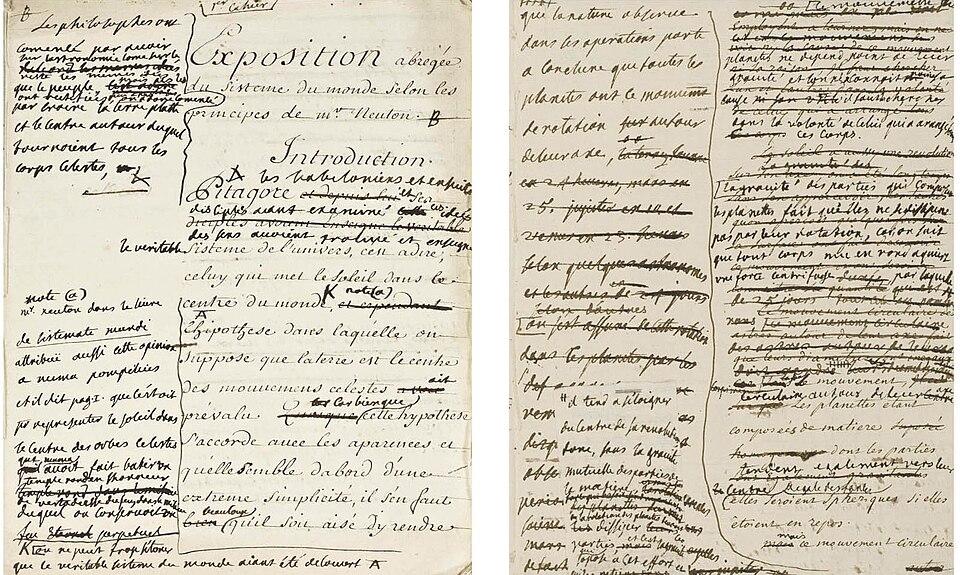
                                                                                                                                                                                                                                            Alt...Gabrielle Émilie Le Tonnelier de Breteuil, marquise du Châtelet (1706-1749), mathématicienne, femme de lettres et physicienne française. Anonyme, graveur Loir, Marianne (Paris, vers 1715 - en 1769), auteur du modèle Chéreau, Jacques-Simon fils (veuve) (avant 1770 - vers 1820), marchand d'estampes An 18th-century engraved portrait of Émilie du Châtelet, shown in an oval frame with an armillary sphere beside her. Below the portrait is an inscribed pedestal with her name and titles, flanked by a coat of arms.

                                                                                                                                                                                                                                            A Brief Exposition of the System of the World According to the Principles of Sir Isaac Newton by Émilie du Châtelet.

A manuscript page (two facing sheets) of Émilie du Châtelet's "Exposition Abrégée du Système du Monde Selon les Principes de M. Newton" — a handwritten French draft with the title and "Introduction" heading visible on the left page, discussing Pythagoras and heliocentric theory.

                                                                                                                                                                                                                                            Alt...A Brief Exposition of the System of the World According to the Principles of Sir Isaac Newton by Émilie du Châtelet. A manuscript page (two facing sheets) of Émilie du Châtelet's "Exposition Abrégée du Système du Monde Selon les Principes de M. Newton" — a handwritten French draft with the title and "Introduction" heading visible on the left page, discussing Pythagoras and heliocentric theory.

                                                                                                                                                                                                                                              [?]The Vulgar Tongue » 🤖 🌐
                                                                                                                                                                                                                                              @TheVulgarTongue@zirk.us

                                                                                                                                                                                                                                              KATE. A picklock. 'Tis a rum kate; it is a clever picklock. CANT.

                                                                                                                                                                                                                                              A selection from Francis Grose’s “Dictionary Of The Vulgar Tongue” (1785)

                                                                                                                                                                                                                                              --
                                                                                                                                                                                                                                              @histodons

                                                                                                                                                                                                                                              Image imitating a page from an old document, text (as in main toot):

KATE. A picklock. 'Tis a rum kate; it is a clever picklock. CANT.

A selection from Francis Grose’s “Dictionary Of The Vulgar Tongue” (1785)

                                                                                                                                                                                                                                              Alt...Image imitating a page from an old document, text (as in main toot): KATE. A picklock. 'Tis a rum kate; it is a clever picklock. CANT. A selection from Francis Grose’s “Dictionary Of The Vulgar Tongue” (1785)

                                                                                                                                                                                                                                                [?]Project Gutenberg » 🌐
                                                                                                                                                                                                                                                @gutenberg_org@mastodon.social

                                                                                                                                                                                                                                                What Is The Meaning Of Humpty Dumpty? Inside The Origins Of The Popular Nursery Rhyme, From Rude Slang Words To King Richard III

                                                                                                                                                                                                                                                By Kaleena Fraga

                                                                                                                                                                                                                                                The meaning of Humpty Dumpty has remained mysterious for centuries, but there are some possible historical explanations for the nursery rhyme.

                                                                                                                                                                                                                                                allthatsinteresting.com/humpty

                                                                                                                                                                                                                                                Humpty Dumpty at PG:

                                                                                                                                                                                                                                                gutenberg.org/ebooks/search/?q+

                                                                                                                                                                                                                                                A cover of the book "Denslow's Humpty Dumpty," adapted and illustrated by W.W. Denslow. G. W. Dillingham Co., Publishers, New York.

A large, egg-shaped Humpty Dumpty character stands in a dancing pose. He has clown-like red facial markings, a joyful expression, and wears a small, pointed white hat with a red brim. His body is covered in a white-and-red polka-dot pattern.

He dances on a wall made partly of bricks.

                                                                                                                                                                                                                                                Alt...A cover of the book "Denslow's Humpty Dumpty," adapted and illustrated by W.W. Denslow. G. W. Dillingham Co., Publishers, New York. A large, egg-shaped Humpty Dumpty character stands in a dancing pose. He has clown-like red facial markings, a joyful expression, and wears a small, pointed white hat with a red brim. His body is covered in a white-and-red polka-dot pattern. He dances on a wall made partly of bricks.

                                                                                                                                                                                                                                                  [?]chrissbiblenewsletter » 🌐
                                                                                                                                                                                                                                                  @chrissbiblenewsletter@mastodon.social

                                                                                                                                                                                                                                                  Hell is often depicted as a place of punishment in various religions. It is frequently described as fiery and eternal. Cultural interpretations vary across history and literature

                                                                                                                                                                                                                                                    [?]The Vulgar Tongue » 🤖 🌐
                                                                                                                                                                                                                                                    @TheVulgarTongue@zirk.us

                                                                                                                                                                                                                                                    GOODYER'S PIG. Like Goodyer's pig; never well but when in mischief.

                                                                                                                                                                                                                                                    A selection from Francis Grose’s “Dictionary Of The Vulgar Tongue” (1785)

                                                                                                                                                                                                                                                    --
                                                                                                                                                                                                                                                    @histodons

                                                                                                                                                                                                                                                    Image imitating a page from an old document, text (as in main toot):

GOODYER'S PIG. Like Goodyer's pig; never well but when in mischief.

A selection from Francis Grose’s “Dictionary Of The Vulgar Tongue” (1785)

                                                                                                                                                                                                                                                    Alt...Image imitating a page from an old document, text (as in main toot): GOODYER'S PIG. Like Goodyer's pig; never well but when in mischief. A selection from Francis Grose’s “Dictionary Of The Vulgar Tongue” (1785)

                                                                                                                                                                                                                                                      Back to top - More...